It’s bad news when you wake up in the morning and find you’ve lost your head, especially if it’s an especially agreeable and handsome head, but there you go, such things happen. In any case, the man who loses his head in The Man Who Lost His Head isn’t about to grin (that is, if he could grin) and bear it. No, he’ll make himself a new one, and starting with a pumpkin and moving on to a parsnip and finally picking up a block of wood, he sets about getting it just right. Still, for all his efforts, it somehow isn’t right. It isn’t the head he had before. It turns out that only a brash bold boy can save the man who lost his head from losing it altogether.
Claire Huchet Bishop’s charming parable is illustrated by the great Robert McCloskey, whose books for children include One Morning in Maine , Blueberries for Sa l, and the Caldecott Medal–winning Make Way for Ducklings .
Claire Huchet Bishop (December 30 1898 – 13 March 1993) was a Swiss-born American children's novelist and librarian. She was the winner of the Newbery Honor Medal for "Pancakes-Paris" and "All Alone," and won the Josette Frank Award for "Twenty and Ten." Her children's book "The Five Chinese Brothers" won the Lewis Carroll Shelf Award in 1959.
An American born in Geneva, Switzerland, Bishop grew up in France and Geneva. She attended the Sorbonne and started the first children's library in France. After marrying American concert pianist Frank Bishop, she moved to the United States. She worked for the New York City Public Library from 1932-1936. She was an apologist for Roman Catholicism and an opponent of antisemitism.
She was a lecturer and storyteller throughout the U.S., and a children's book editor. Beal was the President of International Council of Christians & Jews from 1975–1977, and the President of the Jewish-Christian Fellowship of France from 1976-1981.
After residing in New York for 50 years, Bishop returned to France and died in Paris in 1993. She was 94 years old.
This story cracked me up with some good puns about losing ones head. I never would have thought of something like this.
One morning a man wakes up without his head. He has lost it and must find it. It is difficult to remember where you left your head without a head. He tries on a pumpkin head and a parsnip head, but people are concerned about him. He fashions a head of wood and goes to the fair where he thinks he has left his head. There is a boy there who helps him find it again.
I think this longish little story was very cute and funny and so whimsical. I love it. I love this kind of silly nincompoopery.
The nephew thought this was hilarious. He loved the pumpkin head and he laughed so hard at the parsnip head. He kept asking how a person loses their head. He said, ‘it can’t really happen can it?” Still, he laughed at this story. He thought the guy must get hungry as he wasn’t able to eat at all that day. He gave this 4 stars. He suggested his sister read this and she did not want to.
This is a classic that I don't remember encountering as a child. A man wakes one day with his noggin missing, and sets out on a quest to find the darned thing. A funny tale with wonderful B & W illustrations by the great Robert McCloskey.
I remember being a little creeped out, but fascinated, by these Robert McCloskey illustrations as a kid. A man wakes up one morning and finds his head is gone. He replaces it temporarily with a pumpkin, a parsnip, and a wooden head he carves himself. I see that the New York Review imprint has reissued this in its children's collection, which is nice.
Recently my library put together a display highlighting classic children's books. I brought home a few of them to share with my children, including The Man Who Lost His Head by Claire Huchet Bishop.
The illustrations are what make this book. They were done by the artist who did the pictures for Make Way For Ducklings, Blueberries for Sal and Homer Price among others.
A man wakes up the day after a trip to the county fair to find his head missing. His last memory is of the fair and he figures he has to go back there to find it. He makes for himself a number of dummy heads until he finds one that doesn't turn heads as he makes his way to the fair.
The story is surreal, funny and creepy all at once. It's as off the wall as an Edward Gorey book and just as memorable. The book was put back in print recently so it's readily available. If you see a copy at your library, check it out.
I remember this book from my childhood. McClosky's illustrations are fantastic and the story, while a little strange, still resonates with me. My daughter loves it now and I have found her nestled away looking at it every since I brought it home. There is something about it that just appeals to kids.
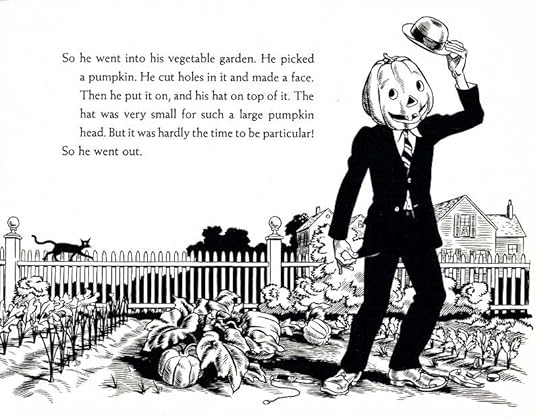
These are definitely Robert McCloskey illustrations which are terrific to look at. If you’re unfamiliar with him, he’s known for Homer Price, Make Way for Ducklings, or Blueberries for Sal. I like the detail that he brings to his drawings and the faces on the characters, for they look life-like. You can’t just glance at his illustrations, you have to stop and take in every detail that he has included because it’s marvelous, from the hair on the man’s arm, to the tin cup lying on the ground, to the untied shoelaces on the young boy. Such detail and that’s just the illustrations in this book! I thought the story was funny and I wasn’t expecting that ending. “BouliboulibouliboulibouliBANG!”
“Once upon a time there was a man who lost his head,” this is how this story begins. The illustration on this page shows a man waking up in his bedroom, his hands fumbling around, reaching up for his head. His pillow is indented which tells me that he did have a head sometime while he was sleeping so, what happened to his head? The man searches and searches but can’t find it. He even sits down to try to remember but “it is very hard once you have lost your head!” His hands and feet remember something which starts him off on his adventure. He’ll go search there but he knows that he must get dressed and take care of another important task, finding a replacement.
Out to the garden, he picks up a pumpkin. Carving out some facial features, he pops it on his head. On his way, he meets some village people who recognized him. They discuss what happened yesterday. The man misunderstands them and he returns home to find something else to wear as a head. Digging up a parsnip, the man tries again to head out and again he meets up with another bunch of village people. This head looks so funny (it’s so skinny and tall). They also talk about what occurred yesterday. Again, the man doesn’t understand so he quickly leaves and returns home. This time the man decides to carve a wooden head. Let’s try this again. He finally makes it to the fair, exactly where his hands and feet remembered. IT’s a busy place and as he looks, he also takes advantage of what the fair offers. Resting, he’s approached by a “kind-hearted and very bright boy.” The boy actually thinks he can help the man, really?
I’m glad that I grabbed this book when I saw it at a sale. I saw Robert’s name on the cover and I knew it had to be good. 5 stars.
This was a delightful trip from my childhood and when I got my hands on another copy, I was eager to share with my children. They did NOT take well to it. Thus is the mystery of childhood maintained as grownups struggle to remember and children stare uncomprehending at adults. Well, at least we agreed on Narnia. I think it was the dream sequence of it that put them off. The book doesn't even bother to explain this, which was purposeful in the least, and mischevious in the purpose. Well, it explains at the end. And finally, what the boy does in the end to 'help' the man would earn a lot of adult disapproval these days. But gee, who of us does not have an inner child that would like to sock it to us for our grownup misperceptions? I have come back to add: When I was a kid, I always considered this book a Hallowe'en book. It has a dream sequence, a jack-o-lantern, a black cat, and other markings of the ghoulish season. Maybe that will help others understand why this book even exists. Well, on second thought, it's not working on my kids! And what can I say about Robert McClosky? An American treasure.
Finally re-claimed this piece of my childhood with this restored edition of one of my favorite storybooks. It's an absolutely twisted, off-the-wall fairy tale from 1942 with amazing old-school illustrations by Robert McCloskey.
My dad used to read this to me when I was a kid, and there were two illustrations in particular which I thought were really funny, so my dad had them photocopied and blown up to put on my bedroom wall. Then I became scared of them and wouldn't go into my room unless they were covered up.
I could've sworn I'd read this as a wee lad, but I would've remembered this masterpiece! What a joy. the story, and especially the harmony with the illustrations, make this a near-perfect kids' book. A kid could stare at these elaborately-detailed illustrations for a wide-eyed hour.
Although this is thought of as a children's picture book, I don't think I would have used it with my elementary school library students. Humor requires at least a middle-school vocabulary. I thoroughly enjoyed it!
This is an example of a book illustrated by someone other than the author. However, the illustrations seemed to agree with the story. The book was originally published in 1942 and all of the illustrations are in black and white. The characters are fairly realistic looking, have a lot of personality and interact frequently with each other. The pictures are placed in a lot of different ways in relation to the text. The book starts with the text on one side, the drawing on the other, but later in the story the picture appears on both sides of the gutter and to the edge of the pages. There are extra details that appear in the pictures but not in the story like the man's cat and various signs in the background. I think the pictures are pencil and ink. Despite the gruesome idea of actually losing your head, the story is quite charming and innocent with the application of the technique of recitation when the boy has the man describe his head, and together they recite all the features he has named up until that point. I enjoyed the story and drawings. I think that this would appeal to grade school kids.
Three stars for Bishop's story (which is eh) but five for McCloskey's illustrations (which are great). McCloskey's attention to small details transform a mere picture into art: (1) a woman carries a basket of vegetables, the weight of which is stabilized by the forearm's cocked angle and is registered by the height of her right shoulder, which is lower than the left shoulder; (2) to add weight and substance to a wooden fence post, McCloskey sets one man's feet on the front of the post and another man's feet behind the post; (3) male adults actually have arm, chest, and facial hair: rather than illustrating children in adult clothes, McCloskey has drawn males who clearly have experienced puberty; (4) he knows how wooden fence posts have been hewn and how they are joined; (5) he knows the way in which suspenders gather pants in the back, as opposed to how belted pants fit a torso; etc.
The story? Spoiler alert! "It was all just a dream!"
I remember at age seven being freaked out by this story of a guy trying on various different head replacements before regaining his own. It was probably the illustrations that did it, more than the storyline. It's a book that I'm pretty curious to re-read after so many years. Maybe not my favorite Robert McCloskey book, but he is a classic childrens' book author/illustrator, and it's great to see NYRB reissuing it in their usual classy and attractive style.
The edition I read was a reprint by the New York Review Children's Collection. Now, I love to see great out-of-print children's books reprinted, but this one wasn't great. While I enjoyed Robert McCloskey's illustrations, the story was, in my opinion, just plain stupid. Not even the Boy's "magic" at the end made sense, except in the ending as the typical nonsense found in a dream. I don't think this was one of Bishop's best books. Recommended only for McCloskey's wonderful illustrations.
This entire review has been hidden because of spoilers.
It was okay. I didn’t think this story was really very entertaining, it was alright. The illustrations were alright too. There isn’t really much to complain about it other than the fact that it was just very dull.
Overall, I gave this a 1.5 stars. It had so much potential to be creative, silly, and funny. It didn’t live up to my expectations, I was let down.
I guess I'm confused why some books are re-printed. This book wasn't terrible. But... it wasn't great. The illustrations weren't anything earth-shattering, and the story was fairly lame. Tricked by a PW review again!!
I know every book has its reader, and it seems from reviews I looked at people who read this in their childhood are its readers. Without that prior experience I don't think this book makes the grade today. Maybe it is just me, but I don't get it and find it annoying.
A delightful find in Maine, home of Robert McCloskey. My children love it and learned some good two-nickel vocabulary words, but it's still a sweet, silly children's book.
SO disappointing. My kid fell asleep in the middle of it so I had to wait to see what happened. It was so engaging. Up until the end. I hate these kinds of endings.