Tom Taylor's life was screwed from go. His father created the Tommy Taylor fantasy series, boy-wizard novels with popularity on par with Harry Potter. The problem is Dad modeled the fictional epic so closely to Tom's real life that fans are constantly comparing him to his counterpart, turning him into the lamest variety of Z-level celebrity. In the final novel, it's even implied that the fictional Tommy will crossover into the real world, giving delusional fans more excuses to harass Tom. When an enormous scandal reveals that Tom might really be a boy-wizard made flesh, Tom comes into contact with a very mysterious, very deadly group that's secretly kept tabs on him all his life. Now, to protect his own life and discover the truth behind his origins, Tom will travel the world, eventually finding himself at locations all featured on a very special map -- one kept by the deadly group that charts places throughout world history where fictions have impacted and tangibly shaped reality, those stories ranging from famous literary works to folktales to pop culture. And in the process of figuring out what it all means, Tom will find himself having to figure out a huge conspiracy mystery that spans the entirety of the history of fiction.
Librarian Note: There is more than one author in the GoodReads database with this name. See this thread for more information. Mike Carey was born in Liverpool in 1959. He worked as a teacher for fifteen years, before starting to write comics. When he started to receive regular commissions from DC Comics, he gave up the day job.
Since then, he has worked for both DC and Marvel Comics, writing storylines for some of the world's most iconic characters, including X-MEN, FANTASTIC FOUR, LUCIFER and HELLBLAZER. His original screenplay FROST FLOWERS is currently being filmed. Mike has also adapted Neil Gaiman's acclaimed NEVERWHERE into comics.
Somehow, Mike finds time amongst all of this to live with his wife and children in North London. You can read his blog at www.mikecarey.net.
Jeff's review was what got me interested in read this one. Normally, his reviews are subpar & waaay off, but you know what they say about stopped clocks and all... shrugs
So, I thought this was pretty good, but I think it may depend on what you're into, individual taste and all, as to whether or not you end up liking The Bogus Identity. Why? Well, this is basically about what it would be like if the Harry Potter books were somehow a real thing, and Harry somehow kinda-sorta ended up in our world...but he didn't know who he was. Oh, and his dad was a J. K. Rowlingish person.
Ok, you're right. That made no sense. *cracks knuckles* Let me try that again:
Tommy Taylor's father wrote a series of beloved books using him as the main character. In the books, Tommy was a boy wizard who saved the world again and again with the help of his 2 best friends, Hermione & Ron. <--Kidding! Sue &...somebody else. Peter! His name was Peter!
You with me so far? Alright. Tommy's dad disappeared years ago, and to make ends meet, the now adult Tom does the Cons and book signings.
Then strange shit starts happening, and it looks like perhaps our world and the story world are both real. And that's about all I can say without spoiling the story for you. If you think that sounds like something you'd like, check it out! Personally, I've already ordered the second volume from my library...
I loved this graphic novel! I love how it was written and put together. I love the story and the graphics! I’m going to share a ton of them! Why in the hell I sat here an hour putting these pics together is beyond me! People don’t give two sh*ts 😂🤣 pics in no order
Tom Taylor is the son of Wilson Taylor, creator of a series of books about a boy wizard, named Tommy Taylor.
Wilson disappeared years ago and left poor Tom, not only with an identity crisis (Is he really a wizard like the character?), but also trolling comic book conventions in order to make a living.
Things start to unravel when a question of Tom’s true parentage is brought to light.
Enter a secret organization who over the centuries has influenced the course of literature.
Now you’ve got two major plotlines on a collision course.
Are they somehow intertwined?
Does Tom have magic powers for reals?
Is he some sort of nerd messiah?
Does Wilson Taylor’s map of literary sites have any significance or is it the product of a nutter?
How many literary meta-references in one volume of comics are too many?
When are you going to stop with the questions, Jeff?
In this volume, Carey’s world building skills were kind of like lurching drunkenly around the library’s fiction section in the dark, but by the fifth issue (Hey, Rudyard Kipling!) I sort of got what he was trying to accomplish. My attention span is rather short these days – Oh, is that a birdie on the window sill – and I’m not known as Mr. Insightful, so take that last comment with a grain of salt.
Bottom Line: Recommended for really, smart literate people who read comics. You know who you are. Yes, you in the second row, fourth seat from the left, you, and the gal with the wheat colored sweater behind you. Ushers, please remove the poseur in the back row wearing the Watchmen T-shirt.
Tom Taylor, (on whom the best selling Tommy Taylor Harry Potter-ish style franchise is based on) has his world turn upside down, when he is accused of identity theft at a London fantasy convention. Alongside his accuser(!) Lizzie Hexham, he seeks to find the truth about his own identity, and the whereabouts of the the missing series creator, his dad --- which results in them seeing parts of the supposedly fictional world emerge in this reality! This volume collects The Unwritten #1-6. This is a pretty clever neo- Harry Potter-ish fantasy conspiracy thriller set in the world of fantasy fiction, celebrity culture and historical fiction, from the man who went on to bring the world The Girl with All the Gifts. 8 out of 12.
I've been meaning to read this one for a long while. I'll read pretty much anything Mike Carey writes at this point, as he's responsible for some of my favorite comic series, most notably Lucifer.
This series is very meta. It's a story about stories. It's about how stories and reality interact.
And I don't mean in a Mirror and/or Lamp sort of way. The premise is that some few rare stories become bigger, more solid, more mythic than others? What if they became real in a way?
It's a cool concept. You get interaction between our world and these story world. You get the characters trying to figure out how this all works. You get cameo appearances from characters like Frankenstein's monster and Barron Von Munchausen.
It's pretty much right up my alley. It's got clever concepts, and is good about executing them. Good tension. Good slow reveal of the mystery....
It's everything I love in a story. Then I hit a major speed bump in the second book....
(Continued in my review of book two, as I give away spoilers there.)
It was an interesting concept for a graphic novel series. However it was a little bit difficult for me to get entirely engrossed in this story, especially at the beginning. Also I loved the art. All in all, I liked it and I will keep reading this graphic novel series because I believe that it has potentials to get better.
I have to say that this is a unique story. I think I'm going to like this, although, it did end on a very bloody note. I didn't think it was horror, but it might be in the horror genre.
Tommy is like a preacher's kid. His father has written very famous books and they have the same name as Tommy and it drives him crazy that people think they are the same person. But, are they the same person??? We don't know.
This volume that starts this story out only stacks questions upon questions with few answers. It is hooking the reader. There is a grisly end to the story too and I wasn't prepared for it.
So I discovered Mike Carey as a NOVELIST before Graphic Novelist, that's totally weird as he's known MUCH MORE in the venue of "Unwritten". SO glad I finally picked it up, Ooooh what I was missing! The Unwritten is an awesome, fun ride in surrealism and fandom and literature. I can't really explain it in detail, it's much better to just read it yourself, but if you're a comic lover RUN to get this. So fun!
Despite the sort of "cutting-edge" reputation graphic novels have, they are terribly old fashioned. Even graphic meta-novels that demonstrate an awareness of the conventions are terribly conventional. It seems strange to me that such a new(-ish) genre with so many creative possibilities and opportunities for invention remains so straightjacketed by formal constraints and genre expectations. But, like the 19th century novel, these have their purposes and pleasures.
I never would have thought I'd come across a graphic novel aimed at horror fans that had much in common with a Cynthia Ozick novel. Her Heir to the Glimmering World featured a character who grew up burdened with the awkward fame of being the real-life model for the protagonist in a series of successful children's books penned by his dad. In Ozick's work the guy is a Christopher Robin type from a Poo-esque collection, adored by people who don't know him. In The Unwritten Tom Taylor has grown up tending the thin reknown accrued from being the inspiration for the youthful hero of his father's series of Rowling-meets-Lovecraft genre bestsellers, Tommy Taylor. But was this author really his father? There is some doubt.
In The Unwritten the identity issues are not merely social and psychological, but both literal and maybe even supernatural. Taylor must endure (while depending upon) the attention of genre conventions (both the kind artists adhere to in fiction and the kind attended by fans). It's a touch post-modern with a book-within-the-comic-book frame-story structure and genre self-consciousness, punctuated by loads of literary references which form an amusing overarching idea I can't believe no one has, to my knowledge, thought of before. It's audacious and ambitious but I can say little more about it for spoiler-avoidage and because, well, this is the first volume in a series and so little has been revealed at this point.
This volume's strong points are the originality of the idea and the interspersal of art that is more interesting and inventive than the typical comic fare. Its downsides are typical comic art that is neither interesting nor inventive, the often dorky dialog, and text panels made unnecessary by the accompanying illustration. I liked the facsimiles of web pages (standing in for the horror convention of the trip to the library or local archives for expositional research) and panel montages rendering the unique cheesiness of local TV news (standing in for updates from the local busybody). Also interesting is a short section at the end where the authors explain how the first drafts of the book were formatted, with some samples and roughs whose pencil drawings and charcoal sketches are more interesting than much of the illustration throughout, which--with the exception of some insets and extended frames--varied little from standard comic book layout. It's a shame how graphic novels have skipped straight to PoMo without having spent a good long weird time in Modernism. Or any at all. If you know of some exceptions, please do tell!
I really enjoyed this! The art is a bit of an older style, but the story is really interesting. I’m loving that authors shape reality and that there is a Harry Potter knock off story in here. I’m definitely going to read the second volume!
Ugh, I've tried three times to start this review properly and fairly by giving a summary of the plot and a fair critique of it and I can't do it. This book just sucks. Tom Taylor is boring, he's Daniel Radcliffe in another life living off of Harry Potter. There's a mysterious organisation which seems to say the places and stories in classic lit are real and meaningful.
Tom's pop, an unlikeable prig, made him memorise fictional locations in novels because one day he'll need them. I have a problem with this as Tom hasn't actually read any of these novels he just knows the locations where they take place. Why not read them for goodness sake, that's the point of novels. But of course dull old Tom hasn't read them, his imagination remains undeveloped so most of his actions are predictable.
He goes to the Villa Diodati (students of literature will notice a lot of famous locales in this book) where he apparently grew up, a bad guy shows up and hunts down some dreary writers.
Peter Gross's artwork is terrible, the characters barely have expressions, most of the panels are unimpressive and scratchy at best. Not one panel jumped out at me, they were all as bland as the others.
I can't write anymore, it's too dispiriting. This joyless, unimaginative dirge of a comic book hasn't got any good characters, any great concept that's worth pursuing, the artwork is utterly crap, frankly "Unwritten" should have stayed just that - unwritten. God knows how it's a "New York Times Bestseller", I suppose anything that whiffs of Harry Potter makes it to the top.
An interesting concept, for sure. The protagonist, Tom Taylor, is the inspiration for his father's Harry Potter-like books. Every day he has to deal with the fact that people confuse him with his fictional counterpart and he just wants to live his own life (though admittedly he does capitulate on his father's books' popularity and the fame that comes with them at times.) Then fantasy starts to bleed into reality and Tom starts to question his childhood, his father, and all of the things he was told growing up.
There were some issues that made it difficult for me to follow the story. At one point Tom ends up in the Globe Theatre and I was sure he had been in New York. I just looked back at that part and he was actually in London, but the jumps from city to city really made things confusing. I also HATED the typeface used at the end, which was made to look like cursive handwriting. And I didn't like how some words were made bold for no reason.
I enjoyed the literary references that I'm sure are going to play a gigantic role in the story and I realize this is just the first book and there's a lot of setup for the series, but it just didn't flow all that well and there was a ton of info-dumping.
I've got the second book out from the library so I'm going to continue but I hope the story is more coherent later on.
First, I am a huge Carey fan. Second, I bought this on a whim. Third, the book is overrated, mainly due to an abundance of cliches. There were so many, I was barely able to close the book. The cliches kept coming to life, crawling from the pages, and forcing me to relive bad literature. At least I am happier than ever to not have read the Harry Potter series.
The Unwritten is supposed to be a mystery but the reader knows right from the start what is going on. Tommy Taylor is real and there's a secret society involved and stories are important. La de da.
I did not like any of the characters. I did not like the Harry Potter homages. I did not like the slasher-horror tangent. I did not like the predictability, the lack of plot progression, the annoying main character, the forced classic literature references, or Kipling's escapade. I finished this yesterday and I had to think hard about how the book ended. Cliffhangers should be memorable.
If you are wondering why I am rating 2 stars, I guess it's because the writing was ok and I just cannot bring myself to rate 1 star but I can not recommend this and I will not be reading the rest of the series. Unless it's free and I have nothing else to read, which will never happen.
It's been a good long while since I tried a new title from Vertigo. Fables was a massive disappointment. A dazzlingly simple, high-concept idea anyone could have had deserves a complex, layered treatment that everyone can only wish they'd thought of. Instead we get a less than fabulous soap opera and hackneyed The Two Towers-style building-to-the-big-fight plotlines. Y The Last Man was another potentially excellent title marred by an excessive reliance on violence as a plot engine, reducing its post-masculine world to an array of warring feminine stereotypes. The fact that the artist only seemed aware of two body types - Barbie and Ken - didn't help.
The Unwritten, at heart, is built from the same theme Gaiman, for one, keeps returning to - that the stories we tell shape us and our world. So what happens when you find out that what you are is a story? That seems to be the revelation Tommy Taylor is headed for - unless there's some vast narrative feint at play. He is the son of a writer who created a series of Harry Potter-esque fantasy novels starring a boy wizard called Tommy Taylor. Taylor's father vanished mysteriously after turning in the penultimate volume of the series. The series is an immense success, but Taylor senior's estate is tied up, so Tommy makes money touring the genre convention circuit, doing signings and public appearances as the original inspiration for the fictional Tommy Taylor. You sense that this fame is something of an albatross around his neck, a legacy from his father that he doesn't care much for but can do little to shake off, just like his extensive knowledge of the real-world corollaries to famous fictions - the places they were written in, the places they were inspired by. Then, a series of revelations that seem to be mysteriously engineered by his own agent suggest that Tommy Taylor might be a fraud. Things get stranger as Tommy Taylor is abducted by a vampiric villain from his father's novels, rescued by a mysterious girl and elevated to a messiah by a section of fandom. He flees to his father's Swiss home - Villa Diodato, in the first stroke of genius in this so far fairly humdrum, if amusing enough narrative. Better still,Carey doesn't go straight for the Frankenstein bit but also dwells on the fact that John Milton dwelt here too. if Tommy Taylor is a boy from a story, then Milton's Lucifer and Frakenstein's monster are his siblings or uncles. There's a gathering of horror writers which makes for a comment on 'genre conventions' (oh did I use that phrase again) that, to my mind, at least equals Joe Hill's rather overrated short story 'Best New Horror'. All this more than makes up for Tommy Taylor who is a bit like the typical Gaiman 'hero': a void at the heart of the narrative, too bland to be truly memorable.
But the real kicker, the bit elevated my rating from 'rather nice' to 'jolly good' if not quite 'transcendentally scrumpy' was the last chapter which ditches Tommy & Co. entirely to follow the career of Rudyard Kipling and the role played in it by a shadowy organisation that identifies powerful storyteller and drafts them in to help shape the world to their own pattern via stories that define an age, as Kipling's works helped shore up and strengthen the colonial spirit. This is a truly brilliant episode, sensitive to the many aspects of Kipling's work - the immense power and appeal of his prose and verse, his deep idealism and its contrast to the truth of what the British Empire was about, and even his interest in fables and just-so stories as time passed. Mark Twain and Oscar Wilde have walk-on roles that are true to their characters, despite one unfortunate bit of camp dialogue between Wilde and Bosie. This story is more than just a what-if - on some level it is literary appreciation and critique as well, in the way it contextualises Kipling's work both factually and within the fictional universe of The Unwritten.
Not an unmixed triumph then, but filled with enough of the good stuff to merit reading more.
I like the premise, but the development is slow -- 7 issues in, the reader has long been aware that Tom Taylor, the son of the writer of a bestselling series of fantasy novels, is in fact the novels' protagonist Tommy Taylor, come out of imagination to reality, and that the mysterious Lizzie Hexam is his best galpal Sue Silver, but Tom is still in denial and the plot movement is mostly spent on horror film slasher tropes, about which I could hardly care less. I do enjoy the bits of the fantasy novels we get -- they're obviously a take on J.K. Rowling, but I also see a bit of Alan Garner's influence; the opening reminded me a lot of Elidor.
I am not entirely happy that the female writer's been masculinized for fiction and that Lizzie/Sue, shiny keen as she is, is secondary to the boy hero. Patterns o patterns. Women writers written out of history.
I'm wondering now where the book boypal Peter is--my bet's that he's the cleancut villain who showed up recently, secret author (ha) of Tom's woes, but it's also possible he's the Loki-like rogue who accompanied him to jail.
The backstory issue about Rudyard Kipling's recruitment by and eventual rejection of an evil secret society is fine, although a little. Hmm. It's interesting what doesn't get mentioned, how the evils of imperialism are never demonstrated except maybe a single panel; you'd think the worst thing about imperialism is that sometimes it kills imperialists' children.
It's an interesting concept. I'm intrigued, from the possibilities, very much like ... I don't want to say Sandman, because that's not quite right, but it's the closest thing I've ever come across to anything like Unwritten. It's about stories being more than storytelling, but kind of being shadows of a bigger, deeper Plato's Cave kind of ideal.
I'm impressed by the ambition and the scale of what Mike Carey and Peter Gross are setting out to do.
And there's this sinister conspiracy of conspiring conspirators who are conning s...sthings. They've taken great care to remain very behind the scenes; I think they may share in Tommy's hinted-at nature--they may not be able to reach out beyond the shadows. They accomplish this by being patrons to writers in order to put out certain stories and destroying other writers to quash other types of stories . And they aren't afraid to resort to murder in order to pressure their clients. :(
This first volume is limited to building the foundations to what may turn out to be a great story. I have high hopes for it.
December 2015: Ughhhh, I need to write a review of this but I don't wanna. Oh, I'm feeling so whiny today. But it's hard! Writing a review of this is hard! It's too smart and I have too much to say! WAHHHH.
I said in my original review that I might come back later and give this five stars, and indeed that has happened. I've only read through Vol. 6, but that's enough to know how much stuff this was setting up, how much was going on under the surface that I didn't even realize the first time I read it. Everything just hangs together so well! I love it when that happens. It's so satisfying.
As for the book itself, this is the first volume in The Unwritten series, which is now finished, hence why I'm re-reading the first six, and tackling the rest now. It was getting to be too much to remember waiting six months in between books. So now I have seven all new ones to read and I'm so happy.
This series is incredibly hard to describe. It's about the power of stories, essentially, but the way it does what it does is just so NEAT. It's a story only a graphic novel can really capture. It goes back and forth between current events, illustrations of the famous book series the main character was the "inspiration" for, historical flashbacks, and pages entirely made up of internet chats, texts, clippings, etc. It's basically brain candy for story nerds.
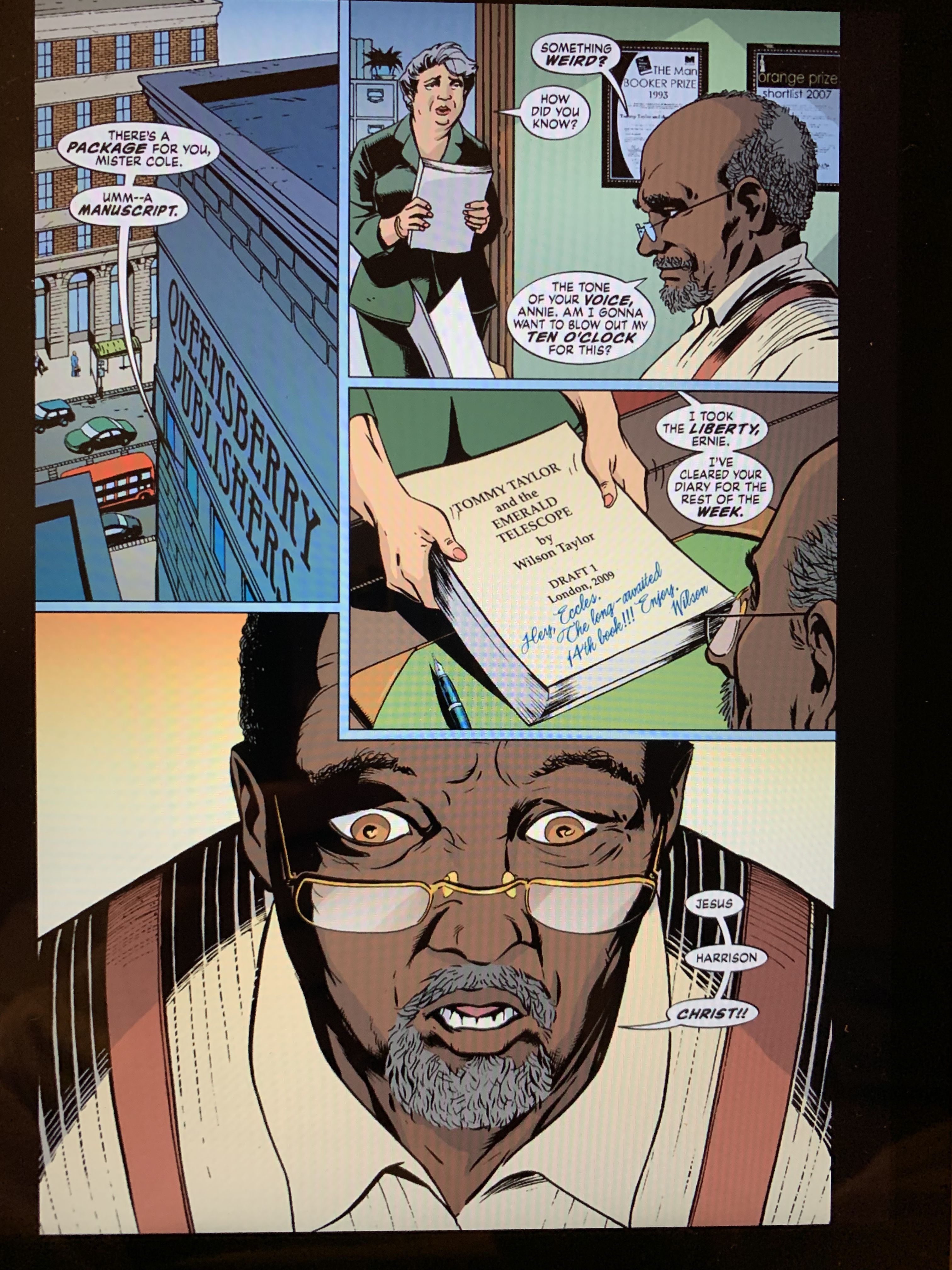
I HAVE SO MUCH MORE I COULD SAY. Like, how cool it is that Tom carries a literal map made out of literary history, or how much fun it is to watch him question what came first, himself, or the book series that made him famous. Like A.A. Milne did with his son Christopher Robin, Tom Taylor's father supposedly did with him, only he and the series achieved a level of popularity that surpasses Harry Potter (which does still exist in this universe). Only Tom's father disappeared when he was a teenager, leaving the 14th and final book of the Tommy Taylor series unfinished. Now, things are happening. Is Tom Taylor who his father claimed he was? Is he a character brought to life from the pages of a book? And who are these mysterious men and their cabal who seek to control the most prominent authorial voices in the world, or silence them if they can't? And the artwork! Oh, it's delicious.
I highly recommend this series, and I can't wait to finish it and finally see what happens.
February 2011: Of course I'm going to love this. It's about the power of stories, and I'm such a huge sucker for that. I don't want to spoil anything plot-wise, but it reminds me of Lev Grossman's The Magicians, except way better, and in the family of comics, Fables would probably be its closest relative, like a second cousin or something.
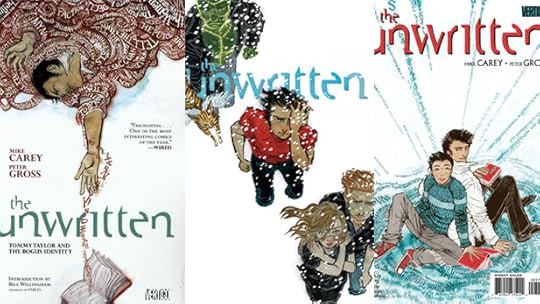
I was actually pretty close to giving this five stars, and maybe in the future I'll come back and do so, but for now, four stars, because I want to wait and see how it all turns out. Right now I think it has fantastic potential. In these first five issues (collected under the title "Tommy Taylor and the Bogus Identity," itself a meta reference to JK Rowling's Harry Potter titles), Carey and Gross manage to create a sense of things happening just under the surface of your comprehension, but because it's completely serialized, the whole picture isn't available to me yet. (On top of all of that, the artwork is just beautiful: the panels, the colors, and particularly the covers.)
If you are a fan of stories for the sake of stories, or graphic novels as a genre at all, you should run out and get this.
The Unwritten strikes me as being somehow 'impressive'. It's hard to clarify what I mean, but the idea of it and the execution was very well done. It delves into the very fruitful literary territory of metafiction, where reality and fiction intersect. I find I truly enjoy metafiction, probably because of being such a lifelong bookworm and having my head stuck in a book for most of that life (since I was four).
In the case of Tommy Taylor, it's a painful intersection. His father is a famous novelist of children's books (in the vein of Harry Potter) who suddenly disappeared. Tommy is left depending on the uncertain income from coasting on his identity as Tommy Taylor, the eponymous character of the books his father wrote. When a lady shows up at a comic book convention and challenges his identity, the stuff hits the fan, and the adoring fans of the books become hateful, vengeance-seeking stalkers. Tommy's life implodes. But things only get worse, when he develops enemies that hail from the so-called mythical landscape of the books.
One of the things I liked the best about this graphic novel was the illustrations. It is clean and elegant. The lettering is also well done and distinctive. My eyes wanted to stay on the page and observe every detail, whereas with some graphic novels, there is too much to look at (so I pick and choose), and some aspects of the frames seem to fade into the woodwork because they are deemed less important. This book is a great midpoint where neither clarity or detail is compromised.
I also liked the prose and the storytelling. I felt sorry for Tommy. He really got a rough deal being who he was, and in effect powerless to change his life. I hope that he does gain some agency and authority in his life situation.
I do have to say I didn't care much for some aspects of one of the sections. The idea of tackling horror conventions since they were at the house at Lake Geneva in Switzerland, where Mary Shelley (and apparently John Milton earlier) wrote the famous masterpiece they are known for, was a good one. I just didn't care for the gory turn of the story. I think it pricks a sore spot I have about the horror genre in general--the sacrifice of story and genuine narrative content for splatter and gore. I understood the purpose of this, but it just seemed gratuitous (although I admit it was still tastefully done).
The last section was rather odd initially. I didn't get why Rudyard Kipling was the narrator, until well into the story, and then the lightbulb came on. It ties in very well with this developing and expansive story and endows it with increased sense of threat and risk.
I still have a lot of questions, and I want to keep reading this series because it has my interest and attention. I hope that Tommy will come to understand his troublesome situation and discover the hero within.
I'd recommend this novel to lovers of books and literature in its various forms.
I have already read the first few volumes of this series back in the day when they were first published. However, that was when I wasn't using Goodreads to its fullest potential and just slapped a star rating on it and called it a day!
I use Goodreads differently now and since this series is going to be wrapping up this year I figured it was time to dive back into this story and start back at the beginning and give it the Goodreads attention that it deserves.
This first volume is fantastic! More or less it asks the question, 'what would happen if a Harry Potter like character were to come from the pages and into the real world?'
But it is a lot more than that! You get little hints, slight glimpses of layers upon layers of how intricate this story is actually going to be. Mike Carey is very subtle in laying down the tracks for what will later on be a very twisty mammoth of a story.
I love the little 'Tommy Taylor storybook outtakes.' I love the news feeds and the internet chat room dialog. They add a whimsy feel to the rest of the darker storyline!
And it does get dark.
I'm so happy to be diving back into this series. It was a treat when I began reading it back in the day - and I am happy to see that it hasn't lost a single beat of its magic since!
This first volume is a wonderful introduction in what becomes quite a sprawling epic. Can't wait to see where it all takes me.
What a weirdly wonderful idea. A fantasy character crossing into reality isn't exactly a new concept, I admit. It's classic wish fulfillment, after all. It's the execution of the concept here that makes it interesting. But it does seem to be developing kind of slowly. Tom Taylor isn't aware that he's fictional, and it's taking far, far longer than it did for me to come to the same conclusion. I know, I know, people in Dracula don't know that they're in Dracula. Maybe it feels slower than it is because the slasher subplot kind of bored me. And though I really liked the last issue, a sort of digression into a secret version of Rudyard Kipling's biography, it falls at an odd place, coming after a serious cliffhanger in Tom's story. And there was the problematic element of glossing over any consequence of imperialism aside from the apparently horrible fact that rich white boys might die in battle in foreign lands. Given that it was meant to be Kipling's own words at the time, I tried to let it go, but it just didn't sit right.
I think this review hasn't sounded as positive as I would have liked. But I really do love this concept, and I'm fascinated to see where it's going. There are hints, still vague, that fictional geography will become important, and I love that stuff. I want to see where this is going.
Tom's father created the wonderful "Tommy Taylor" novels (think Harry Potter) and he based the main character on Tom: Same name, same features... the resemblance between him and the character is so uncanny that Tom has spent his whole life explaining strangers that he is NOT the character in his father's novels.
But of course, he actually is.
The intro to this volume is really good. The premise is interesting and I really like the representation of the love/hate of the public and how the media can twist everything around Tom's life.
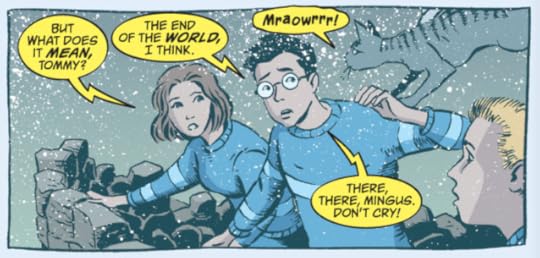
I did not like how alike the "Tommy Taylor" fake novel was to "Harry Potter", yes you can call it an homage or whatever. But did he had to have round glasses, black hair and two friends, a girl that looks really brainy and a boy with reddish hair? I mean, look at them!
During the second half of the volume strange things start to happen, and we begin the weird part, there's lot of info thrown around that I'm sure I'll understand later, but right now is just a bit too complicated for my taste. At least it's interesting enough that I want to read the next one.
The art is okay. It's reminds me of the artwork of some issues of Fables.
There's a backstory issue at the end which I have to admit I found quite boring!
A truly, truly awesome concept about authors being manipulated by some mysterious group to write stories that magically have an effect on the outside world. The main character, Tom, is the son of a missing world-famous children's author - or maybe he's actually Tommy Taylor, the main character from his dad's books, summoned to life by his dad's prose. The story has some familiar threads in it (I'm reminded of a certain Twilight Zone episode and Christopher Golden's Strangewood) but it feels fresh and fascinating all on its own. I think that the addition of the shadowy group and the point-of-view being one of the characters rather than the author help with that. If you like stories, comics, mysteries, or any/all of the above, I recommend this.
I'm re-posting this because none of my friends, besides Tracy, have marked it as to read or sought it out. Don't miss out!
What if Harry Potter were based on the author's son? And then the author disappeared--it has been ten years. And the son hits the conventions for money and was tired of being called by the fictional character's name and then it turns out that his father may have stolen him from his real parents and even though events around the world are grim all anyone cares about is this fraudulent son who has soiled their beloved books and when he's kidnapped and nearly killed he then becomes a messiah-like figure but meanwhile a mysterious someone sends a dangerous man to set plans in motion that end with a bloody killing spree and--yes, a little breathless this leaves me, such a tantalizing start to the story. I liked it for sure. Then I got to the last story.
And I loved it.
4.5 stars (I'm holding off on that last half in case they don't deliver what these first stories promise). Highly recommended. 5 stars, after 54 (plus) issues and a graphic novel.
This review will not have intended spoilers, but still it regards my on-going reading of the series (so far I'm in volume 6). Please be advised.
It remained in my reading list for a long time, for some reason it did not seem appealing. At this distance, I think I confused it with stories like "The Wicked + The Divine" that focus on fame/celebrity status and (to my sensibility) have no real insight about it. This does touch, in some points, in what being world wide famous could be about but, besides not focusing on it as main subject, the insights and coherence are there.
The series is quite amazing, balancing the back story with the individual volumes, and even issues. The way it introduces mini-naratives and constantly feeds the big picture is masterful.
It's great that it is a real colaboration, a work of two talents, and not just a visual artist ilustrating a writer's script. There is a coherence, a style that gets reinforced and even allows for interludes, variations on the themes presented, many plays on the way this story can be told and visualized.
After thinking about some comics I read previously, I did hesitate in putting it in the same trend as "The Manhatan Projects" and "MIND MGMT". Conspiracy theories abund, nowadays. They seem to be a sink hole, in a culture that has run out of ideologies, they say. And so popular culture uses those paranoid narratives a lot, in different ways. But if in Jonathan Hickman's work the conspiracy, the puppets and the puppet master, the paranoia about some major thing behind the scenes seems to be the theme itself, it's not always the case with other authors. Matt Kindt's work is all about the art and the atmosphere, not just about creating that anxious relation with the "truth out there".
"The Unwriten" uses conspiracy not as a theme. It reminded be about cult/sect fiction like the great "Foucault's Pendulum" by umberto Eco. There is an idea, a theme, but the conspirators who move the strings are "just" part of the story. So the theme here (forgive me for constantly being vague, so I can avoid spoilers) is not at all the same as in Eco's novel. And if we extend this idea, Dan Brown's "Da Vinci Code" seems similar to Eco's "...Pendulum", but again in Brown's work it is the conspiracy that takes front stage. So maybe Jonathan Hickman atmosphere is closer to Dan Brown's (I've only read Da vinci Code) than to The Unwriten.
Here the central metaphore, about stories, narratives, is brilliant. It's an evolving premise, since every details added to the big story makes the initial insights deslocate and morph. This last bit is still something I need to think about more, since it's strange even to me. I will defenitely try to read all of it. Quite an intriguing and enjoyable read.
Graphic novels, or comics, are not my primary reading medium, but I enjoyed this and look forward to the sequel. While there's a violent section in the middle that's not my thing (though I understand its purpose), there were enough literary references and literary geography (as the main character calls it) to more than keep my interest.
A back story that stretches back to the 19th century is clever and has me wondering what will happen next. The illustrations advance the story and unlike The League of Extraordinary Gentlemen, Vol. 1, which I didn't care for, this story wears its literary references lightly and intelligently, not bludgeoning you over the head with how learned (and subversive) it is.
When Tom (don't call me Tommy) Taylor, the inspiration behind the main character of his father's bestselling fantasy series, is accused of identity theft he sets out to figure out who he really is. Along for the ride, strangely enough, is the very person who levied the accusation.
I was hooked pretty quickly. Tom is pretty annoying, but I got past that. The artwork is fantastic, as well as the writing, and i like the premise of this series. I'll definitely be continuing on, and I'm looking forward to seeing where it goes.
A long time ago I read American Gods because (I think) Anansi Boys was recommended by Eloisa James, romance novelist/ Shakespeare scholar. And that superlative reading experience introduced me to the Sandman graphic novels. Until then I think I had been completely unaware that comic books did anything other than superheroes, Donald Duck, and Archie. So I liked Sandman but couldn't afford to buy it back then, and FYI, it is never available in used bookstores. (And I wasn't much of a library user back then, and I guess it never occurred to me that a library might carry graphic novels.) I read a few volumes standing around in Barnes & Noble.
It's hard to break in if you're not part of that world. I spent ages in a comic book shop with my son over Christmas break, and I found zero--nothing--zippo--that caught my own interest. And I was willing to be interested!
Fortunately, I asked a librarian yesterday--how can you search for graphic novels for adults? He showed me, and I found this--only because I was looking for graphic novels where the first volume was in my branch, so I could check it out right away.
This long personal story is just to clarify what serendipity this was. I have never, ever, ever heard of this series, or of Mike Carey. But it is so up my alley--the borders between reality and fiction are blurred in ways that are confusing for our (foul-mouthed) main character but delightful for someone who reads and reads and reads. Our hero's father wrote an incredibly popular series of books about a boy wizard (and yeah, you're supposed to think of Harry Potter) named after him. It confuses people. It confuses him. And then the last comic in the collection offers some tantalizing insight into the weird backstory of storywriting--and I'm hooked.
Fortunately 8 (all 8??) of the series were also at my branch. I have checked them all out.