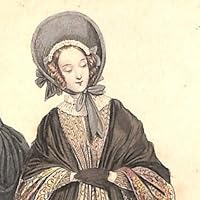
In the year 1802, banished by her father for refusing to marry, Lady Cristabel teams up with the American Martha Peabody and heads to Lissenberg to continue her opera career, becoming involved instead in political intrigues. It is a world where the hazards of Napoleonic power politics mix with the glamour of early 19th century opera and culture.
Jane Aiken Hodge was born in the USA, brought up in the UK and read English at Oxford. She received a master's degree from Radcliffe College, Harvard University.
Before her books became her living she worked as a civil servant, journalist, publishers' reader and a reviewer.
She has written lives of Jane Austen and Georgette Heyer as well as a book about women in the Regency period, PASSION AND PRINCIPLE. But her main output has been over twenty historical novels set in the eighteenth century, including POLONAISE, THE LOST GARDEN, and SAVANNAH PURCHASE, the beloved third volume of a trilogy set during and after the American War of Independence. More recently she has written novels for Severn House Publishers.
She enjoys the borderland between mystery and novel, is pleased to be classed as a feminist writer, and is glad that there is neither a glass ceiling nor a retiring age in the writers' world. She was the daughter of Conrad Aiken and sister of Joan Aiken.
"A bold plan indeed, three unaccompanied ladies to conquer at once the social and the musical world."
I liked this book much more than the last one by Jane Aiken Hodge, that I have read. In this novel three women boldly decided that they would try to lunch a successful singing career for one of them, introduce her to great opera houses and make her a primadonna. The talented young woman Lady Cristabel Sallis was a duke's daughter and she was determined to leave her old life behind and launch an amazing career. Her aunt agreed to be her chaperone and a rich American friend Martha Ann Peabody decided to sponsor it all. Martha loved music and adventure. She was also the most likable person in the story. She was the one who convinced Cristabel to start her journey to greatness:
"With your voice, and my money, think we might be able to make a life for ourselves, if you would only risk it, only trust me.
Most of the novel took place in Venice, Italy and Lissenberg, which was a fictional place ruled by tyrannical Prince Gustav, who made everyone's life miserable through the story. Prince Gustav had a son, who was a great fan of opera and fell in love in Cristabel, but couldn't be with her because obviously reasons (and also because of the raison de l'état and his infuriating father).
The plot resolved around the competition held in Lissenberg for the best new opera and also around conspiracy and rebellious discontent in Lissenberg. As a result there was a lot of singing and opera writing in the story. The author revealed many characters' secrets, especially at the end... But, honestly, they were a bit too far-fetched for my liking. Also some characters disappointed me badly with their actions. It was hard to understand how some characters decided to ignore the political situation in Lissenberg, which threatened their and their friends' safety and to live on happily as nothing was wrong. Also Cristabel's feelings weren't really explained in the book and consequently her actions were completely baffling.
Overall, "First Night" made an interesting read, but I would prefer the story to take place in an actual place not in a fictional country. I also would rather the author explained better the motivation and feelings of characters.
Cristabel and Max are headlining a youth performance of Orpheus and Eurydice in Lissenberg’s new opera house. Thirteen year old Christabel convinces Max to switch parts to let her sing the male lead only to reveal herself to thunderous applause, and her father’s burning shame, at the opera’s close. Disgraced, Christabel is sent back to England. American heiress Martha Peabody seeks Cristabel out with an unorthodox proposition: Martha has money and independence but no talent, Christabel has raw talent but no means to support herself. But tensions in Lissenberg are rising: Napoleon Bonaparte’s supporters are growing in number and Max’s father, the mad Prince Gustav, is tightening his iron grip on his kingdom. Max’s distant behaviour confuses Cristabel. Meanwhile, Martha finds herself drawn into a political intrigue destined only for trouble. An engaging read of a novel that was first released in 1990, the pace of the story was good & the characters well portrayed but unfortunately I found my attention wandering & I also skipped through pages. I didn’t connect with the characters & thought they were OK but didn’t really like any of them
My honest review is for a special copy I voluntarily read
At thirteen, Lady Christabel exchanged roles with her friend Prince Max of Lissenberg, and became a sensation singing Orpheus to his Eurydice. Her furious father the duke dragged her home to England and shut her up away from society. Fifteen years later, wealthy American Martha Peabody arranges to hear Christabel sing; afterward, the two young women and Christabel's spinster Aunt Helen set out to make Chris and opera star. They go first to Paris, then to Venice. When they have the opportunity to return to tiny Lissenberg with Prince Gustav's new opera company, Christabel leaps at the chance. But all is not well in Lissenberg. Prince Gustav is a tyrant, rebellion is brewing, and Napoleon's imperial ambitions threaten from outside. While Chris embraces life in the opera, Martha--the main viewpoint character--finds herself embroiled in plots.
First published in 1989 and now available as an ebook, this holds up well to a modern reader. Although there is romance aplenty, it isn't really a romance novel. Nor is it quite genre romantic suspense. But it is definitely a good read, with appealing characters.
Lady Cristabel, daughter of a duke, wants nothing more than to be a great singer like her mother. Martha Peabody, an American heiress, has money and independence, and offers to take Cristabel under her wing as a manager to help get the young woman the training she needs. The pair become surrounded by political intrigue as Napoleon rises in power.
What I especially enjoyed about this story was it is set in my favorite time period, but mostly takes place in a small country and not entirely in London. While I found Cristabel naive and foolish, I very much enjoyed Martha. Her confidence and wit in facing whatever she faced were admirable.
The plot is rich with details of the era, and I do feel like I learned quite a bit about opera, composing, and the politics of the time. The romance is understated, and the ending is a bit fantastical.
Overall, I would highly recommend this to readers who enjoy a different view of the Regency era.
I received a free copy from NetGalley and am reviewing of my choice.
Martha Peabody is bored so goes to Europe. She hears about Lady Cristabel and her beautiful voice. Crisabel and her friend Max had changed places in doing a child's Opera of Orpheus and Eurydice which they are found out and Cristabel is sent to the country not to sing again. Cristabel and her Aunt Helen are met up with Martha and they go to Italy to develop her voice. They eventually go to Lissenberg where Cristabel first sang with her friend Max. They are stuck there for the winter. Martha tries ot help the people as the Prince cannot see past his own needs. He is hoping to make an aliance with Napoleon but that may not work as Napoleon is becoming Emperor Will the ladies accomplish what they want? Read to see where all this story goes. .
Definitely not my favorite JAH. Some parts were rather slow and boring. The ending seemed oddly anticlimactic and abrupt. Now I see there are 2 more books in the "series" but based on the reviews, I won't be reading them. I'm going back to reading her earlier works.
I'll be honest, I just could not get to grips with this book and did not read it all the way to the end. It just did not capture my attention and sadly I did not enjoy it.
My Review (spoiler alert!)—What can I say? It started off with such promise, as many Jane Aiken Hodge novels do. But I can’t say I cared for the ending (though I realize now there was a sequel put out a year later, which helped my understanding of why it ended so abruptly and awfully).
However, putting aside the ending, the story, itself, was good: filled with drama and suspense—all set in 1800’s Lissenberg, England, France, Italy, and then back in Lissenberg till its conclusion. Usually Jane Aiken Hodge has a masterful way with a romantic tale, weaving a veritable rollercoaster ride of peaks and valleys, twists and turns, “will they? won’t they?”—until the very end. But I must admit, this time, I found myself wishing for a different ending, for different men to prevail.
There were two heroines, Martha Peabody (an American heiress) and Lady Cristabel (an English duke’s daughter with dreams of being an opera singer). Martha is obviously meant to be with Franz, and Cristabel starts out in love with Prince Max. But Jane Aiken Hodge veers from her usual formula and pairs Cristabel with a complete cad (the story of which, after reading the sequel, is not set to rights by having her end up with Max after all but an entirely new character!), after getting her readers’ hearts set on a Cristabel-Max pairing. That’s highly unfair, I think. And Martha falls for a real jerk, a Napoleon-loving radical who’s inconsiderate, moody, and just not at all likeable (the man doesn’t even claim to love (or like) her until the very last page of the novel—and that’s done as if “oh, yeah, I forgot to say: I love you.”). I wished for Cristabel to end up with Max (a nice guy) and Martha to end up with Ishmael, who falls in love with her during the dramatic storyline. Martha, whom men love solely for her money (she’s too plain otherwise), wants a man to love her for her mind and strength. Which she finds in Ishmael who, with plenty of money of his own, obviously loves her for her—not money or looks. He appreciates her mind and her compassion (for the needy and hurting). But who does she end up with? Franz! Yuck.
As I said, the basic story is good, but the romances’ endings leave much to be desired. Jane Aiken Hodge is usually so much more astute in her romantic finales.