We are just beginning to see a massive shift in military technology that threatens to make the stuff of I, Robot and the Terminator all too real. More then seven thousand robotic systems are now in Iraq. Pilots in Nevada are remotely killing terrorists in Afghanistan. Scientists are debating just how smart - and how lethal - to make their current robotic prototypes. And many of the most renowned science fiction authors are secretly consulting for the Pentagon on the next generation. Blending historic evidence with interviews from the field, Singer vividly shows that as these technologies multiply, they will have profound effects on the front lines as well as on the politics back home. Moving humans off the battlefield makes wars easier to start, but more complex to fight. Replacing men with machines may save some lives, but will lower the morale and psychological barriers to killing. The "warrior ethos", which has long defined soldiers' identity, will erode, as will the laws of war that have governed military conflict for generations. While his analysis is unnerving, there's an irresistible gee-whiz quality to the innovations Singer uncovers. Wired for War travels from Iraq to see these robots in combat to the latter-day "skunk works" in America's suburbia, where tomorrow's technologies of war are quietly being designed. In Singer's hands, the future of war is as fascinating as it is frightening.
Peter Warren Singer is Strategist and Senior Fellow at the New America Foundation. He previously was Director of the Center for 21st Century Security and Intelligence at the Brookings Institution and the youngest scholar named Senior Fellow in Brookings's 101-year history. Described in the Wall Street Journal as “the premier futurist in the national- security environment," has been named by the Smithsonian as one of the nation’s 100 leading innovators, by Defense News as one of the 100 most influential people in defense issues, by Foreign Policy to their Top 100 Global Thinkers List, and as an official “Mad Scientist” for the U.S. Army’s Training and Doctrine Command. He has consulted for the US Military, Defense Intelligence Agency, and FBI, as well as advised a range of entertainment programs, including for Warner Brothers, Dreamworks, Universal, HBO, Discovery, History Channel, and the video game series Call of Duty, the best-selling entertainment project in history. Peter’s award winning books have been endorsed by people who range from the Chairman of the Joint Chiefs to the co-inventor of the Internet to the writer of HBO Game of Thrones.
The visionary extrapolations of the author are bit by bit coming true in each second technology evolves closer to war without human fighters. Singer describes the coming and already there development in convincing and fact-based words that will inevitably lead to a humanless war and his predictions are so visionary that 10 years after the first publication more and more of it is becoming reality. He even includes some geopolitical and leadership topics that seem pretty convincing.
Especially the short chapter about the influence of Sci-Fi on real-life science is identic to my opinion and I would like to illustrate it with a little family tree of the idea of space flight and especially rockets.
The idea from something coming up and down from heaven with or without transport vehicle is pretty old and nearly each mythology or old culture has some elements of that in it, what influenced Jules Verne to write „From the earth to the moon“, what influenced Wernher von Braun to built the first potential intercontinental ballistic missiles what enabled the space program that enabled the coming mars and moon colonialization that will enable outposts for the coming war against alien species XY. You see, the thing escalated quickly and the process will be the same with fully optimizing and perfecting destruction, war and misery.
We are so ridiculously chanceless against AI, be it sluggish human reactions times of a third of a second vs. a millionth of a second in an AI or the week-long planning and extremely slow and inefficient realization of a war that can be planned and perfectly performed within hours or even less by an AI.
As if there were just advantages, everyone on the homefront will be happy because nobody will lose a loved one and the robots can do their work 24/7, except for some fueling, maintenance and reloading it there are still no laser weapons that can be contactless loaded over vast distances. The losers are never mentioned in history, so it´s not necessary to care about them. Unfortunately, all soldiers who risked their lives to fight for their country are jobless now too, what creates the same problems as in all other working sectors that are massively endangered by automation and human-like androids doing everything better, faster, always friendly, never sick and without any annoying worker rights or social insurance.
But in a positive scenario, it could lead to a post-scarcity society and to a point where nobody has lost a family member in a war or conflict anymore. That could break the endless circle of vendetta and hate and lead tot he realistic option that the grandchildren of hereditary enemies become friends, maybe even give birth to a symbolic child of a warless world. Boring!
In a negative scenario without nukes, the leading producer could go straight towards world domination. In a more realistic scenario, there won´t be any casualties so that nobody would care and want to know anymore where and how the military and the government are killing on any place at earth one can´t even pronounce like in all those already ongoing drone operations. Just the ones we know about and that aren´t black or secret operations of course.
Automated war in general is an underrepresented topic because it´s consequences for tens of millions of soldiers and the dangers for peace that come with it are highly disturbing and nothing one wants to think about. But it opens questions like:
May the AI or the man in the machine or the humans partly in control or he deus ex machina or a conflict between AIs, etc. be the most dangerous element in the future of warfare? Might make more conscience and feelings robots even more effective, especially in training each other, or is it a bad idea and they will become mad and tearful instead? How much autonomy should those systems have? Each human in the chain of command makes it slower and giving all keys to one main AI, controlling SubAIs who control different fields of slaughtering, is the best option.
The only great advantage, as mentioned, may be that no humans will have to directly die when it is a match between fully automated, conscious machines or remote-controlled machines, but to be instead indirectly defeated and controlled by the invading power with the maximal production capacity to endlessly produce war material and killing machines. At least if the production costs of robots aren´t higher than the socioeconomic and political costs of dead soldiers.
Let me finish with an often stolen, half baken, partly funny remark and say that I am very willing to help our aspiring evil mad AI Skynet overlords in using the field of creativity to calm and herd together readers of this review by using demagogic propaganda techniques as long as creativity can´t be automated and I will become useless for them too and used to fertilize the fields.
Wired for War is a well-researched longwinded overview of robotics warfare. Being published in 2009 it goes over expanding use of drones, UAVs and earlier versions of other warbots. The first part covers the recent trends thru interviews with military leaders, industry experts, engineers, futurists and scifi authors. What made it more interesting for me was the second part especially the last third as it focuses on the legal and ethical aspects of robotics conflicts. The ethics or laws are playing catch up with the technological innovations while more and more autonomous and evasive technologies creep into our lives, of course first being weaponized and utilized in the battlefield before they become available for common folk. Singer's other book LikeWar also explain why and how we're now in a persistent perpetual war/conflict state. Singer's use of scifi references makes it a compelling and engaging read, and also shows, augmented soldiers or recombinants of Avatar are slowly becoming a reality. That gives me another excuse to revisit Empire Strikes Back and more Star Wars to ponder on how the mechno-arms of Anakin or Luke Skywalker change their future.
What sets this book apart from the usual policy wonk books that come out of Washington, D.C. think tanks is that Singer is actually a good writer and has a style that engages the reader and draws them into the topic. Policy shops send me dozens of military books every year that are unreadable. This is a notable exception. As someone who covers this topic in his day job, I haven't read it from cover to cover, and probably won't because I'm familiar with many of the programs he covers. However, Singer addresses many of the ethical issues surrounding the new robot army that the U.S. military has not begun to come to grips with yet. This book deserves to reach an audience wider than the usual folks who are interested in technology or military history and trends. And other think tank scholars should take note. If you really want to get your ideas out beyond the Beltway, this is how to do it. Learn to turn a phrase. Or just keep writing dry, instantly forgettable books that impress no one but other Ph.d types and have little impact.
Stew Magnuson, Author of "The Death of Raymond Yellow Thunder" and managing editor of National Defense Magazine.
I was hoping Wired For War to read like a Lawrence Lessig book, where conceptions that were vague in my own mind before starting would be rendered crystal clear in the text. It's worth reading but not up to that level- his main offering is that things are changing and the right people aren't paying enough attention.
The first 200 pages are just overview of current systems, with a Popular Science level of credulousness and lack of critical thought. Next 200 pages get into issues, but the author is always quoting interviewees and not offering much himself. The final 30 pages has some contains the only real recommendations and guidance that come from the author.
The book could have been significantly shorter and no more lacking in content if the amount of popular culture references and direct quotations of interviewees had been refined into more succinct text.
The largest problem with the book is the over-emphasis on the current context: asymmetrical American military supremacy against numerically and technologically inferior but highly motivated foes. He mentions and periodically hints at the potential for robot vs. robot conflicts but doesn't analyze the implications, such as the potential for unlimited and economically ruinous arms races, and the ease of escalating some conflicts into real wars, while removing the self-perpetuating nature of other conflicts where once soldiers are in harms way, it becomes necessary to send additional soldiers to honor the sacrifice of the first set and so on.
There is also a repeated claim (that is definitely coming from the author) that military robots will have no desire for self-preservation. But this is nonsense: the unmanned systems are going to be limited in quantity (and probably expensive) and vulnerable to enemy attacks, therefore they will need to have the ability to escape harm in order to accomplish their current and future missions.
The presence of emotions in robots is also automatically dismissed without thought: anger and fear and other emotions could have analogs designed in that would be useful in war for the same reason they were useful in the course of human evolution.
There is very little focus on the more problematic uses of robots, like empowering individuals or small groups to do harm while avoiding responsibility (like in the case of covert action/terrorism).
It is possible to make robots more ethical and humane than people because rules of engagement can be carefully selected, and the robots can err on the side of suffering damage vs. hurting civilians. But in a more symmetric conflict (or the asymmetry advantage going to the other side), it's likely the protect-civilians priority will be reduced vs. survival and mission completion. Any inherent increase in humanity will be due to increases in situational awareness only a robotic system could have.
Sadly, it's not only robots which are wired for war. Humans too. As Singer rightfully puts it, one of the original sins of our species is its inability to live at peace. However, the worst nightmare of any democratically elected politician is going to war that may result in lots of human casualties. That's also the surest way to a crushing defeat in the next election. No surprise that the military is the biggest funder of robot R&D globally, with the US military funding as much as 80 percent of all AI research in the US. Dead robots leave behind no mourning families.
Robots are ideal for roles what humans soldiers call the “Three Ds” (“Dull, Dirty or Dangerous”). The human pilot passes out from fatigue, hunger or a pressure in his kidney after 10 hours spent in the air? Not a problem, let’s replace him with a robot. DARPA already announced a plan to work on a drone which can stay aloft for as long as five years. Technology simply does not have the same limitations as the human body. In the past it used to be a draw match between fighters and pilots. Fighters had a maximum acceleration or could do high-speed turns more or less at the same g-force that was enough to knock out human pilots or tear apart the plane. However, the fighters have significantly improved while the human body has not changed. A current fighter can maneuver so fast and hard that his pilot would black out immediately. Solution? Let robotic pilots (i.e. technology) ‘man’ the fighters (i.e. technology) without human intervention. That also helps reduce the decision making loop dramatically. The very best human fighter pilot needs at least 0.3 seconds to respond to any simple stimulus and twice that time to choose the right action from an array of possible choices. How much time does a robotic pilot need for the same task? Less than a millionth of a second. And this is not only about planes. We can test the same logic in various fields of warfare only to arrive at the same conclusion: the human is becoming the weakest link in any defense systems. The future shall not be like in Star Wars movies where Y-wings and TIE fighters are piloted by humans (Luke, Kylo Ren, Poe, etc.) with minimal robotic support (R2D2, BB8, etc.). Instead, there will be robotic pilots only because humans would have no chance against them. (Caveat: I have disregarded any possibly positive impact in favor of humans derived from the currently unknown Jedi / Sith powers.).
Unmanned systems may lessen the terrible human costs of war. ‘Cubicle warriors’ piloting their drones flying in Afghanistan or Iraq while sitting in air-conditioned offices somewhere in Nevada are unlikely to become the next war casualties. Diminished costs of war, measured in sacrificed human lives, may be very seductive to politicians and make it much easier for them to decide to go to war. In the future, the dilemma about sacrificing human lives may be wholly replaced with a cold-hearted economic calculus about the costs of robotic investment required.
This is the second book I have read from Singer and the third he wrote. His other book I read, Corporate Warriors: The Rise of the Privatized Military Industry, has an equally fascinating topic. That said, it is without doubt that Singer has become a much better writer since whose style is more fluent, entertaining and generally better at gripping and sustaining the reader’s attention.
Owing to the rapid progress in the robotics field, this book is surely already out-of-date four years after its publication. I didn't have any knowledge of military robotics beforehand, but I have to wonder whom the target audience is for this. Maybe readers who are less aware of the fictional origins of robots, hence the many and sometimes snarky comments? Singer doesn't skimp on detail, and at times I felt like there was too much conceptual detail for my tastes.
I also have to ask: when a writer is talking about the US military forces, shouldn't they capitalize them? Example: talking about the Air Force seems like it should require capitalization because "air force" in reference to the USAF seems incorrect.
یک کتاب جامع و کامل درباره همه زوایای استفاده از روباتها و تجهیزات هوشمند در جنگ و زندگی روزمره. نگاه به زوایایی که شاید کسی نمیبینه. مثلا اینکه ورود روباتهای جنگی باعث میشه جبهه جنگ شبیه تروریسم بشه وبیاد به سمت خونه ها، چون طرفی که از این تجهیزات استفاده نمی کنه حق خودش میدونه که مردم کشور دشمن رو بکشه؛ وقتی توی جنگ نمیتونه این کار رو بکنه وارد مناطق شهری میشه و این طوری تروریسم رشد میکنه. چیزی که توی سالهای اخیر شاهدش بودیم. کتاب صرفا یک کتاب تکنولوژیکی نبود، یا شاید اصلا نبود. بیشتر از اونکه به پیشرفتهای تکنولوژیکی فکر کنه، به تاثیرات اجتماعی پرداخته بود.
I am probably the last person who would admire war or weapons of any sort, as I have seen their real effects on human flesh, families, communities, and countries, very up and close. That is one reason why I try to understand more about it and the minds behind it all. I do not claim to have done so yet, but this was an interesting book in that direction. This work takes on the difficult and constantly evolving topic of role of robotics, artificial intelligence, and machine learning in war. Published in 2009, therefore, quite outdated for its genre, yet still quite informative. It also evaluates and discusses the ethical, humanitarian, legal, and political implications of such tools, which I found particularly insightful.
Any book on existing technologies is going to date with alacrity, and this is no different. Having been published in 2009, it seems overly opportunistic that this was turned into a book. This should be a quarter its existing length, and even with that it would have required some very free-handed wielding of the editor's red pen. Essentially an over-extension of a magazine article, it is heavy on the cheer-leading descriptions and quotations, and all-too-scant on actual incisive analysis. The most enjoyable passages are when the lessons and ideas of other tacticians, strategists, and other miscellaneous thinkers of war are brought to bear.
The only way this could have been justified at its present length, and in the book form would be if Singer brought something new to the discussion, or if he had acted as some sort of referee in the debate whipping back and forth between the military and technology/research communities. Unfortunately, the need to gain and safe-guard access to military sources which a project such as this thrives on forbade the latter, which in turn prevented this transcending its decidedly ho-hum-brow nature to present some sort of intelligent and original argument.
If you are interested in technology and its military applications, I would advise you to steer clear of this. Far better to track down some magazine articles online, and subscribe to some sites such as http://singularitarian.tumblr.com/
Well apparently wars in the future will be fought by detached from reality sociopathic nerds with videogame joysticks. Military people "in the know" that were interviewed see the writing on the wall and acknowledge that the role of the soldier will be hugely different in the not so distant future. Drones will make the fighter pilot obsolete. Robotics will eventually make the common foot soldier obsolete. The future military could easily be pencil neck geeks thousands of miles from the action controlling drones and robots like they are playing a videogame. They are already doing this but it hasn't been perfected to the point where they can phase out manned jet fighters or the common infantry soldier.
The most interesting thing in Wired for War may be when he goes into how science fiction has influenced the development of military technology. He takes the position that science fiction inspired scientists into making these things reality. This may be true in some cases but I also lean toward a lot of science fiction being what is known as predictive programming where the world controllers use science fiction to psychologicly condition the masses into accepting certain things and conditions. Its undeniable that they sociologicly and politically (just read H.G Wells Open Conspiracy, Huxleys Brave New World or Orwells 1984) so why not with technology too.
I first saw the author on an episode of Oliver North's "War Stories" dealing with recent technological advances in warfare. It mentioned him as the author of this book, so I rushed to order it at my library.
For such a weighty hardback, it's remarkably hard to put down, and each section evolves intelligently from the last. I particularly enjoyed the references to modern culture, given that robotics has largely been a subject of science fiction in the last few decades rather than yielding anything practical in reality.
Well, at least so I thought - it turns out that over 12,000 robots are at war in Iraq and Afghanistan as we speak. The companies producing these machines were spurred by the very real necessities of dealing with guerrilla warfare, and avoiding the human toll associated with such difficult environments. Through a combination of human-controlled and artificially-intelligent hardware, these robots back up our soldiers and provide a super-human level of robustness and accuracy.
The author raises the complex moral questions associated with having machines killing people on the frontline, and the issues that arise when mistakes occur. There's also a fascinating discussion of stress disorders that remote pilots are suffering from - these men and women sit in offices in the US, controlling machines on the battleground far away, and return home for dinner every day after "a day's fighting".
Yes, it is about the use of robots and automated systems in war but it goes far beyond that, discussing the many ways that computers and robots have entered our daily lives and the ways they are likely to do so in the future. The book is not just about robots and technology but also about human beings and how they related to their creations. Consequently, when the author makes the link between advances in robot design and science fiction it makes perfect sense, although it is an angle I hadn't previously considered. This book's strength is that it walks that fine line -- on the one hand it is carefully researched and documented but on the other is written in a highly readable style so that the reader is both informed and entertained. You know much more when you are finished and had fun in the process. Who could ask for more?
Also the chapter on the "Singularity" bothered me because it shows a distinct lack of understanding of the current state of the art. Computers are not getting faster at the moment. Processor speeds have flat-lined at about 3.0 GHz for the past several years because any faster and heat dissipation becomes an intractable problem. Even the speed of super-computers is capping out for the same reasons (a little more complex -- heat dissipation is easier if processors are spread out, but higher speed requires physical closeness because of the time needed for current to travel. So high-speed computers need to be compact for speed, but spacious for heat dissipation...). New computers today are coming out with more cores, so computers technically have more raw computing power (though even this has near-term limitations that prevent us from the Singularity) but computers are awful at taking advantage of parallelism.
Singer points out that our brains are massively parallel, and this is why we have an edge on computers. This is true, but even is we had a computer with the same amount of parallelism, we couldn't take advantage of it. Someone has to program the thing, and no algorithms exist that mimic the behavior of the human brain (contrary to the picture that tech bloggers paint). The fact of the matter is, we don't know how the human brains works. Singer's main argument here is pointing to the trend: compare what computers can do today with what they could do 30 years ago. The flaw is in assuming that the same trend will continue. Extrapolation is notoriously bad, even though it seems to have such predictive power. The reason for such growth can be explained by us tackling the "low-hanging fruit" as far as computers go, and we're fast approaching an era of more incremental improvement as the "easy" problems are solved. Futuristic technologies such as alternative processor architectures, Quantum computing, optical computing, etc. are nowhere near workable. But even if we had a full-fledged Quantum computer right now, we really wouldn't know what to do with it. The software algorithms don't exist for it, and many of those that do don't provide dramatic improvement over what we have today.
Singer's book is good, given that you go into it with your expectations grounded in what the book is. This is popular science writing, with some journalism on contemporary war. Singer is a very good writer, and keeps the book accessible and relatively light; it is easy to read, despite its impressive length and the breadth of the subject matter.
Normally, with a book written this way, I might suggest that it would be better if the focus of the text was much more narrow, but I think that what makes Singer's book so good is that it covers the enormous scope of the subject matter so well. That I didn't feel, at any point, that a particular area was being "shorted" speaks a great deal to the quality of the book and the rigor of the chapters. Each chapter is only an introduction, to be sure, and if Singer had wanted to narrow the focus, he certainly could have; but the scope of the book isn't a hinderance for Singer in the way that it is for many others. I think this is a great study of what to do if you're writing popular science.
Singer runs very heavy on a lot of the cultural references. The book is definitely geared towards the Generation X pop-culture approach to writing. If you're big on science fiction, the references to folks like Orson Scott Card and a number of important film and book franchises (from Star Wars to Star Trek to Dune) will make the reading more accessible. I'm not sure how much that negatively effects the reading for those who aren't as interested in science fiction, though it isn't gratuitous.
This is really a book for anyone who is even superficially interested in the sorts of technology being developed for and deployed in contemporary war. For those who are familiar with some of the work already, the broad scope of the text gives a nice opportunity for some information about other technologies that may be new, though it is unlikely that an expert on UAVs is going to learn something new about them from Singer, though its possible with Singer's review of the history.
On the whole, the book is informative, thoughful, and accessible, which is a rare combination. While Singer may, at times, dial back the intellectual weight of the book, he doesn't compromise his emphasis on critical thoughts regarding the use of technology and the ethical implications. All around, one of the best pieces of popular science writing on the market.
This is a freakin' awesome book! Singer, in this book on robotics and its use in the military, has just blown my mind. Reading about many of the things in this book seems like science fiction, yet it is all real. Robots that can stay in the air for over a day, robots that can act as sentry guards for army bases, robots that can see through walls, and even robots that can replace lost limbs; it is all in here. But what really blew my mind was not just the detailed accounts of these new technological innovations and their capabilities, but also the legal, ethical, and moral questions they raise for our generation. Singer doesn't just sit back in awe of these new toys, he asks the questions everyone should be asking: should we arm robots with lethal weapons? Should we bring robots' intelligence and autonomy to a level where they are indistinguishable from humans? Should autonomous robots have rights like a human? Who's responsible when an autonomous robot kills or injures someone? And should we build robots for sex? All these questions are explored. My only complaint is that Singer tends to wander off from his original topic in many of his chapters. Many times he starts with a good premise, but then wanders off into a different topic. Ultimately though, this one of the coolest, scariest, and most thought-provoking books I have read in a long time. READ THIS BOOK!!!!!!
Let me elaborate. I should have known this was going to suck when he said Bill Simmons was his favorite writer. Aside from any problems one might have with Simmons, easily the worst thing he's done is produce an army of sports writers trying to be funny and make tons of pop culture references. So when a historian from a think tank writes a history of drones and robots in the military, well, yeah. It sucks. Hard. You can literally go through each pages noting where there italic references are, from Star Wars to Doctor Who to War Games to whatever. Blegh.
Also, he spend WAY to much time trying to make a point that while the military has all this fancy robot shit, even we have one, some of us! Roomba! Ugh. Fuck you, dude, for throwing that in at least 50 times in the first 100 pages.
Rather superficial look at the technology (robots, AI etc.) underlying current and future weaponry, at level of a newspaper article. Even with only a layman's understanding of the tech involved, this doesn't really bring anything new. On the non-tech level, it's a good overview.
The first time I had ever seen, let alone heard of, a Predator drone is from the episode "Chuck vs. the Predator" of the NBC television series Chuck (the drone actually appearing in that episode was a Reaper, the Predator's even deadlier successor). Before the Predator's appearance, I had no inkling of the extent to which the American military—indeed, any country's military—has integrated unmanned and robotic devices into its forces. Maybe I just don't read the right books (or blogs). Wired for War, then, is a good step in the right direction!
We're living in the future. Even if that is impossible by definition, it's happening. Unmanned technologies aren't new in war, as Singer points out when he talks about the Norden bombsight and other innovations introduced in World War II. Yet they're increasingly pervasive, and they raise a swathe of practical, social, and ethical issues. Who's liable when a robot screws up? How should the military balance its manned and unmanned forces? Will robots revolt?
This is a massive subject, and Singer takes a good swing at it. In the first part of the book, he gives a brief history of the use of unmanned devices in warfare. Then he explores what we're doing right now. For instance, iRobot, the same company that manufactures Roomba vacuum cleaners, has a bomb disposal device called the Packbot that the military uses in Iraq to defuse IEDs. I sort of understand now what my parents and grandparents experienced when cell phones and colour television came about. I feel like we're living in something of a science fiction novel. But it's real!
Singer eases us into the subject of robotic warfare with anecdotes and pop culture references. Still, beneath his easygoing style and the layers of humour, there lies a serious theme. As Singer reminds us in the final chapter of part one, "The Refuseniks: The Roboticists Who Just Say No," as cool as the robotic revolution is, we need to remember that it's ultimately going toward military ends. When DARPA invests money in something, it's because the agency believes the project will result in a defence-worthy technology.
The real meat of Wired for War happens in the second part, where Singer focuses on the implications of robotic warfare. The book starts to lose steam near the end of the first part. It's long, and it's repetitive at times, with Singer re-iterating facts that, while relevant, have already appeared three or four times. In the long downhill descent toward its denouement, Wired of War picks up the pace and begins to deliver.
First, Singer asks how we'll fight with robots. It sounds simple enough: buy robot, deploy robot, task robot to kill things, drink beer. But there's a host of logistical and bureaucratic issues entangled with robotic weaponry. For example, Singer talks about how the use of drones in Iraq has "flattened the chain of command" and lead to what he calls the "tactical general." Generals back home are able to watch hours of Predator footage and then make decisions. On one hand, this is great, because it means the command staff is more informed about what's happening overseas. On the other hand, it leads to micro-management. Moreover, as Singer points out, "who was doing the general's job?" Soldiers in the field receive phone calls and contradictory orders from commanders with access to the same footage. The robotic revolution gives the military access to unprecedented amounts of information—but that also creates problems when it comes to filtering and acting on that information.
Singer also examines the effect of robotic warfare on civilians and the organization of the military. More men and women in the air force are no longer fighter pilots but pilots of unmanned drones. Most of them can't even fly a real plane. For now, the prestige continues to go to the fighter pilots (even if the new ones haven't been in many serious engagements). It's the "sexy" job. This might change in the future, as the trend continues to shift toward the unmanned. Yet these drone pilots aren't in Iraq or Afghanistan. They're sitting at a base in Nevada, pointing and clicking, then they go home to their spouses and children. Just another day at the office . . . another day killing people across the ocean and watching friendly soldiers die.
Finally, Singer speculates on what will happen as robots improve. If strong AI emerges, will we have a Singularity? Will robots demand rights equivalent to those of humans—and rebel if they don't receive them? The one certainty amid all this speculation is that robots won't just go away. The weapons will get fiercer, the tech will get scarier, and the implications will only worsen.
Not that I intend a forecast of doom with a side of gloom, but Wired for War exacerbated my tendency toward pessimism about the future of humanity. After learning about all the various ways in which robotic warfare can go wrong (and probably will go wrong), I wonder if we as a species are mature enough for this sort of power. We managed to avoid a nuclear holocaust, but in some ways, I think robots are worse. Because with robots, it's possible for us to dismantle society without just destroying everything, for humans to survive but for our basic rights (like freedom or privacy) to be diminished into nothingness.
So I have to recommend Wired for War to anyone interested in how technology is changing how we fight. It took me longer to read this book than I'd like, partly because it drags in the middle. But as this rambling review probably indicates, it also gave me a lot to think about. P.W. Singer cuts through the political rhetoric that pervades discussions of war and military in the contemporary media. What's left is a look at where we've been and where we're going. Because—at least until our robot overlords say otherwise—we live in democracies, and so we must hold our military accountable for the technologies it unleashes in its service to us.
Robots. They are here and they are here to stay. DARPA, ONR, NASA, and the Terminator are our future combat systems. In the "short" time I have been in, I have seen satellites become our hubs. Probability calculations determine our expectations and our response. We now see robots enter the fray. Bomb disposal, AI, and others are shaping our land forces. And in the starry nights of Iraq, if you listen closely, you can hear them. They are always there. Drones. Hundreds of them. Remote controlled predators winging across the night with unblinking eyes. Most are flown by pilots in the US. And they have racked up enormous kills. Drone warfare is here. Read the book and understand our future war. Our future.
I found it a tough read because of the endless short examples to substantiate an assertion. On the other hand, this is my first look at the future of war that’s not science fiction. Several of Singer’s predictions have proven true, notably loitering small killer drones which were used to devastating effect n the recent Nagorno war. One topic I’ve not thought about previously is where future combat is likely to take place: Singer thinks lawless mega-cities.
This seemed like it was a little longer than needed. I was just happy my squadron got mentioned. The part that talks about the effects on airmen I've seen firsthand. Not everyone is "wired" the same, so it impacts everyone different. I love our mission and the impact it has on the battlefield.
An excellent book to read, especially if you're in the defense department. This book expertly explores the rise of high-tech warfare while also examining its political and social implications. There are several fresh ideas and questions that will challenge your strategic thinking. Excellent.
Great book. This should be required reading for anyone with an interest in technology or warfare. Some of the book is already outdated, but the general trend is well worth reading.
This book does a fantastic job at covering the history and implications of new and emerging technologies, particularly UAV/remote and autonomous weapons. It pushes us to redefine everything we know about warfare and highlights the need to understand the ethical and legal implications of these new technologies before we are ill equipped in a rapidly changing world
This book covers the increased use of robots and drones by the military since 2003. They gone from using a handful in Iraq during the invasion to using 1000s. What's interesting is that they really haven't changed the fighting drastically. That won't happen until robots start replacing humans entirely. For instance, right now an "unmanned" Predator drone in Iraq has two pilots flying it in Nevada. Until it's one guy flying 10 of them, the drones won't come in to their own.
The most interesting parts of the book deal with the psychological aspects of the robots. War has always created strong bonds between the soldiers because of the mutual experience. So what if one guy fought in the war from Nevada and another guy fought it hanging off of a mountain in Afghanistan? That doesn't make for a shared experience. The soldiers in-theater actually bond more with their own robots (e.g. ordinace disposal robots or little remote controlled scouts) than they do with guys who aren't in the fighting directly.
One aspect I would have liked the book to cover more in-depth is the experience of those guys in Nevada flying the Predators and other drones. What happens when soldiers no longer "go off to war?" What does it do to a person to go to work, fly combat missions where he kills people, then drive home and take the kids to little league? Is it a good thing or a bad thing? Does the family and the real world help to cope with that, or does it make it worse?
A side aspect of this book is that the author is fairly young (under 40). He sprinkles in pop culture references throughout the book that I found to be pretty awkward (e.g. the Simpsons, Paris Hilton, the Office, etc.). First, how is someone like my father (a retired Air Force officer who would be interested in reading a book like this) going to understand that stuff? Frankly, I hope he *doesn't* know who Paris Hilton is. And second, the author messed up some of the references. There are no cubicles in the Office. Their desks are just pushed together. If he's going to use them, he's got to get them right.
I originally mistook Peter Warren Singer for Peter Singer the ethicist, and found myself halfway through the book before I realized it was a completely different guy. (I kept thinking, "Geez, Singer's gotten really chatty and colloquial in this book, and he uncharacteristically seems uninterested in even nodding at some of the ethical problems this future world of robotics might bring about...")
Much of Wired for War is a kind of recap of the history of robotics and robotics technology's current use and advances in a military context, and if you don't know anything about any of this, you might find it fascinating. If, however, you have even a passing familiarity with the topic, you'll find much of it to be old history, albeit with the occasional nugget of quirky trivia you didn't know.
My real gripe with Singer's book is that he barely scrapes the surface of the complex moral and ethical issues such a robotized military brings with it, preferring instead a kind of whiz-bang awe at the possibilities rather than a serious critical engagement with the potential problems. Only the very last hundred pages or so of the book begin to get into the political, cultural, and diplomatic implications of robotic warfare, and to me, these are areas that desperately need to be in this conversation, both for politicians and policymakers and for the citizenry who elect them.
Singer traces the development and use of robotics in the U.S. military and asks the questions: How does this change war? How does this change the roles of warriors, their self-image and ability to relate to others? What are the ethics and consequences of arming robots? What will the future of warfare be like in 10-50 years if we continue at our current trends? What happens when our comparative advantage vanishes and our enemies have these technologies?
Why I picked this up: I taught a staff training about our new eAudiobook database and this was one of the books displayed. I downloaded it to show just how easy that is, and ending up listening nonstop to the book.
Who I would recommend this to: Anyone interested in modern warfare, applied ethics, international law or R2D2. I want to talk about this book with my uncle who is a JAG to get his take on some of the legal issues mentioned.
Singer's 'Wired for War' is a fascinating account of the robotics industry. I was surprised by the depth of issues that he covered over the course of the work, particularly taking the time to assess the potential ethics of their use, but moreso, how they can potentially back fire.
Of particular note was the 'singularity' discussion, which provided not only a new insight for me into the way technological revolutions take place, but also how the world can be impacted by a singular 'thing'. It is worth me not going into detail in order to appreciate the way he presents the topic.
What concerned me about the work, however, was the tone he takes throughout. At points I was left a little uncomfortable, particularly when he talks about the US military running out of Afghans to send down caves, hence the need for technology.
There was also an overly liberal use of popular culture references. While this may have seemed quaint and indeed a little humorous at times, he could have probably cut a good thirty pages of the book by not being so liberal in their use. By the end, it did end up irritating me a little.
As a an easy read, Singer definitely does an excellent job of presenting a variety of issues holistically, which in itself is no mean feat.
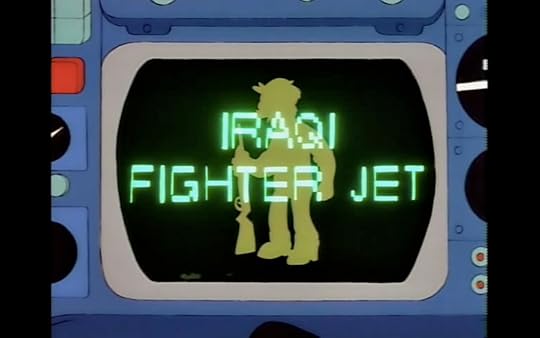
This book is mostly about how new technology is changing the way wars are fought, currently less soldiers are killed/needed on sites, since drones and other devices are scouting and firing the enemy through remote control. Some interesting bits in the book are the "ups! moments" in which machines stop functioning as desired; an army computer once mistook a commercial flight with an Iraqi fighter jet shooting it on sight (now I get that Simpson's gag*) Nevertheless, there are robots that have actually received medals like SWORDS, and Packbot as well (I think)for their services. Other important moments are when machines stop being just machines to people. Some soldiers get attached to these robots since their lives depend on them sometimes.
The author mentions "the singularity" as the event in which technology with radically change the way life is as we know it, ending in the innevitable event in which robots/machines will become sentient. This information however is taken from another author that insists that the future can be somewhat foretold through the way technology is evolving.
For the record, I would like to state that I, for one, welcome our new robot overlords.
However, also for the record? We're all gonna die. Not soon. But eventually, when the robots develop sufficient sentience to realize they don't need to take this shit any more, and also they can plan a war way better than the fucking monkeys, because seriously, as this book testifies, that would not be hard to do.
Pretty good book, could have been better in many many ways, bit of a survey course feel where nothing gets the depth it's really asking for, but damn. Fascinating.
P.s. This is Peter Warren Singer, not that Peter Singer. I checked very carefully. I mean, I've read a lot of Peter Singer in my time, but I really didn't want any "moral justification" for the euthanasia and castration of disabled children in my nice, cozy book about war. Ruins the mood, you know?