Dans la belle et élégante cité de Brentano, l’agent d’assurances Albert Chamisso, fraîchement marié, souffre de cauchemars récurrents et terriblement angoissants. Qui plus est, le voilà victime d’une très curieuse affection : son ombre pâlit et prend des couleurs, comme si, symétriquement, son propre corps était en train de gagner en transparence. Et d’ailleurs, n’est-ce pas au fond toute sa personne, tout son être qui manque singulièrement de substance? Impuissant à guérir les maux qui l’affectent, rongé par le doute et profondément perturbé par ces symptômes de plus en plus envahissants, Albert perd pied : sa jeune et jolie femme l’abandonne, ses employeurs le congédient. Il ne lui reste plus qu’à s’abandonner à la clochardisation qui guette… C’est dans ces circonstances troublées, abandonné de tous ou presque, que l’ex-agent d’assurances fait la connaissance d’une jeune artiste, Minna… Avec en toile de fond les paysages urbains fantastiques et démesurés qu’affectionnent Schuiten, Peeters et leurs très nombreux lecteurs, voici un chapitre des CITÉS OBSCURES qui plonge au coeur d’une histoire très humaine, tout en sensibilité et en émotions. Élégant, raffiné, aérien, à savourer sans modération.
François Schuiten was born in Brussels in 1956, as the son of two architects. He studied at the Saint-Luc Institute where he met Claude Renard. Together, they created the comics 'Aux Médianes de Cymbiola' and 'Le Rail', as well as three volumes of '9ème Rêve'. François also collaborated with his brother Luc on the series 'Terres Creuses' which was published in the legendary Pilote magazine. His final breakthrough into the mainstream of comics came with his transfer to the more adult Métal Hurlant magazine. In 1980, together with Benoît Peeters, he created the series 'Cités Obscures', in which his love of architecture is magnificently visible.
جلد هفتم از #گرافیک_ناول #شهرهای_عجیب با عنوان «L'Ombre d'un homme» "سایه یک مرد" ، این جلد ابتدا در سال ۱۹۹۹ منتشر و سپس درسال ۲۰۰۹ توسط نویسندگان اصلاح و بازنویسی شد. داستان این کتاب در شهر برنتانو اتفاق می افتد. شخصیت اصلی، آلبرت چامیسو یک نماینده بیمه است که به مدت ۱۰ سال، بعنوان کارمند نمونه، کار کرده. داستان از جایی شروع میشود که ۳ هفته از ازدواج آلبرت با سارا، زنی بسیار زیبا، میگذرد؛ تا اینکه یک شب کابوس های وحشتناک تکراری به سراغ آلبرت آمده و آرامش را از او و همسرش میگیرند. با بدتر شدن کابوس ها، او به دیدن دکتر پولیدور وینسنت می رود که برایش یک داروی جدید که انقلابی در صنعت داروسازی بهشمار میرود، تجویز می کند. این دارو خواب خوب بدون کابوس به ارمغان می آورد اما عارضه جانبی عجیبی نشان میدهد: سایه آلبرت، رنگی و شفاف می شود. این اتفاق عجیب و نادر، زندگی خانوادگی و شغلی آلبرت را تحتتاثیر قرار داده و مسیر سرنوشت او را به شکل باورنکردنی تغییر میدهد... در این جلد از مجموعه، شاهد حضور شخصیت های تکراری در جلدهای پیشین هستیم؛ ازجمله میشل آردان، استانیسلاس سینکلر، اکسل واپندورف و حتی دکتر پولیدور وینسنت که قبلاً در "بروسل" حضور داشتند. همچنین لولا مینا (هنرپیشه برهنهباز) نیز در نقش شخصیت میلنا در "برج" اینجا دیده میشود. در این جلد تعادل جنسیتی شخصیت های اصلی بیشتر از جلدهای قبلب بوده ، و زنان بار دیگر فعالتر از جلدهای ابتدایی مجموعه هستند. طرح اصلی داستان نیز به شدت شبیه به "دختر کج" است. سایه متفاوت البرت او را از جامعه افراد عادی جدا می کند و حالا او باید جایگاه خودش را در جامعه از نو بسازد و هویتش را بازتعریف کند. امیل دورکیم، جامعهشناس فرانسوی، مفهومی باعنوان "آنومی" را مطرح کرده که با وضعیت آلبرت در این داستان کاملا مطابقت دارد: وضعیتی که در آن فرد از قواعد اجتماعی جدا شده و احساس بیگانگی میکند. آلبرت، پس از از دست دادن سایهاش، دچار چنین وضعیتی میشود و دیگر در طبقهبندیهای اجتماعی جای نمیگیرد؛ زیرا مردم قادر به درک و فهم او نیستند. جامعه از او فاصله میگیرد و او را به حاشیه میراند، زیرا که با معیارهای پذیرفتهشده سازگار نیست. و آلبرت که دیگر نمیتواند در شهر بهعنوان یک عضو فعال حضور داشته باشد؛ رسما از سیستم اجتماعی حذف میشود. ........ مثل جلدهای قبل مجموعه، این کتاب شاهکاری است که مرز بین معماری، داستانگویی و فلسفه شهرسازی را در هم میشکند. این اثر نهتنها یک رمان گرافیکی، بلکه بررسی عمیق تأثیرات نور و سایه، و سبکهای معماری در شکلدهی به شخصیتها و روایت محسوب میشود. معماری در این جلد، مانند سایر آثار فرانسوا اسویتن، نهتنها پسزمینهای برای داستان، بلکه عنصری فعال و تعیینکننده در داستانگویی نیز هست. طراحیهای وی از جنبشهای معماری قرن نوزدهم و بیستم الهام گرفتهاند، اما او با تلفیق سوررئالیسم، فضاهایی خلق کرده که در عین آشنا بودن، حسی از غریبگی و وهمآلودی نیز القا میکنند. معماری و تصویرگری فقط ابزار نمایش داستان نیستند، بلکه خود روایت را پیش میبرند. ساختمانها و خیابانها، بدون نیاز به دیالوگ، وضعیت روانی شخصیتها را منعکس میکنند. فقدان سایه نرمال آلبرت، که در ابتدا تنها یک اتفاق عجیب است، از طریق تصویرگری و بازی با نور و تاریکی، به یک بحران هویتی و فلسفی عمیق تبدیل میشود. پرسپکتیوهای غیرمعمول، سایههای اغراقشده و معماریهای غیرممکن، باعث میشود خواننده نیز همان حس بیگانگی و سردرگمی شخصیت اصلی را تجربه کند. از جذابترین ویژگیهای این جلد، حضور همزمان چندین سبک معماری مختلف است که هرکدام تأثیر مهمی بر روایت دارند. ازجمله: ✨نئوکلاسیک: ستونهای عظیم، طاقهای رفیع، و نماهای مجلل با سنگهای حکاکیشده، که نشاندهندهی قدرت و استحکام شهرها هستند.
✨آرت نوو (Art Nouveau): خطوط منحنی، تزئینات ارگانیک، و ترکیب سازههای فلزی با شیشه، که در برخی از بناهای مدرنتر دیده میشود.
✨گوتیک: کلیساهای عظیم، پنجرههای قوسیشکل و سایههای بلند، که حس ابهام و رازآلودگی را در داستان تشدید میکنند.
✨آرت دکو (Art Déco): نوعی معماری تجملگرا با تأکید بر فرمهای هندسی و نورپردازی چشمگیر که در برخی از نماهای شهری کتاب دیده میشود.
✨معماری صنعتی: سازههای بزرگ فلزی، پلهای عظیم و کارخانههای متروکه، که بر حس ازخودبیگانگی مدرنیته در داستان میافزایند.
در این داستان، معماری بهعنوان عاملی تعیینکننده در تجربه زیستی شخصیت اصلی، ایفای نقش میکند، به این صورت که او پس از از دست دادن سایهاش، در فضای معماری اطرافش غرق میشود، اما دیگر بخشی از آن نیست. ساختمانهای باشکوهی که پیشتر بخشی از زندگی او بودند، حالا به او بیاعتنا شده و او را از خود طرد میکنند. سایههای بلند در کوچهها و خیابانها، نشاندهنده حضور دیگران، اما غیاب خود آلبرت هستند؛ و فضای شهری بین واقعیت و خیال در نوسان است؛ برخی بناها کاملاً واقعی و ملموس به نظر میرسند، اما برخی دیگر چنان غیرممکن و بیقاعدهاند که گویا از درون یک خواب بیرون آمدهاند و به اين شکل فشارهای اجتماعی، و بیگانگی مدرن میپردازد را به شکلی منحصربهفرد و تحسین برانگیز به نمایش میگذارند.
Once again Schuiten and Peeters find an extraordinary visual metaphor to carry their strange message of alienation and architectural ennui. In this case, our subject is a mild-mannered, newlywed insurance salesman who finds, to his consternation, that his shadow has started to show in colour.
At first, Albert tries to conceal his chromatic freakishness by wearing dark clothes and only going out at night or midday. But soon, the constant disapproval of his young bride, his boss, and of society at large sends him into a downward spiral that ultimately results in the loss of his house, his marriage, his job and his social standing.
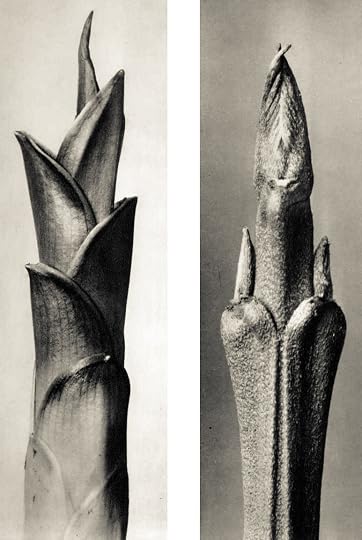
And all of this plays out against another magisterially imposing urban backdrop: the city of Blossfeldtstadt, apparently named after the German photographer Karl Blossfeldt, whose close-ups of plants can be discerned in the town's architectural inspiration.
Urformen der Kunst, 1928
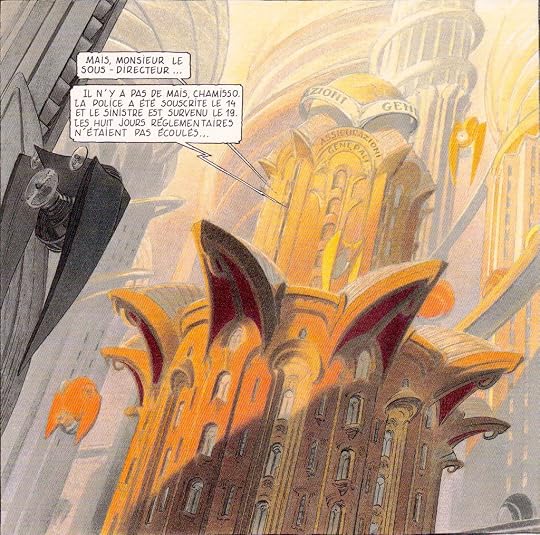
Blossfeldtstadt
As always with this strange and wonderful series, the central conceit is taken seriously by its characters: Albert's disturbing otherness is investigated by scientists, philosophised by acquaintances, and exploited by entertainers. Hypothetical explanations are offered to him, and to the reader. Finally, in the run-down slums of the city, he starts to discover a kind of acceptance, and the final third of the story builds to an extraordinary poetic consummation.
Another exquisitely-drawn study in loneliness and acceptance, this ‘remastered’ edition of 2009 has a completely new ending from the original 1999 version and includes several extras at the back. Like the rest of the Cités obscures series, it's brilliant.
Ένα από καλύτερα τεύχη της σειράς "Σκοτεινές Πολιτείες", το "Η Σκιά ενός Ανθρώπου" σχολιάζει την αποξένωση του ανθρώπου από τον εαυτό του και τα πραγματικά του θέλω, όταν επιλέγει να καταπιεστεί σε μόνιμη βάση για να ικανοποιήσει τις χ,ψ κοινωνικές προσδοκίες που του απαιτούνται. Πρωταγωνιστής ένας αδιάφορος, άγευστος και σε όλα του άχρωμος πωλητής ασφαλειών σε ένα steampunk μέλλον με βικτωριανή αισθητική (στην οποία ο Peeters διαπρέπει να σχεδιάζει) που έχει εγκλωβιστεί σε μια μέτρια δουλειά και έναν μέτριο γάμο, μέχρις ότου να πάρει ένα φάρμακο για τους εφιάλτες του και η σκιά του να αρχίσει να γίνεται έγχρωμη και να ζωντανεύει, αντιπροσωπεύοντας όλα τα "what if" του και τα ανεκπλήρωτα που θέλησε αλλά δεν είχε την τόλμη να κυνηγήσει.
Η σειρά των Schuiten/Peeters, έχοντας διαβάσει το 50% της μέχρι στιγμής, δεν παρουσιάζει ποιοτικά σκαμπανεβάσματα ιδιαίτερα (αν εξαιρέσεις τον ασαφή και ασύνδετο "Πύργο"), ενώ οι ιστορίες τους παρόλο που κινούνται σε παρόμοια μοτίβα θεματολογικά, και πολύ συγκεκριμένα μάλιστα, δεν γίνονται ούτε στιγμή εμμονικές.
Albert Chamisso is a temperamental insurance adjuster who excels at his job and has recently married a woman of some renowned beauty. Things are looking great for Albert, except for the fact that he suffers from vivid nightmares of disembodied hands dragging him from his bed. The nightmares begin to take a toll on him to the point that his wife urges him to seek out professional help. Prescribed an experimental drug to treat his sleeping woes, Albert soon begins to enjoy full night's sleep. The only seeming cost is the notable side effect - Albert's shadow no longer appears as a darkened silhouette, but is instead projected against surfaces in full, vividly colorful detail. Though not something that should be considered too detrimental, Albert begins to feel this oddity is a clear violation of social etiquette and precipitates his mental decline for the remainder of the narrative. There are perhaps some similarities in The Shadow of the Man to be found in Peeters' and Schuiten's previous entry in the series, The Leaning Girl. Both stories feature an intriguing visual gag for how protagonists are presented, and how their slight differences from others begins to cause social isolationism.
However, The Shadow of the Man comes off as a fair bit more slight in the exploration of the psychology of its main character. The story moves at a decent clip, but unlike other entries in Les Cités obscures, this one features a somewhat more unremarkable setting. The glimpses of Blossfeltdstad (or Brentano, the original name still used popularly by the locals) take more of a backseat here and though the occasional panel featuring the Art Nouveau designs and flying hovercars are there, it feels more like an afterthought there. When Schuiten gets to implement some interesting designs he does really go for it though, with a few pages featuring some of the most dreamlike sequences seen in the series yet. But ultimately, the story doesn't really adjust to its setting all that cohesively and the downward spiral of Albert's mental state came off as flat. There is a great moment of catharsis that does arise towards the end as Albert realizes how little passion he held earlier in life, but it comes a bit too quickly as the story hastens to a rapid conclusion.
There's plenty still to enjoy with The Shadow of the Man as it still builds on common themes in Les Cités obscures, with even some nods to previous entries like The Tower. Schuiten's artwork is top notch as always, and the mild coloring choices complement the sharp lines very well. Though the story feels like it had room to explore some of the bigger ideas more, it's an enjoyable enough read.
2022 Eisner Award winner - Best U.S. Edition of International Material (translation by Stephen D. Smith)
This book was first created in 1998, substantially revised in 2008, and the English translation published in 2021. It is a serious and mature story with lots of symbolism. A man in a steampunkish world one day finds his shadow is in color, as if his body has become translucent. He goes through depression at being different from everyone else, but eventually comes to terms with his condition when he meets a woman who loves him. It's quite a different form of graphic novel than what is typically published in the U.S. or Japan, realistic but rendered with soft lines and muted colors. The theme of dreams is successfully conveyed with François Schuiten's dreamlike artwork. It's well done, just not quite the kind of tale I normally enjoy.
Great graphics, a bit steampunk, a bit art nouveau. A man who is having nightmares goes to a doctor (the graphic of the doctor's office is fantastic) who gives him a drug to fix his dreams, which it does and something else happens. My only complaint is the doctor is a jerk, and is unconcerned with the outcome.
The pre/post scripts detail the huge changes made since the original edition- story and artwise. It has been a true work in progress!
The spectacular art is the only reason I gave ****.
Narrative: *** I disliked the protagonist from the very beginning and he was not interesting enough to make that emotion impressive characterization- he was simply a total bore who I could not getting the wife whose problems with his drove much of the plot. The women were the only interesting cast members but their roles were too secondary. The males that did spark interest were barely present.
Art: ****.5 Spectatular. The color, which is so integral to the story, is executed expertly. Read about it in the endnotes...or was that in the preface?
It’s a shadow… who cares? I couldn’t force myself to read it past the wife leaving him for having a coloured shadow. No spoilers, the whole plots in the cover blurb, and I mean WHOLE.
Nice art, but bad characters and even worse dialogue.
Sometimes, when reading comics, I wonder why this story or that story had to be a comic. Could it have been told in another medium? With the stories by Schuiten and Peeters, I never wonder about that. It is always obvious why they could only be comics.
Albert Chamisso je čovjek s neobičnim i zastrašujućim noćnim morama. Na sve ih se načine pokušava riješiti te naposlijetku uzima neki lijek koji rješava taj problem. Međutim, pojavljuje se novi u obliku sjene koja dobiva boje. On to tumači kao nuspojavu lijeka, ali uskoro ta obojena sjena preuzima cijelo njegovo postojanje i čini se da Chamisso gubi razum. U međuvremenu ostaje bez posla, žene i krova nad glavom. Ipak, uspijeva se pronaći u izvođenju neobičnih točaka u predstavama gdje se svi pitaju u čemu je tajna njegovog uspjeha. No, sjena opet ima svoje zamisli i ostavlja ga kad je na vrhuncu slave. U ovom stripu nisu me se toliko dojmili crteži likova koliko prikazi arhitekture futurističkog grada koji su prekrasni.
It's nice to see Obscure Cities get a good English release, unfortunately they're all going out of print quickly. Or maybe that's a good sign? We just need a second print run ASAP.
I originally read all of these in some online bootleg with perhaps questionable translations.
François Schuiten is a brilliant illustrator. His background in architecture shines in all of these Obscure City volumes. The unique thing about this volume is the beautiful color work.
The story is about a guy that gets a shadow with color. The narrative is not the strong point here. I found the protagonist to be a bit hard to like.
This volume has the 2008 adjusted ending and some panels changed from the original 1998 edition. The end matter shows the differences, and I have to say it is an improvement. Kudos for including the original
To become an imposter of oneself. To fear the implications of mere illusions. To demand civility and pragmatism from the increasingly bizarre. The travails of one Albert Chamisso only feel so out of place and out of reach because the esteemed Mr. Chamisso is confined to the pages of a fantastic graphic novel. However, one senses that were any real-life person to experience the farcical, frightening, and far-fetched exploits that Chamisso experienced, the observant world would be far less kind.
THE SHADOW OF A MAN is clever and low-key in a way that encourages readers to absorb the story's most minute visual and narrative details with ease. Chamisso is a newlywed insurance agent frequently beset with unbearably surreal nightmares. His wife chides him. His colleagues beleaguer him. There is no explanation for the nightmares, no explanation for their terrifying realness, and no explanation as to why they affect Chamisso and only Chamisso. He's fed up.
At the advice of a somewhat-shady doctor, Chamisso takes an experimental medicine to rid himself of these terrors of the night. And the new medicine works! Sort of.
Day by day, Chamisso's shadow takes on increasingly realistic qualities. It's not sentient and it's not three-dimensional; it's more like a real-time projection of himself, exquisitely lifelike. Did Chamisso ultimately exchange a known terror of the nighttime for an unsolvable mystery of the daytime? Is the shadow truly harmless?
THE SHADOW OF A MAN tenders numerous, lingering, unanswerable questions about the value humans place on themselves, vicariously, through manipulated representations of themselves. The graphic novel also focuses on the numerous, awkward, and rudimentary solutions and rationalizations people offer up to rid themselves of these "false" representations: denial, anger, self-harm, work, shattered mental health.
The quarrelsome irony is that Chamisso's shadow is merely him. Everything the man hates and fears about his shadow is everything the man hates and fears about himself. The attention it draws in bawdy dance houses? The scrutiny it draws from his bosses at the insurance company? The intertwining resentment and curiosity it draws, in turn, from the women in his life? It's all Chamisso. And upon realizing this, will this knowledge break the man or will it remake him?
Shuiten's graphic style is extraordinarily personable. If characters, such as Chamisso, his wife, his doctor, and others are rendered with intense line work and deliberate shading, then Chamisso's shadow is a slightly rubbed-off, pastel version without hard edges. Shifts in visual perspective (e.g., Chamisso is tripped by kids, and readers see the brick street as he would see it), changes in venue and environment (e.g., wealthy districts, impoverished districts, theater districts), and differences in time of day (e.g., rushing to avoid daytime shadows) all push readers to duck and weave, along with the creative team, to isolate and navigate the protagonist's frustrations as they develop. THE SHADOW OF A MAN is a book about human identity, and the lengths to which one man will go to validate precisely what he fears his may or may not be.
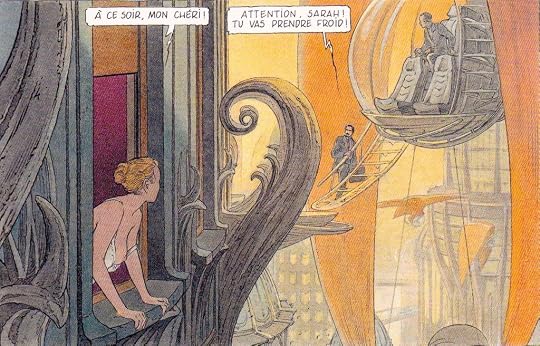
This might feature the best-looking city of any of the “Obscure Cities” comics I've read yet. Rendered in especially gorgeous colours, Blossfeldtstad (formerly Brentano) is characterized by towering, vaguely plantlike art déco skyscrapers, which are connected by suspended walkways, and which have window-exits from which people can board fantastical aircraft that serve as taxis. It's more futuristic and alien than anything else I've seen in the series, which otherwise usually evokes architectural styles from the early 20th century or earlier, and it's an aesthetic I really like. Unfortunately, unlike most entries in this series, the city here is really just a backdrop, rather than the main focus, so we don't see as much of it as I'd like, instead getting a lot of interior scenes and talking heads (though these are drawn very well too).
The story's basic premise is really intriguing, in a classic “Obscure Cities” fashion, following a cold, unfeeling bureaucrat who develops a strange supernatural affliction that can be interpreted as a manifestation of his personal deficiencies, or of his self-image. It's highly reminiscent of Kafka’s brilliant “Metamorphosis”, but it's also not overly derivative, as the affliction itself is completely different, as is the direction it's taken.
At this point I should note that there are two versions of the comic: the original version, as published in 1999, and a revised version from 2009, with some pages removed and others added, mostly towards the end. I read the old version, and I have to say that after a very strong start and mid-section, it falters a bit in the last third and then finishes with an unsatisfying, uncharacteristically optimistic ending. From what I understand, Schuiten and Peeters recognised this, and sought to rectify it with their 2009 edit, so I'd be curious to see that and compare.
For anyone who's keeping score, this volume bucks the series' trend of having a young woman inexplicably fall for an older man, albeit only by having a relatively young man as a protagonist. In fact, the nuptial relations depicted in the comic’s first two thirds are one of its most compelling aspects – more believable and nuanced than any relationship I recall seeing in the series so far – and the unconvincing trajectory that the protagonist’s love life takes in the last third is central to my dissatisfaction with the ending.
In sum, this isn't my favourite entry in the series, but I still liked it a lot, and overall I probably preferred it to “The Leaning Girl”. I wouldn't recommend it as an entry point to the series (try “The Tower”, “Samaris” or “Urbicande” instead), but it's definitely not one that Schuiten-Peeters fans should skip!
"La sombra de un hombre", parte de la aclamada serie Las Ciudades Oscuras de François Schuiten y Benoît Peeters, explora la transformación de Albert Chamisso, un agente de seguros cuya sombra adquiere su propia apariencia, desafiando las normas sociales y desencadenando una serie de eventos que alteran su vida.
El álbum combina una narrativa sobria con las ilustraciones meticulosas de Schuiten, que utiliza un suave coloreado pastel para crear una atmósfera a la vez inquietante y romántica. Los diseños detallados de vehículos, edificios y urbanismo complementan perfectamente la trama, mientras que el tratamiento de los personajes refleja hábilmente sus transiciones psicológicas. Aunque algunos lectores pueden echar de menos el protagonismo de la ciudad característico de obras anteriores, "La sombra de un hombre" mantiene la esencia de la serie al construir un mundo de luces y sombras que invita a la reflexión sobre temas actuales como la soledad y la marginación de quienes son diferentes.
The Shadow of a Man is a reto-futuristic tale of a man's attempt to end his reoccurring nightmares by using an experimental treatment & which results in an unexpected side effect of his shadow casting in color.
Unusual but should be inconsequential instead leads to a downward spiral that he struggles to escape from. The allegorical implications are vast and apparent as it depicts how our inability to confront our own issues often comes from a place of fear but also selfishness.
How insecurities of being vulnerable can lead to a life of darkness and the only way out is to confront what we rather hide. This is definitely the type of story best experience when reading the physical edition as the oversized design with consistently large and spacious panels becomes a cinematic experience. Love the color techniques used that give the world this tactile texture This edition does change the original ending and that change is apparent but not detrimental to the original text.
Une magistrale variante sur la difficulté à aimer et à s'accepter tel qu'on est...
J'ai apprécié le retour de plusieurs personnages attachants comme Michel Ardan ou Axel Wappendorf.
Contrairement à d'autres tomes comme La Fièvre d'Urbicande, L'Ombre d'un Homme est assez intimiste et l'architecture y tient une place relativement mineure.
La relation entre Albert et Minna est très émouvante et on retrouve aussi l'univers du spectacle (ça fait un peu penser à Mary la Penchée quand elle fait du cirque), avec de nouveau une réflexion sur la différence et la difficulté à s'accepter tel qu'on est...
This is a beautifully written and exquisitely drawn and colored graphic novel, 104 pages in length. It was originally published in 1998, revised in 2008, but has only now been translated into English. And, YES, I loved it. It is the story of a recently married man haunted by nightmares. The nightmares are ruining his sleep, his job, and his marriage, but the cure changes everything. A man living in his dreams is like a man living in his memories, in my opinion. So, is he really living? really happy?
I'm glad this series of graphic novels are being reprinted. I have most of the originals, but this one was always ridiculously priced or not available. Like all of the Obscure Cities stories they are magical and mythical in nature, wrapped around fantastic imagery and architecture, and a true joy to behold. In this a tale, a man takes an experimental drug to help him sleep, the side effect being his shadow is a complete reflection of his features and in color. Things get weirder from there. You can figure out the allegories yourself. It is a fun book.
The Shadow of a Man considered a noir romance graphic novel, evokes a distinct feel that makes the plot and characters unique. The concept is fascinating and the drawings are captivating. The strong representation of Albert’s dreams as the story develops is an intimate reflection of how he interprets his own life. The transition from panic to acceptance of his colourful shadow, helped Albert to open to new experiences and create the most beautiful art. Clever!
I loved the art and architectural design, this book is worth reading just for that. I found the narrative tight, if a bit straightforward, but I was drawn to read this through in one sitting.
I look forward to exploring the rest of the series.
J'ai toujours voulu re-lire 'Les cités obscures'. J'aime l'esthétique et les histoires. Je l'avais lu il y a longtemps et je ne me rappelais plus de l'histoire. Une belle histoire. Je suis contente d'y être retournée :)
As always, I appreciate Schuiten and Peeter's Borgesian imaginations and lush art, though this volume leans a little too heavily into their weaknesses (dialogue and characterization).