Jump to ratings and reviews
Rate this book

The Black Stone

Rate this book
"The Black Stone" is a short story by Robert Ervin Howard. Robert Ervin Howard (January 22, 1906 - June 11, 1936) was an American author who wrote pulp fiction in a diverse range of genres. He is well known for his character Conan the Barbarian and is regarded as the father of the sword and sorcery subgenre. Howard was born and raised in the state of Texas. He spent most of his life in the town of Cross Plains with some time spent in nearby Brownwood. A bookish and intellectual child, he was also a fan of boxing and spent some time in his late teens bodybuilding, eventually taking up amateur boxing. From the age of nine he dreamed of becoming a writer of adventure fiction but did not have real success until he was 23. Thereafter, until his death at the age of 30 by suicide, Howard's writings were published in a wide selection of magazines, journals, and newspapers, and he had become successful in several genres. Although a Conan novel was nearly published into a book in 1934, his stories never appeared in book form during his lifetime.

42 pages, Paperback

First published November 9, 1931

8 people are currently reading
262 people want to read

About the author

Robert E. Howard

3,022 books2,674 followers
Robert Ervin Howard was an American pulp writer of fantasy, horror, historical adventure, boxing, western, and detective fiction. Howard wrote "over three-hundred stories and seven-hundred poems of raw power and unbridled emotion" and is especially noted for his memorable depictions of "a sombre universe of swashbuckling adventure and darkling horror."

He is well known for having created—in the pages of the legendary Depression-era pulp magazine Weird Tales—the character Conan the Cimmerian, a.k.a. Conan the Barbarian, a literary icon whose pop-culture imprint can only be compared to such icons as Tarzan of the Apes, Count Dracula, Sherlock Holmes, and James Bond.

—Wikipedia

Librarian Note: There is more than one author in the Goodreads database with this name.

Ratings & Reviews

What do you think?
Rate this book

Friends & Following

Create a free account to discover what your friends think of this book!

Community Reviews

5 stars
90 (21%)
4 stars
164 (39%)
3 stars
131 (31%)
2 stars
26 (6%)
1 star
8 (1%)
Displaying 1 - 30 of 41 reviews
Profile Image for Eloy Cryptkeeper.
296 reviews230 followers
October 21, 2020
"Dicen que los seres inmundos de los Viejos Tiempos acechan
en oscuros rincones olvidados de la Tierra,
y que aún se abren las Puertas que liberan, ciertas noches,
a unas formas prisioneras del Infierno"

El narrador obtiene uno de los pocos ejemplares existentes del libro "Cultos Sin Nombre" del ocultista Von Junzt.Quien murió años antes en extrañas circunstancias. Entre multitud de cosas extrañas que alberga el libro, encontró una alusión a la Piedra Negra, un monolito siniestro que se cobija en las montañas de Hungría y en torno al cual giran leyendas tenebrosas. Esa Piedra Negra representaría algún orden o algún ser al cual razas primitivas le rendían culto y sacrificios.
El narrador decide investigar e ir tras las pistas del monolito. Descubriendo su origen, las claves que contiene y mucho mas de lo que cualquiera quisiera descubrir y encontrarse.
Profile Image for Benjamin Uke.
647 reviews51 followers
February 12, 2024
Another one of Robert E. Howard’s Lovecraft homages.

Robert E Howard, together with HPL and Clark Ashton Smith completed “the big three” of storytellers published in Weird Tales. There was much fanfare for the heroic hijinks of Conan the Cimmerian and Solomon Kane as his major works.
Howard and Lovecraft were penpals however, so like with Clark Ashton Smith, it was only a matter of time before he dabbled in elder gods ancient forbidden rituals and well, -dated- concepts of race.
The story opens in a typically Lovecraftian trope of an ancient book (Nameless Cults) being discovered by the protagonist who then goes on to, through its pages, separate us from the current day and the very old history it describes.

(Note: When Lovecraft does this, it served not to safely separate a reader from the action, a sign of sloppiness, but to deepen the sense of history and ancient connection involved and thus heighten the unsettling cosmic danger the protagonist, (perhaps also the reader), may be in. He shows you the terrible betentacled pit you've been standing on without realizing it.
Howard, well. Howard does his best. I feel he couldn’t write a Lovecraft story without it becoming a Howard story.) (2/5)

Our protagonist arrived in the storied village of Stregoicavar nestled within the mountains of Hungary. Beautiful use of the imagery reminded me a lot of the opening scenes of Dracula …a three days ride in a jouncing coach brought me to the little village which lay in a fertile valley high up in the fir-clad mountains.” (4/5)

The protagonist, against all advice, seeks out the titular black stone, a monolith about sixteen feet high and a foot and a half or so in diameter (4/5, excellent lead-up, bit trite).
And wouldn’t you know it, but it just happens to be Midsummer’s Eve (1/5, you've got to be kidding me).
A dream-like state comes upon him and he witnesses true horrifying past. Howard’s writing is a lot more direct that Lovecraft’s and even though it isn’t devoid of description, and doesn't WORK when it comes to horror usually. There is an immediacy to his writing that is exciting, a real focus on seeing and experience rather than the abstract creeping spinechill contemplation of Lovecraft.

There's repeated use of the phrase “I opened my eyes,” a number of times, and constantly emphasizes the visceralness of what is before the character, demonstrating that what is going on is real. It may drive you insane, yes, but you are not insane yet. Howard throws driblets of reference with choice words like “cyclopean”.

Also, if Howard’s style is present in his writing, it is also present in his preconceptions. There is quite a lot in this story about racial superiority and inferiority, which comes as no surprise and not part of the writing-quality of the review, but is regretful all the same.
Profile Image for Drew Canole.
3,208 reviews46 followers
November 22, 2024
[Short story read in The Best of Robert E. Howard Volume 1: Crimson Shadows]

Kind of cool to read this after seeing Jim Zub is using this Black Stone monolith as a macguffin to bring together all of REH's characters. After reading this story, I think it's a great idea.

Very Lovecraftian. The writer investigates this mysterious stone in Hungary, identifying in it an unknown and ancient language. At night he sees a horrific cult worshipping the stone, seemingly from a different time. Includes a giant frog THING. Pretty cool, perhaps not necessary since Lovecraft did the same sort of thing.
Profile Image for Ευθυμία Δεσποτάκη.
Author 31 books239 followers
September 2, 2019
Είναι το πρώτο μέρος μιας συλλογής tribute σε όσες ιστορίες του θείου Μπομπ άπτονται έστω αμυδρά της Μυθολογίας Κθούλου. Από τον Μαύρο Λίθο, όπου ξεκινάει με την περίφημη περιγραφή του θανάτου του Φον Γιούνστ, μέχρι τη Φωτιά του Ασσουρμπανιμπαλ και τα Σκουλήκια της Γης, ο αναγνώστης μπορεί να γελάσει με την αφέλια της θεωρίας, αλλά όχι και με τη γραφή.

Το κακό είναι ότι δεν είμαι και τόσο σίγουρη για την έκδοση αυτή. Εντάξει, ο θείος Μπομπ είναι πάντα ο θείος Μπομπ και η περιγραφή του πώς πέθανε ο Φον Γιουνστ -στο ομόνυμο διήγημα- αξεπέραστη. Αλλά έχει α) κάποια κομμάτια γραμμένα "μαζί" με άλλους (προφανώς πρόχειρα και σημειώσεις του Χάουαρντ που ξώμειναν όταν πέθανε, να τα σκυλεύουν επιτήδειοι) και β) κακή έως κάκιστη μετάφραση.

(Ίσως κι ένα μικρό θεματάκι επιμέλειας. Ο δευτεραγωνιστής της "Πόρτας στον Κόσμο" λέγεται Ζάθα εκτός από ένα σημείο περίπου στη μέση του διηγήματος, όπου ξαφνικά μετονομάζεται σε Χάθα. Για να μην πω για τον Φον Γιουνστ που μετονομάζεται -ευτυχώς σε όλη τη διάρκεια του βιβλίου- σε Φον Τζάνζ.)
Profile Image for Tim Pendry.
1,176 reviews493 followers
April 5, 2018

Published in Weird Tales in 1931, what might have been a major addition to the Lovecraftian genre with its highly imaginative beginning and acceptable ending is somewhat weakened by the pseudo-anthropology and ancient races story line that has become a Howard cliche.

The dream-like account of the dreadful rites of the worshipers of some demonic ancient toad-like god is filled with sexual sado-masochism but is ultimately dull when compared with the clever elucidation of Von Junzt's "Unaussprechlichen Kulten" in the opening pages.

The path to the Black Stone through a village worthy of a classic Hammer tale is well done and, despite some hurried plot holes, so is the ending but it could have been so much better without the ghostly debauchery. Perhaps I was prejudiced from reading too much later Wheatley devilment.
Profile Image for David Elkin.
294 reviews
Read
October 17, 2011
A marvelous rendition of the short story the Black Stone by Conan author Robert E. Howard.

You can find the free audio book here (part 1 an part 2)
http://cthulhupodcast.blogspot.com/20...


The reader does an excellent job of conveying the horror created by the author. It is a brooding tale of suggested horrors finally realized on Mid Summers night

Historically placed a solid tale that falls in with the best of the Lovecraftian lore. "The Black Stone" was first published in the November 1931 issue of Weird Tales. It can also be found in Tales of the Cthulhu Mythos published in the late 60's.
Profile Image for Tom.
714 reviews41 followers
February 4, 2018
A gigantic oppressive black stone in the mountains holds a terrifying and mysterious past. Tsathoggua the Cthulu Mythos deity who is a gigantic black toad was once worshipped there.
Profile Image for Angelasdawn.
133 reviews
Read
January 2, 2026
I'd like to reread this one when I'm able to give it my full, well-rested attention.
Profile Image for Keith.
962 reviews12 followers
October 11, 2022
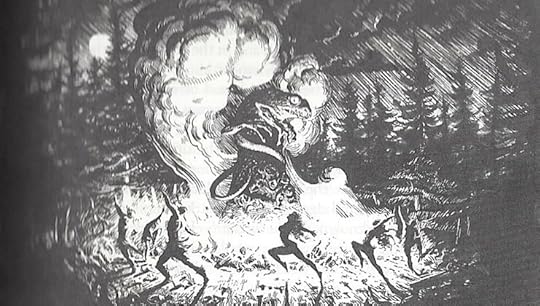
“All eyes were fixed on the top of the Stone which they seemed to be invoking. But the strangest of all was the dimness of their voices; not fifty yards from me hundreds of men and women were unmistakably lifting their voices in a wild chant, yet those voices came to me as a faint indistinguishable murmur as if from across vast leagues of Space—or time.”


[Art by Greg Staples]

“The Black Stone” is a short story by Robert E. Howard (1906-1936) and was a pastiche of the work of his friend H.P. Lovecraft (1890-1937). I read it because it is featured in The Literature of Lovecraft, Vol. 1 , a collection of stories by authors that HPL admired. While they never met in person, Howard and HPL corresponded for years and shared ideas, such as what is now called the Cthulhu Mythos. In an October 30, 1931 letter to August Derleth, HPL wrote “Howard’s ‘Black Stone’ gave me a kick despite the awkward management of the pseudo-erudition.” (Essential Solitude, p. 400). I was highly impressed by “The Black Stone,” myself. I loved the historical elements that Howard brought in, along with the eastern European setting. The ritual is deeply disturbing, thanks in part to the inclusion of far more explicitly violent imagery than HPL would have included himself.

Following Howard’s suicide in 1926, HPL wrote a lovely tribute to him, published in the September 1936 issue of Fantasy Magazine:
The character and attainments of Mr. Howard were wholly unique. He was, above everything else, a lover of the simpler, older world of barbarian and pioneer days, when courage and strength took the place of subtlety and stratagem, and when a hardy, fearless race battled and bled, and asked no quarter from heartless nature. All his stories reflect this philosophy and derive from it a vitality found in few of his contemporaries. No one could write more convincingly of violence and gore than he, and his battle passages reveal an instinctive aptitude for military tactics which would have brought him distinction in times of war. His real gifts were even higher than the readers of his published works would suspect, and had he lived, would have helped him to make his mark in serious literature with some folk epic of his beloved southwest.

It is hard to describe precisely what made Mr. Howard's stories stand out so sharply, but the real secret is that he himself is in every one of them, whether they were ostensibly commercial or not. He was greater than any profit-making policy he could adopt -- for even when he outwardly made concessions to Mammon-guided editors and commercial critics, he had an internal force and sincerity which broke through the surface and put the imprint of his personality on everything he wrote. Seldom, if ever, did he set down a lifeless stock character or situation and leave it as such. Before he concluded with it, it always took on some tinge of vitality and reality in spite of popular editorial policy -- always drew something from his own experience and knowledge of life instead of from the sterile herbarium of dessicated pulpish standbys. Not only did he excel in pictures of strife and slaughter, but he was almost alone in his ability to create real emotions and spectral fear and dread suspense. No author -- even in the humblest fields -- can truly excel unless he takes his work very seriously, and Mr. Howard did just that in cases where he consciously thought he did not. That such an artist should perish while hundreds of insincere hacks continue to concoct spurious ghosts and vampires and space-ships and occult detectives is indeed a sorry piece of cosmic irony!


Title: “The Black Stone”
Author: Robert E. Howard
Dates: 1931
Genre: Fiction - Short story, horror
Word count: 6,863 words
Date(s) read: 10/10/22
Reading journal entry #281 in 2022

Link to the story: https://gutenberg.net.au/ebooks06/060...

Sources:
Emrys, R. & Pillsworth, A.M. (2016, March 16). Please Do Not Climb the Cyclopean Artifact: Robert Howard’s “The Black Stone”. The Lovecraft Reread. https://www.tor.com/2016/03/16/please...

Fifer, C., & Lackey, C. (2015, May 6). Episode 255 - The Black Stone. H.P. Lovecraft Literary Podcast
https://www.hppodcraft.com/list/2015/...

Howard, R.E. (2021). The black stone. In H.P. Lovecraft Historical Society (Ed.), The literature of Lovecraft, vol. 1.. (S. Branney, Narr.; A. Leman, Narr.) [Audiobook]. HPLHS. https://www.hplhs.org/lol.php (Original work published 1931)

Lovecraft, H. P., & Derleth, A. (2013). Essential solitude: The letters of H.P. Lovecraft and August Derleth. (S. T. Joshi & D. E. Schultz, Eds.). Hippocampus Press.

Maliszewski, J. (2011, January 22). In Memoriam: Robert Ervin Howard. Grognardia. https://grognardia.blogspot.com/2011/...

The contents of The Literature of Lovecraft, Vol. 1 are:
"The Adventure of the German Student" by Washington Irving
"The Avenger of Perdóndaris" by Lord Dunsany
"The Bad Lands" by John Metcalfe
"The Black Stone" by Robert E. Howard
The Boats of the "Glen Carrig" by William Hope Hodgson
"Count Magnus" by M.R. James
"The Dead Valley" by Ralph Adams Cram
"The Death Mask" by Henrietta Everett
"The Fall of the House of Usher" by Edgar Allan Poe
"The Ghost of Fear" by H.G. Wells (also called “The Red Room”)
"The Ghostly Kiss" by Lafcadio Hearn
"The Horla" by Guy de Maupassant
"The House and the Brain" by Edward Bulwer-Lytton
"The House of Sounds" by Matthew Phipps Shiel
"Idle Days on the Yann" by Lord Dunsany
"Lot #249" by Arthur Conan Doyle
"The Man-Wolf" by Erckmann-Chatrian
"The Middle Toe of the Right Foot" by Ambrose Bierce
"The Minister's Black Veil" by Nathaniel Hawthorne
"The Monkey's Paw" by W.W. Jacobs
"One of Cleopatra's Nights" by Théophile Gautier
"The Phantom Rickshaw" by Rudyard Kipling
The Place Called Dagon by Herbert Gorman
"Seaton's Aunt" by Walter de la Mare
"The Shadows on the Wall" by Mary E. Wilkins
"A Shop in Go-By Street" by Lord Dunsany
"The Signal-Man" by Charles Dickens
"Skule Skerry" by John Buchan
"The Spider" by Hanns Heinz Ewers
"The Story of a Panic" by E.M. Forster
"The Strange Case of Dr. Jekyll and Mr. Hyde" by Robert Louis Stevenson
"The Tale of Satampra Zeiros" by Clark Ashton Smith
"The Tapestried Chamber" by Sir Walter Scott
"The Upper Berth" by F. Marion Crawford
"The Vampyre" by John Polidori
"The Venus of Ille" by Prosper Mérimée
"The Were Wolf" by Clemence Housman
"What Was It?" by Fitz-James O'Brien
"The White People" by Arthur Machen
"The White Wolf of the Hartz Mountains" by Frederick Marryat
"The Willows" by Algernon Blackwood
"The Yellow Sign" by Robert W. Chambers
"The Yellow Wallpaper" by Charlotte Perkins Gilman

Here is a list of the stories in the order in which they were written, with links to my reviews of them:
The Vampyre (1819) by John William Polidori
The Adventure of the German Student (1824) by Washington Irving
The Tapestried Chamber (1828) by Walter Scott
The Minister's Black Veil (1836) by Nathaniel Hawthorne
The Venus of Ille (1837) by by Prosper Mérimée
The White Wolf of the Hartz Mountains (1839) by Frederick Marryat
The Fall of the House of Usher (1839) by Edgar Allan Poe
What Was It? (1859) by by Fitz-James O'Brien
The House and the Brain (1859) by Edward Bulwer-Lytton
The Signal-Man (1866) by Charles Dickens
The Man-Wolf by Erckmann-Chatrian
The Ghostly Kiss (1880) by Lafcadio Hearn
One of Cleopatra's Nights (1882) by by Théophile Gautier
The Upper Berth (1886) by F. Marion Crawford
The Strange Case of Dr. Jekyll and Mr. Hyde (1886) by Robert Louis Stevenson
The Horla (1887) by Guy de Maupassant
The Phantom Rickshaw (1888) by Rudyard Kipling
”The Middle Toe of the Right Foot” (1891) by Ambrose Bierce
Lot #249 (1892) by Arthur Conan Doyle
The Yellow Wallpaper (1892) by Charlotte Perkins Gilman
The Ghost of Fear (1894) by H.G. Wells- also called The Red Room
The Yellow Sign (1895) by Robert W. Chambers
The Dead Valley (1895) by Ralph Adams Cram
The Were-Wolf (1896) by Clemence Housman
The Monkey's Paw (1902) by W.W. Jacobs
The Shadows on the Wall (1903) by Mary E. Wilkins
Count Magnus (1904) by M.R. James
The White People (1904) by Arthur Machen
The Willows (1907) by Algernon Blackwood
The Boats of the "Glen Carrig" (1907) by William Hope Hodgson
Idle Days on the Yann (1910) by Lord Dunsany
The Story of a Panic (1911) by E.M. Forster
The House of Sounds (1911) by Matthew Phipps Shiel
A Shop in Go-By Street (1912) by Lord Dunsany
The Avenger of Perdóndaris (1912) by Lord Dunsany
sThe Spider (1915) by Hanns Heinz Ewer
The Death Mask (1920) by H.D. Everett
The Bad Lands (1920) by John Metcalfe
Seaton's Aunt (1922) by Walter de la Mare
The Place Called Dagon (1927) by Herbert S. Gorman
Skule Skerry (1928) by John Buchan
The Tale of Satampra Zeiros (1929) by Clark Ashton Smith
The Black Stone (1931) by Robert E. Howard
*The difference between a short story, novelette, novella, and a novel: https://owlcation.com/humanities/Diff...

Vignette, prose poem, flash fiction: 53 - 1,000 words
Short Stories: 1,000 - 7,500
Novelettes: 7,500 - 17,000
Novellas: 17,000 - 40,000
Novels: 40,000 + words
Profile Image for Hani Abdullah.
32 reviews7 followers
November 1, 2015
The third of the Weird Tales trio sheds this great short in a style not dissimilar to his contemporary H.P. Lovecraft, in fact, "The Black Stone" is considered a canonical part of the Lovecraft mythos, and for good reason. The story is eerie, the narration chilling, and the characters interesting. I adored the inclusion of the narrator's investigations into the historicity of the place he was to visit, and how it tied very well to form his image of the events that later plagued him. I haven't read any Conan, of which Robert E. Howard is most known for, but if they are anything like this gem, aside from the stark contrast in genres, then Conan here I come.
Profile Image for Tiffany Lynn Kramer.
1,988 reviews10 followers
July 19, 2024
Usually it's not hard for me to find something to enjoy in a Lovecraftian tale and to be fair the beginning showed some promise but far to much of the rest rubbed me the wrong way. I understand this was published 90 years ago and Lovecraft himself was not shy when it came to showing his feelings towards other cultures however there was something in Howard's delivery that made it hard for me to overlook those elements.
Profile Image for Preetam Chatterjee.
7,558 reviews390 followers
January 17, 2026
Mission 2026: Binge reviewing all previous Reads, I was too slothful to review back when I read them

Robert Howard’s 'The Black Stone' reads like a fever dream assembled from anthropology, cosmic dread, and pulp bravado, and what surprised me most on revisiting it was how unsettling it remains beneath its rough surfaces. This is not horror polished into elegance; it is horror as intrusion, as something that tears through scholarship, travel, and rational curiosity with violent indifference.

Howard begins with an almost academic calm, drawing us into maps, manuscripts, and rumors, and then lets that scholarly posture collapse under the weight of something older and far more indifferent than human meaning.

The Black Stone itself is less a symbol than a wound in reality, a reminder that knowledge does not always illuminate; it sometimes exposes us to what we are not equipped to survive. What struck me was how modern the story feels in its suspicion of intellectual mastery. The narrator’s pursuit of understanding is not heroic; it is compulsive, almost self-destructive. Howard seems to suggest that curiosity, stripped of humility, becomes another form of hubris.

The story’s violence is abrupt and unceremonious, and its supernatural elements are presented with a matter-of-fact brutality that denies the reader any aesthetic distance. There is no moral framework here, no comforting allegory. The universe Howard hints at is vast, predatory, and utterly uninterested in human values. Yet what gives the story its lasting power is its atmosphere of dread rather than its plot mechanics. The landscapes, the ruins, and the whispered histories, all feel saturated with menace, as if the world itself is complicit. Reading it now, I felt the tension between Howard’s pulp excesses and his genuine philosophical pessimism. The prose may be uneven, but the vision is coherent and bleak.

'The Black Stone' left me with the uncomfortable sense that some doors, once opened, do not simply lead to knowledge but to erasure. It is a story that does not ask what evil is, but whether the human mind is capable of bearing the truth it so eagerly seeks.

Most recommended.
Profile Image for Анатолій Волков.
748 reviews2 followers
May 29, 2024
«Черный камень» Этот рассказ меня привлек в первую очередь своим названием и уже в дальнейшем своей историей. Во-первых, черный камень из истории очень похож на черный камень, который хранится в музее Национального заповедника «Хортица» и во-вторых на нем тоже есть древние, и в-третьих ему тоже приписывают магические свойства, пусть и не столь кровожадные. А теперь вопрос – совпадение ли это, откуда автор услышал про черные камни?
В рассказе камень имеет магические свойства, влиять на сознания людей, наводить морок и страх на всех, кто стоит поблизости. Так главный герой, исследуя «Черную книгу», что-то вроде «Некрономикона», натыкается на известие о черном камне, сведшем с ума многих людей. Рассказчик отправляется в горы Венгрии чтобы самому взглянуть на магический камень и в одну из ночей сам подпадает под его чары, ему видится давно минувшие события жертвоприношения странному и страшному существу, напоминающему жабу.
Рассказ входит в сборник «Конрад и Кирован», объединенных в антологию «Мифы Ктулху»
Profile Image for Lynsey Walker.
325 reviews12 followers
November 26, 2020
Wahoooo!! That's much better, this is what I want from my Mythos stories; evil monsters, blasphemous monoliths and baby sacrifice. I thank you Mr Howard, I thank you indeed.

A lovely little gem of cosmic horror this, telling the (usual) tale of city lad with a hankering for forbidden knowledge going off in search of some. And boy does he find it. Sadly he maintains his sanity, but we can't have everything.

The unease it carefully drawn out in the lead up to the gory, dancy, climax when the true terror is revealed in all it's abhorrent, unnameable glory. Oh yes, very nice, Mr Lovecraft would be proud.

My next question is how do I join one of these cults? All info gladly welcome!
Profile Image for Costin Manda.
684 reviews21 followers
October 16, 2021
Not a badly written short story, but really hard to feel the horror these days. Some guy watches images from the past, violent and sexual rituals involving a giant toad like thing, and ends the story with bland descriptions of his own horror. The reader is not involved at all.

I understand that at the time it was customary to react all outraged, horrified and disgusted at things that were not culturally acceptable, but it is difficult to feel any more involved with the story than with a random tweet, which serves the same purpose nowadays.
90 reviews1 follower
July 20, 2020
It definitely reads like a Lovecraft Cthulhu-mythos tale, complete with its own Necronomicon, a curious researcher, a hidden cult, eldritch monster gods, and even disdain for questionable mixed genealogy. Robert E. Howard writes like Lovecraft without using obscure and antiquated terms, so this makes for a more pleasant read but it lacks the inevitability and grandiose of Lovecraft.
151 reviews1 follower
August 31, 2025
This is not a Conan story, but a short dark horror, "Lovecraftian"-style story from Robert. E. Howard about a travel to Hungary (Transylvania, probably) and some dark cult and dark stone, not as good as many other Conan or original Lovecraft stories, very basic.
Profile Image for Carly  Patrick.
277 reviews29 followers
September 18, 2020
Wow de verdad me hizo sentir miedo...

Es una historia corta, pero encierra tanto.
Profile Image for Morcys.
166 reviews18 followers
May 14, 2021
Not too shabby; as a matter of fact it's a nice addition to lovecraftian folklore.
Profile Image for Anna Welch.
492 reviews1 follower
January 4, 2022
Fits well in the Lovecraft Cthulu Mythos. Audio book read on "Horrorbabble" on YOUTUBE.
57 reviews1 follower
March 29, 2023
Short and fits in well with the Cthulhu Mythos as a whole, up to and including the narrator fainting when everything got to be too much.
This entire review has been hidden because of spoilers.
538 reviews6 followers
April 10, 2023
Говард хорошо создаёт атмосферу готичности (Венгрия-Румыния) и космического ужаса, доказывает. что не зря он вышел за пределы своей ниши в журнале.
Profile Image for nooker.
782 reviews1 follower
August 17, 2025
WARNING: bad things happen to a baby in this.
Displaying 1 - 30 of 41 reviews

Can't find what you're looking for?

Get help and learn more about the design.