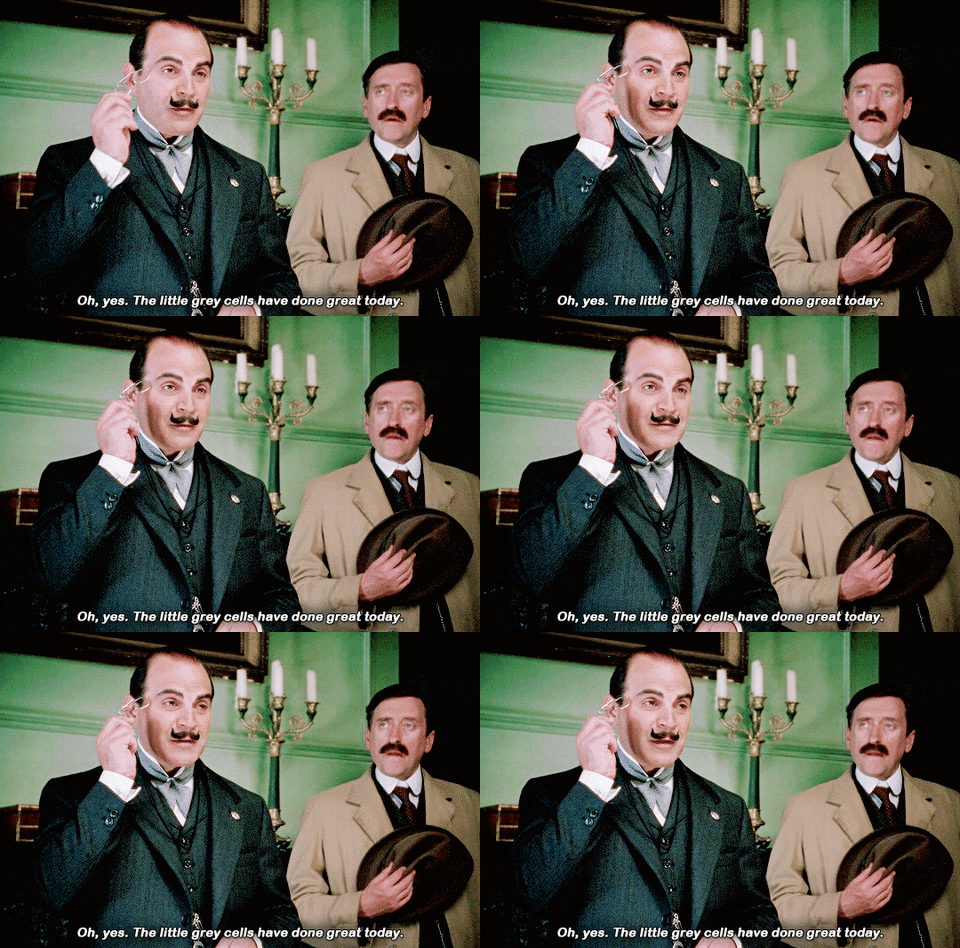
Hercule Poirot and Captain Hastings are on holiday at the opulent Grand Metropolitan Hotel in Brighton, where they meet the wife of a wealthy stockbroker. As they discuss the jewels worn by Mrs. Opalsen, the great detective relates his experiences in cases which have concerned some of the best-known jewels in the world. Excited by his anecdotes, the wealthy matron eagerly offers to show him a very expensive pearl necklace, but when she goes to retrieve it, she discovers that it has been stolen...
Dame Agatha Mary Clarissa Christie, Lady Mallowan, DBE (née Miller) was an English writer known for her 66 detective novels and 14 short story collections, particularly those revolving around fictional detectives Hercule Poirot and Miss Marple. She also wrote the world's longest-running play, the murder mystery The Mousetrap, which has been performed in the West End of London since 1952. A writer during the "Golden Age of Detective Fiction", Christie has been called the "Queen of Crime". She also wrote six novels under the pseudonym Mary Westmacott. In 1971, she was made a Dame (DBE) by Queen Elizabeth II for her contributions to literature. Guinness World Records lists Christie as the best-selling fiction writer of all time, her novels having sold more than two billion copies.
This best-selling author of all time wrote 66 crime novels and story collections, fourteen plays, and six novels under a pseudonym in romance. Her books sold more than a billion copies in the English language and a billion in translation. According to Index Translationum, people translated her works into 103 languages at least, the most for an individual author. Of the most enduring figures in crime literature, she created Hercule Poirot and Miss Jane Marple. She atuhored The Mousetrap, the longest-running play in the history of modern theater.
Hercule Poirot and Captain Hastings try to solve the case of the missing pearl necklace of Mrs. Opalsen. She apparently finds out about the missing jewel only when she tries to show it to Poirot. Who has actually stolen the necklace? Will Poirot be able to solve this case? Agatha Christie will give you the answer to it in this book.
Hercule Poirot is invited to the Grand Metropolitan Hotel in Brighton by Captain Hastings. While they are there Poirot meets a lady whose necklace is later stolen. It's up to Hercule Poirot to solve the crime.
Did the French maid make off with Mrs. Opalsen's pearls? Nah. That would be too easy, right?
When Poirot and Hasting run into a wealthy couple who have a love for jewels, they also run into sneaky-ass jewel thieves. Can they stop them before a (maybe?) innocent woman goes to jail for a crime she didn't commit? Well, if Poirot is on the case, then the answer is yes.
This was first published in 1923 in The Sketch magazine as The Curious Disappearance of the Opalsen Pearls. In that same year, it was published in the US in The Blue Book Magazine under the title Mrs. Opalsen's Pearls.
IMHO, a wonderful short story. SYNOPSIS: "Hercule Poirot and Captain Hastings are on holiday at the opulent Grand Metropolitan Hotel in Brighton, where they meet the wife of a wealthy stockbroker. As they discuss the jewels worn by Mrs Opalsen, the great detective relates his experiences in cases which have concerned some of the best-known jewels in the world. Excited by his anecdotes, the wealthy matron eagerly offers to show him a very expensive pearl necklace, but when she goes to retrieve it, she discovers that it has been stolen…"
‘The case is not over, my friend. It will not be over until we find out who stole the pearls.’
Hercule Poirot can't even go on an impromptu vacation without being recognized immediately, leading to being commissioned to recover some pearls stolen. The case isn't as simple as it originally appears however, and Poirot doesn't give up until the culprit is found and arrested, in addition to recovering the pearls.
Recommended as a fun read of the thieves' method.
🌟🌟🌟 [Half a star for the premise; Half a star for the characters; 3/4 star for the plot; Half a star for the world-building; 3/4 star for the writing - 3 stars in total.]
Average, as usual, but there are two facts which I didn't like: the probability of a theft just under Poirot's eyes and his rudeness regarding Hastings. This little fellow is sometimes no more than a pricked cock. But that is part of his charm...
A very satisfying short story. As always Poirot saves the day by using resourcefully his grey cells. This is an older short story, Poirot is younger and in his element when a mystery is presented to him.
The Jewel Robbery at the Grand Metropolitan is a Hercule Poirot short story first published in The Sketch magazine in the UK on March 14, 1923. The original title was "The Curious Disappearance of the Opalsen Pearls.'' In 1924, the story was published in the US as "Mrs. Opalsen's Pearls.''
In this second Poirot short story, the dapper Belgian is called on to help investigate the disappearance of a pearl necklace. Somehow the necklace was stolen right under the nose of Mrs. Opalsen's maid. Poirot sets out to prove how it was done, hopeful that he can recover the stolen property.
I'm enjoying these short Poirot stories. The characters aren't fleshed out and the plots are simple....but each is only a few pages long, so brevity is a necessity. The mystery and its solution are the goal....not the characters themselves. The tales are bare bones, quick reads....a flash of Poirot's magnificent little grey cells and done.
All in all, an entertaining short story! I've read a lot of Christie's novels over the years...but never read any of the short stories. I'm reading the text for each story in ebook format while listening to the audio just because I love hearing Poirot's dialogue in his accent. In this case, the narrator for the story was not David Suchet, but Charles Armstrong. Armstrong did a very good job! I'm reading text and listening to audio at the same time for the novels as well....but for different reasons. I have come across several newer editions of Christie's books that have a disclaimer about "editorial edits'' being made. I was very curious about those edits....so I'm reading the text in my older paperbacks while listening to unabridged audio from a newer edition.
The television series Agatha Christie's Poirot starring David Suchet as Poirot did an episode based on this short story (Season 5, episode 8). The episode follows the basic plot, with a few changes and additions to stretch it to fill a 45 minute episode. I streamed the episode on Britbox, but you can find it on YouTube as well.
The Publisher Says: Hercule Poirot and Captain Hastings are on holiday at the opulent Grand Metropolitan Hotel in Brighton, where they meet the wife of a wealthy stockbroker. As they discuss the jewels worn by Mrs. Opalsen, the great detective relates his experiences in cases which have concerned some of the best-known jewels in the world. Excited by his anecdotes, the wealthy matron eagerly offers to show him a very expensive pearl necklace, but when she goes to retrieve it, she discovers that it has been stolen...
My Review: Another 99¢ Kindle Single and fifth season episode of Agatha Christie's Poirot.
The story is a simpler version of the same basic caper tale the episode tells. The pearls are part of a costume drama produced by the amusingly named Opalsons, a theatrical couple on their uppers and using the famous Russian pearls to promote their crap show.
The theft is tempting Poirot to forget the doctor's orders that he take it easy at the seaside. He's stressed and needs time off. And now there's a tis-was over incredibly valuable pearls stolen from under the nose of the ladies' maid after the opening of the crummy play that Opalson used Poirot to help promote? Ha! Game on.
What a lark, and how different from the story. I think the criminals are the same in both versions. I truly enjoyed the enriched tale in the episode. Fun!
4 Stars. Is 'The Grand Metropolitan' of the title, in reality, 'The Grand Hotel' in Brighton, south of London on the English Channel? Built in the 1860s and still standing in all its expensive glory? It was the site of the IRA's assassination attempt on UK Prime Minister Thatcher in the 1980s. This Canadian colonial has never been to Brighton, but the description in Christie's 'The Jewel Robbery ..' is attractive! The twenty page short story was first published in 1923 and I read it in a collection titled 'Poirot Investigates.' Hastings believes our master detective needs a rest and he has money to burn so, "A weekend at the Grand Metropolitan would do us all the good in the world." Poirot accepts. The hotel dining room was filled on Saturday evening with, "All the world and his wife!" Many marvelous dresses and magnificent jewels on display! The two strike up a conversation with Mr. and Mrs. Opalsen, and she insists on getting her necklace, the pearls are so perfect in colour, to show Poirot. But it's gone! The police and Poirot investigate. How could it have been stolen when her maid, Celestine, was in that very room all the time? Or was she? (Au2020/May2025)
Very short but effective! Too short to rare. I think I liked the show better than this short because it was more developed (probably merging 2 stories). Still fun
As a type of person who tends to dig into all kinds of hints and foreshadowing--even when the work doesn't really have any mystery--I didn't find this story that much enjoyable. An "alright" definition would serve it the best.
The solution was somewhat obvious, although the felt like a twist the readers weren't supposed to guess due to the lack of some crucial info. For that reason, this story is more of a treat rather than a mental exercise. Unfortunately, I'm not a fan of the former.
Detective Hercule Poirot is with his friend Captain Arthur Hastings at the Grand Metropolitan Hotel when a wealthy matron's pearls go missing in The Jewel Robbery at the Grand Metropolitan by author Agatha Christie.
I've read very little of Christie's work (so far, at least) and haven't done so since my adolescence. But I was in the mood for a good old-fashioned mystery, and though I do read murder mysteries from time to time, I more often look for mysteries that aren't about murder.
And since I didn't have much time, it was the perfect occasion for an entertaining short story.
No, I'd not read anything about Poirot and Hastings before, but that didn't make this any less enjoyable. The robbery case has just the number of twists to keep it interesting and all of the cleverness and the quirky-and-proper kind of humor I was hoping to find here.
I'm sure I'll be reading more about Hercule Poirot, likely sooner than later.
Poirot really is the King of the Humble Brag, isn't he? I just adore him. This was a great story, much less complicated and flashy when compared to the television adaptation. Christie is a really no-nonsense (unless it is humorous nonsense, usually at her own expense) sort of writer. And yet, she can take a crime that seems so simple or ordinary and make a wonderful story out of the solving of it.
As always, Agatha Christie uses brilliantly minute yet obvious once its pointed out details that reveal who the culprit is. It is highly admirable how she constantly brings new, yet no less clever, angles to her mysteries. I loved how Poirot knew that the chambermaid was behind the robbery and was not a real maid because the adjacent room to the crime had not been properly dusted. The text pointed out that the furniture had a thin layer of dust but I did not make this connection. As usual, Poirot noticed details that went over the reader's head. I love that Christie is still able to surprise me regardless of how many of her stories I read.
My biggest complaint for this story is how all the action happened off page. We witnessed Poirot briefly investigate the robbery, but then he developed a hunch and left for London, leaving our narrator Hastings alone at the hotel none the wiser about whodunit. We follow Hastings go out for lunch, meet up with some old friends, and putter around on his own while waiting for Poirot to return. Finally he finds the detective again only to be told that the case is over. Poirot proved his hunch, called the police, and the culprit was already revealed and arrested. It felt like we missed the payoff since the best part of a mystery is the grand reveal and takedown of the bad guy. Poirot summarized how he put the pieces together and called Inspector Japp, but this had the same effect as when I DNF a book and ask someone who finished it to relay what happened to me. I felt removed from the resolution and denied what the entire story was building towards. This made it a deeply unsatisfying ending and I would have been more annoyed had the story not been so short.
The other criticism to note is how the characters kept referring to Mrs. Opalsen as fat. They must have said this word half a dozen times in a 35 minute audiobook. Sure, this story was first published in 1923 when times were different, but it was still irritating and unnecessary to hear the character defined primarily by her size.
Overall this story was as clever as readers expect from Agatha Christie and brought the usual joys of reading her books. I especially enjoyed the short length of this installment since it was delightfully bite-sized. I felt deprived of the best part of the mystery when the resolution happened off page, so this was not the Queen of Crime's best work, but it was still a solid mystery and returning to these characters is always a good time.
This entire review has been hidden because of spoilers.
Another clever short story. I had originally thought that the husband was responsible since he made that comment about needing money but of course I was wrong. I enjoyed the more relaxed atmosphere between Poirot and Hastings since they were away from their normal surroundings for a weekend holiday by the sea.
2026 re-read: While on a weekend getaway, Poirot and Hastings help a woman who had her pearl necklace stolen from her room. Both the woman's own maid and the hotel chambermaid are suspects and the maid is arrested when the police find the string of pearls under her mattress. But Poirot knows that those pearls are fake and continues investigating. He figures out that the chambermaid and the valet were in cahoots. The chambermaid took the jewelry box out of the drawer when the maid had her back turned and passed it to the valet in the next room via the connecting door. Once he took out the pearls, he passed the box back when the maid was distracted and the chambermaid returned the box to the drawer.
This entire review has been hidden because of spoilers.
Not a bad short story, the crime and solving were interesting enough, however it was hurt by being what it is—short. I liked the idea that Poirot is so well established now that even when Hastings takes him on a weekend get away he’s immediately recognized and needed to solve a crime. Also, I’m pretty sure Christie remarks that Hastings “knows nothing” in every single short story she writes.
Captain Hastings invites Hercule Poirot to Brighton and the Grand Metropolitan Hotel for a weekend. While talking to a wealthy stockbroker and his wife, Mrs. Opalsen, she insists on showing Poirot a pearl necklace only for it to have been stolen. Poirot is asked by Mrs Opalsen to discover her necklace. An enjoyable short story mystery
Definitely didn't guess the ending, but I feel like she could have done better, it was a little bit confusing, kind of boring, and one of the suspects doesn't even really come into it so why suspect them when you haven't really introduced the reader to the character? But other than that, enjoyable.