From the pages of Neil Gaiman's multi award-winning Sandman series...Cast out of heaven, thrown down to rule in Hell, Lucifer Morningstar has resigned his post and abandoned his infernal kingdom for the mortal city of Los Angeles. But retirement means only opportunity for Lucifer's many and varied enemies, all of whom have bitter and long memories, and it's going to take more than quick wits to survive the coming storm. As Lucifer bids to reclaim his lost wings, so his mortal vulnerability is revealed, and from the grim tapestry of his past the agents of chaos gather, ready to feast on his damned soul!
Librarian Note: There is more than one author in the GoodReads database with this name. See this thread for more information. Mike Carey was born in Liverpool in 1959. He worked as a teacher for fifteen years, before starting to write comics. When he started to receive regular commissions from DC Comics, he gave up the day job.
Since then, he has worked for both DC and Marvel Comics, writing storylines for some of the world's most iconic characters, including X-MEN, FANTASTIC FOUR, LUCIFER and HELLBLAZER. His original screenplay FROST FLOWERS is currently being filmed. Mike has also adapted Neil Gaiman's acclaimed NEVERWHERE into comics.
Somehow, Mike finds time amongst all of this to live with his wife and children in North London. You can read his blog at www.mikecarey.net.
This volume has two storylines in it and is a bit longer than volume 1. The first part is The House of Windowless rooms, which I love for a couple of reasons. First, I love how this series seamlessly blends all different types of mythology together and how there are many different gods and pantheons and afterlives and it's cool to get our first real glimpse of that here. Second, I just love when people underestimate Lucifer - either because he is temporarily powerless for some reason or because they're just that fucking stupid - because it always means they are going to get their asses handed to them in the best and most satisfying way.
The second storyline is Children and Monsters, and it really starts setting up the plot that will carry us through the entire series. It continues with Elaine's story and also introduces Michael and some great one-off characters. I like how there's always like 2 or 3 simultaneous threads going at once because it keeps things interesting and really shows how well planned out this series is right from the start. If it was just all about Lucifer all the time I think it would get old pretty fast no matter how amazing he is, but fortunately this series has a really great extended cast. Even characters that are only there for an issue or two feel like real well-rounded characters and stick with you after you've finished reading.
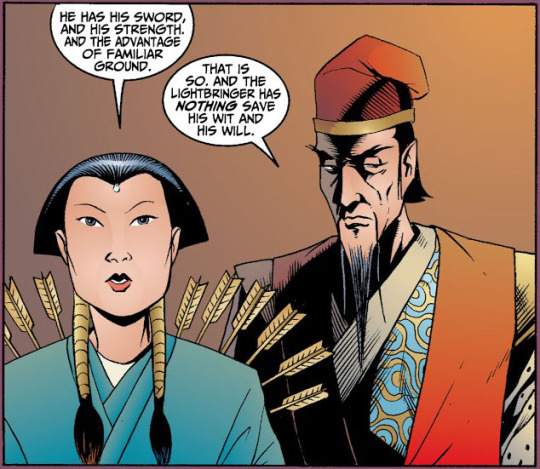
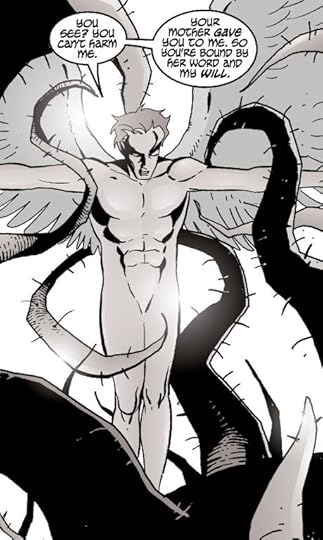
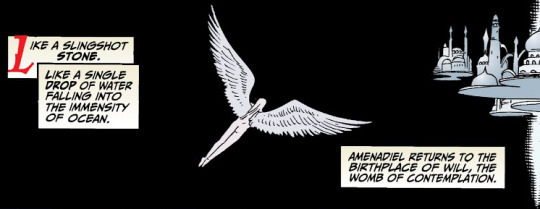
Continuing my documentation of every place that 'will' is talked about, a few less than last time but still very much present in the overarching plot:
And on my fifth reread I actually caught one that I missed last time so have that as well:
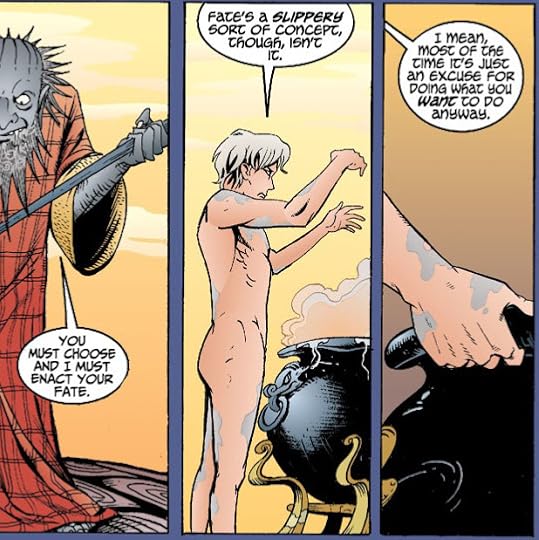
I figured fate is kind of like ...I don't know, the antithesis of free will most of the time I guess, although Lucifer has certainly turned that around to serve his purposes instead:
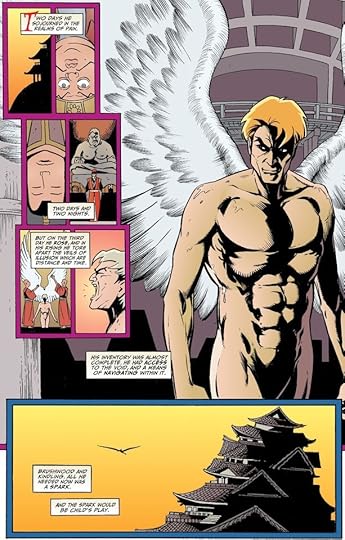
I just really like this page:
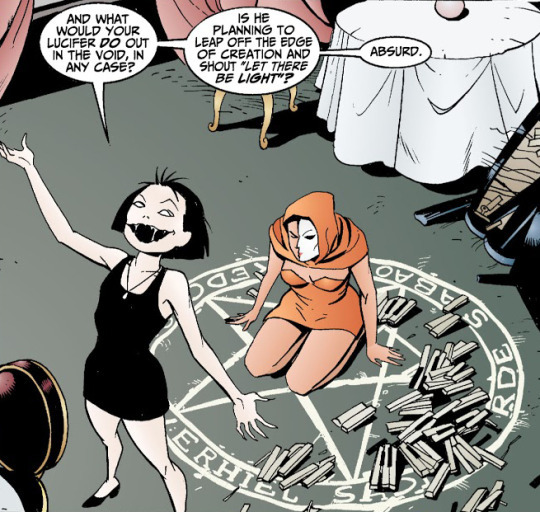
This I love because Jill pretty much just breaks down all of his character flaws in one sentence and he's just like 'yeah, what about it?'. At least he's self-aware lol
And then this is one of my favorite quotes from this series, and also very indicative of things to come:
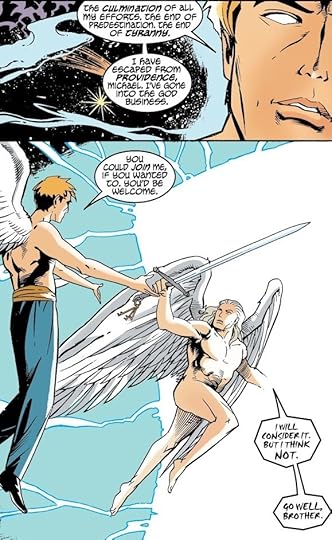
Really love this as well, since that's exactly what he ends up doing!
Lucifer @ Michael: Don't you ever get tired of being nice, don't you just want to go completely batshit?
The House of Windowless Rooms This is where all the cool gods and foreign dimensions begin to come in that make this series so interesting. As we see here, underestimate Lucifer at your regret, even when he's at his most vulnerable. I love how manipulative Lucifer is. We also get to see what's behind Mazikeen's mask.
Children and Monsters This is where Carey really begins to set up the story that will carry through the end of the series. Carey is excellent at planning ahead and building stories atop stories. It's what make this series so satisfying.
This book also gives us the art team that will carry through most of the rest of the series. Peter Gross and Ryan Kelly with Dean Ormston filling in between the bigger arcs. Mike Carey and Peter Gross establish a creative relationship that carries over the next 20 years to The Unwritten, The Highest House, and now The Dollhouse Family.
Something I forgot to mention in my review of book one that bears note.
This series does a masterful job of interweaving mythologies. In just the first couple books, you get Judeo-Christian, Navajo, Sumerian, Japanese, Norse....
If you're a mythology geek like me, it's lovely. It's everything I love woven into something new and strange and lovely.
I read the first Lucifer tpb quite a while back; it didn't do too much for me either way. It didn't seem to be much beyond the rather cutesy premise of making Lucifer and Mazikeen open a nightclub in LA. This volumes seems a lot more epic, cosmic even, and I do like my horror-oriented narratives to have a cosmic touch. Carey begins building his own universe for real here, even if he uses loads of elements from Gaiman's. In fact, considering what happens by Volume 3 it's tempting to think that Carey is to Gaiman as Lucifer is to the Lord of Hosts. A couple of fascinatingly twisted subplots weave around Lucifer's mysterious maneuvers, and an angelic army attempts to launch a war against Lucifer.
I like Carey's take on Lucifer. He is definitely diabolical - a shrewd, deep schemer who will use you for all you're worth in a long-term game that don't even realise you are a pawn in. He is Satanic without descending to the level of a pantomime devil - that sort of behaviour is reserved for several of the lesser demons, gods and other entities he deals with.
The story itself is sufficiently complex and I am not yet sure what stakes Lucifer is actually playing for, but there is enough of a payoff in various subplots and enough intrigue to keep me hooked for the moment at least.
When a spark of plan ignites in the mind of God’s former lamplighter, there’s nothing that can stop him from incinerating it to action. That’s what’s proven in the second volume of Mike Carey’s The Sandman spin-off, Lucifer: Children and Monsters.
After coercing the Basanos (a magical deck of tarot cards created by the angel Meleos) to give him a reading, Lucifer moves to execute a clandestine scheme. Heaven has given him a “letter of passage”, the payment for his last cleanup job in Devil in the Gateway. He turns the letter into a portal to the Void, the vacuum outside existence that is not under control of anyone—even of the heaven. This new creation attracts unwanted attention, and as we move further, we realize that Lucifer does not want to play neutral or wallow in the easy luxuries of the mortal world anymore… and we’re given a glimpse of his proud heart that caused his Fall.
Children and Monsters is a good follow-up to volume one, as Carey is now beginning to cook up a very intriguing, plot-driven story. In retrospect, Lucifer had magnetized attention by abandoning his realm; he did it again, but this time by creating a new territory. As it is in Sandman, various mythologies are beginning to incorporate themselves with the story. I find the Japanese pantheons of the Afterlife fascinatingly grotesque, and I’m simply in awe about the new things I’m learning from here.
The series is becoming more and more reminiscent of The Sandman series, only this time with Lucifer in the shoes of Morpheus. In that setup, we can that these characters are poles apart. In Season of Mists, Lucifer gives Morpheus the key to Hell and the dream lord’s new ownership attracts attention from different realms; likewise in The House of Windowless Rooms issue, where Lucifer opens the void and all sort of beings want to have access to it. Morpheus goes to Hell in Preludes and Nocturnes to get his helm of office back; in THOWR, Lucifer goes to the desert-like Japanese version of inferno to collect his wings. Note that both things possess power that is significant to their owners. There are stunning episodes of contests of wit in both graphic novels where the protagonists win, closing with the defeated swearing to destroy the winner. We all know what happened to The Sandman. Somehow, I want Lucifer to survive what the Japanese pantheons have in store for him in the end.
There are a lot going on in this volume like Mazikeen losing her demon half-face; the appearance of the archangel Michael, Lucifer’s brother; involvement of a girl with an important parentage; and ultimately, Lucifer’s first steps in defying predestination.
I hope this series gets better, or the next volume will be on par with this volume. :D I’m beginning to love it.
This hefty volume of Lucifer has two major threads and some minor narratives that run parallel.
The first thread is The House of Windowless Rooms. After the events of Vol. 1, Lucifer obtains a letter of passage from heaven to pass into Japanese afterworld, Izanami, to reclaim his wings. Lucifer encounters scheming gods, demons, and other supernatural beings.
In the second thread, someone is stealing unborn children in order that they might turn them into archangels and storm the gates of heaven.
This series has a complex mythology with so many characters, it’s a bit of a challenge to balance everything in your mind. It definitely requires effort. These ain’t your grandpa’s comics.
Lucifer in mortal peril, among a pack of deceitful and clever Japanese gods? Yes, I think this is what's required to give us a sense that our anti-hero is actually in enough danger to make the read worthwhile.
And even better, while Lucifer has abandoned his HQ with a tempting target, all manner of threatening folk come skulking about to take it over? Hmm, maybe Carey was just having a little first-book jitters in the last volume and now he's finally found his feet.
As the first storyline comes near its climax, Carey teases us with three or four storylines, each teasing out a couple of pages at a time and then switching to the next. Letting us know there's some further torment or reveal just out of reach. This is the same technique Tolkein used in his LotR to heighten and stretch out the drama, and it works just as well here.
The second storyline was agonizing to read - I don't mean in any pleasant way, but that it took me at least six sittings to get through it, and each time was a chore to will myself to face the book once more. The story itself was slow as molasses, with very little tension and just a lot of langorious thoughts spilling from many heads and mouths. It sure didn't seem to be leading anywhere in particular, nor did it capture my imagination (even despite the little throwaway lines that Carey conjured in the ways that these weird creatures spoke to each other).
The final climax was a little too short for all the power that was drawn together all at once, and while the way it resolved was rather clever and unexpected, right now only ten minutes after finishing it, I'm pretty sure it wasn't worth it.
I'm so conflicted over this story - I've enjoyed others of Carey's works (Hellblazer, X-Men Legacy) and I've appreciated his approach to exploring characters. For some reason, here I'm dying for him to really let Lucifer loose and he's doing everything in his power to use Lucifer's abilities as little as possible. It's supremely frustrating to me, and while I can see what he's doing from a craftsmanship point of view, it's not really any easier for me as a reader to enjoy him dragging this out and torturing me. Perhaps if Carey took the Heaven-versus-Lucifer battle off the table permanently, it would be easier to enjoy the meandering journey this is taking.
I'm going to take a break from this series - focus on other stuff that gives me more immediate gratification. I'm sure I'll regret it and come back to Lucifer soon enough, but for now I need to reconcile my frustration with the different kind of storytelling.
Mike's synopsis - plot points I need to remember for later volumes:
I liked this volume better than the first one, though I'm still not a big fan of the series yet. The individual storylines didn't feel terribly complete in and of themselves. (Is there a word for the books within the books that they do in comics? Like how this one had The House of Windowless Rooms and Children and Monsters.) But I finally started to get a sense of where the overall story arc is going, or at least that it's going somewhere, and it's intriguing me a bit more. Enough that I do want to get the next volume. So far it was still just kind of interesting, and kind of a lot of work to plow through, but it wasn't fun yet. I did like that it again included mythologies other than the Judeo-Christian that I expected, that was interesting. And the art was an interesting change too. I thought I didn't like the art in the last book that much, but it turns out in hindsight that I prefer it. I liked some of the images I remember a lot, like the stuff with the tarot cards. I'm a fan of Peter Gross's art from the Fables series, so I should have liked the switch to his work here. But I don't think it worked that well for this series, I preferred the grittier, darker, less polished, less pretty work that was in volume one. The colors here were much too bright, the demons were too pretty, things were too round, too soft, too cute. It's not a deal breaker or anything, I just didn't find Gross and his team to be a good match for Lucifer or the story. I think the art should have been darker, edgier, cooler.
Contains the arcs: The House of Windowless Rooms + Children and Monsters.
The House of Windowless Rooms: Lucifer hasn’t really been challenged in the previous arcs thus far, so to see him at a physical disandvantage and having to use his guile and cunning to outwit his enemies at each turn is very absorbing. Seeing more of Mazikeen and Jill and learning more about their powers was fun.
Children and Monsters: Another fantastic arc. Mike Carey takes the flavour of Sandman, adds a dash of treachery and a whole lot of good plotting. I love that every arc so far builds upon what was established in previous ones. Elaine is my favourite character so far.
جلد دوم شامل کامیکهای شماره ۵ تا ۱۳ هست که دو آرک داستانی داره که البته متصل به هم هستن. از لحاظ داستانی بهتر از جلد شماره ۱ بود، وقایع بیشتری اتفاق افتاد و میزان باهوش بودن و cunning بودن که امضای لوسیفر هست رو بهتر از جلد قبل دیدیم، خیلی خوبه رفتارهاش. به نظر chaotic میاد اما داره میدونه چیکار میکنه و روی لبه تیغ جوری میرقصه که انگار ترسی نداره و بینهایت از خودش و تواناییهاش مطمئن هست و خلاصه خیلی خوب بود طراحیها و رنگها هم، البته توی طراحی چهره خود لوسیفر، فعلاً مال جلد ۱ رو بیشتر دوست داشتم و لوسیفرتر هست اونجا :دی حالا در انتها به لیست درست میکنم که از کدوم کار طراحی لوسیفر بیشتر خوشم خواهد اومد.
(Zero spoiler review) 4.75/5 Forgive me, but I'm much further along in this series than these reviews would indicate, and have just read the most touching page. I have been jealously guarding this series before finally committing to reading it, for it can only be read for the first time once. Had I know it would turn out to be THIS good, I don't know if I could have let it sit on the shelf for so many years. This could easily turn out to be the greatest Vertigo series, if not my favourite comic series of all time. High praise indeed, but no less true. It all starts here. 4.75/5
Lepší než první díl, více epický, hlubší,... ale stále mi něco chybí, anebo spíše přebývá. Možná "laciné" pojetí andělů, kdy jejich konec nic neznamená, možná superhrdinské pojetí Lucifera, když nikdy nechybuje a je v podstatě hlavním "klaďasem" i "záporákem" zároveň. Nevím, prozkoumejte a dejte mi vědět.
Now that Carey's gotten the (re)introductions out of the way in Devil in the Gateway, his Lucifer is free to fly - or he will be, once he reclaims his wings from the Japanese goddess of death. That premise alone holds more excitement than the first third of the series's initial volume, and Carey follows it up with a duel with poisoned blades, a giant carnivorous spirit baby, and a full-scale invasion by the heavenly host. Presiding over all the mayhem with a look that might be a sneer if he actually gave a shit is Lucifer, whose debonair savoir faire likely leaves James Bond weeping with envy.
The narrative is episodic, jumping from thread to thread far more frenetically than the last volume, but somehow seeming more cohesive despite that - possibly because there's some payoff for the reader as we begin to divine (get it?) our devilish antihero's plan. Even better than getting to watch Lucifer's schemes begin to fall into place is seeing Mazikeen blossom into a character with her own motivations, ones that may or may not always line up with the Lord of Hell's.
Though a bit slow out the gate, Carey's Lucifer really takes off in its second volume. And I, for one, can't wait to see what kind of trouble he'll land in.
Good Story - Average Art The first one with the Bolton art was better, but still, the story makes it a worthwhile read.
« Picking up where LUCIFER: DEVIL IN THE GATEWAY ends, this trade paperback has Lucifer continuing his plans for a new revolution as he attempts to reclaim his wings from a hell not his own. And as this mission ends, Heaven, Hell and Earth all quickly feel the repercussions. Suddenly old enemies and allies such as the cabaret star Jill Presto, the hybrid angel Elaine Belloc, and the living Tarot deck known as the Basanos cross paths with Lucifer as he draws closer to the apocalyptic showdown that he desires and its resultant new chapter in the history of creation. »
Original review (still stands) : From the pages of Sandman comes the on-going saga of everybody favorite lil' devil, Lucifer. Yeah, I liked this book. I just wish this series had been given a better format, such as a Deluxe Hardcover, or, at the very least, better paper.
You know, I never though I would give two stars to a Mike Carey book, especially not Lucifer, but here we are...
A friend calls it the Lucifer Loop: having read Lucifer a long time ago, you remember how cool it was, and go back to reread it. Rereading it, you realize it is not that good, especially in the beginning when it takes forever to get to the point. Then you get to the good parts, around the middle of the series, that somehow seem to obfuscate the grind you endured to get to those parts. And then, a few years later, you think to yourself "man, Lucifer was cool; I should reread it." And you realize... Well, rinse and repeat.
I struggled with this volume, almost from beginning to end. And I really shouldn't have, this being a Carey book illustrated by Kelly and Ormston, whose work I absolutely love. But struggle I did, especially with the whole origin of Elaine Belloc (while most segments with Elaine are pretty fun). The Sumerian priestess bit was actually one of the best parts - powerful, visceral and to the point.
If I had to describe the broader feeling, though, it's as if Lucifer himself is bored in his own series. I am not terribly optimistic about volume 3 either, but I will keep going.
Lucifer puts his plan into action, and it's a doozy. But then he needs to visit one of the Japanese Hells, where he has no powers (being from a different religion as he is) but where he needs to recover his lost wings from the ruler of that realm. And that's only the beginning.
Carey and main artists Gross and Ormiston takes us through both mystic and mundane realms, sometimes at the same time. Magical beings and humans are being drawn like moths to a flame to Lucifer's piano-bar Lux, wherein Lucifer's grand plan unfolds. Hosts of angels plan a massive attack on Lux, with Los Angeles itself caught in the crossfire. And for some reason, a little girl who can see dead people is a major part of Lucifer's plan.
This second volume of Lucifer's wacky adventures also gives us an ancient and horrible curse, the fate of the Sumer-Babylonian gods (who are themselves weirdly and creepily rendered), and the further unfolding of Lucifer's plan. The archangel Michael, the fallen angel Sandalphon, and a variety of other gods and monsters also make appearances, including a particularly nasty pair of proto-Djinns who really, really want to get out of the 'normal' universe they've been trapped in for millennia.
I think I liked this trade paperback even more than the first. So much imagination went into making this--the Japanese underworld is a good example, I really loved that as a setting. Musubi was an especially fun character from that realm.
There were a lot of plot threads going on here, and I actually liked how much and how abruptly the stories switched, it kept things interesting. The entire trade was sitting-on-the-edge-of-your-seat enthralling.
The main criticism I have is that some of the major plot points are not explained very well. This seems intentional--maybe to allow for more creative freedom in future issues? Maybe to give the story an air of mystery? Maybe to leave room for the reader to add their own interpretation to the work, making it more personal? Who knows. One other negative for me is that I don't really like the illustration style of Dean Ormston, so the pages he illustrates kinda break me out of the story.
This is the first Lucifer comic I read, finding it at the store and being SO EXCITED to find something that appeared to feature my favourite character from Sandman. (I did read Sandman out of sequence as well, and while it fuddled the plot somewhat, I never actually found it to be confusing - or to lessen my enjoyment of the comic.) I loved it then, I love it still, but the first arc is one of the Lucifer stories I enjoy the least (The House of Windowless Rooms). Bit too gory, and the Japanese pantheon holds no interest for me in this particular form. The second arc, where Elaine's origin (despite her protests) are revealed, is a damn treat, though. Also, Mazikeen goes off on her own! (I mean, I totally ship her and Lucifer, but they only work for me when they are no slightly more equal footing.)
Amenadiel, you still need to die, you stupid prick.
3.5 stars Lucifer carefully and cleverly prepares for an assualt from the Heavens. This is the last volume of the Lucifer I'm going to read. I really enjoyed this book, it just has its limitations. There are no real stakes, Lucifer as a character is ambigiously neither good nor evil, the outcome is a given from the start and the rules are made up along the way.
On the plus side, it is a well crafted story that builds nicely. The plot is interesting, the artwork is varied and great, the world it is set in is cool and Lucifer is a good protagonist. Enjoyable or not, two volumes in the series already feels repetitive.
It's Book 2 and things are really starting to heat up for Lucifer in this one: as he places his pieces on the board, other forces position themselves to get what they want from the Morningstar - one way or another.
I've started this right after completing the Sandman series - the amazing comic book series penned by Neil Gaiman, and from which our main character is from; to be perfectly honest, when I began I was not sure if this series would be able to meet my expectations set by the Lord of Dreams, in terms of complexities. I'm ecstatic to say how surprised I was that this volume exceeded all expectations and then some. I can't wait to start the next.
Tak tenhle Lucifer, ten je libový. Po všech stránkách. Světlonoš je zde konečně takový, jaký by měl být. Vznešený, sobecký, nelítostný, lstivý a zatraceně chytrý. Kniha “Děti a monstra” má moc dobře vystavěný příběh. Vyprávění je celkem přímé, bez skrytých narážek a nevyřčených point, které by vedly k domýšlení a dohadům, co tím autor vlastně myslel. Za to jsem rád. Příběh je vyprávěn v několika souběžných dějových linkách, které se dříve či později protnou a všechno do sebe krásně zapadne. Navíc jsou zde všechny postavy, které jsem si oblíbil v první knize. Bavila mě i výtvarná stránka. Jak kresba Petera Grosse, tak i kresba Deana Ormstona. Oba jsem si již dříve oblíbil v jiných sériích.
Lucifer ma poriadny plan a vsetko co robi ma urcity ciel. Najprv si zasiel pre kridla do sveta bohyne smrti, otvori portal do nicoty a potom pripravuje obranu pred armadou anjelov. Na konci knizky to pekne zapadalo do seba a aj udalosti z neskorsich kniziek mi uz davaju zmysel. Konecne mam v rukach celu seriu a mozem to sfuknut v chronologickom poradi.
Ok, fine, I admit it: This is an excellent series and everyone should go read it. That's all.
(Also, I'm watching the TV series right now and I think it's hilarious that it should be called an adaptation at all, when the characters themselves and the entire tone are completely different between the two works.)