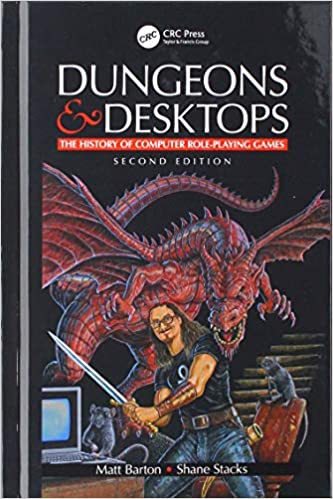
Dungeons and Desktops is a great overview of computer role-playing games from the beginning of the era all the way to when the book was published in 2008. The research required for these summaries must have been staggering, although I'd guess it was fun "research" since the author actually played at least most of the games.
One thing the author does repeatedly that sometimes confused me is referring to games by their subtitles. For instance, he'll make a reference to "The Black Gate" instead of using the full title, "Ultima VII: The Black Gate." When he does this for games I know and have played (like The Black Gate), that's fine. But when he does it for games and series with which I'm not familiar, it's disorienting. I have to either shrug and keep reading, or flip back a few dozen pages and try to figure out what game he's talking about. Beyond that, there were only two things he mentioned that I believe are incorrect. First, when he reviews the Spelljammer game, he refers to it as Steampunk (ugh, no, it's AD&D in space, not some techno-magic mashup... although it is possible the game just presented the universe wrong). Second, when talking about Ultima Underworld, he compares it to id Software's Wolfenstein 3D. Actually, a better comparison would be id's Catacomb Abyss 3D, which featured the same type of realtime graphics, but was released a full year before Wolf (not to mention Hovertank, Interphase, or MechWarrior--all of which preceded even Catacomb 3D). Wolf 3D was a landmark, sure, but it was not the first game with realtime 3D graphics.
The book never mentions GOG.com (granted, I think GOG started in the same year the book was released), but I wanted to mention it in this review. Many of the games mentioned in the book can be purchased, legally, from GOG.com, and every game on there has been updated with emulation so that it will run on your modern computer. Many of the classic series like Ultima, Neverwinter Nights, and Might and Magic can be purchased, some are even available in multi-game packages and a few are totally free. Obtaining and playing most of these games on modern machines should be trivial. If you want the Apple IIe, C64, NES, or Amiga versions of the games, you're on your own. But you can definitely find a lot of the DOS games on GOG.
Overall, this book was an enjoyable read, one that had me making many notes to search for older classics I never played (but should). Not only that, but reading this book has gotten me thinking and excited about making my own RPG. My obscure 1994 CRPG that four people on the planet have played is just begging for a sequel. I might even make the sequel using more than four colors, wheee!