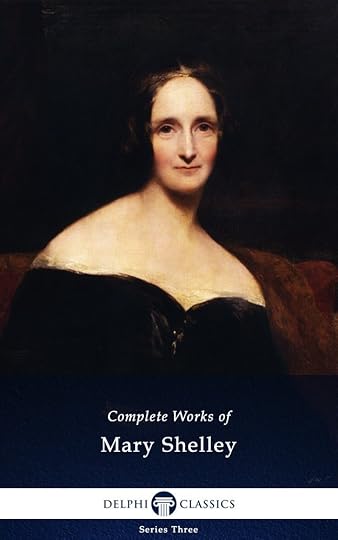
This meticulously edited Mary Shelley collection is formatted for your eReader with a functional and detailed table of contents: Novels: Frankenstein (Original Edition, 1818) Frankenstein (Revised Edition, 1831) The Last Man Valperga The Fortunes of Perkin Warbeck Lodore Falkner Short Stories: The Sisters of Albano Ferdinando Eboli The Evil Eye The Dream The Mourner The False Rhyme A Tale of the Passions; or, The Death of Despina The Mortal Immortal Transformation The Swiss Peasant The Invisible Girl The Brother and Sister The Parvenue The Pole Euphrasia The Elder Son The Pilgrims On Ghosts The Hair of Mondolfo Plays: Proserpine Midas Travel Narratives: History of a Six Weeks' Tour Rambles in Germany and Italy in 1840, 1842, and 1843 Notes to the Complete Poetical Works of Percy Bysshe Shelley The Life & Letters of Mary Wollstonecraft Shelley by Florence Ashton Marshall
Mary Shelley (née Mary Wollstonecraft Godwin, often known as Mary Wollstonecraft Shelley) was an English novelist, short story writer, dramatist, essayist, biographer, travel writer, and editor of the works of her husband, Romantic poet and philosopher Percy Bysshe Shelley. She was the daughter of the political philosopher William Godwin and the writer, philosopher, and feminist Mary Wollstonecraft.
Mary Shelley was taken seriously as a writer in her own lifetime, though reviewers often missed the political edge to her novels. After her death, however, she was chiefly remembered only as the wife of Percy Bysshe Shelley and as the author of Frankenstein. It was not until 1989, when Emily Sunstein published her prizewinning biography Mary Shelley: Romance and Reality, that a full-length scholarly biography analyzing all of Shelley's letters, journals, and works within their historical context was published.
The well-meaning attempts of Mary Shelley's son and daughter-in-law to "Victorianise" her memory through the censoring of letters and biographical material contributed to a perception of Mary Shelley as a more conventional, less reformist figure than her works suggest. Her own timid omissions from Percy Shelley's works and her quiet avoidance of public controversy in the later years of her life added to this impression.
The eclipse of Mary Shelley's reputation as a novelist and biographer meant that, until the last thirty years, most of her works remained out of print, obstructing a larger view of her achievement. She was seen as a one-novel author, if that. In recent decades, however, the republication of almost all her writings has stimulated a new recognition of its value. Her voracious reading habits and intensive study, revealed in her journals and letters and reflected in her works, is now better appreciated. Shelley's recognition of herself as an author has also been recognized; after Percy's death, she wrote about her authorial ambitions: "I think that I can maintain myself, and there is something inspiriting in the idea". Scholars now consider Mary Shelley to be a major Romantic figure, significant for her literary achievement and her political voice as a woman and a liberal.
For only $1.99 you can get just about everything Mary Shelley wrote, plus a biography of her. So despite what follows, I wouldn't want to discourage anyone from buying this book because you can't beat the value. There are some gaps and errors in the text, most notably in Lodore, the main character's name is missing and usually there is a gap or an 'L" where Lodore should be but he's a jerk so it doesn't matter.
Well, I have read Mathilda, most of The Last Man, Lodore and Falkner, and I would say, unless you are crazy about morbid, maudlin, pre-Victorian dramatics, best stick to Frankenstein. In fairness, Shelley's post-Frankenstein novels were written to support herself, her father and her son, so perhaps their sensationalism is a nod to popular tastes, rather than artistic merit. These novels are all verbose and dramatic and the plots, particularly Falkner, rely on improbable coincidences. People run into friends and relatives in a manner reminiscent of Jane Austen's juvenile parody in Love and Freindship when Lord St. Clair encounters all of his long-lost grandchildren in an inn.
Mary Shelley's heroes are often based on her late husband Percy Shelley and the poet Lord Byron, and in consequence, her male characters are highly irrational men who, although blessed with intelligence and wealth, squander their lives and the good they might do for their fellow-creatures through stupid decisions and ridiculous overwrought emotionalism. We are asked to admire and pity Falkner, for example, a man who kidnaps the woman he loves, terrifies her, buries her body on the beach after her accidental death, hides the fact of her death from her family, leaving her little son to grieve for years--we are asked to admire Falkner because he suffers guilty torments for what he did, although he never finds a moment to send the widower a note telling him where his wife is buried. There is much semi-autobiographical material in Mary Shelley's novels and I suspect that here she is working through the death of Shelley's first wife, Harriet, whom Shelley abandoned to elope with Mary. Yes, Harriet killed herself in despair, but Shelley didn't actually murder her, after all. The character Falkner seems also to draw from Mary Shelley's father, William Godwin, particularly in the prison scene where he passive-aggressively lays a guilt trip on his former servant to force him to testify at the murder trial. Throughout it all, Falkner's adopted daughter, the lachrymose Elizabeth, is completely loyal to him. Sure, he spent the first two volumes of the novel saying that he only wanted to die, and now that he's on trial for murder, he wants to stay alive, but whatever.
If the men are contemptible, the heroines are tiresome--they cry buckets, almost constantly, and they unquestioningly devote their lives to the men. In Mathilda, the main character is excessively devoted to her father, because, hey, he showed up in her life after abandoning her and ignoring her completely for 16 years, what is not to adore about that? When he encounters his grown daughter, he falls in love with her--eeewww--and kills himself and Mathilda eventually succumbs to Wasting Victorian Heroine Disease. That's the entire plot, except that a poet called Woodville (Percy Shelley) shows up briefly and is angelic and delightful and wonderful but he can't lift Mathilda's grief. Mary was stricken with deep depression after the death of two of their children and felt alienated from her husband at that time; this aspect of the novel draws from those feelings.
Clorinda, the Italian wife of another character in Lodore, is a thinly veiled portrait of Emilia Viviani, with whom Shelley was briefly infatuated. Mary put up with this and other indignities during their married life. She takes her revenge by allowing the Percy-based character to marry Clorinda, and it turns out the lady is a nightmare on wheels. Mary's half-sister Fanny, who also killed herself, appears in Lodore as well, but just as a plot device, a useful carrier of messages at crucial times, when the heroine and her lover are hiding from creditors. Again, we are expected to sympathize entirely with Edward, who lives beyond his means and won't pay his debts, not with the tradesmen and money-lenders who gave him the money. Alas, he explains to his weeping wife Ethel, "I should have hardened my hands with labour, and earned my daily bread; but I was trained to high-born necessities, and have all of the wide wants and narrow powers of the heir of wealth." (Shelley, for example, bought a carriage and a piano that he never paid for and had to hide out to avoid being arrested for debt.)
The essence of tragedy is the fatal character flaw that brings down the hero, but Mary Shelley's heroes are, for me at any rate, more selfish than heroic. One longs in vain for a sensible fellow like Emma's Mr. Knightley to walk into the story and knock some heads together.
The one aspect I do enjoy about these novels is the careful way characters are introduced with a sketch that describes their appearance and personality: here is an excerpt from a long description of the fair, doomed Alithea: "Her impulses were keen and imperative; her sensibility, true to the touch of nature, was tremblingly alive; but their more dangerous tendencies were guarded by excellent principles, and a truth never shadowed by a cloud."
So I am not going to bother with Valperga, even though the heroine rejoices in the name of Euthanasia and the main character's name is Castruccio Castracani. Had enough.
I read most of these over the past several years but especially enjoyed Frankenstein and The Last Man, which I read to pass the time during COVID captivity. On these two along she is one of the greatest female English language writers of her time and I am glad that there has been more awareness of her Frankenstein, as opposed to the Movie and its spawn. She deserves much more recognition than she has received to date.
Esta edición Kindle está muy mal realizada. Tiene muchos errores y se salta páginas. No recomendable. Aunque la historia de Mary Shelley es genial ⭐️⭐️⭐️⭐️⭐️
Like with many people, I read Frankenstein first, before ploughing into other works of Mary Shelley. I work on the theory of reading the well-known work(s) by an author first, if I like their style, then, I plough into the rest of their works. This was true with Mary Shelley, and, well, what a great surprise this was. There were some works that were in part tough to get through, some of her short stories were wonderfully well written and superbly visual in their descriptions. Then, we come to ‘The Last Man’. At the time of reading, in parts, I did feel it was tough going, a very hard read, however, stick with this book and you won’t be disappointed. The visual descriptions that the story evokes is purely stunning, you follow the trail of mankind’s downfall and trying to deal with their potential demise. For me, this book truly stands the test of time, it stays with you and you look back and think, yes, that was truly a great work to read.
I will admit to not reading the biographies at the end. I am more interested in modern biographies of Mary Shelley, as we now have greater access to information on the author and her eventful, radical life.
Citation: Shelley, M. (2015). Complete works of Mary Shelley (Kindle Edition). Delphi Classics. https://www.amazon.com/gp/product/B00.... Title:Complete Works of Mary Shelley Author(s): Mary Wollstonecraft Shelley (1797-1851) Year: 2015 Genre: Fiction, Nonfiction, and Poetry Length: 5,955 pages Date(s) read: 8/28/25 - 11/9/25 *******************************************************************************************
I’ve owned this collection for a few years, but I finally got around to reading it over the past few weeks. (Thank you Covid.)
I enjoyed the novels, and even the introductions by Mary to her husband’s poems. She was very open and raw about them.
However, there are a few issues with this collection. First, in “Lodore” and “Valperga,” proper nouns are often missing. In both cases, it is the use of the title noun that fails to appear. This is especially confusing in Valperga, because most of the time, the name of the title castle is missing. Since it does appear at times, the reader is left to think that the unnamed castle is a different one that Valperga. Lodore is afflicted by a similar issue, but there it is easier to follow and figure out which character is supposed to be represented.
One highlight is the notes available for “Mathilda,” a novel not published until close to 100 years after it was written. The novel was pieced together from several different manuscripts in several different places, so it’s interesting to see how those who assembled the novel did so, and what choices they made on disagreeing manuscripts, etc. I wish the other novels had been noted, because some allusions are lost to time. It would also be helpful to translate the Latin or Italian in some of the novels, because not everyone can read all the Romance languages.
Still, it’s a valuable collection. Everyone is familiar with Frankenstein, and it’s still her best work. But the others deserve mention as well. Valperga is solid; Lodore may be my favorite non-Frankenstein novel. The Last Man is over-written and depressing, but coming off the loss of three children and her beloved husband, such a story wouldn’t be her best work. Falkner has a lot of autobiography in it, as do most of the novels.
The collection also includes her unpublished plays. They’re short, and explore classical Greek myths. Also the short stories are there, and they seem more in line with Romantic thought that some of the later novels.
The biography is disappointing, but I understand you can’t get a recent biography for a collection like this and still keep it at the same price.
Overall it’s a valuable collection. I’m thankful to have read it.
Not gonna lie Mary Shelley is kinda mid... Frankenstein is a 6/10 and while some of these stories (Guelphs vs Ghibellines, Immortal one) are interesting the rest are just, meh. A bunch of romantic drama that boils down to uninteresting people with 0 common sense or redeeming qualities who seem to think that the best way to show their love for each other is by hurting each other. There is some beautiful imagery and her writing style is at times quite enjoyable to read -words like U M B R A G E O U S.
I have only read Frankenstein as part of my 2018 book challenge covering: * A banned book * A classic * A book that takes you out of your comfort zone I really did find this hard going and struggled with the language. Victor was a horid person, to take all that time over creating the monster and then just discarding him to survive all by himself there was no wonder it turned into the wretched creature it did.
Valerius, The Reanimated Roman: A retrospective look at one life in Ancient Rome and the principles and passions that governed it. Thoughts on what we hold dear in life.