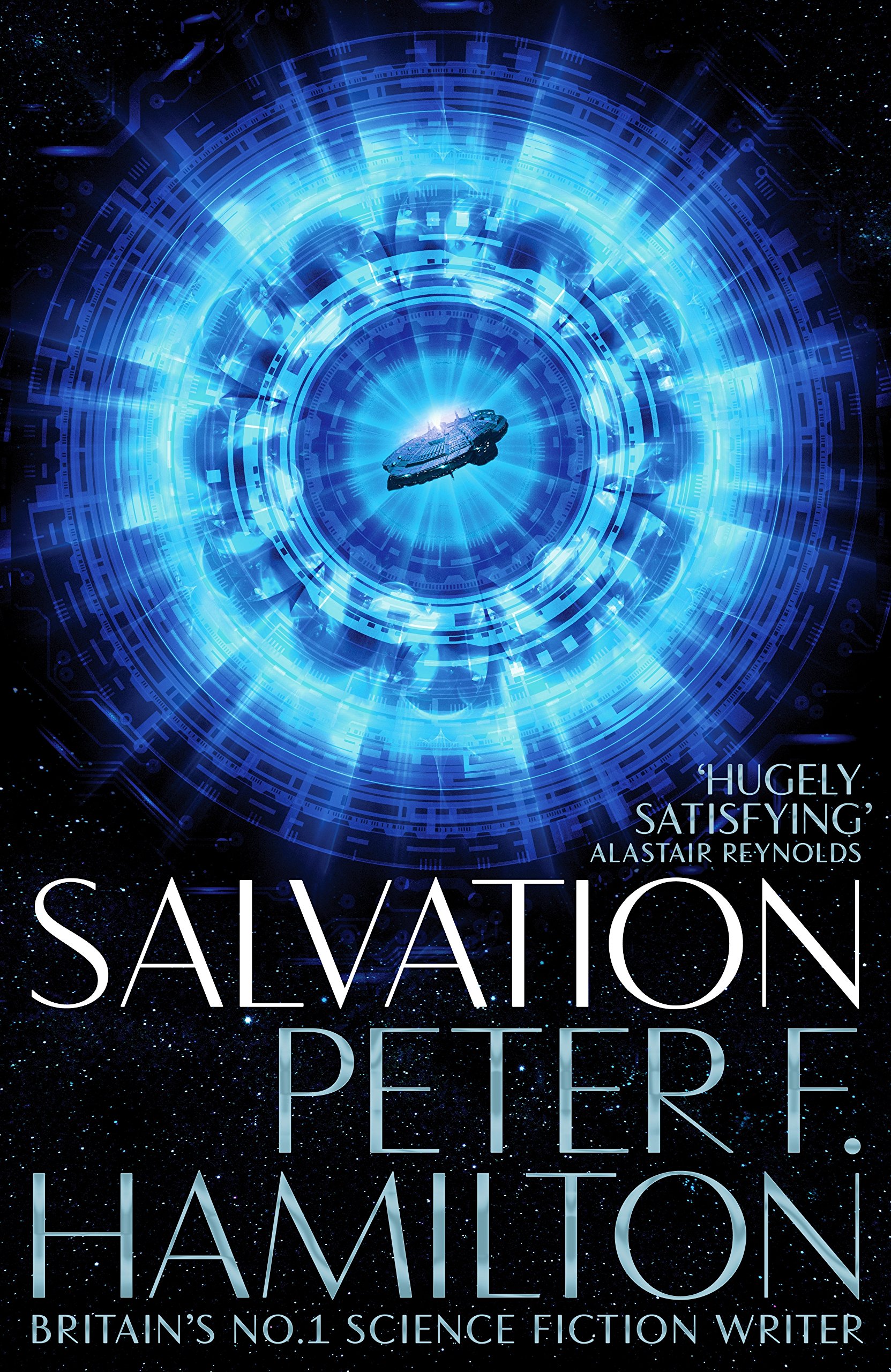
This is my most anticipated release of 2018, and I was extremely fortunate to get an early advance copy. I won’t say much to avoid spoilers, but Salvation was very good – typical Hamilton. It has a similar feel to Pandora’s Star or Fallen Dragon, if anything, but it’s also a very different story. It’s also clearly the first part of a trilogy, which is good, but with the first book issues that come with the territory. Great world building, great characters, intriguing plot – Salvation ticks almost all the boxes.
Full review now below:
Salvation is Peter F Hamilton’s latest novel, the first book in his Salvation Sequence, and a series set in a brand-new universe. After some considerable time (and eight novels) spent writing in his Commonwealth universe, with a slight detour for 2012’s Great North Road, Salvation is a chance to see Hamilton build a setting from scratch with a longer story in mind. As one of the best SF writers out there at doing this, I was eager to see just how it would compare to his previous stories, and what this fresh canvas would produce.
With Connexion Corp’s quantum entangled portals, everywhere in human space is but a step away. When a crashed alien starship is discovered at the edge of explored space, with cargo it shouldn’t contain, Connexion’s deputy director of security, Feriton Kayne, hand-picks a team from across human society to travel and investigate. With security and defence of humanity a high concern, strict protocols are put in place to separate the discovery from the portal network, and it’s a long drive to the crash site.
It is during this journey we learn more about the selected team members: Yuri Alster, Feriton Kayne’s boss and security chief for Connexion Corp; Callum Hepburn, former emergency detoxification team leader at Connexion and now living as part of the Utopial society; Alik Monday, FBI senior specialist detective; Kandara Martinez, dark ops and mercenary specialist. We also have some aides with the main group: Loi, executive assistant to Yuri and great-grandson of Connexion founder Ainlsey Zangari; Edlund, aide to Callum and a true Utopial – genetically modified to be both male and female through a thousand-day cycle; Jessika Mye, Callum’s assistant who has been part of both the Universal and Utopial societies. We follow this group through various flashback events, seeing each of these characters doing what they do best, and discovering some interesting information along the way. Some of these sections are quite long (one particularly so), others short and sweet, but each contribute to the overall story in their own way.
Interspersed between these chapters is the story of Dellian and his classmates. Set many millennia in the future, humanity are running from an enemy, one that stops at nothing to track them down and wipe them out. Bred specifically as soldiers to take the fight to the enemy, we follow them from childhood to adulthood, watching as they learn and perfect their training…
Hamilton starts Salvation off with a couple of revelations that set the scene for the novel. The first of these is the mission of the Neána, an alien civilisation that have sent an expedition after detecting electromagnetic signals from Earth. A species in hiding, they have sent their envoys with no knowledge of where they have come from, only what they must do when they get to Earth. The second bit of information is the discovery of the crashed starship and its human cargo that simply could not be that far from human space when it crashed. It’s with these in mind that we step into the meat of the story – or more accurately, a history of what has come before.
Essentially, Salvation is the backstory of the characters on this trek to the alien shipwreck, and serves to give us a lot of information, but without moving the actual plot forward much. However, Hamilton manages to give us this backstory in a way that is interesting and relevant, slowly building the setting he has created and allowing his imagination to run wild with the implications of the technology here. While he has a slightly different take on FTL travel with his portals compared to previous novels, it’s the Utopial society he’s crafted that is of most interest with its focus on working together as a whole rather than the capitalism of the rest of humanity. It’s also a society that requires those who join to have their genome modified so all children born are omnia – both male and female – slowly switching between the two in a thousand-day cycle. With a different core philosophy and equality the standard in their society, it’s fascinating to read and see the more intricate workings as we discover more about it.
We have also made contact with the Olyix, an alien species travelling across the universe on their voyage to meet their God at the end of time. They’ve contributed towards human medical advancement, trading knowledge for the antimatter they require to fuel their colossal arkship on its onward journey. But with their advancements come sceptics and conspiracy theorists, and some aspects ever so relevant to the stories we hear.
This brings us to the far future narrative, and one that shows humanity on the run from an enemy that is constantly searching for them. Humanity is an omnia society that has now decided to take the fight to the enemy, but is doing so by genetically creating soldiers of distinct gender – Dellian, Yirella, and their cohort. Led and guided by their year group leader Alexandre, they face a variety of situations while growing up that is to prepare them for the inevitable fight. It’s entirely fascinating, yet just not quite enough focus here outside of the necessary, and it’s clearly a thread that is going to be playing a larger role in future novels.
This all brings me to my general thoughts on Salvation: it’s a great novel but reads much like a set up for the rest of the trilogy. It’s a frustrating thing to say given how much I enjoyed the book (on both first and second reads), yet it’s true. The split narrative also means that the future sections are written not to give things away, and while it works overall, it raises plenty of questions as the story progresses. However, despite the heavy focus on back-story rather than plot progression, I was thoroughly entertained throughout, and relished getting to know this new setting and all its inhabitants.
Salvation is, without a doubt, the type of novel you would expect from Peter F Hamilton. It’s got thoroughly in-depth world-building, a large cast of characters, plenty of advanced technology, and enigmatic aliens. Add all of these together and you get the kind of Space Opera that Hamilton is known for, in a shiny new universe that has plenty promise for a great continuation, and given the ending here the sequel can’t come soon enough. Recommended.