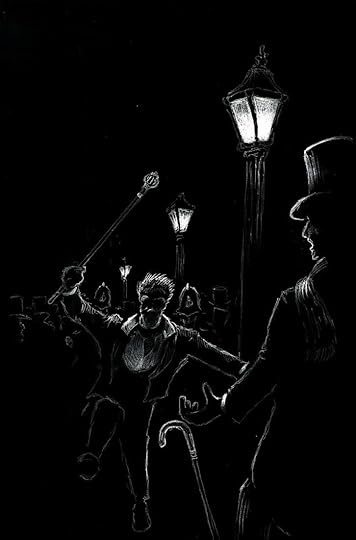
كان الاهتمامُ بالأبحاثِ الرُّوحانيةِ والتَّخاطُرِ هو ما دَفَعَ السَّيدَ «بيزل» إلى هذه التَّجرِبةِ الخطيرةِ التي أدَّتْ إلى سَرِقةِ جَسدِهِ ودُخُولِهِ عالَمَ الأطياف. إنَّه عالَمٌ مفقود، ليس بحياةٍ وليس بمَوْت. وهذه الأطيافُ الشِّريرةُ التي لا أجسادَ لها تُراقِبُ وتَتُوقُ دائمًا إلى طِريقٍ لدُخُولِ الجسدِ الفاني وتَمَلُّكِه. إنَّه عالَمٌ صامتٌ لا سبيلَ للتواصُلِ فيهِ مَعَ الأحياءِ إلا مِن خِلالِ الوُسطاءِ الرُّوحانيِّين. ولا بُدَّ مِنَ استرجاعِ الجسدِ المسروقِ، وإلَّا فالمصيرُ هو البقاءُ في أرضِ الأطيافِ إلى الأبَد. إنَّها رحلةٌ يبحثُ فيها السَّيدُ «فينسي» بمُساعَدةِ الوسيطةِ الرُّوحانيةِ عن جَسدِ صديقِهِ الذي استحوذَتْ عليهِ الأطيافُ ليَسترجِعَ صديقَهُ قَبلَ فَواتِ الأوان.
Herbert George Wells was born to a working class family in Kent, England. Young Wells received a spotty education, interrupted by several illnesses and family difficulties, and became a draper's apprentice as a teenager. The headmaster of Midhurst Grammar School, where he had spent a year, arranged for him to return as an "usher," or student teacher. Wells earned a government scholarship in 1884, to study biology under Thomas Henry Huxley at the Normal School of Science. Wells earned his bachelor of science and doctor of science degrees at the University of London. After marrying his cousin, Isabel, Wells began to supplement his teaching salary with short stories and freelance articles, then books, including The Time Machine (1895), The Island of Dr. Moreau (1896), The Invisible Man (1897), and The War of the Worlds (1898).
Wells created a mild scandal when he divorced his cousin to marry one of his best students, Amy Catherine Robbins. Although his second marriage was lasting and produced two sons, Wells was an unabashed advocate of free (as opposed to "indiscriminate") love. He continued to openly have extra-marital liaisons, most famously with Margaret Sanger, and a ten-year relationship with the author Rebecca West, who had one of his two out-of-wedlock children. A one-time member of the Fabian Society, Wells sought active change. His 100 books included many novels, as well as nonfiction, such as A Modern Utopia (1905), The Outline of History (1920), A Short History of the World (1922), The Shape of Things to Come (1933), and The Work, Wealth and Happiness of Mankind (1932). One of his booklets was Crux Ansata, An Indictment of the Roman Catholic Church. Although Wells toyed briefly with the idea of a "divine will" in his book, God the Invisible King (1917), it was a temporary aberration. Wells used his international fame to promote his favorite causes, including the prevention of war, and was received by government officials around the world. He is best-remembered as an early writer of science fiction and futurism.
He was also an outspoken socialist. Wells and Jules Verne are each sometimes referred to as "The Fathers of Science Fiction". D. 1946.
The Stolen Body is a story of a man who experiments with astral projection. A well written story, but I just couldn't get myself into it. I enjoyed the style of writing and the way the story flowed, but I must admit that I wasn't terribly interested in the characters or events. I enjoyed reading it, yet I wasn't engaged. That's why I'm giving it three stars. There isn't anything wrong with the story as such. The Stolen Body is successful in creating suspense and it is elegantly written. However, as a reader I didn't feel a connection to it. I was definitely interested in what happens with Mr Basil, yet I can't say I cared that much. It might be my mood at the moment, more than anything else. I'm currently reading more demanding books, so perhaps this short story just pales in comparison. I listened to an audio version of this story, something I don't do that often. The narrator was lovely, but perhaps I would have been more engaged with the story had I been reading it myself. Anyhow, I did like the taste of Wells' short stories. I don't think I have read any of his stories before. I'm looking forward to reading more stories by H.G. Wells.
A nice story, vaguely reminiscent of 'Strange Case of Dr Jekyll and Mr Hyde', and with downplayed jokes at the expense of Holmes-style detectives. Maybe not the best scary story I've ever read, but atmospheric enough for me, and definitely not the worst.
Normally, I’m a big fan of Wells — I genuinely enjoy dipping into his bizarre way of thinking. His creations are often fascinating, but this one failed me big time, even though the title had me excited from the start.
I’m not sure if it’s because I have zero belief in the paranormal or because the characters felt too detached, but the story didn’t click for me. It’s about two men obsessed with the idea of the paranormal and trying to transcend themselves to explore another realm. One of them succeeds — but gets lost in the shadow world, and his body is taken over by a ghost who keeps crying out “Life!” — the one thing he longed for most. That spirit then goes on to create chaos across town.
The second man tries everything to bring his friend’s spirit back to his body His friend in the meantime gets a glimpse of the shadow world — lifeless, emotionless, and eerily empty.
I did enjoy the parts where Wells described that haunting void between worlds — he captured that sense of existential stillness beautifully. But beyond that, I couldn’t connect. The characters felt too distant, and the story, though imaginative, lacked emotional gravity.
كمان في النبذة عن الكتاب فهو المختصر للكتاب "كان الاهتمامُ بالأبحاثِ الرُّوحانيةِ والتَّخاطُرِ هو ما دَفَعَ السَّيدَ «بيزل» إلى هذه التَّجرِبةِ الخطيرةِ التي أدَّتْ إلى سَرِقةِ جَسدِهِ ودُخُولِهِ عالَمَ الأطياف. إنَّه عالَمٌ مفقود، ليس بحياةٍ وليس بمَوْت. وهذه الأطيافُ الشِّريرةُ التي لا أجسادَ لها تُراقِبُ وتَتُوقُ دائمًا إلى طِريقٍ لدُخُولِ الجسدِ الفاني وتَمَلُّكِه. إنَّه عالَمٌ صامتٌ لا سبيلَ للتواصُلِ فيهِ مَعَ الأحياءِ إلا مِن خِلالِ الوُسطاءِ الرُّوحانيِّين. ولا بُدَّ مِنَ استرجاعِ الجسدِ المسروقِ، وإلَّا فالمصيرُ هو البقاءُ في أرضِ الأطيافِ إلى الأبَد. إنَّها رحلةٌ يبحثُ فيها السَّيدُ «فينسي» بمُساعَدةِ الوسيطةِ الرُّوحانيةِ عن جَسدِ صديقِهِ الذي استحوذَتْ عليهِ الأطيافُ ليَسترجِعَ صديقَهُ قَبلَ فَواتِ الأوان".
Mr. Bessel and Mr. Vincey are a pair of amateur psychical researchers experimenting with the idea of communicating via astral projection. In the experiment that ensued Bessel's astral spirit had left his corporeal body which was usurped by an evil spirit. Bessel's body then suddenly runs amok around the area shouting "LIFE!" and wielding a cane on anyone who comes in his way. He is pursued by a mob but is able to evade them. When sometime later Vincey through a mediumistic communication is able to find Bessel at the bottom of a detached shaft with his arm and leg and two ribs broken. Bessel is found restored to his sanity, but terribly weak and hysterical with terror.
The idea was great, of a stolen body but I didn't enjoy it as much as i thought. I listened to the audiobook by Arthur Lane last year and now i read this one. As i wasn't sure of what to think about this one(as I was disappointed in Wells writing).
Astral projection makes this intriguing but the book doesn't click for me. Maybe I can't understand or it's not for me.
I enjoyed this so, so much! Apparently, this short story by H.G. Wells could also be considered a double tale that I could've used for my Masters thesis, but alas!
The Stolen Body is a very creepy and highly psychoanalytical story about two men, looking for a way to transcend their spirits from one place to the other. One of the men seems to have succeeded as the other man could see his face from miles away. However, the following day the man turns mad. The other man can't shake away the visions he suddenly has, visions of the other man in distress, surrounded by evil faces. Apparently, the mad man had transcended into a 'shadow world' in which the evil spirits of madmen reside. He is able to see other people's brains light up whenever the layer between the 'shadow world' and the 'human world' grows weak and the spirits are able to communicate through said person by thrusting their spirit hands into their brains. Eventually, the mad man is able to merge his spirit back into his body and he is found by the other man, after which he is able to put forth a statement about his travels to the 'shadow world'.
With this theory, H.G. Wells basically confirms the work of mediums, which I find very fascinating! So much was packed into such a short story and I really enjoyed it!
"The Stolen Body" is a science fiction short story by H. G. Wells that was originally published in The Strand Magazine (November 1898); collected in Twelve Stories and a Dream (1903) and Tales of the Unexpected (1924); reprinted in Weird Tales magazine (November 1925) and was later reprinted in many collections and anthologies.
Plot summary
The story's main characters are a pair of casual paranormal researchers who are experimenting with the idea of astral projection. One night, one of them inadvertently succeeds in projecting his spirit from his body, which is then taken possession of by a malevolent entity in his absence. His partner receives a vivid sensation of him calling out for help and rushes to his residence, only to find him absent and the place in shambles. The researcher continues to search for his partner and learns that he has perpetrated a series of violent incidents around London. He seeks the aid of a medium, who channels his partner's spirit and finds that he has fallen down a well and subsequently been abandoned by the possessing entity. They locate the well and rescue him, after which he recounts the story of his possession.
I listened to the audiobook on Youtube; Read by Arthur Lane. If you have read any books about astral projection, please let me know as I forgot that it was possible to find books like this. I will read it regardless if it is non fiction, or fiction.
Now onto my review:
This is a rather difficult tale to write a review about, because I'm someone who at least once a week slips between night terrors, sleep demons as some call them and astral projection.
Now personally; this book is ahead of its time, but also; the fact we haven't moved on in terms of facts about astral projection and night terrors and sleep demons; is intriguing and horrifying to me. I have had a few astral projections like what Wells describes here. Some. Not many. It's interesting to see it in a work of fiction, especially a story wrote years before my time. I have an unusual connection with this story that I know a lot of people wish they had
but astral projection is still, after my 12 years roughly of personal experience with it- an absolutely horrifying thing to experience. I am intrigued and glad this is considered a horror story- but unlike the protagonist, I would do anything to not experience it. It's awful, and I wish I could just be in my body. Sleep doesn't come easy to me and I absolutely enjoyed this tale in terms of descriptions. The reason I'm not rating higher, is I'm unsure how to process this book. It is a work of fiction about a real thing; and I'm always about representation in media; however, I'm unsure how to rate this properly.
I know it is fiction. I know that there's thousands of ways to experience astral projection. I feel like in some ways, this story romantacises the idea of astral projection; but in the same breath; it doesn't. It intrigues me how he does this.
I'm also intrigued because; the romanticisation, the desire to have astral projections; isn't anything new. It's been scary meeting people who wish they could do it, because it's often seen as a super power. You have semi control, and no control over your body. From the social persepective; not much is different of current society, in terms of how they handle this topic. Which hurts to know, but so little changes.
Blitzed the Polish version of The Stolen Body (Skradzione ciało) and could not concentrate on the story. I think it was a combination of the bland writing and too much sugar in my bloodstream.
تقريبا السمه اللي لحد ناو ملاحظها في اسلوب ويلز هي التلخيص والإنجاز مش عاوز اقول الكسل ليه تكتب 100 صفحه مثلا وتمتع القاري في حين انك ممكن توصل فكرتك بإيجاز تام في 20 صفحة فقط تاني كتاب ليه في يوم واحد ومش عاوز يبقى الأخير
I wasn’t that much into the story. I found it not engaging enough and thought about other things while reading it, which led to me reading but not actually understanding. However, the Gothic vibe in this science-fiction story interests me, so I might read it again.
A paranormal researcher practices astral projection and enters the spirit or shadow world. Here, noise is absent, spirits move about like fog, and physical reality feels something like “glass.” His vacant body is later possessed by an evil spirit who wreaks havoc in London.
قصة رعب ما ورائي اظن ان فكرتها سنة 1897 أول مرة نُشرت كانت جديدة ومثيرة .. في العصر الحديث مش بنفس الإثارة ولا الغرابة لكن تستاهل لأنها مازالت مسلية ولأن الكاتب كان عبقري وأفكاره مبتكره بالنسبة لعصره.
This has a good premise and could potentially have been quite scary. Unfortunately, as this was such a short story, the plot just wasn’t developed enough to really make an impact.
A superb story about a paranormal researcher experimenting with astral projection who finds himself outside of his own body watching on whilst an evil spirit uses it to create chaos. HG Wells was an utter genius.
This story in a way reminds me of Dr.Jekyll and Mr. Hyde. H.G. Wells does a wonderful job of describing the frantic nature of the minds of these scientists and the destruction science can bring if we're not careful. I did listen to this at 10:00pm in the dark.
An interesting take on ghosts, is there life after death and astral projection. How would you communicate with someone stuck in limbo or the afterlife?