Dönemler ve toplumlar farklı da olsa, kadınların yaşadıkları zorluklar değişmiyor. Hatta James Joyce’un kızı dahi olsanız, durum hep aynı. Hayallerinin peşinden koşamayan kadınlar, evlenmek zorunda bırakılan kadınlar, aile içi şiddete maruz kalan kadınlar... Kadınlık, “öteki” olmanın bir manifestosu.
Cinsiyet çalışmaları alanında ünlü bir akademisyen olan Mary M. Talbot’ın, kendi hayatından da izler taşıyan ve James Joyce’un, kızı Lucia ile ilişkisini paralel bir öyküyle anlatan Babalar ve Kızları, bir asırlık geçmişi mercek altına alarak günümüze ayna tutuyor.
“Babalar ve Kızları, son yıllarda gördüğüm en iyi grafik romanlardan biri.” -Joe Sacco
Dr Mary Talbot is the author of the graphic novel Dotter of her Father’s Eyes (Jonathan Cape 2012), illustrated by her husband, award winning comic artist Bryan Talbot. She is an internationally acclaimed scholar who has published widely on language, gender and power, particularly in relation to media and consumer culture. Dotter is the first work she has undertaken in the graphic novel format. It went on to win the Costa Biography Award in January 2013.
Mary’s recent academic work includes a second edition of Language and Gender (Polity 2010), a book that continues to be popular with university lecturers and students worldwide. However, she’s probably still best known for her critical investigation of the “synthetic sisterhood” offered by teen magazines.
She has held academic posts in higher education for over twenty-five years, mostly in England, but also in Wales and Denmark. In 2004 she was invited as Visiting Professor to Sun Yat-Sen University in Guangzhou, China. She has also done extensive consultancy work, including for the Arts and Humanities Research Council and the Quality Assurance Agency.
Born in Wigan in 1954, Mary married Bryan and moved to Preston in 1972, where she brought up two sons, wrote poetry and short stories. She studied English Literature and Linguistics at Preston Polytechnic as a mature student, graduating in 1982 with a first class BA in Combined Studies. She later went on to study at Lancaster University, completing with a PhD on Critical Discourse Analysis in 1990. Employment as Reader in Language and Culture took her to Sunderland in 1997. She still lives in Sunderland, but has been a freelance writer since 2009.
Her second graphic novel, Sally Heathcote, Suffragette, is illustrated by Kate Charlesworth and Bryan and due for publication by Jonathan Cape in May 2014. It follows the fortunes of a maid-of-all-work as she is swept up the feminist activism of Edwardian England.
Interesting tale of two daughters, both sort of cast-off or neglected or verbally abused by their famous fathers; one, Lucia, daughter of James Joyce, was tragically lost due to parental mistreatment; the other, Mary Talbot, the author and feminist literary critic, the daughter of a famed Joyce scholar, also was maligned and mistreated. Is this ironic, given that the authors are so highly esteemed by the world, or expected, given their fame and attendant massive egos? Both seem mired in patriarchal conceptions of women and girls, which may in part be attributed to the times, the history of patriarchy, but it still feels sad/maddening, without justification. Interesting and complexly emotional paired stories, with art by Bryan Talbot.
Cultural evolution is always a tricky endeavor, inevitably littering the social landscape with a detritus made of the the scattered limbs of rituals, mores, and institutions that couldn't get out of the way quickly enough. Both vanguard and old guard are sacrificed in the collision of ideals. And sometimes the casualties aren't just metaphor and social construct. Sometimes there are literal casualties—human ones.
Dotter of Her Father's Eyes relates the struggles of two such human sacrifices in the battle of ideological paradigm shift. Both Lucia (James Joyce's only daughter) and Mary Talbot (this book's scribe) were real combatants in a war they may not have even been quite aware they were embroiled in. Certainly, they recognized the fact of the skirmishes that framed their lives' choices and developments, but could they have known from the inside just how monumental the transformation being wrought upon the kingdom of Western Civilization was? (It's possible, of course, but the young are rarely the most aware of the larger struggles that govern the architecture of their lives.)
Ideas are important and have value because people believe in them.1 And not just in the sense of casual assent. Not like how I believe that Antarctica exists but can't be bothered to shape my life around the fact. Discovering Antarctica isn't actually there or is there but underwater or is a flying continent—or probably really anything I could discover about Antarctica won't do much to ruffle the feathers of my life. If someone brings it up in conversation, the entire summation of my response would accurately be distilled to: Huh. Interesting. If, however, you and forty otherwise intelligent people tried to seriously convince me and society that having kids was actually evil, my reaction would almost certainly be more visceral (depending on how real I believed the threat to my way of life to be). At the least, there might be defensiveness and some frustration. As the threat escalates, tolerances strain and violence or unhappy legislation (for one or both sides) may erupt.
In her biographical and autobiographical work, Mary Talbot (aided visually by husband and illustrator Bryan Talbot) confronts the struggle of society to lurch into the era of modernity and beyond. It's unclear whose story Talbot is more interested in (or if she even has a preference), but she introduces an inclusio whereby she in the current day finds an old ID card belonging to her now-deceased father. Inside the framing device Talbot pursues two narratives: one concerning her own formative years at the hand of her father James Atherton, a well-regarded Joycean scholar, and the other charting the development of James Joyce's own daughter Lucia and the relationship he had with her. Neither relationship is a thing of joy and beauty, but one suspects that if both girls were born to the same fathers a century later, the absence of certain social constriction might have allowed for happy endings all the way around.
As delineated by Talbot, both Mary's and Lucia's lives are welled up under the pervasive irony of being the children of bastions of modernism who cannot see clear to apply modernist principles to their own patriarchal relationships. Dotter lays special emphasis on the rallying cry of the paradigm movement: "How modern!" Everyone around both Mary and Lucia are caught up in the transformation of culture—of the evolution of the stilted, errant, grossly conservative pre-modern society into the glorious fortress of progressive social democracy found in the modern utopia. It's a period of hope and change. And each of these two fathers are in some sense heralds or ambassadors or representatives of this new civilization.
The irony of course is that in the cold darkness of their hearts' hearts, they are still staunch defenders of the Old Ways—hopeless, helpless relics who will unconsciously stop at nothing to crush the Spirit of the Age in its most immediately tangible bastion. They will carelessly destroy their children (or perhaps die trying), unaware that in so doing they make mockery of those values they pretend to hold dearest to their hearts. Mary's father Atherton will do so by his direct actions built of disdain and outright dismissiveness of his daughter. Joyce, on the other hand, will combat his own values through a negligence in policing he and his wife's failure to recognize Lucia as something more than their provincial understanding of the female being will allow.
Compared to Atherton, Joyce appears a doting father—one who truly loves and admires his daughter but simply doesn't have the grounding by which to combat either his wife's vindictiveness or to understand the place of the female in modern applications. Perhaps he was more a doer than a thinker. Atherton, however, cannot claim such excuses (as if excuses ever really exonerate one human from destroying another)—he is a scholar, a thinker, and devoted to considering the ramifications of Joyce's body of work. Surely some mote of the new paradigm, some willingness to apprehend the world through inventive, fresh structures ought to have asserted itself through his studies. Still, as poor, blind humans, our penchant for adhering to comfortability and ritual and the tried-if-not-true will ever hold power over our sense of reason—so while tragic and ironic, neither Joyce's nor Atherton's failures are particularly surprising.
"Sad life. Sad life," to quote a certain wise but immolated horse.2
As a work, Dotter of Her Father's Eyes is an enjoyable, thoughtful read. (Or at least as enjoyable as a non-fictional pair of tragedies can be.) Mary Talbot's script was at all times interesting for me—even if I didn't necessarily understand the purpose of combining her own story with Lucia's. Though I described Dotter as an exploration of the irony of a particular conflict between ideology and praxis, that's a layer of interpretation that I read onto the story because I felt the need to draw out an overriding theme from the work. While the irony is there pretty unquestionably, it's unclear whether this is Talbot's primary aim with the narrative. When I first finished reading, I was frustrated with not being able to discern why Talbot may have tied her story to Lucia's beyond the simplistic connection constructed by Atherton being a primary scholar of Joyce's oeuvre. My wife felt a similar dissonance and we tried to suss out Talbot's point unsuccessfully. Perhaps it's there and obvious. Perhaps we were unqualified to discover it or perhaps our concentration was too divided by the conflict of late-night readings versus days filled with the stress of juggling earning an income against good, loving child-rearing. Perhaps we were just dense (momentarily or permanently). Or perhaps Talbot didn't quite succeed in tying together the threads of her purpose.
Regardless, the book is good and worth a reader's time. Both Mary and Lucia lived in horrifying and exciting times. I can't imagine the struggle of mind and heart. From my position of genetic and historical privilege, I can't imagine being a thinking person burdened under such constraints. I'm grateful then to the Talbots for bringing this segment of the historical record to light and life, no matter how nauseating. _____________________ Art Note For his part, Bryan Talbot is in stellar form. My only other intersection with his work is his celebrated Tale of One Bad Rat. In the two decades since then, he's clearly honed his artistic sensibilities and as crisp as his vision was then, it's become something truly beautiful and evocative here.
Talbot uses usually monochromatic palettes of washes to indicate narrative threads and imply mood and warmth and love and panic and everything else. I never felt any question as to what a scene was meant to display. I'd love to see more of Talbot's work, especially if along these lines. _____________________ Two Other Notes 1) It only just occurs to me that Talbot introduces her story with the faerytale-esque:
Once upon a time And long ago A King and Queen Had a daughter Her name was Marushka Or Lucia Or Lucy Maria Or Mray
I suppose then it's possible that Mary Talbot's name is Lucy Maria (named for Lucia) but she that goes by Mary, giving a touch more connection between the two women and better justifying the dual-nature of the book? _____________________ Footnotes 1) Terry Gilliam played this to interesting effect in his Baron Munchausen. Gilliam focuses his narrative lens on the birth of the age of reason and represents his ideological combatants as individuals with fantastic powers. Throughout the adventure, Gilliam treats us to the blending of the literal and the ideological such that the conflict between the two is made more tangible. Really, I'm not sure that Baron Munchausen has much to do with Dotter, but I think we shouldn't probably miss any opportunity to remind ourselves of Gilliam's genius. Plus, isn't this kind of what footnotes are for?
2) See the first chapter of Patrick DeWitt's The Sisters Brothers. _____________________
"Dotter of Her Father's Eyes" is about the father/daughter relationships of two women - Mary Talbot, wife of Bryan Talbot (writer/artist extraordinaire of such books as Luther Arkwright, One Bad Rat, Nemesis the Warlock, Sandman, and the Grandville series), and Lucia Joyce, daughter of legendary novelist James Joyce (author of Ulysses, Portrait of the Artist as a Young Man, and Dubliners).
The book alternates between the two women at similar points in their lives from childhood to adolescence to adulthood and shows parallels between them and their fathers. Mary's father was an eminent James Joyce scholar whose work "The Books at the Wake" remains the best book written analysing Joyce's incredibly difficult novel "Finnegan's Wake", and in turn an equally difficult man to get along with. Mary details her clashes with her dad who was mentally abusive to her while growing up, often belittling her achievements and dreams.
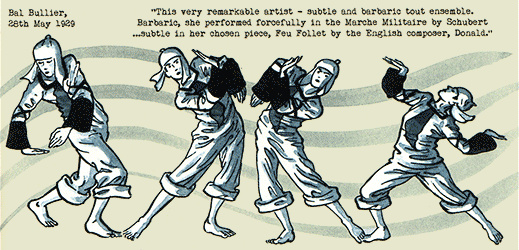
Lucia's father wasn't abusive - Joyce was too wrapped up in his own writings to be that way - and he was generally quite involved in raising his daughter, but when she became a young woman wanting to become a professional dancer and start an independent career, Joyce and his shrill wife forbade it to the point where she became so frustrated she threw a chair at her mother. Incredibly this incident led to her becoming institutionalised, a forced way of life that she would never escape until her death.
Mary Talbot's writing is superb and she brings to life her story with warmth and candour, perfectly matching her husband's artwork in tone and mood. The book is enthralling to read and, for Mary, ultimately a happy ending. For Lucia, it's hard to imagine a thwarted dance career and an overbearing mother could lead to a decades long imprisonment, but perhaps it really was all that - maybe there is more to her story than presented here.
I loved Bryan Talbot's work in this book. It's not nearly as polished or dramatic as his work in books like Grandville, and the book is coloured infrequently, mostly in sepia tones throughout, but it's still wonderful to see. His depiction of Lucia's descent into madness is as high a quality fans have come to expect from this artist, while the drawing of he and Mary's wedding day is very beautiful in its simplicity and expression of pure happiness.
"Dotter of her Father's Eyes" is a fascinating comic book of human relationships and the importance of an unshackled human spirit, but moreover it's a great read. Who knew that Bryan Talbot's wife was also a talented writer? Highly recommended.
What do two women, one born in 1907 to James Joyce and Nora Barnacle, and the other born in 1954 to James S. and Nora Atherton, have in common? Have they led strangely parallel lives, and if so, how are these parallels intriguing, instructive or clarifying?
That is the mystery set up at the beginning of this book by an odd, fairy tale opening.
Once upon a time And long ago A King and Queen Had a daughter Her name was Marushka Or Lucia Or Lucy Maria Or Mary.
But this opening confuses me, with its flippancy. One or after another. All of the possible names of who this book might call its hero. I thought, this isn't the way a story begins, in which the hero might, really, be anyone.
Clearly this opening is meant to call attention to the connection—between Mary and Lucia, and the Jameses and the Noras. But right away it was a bit of a pebble in my shoe, this "or" and "or" and "or", as I stepped into the world of the book.
It is perhaps almost fantastical that Lucia Anna Joyce and Mary M. Talbot are daughters of one James and one Nora, the first James being the modernist writer Joyce and the second a well-known Joyce scholar.
And perhaps Mary and Lucia had a little more in common than just the names of their parents and the fact that one's father wrote of the other's. Both Lucia and Mary, after all, sought the love and perhaps approval of their fathers, didn't they? And both had the rhythmic prose, the voice of Joyce, in ear-shot from the beginning. As the book opens, Mary walks around with snippets of Joycean prose unconsciously salting and peppering her thoughts. It is a music that is already inside her head. But is that enough of a connection to fuel this memoir?
This is a memoir/biography of two women whose lives and work are in themselves intriguing, and whose connections are interesting. But the tangling their lives up in the context of this book feels not quite settled or satisfying.
I have wanted to read more about the life of Lucia Joyce since reading the recent graphic biography of Joyce "Portrait of a Dubliner" and I was looking forward to "Dotter of Her Father's Eyes." But I don't know that there is a meaningful enough connective balance of exploration in here. The transitions between one life and another are jarring and don't do much to work in terms of shaping the text.
What this book does do well is to show that what a person sees outside of a familial world might be starkly and shatteringly different from what one would see when the family is alone. The seeming charm of parents can turn to hideousness the moment a guest closes the door behind them.
The book also shows that the men of so-called modernism aren't necessarily modern at all. Perhaps their art has a certain 'newness' to it, but the writers themselves might be horrifying, violent, narcissistic creeps who are unable to see women as anything but objects.
I'm glad this book exists, but I wish that there were more of it, more exploration of the lives of Mary and Lucia and a deeper building of connection, any kind of connection between them.
I am between a 3 and a 4 in the gr star rating system. This is a nice potential antidote to the books that are so obsessed with male writers and scholars, and the homosocial world of 20th century fiction. But, I found the book to be a bit disappointing. I suppose if I could give this book a 3.5 i would.
This fascinating graphic novel was part-memoir and part-biography with two coming-of-age stories simultaneously featured: that of author, Mary Talbot’s, own, and the other of Lucia Joyce’s, daughter of infamous post-modern writer, James Joyce.
Many features of these two stories aligned, despite the differences in time and circumstance that separated the two females. This caused some early, momentary confusion however, as I struggled to understand which young girl was the book’s current focus. I began to understand that a clever distinction was made in black-and-white pages, those in sepia tones, and full-colour illustrations to dictate Talbot’s present-day.
This was a fascinating account of the younger years of two fascinating women. I did appreciate what the author set out to do, and how she managed it in under 100 illustrated pages, but would be interested to read a more traditional biographic account of Lucia Joyce’s life, next.
I knew James Joyce's daughter Lucia ended up in a madhouse, largely because that's the subject of the chapter which seemed to be holding up Alan Moore's second novel, but little else about her. Turns out a lot of her problems stem from her none-more-modernist father being terribly old-fashioned when it came to subordination of a daughter's wishes to her father's needs (though by the sound of it the mother was even more to blame). Mary Talbot's father, a Joyce scholar, was likewise beloved by the world but a prick to her. And the intertwined story of the two women's lives is illustrated by Mary's husband Bryan, who may implicitly have been responsible for stopping Mary from going the way of Lucia, because hippy that he was he proved a much better white knight than Sam Beckett (then again, wouldn't anyone?). Mary then annotates Bryan's comics version to pick up on all the stuff he's got wrong. The whole business is quite upsetting. Why are people such dicks to their families?
This book tells the dual stories of the lives of the author, Mary Talbot, and James Joyce's daughter, Lucia Joyce. And the parallels of their lives are compared and contrasted.
There's many moments in the book that have emotional defeats in them. From Mary's constantly dismissive and emotionally abusive father always bringing her down and not paying enough attention to her, to Lucia struggling with her wants and needs against her father and mother's wishes - the story can be brutal in a quiet and subtle way. I think it's interesting that the story kind of reflects how women have to deal with the expectations of what women should be - according to other people- against what they truly want. Eventually Mary meets her husband, which leads her down a better path - but Lucia unfortunately bends, then breaks to the pressure.
This was heartbreaking at times, and an interesting read. Recommended for fans of biographies.
Dotter of Her Father's Eyes is a book unlike any other I've read, a combined graphic biography (of Lucia Joyce, daughter of James Joyce) and autobiography (of the graphic novel's writer, Mary M. Talbot, daughter of Joyce scholar James S. Atherton and a respected academic in her own right). Talbot had a pretty big "in" in terms of an artist for her first graphic novel, seeing as her husband is the legendary Bryan Talbot, the award-winning creator of many comics and graphic novels, from the groundbreaking The Adventures of Luther Arkwright to heartbreaking The Tale of One Bad Rat to the genre-busting Alice in Sunderland and more.
Given that I've long been a fan of Bryan Talbot's work and studied (end enjoyed!) a fair bit of Joyce in my undergraduate and graduate student days, I was prepared to love this book. Sadly, I only liked it well enough - usually that's fine, but I had such high hopes, given its subject matter and pedigree. Mary is a fine writer, without question, and Bryan's artwork is top-notch as ever (although this is not the bravura performance he gave in Sunderland), but I just didn't feel that these two stories really needed to be told together, or that they benefited much from their joining. It's true that there are obvious linkages between the two (Joyce, most obviously, plus enigmatic fathers), but those links don't really add up to much in the telling, apart from those basic means of comparison.
Lucia's story is heartbreaking, to be sure. A talented dancer, she found her life choices always constrained and compromised by her parents' constant moving from one country to another, even after Lucia reached adulthood. Her eventual committal to a mental institution in 1932 (her first of what became many stays) is as terrible as it is incomprehensible: After one of many rows, Lucia throws a chair at her mother, and "Her brother made a snap decision. He had her committed" (82). We're not given any hint previously that anyone in her family thought she had mental issue: She fights with her parents and chafes at their control, yes, but who doesn't, really? In this telling, this "snap decision" signals the end of Lucia's active life - the book ends less than ten pages later. It's a tragedy, without question, but an incomprehensible one here. Surely there has to be more to the story than a simple "snap decision" by her brother.
Mary's own story, growing up the only daughter in a postwar British household, is engaging, if sad: Eager to please but also intelligent and headstrong, Mary constantly runs afoul of her father and his snap-temper. Perhaps the book's most powerful and damning observation appears on page 30: "Claims about men being unable to express emotion irritate me to no end. My father did anger very well." The love story between Mary and Bryan charms though suggestion; there's enough tensions here to sustain a much longer, more detailed narrative.
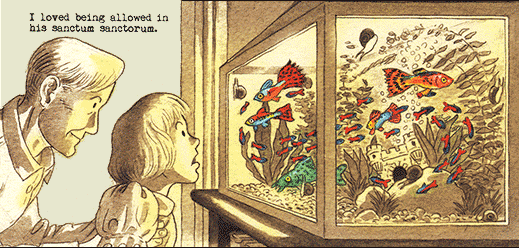
Visually, the book is divided into three portions: The present-day frame story, in clearly inked full color panels; Lucia's story, in borderless blue-grey; and Mary's story, borderless and primarily in sepia. The borderless panels throughout both help to emphasize the flashback nature of the narrative and allow for some beautifully blended page layouts. In Mary's story, the artwork is the least polished, with preliminary pencil lines and paste-up markings visible. I'm guessing this is somehow to make that section feel more "authentic," perhaps, as it is the author's own memories? I don't know - it doesn't look incomplete, exactly, but it is rougher... maybe to mirror Mary's own pain at "becoming" an adult?
The pages also show evidence that it was a couple who created the book. There are several places where Mary inserts a footnote about something that Bryan got "wrong" (the frilly apron that her mother never would have worn, the favorite children's book of Bryan's that he "snuck " into a montage of her favorite children's books), and a place or two where we see "dueling footnotes" from both author and artist. It's a cute personal touch, but it creates a bit of tension when it comes to how the book presents history: If there are factual errors (such as they are) in the Mary sections, might the same be true in the Lucia sections? If the book were Mary's (and, to a lesser extent, Bryan's) story alone, these moments would seem utterly good-natured and fun; but they introduce questions of authenticity that seem strange in a book that's based as much on research as it is on memory.
Still and all, I'm glad I read Dotter of Her Father's Eyes. It's an enjoyable if at times painful set of true tales, of interest to readers of biography and history and literature. I imagine that, seeing as how it was awarded the Costa prize for biography, it will serve to introduce non-comics readers to the graphic novel format, which is a good thing, and I'm looking forward to what both Mary and Bryan have coming next.
The art isn’t top shelf and the story is a bit slow in places but it was a bit entertaining. A woman finds her father’s passport and remembers her childhood. Her father was emotionally absent. Meanwhile her father is more interested in the life of the daughter of a poet’s life.
Helt grei og veldig lett lest, men også kjedlig og forutsigbar. De fleste biografier, eller det som er deromkring som denne, er som oftest forutsigbare men kommer likevel med overraskelser her og der.
This was enjoyable enough but I don't understand why it won the Costa prize for biography. If readers who wouldn't otherwise look at a graphic novel are encouraged to do so then that's great, but this isn't an outstanding example of the genre. This book covers fairly similar territory to Alison Bechdel's Fun Home, but Fun Home is much better book.
Mary Talbot recounts her childhood and teenage years growing up respectably poor in Wigan with a tyrannical Father who is a school teacher and respected Joyce scholar, and she draws parallels between her life and that of James Joyce's daughter Lucia. They both struggle against the limitations and expectations their parents and wider society place upon them as women. Lucia's story ends tragically with her being committed to an insane asylum for decades, whilst Mary meets Brian Talbot and seems to go on to have a successful marriage and career.
This book belongs to a subgenre of feminist literature which examines the lives of the wives, sisters or daughters of famous men. Personally, I don't really give a shit about the life of Mrs Shakespeare or Miss Milton. I'm interested enough to learn about them in the context of a biography of the great men they are connected too, but I can't see why anyone would be interested in reading a whole separate biography. Lord Byron's daughter Ada Lovelace went on to be a pioneering mathematician, she achieved things herself and interest in her isn't entirely dependent upon her connection to a great man. I am unaware of any books on the subject of the husbands, brothers or sons of famous men or women.
I do not lack empathy for the Lucia Joyce, or Mary Talbot for that matter. Lucia had a really rough time and I feel sorry for her. I do take issue with the fact that people may read this book without knowing anything else about James Joyce and come away with the impression that he was a misogynist and a monstrous father. It may be true that he didn't offer his full support to Lucia in her efforts to become a modernist dancer, or stop his wife from crushing her dreams, but that wasn't Joyce's only failing or eccentricity. He was a bizarre, unique man as geniuses often are and he left a trail of bad feeling and destruction in his wake. Joyce's behaviour towards Lucia wasn't separate from his behaviour towards anyone else. When he says to his daughter "Lucia, Lucia. Be content. It's enough if a woman can write a letter and carry an umbrella gracefully" I think a lot of readers will come away from this utterly horrified from a feminist point of view. Joyce didn't conduct himself according to the generally accepted standards of behaviour of his time and place. He read the renaissance guide to conduct the Book of the Courtier by Baldesar Castiglioni and adopted it as a code, which lead to his brother telling him he had become more polite, but less sincere. This is exactly the kind of thing you would say or think if you lived according to the principles of the Book of the Courtier. Graham Greene said 'there is a splinter of ice in the heart of every writer' and if Joyce's actions caused pain to his family and those around him because he prioritized his writing over everything else I can't bring myself to regret that.
Bryan Talbot creates some really amazing sequential art. Grandville is a highlight of my graphic novel reading history. Alice in Sunderland is an amazing monsterwork.
Apparently, Mary Talbot is both Bryan Talbot's wife AND an academic expert on things like feminism and teen magazines and other things I'd enjoy studying.
This book is partially an autobiography of Mary (drawn by Bryan) and sort of a biography of the daughter of James Joyce. The two stories run parallel with different color schemes and illustration styles showing which story the Talbots are telling.
It's a neat idea. Mary Talbot's father was a prominent Joycean scholar and Lucia Joyce was a dancer in Paris who studied with Raymond Duncan (Isadora's brother) and Margaret Morris. Mary had a very negative relationship with her father, and Lucia had a good one with hers, though unfortunately the restrictions around women in her time lead to an eventual tragic end. Interesting, interesting, interesting.
Although Bryan's illustrations are lovely, occasionally the storytelling feels a little clunky. The narrative begins with Mary (though she's not identified) chosing to read a biography of Lucia on the train. After only a couple of pages, we transition into Mary's early life, but her story is told in first person. It is unclear whether the story is what Mary is reading or something she is thinking about. I found myself looking back and forth trying to figure out whose story was being told. Now that I know everyone's names, it's clear that this is the early life of Mary, but the way the book is introduced, it could easily have been Lucia. This is merely the first example of the occasionally confusing narrative.
Another thing that struck me as odd were the notes in small print typed in a few places. They start "NB" and comment on the illustrations (i.e. "My mother wouldn't have been seen dead in a frilly apron" when the apron in the frame is a frilly one). It's never explained why those kinds of details weren't changed as the couple worked on this book together. I didn't see the point.
Overall, though, I enjoyed these stories. Learning about women, academia, families, history, dance...
This was very clever in its structure - the way that Mary Talbot's story was told in the present and the past, also interweaving Lucia Joyce's story. The strands were differentiated by colour - sepia, blue tones and full colour. I wanted more I think - the story was a bit slight at 89 pages and the present felt a bit like bracketing. But still - the Lucia story was fascinating, and the common thread of tyrannical fathers was very engaging. Lucia was another creative woman who ended up in an asylum because society wouldn't accommodate her creativity - I feel so grateful to be living now! I also want to read James Joyce, Lucia's father.
I'm not sure this book hangs together very well. And the author's own story sort of begs for more examination. But I did enjoy the story of Lucia Joyce.
Two stories: one a memoir and one a biography; interlocking in that each illustrates a difficult father-daughter relationship, with a mom sanctioning the behavior on standby.
The loving characterization of Nora found in the graphic novel James Joyce: Portrait of a Dubliner was absent-Nora was an utter shrew in this book. But this one gave a very sympathetic take on daughter Lucia, especially on the root of her psychiatric problems, which Talbot blames more on their patriarchal times and the roadblock after roadblock that halted her creativity, and not her mental illness. Dad -Joyce himself-had an outlet for his unparalleled imagination and because he was a man, he could pursue a living at it. One can imagine his progeny having the same need to create (with Lucia, it was dance), yet being denied the outlet.
The Talbot side of the story was analogous in that father-figure again was a propellant for the daughter’s career, only in a way that a good therapist would be needed to help figure out. The dad obviously was a frustrated force of fury and disapproval at the kitchen table. Lots of tension for a young girl to live with, and want to escape from using scholarly achievement: and like the Joyces, with a reverberation of the father’s career.
Good art-the throwback to Joyce’s time was more finished; the Talbot/Atherton section had an interesting work-in-progress feel, with visible sketch lines underlying the pen work. The author’s husband (and hence, Atherton’s son in law) did the art; corrections were made by footnotes inserted by the author, which added the lone humor to the book’s overall choleric tone.
Graphic novel that juxtaposes the life story of the author, Mary Talbot, and Lucia Joyce, dancer and daughter of James Joyce. Talbot's father was a Joyce scholar, so this work captures that feeling of finding a connection with someone else's biography with special poignancy. It is shocking how terrible the Joyce family is at supporting their daughter's talent; Talbot's father exhibits his own emotional distance in different style, but I felt like the jump in the author's own life from student to mother to scholar left gaps in the narrative that weakened the connection between the two life stories as the book developed.
Quando si tratta di Lucia Anna Joyce ammetto di essere di parte. Ho trovato questa graphic novel deliziosa e accurato il lavoro di Mary e Bryan Talbot. La storia si svolge su tre livelli (meglio, intrecci) temporali segnalati dal cambio stile del disegno. La prima parte risulta più elegante dell'ultima, purtroppo un po' frettolosa su un paio di eventi piuttosto significativi della vita di Lucia Joyce (il suo rapporto con Samuel Beckett, il ricovero in varie cliniche psichiatriche per il resto della sua vita, ad esempio). Attualissimo il tema della realizzazione artistico-professionale femminile.
3.66* Father -daughter relationships are a topic that I don't think I've read much on. Mary Talbot weaves parallels between her relationship with her father, a distant man and Joycean scholar and James Joyce's life/his daughter. Lucia was a fascinating woman! I wonder how many women and bipoc people have gone insane from having their dreams deferred?? I wasn't expecting this to have a connection to my recent readings on madness/insanity.
that being said, I far preferred Armed with Madness, I felt that the Talbots were really in synch!
Graphic novel in which Mary Talbot draws the parallels between her own life and that of Lucia Joyce. Lucia was the daughter of Nora and James Joyce, a talented athlete and dancer. Mary, also something of a toyboy, struggled to connect with her own father, an eminent Joycean scholar. This was a quick and engaging read.
We Americans have just endured another presidential campaign, which means we have seen some of the meanest and basest behaviors to which we can sink, most notably in how people portray themselves and their adversaries (in words+pictures) when they want you on their side. I think one of the most believable explanations for the low voter turnout in the 2016 general election is that many people were convinced that "They're all liars and crooks."
After reading this coming-of-age book about Lucia ("loo-CHEE-uh") Joyce and Mary Talbot, i can't help but wonder if maybe all people who create art are liars and crooks, too. If given a multiple choice question about James Joyce's parenting style, the last one i'd've selected would've been the kind depicted in this graphic biography: a man who loves his only daughter but who cannot see that his grown daughter is neither his vassal nor his wife's minion. How could i be so sure? Well, i've read Ulysses and A Portrait of the Artist as a Young Man. Plus, artists tell the truth. Also, artists reveal themselves in their work because they reveal the truth. For James S. Atherton, however, i might've been able to guess what he was like even if i only had minimal biographical details such as the year of his birth and his religious upbringing and his occupation.
So maybe the greatest works of art are The Greatest only when the person of the artist disappears into the work in such a way that the admirer nevertheless believes some part of the artist's self has been revealed.
[end fruitless speculation but begin unnecessary personal divagation] [i seem to wanna segue into a different mini-obsession; earlier in the year it was philosophy, the past couple months it has been comic books, but today the notion of typing up my college essays as Goodreads reviews rose to the level of consciousness again; if i do it, i promise to start each one with a warning label more explicit than "Barely post-juvenile ramblings of a wannabe know-something"] [ok, sorry! that's really it for now] i'll try to read another graphic bio and leave you in peace for a bit.
Part memoir, part biography, Dotter of Her Father's Eyes is also a graphic novel with it's own brand of angst and parental disdain. Two women from different time periods, related only through their fathers interests, are compared to one another in a number of ways. The daughter of author James Joyce tries to make her way in the Parisian dance world of the 1920's, with her own promise outweighed by the genius of her father. Eventually sent to an insane asylum, she was never able to reunite with the family that cast her off. Meanwhile in the 1960's, the daughter of a Joycean scholar (author Mary Talbot) relives her young adult life, growing up under a father who never related to her in a meaningful way. He spent all his time so wrapped up in the works of another man that he never appreciated the family he created.
These parallel lives are drenched in teenage self-importance and a deeply troubled sense that others do not consider their desires. Both young women are also stifled by their inability to find their own voices and unable to flourish under parental pressures. Dotter of Her Father's Eyes is a story that many young people might be able to relate to, but presents no critical thought or substance behind the actions of self-indulgent teens. It is pure activity and narrative without reflection and meaning. Illustrations are standard-issue comics yet utilize multiple color palettes to represent different story lines. The present is saturated in realistic tones; the life of Lucia Joyce is presented in monochromatic black and white; and the story of Mary Talbot is muted and subdued. All in all, Dotter of Her Father's Eyes is not really worth the read.
This was a really well written and interesting graphic novel! I loved learning more about Joyce and his daughter because I wasn't aware of her story. Beckett, Ezra Pound and Man Ray make an appearance too which is cool. Don't think I'd read this again but it's a lovely story and if you are interested in Modernism and Joyce this is definitely for you.
Ok, so here's the thing about Dotter of Her Father's Eyes: I don't think it's particularly successful as a graphic novel/memoir. I don't think it reveals very much at all about Mary Talbot's life (or her father's life, either), and as such I'm quite confused about the rationale for writing a memoir in the first place. I'm not crazy about the art style. There's little connection, flow, or interaction between its two narrative lines. And the collaborative relationship between writer/wife and illustrator/husband feels invasive and just plain weird in places. It may attempt to chart a daughter's relationship with her academic, modernism-obsessed father, but Fun Home: A Family Tragicomic this ain't. It also doesn't hold a candle to Sarah Laing'sMansfield and Me, which I read straight after this and found much more convincing as a simultaneously biographical and autobiographical graphic work. Judging Dotter of Her Father's Eyes as a finished product in light of all of this, it probably deserves to be rated 2 stars or maybe 2.5. However, I was so enthralled by the portrayal of Lucia Joyce within this so-so graphic novel that I had to up my rating at least a little.
A disclaimer: I'm not particularly well versed on James Joyce and matters involving him. However, as 1920s modernist expatriate Paris is my undying obsession and Sylvia Beach is my hero, I did have a basic idea of Lucia Joyce's life story going into Dotter of Her Father's Eyes, most of which was drawn from reading Noël Riley Fitch's charming Sylvia Beach and the Lost Generation: A History of Literary Paris in the Twenties and Thirties. For that reason, I was not expecting to get anywhere near as swept up in this version of the story as I did, because I presumed that I knew all the important stuff already. I absolutely did not. Previously, all that I *really* knew about Lucia Joyce is that she struggled with mental illness and ended up being institutionalized. More to the point, the previous versions of her story that I've read had always given me the impression that she was *always* insane and that there was no hope for her. That is absolutely not true for the Lucia Joyce depicted in this graphic novel. And yes, I realise that her story is deeply contested, but if nothing else, Dotter of Her Father's Eyes has made me want to research and find out for myself what the truth is. That, to me, constitutes a successful portrayal of a historical figure, even if the medium telling her story is flawed.
The Lucia Joyce depicted in Dotter of Her Father's Eyes reminded me super strongly of Zelda Fitzgerald, which is probably the main reason for my sudden intense interest. I've suddenly got all these ideas swirling around in my head about dance and how it was one of the few creative outlets open to women at this time, but it seemingly also encouraged disordered behaviour and had longterm physical and mental consequences. I also absolutely could not BELIEVE that Lucia had a relationship with Samuel Beckett. Who knew? And, finally, I really liked the way that she was portrayed in this graphic novel because she came across as really proactive, ambitious, and, most importantly of all, sane. I'm not 100% sure how accurate this is, but Dotter of Her Father's Eyes strongly suggested to me that Lucia Joyce was simply a woman too modern for her time, and was not just the 'mad woman' that history often makes her out to be. Regardless of whether it is true or not, this portrayal certainly changed my perspective on a woman that I thought I knew, and I'm really grateful to Dotter of Her Father's Eyes for opening my mind in this way even if I didn't exactly enjoy reading it.
So, in conclusion, I really liked the Lucia Joyce strand of Dotter of Her Father's Eyes because it gave me food for thought, but I didn't see many connections between Lucia and Mary Talbot at all, and I thought that the transitions from one story to another were choppy at best. This is just a really strange book that tries to be many things but isn't committed enough to any one thing as a result. I haven't even gotten onto the bizarre depictions of Mary being unhappy in family life whilst her husband smiles in the background that Bryan himself drew yet. And I haven't touched on Mary's footnotes which criticise Bryan's drawings for being inaccurate. It's very strange, and I feel that it could have been really good if just a few changes had been made, but, sadly, they weren't. Dotter of Her Father's Eyes remains too uninteresting in places to be deemed enjoyable overall, and not meta enough to be as self-conscious as it seems to think it is, so it doesn't satisfactorily deliver as a pleasure read or an intellectual read. I think the main problem is that I just couldn't locate the narrative within it. It felt more like a series of ideas and important moments than it did a complete life story of either of its central women, hence it left me feeling flat. Overall then, a very interesting piece of work which I'm glad that I read in many ways, but not one that I would call especially good.
Part personal history, part biography, Dotter of Her Father's Eyes contrasts two coming-of-age narratives: that of Lucia, the daughter of James Joyce, and that of author Mary Talbot, daughter of the eminent Joycean scholar James S. Atherton. I wanted to read Bryan Talbot’s work for so long, I’m guessing this is probably not the ideal place, as it’s definitely more of Mary’s work as an author and Bryan’s as the artist, yet it’s quite captivating. It's quite short but definitely packs a punch. I do like the sort of aimless nature of it, as it's just depicting life. James was a complicated man, sometimes a horrible father and then suddenly a loving and caring one. The complicated nature of their relationship never really gets sorted, but how can it? Life is unpredictable like that. Mary Talbot's writing is superb, there's a very nice warmth to it, which matches the art style Bryan chose for this narrative. I do wish we had a bit more of Lucia, but nevertheless, it was interesting. Mary ultimately had a good ending, able to realise her ambition; sadly, not for Lucia. While Joyce wasn't necessarily abusive, he was so dismissive of his daughters achievements, so solely focused on what he deemed aesthetically beautiful and right. Joyce's wife, Nora, on the other hand, clashed a lot with her daughter, as she was the typical stay-at-home wife, whereas Lucia was much more modern in comparison with her own ambition and career, which was cut short by her two parents. Ultimately, Lucia becomes so vexed she lashes out and becomes institutionalised, forced to live a certain way without having control of her destiny. It's a tragic fate. Overall, it's a great comic and a nice and short read about these two interesting figures.
Great memoir entwining the lives of two women: Lucia Joyce, daughter of *the* James Joyce, and Mary Talbot, daughter of one of the most preeminent Joyce scholars.
Brutal to read at times given the abusive nature of both women's upbringing, and expertly drawn by Bryan Talbot*, Mary's husband.
Highly recommended.
*It was only after I finished reading it that I realized I'd already read another of his works and recently to boot. He's also the creative force behind "Grandville" which I read earlier this year.