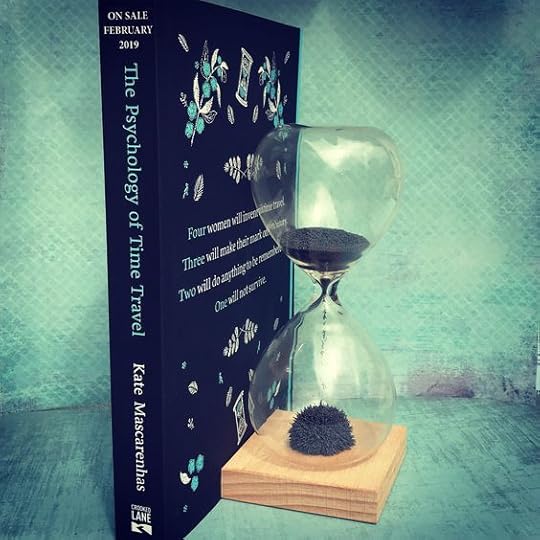
At one point in the novel, one of the characters observes that a characteristic of more experienced time travellers is that they generally have ‘a weird hippocampus’. Having now read the book, I feel I can definitely identify with this – and goodness knows what the author’s hippocampus looks like! As it happens, during the time I was reading the book I had to undergo an MRI brain scan. In my imagination, the radiographer is now looking at the scan and thinking, WTF…
There are so many intersecting story lines and switches of time period in The Psychology of Time Travel that I can’t imagine how the author kept track of everything. I picture her surrounded by post-it notes, whiteboards, flowcharts… The Psychology of Time Travel is definitely a contender for a ‘read-in-one-sitting’ book. Once you pick it up, you may just decide to cancel all your plans for that morning, afternoon or evening. In fact, to save you the trouble of making the decision, I took a quick trip to the future myself and I can reassure you that reading the book will turn out to be much more satisfying that what you intended doing anyway. And, by the way, Jaroslav says ‘Hi’. Oh, I forget, you haven’t met him yet, have you? Plus that new recipe you were planning to try later? Don’t bother; it doesn’t work out too well.
I said earlier that my proof copy was personally inscribed by the author. I had the uncanny sense when I finished the book that if I turned back to that page, rather than 'Hope you enjoy it!', it would now read ‘Glad you enjoyed it!’.
A sort of modern day version, for grown-ups, of John Masefield’s The Box of Delights, Kate Mascarenhas’ debut novel is a clever, funny, exhilarating, mind-bending mystery that deserves all the rave reviews it is getting. This is an author to look out for in the future. (See what I did there?)
I received a review copy courtesy of publishers, Head of Zeus, in return for an honest and unbiased review.