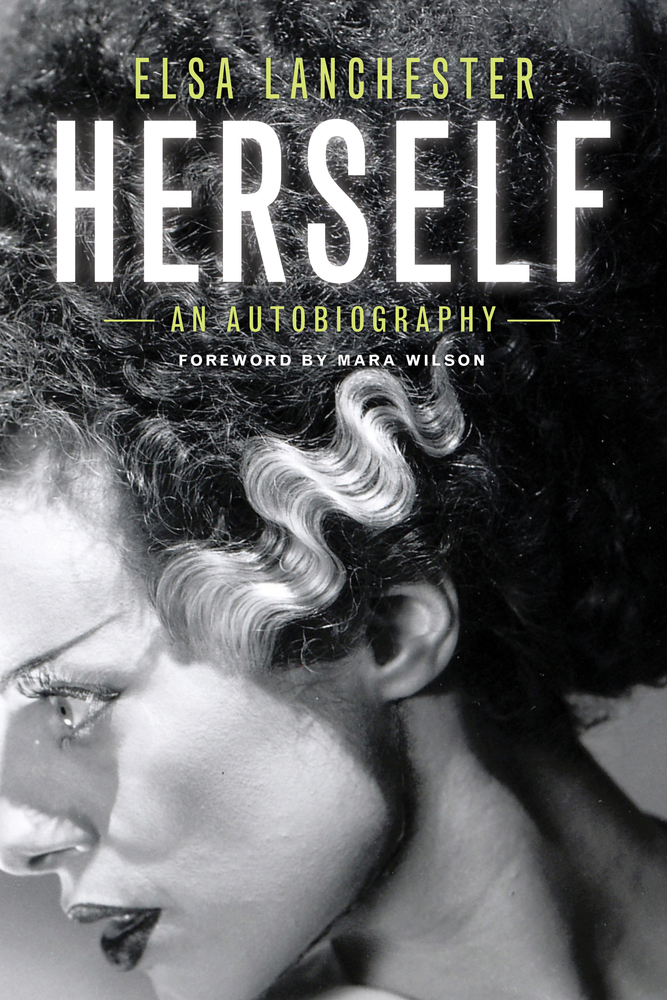
Being known as “The Bride of Frankenstein” is an unusual form of fame, but for Elsa Lanchester the unusual came naturally. Born to radical socialist parents, Elsa attended an all-boys school and later “studied” in Paris with dance pioneer Isadora Duncan. At 17, she opened her own theater, which was frequented by writers such as H. G. Wells, Aldous Huxley, and Evelyn Waugh. She began performing with and then fell in love with a brilliant young actor named Charles Laughton. Soon after their marriage he revealed his homosexuality. Though it made their union shaky at times, it did not overshadow their common love of art, music, and nature, and their marriage endured for 36 years until Laughton’s death. Elsa Lanchester, Herself presents the story of a woman ahead of her independent, iconoclastic, liberated. It is the chronicle of a life filled with famous people (from Bertolt Brecht to Henry Fonda), and of a career that spanned almost seven decades. It is also a warm, truthful account of a very special marriage. Witty and wise, Elsa Lanchester’s account of her life and times is a delight.
Being known as "The Bride of Frankenstein" is an unusual form of fame, but for Elsa Lanchester the unusual came naturally. Born to radical socialist parents who made civil disobedience a way of life, Elsa attended a Summerhill-like all-boys school and later "studied" in Paris with Isadora Duncan. She returned to London at age thirteen to dance and give lessons in the new style. At seventeen, she opened her own theater. The Cave of Harmony, which was frequented by people such as H. G. Wells, Aldous Huxley, and Evelyn Waugh. She began performing with and then fell in love with an up-and-coming young actor named Charles Laughton. Soon after their marriage he revealed his homosexuality. Though it made their union shaky at times, it did not overshadow their common love of art, music, and nature, and their marriage endured for thirty-six years until Laughton's death. Elsa and Charles were paired in many plays, including Peter Pan and The Tempest. They began to appear in films and soon Hollywood beckoned. After making two films for MGM, Elsa was loaned to Universal Studios in 1935 for the role that would win her the most enduring fame: The Bride of Frankenstein. Elsa Lanchester, Herself presents the story of a woman ahead of her time: independent, iconoclastic, liberated. It is the chronicle of a life filled with famous people from Bertolt Brecht to Henry Fonda, and of a career that spanned almost seven decades, encompassing stage, screen, television, nightclubs, recordings, and books. It is also a warm, truthful account of a very special marriage. Witty and wise, Elsa Lanchester's account of her life and times is a delight.
ELSA LANCHESTER, HERSELF is a book filled to the brim with ironies. Here are three examples:
* I imagine that a significant percentage of Readers who come to this book also have an interest in Elsa Lanchester’s most iconic role as the title character in “The Bride of Frankenstein.” I will admit that this also contributed to my curiosity. If I’m not mistaken, a later paperback edition prominently featured the image of “The Bride” on its cover. Yet, in the short chapter covering that film, Lanchester states, “I suppose the quickest way you can shut me up nowadays is to ask me about “The Bride of Frankenstein” … and she follows this up with scant detail. Most of the on-set content involves her make-up, difficulties in going to the bathroom when wrapped like a mummy, and her lingering sore throat from excessive screaming. That’s pretty much it. Although she says that she had a good experience on the film, there is very little about Director James Whale, and virtually nothing about her co-performers.
* Elsa Lanchester knew many, many famous people and name-drops frequently. When she does so, however, she says virtually nothing about them. A discussion she had with H.G. Wells does little more than briefly describe his mannerisms! This constantly frustrated me!
* I’ve read numerous criticisms that the book is more about Charles Laughton than it is about her. Once she marries him, this is true. Yet, although they were on “equal artistic footing” when they met, his achievements grew to eclipse hers. Many times, there are indications that her life was given over to supporting her husband’s endeavors. Although she appreciated his genius, she did not appreciate her subservient role.
What I mainly gained from the book (which did contain some fascinating revelations, especially about her Mother) was that Elsa Lanchester was dedicated to developing herself in many ways. Truth to tell, she didn’t care for people a great deal, and I think you’ll find that she includes the Reader among them.
Apart from the revelations, she had an intriguing perspective of life. Many times, she will drop comments that I wish she would develop further at the time, but that I’ve turned over again and again in my mind. (One of them pertains to an issue that has troubled me for some time, so I suppose you could say that she became my mentor through her book.)
The hard bound first edition that I purchased through Abebooks has a generous sampling of photographs in three sections. I absolutely loved these! At the end of the book, she also references the photograph that she chose to grace the cover … and I can guarantee you that it wasn’t from “The Bride of Frankenstein.”
Her most lively comments refer to her stage work which she especially enjoyed. Those book sections just sing with energy. She also finds her freedom when she settles into life after her husband’s death. Of course, even while she celebrates all of the opportunities that have opened for her, it is not without a cutting observation: “Getting older is, to put it mildly, gruesome.”
ELSA LANCHESTER, HERSELF is a book for those interested in Elsa Lanchester as a theatrical performer, her life with Charles Laughton, and for those desiring “life advice” that is not heard every day!
A really very heartfelt autobiography by one of the great, yet mostly forgotten English actresses. This was written in her 80s and looks back on her life in film, two world wars, stage acting in London, her dance career and her marriage to actor Charles Laughton. A large portion focuses on her husband's struggle with his own homosexuality and his career, and her own philosophy on it and her decisions to support him are most touching. Her early bohemian lifestyle is a very magical read,especially if you are a Londoner and it counterpointed by the later exhausting toll the American acting world had on her.
Tracing an entire life—or most of it—by reading a biography, is always an overwhelming reading experience for me. This one was no exception, and it carried a lot of weight within its pages due to Elsa telling a detailed account of her husband’s deterioration due to cancer. Through all the compiled letters, telegrams, recollections and anecdotes, I found myself very enamored of and invested in these two iconoclastic people, both as individuals and as a pair. When the end came for Charles, I truly felt the emotional weight of his loss.
Elsa’s relationship with Charles Laughton is revealed through seemingly countless anecdotes about his work, her work, and the happy times when those various engagements intersected. I wouldn’t say the book is too focused on Charles any more than one could say that the lady herself had been. Their relationship makes for a fascinating read, and the story has a lot to teach us about acceptance and love. As a gay man I was very touched by her tenderness towards her husband despite his deep shame at his homosexuality. Ironically, it seems that she accepted him far more fully than he could ever accept himself.
And as an actor, wow! This book serves as both history lesson and master class. Elsa has many valuable insights to share about acting a song, creating a character, and interpreting Shakespeare—and her rumination on Charles’ process yields many more. Her early days in nightclubs honing her comedic musicality is a particularly interesting adventure to behold, following an outrageous childhood with somewhat infamous socialist parents and all manner of strange schooling situations. The list of creative people Elsa knew throughout her life is intensely impressive, and she seems to know it, fully aware that she came up among a rare generation of trailblazing artists.
I am not sure why it took me several months to finally pick up this charming, acerbic, forthright, brave memoir. But once I really dug in I made quick work of devouring it in about three days. Highly recommended for fans if either Elsa or Charles, anyone interested in learning about England in the 20’s and 30’s, and for any and all actors or artists of any other ilk. What a life!
My one complaint might be that although the vibe of sitting down to tea and chatting with Elsa is totally pleasant, there might have been something more of a structure to the memoir. It is largely chronological and at the very least chapter subtitles might have been helpful in organizing Elsa’s thoughts. So as a work of literature, therefore, I think it suffers a bit. But taken as a whole I loved every minute of it. I honestly feel like I learned a lot about human beings and about acting, creativity, and art.
Elsa's writing style is a bit scattered, like she had ADHD or something. That said, she knew everyone and did everything! Her creative being/performer's high strung personality was offset by compassion and ability to love unconditionally.
Be ready to hear of the many profound personalities she met from the first half of the 20 the century (the list goes on and on, Bernard-Shaw, Pound, DH Lawrence, Brecht, Weill Olivier and later the Hollywood people), altho Elsa is not a name dropper. She really was friends with these people.
This book also made me consider the compromises people make to stay married for a long time. Charles Laughton liked to have the occasional dalliance with a man, and Elsa, contrary to what Charles deeply desired, did not want any children and wouldn't have any. Yet together they stayed and together performed for decades. Ironic, as her own parents never married, on general principle (iconoclastic socialists in turn of the century London).
Fascinating at first, but sadly kind of tedious by the end, as it kind of degenerated into a lot of score-settling, and I didn't care about any of it. Not sure why I finished it, but I did. Anyway, the first part, about her parents and her childhood and youth is really good, well worth reading. After they move to Hollywood, there's a fair amount of fun show-biz gossip. I was hoping she'd have more to say about the 3 gay men she worked with at the Turnabout Theater in LA (one of whom was the author of an early gay novel with a happy ending, that was basically their story), but she's only focused on the fun she had working with them. Given that she was married to the closeted actor Charles Laughton, maybe she felt that discretion was called for? The oddest thing about this book is the weird way she writes about her marriage: She seems to be accepting of his homosexuality as a need, and feels sorry for him that he is so guilt-ridden about meeting the need, but then relates all these incidents without commentary that make you wonder what the heck was going on with them. She clearly loved him, and felt protective of him, but the situation also seems to have been hard for her, too. Yet she is either incapable or unwilling to enlarge on the topic, instead merely reporting as if what we really need to know is who said what to whom on which occasion. So if you are curious at all, I highly recommend the first part of the book, but if and when you get bored, give up, don't keep going, you really don't need to finish the whole thing.
Elsa... is quite a character. Invented? To a degree, yes, but entirely original. She came of age when ideology was lived (her parents were first socialists before becoming communists at the turn of the 20th century). Though no ideologue herself, it's pretty obvious her sympathy lies in what we might call libertarianism (small "l").
And as to her schooling! It was hardly the stuff of classical English aristocracy (no Royal Academy for her!). Her parents were working class through and through, living from boarding house to boarding house, using loopholes in the law to avoid paying rent or being tossed out. The stories there are enough to make any Bernie fan proud! It was her mother, Biddy, a Cambridge educated woman, who taught her daughter Elsa the basics before she was later sent to Paris to learn dance by a leading American dancer. After that, her formal education is pretty much over.
Before 18, she was already teaching dance. Before becoming an actor herself, she was friends with leading novelists, poets, playwrights and theater directors. Indeed, she knew James Whale, the director of the Frankenstein films, before they immigrated to Hollywood. And yet it is her relationship with Charles Laughton, a gay man, that centers the book and her life. And though I cannot find any traces of resentment, one does get the impression part of her wonders what might have been had she not married a troubled but brilliant man, and instead focused on her own career. We'll never know, because she doesn't make a habit of regretting only reminiscing on adventures gone by in the twilight of her life (this book was published in her '80's.)
While it was a really fun read, it left me with a few more questions than answers, but that's probably how Ms. Elsa would have wanted it. We can never really know a person's life, even with the best of memoirs. The best we can hope for is that they leave us with good stories and a better context for their choices. In that, Ms. Elsa achieved her goals.
After reading Elsa Lanchester, Herself, a memoir that was originally released in the early 80s, I have to say that I have developed an unhealthy obsession with Elsa Lanchester. When I started the book I was really only aware of Elsa as The Bride but as I continued I realized that I've actually seen quite a bit of her bigger works - The Beachcomber, Witness for the Prosecution, The Spiral Staircase, The Razor's Edge, etc. I just didn't realize it was the same person as The Bride.
Elsa was an incredibly open and liberal woman, and was born to parents who lived unconventionally, as they decided not to marry during a time when that was unheard of. Elsa's life is filled with interesting people in interesting places doing interesting things. She had a big, colorful personality. She was funny and talented and beautiful. She was also married to mega-star actor/director Charles Laughton, who she talks about. Ad infinitum. In fact, the second half of the book is dedicated almost entirely to Charles and his life, even though her career was still active during that time. It was, of course, still interesting because Charles was just as eccentric as she was, as was their unique relationship, which she did spend a lot of time talking about. I also would expect her to talk about his illness and death but I wanted to hear about her work and her life. It made the back half of the book a bit difficult to get through but I still decided to give it four stars because (1) she's a great storyteller, (2) the first half was worth it, and (3) the second half was still interesting even though it focused more on Charles then Elsa.
I received an ARC of this book in exchange for an honest review.
Elsa's began her autobiography with a delightful voice in which she described her parents and her own early lives. The Lanchester family was intriguingly counter-culture, creative and socialist-minded. I was delighted and inspired by Elsa's early life - she very much embodied the "Bohemian" in all that she did. And then she met Charles Laughton - at which point, the book seemed to detail more of Charles's life than anything else. At one point, she commented on a female acquaintance who didn't work and how frustrated this talented woman must be - living under her husband's shadow. But, Lanchester - for all her cinematic accomplisments - seemed to have written her memoir under similar circumstances. After the promising first few chapters, the book became a vague but sometimes witty collection of observations - mostly highlighting Charle's career and life. I imagine it would be incredibly difficult to be married to Laughton - aside from the fact he had male lovers throughout their marriage - he seemed quite self-centred. She barely discusses her film roles and even omits roles (no mention of Bell, Book & Candle film, for example). The book warrants a read simply because she was such a unique and talented person but sadly I think the book is also a sign of the times in which she lived.
First off, if you pick up this book because you are a fan of "The Bride of Frankenstein," you will be disappointed. Elsa spends about 2-3 pages discussing her time on that film. It will forever be her most iconic film role, but she doesn't dwell on it. Some people have complained that too much of this book is spent discussing her husband Charles Laughton. That is a fair complaint, but he was a huge part of her life, so it kind of makes sense.
This book was interesting in discussing a behind-the-scenes look of the relationship and lives of a famous Hollywood couple who had their secrets--namely that Charles Laughton was gay. Lanchester has a great writing style, and her life was interesting. She comes across as the sort of person I'd love to sit and have a drink with.
Okay so the book starts with her childhood as the daughter of a socialist upstart who remains so her entire life! I was like, this is magical, five stars. Then 80% of the book after that is essentially a biography of her husband, Charles Laughton. If you really love old Hollywood and the tortured lives of actors, you might like that 80, but it was tough. Also, I felt angry that she devoted so much of her book to him, as amazing of a man he was. So I was gonna say four. but then the last 5% gets back into the magic and is a searing view of daughterhood and rebellion. Just wonderful. So, yes yes another five from Dan but really, her childhood and her ending are fucking perfect.
The first half or so of this Elsa Lanchester biography is fascinating. Her parents were unconventional, living together in 1895 and refusing to marry, giving rise to a scandal involving a landlady with a black eye and revolutionaries calling each other, “Comrade,” while protesting outside a mental asylum. Elsa’s relationship with the famous actor Charles Laughton dominates the last half of the book as his career quickly eclipses hers. Their marriage, too, is avant-garde. All in all, a very interesting read with lots of name-dropping of famous actors with whom mostly Charles worked.
Really fascinating - if you're into Old Hollywood and the thoughts of Elsa Lanchester, Herself, I highly recommend it. I do wish I had an edition with a different cover, though. She mentions hating being asked about the Bride or signing photos of the Bride, so this seems like a silly cover.
Interesting read about her and her relationship with Charles Laughton, my only complaint is that I was hoping for more on her as the Bride of Frankenstein, none the less the book is very interesting. I'm planning on binging a few of her and Laughton's films.
The beginning is very slow and dry, but once Elsa stops talking about her Parents and their political views. You really get to finally see who Elsa was.
I read this as Beatrix dedicated her first book to Elsa. Her fist stage role was taking over from Elsa in the West End. But I always thought there was more to their relationship than that. Elsa's stories of growing up with her socialist unconventional parents were highly entertaining. I could definitely see Bea, growing up in the big posh house, entranced by that. But Bea is never mentioned in the book. Despite being open about her husband's homosexuality. Elsa herself mentions women flirting with her, but always in a way that she recoils or is horrified by it. She mentions that Tallulah Bankhead was a friend who arranged an abortion for her and that she was always grateful. That every time she saw Tallulah when she was on a date with a man Tallulah went to great lengths to describe the man as ugly and dull. But never why. And I wonder what really happened between the three of them. It was interesting to read about Elsa's club and theatre work that she did. Her "wild" times which seemed to mostly involve taking off her clothes. And I wonder what were the differences between what you could do and what you can say you did from the 20s to the 70s. Unfortuantely when she met and married her husband Charles the book shifted. It became all about him and his work. Elsa seemed to have lost herself married to him. She also seemed to have a totally different idea towards activism and politics than Bea. So it's not surprising the two lost touch.
I’m one of those horrible people who desperately wanted to read this as a fan of Charles Laughton. I like Elsa, too, and have seen a fair few of her movies, so I was curious about her life as well. Reading this, you get a little depressed. She spends so much of the book talking about Charles, you wonder where she is in all this. Doing her shows, I suppose. Besides the scatter-brained writing style, I don’t think it’s particularly her fault she wrote so much about her husband—who wouldn’t? Like most people who read this, you wish she stopped leaving so much to the imagination, given this is a work of non-fiction, after all.
I can only hope I grow up to be as strong-headed, severe, and marvellous as she, and that I don’t spend my life talking about my partner. He’s wonderful, but come on, this is my life too!
Elsa’s autobiography was fascinating and insightful. I was happy to learn about her roles other than “The Bride” but her focus on being Charles Laughton’s bride took over much of the book. I recently watched Murder By Death and am excited to see her in other films and to continue listening to her on Apple Music. Enjoy!
She's a very readable and interesting writer, but the book is mostly about her husband, Charles Laughton. I'm not saying that's bad. I was rather disappointed how little she wrote about James Whale, Boris Karloff, and her appearance in Bride of Frankenstein.