Jump to ratings and reviews
Rate this book

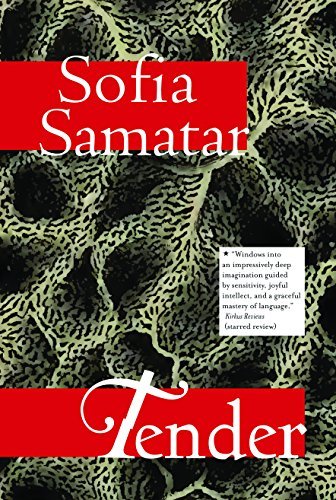
Tender: Stories

Rate this book
The first collection of short fiction from a rising star whose stories have been anthologized in the first two volumes of the Best American Science Fiction and Fantasy series and nominated for many awards. Some of Samatar’s weird and tender fabulations spring from her life and her literary studies; some spring from the world, some from the void.

256 pages, Kindle Edition

First published April 11, 2017

80 people are currently reading
5597 people want to read

About the author

Sofia Samatar

82 books649 followers
Sofia Samatar is the author of the novels A Stranger in Olondria and The Winged Histories, the short story collection Tender, and Monster Portraits, a collaboration with her brother, the artist Del Samatar.

Ratings & Reviews

What do you think?
Rate this book

Friends & Following

Create a free account to discover what your friends think of this book!

Community Reviews

5 stars
276 (42%)
4 stars
243 (37%)
3 stars
90 (14%)
2 stars
28 (4%)
1 star
5 (<1%)
Displaying 1 - 30 of 153 reviews
Profile Image for chai (thelibrairie on tiktok) ♡.
357 reviews176k followers
November 1, 2023
I am incapable of reading anything Sofia Samatar writes without the tumbling headlong desire to put my whole body into her words, to dissolve into them like salt into the waves, to be subsumed so completely into something so aching and grieving and beautiful.

I spent 6 long months reading this short-story collection, because the language is so sensuous, so rich and profuse with feeling I didn’t want to miss a second of it. I wanted to carry each word in my mouth and savor it for hours like an exquisite unfamiliar delicacy. And because I would go back routinely to my favorite stories and reread passages several times to fix them into my memory. “Walkdog” broke me open in ways I did not anticipate. “Olimpia’s Ghost” made me long for poetry in an absurdly intense way. “The Red Thread” left me drunk with melancholy, reciting the words “Belonging, Fox. It hurts” until they curdled in my mouth. “Meet me in Iram” and “Cities of Emerald, Deserts of Cold” are the stories that spoke of the things that haunt me the most, and the ones my thoughts often circled around, full of ghosts and cities and land and absence and belonging.

To read a Sofia Samatar story is to fill your whole world with it and to feel inconsolably bereft once you depart from it. Though, I suspect, it is impossible to depart from her stories—not completely anyway, not all the way.
Profile Image for Charlotte Kersten.
Author 4 books566 followers
Read
February 7, 2022
I’m contractually obligated to gush about Sofia Samatar every few months – so it always has been, and so it always will be. This is just the way of the world. Today’s book is her 2017 short story collection Tender. Spoilers follow!

Selkie Stories Are for Losers: a girl grieves the loss of her mother, who may or may not have been a selkie. This one beautifully captures the central sense of loss, sorrow, betrayal and anger that is directed at the girl’s mother because of her abandonment; interwoven are tender snippets that belie her growing feelings for her friend Mona and betray hope for the future.

Ogres of East Africa: Alibhai works for a European intent on hunting the famed ogres of East Africa. In this story’s exploration of colonialism, each ogre is a fragment of strange and beautiful mythology from an untouched world, and Alibhai’s master can only see his own triumph over them: trophies to be won, conquests to be the victor of. Alibhai rebels in his own quiet way with the notes he writes in the margins of his master’s papers.

Walkdog: a girl’s essay about the environment tells the story of a mythical creature and her bullied boyfriend’s disappearance. This might be my favorite of the bunch – the chosen medium of a middle schooler’s poorly-written essay is brilliantly achieved. The student’s battle with guilt and the cruelty of her peers is a heart-breaking one interwoven with the story of a creature of urban legend known as the Walkdog.

Olimpia’s Ghost: an epistolary story told in a young woman’s unanswered letters to a Sigmund who is PROBABLY Sigmund Freud, chronicling either her descent into madness or the strange magic of her living dreams. Okay, so I think this one has something to do with Freud’s 1919’s essay “The Uncanny,” where he analyzed an 1816 short story by ETA Hoffmann called The Sandman, dealing with an automaton named Olympia (also the name of the young woman in this story). I looked up the essay and read like 2 sentences of it before remembering why Freud is my mortal enemy, and decided to stick with this dreamlike story by Samatar instead.

The Tale of Mahliya and Mauhub and the White-Footed Gazelle: a person whose identity I will NOT spoil tells a series of tales surrounding the mythical lovers Mahliya and Mauhub. This one reminded me a lot of In the Night Garden by Catherynne Valente – it was something about the graceful, digressive nature of the story-telling along with the framing device of several short stories coming together to form a whole, cohesive narrative.

Honey Bear: parents take their daughter on a trip to the beach, but the day is ruined by supernatural occurrences. This story is very much one of a family desperate for normalcy in a world gone wrong, with a mother trying to placate and keep the peace and a father much less equipped to deal with the difficulties of his reality as a parent to a supernatural being.

How I Met the Ghoul: an interviewer talks to a ghoul who thrives on waste and chaos. I loved the idea of an interviewer trying to get a beat on an ancient supernatural being by asking her what her favorite movie is (it’s Titanic), and I especially enjoyed the impossible ways the ghoul was described: “one of her ears was like a dead mine-shaft, the other was like a window in some desolate bed-and-breakfast of the plains.”

Those: a dutiful daughter cares for her father as he reminisces about his strange experiences while overseeing a farm where natives labor in colonial Africa. This one is another thoughtful meditation on the impacts of colonialism: its dehumanization and brutality. It’s especially impactful to hear the stories told by the colonizer’s viewpoint, with its casual othering and justifications for violence. The horror element of this story could possibly be considered one of redistribution for the wrongs committed in colonialism, and Sarah’s dutiful, placid veneer belies inner conflict over the loss of her mother and her existence as a biracial woman.

A Girl Who Comes Out of a Chamber at Regular Intervals: an automaton dreams of life as a real woman in a world that has been destroyed. This one made me feel a little stupid, because as I read it I had very little understanding of how the automaton’s dreams related to her reality as a mechanical invention and gift to the king. Confusing, yes, but the automaton’s voice is vividly captured.

How to Get Back to the Forest: a grown woman reflects upon her formative experiences at Camp in a dystopian future. I read a review of this story that compared it to Never Let Me Go by Kazuo Ishiguro, and I think that comparison holds up really well. There’s a similar surface level idyllic childhood with a dark undercurrent of wrongness and uncertainty, as well as a friend who questions everything and struggles to fit in.

Tender: a tender for a radioactive waste containment facility, a woman reflects on the choices that led herself, and humanity as a whole, to the current state of affairs. A parallel is drawn between toxicity in the radioactive sense and toxicity in the context of personality and relationships, and Samatar examines the idea of nuclear developments as progress.

A Brief History of Nonduality Studies: sorry, I can’t even provide a summary for this one because I wouldn’t even know where to begin. If Samatar can be a little esoteric at times, a little infatuated with her obscure, opaque quotations and her freewheeling prose, I think this is usually present in small doses and is therefore manageable. This story is more or less entirely comprised of these things, so I struggled with it a great deal.

Dawn and then Maiden: a maiden’s love struggles with a sense of unreality and she braves a confrontation with the Lady, all-powerful ruler of questionable benevolence, to save his life. Here I think Samatar’s writing is at its most beautiful, and this one had the sense of a metaphysical fairy-tale.

Cities of Emerald, Deserts of Gold: In this essay Samatar reflects on her relationship to the concepts of land, home and flight in a comparison to The Wizard of Oz. This story’s structure is one of the most interesting of the bunch, with sections no longer than a paragraph or two all spinning around and returning to the essay’s central ideas.

An Account of the Land of Witches: an account of the Land of the Witches by an enslaved woman chronicles her initiation into the magic of dreaming and her escape from slavery. This is followed by a refutation of her account, a refutation of a refutation and the reflections of a grad student studying all three documents but currently caught in a war-torn country, unable to return to her studies in the United States. The final episode features a company of dreamers on a quest together. This is my favorite story of the bunch – in addition to the power of the first story’s examination of an enslaved woman’s experiences and her escape, I loved the vivid, bizarre descriptions of the Land of the Witches, the structure of refutations and refutations of refutations is clever and the tie-in to present day conflicts is also very resonant. Out of all the stories in this collection, I think this one best represents Samatar’s amazing imagination and scope of story-telling ability.

Meet Me in Iram: a young woman’s family lives in the lost city of Iram, mentioned in the Quran, One Thousand and One Nights and the work of H.P. Lovecraft. The descriptions of the lost city are fascinating and beautiful, and I think Iram comes to represent a kind of liminal space absent from loss and pain.

Request for an Extension on the Clarity: a solitary woman lives on board a maintenance spacecraft and requests an extension of her menial job. I loved the way that this one explored the tradition of Hotep black literature, focused on Afrocentrisim and glorified black nationalism, interweaving the narrator’s experience of never quite belonging with her love of solitude in space.

The Closest Thing to Animals: in the future, a woman struggles with her jealously in friendship with a successful artist. This is perhaps the least speculative of the bunch, but the main protagonist’s insecurity and jealously are well-realized and I really liked hearing about the friend’s environmental art.

Fallow: tells the story of a fundamental Christian settlement on a barren, harsh planet. This one is the longest of the bunch, I think, and is divided up into portions focusing on specific members of the community and their stories. It does a beautiful job of capturing the bleak essence of a Puritan-esque community trapped on an isolated world, as well as the psychological repercussions of living in such a community.

The Red Thread: another epistolary story, this one from the perspective of a girl writing to her brother and traveling with her mother after a revolution of some kind has taken place. My favorite part of this one was trying to piece together exactly what happened in the revolution and its aftermath.
This entire review has been hidden because of spoilers.
Profile Image for Emma Deplores Goodreads Censorship.
1,419 reviews2,011 followers
July 4, 2017
This is a beautiful, original, often surprising, and yes, tender, short story collection by a fantastic author. Samatar’s novels are lovely, but I think she may excel even more in the short story format, which combines her exquisite writing with compressed plots that necessarily move briskly. And her wide command of genres is impressive: fantasy, science fiction, historical fiction, fairy tales, contemporary, young adult. Most of the stories are sci-fi and fantasy, and while I love fantasy I typically avoid sci-fi, but I absolutely would read more if Samatar wrote it. Her stories never use characters simply as a long-winded way of examining an idea or making a point; instead the characters are the point, and no matter how inventive their settings, the stories are about the people, their lives and relationships. And to the extent they’re about larger issues, they are issues that matter in human society today, like race and religion.

But then there are stories that break the mold I would expect from a genre author. “Olimpia’s Ghost” is a work of epistolary historical fiction set in 19th century Europe, involving a relationship that may or may not have existed between two real people (I won’t say who since figuring it out myself was so much fun), while “Those” is an answer to Heart of Darkness, written in a similar vein but with the frame story narrated by a mixed-race character, which changes everything.

There are a lot of fantastic stories in this collection, and from perusing the reviews it looks like different readers have different favorites, which is a sign of strong writing. I’ll mention my favorites here:

“Selkie Stories Are For Losers” – A young woman in the contemporary U.S. builds her life in the shadow of a fairy tale. This could easily be a novel and I’d love to read it.

“Walkdog” – This is an epistolary story written with a certain amount of deliberate inelegance, since it’s meant to be by a typical high school girl. It’s an achingly sad story about love, bullying and social conformity, with a bit of mythology wrapped in. Unlike in a lot of YA, which seems to be a weird adult vision or fantasy of teenagers, I completely believed this one; no one would want to admit to making Yolanda’s choices, but they feel realistic.

“Honey Bear” – This is a lovely post-apocalyptic tale. In the tradition of my favorite short fiction, it’s a story you’ll want to read twice, because everything comes together at the end in a way that changes your entire view of the story, and so you re-read it with new eyes and understand all those references that didn’t quite make sense before. But despite the post-apocalyptic world, the story is closely focused on its main characters, and its heart and primary source of tension is a couple who react to changed circumstances in very different ways.

“How to Get Back to the Forest” – I’d classify this one as dystopian; it reminds me of Never Let Me Go, with young people raised in superficially pleasant institutions, slowly and imperfectly discovering how their world really works. The key difference is that here the characters resist, at least in small ways.

“Request for an Extension on the Clarity” – This is superficially science fiction, but it’s really about race and immigration and isolation; the protagonist finds refuge in the stars from a world where she doesn’t seem to belong anywhere. The collection includes several stories with similar themes, but this is the one that brought it all together for me.

“The Closest Thing to Animals” – Straight-up science fiction, set on a quarantined world, but about a character whose abandonment issues cause her to see rejection where it doesn’t exist and prevent her from seeing the ways in which others need her. The story is lovely and so are the weird images of its world.

“Fallow” – This is a novelette, by far the longest piece in the collection, set on a world inhabited by refugees from a self-destructing Earth. It’s a meditation on religion (eventually we’re given enough information to figure out what group is involved) and social pressure, hearkening back to the Puritans despite its otherworldly setting.

Of course, as with most collections, I didn’t love all the stories; some seemed opaque or didn’t quite land for me. In particular, there’s a stretch from “Tender” through “Meet Me in Iram,” of stories dealing with alienation and characters feeling out of place in their own skin – sometimes, though not always, related to immigration – that I bounced off of until I reached “Request for an Extension on the Clarity.” A few of the other contemporary or parable-like stories also didn’t strike any particular chord with me. But these are skillful stories that clearly landed for others, so I’ll chalk that up to my limitations as a reader rather than Samatar’s as a writer.

Overall, I loved this collection and would absolutely recommend it, probably even ahead of Samatar’s novels to those with any liking for short fiction. To my surprise, I especially loved Samatar’s science fiction and hope to see much more from her along these lines in the future.
Profile Image for Algernon (Darth Anyan).
1,838 reviews1,163 followers
April 15, 2021

Perhaps the story is a kind of treasure map.

The right kind of storytelling can lead to the most amazing places, there to uncover precious stones of wisdom and emotion and wonder even in the midst of a ravaged landscape filled with broken people. Sofia Samatar has already proved to me that she is a master of beautiful prose and of original worldbuilding with her first two novels, but this collection of short stories still managed to impress me with the intensity of feeling and the power of the metaphor. She is a poet first, and the short form serves her well.

This Tale Contains:
Yellow silk, red leather, white marble, red onyx, gilded copper, ambergris, topaz, emerald, amber, musk, ebony, gold, carnelian, camphor, Indian aloes, Bactrian camels, pearls, rubies, Chinese steel, silver, sandalwood, slaves.


These stories contain pain and loss, war and devastation, persecution and betrayals, deadly viruses and wholesale destruction. Instead of offering an escape from reality and into a fantasyland of cute sprites or heroic dwarves, these stories are anchored in real history and real world problems. They examine the way we re-interpret the past and history through art and storytelling, the way we patch ourselves back together with the help of friends and family and faith. ( A friend is like armor, I thought. Or like a tent. ) Do you dare start on the journey?

Children know better. You always say yes. If you don’t, there’s no adventure, and you grow old in your ignorance, bitter, bereft of magic. You say yes to what comes, because you belong to the future, whatever it is, and you’re sure as hell not going to be left behind in the past. Do you hear the fairies sing? You always get up and open the door. You always answer. You always let them in.

The title is important ! There is a certain tenderness needed in approaching somebody who is hurt and in need of healing. Especially if that someone is as big as a planet.

I sit with the earth as if at the bedside of a sick friend. I am so tender now, I feel the earth’s pain all through my body. Often I lie down, pressing my cheek to the dust and weep. I no longer feel, or even comprehend, the desire for another world, that passion which produces both marvels and monsters, both poisons and cures. Like the woman in this story, I understand that there is no other world. There is only the one we have made.

So ‘tender’ is an attitude, a call to action in the way we relate to other people, especially those less fortunate than us, a pathway for mending the destruction of wars and industrial excess. The storyteller herself is offered as a prophet trying to usher a better future with her pen.

My hurt friend has a theory that tenders are the new priests, in charge of the soul of the world.

>>><<<>>><<<

Selkie Stories Are For Losers
The first story sets the tone and the thematic for the whole collection. Let’s take a closer look at popular myths and think about the implications more carefully.
A young girl has to deal with abandonment and mistrust after her mother disappears, leaving behind a fish skin. She works hard in a fast-food store and dreams not of fairytales, but of new life somewhere else, somewhere where she can be herself without bitterness and anger.

No one loves you just because you love them. What kind of fairytale is that?

Ogres of East Africa
A collection of essays about East African mythological creatures, written by a paid Arabic scholar travelling with a wealthy merchant. It starts in a playful mode, but soon delves into darker places about colonialism, identity, cultural heritage.

Apul Apul
A male ogre of the Heart Lakes region. A melancholy character, he eats crickets to sweeten his voice. His house burned down with all of his children inside. His enemy is the Hare.


Walkdog
Another series of essays, written as a school assignment by a girl who witnesses her best friend being driven to suicide by his peers and teachers, punished for being an oddball.

Even though not much has been written about it Walkdog is an important part of North American wildlife. I hope you can see why Walkdog is important.

The story somehow combines the twin heritage of the author, Somali on the part of her father and Mennonite Christian on the part of her mother. Samatar manages to avoid the preachy tone, presenting the situation without giving judgement. This ‘Walkdog’ story is anchored and made memorable by how it captures the essence of ‘blues’ music with a song titled ‘Indiana Morning’ (probably fictional, but I would sure want to listen to it)

“Indiana Morning”
If you got a dollar,
why don’t you give me half.
If you got a dollar,
come on and give me half.
The stories I could tell you,
they’d make a preacher laugh.

When I had a good man,
the sun shone every day.
When I had a good man,
the sun shone every day.
Now I need this whiskey
to take the pain away.

Budworm in the cotton,
beetle in the corn.
Budworm in the cotton,
beetle in the corn.
Feel like I been walking
since the day that I was born.

Hear that hound dog.
Day that I was born.


Olympia’s Ghost
Is a re-imagination of a story by E. T. A. Hoffmann about a monster that comes at night and steals the eyes of children, a darker version of the Sandman figure than we are used to. The story takes the form of letters written by a young girl living in Germany in a period contemporary to Hoffmann

The Tale of Mahliya and Mauhub and the White-footed Gazelle
A beautiful Somali fairytale that seems to belong to the Arabian Tales universe. This is where my earlier quotes about treasure maps and precious stones have come from.

Honey Bear
Moves us from fantasy to science-fiction, of sorts, describing a future world where alien creatures visit Earth, but they spread a deadly virus that transforms young children into something more similar to their own image. Parents struggle to deal with the sickness, torn between protecting the child from exposure and accepting the inevitable change into something else.

Those
The story takes on an expedition to the ruins of the kingdom of Kush (ancient Sudan), exploring the tombs at Meroe and musing on the nature of conquerors and conquered, only to land in Congo at the time of Belgian colonial rule.

Look, here’s the king, and under his feet, bound captives – a conquered people. Look how they fall beneath him in a line. And their arms and legs, twisted and broken, but repeated in the same pattern, as if with a stencil. Such precision!

A Girl Who Comes Out of a Chamber at Regular Intervals
Another story inspired by the XIX century, this time about an automaton build by a craftsman for the entertainment of his king. It is told from the perspective of the mechanical woman who is supposed to come out of a box, dance and offer a drink to its master. Feminism with a twist and turn.

“I am an instrument that plays itself”

How to Get Back to the Forest
In a dystopian future world children are enrolled automatically into indoctrination camps, where they learn obedience and are assigned pre-established roles for their future careers. In order to control the children, they have monitoring chips inserted in their chests. Rebellious personalities are severely punished.

Tender
The story that gives the title to the collection is about radioactive exposure and waste management. A man accepts genetical treatment that allows him to live in isolation inside a glass dome where he is tasked with the management of radioactive waste. His best friend, a physics researcher, is dying of radiation poisoning.

What is the half-life of a lie? Each one produced a chain reaction, an almost infinite amount of energy. The possibilities appeared endless, the future terrifying. Eventually, things reached critical mass.

There is a mention of Glenn T Seaborg, a scientist who was directly involved in the development of the plutonium bomb but who, later in life, was a militant for peace and disarmament. A story for the post-truth world.

A Brief History of Non-Duality Studies
A playful romp though African geography, mythology and philosophical studies, described at one point as a ‘radiant whoosh of cognitive effervescence’ , which seems to me like a good descriptor for much of this here collection.

Ibn Zahir: “If creation is time, then creation is a constant. The world is recreated every day.”

Dawn and the Maiden
A poem in prose about a couple of young servants in the temple of a powerful Lady who demands absolute devotion from Her followers. It may be the shortest tale in the whole book, but also the most beautiful.

My love is a river. My love is a river of ice.
My love is a brink: the brink of the River of Terror, or the brink of the River of Truth.


Cities of Emerald, Deserts of Gold
An immigrant meditates on her choice of identity, between the dreariness of a monochrome Midwest American landscape and her native East African desert with the natives vibrant dress code. As an anchor to her study, she invites us to revisit several well-known stories, like ‘The Wizard of Oz’.

Reconsider the meaning of ennui. Reconsider Dorothy’s longing for many colors, her final acceptance of dusty Kansas. Reconsider the role of flight.

An account of the Land of Witches
Continues the theme of multi-cultural studies though the eyes of a black slave girl named Arta, taken by her master to Africa, where they search for a mythical country ruled by witches.

The smallest child can roll time into a ball and chase it down the stairs or fashion it into elaborate paper chains. In the pastry shops, they drizzle time over the cakes. This molding of time, like all their miracles, is achieved through the Dream Science.

Meet Me in Iram
Civil wars breaks both the land and the people, tearing families apart and feeding the immigrant frenzy. Iram, a fantastic city that seems to have come from the pen of Italo Calvino, is the place where a young woman comes searching for her missing father.

“There is enough cruelty in the world,” she told me softly, “to justify all the music ever made.”

The tale is offered as an elegy for a broken earth, a homage paid to the ones who sacrificed themselves and a reminder of the healing power of art.

Sometimes I see the world traversed by jagged lines of borders, like the cracks across a broken windowpane.
Can you see anything through that window? Do you recognize the world?
Don’t touch it: you’ll cut yourself.
Tonight, on the radio, an old Sudanese song. The kind my father used to love. I sat in the dark and cried. “Why did you have to study history,” my brother said.


Request for an Extension on the Clarity
This may be an answer to the pain from so many of the stories included so far in the collection. A lady astronaut submits a request to renew her contract for another ten years of monitoring the planet from the high vantage point of a satellite.

But just think: I’m always visible from somewhere. I’m a star!
I dance the pull of gravity, the steady embrace of home.
We are twins, the Clarity and I. We are going around the Earth. At this distance, everything’s clear. I know where I’m from.


The Closest Thing to Animals
A quarantine story about a city forced into total isolation under a huge tent by another deadly virus. People try to survive by pursuing artistic projects, but this seems to exacerbate selfishness and division. Maybe we need a new attitude.

For me it is difficult even to imagine a center. A center seems like something inside, but I picture everything going out. My whole effort over the last few years has been to open, to give, to be in the motion of opening. Maybe I don’t want a center.

Fallow
The longest novella included here, probably deserves to become a stand-alone novel.
Another dystopian future sees a colony of survivors from an Earth destroyed in a nuclear conflagration trying to survive in a new place called Fallow. The villagers are struggling for survival, while the ship that brought them to Fallow several generations earlier is now called the Castle, where the administrators and scientists live. The whole population belongs to an Anabaptist sect that promotes pacifism, yet it deals with dissent in the most cruel ways imaginable.

Those who refused either work or Christ were shunned

Shunning, including for those rare Earth astronauts who reach Fallow from time to time and for villagers who transgress on the many rules imposed on the community by the Bishop, is a death sentence in the freezing, radioactive world of Fallow.

The story is told through the eyes of a young village girl, describing first her school years under a liberal teacher, later her post-graduate studies of a group of New Evangelists who tried to make their society more permissive and welcoming of strangers, and finally, the story of her sister trying to use her job in the Castle in order to escape from this strict society.
Even if her effort will probably be futile, this woman insists on writing her memoirs, in the hope that some different future might still come about.

I am engaged in a process of grounding, which, it seems to me, is similar to the process of writing. In this manner I hold myself down and remind myself where I am.

Grounding, as presented here, is the opposite of ‘escapism’ – an often offered critique of speculative fiction.

The Red Thread
Is a fitting coda for the collection, tying all the lose threads together elegantly. Another doomed earth, another result of misguided human interactions taken to extreme. It describes a sort of ‘cancel’ culture on steroids, where every person or group or city you disagree with is ‘shunned’ by pacifists though passive aggression. A young girl travels with her militant mother North in search of shelter. She writes notes to the one boy she once connected with, high on a cliff in the desert, gazing at the stars.

Later, I don’t know if she could recognize me, but she asked: “Where are you from?” and I said “Here.” Because “here” means this house and this planet. It means beside you.

So, this is it, a single red thread to link all these stories together with the question about who we are and where we are heading? Where are the better angels of our human nature?

I just walk, Fox, I meet people, seek shelter, avoid isolation. I make art with kids out of gratitude. I think about Mom all the time. “Are you an angel?”
Profile Image for fatma.
1,020 reviews1,179 followers
December 31, 2020
"I once heard a beautiful story. I suppose that's why I write: because once somebody told me something beautiful."

How to describe the stories of Sofia Samatar's Tender? They're all beautifully written, for one. Samatar's language is economical and powerful, powerful because it is economical. In every one of these stories there is a line that makes you stop because it is so moving, so devastating, so poignant, so true-to-life. The short story lives and dies by its writer's ability to deliver substance within a bounded span of pages, and it is exactly for this reason that Samatar's stories hit their mark so precisely. Her language is just as a short story should be: sleek, compact, and clearsighted.

As for what the stories themselves are about, there is so much ground covered in terms of both depth and breadth. The collection is split into two parts, "Tender Bodies" and "Tender Landscapes," which is just so apt (and beautifully put). Tenderness is a potent concept undergirding all these stories, and in every story it bears different resonances, from the hopeful to the melancholy, from the playful to the grieving. And as for scope, these narratives are as wide-ranging as their styles. "Walkdog" is a story delivered as a footnote-laden essay written by a high schooler, spelling mistakes and all; "Olimpia's Ghost" is an epistolary story whose protagonist receives no response to her letters; "The Tale of Mahliya and Mauhub and the White-Footed Gazelle" is a story-within-a-story-within-a-story (-within-a-story?). The more I list these stories off the more I realize that really, every one of them is so distinctly its own entity, suffused with a particular tone or flavour or atmosphere.

What are these stories about, then? So much: diasporic identities, imperialism, language, storytelling, myths, grief, alienation, technology, dystopic futures--and all explored with such nuance and insight. There was not a single story that I disliked, but my favourites were "Selkie Stories Are for Losers" (a gorgeous story to start off the collection), "Walkdog" (it made me cry), "The Tale of Mahliya and Mauhub and the White-Footed Gazelle" (wry and playful yet profound at the same time), "Honey Bear" (one word: haunting), and "How to Get Back to the Forest" (an ode to the sheer force and vitality that female friendships can have).

One last thing: what distinguishes this collection from many other that I've read is, I think, that Tender's short stories don't just benefit from, but indeed ask for multiple readings. This is not to say that they're confusing or convoluted, but rather that after having read them for the first time, you get a sense that there's so much material to be mined beneath the surface of their words, if only you look again and look carefully.

If you like short stories, if you don't like short stories: read Tender. It's a luminous collection.

(Thanks so much to Small Beer Press for sending me a copy of Tender in exchange for an honest review!)
Profile Image for Inderjit Sanghera.
450 reviews143 followers
July 11, 2020
'Tender' is a collection of short, Borgesian short stories, where the fantastical are entwined with different versions of our world, or rather the world is seen via the lens of Samatar's imagination, which chooses to explore issues like identity, belonging, immigration and the tribulations of not fitting in via a series of weird and wondrous narratives.  'Walkdog' is a story in the form on an essay about the blossoming romance between the narrator and the strange and awkward nephew of her teacher, who is missing and has presumably been killed by a mythical creature, 'An Account of the Land of Witches' is the story of one person's search for a mythical land, however beneath the fable-like qualities of the stories, Samatar is exploring various aspects of the human conditions, a theme which reaches its crescendo in 'Fallow'. 'Fallow' explores the life of a young girl in a village which, perhaps in a deliberate homage to Kafka, sits next to an all powerful castle whose mysterious inner workings dominate village life. However 'Fallow' is much more than this, as the narrator explore the lives of the various lachrymose characters who inhabit the village, including the tender Miss Snowflake and the pathetic yet oddly sympathetic Brother Lookout, it is as if each of these characters are seen through the pale half-light of the world Samatar creates. 

A sense of humanism told by the lens of fantasy would be the best way to sum-up Samatar's short story collection, whilst there are a few weaker stories, they are levelled off by the quality of her stronger ones like 'Walkdog', 'Fallow' and 'Honey Bear'. 
Profile Image for Kiki.
227 reviews194 followers
September 23, 2022
"You called me an ant" she'll say.

And he, sitting up, framed by wild white hair, "Why, Sally, what's come over you, are you mad?"

"I'm not an ant."


The characters in Sofia Samatar's Tender seek to make sense of the world, of themselves, and their place in it. Samatar's inventiveness is shown in the variety of forms this quest takes, almost all of them explicitly related to the act of writing. The love letters, research essays, encyclopaedia draft entries, a dream journal--these are the tools for the quest or the journey itself. Sometimes it's a first person account, unfettered, or it's an extant document of competing narratives framed by a critique. We get personal imaginative ruminations on immigration, family, identity, displacement, exile, community, rural Vs urban landscapes. These are couched in a familiar character story or let loose in a more abstract entry that ends with the narrator "screeching with joy" as she tumbles "into the the sparkling air, where thousands like me already cavort, rising and falling on stunted wings, like miniature cyclones among the grinding towers."

Samatar is Somali American which connects her to African cultures that have eluded most Western publishers, somehow. From Maghreb and the Dogon, through a milky moonlit city in Cairo, to a busy city by the Nile in Sudan, I was eager to google every detail and soak in every unfamiliar reference. (It still feels a little stranger to remember that the Nile river exists in other countries beside Egypt.)

Yuh really not ready for all the things this book can do. At turns I shook my head in awe at its bounty or shrugged, thinking, After all this is what fiction ought to be and do; all other writers shall be judged accordingly 😄. Mi spwoil now.

If you've read Samatar's previous novels you'll be treated to far more diverse examples of her style here. The dreamy, heady Olondria books offer more voluptuous, vaguely archaic writing. "Dawn and the Maiden" seems to be of that world and "An Account of the Land of Witches" is done in the same language, so to speak. But the first story, "Selkies Stories are for Losers", from title to opening line declares that Samatar can and will be flexing different muscles.

With these stories Samatar explores and interrogates the different narratives characters create about themselves, which ones they participate in, or others impose on them, how they do it and what that looks like. They invoke sympathy, suspicion, curiosity, fear, laughter, sadness, hope. There's been much talk in the literary media about the short stories' renaissance: Tender deserves to be front and centre in that conversation.

4.5 stars

P.S. If you've ever done research on African cultures online, especially as an effort to know more about your history, you must read "Request for an Extension on the Clarity". It's hilarious and bittersweet.
402 reviews57 followers
September 14, 2024
the way i was *convinced* this collection was 400 pages long (because THERE ARE 20 STORIES IN IT), only to log onto gooodreads.com to find out it's apparently a measly 273 pages?! i am genuinely shocked.

anyway, extending my heartfelt thanks to Cait for putting this book on my radar over 2 years ago. i'm not much of a fiend for short stories, and braving a collection this long certainly reminded me of that fact at times (20!!! that's too much for one collection, i'm sorry). but all in all...yeah Samatar is THAT good. not ashamed to say there were tears!! while a scant few stories were skips, and some i was neutral-to-positive on, the standouts were many, and they were incredible (i am still recovering from Fallow tbh 😭). i'd say a common thread running through much of the collection is that Samatar is approaching the speculative fiction short form as a way to examine not only large systems/themes (racism and colonialism, environmental collapse, religious and institutional oppression, misogyny), but to hone in on some really nuanced character work. there is also her fondness for experimenting with form (there are a lot of stories here told through the form of a letter or a report, and in one notable case, a homework assignment! delightful!) which suits my tastes to a tee.

in case any readers of this review need further convincing, i am enclosing the first three stories (all certified bangers, mind you) so you can get a taste of Samatar's writing. the stories in question are Selkie Stories Are for Losers, Ogres of East Africa and Walkdog. enjoy!!!
Profile Image for Cait.
1,308 reviews74 followers
May 11, 2022
yeah, this is the best of the best. tough to imagine that a collection that starts out with a story as good as "selkie stories are for losers" (which, btw, h/t to e whose short fiction fb group introduced me to samatar's writing years ago!!) can only go up from there, but every time you think this must be it, this must be the best story, surely there can't be any better—samatar outdoes herself again. I cried so many times reading this (luxuriating over it lol stretching it out just to be able to spend a little longer with it), just like, a sudden welling over of tears because something will just be so small and so painful and fucking tender all of a sudden. I went into a full-on catastrophizing panic over the Everything of Everything after weeping out of nowhere at a moment of shocking beauty. CATHARSIS, BABY. but also just like a miracle of language throughout. all over the place and in every direction. press that bruise. this review and my puny feeble little strings of words do this book a disservice!!!!!!!
Profile Image for Teleseparatist.
1,274 reviews160 followers
January 15, 2019
A collection of prose, ranging from good to excellent. I started it off a while ago, by reading the novella (?), Fallow, whose power and beauty are still with me, and then spent much of January reading one story a day, usually in the evening. The beauty of language, the melancholy of style, the voices and concepts will stay with me for a long time. I highly recommend it.
Profile Image for Mallory Pearson.
Author 2 books288 followers
November 15, 2023
there are no words to express how special this book is to me.

okay, maybe i found a few words. Sofia Samatar’s short story collection Tender became an all-time favorite the moment i started to read. there are some books where you just know—the language, the atmosphere, the energy, the (aptly named) tenderness—it was just perfect for me. this is one of those books that i love inexplicably, making it so hard to describe my obsession, but it’s one that i will hold in my heart forever.

split into two sections, Tender Bodies and Tender Landscapes, these stories are tense and beautiful, ancient and contemporary, fabulist and fantastical, near to life and far from reality. every story in this collection carries an element of fantasy regardless of its time or place. they’re so hard to describe and yet written very accessibly, and i wanted to savor every page. some of my favorite quotes follow below:

“Death is skin-tight, Mona says. Gray in front and gray in back.
Dear Mona: When I look at you, my skin hurts.”
— from Selkie Stories are for Losers

“I want you to tell me that he's not cold. Somebody's always with him. He's got protection. No one will ever hurt him again.”
— from Walkdog

“I think of how bright it was in the bathroom that night, how some kind of loss swept through all of us, electric, and you'd started it, you'd started it by yourself, and we were with you in that hilarious and total rage of loss. Let's lose it. Let's lose everything.”
— from How to Get Back to the Forest

“SO ALONE WISH I WAS DEAD, I once wrote in a notebook, but it wasn't true.
I wished I was alive.”
— from Request for an Extension on the Clarity

“Jacob wrestled the angel by the waters of the brook and said: "I will not let thee go except thou bless me." Temar, I thought, I will not let thee go except thou bless me.”
— from Fallow
Profile Image for Bill Hsu.
991 reviews221 followers
July 26, 2019
Samatar's author bios generally don't mention her Somali-American family background, and that she has lived in Egypt and Sudan, among other places. These traces are all over her stories. Even in her most obviously fantastic pieces, she is often commenting on the shit state of our world at the moment, in thoughtful and nuanced ways. I love her language, and her approaches to character and story. Just look at how much intrigue she's able to squeeze into the title of the first story: "Selkie Stories are for Losers". The opening (and the narrator) are irresistible:
I hate selkie stories. They're always about how you went up to the attic to look for a book, and you found a disgusting old coat and brought it downstairs between finger and thumb and said, "What's this?", and you never saw your mom again.


In her best stories, like (say) Tiptree's classics, I'm immediately embedded into a character and environment, and left to fend for myself and figure things out. Some of the stories are almost about resisting explanation. "Meet Me in Iram" begins:
We are familiar with gold, says Hume, and also with mountains; therefore, we are able to imagine a golden mountain. This idea may serve as an origin myth for Iram, the unconstructed city.
The narrator engages with Iram in various ways, but we never figure out the mundane specifics. (Just search for "Iram of the Pillars" on wikipedia.) Somehow the central idea of the city is less important than the odd little snippets it coaxes out of the narrator.

There's an overall melancholy air, though some of the stories have very funny bits. Her characters don't offer false hope, they try (and sometimes fail) to take care of each other, and soldier on in their complex and challenging situations. Even the final story, "The Red Thread", which is so sad, and says so much indirectly about what's wrong with everything around us, has a glimmer (of something?) at the end.

(I was less enthusiastic about the novella "Fallow"; all the intriguing details don't seem to weave together. Otherwise this would have been a 5 star book for me.)
Profile Image for Charlotte.
66 reviews81 followers
January 4, 2018
The best book of 2017.

Each story contains a whole world. Each object, each tiny thing, has so much metaphorical or symbolic weight, and is also itself. People who love generously, cruelties that resonate & expose entire structures and ways of being that depend upon them. Potatoes, lassi, American soda, cigarettes made from scraps of written records. Stories made up of letters and other documents that question that very materiality, the ethics of writing and recording and excavating. Excavating is not always a kindness. And sometimes it is all that we have. The words that have special meanings, and let those who dream of them escape to the land of mourning...
Profile Image for Nell Beaudry McLachlan .
146 reviews42 followers
May 20, 2017
As with any collection of short stories, the majority of these are good, a couple are lacklustre, and a few are spectacular. Samatar draws out, with tenderness, the aches and injuries and wounds of humanity and humans, these being two different things that intersect. Fantastic stories, often science fiction or fantasy with fairy tale elements, that express different pains in exquisite ways, always with a delicate prose and unique voice. I really enjoyed these, and look forward to reading more buy her.
Profile Image for Allison.
488 reviews193 followers
February 7, 2017
I don't even know what to say about Samatar anymore....everything I read from her is immersive and breathtaking. I'd read many of these stories before in various spec fic publications but a good portion was new and wholly amazing.

One of my favorites (and it was a favorite of mine when it was originally published) is her "Ogres of East Africa".

Longer review to come.

Thanks to the publisher for the e-galley!
Profile Image for Paul Williams.
134 reviews49 followers
July 11, 2024
Probably 4.7/5 stars. Not every story worked on first reading, but each one was written with such confidence that I'm willing to bet they'll make more sense with time and effort.

Sofia Samatar is, to my mind, the closest any writer today has come to following Ursula K. Le Guin's aesthetic. I mean this in a few ways, and each is manifest in this collection.

1) Like Le Guin, Samatar has a remarkably dexterous writing style, always effortless and elegant at the same time. It shows in a mastery of language and how it works, enabling all sorts of clever bits of wordplay and sentences that seem unorthodox but are true to what English allows. And always it is beautiful, readable, and hypnotic without being burdensome or exhausting.

2) Like Le Guin, Samatar thinks deeply, passionately, lucidly, and intelligently about her story subjects. She is able to take outlandish ideas, such as a world where there are fairy-like creatures called angels that are colonizing our world and who emit some sort of toxin that requires a coordinated response similar to a radiation leak, and weaves it into a story about a family going to the beach. Sounds ridiculous, doesn't it? But Samatar pulls it off in "Honey Bear." This wonderful blending of the wondrous and apocalyptic with the mundane and the domestic was a major fascination for Le Guin, especially in the latter half of her career. Additionally, Samatar, like Le Guin, blends in small tidbits of everyday biography – some of the narrators clearly reflect aspects of Samatar herself, whether they're a grad student at University of Wisconsin-Madison, or they're living for a time in Africa teaching English, or other small details that Samatar lifts from her own biography. This doesn't mean these narrators are Samatar herself, but rather that she's not afraid to put a bit of herself into one of her stories.

3) Each story is radically different, deploying all sorts of discourses. Some stories are deconstructions of familiar tropes (e.g. "Selkie Stories Are For Losers" and "The Tale of Mahliya and Mauhub and the White-Footed Gazelle") while others follow the example of Borges, presenting cerebral thought-experiments (e.g. "A Brief History of Non-Duality Studies"). I love me a good, crisp story in the vein of Chekhov, which are rich in character and plot, but I admire that Samatar (like Le Guin) does both forms, and others that maybe fit into neither mode. Nothing here feels redundant, that's certain.

4) Samatar is deeply concerned with difficult questions and pointing out certain complications to her audience. This is probably most apparent in "Fallow," a novelette published for the first time in this collection. It's a bit long and very complex. It deals with a society of Anabaptists who left Earth generations ago and set up a small space colony (perhaps in the Astroid Belt?). Now, generations later, the theocracy has compromised itself and we see tropes from other dystopia stories (The Giver, I would say, among others). Samatar has recently described herself as spiritually lapsed but she is still dedicated to her faith community at least as a useful and maybe even essential social structure, and so this is not a hit job, but more a lamentation for how humanity continually screws itself up, even with benign intentions. The story is honest and unflinching, but never aggressive. Readers familiar with Le Guin's magnificent sci-fi novel, The Dispossessed, will likely notice echoes of that, as well as faint shadows of her singular short story, "The Ones Who Walk Away from Omelas".

This collection is beautiful and I feel blessed to have read it. I want to teach many of these stories and hope they will touch the hearts of my students as they have me (and some friends upon whom I foisted some of these stories, many of which are available for free online). If you're a fan of good storytelling in general, I commend this collection. If you've previously enjoyed Le Guin's short stories, or Ted Chiang's Stories of Your Life and Other Stories, or Ken Liu's The Paper Menagerie and Other Tales, I can confidently recommend this collection to you. Please read it and help make Sofia Samatar a household name!
Profile Image for elizabeth.
148 reviews20 followers
April 11, 2024
a really wonderful collection
updating this review because i'm still thinking about this, it's just soo good and i want more people to check it out. so weird and intertextual and experimental and tactile, the way samatar wields language and form is really deft and wonderful. selkie stories are for losers and walkdog, two of my favourites, are available to read online!! go read them 🔫
Profile Image for kelly!!.
57 reviews1 follower
September 22, 2021
if you've met me for the past. two weeks you would have seen me carrying this book around. i picked it up at orchard library for the cover alone, and it really did not disappoint...

tender is a collection of short stories, separated into two sections: 'tender bodies' and 'tender landscapes'. in general i found 'bodies' to be the stronger half, but her writing is consistently incredible, flowing through the narrative with such ease ? i don't know how to describe it... but her writing style is one of the best i've encountered. beautiful words without superfluous language.

her stories blend together a mix of soft science fiction and magical realism. a much more earthen magic, something slightly gritty and grounded. tales of loss? belonging? everything in between? every story is different but the writing ties it together as a strong collection.

some stories are better than others, and those that don't quite hit suffer from too much abstraction imo... or too much style. but this is a considerably long collection, so it's pretty guaranteed you'll love at least three or four stories.

my favourites:
Selkie Stories Are for Losers
Walkdog
Olimpia's Ghost
How to Get Back to the Forest
An Account of the Land of Witches
The Closest Thing to Animals
Fallow

i will return it to orchard library soon, where you may borrow maybe the only copy ? that is in singapore? idk. it's so so good. cannot recommend it enough.

Profile Image for elle.
204 reviews43 followers
November 7, 2024
as with the other short story collections i’ve read, i’m going to write a one-sentence (or more because with this collection there’s so much to say) review of each story:

SELKIE STORIES ARE FOR LOSERS - 5 Stars
i read this story, read for one of my classes, then immediately read this story again. my only complaint is that the title sounds like a middle-grade fantasy novel and i have to repeat it every single time i recommend this to someone. and also i can’t even be mad at the title because it suits the story so well. anyway. read it please!

OGRES OF EAST AFRICA - 3.5 Stars
this story has an interesting format and a really cool premise, but it’s not as great as the other stories in this collection that have similar themes.

WALKDOG - 4 Stars
full disclosure: i read this story outside of a Whole Foods while waiting for the bus and this girl passed by me and said to her friend, “wow. really into that book.”

OLIMPIA’S GHOST - 4 Stars
a boy loses interest in a girl when she starts to grow up, and she responds by telling him that she’s better than he ever has been and ever will be. obviously i loved it.

THE TALE OF MAHLIYA AND MAUHUB AND THE WHITE-FOOTED GAZELLE - 4 Stars
my love for fairytales and my love for depressing books combined into this utterly weird and wonderful story.

HONEY BEAR - 2 Stars
this story is a metaphor for how beautiful and painful it is to have a child; it served to reinforce how much i Do Not Want a child.

HOW I MET THE GHOUL - 3.5 Stars
this story was full of excellent dialogue; it was also so, so weird.

THOSE - 3 Stars
i didn’t love the formatting of this story, but… i can’t explain it. here’s a quote.

“‘Egypt conquered Kush, you see, and the artists of Kush adopted Egypt’s painting style. And generations later, these Kushite artists used these images, images of their own people, to depict their enemies! Isn’t that odd? As if the images have no character at all. As if they are vessels that can be filled again and again. Simply the enemy. And what is required of the enemy’s image? Only that the figures are identical, and that they are many.’”

A GIRL WHO COMES OUT OF A CHAMBER AT REGULAR INTERVALS - 2 Stars
a lot of the stories in this collection were ones i had to reread to let them sink in; i probably should have reread this one, but it didn’t hook me enough the first time to warrant it.

HOW TO GET BACK TO THE FOREST - 4 Stars
i had to read this story for school a while ago. it was one of those stories you read for school that are completely haunting and just dark enough that you’re surprised you read it for school. i remember thinking it was enthralling and being like 65% sure it was gay. now that i’ve found it again i think it’s enthralling and i’m like 98% sure it’s gay.

TENDER - 5 Stars
while i think selkie stories are for losers is the best story in this collection, this story is the one that feels like it was written specifically to cater to me.

“The woman went to a hotel. She sat in the dark. Somewhere in the room, an animal kept making a small sound.
Rabi again: ‘It was a vision which was seen with more than the eye. It was seen to last forever.’

There are certain things I miss, though I cannot bear to think of most of them. Occasionally I can bear to remember the voice of the loon. The loon has two calls. One of them, someone once told me, sounds like ‘the laughter of a hysterical woman.’ The other, the same person explained, is ‘the saddest sound in the world.’ In films set in the jungle, which calls for exotic noises, the voice of the loon is often inserted, incorrectly of course, recognizable to anyone who knows.

Sometimes I feel like that. A voice inserted in the wrong place. A hysterical woman. Loony. Saddest in the world.”

A BRIEF HISTORY OF NONDUALITY STUDIES - 3 Stars
this story was so weird in a way i’m still not sure how i feel about. but the way sofia samatar writes love for other people is so, so captivating.

“she was right, of course. i should have rejoiced when i saw your bag was missing. you were dangerous, toxic. your presence in the city was like a plague. you wrecked my apartment and nearly killed me. you made me lose my job. you stole my electric razor. when are you coming back?”

DAWN AND THE MAIDEN - 2 Stars
two teenagers fall in love. i don’t think they were actually in love, and i think that Might have been the point.

CITIES OF EMERALD, DESERTS OF GOLD - 4 Stars
this is one of those works where you finish it and have to stare at the wall for a second thinking about how incredible the person who made it is.

AN ACCOUNT OF THE LAND OF WITCHES - 3 Stars
the first two parts of this story are so interesting, but i started to lose the plot by part three. still cool, though!

MEET ME IN IRAM - 3.5 Stars
i think this is obvious by now, but some of these stories are lovely in ways i can’t put into words. so here’s a quote:

“I have a terrible longing to visit Iram again. I’m full of plans. I want to take a beaded wooden spoon with me next time- I think it’s somewhere in my parents’ house. The Somali pillow, too, and the little stool we used to call the African Stool. I’m sure that, when I reach Iram, I will know its true name. Perhaps that sounds romantic, but I believe things have true names. I believe everything has a name that I don’t know.”

REQUEST FOR AN EXTENSION ON THE CLARITY - 4 Stars
this story reminded me of a quote from Transcendent Kingdom that goes something like, “I was so lonely that all I craved was more loneliness.” also, it’s so unique and it hits you like a punch to the gut.

“The Clarity is alive and so am I. I turn and turn again, not dead, not sick, not a jackal and not alone. We are twins, the Clarity and I. We are going around the Earth. At this distance, everything’s clear. I know where I’m from.”

THE CLOSEST THING TO ANIMALS - 3 Stars
an unreliable narrator can be so interesting but can also make you think about your life. booooooooo!!!!!

FALLOW - 2 Stars
woof. the reason i don’t love short story collections is that there are always stories you don’t love that bring you to a screeching halt, and you have to get past them to reach the rest of the collection. this was the longest story at 60 pages long, and i didn’t resonate with it until the last two pages. still read it, though!

THE RED THREAD - 3.5 Stars
i love an epistolary format so much, and this story made me cry.

anyway. this is the best short story collection i’ve ever read, and i will absolutely be reading more from sofia samatar. while my ratings average out to a 3.4, this collection together is a 5 star, and i will definitely be back to reread many of the stories.
Profile Image for Beth Cato.
Author 131 books693 followers
February 26, 2017
I received this book through the LibraryThing Early Reviewers Program.

I had read one of Samatar's stories before, her acclaimed "Selkie Stories are for Losers," and was happy to read it again as the opener to this collection. Samatar's stories are eloquent and thought-provoking. She doesn't use formulaic plots like most short stories writers; her narrative tends to glide along, relying on inference rather than blunt statements. She often draws on themes of isolation. I found some of the works a bit strange for my preference, leaving me in wonder of what happened, but even those were worth reading through. Some of my new favorites included "Cities of Emerald, Deserts of Gold," "Request for an Extension on the Clarity," and the long work "Fallow."
Profile Image for Geoff.
994 reviews131 followers
January 1, 2018
Really interesting worldbuilding that shows up as mysterious subtext readers slowly discover (and why should the characters discuss up front the detsils of their worlds? they're only strange and miraculous to us - to them it's just their normal existence.). The punch of these stories comes from the ways the speculative world building affects people's lives. like all of my favorite SF, these stories are concerned with people - why they love, hurt, break, and endure.
Profile Image for Erin.
494 reviews4 followers
November 28, 2017
The story "Fallow" was incredible and worth reading this whole collection for.
Profile Image for Shamiram.
192 reviews
April 17, 2020
I... am still processing this book. But! All of these stories took me to a different world (sometimes literally). The stories in Tender are dark, deep, funny, sad, and fantastical. I don't really know what I expected with this, but I enjoyed it, even when sometimes I had to set it down because it was jarring. One of the reviews on the back of the book says "reading these stories I am left deliciously tilted, the world around me stranger and more beautiful than before I opened the book" and I'd have to agree.

"'No one asks where they come from,' Arta said. 'They are considered tokens of love, and no one asks where love comes from, or where it goes.'"
Profile Image for Rachel.
91 reviews1 follower
April 15, 2022
4.5 rounded up. Some of these stories were incredibly thought provoking and I had to sit with them for some time. Others were confusing or maybe I wasn’t able to grasp the larger image. These stories vary so widely it is difficult to even describe the collection. Mostly Science Fiction, Fantasy, and Dystopian? They all sort of leave you feeling hallow but in a good way?
My favorites but not in any order:
-Selkie Stories Are for Losers
-Walkdog
-Honey Bear
-How To Get Back to the Forest
-Tender
-Fallow
Profile Image for Areeb Ahmad (Bankrupt_Bookworm).
753 reviews262 followers
July 10, 2022
"I am so tender now, I feel the earth's pain all through my body. Often I lie down, pressing my cheek to the dust, and weep. I no longer feel, or even comprehend, the desire for another world, that passion which produces both marvels and monsters, both poisons and cures. Like the woman in this story, I understand that there is no other world. There is only the one we have made."


Just 2 out of 20 stories appear here for the first time; the rest have been previously published. I hadn't come across Sofia Samatar before and I was introduced to her through Kiki last year. In her own review, she says, "The characters seek to make sense of the world, of themselves, and their place in it. Her inventiveness shows in the variety of forms this quest takes." It is an aspect that struck me instantly as well. From letters to research papers to catalogues to fragmentary "essays" to deconstructed fables to traditional stories, there's clever innovation on every level.

While many of the stories missed me, there are more than a couple in here that made a lasting impression. Almost all of the latter had started innocuously, taking macabre turns towards the end that intensify the horror of the whole story. Few favourites: "Selkie Stories Are For Losers", "Walkdog", "Honey Bear", "Those", "How to Get Back to the Forest", "Tender", and "Request for an Extension on the Clarity". The stories I liked are concentrated in the first section; I struggled more with the second. Samatar brightens SFF by unleashing the genre's imaginative potential.


(I received a finished copy from the publisher in exchange for an honest review.)
Profile Image for Nathaniel.
414 reviews66 followers
May 27, 2017
“...Egypt conquered Kush, you see, and the artists of Kush adopted Egypt’s painting style. And generations later, these Kushite artists used these images, images of their own people, to depict their enemies! Isn’t that odd? As if the images have no character at all. As if they are vessels that can be filled again and again. Simply the enemy. And what is required of the enemy’s image? Only that the figures are identical, and that they are many.” — from “Those”

I just did a thing that involved saying what my favorite book is, and I said The Winged Histories, but maybe now it’s Tender. reading Sofia Samatar is an exercise — as someone who writes, myself — in despair (that I’ll never be able to write anything that beautiful), but at the same time Tender, even more than A Stranger in Olondria and The Winged Histories, has left me feeling inspired. like my writing practice might actually, even just barely, be able to grasp something worthwhile after all.
Profile Image for Ty.
163 reviews31 followers
February 14, 2020
I always want to like short story collections and rarely actually do, but I loved this one. Most of the stories are slightly fantasy or sci fi, but subtly so, and in a way that makes their world and our own world seem strange and beautiful and tangible, and humans and other kinds of creatures seem wild and sad and real. Many of the characters long to be in other places or to be other kinds of beings, a feeling I'm familiar with. My favorite story, "Ogres of East Africa," is sort of about that, but here it feels like a great delight, not a sorrow but a victory.

http://www.tymelgren.com/books/septem...
Displaying 1 - 30 of 153 reviews

Can't find what you're looking for?

Get help and learn more about the design.