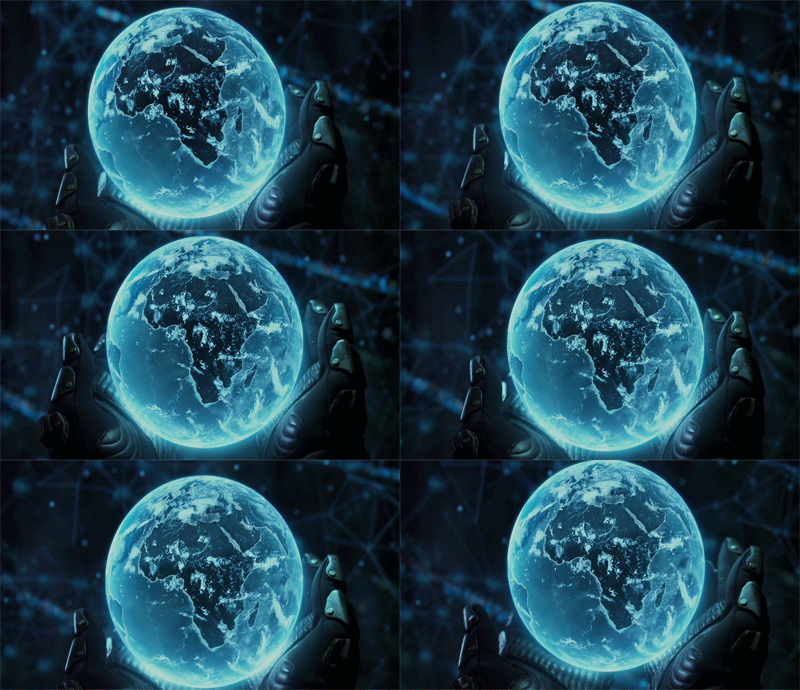
Multi-award winning author Greg Bear established himself as the most ambitious and imaginative of the potential successors to Arthur C. Clarke with his bestselling space operas Eon and Eternity. Tangents is his first collection of short stories and includes two tales that won both Hugo and Nebula ‘Tangents’ a remarkable account of contact with beings from another dimension, and the original short version of his classic novel Blood Music.
One of the books listed by Nihei as an influence on Blame!, I see it most in "Blood Music" and "Tangents", though pretty slight. Interestingly, Bear lists Stapledon as among his literary influences, thus making Blame! a faint descendant of Stapledon. There's certainly a strain of Stapledon's universalism to be felt here.
I found I enjoyed Bear's fantasies more than his scientifictions. Maybe I just find dated scifi from the 80s and 90s somehow even more dated than that from earlier eras.
★ "Blood Music" (1983) - 1) I really should've seen the end coming, but didn't. 2) How the hell did he expand this into a 300+ page novel? A mad scientist injects himself with experimental white blood cells enhanced with biological nanoprocessors. Things start weird and rapidly get weirder. A precursor to today's peptide bros. This is one of those stories that loses a little from its concept becoming commonplace, yet still packs some punch. May have influenced Nihei's concept that Blame!'s City is filled with nanomachines that prevent illness.
★ "Sleepside Story" (1988) - Captain Save-a-hoe as an "urban fairy tale," as Bear puts it. Definitely not what I was expecting from Bear. A young man is kidnapped by a witch-whore with a mansion full of ghosts that she is equally master and slave to. Her captive must decide between escaping and saving her. I'm always down for a good weird city story, and this one delivered and then some. I love how it mixes normality with the weird. The way it's written, you could almost not realize something's off until he arrives at the mansion. It feels like it has infinite potential for expansion, but as far as I'm aware it was a one-off.
"Webster" (1974) - A femcel conjures a man from a dictionary. Doesn't particularly go anywhere.
"A Martian Ricorso" (1976) - Martian explorers discover the non-existence of Mars' canals was greatly exaggerated. They arrive as hordes of Martians hatch from underground nesting sites and start deconstructing the ruins of the canals and aqueducts, their level of intelligence not entirely clear. Light story, drama pretty contrived. Would fit right into the Old Mars collection (derogatory).
★ "Dead Run" (1985) - A trucker works a union job transporting the damned to Hell. After picking up a hitchhiker, he begins learning more than he ever wanted to. Bear again mixes the quotidian and supernatural in an unusual way. It's not entirely clear how much "normal" people know about the business, and there seems very little sacred about the process. Has some twists, and was made into an episode of one of the Twilight Zone reboots.
"Schrödinger's Plague" (1982) - Deranged physicist commits an EPIC PRANK that may kill all of humanity. Eh.
"Through Road No Whither" (1985) - SS officers in 1979 meet some kind of goddess of time in France. Eh.
"Tangents" (1986) - A musically gifted boy helps a scientist try to visualize the 4th dimension, and succeeds beyond his wildest dreams. Bit of a riff on Flatland, the best of the shorter entries in here.
"Sisters" (1989) - A natural child deals with being different in a school full of designer children, which turns out to be more of a blessing than she could have imagined. The story takes a more positive view of the interaction between the natural and designed than usual. Everybody has their own problems. Not bad but not the kind of thing I go out of my way to read, and it ran a bit long.
"The Machineries of Joy" (1987) - A non-fiction article about computer graphics, never published in its original context. As you can imagine, it's a tad outdated, or of historical interest, if you like.
For my 10th and final fiction read of 2024, I revisited a discarded library book I've had since childhood whose publication predates me, the late Greg Bear (1951-2022)'s book of science fiction short stories Tangents. My first read-through of the book was in the mid/late 1990s when I was a preteen, and at that time, the story Sisters stuck with me the most. Sisters is about a not-too-distant future where most young people are genetically engineered for traits like physical beauty, hyper-intelligence, and physical adaptions to make them suited for superhuman tasks like living in outer space, and explores the protagonist Letitia's feelings about being one of the few non-genetically engineered teens in her school. Reading this story and this collection back as an adult, it occurs to me that Bear's writing of female protagonists is quite clumsy, most evidenced by his middle-aged female protagonist in the story Webster.
While re-reading Sisters brought up some nostalgic feelings, the story that stuck with me most this go-round was Dead Run, about a truck driver who, finding himself iced out of most transportation work, takes a job transporting the souls of the dead to "the low road" (i.e., hell). Honorable mentions go to Blood Music (the twist ending took me by surprise) and Sleepside Story (which I distinctly remember taught me a word that I probably shouldn't have known as a preteen; my parents were definitely not monitoring my reading at that age as this story is quite inappropriate for preteens).
My statistics: Fiction book 10/10 for 2024 Book 307 for 2024 Book 1910 cumulatively
Blood Music - A scientist's nanobots rework and integrate into his system... their system. Sleepside Story - A madame with a colorful past convinces a boy to appreciate her in a magical dystopia. Webster - A lonely woman dreams her dictionary to life, but remains unsatisfied. A Martian Ricorso - Martian first contact turns tragic when an unknowing juvenile martian stampede kills an astronaut and a second astronaut accidentally kills himself trying to fight them; the third is left unharmed. Dead Run - A trucker delivers souls to hell until he and they realize hell's rules aren't real. Schrodinger's Plague - A scientist sets up an experiment with deadly consequences and paradoxical set of probabilistic outcomes. Through Road No Whither - An alternate universe triumphant post-WWII Nazi crosses an old woman whose power is to rewrite history. Tangents - Fictional post-war Turing is befriended by a talented child and helps him play music for four-dimensional beings. Sisters - Genetically natural girl is discriminated against by genetically enhanced classmates, who turn out not to be as perfect as they were designed. The Machineries of Joy - Nonfiction article on computer graphics from 1984.
This collection has a lot of awe and wonder, but little optimism, and a lot of sadness. This book riffs on the ideas that the future is scary... which is unfortunate, because it can be wonderful and uplifting too, and that's more what I look for in science fiction. There are many interesting ideas, but I don't think I'd like to see any of these stories expanded... maybe something nicer in similar universes or with similar technological advances. It makes me question whether I'll like longer stories by this author. Written inclusively with respect to there being more than just straight white male characters. I forgot to review it when I originally read it three months ago, I found rereading it quite fast and easy.
This is a book of short stories by the science fiction author Greg Bear. Don't be fooled, however. Only one or two of these stories are actually science fiction. The rest are bizarre and often incomprehensible fantasy. None of them are fully developed and all of them left me wondering why I keep giving Greg Bear a chance.
The final chapter is a non-fiction story about 3D computer graphics which is hilariously outdated.
Tangents is an interesting collection of short fiction, plus one nonfiction story to wrap things up. This was a mixed bag for me as I really do not like fantasy and at least half of the stories were fantasy rather than the science fiction I was hoping for. Still, this was a fun read and even the fantasy content kept me turning pages. I listened to the audiobook on Audible but also have a paper copy. The audiobook featured both a male narrator, Brennan Taylor, and a female narrator, Therese Plummer, and having both of them really added to the experience. A summary of the stories follows:
"Blood Music" - a bio-horror/sci-fi story about a scientist who injects nanobots in to his blood and things don't exactly go as planned. For him. Bear expanded this in to a novel which I'll have to check out.
"Sleepside Story" - a boy from the other side of the tracks befriends a prostitute with magical powers which causes her to change in unexpected ways.
"Webster" - a lonely woman magically creates the man of her dreams but their relationship doesn't grow as she hopes.
"A Martian Ricorso" - a mission to Mars involving first contact doesn't go well for the three astronauts on the red planet.
"Dead Run" - things don't go as planned for a truck driver in charge of delivering souls to hell.
"Schrodinger's Plague" - a gripping, mind melting story about a deadly viral pandemic, or not?
"Through Road No Whiter" - Nazis on a road trip come upon an old lady who isn't who she appears to be.
"Tangents" - a scientist famous for his work cracking codes in WWII encounters a boy who seemingly can see and communicate with beings in the fourth dimension.
"Sisters" - in the future where many are genetically modified to be physically attractive, a natural high school girl struggles to be part of the group.
"The Machineries of Joy" - this is a non-fiction article which Bear wrote for Omni magazine in 1984 in which he talks about the future of computer technology especially how it relates to movies. I found it fascinating. He predicts many of the things we take for granted now regarding CGI and gets some things wrong, too. Very relatable for those of us who were first dabbling in computers around that time, as I was as a college boy.
Overall, there weren't a lot of feel good stories in this collection. Most were pretty dark and some were really dark. Standouts for me were "Blood Music", "Sisters", and "Schrodinger's Plague". I've got a number of Bear novels on my shelves I need to get to now.
4.75 Stars! This was my first introduction to Greg Bear, and I am very impressed. His writing is so great!
After hearing of his passing, I decided to read one of the many books of his I own but haven’t got around to yet. I started with this one and am very happy with that decision. I loved it!
My favorites were probably “Tangents” and “Sisters”, but so many I gave 5 stars to, which is pretty rare for a collection. All of the little music references in practically every story was neat too. I can safely say this is definitely one of the best short story / novelette collections I’ve ever read. Enjoy!
Blood Music: 5 Sleepside Story: 4 Webster: 5 A Martian Ricorso: 5 Dead Run: 5 Schrödinger’s Plague: 4 Through Road No Whither: 3 Tangents: 5 Sisters: 5 The Machineries of Joy: 5
Quotes: - “Science, for him, was like the woman you couldn’t possibly have, who suddenly opens her arms to you, long before you’re ready for mature love—leaving you afraid you’ll forever blow that chance, lose the prize.” - “There is only so much change anyone can stand: innovation, yes, but slow application. Don’t force. Everyone has the right to stay the same until they decide otherwise.” - “The great shall mimic the small.” (p36)
- “They were pimps in a whorehouse without whores… there was nothing much lower than that.” (p87)
- “Her name, Coates, was not in the dictionary. There was Coati, Coatimundi, coat of arms, coat of mail, and then Miss Co-author, lover to a handsome author. They would collaborate, corroborate, celebrate. Celibate. She shut the book.” (p91) - “Obtuse, acute, equilateral, isosceles, vector, derivative, sequesential, psych-integrative, mersauvin powers… That’s the future of mathematics for the next century… Words mix in blood, my blood is made of words… Words are numbers, too. Signs and portents, measures and relations, variables and qualifiers.” (p100-101) - “You don’t need something real to kill a dream. All you need is a little sunlight.” (p105)
- “Like in most jobs keeping one’s mouth shut is good policy. That and don’t volunteer.” (p142) - “I never saw beauty. I saw only dirt. I loved the dirt and the clean just passed me by.” (p151)
- “A monster walked through her generation, but it would not touch her.” (p228) - “The darkness beyond the stagelights seemed so profound it should have been filled with stars and nebulae. Would her small voice reach that far?” (p231) - “There are some things nobody’s saying, and they should be said. If nobody else will say them, then maybe I can… People have made mistakes, bad mistakes. But you are not the mistakes. I mean… They weren’t mistaken to make you... We’re different in a lot of ways, but I just thought it was important to tell you… I love you. I don’t care what the others say. We love you. You are very important. Please don’t forget that. And don’t forget what it cost us all.” (p236-237)
- “How can a computer hope to match the work of a skilled cartoon animator, much less the reality of a human being?” (p251) - “Few artists or writers have ever made anything worthwhile by pandering to the lowest common denominator, yet this is the current state of most of network television.” (p254) - “The printed word allows more freedom. A pencil and a piece of paper are all that is required for expression in print...” (p254-255) - “The dilemma is clear. Print offers diversity and individual expression—as well as the active participation of the reader, in imagining and fleshing out what the words convey—but cannot reach as many people as television or motion pictures.” (p255) - “The author, by the way, is highly enamored of books and other print media. All letters of protest should be addressed to people not yet born.” (p260)
This is a collection of short stories by Greg Bear, and they are not just Science Fiction though looking at the cover art, I thought that was what I was in for.
And gladly, I was not. The tales contained in this collection are quite different and thoughtful. It’s easy to see why Greg Bear is a multiple Nebula and Hugo winner.
“Blood Music” is a very neat look at one reason we may be alone in the universe.
“Sleepside Story” reminded me of Dickens and Poe and I’m not quite sure what else. Pretty creepy tale set all mythological like. Effective, if strange.
“Webster” was a weird fantasy tale - notice a not just Science Fiction trend here - and I read as a person was created from a dictionary. I kid you not.
“A Martian Ricorso” was a more true to form Science Fiction - but it was bent all to hell as well.
“Dead Run”, and speaking of hell. Ever want to drive trucks filled with the dead going there? Yup, that is what this tale is all about. My favourite of the collection. Very odd but enjoyable.
Several other tales make up the rest of this collection which, in my estimation, is worth picking up if you can still find it.
Like I said earlier, it is not wonder Greg has won so many awards. But not only are his ideas odd, but the stories themselves are well executed. He is a good writer.
I’ve read a few novels from Greg Bear, but not in a long time. I think maybe it’s time to go blow the dust off of some of them on my shelf and give him another go.
Tres estrellas y media. Pero lo que le bajo la media estrella a este libro no fueron las historias si no el audiolibro. Estuvo malona la narración y que no haya diferencia entre historia e historia está gacho pareciera que solo lee otro enunciado y pum se inicia de nuevo.
Сборник, если откровенно, довольно средненький. Если бы не шедевральная "Музыка в крови", было бы совсем плохо.
Далее по отдельным рассказам:
Sleepside story Прихотливая urban fantasy, больше похожая на Мьевиля, чем на Бира. Герои живут в типично мьевилевском городе, где метро днем перевозит живых, а по ночам — души самоубийц. Сутенеры не только избивают своих шлюх, но и накладывают на них древние проклятия. А по улицам разгуливает минотавр, серебряными ножницами перерезающий нити жизни грешников. Читается неплохо, но без восторга.
Webster Очень странный рассказ про немолодую одинокую женщину, у которой старый словарь внезапно превратился в мужчину и она пыталась заставить его с ней жить, но тот не растерялся, купил себе другой словарь, превратил его в женщину и дал деру.
Dead run Герой рассказа — дальнобойщик, перевозит души мертвых в Ад. Правда, никакие вечные муки им не угрожают, Ад — это просто огромное поселение, куда ссылают души, забракованные для Рая. Ну и они там строят себе домики из подручных материалов и живут себе дальше. Чертей в Аду довольно много, но они все заняты на подсобных работах, а управляют системой обычные люди. Людей раньше назначал сам Господь, но он отлучился и предприимчивые хуманы тут же взяли управление на себя, организовали корпорацию, сами решают, кого отправить в Ад (с грехами и праведностью усопшего это никак не связано, как менеджеры решили, так и будет), короче, живут в свое удовольствие. Герой ездит туда-сюда, грустно смотрит на происходящее, временами порывается уволиться, но ему не дают. Он опять пытается уволиться, но ему не дают. Ну и в целом как-то так проходит его жизнь. В целом рассказ не сказать чтобы захватывающий, но сеттинг безусловно оригинальный — особенно идея о том, что Господь никогда не планировал отправлять геев в Ад, это уже мы сами, все сами, своими руками.
Through Road No Whither В альтернативном будущем два фашиста едут по покоренной Европе и в глухом лесу натыкаются на избушку старухи-ведьмы. Принимают бабку за цыганку, начинают угрожать. Бабка серчает и отправляет их в альтернативное прошлое, прямо под пулемёты доблестных американских освободителей. Бабка сыплет им вслед библейскими цитатами, толсто намекая читателю, что она есть воплощение Яхве и «аз воздам». Конец рассказа (разводящий руками смайлик)
Sisters Хорошая НФ, по моему глубокому убеждению — это не только репродуктор передовых научных идей, но и мощная лупа, позволяющая под большим увеличением изучать реальные социальные проблемы. «Сестры» Бира как раз из этой категории. Рассказ чисто о страданиях некрасивой школьницы из простой семьи, которую унижают красивые и успешные одноклассники. Только здесь школьница некрасивая не потому что так жизнь сложилась, а потому что она единственный «натуральный ребенок» на всю школу, по воле отсталых родителей лишенная пренатальной генетической терапии. А вокруг все дети сплошь генномодифицированные, следовательно, умнее, талантливее и красивее ее. Правда, ничуть не добрее. И вот девочка в очередной раз возвращается из школы в слезах и спрашивает у родителей — мама, папа, за что вы так со мной поступили? А им и ответить толком нечего, кроме околорелигиозного мычания, «манипулировать с природой человека большой грех», «наши тела изначально созданы несовершенными, в этом есть высший смысл», все такое. Но, находясь в этой тяжелой ситуации — в школе травят, дома поддержки ноль — девочка все-таки находит в себе силы вырваться из порочного круга, социализироваться, даже подружиться с одноклассниками. Причем все происходящее описано просто мастерски, скупыми, но очень психологически точными штрихами. Ну, думаешь, прекрасный рассказ, десять из десяти, просто современная классика. Но не тут-то было! Ближе к финалу Бир вспоминает, что он все-таки католик и надо бы пояснить читателю за греховность генной терапии. И в рассказе моментально начинается ужасная эпидемия, миллионами убивающая «пробирочных» детей, а натуральные становятся героями дня и обращаются к публике с натужно-приторной речью про «бог есть любовь». Вот как Господь карает грешников! Вот, вот награда истинно верующим за их долготерпение и унижения! А жаль, реально талантливый рассказ вырисовывался.
Tangents 00:00:00 - 08:52:08 BLOOD MUSIC (later expanded into novel Blood Music) 00:00-01:07:40 Len 1:07:40 Scary tale of bioengineering gone wrong. 90%
WEBSTER 02:58:00 03:35:30 Length 00:37:30 man made from words 70%
A MARTIAN RICORSO 03:35:30 04:20:36 Length 00:44:24 visit to mars 95%
DEAD RUN 04:20:37 05:30:36 Length 01:09:41 Trucker of souls discovers corruption in afterlife sorting 95%
SCHRÖDINGER’S PLAGUE 05:30:36 05:50:36 Length 00:20:00 Mad physicist threatens humanity with a 98% lethal virus. Release depends on quantum waveform collapse triggered by you “observing” this tale! 40%
THROUGH ROAD NO WHITHER 05:50:36 06:04:10 Length 00:13:34 Lost in France a Nazi abuses an old crone in an alt. 1984. Oblivious, he’s sent back to 1944 , “his fathers time”, into a Spitfire’s sights 75%
TANGENTS 06:04:10 06:45:00 Length 00:40:50 Excellent story about a boy who sees in higher spatial dimensions 95%
SISTERS 06:45:00 08:10:05 Length 01:24:05 A relatively “ugly” 15 year-old schoolgirl struggles with being uniquely different. She was not genetically designed for beauty, health and IQ, so she’s the only “natural” female teen in her 2070 class. To be overcritical it overran after thalidomide analogy was revealed but still gets 90%
THE MACHINERIES OF JOY 08:10:05 08:51:42 Length 00:41:37 Quite prophetic from a 2017 to 1984 perspective. Documentary about history of computer graphics, how Cray 1 & 2 was used to create “The Last Starfighter” , mentions Voyager animation in 1984.
This is my first contact with Greg Bear's work, and unfortunately this is the very definition of a mixed bag. To be truthful, there are only two really good stories (among the nine) here in the form of Blood Music (which won various awards) and Dead Run (which did not but it darn well should have). Tangents which is the other award winner I suspect only won the award because of its underlying subject matter.
Other stories like Sleepside Story and Sisters range from confusing to incomplete to WTF in some cases. Also, this book one would think would be all Sci Fi (due to the cover and what Mr. Bear is known for) but only Blood Music, Tangents, and Sisters really fall into that category. I blame the publisher more on that one though. I would even say hardcore Greg Bear fans might only want this collection of short stories to complete their collection for its doubtful they will ever come back to it.
Finally, I did want to say for those who are only reading the award winners and interesting stories I have outlined here might also want to take a look at Machineries of Joy. It is a non-fiction piece at the end of the book that is about computer graphics (from the 80's) with a tiny fiction piece at the end. As the author even mentions it seems dated now, but there are some interesting ideas that can sound an awful lot like 3d and VR technologies today.
I feel that this collection is quite underrated; I enjoyed most of the stories and REALLY enjoyed a few of them. There was one dud, “Websters”, that I didn’t particularly care for, but overall it was an exceptional, cohesive collection that I return to frequently, especially for such classics as “Blood Music” or “Tangents” or “Schrodinger’s Plague”. My favorite story was “Blood Music”, and a close second would be “Schrodinger’s Plague” (a very short, scientifically funny piece about quantum physics).
I liked what little of Greg Bear's writing I had encountered before, but this is an extremely strong collection of stories. "Sleepside Story" is one of those legendary short stories that will stay with you for a long time, like "Replacements" by Lisa Tuttle, or "Pop Art" by Joe Hill. This was a pleasant surprise for a $2 impulse buy at the bookstore, don't pass this up!
Okay book. Some of the short stories have interesting premises but mostly aren't developed enough. I've read full length books by Greg Bear so I know he can create characters to get invested in. He just doesn't do it here, perhaps due to lack of time.
DNF'd part way through the second short story. I remember really liking Bear, but didn't care for the first story and couldnt stand the second. Might have to reread a novel of his and see if I still like him as an author.
De verhalen zijn van een nogal wisselend niveau. Sommige boeien ontzettend en vragen erom in één ruk uitgelezen te worden, anderen kosten veel meer moeite en leg je gemakkelijk tussendoor even weg.
There’s one simple instruction for the person who imagines she might want to be a writer: read. Marilynn Robinson said it. Steven King said it. I’m saying it too. Are there other careers like that? Probably. Do you want to be a famous composer? Listen. Do you want to be a painter? Learn to see. Do you want to be a writer? Read.
This means it’s going to be important what books are on your shelves, particularly what books are on your “to read” shelf. I know some writers collect books impulsively, simply for the love of books, and they live in wonderful houses bricked up with shelves of books they have no intention of ever reading or that they imagine they one day might get around to reading. There is a certain freedom of genius there. I’m far too rigid for something like that though. The books on my diminutive “to read” shelf I have every intention of (some day) reading. Otherwise why would they be sitting there?
It’s not a very big shelf. (My house isn’t big enough—or at least lacks the shelving—for the other sort of approach.) Which means that when I wander into a huge annual used book sale in the basement of the public library of my home town and can come home with a large bag of books for something like three dollars total, I have to be very careful. I pick. I chose. I collect a large pile of titles that catch my eye, and then I whittle it down to half that.
What do I want to read that might conceivably help me improve my craft? Someone who had donated to this particular book sale had a collection of book club editions of important science fiction authors—most interestingly, anthologies of short stories, including several authors I’ve been meaning to explore: Phillip Jose Farmer, Samuel Delany, Fritz Leiber. And this one, a slim volume of eight or nine of Greg Bear’s short fiction.
I was ill when I was reading most of it, recovering from a stomach flu. I’m glad I had already gotten through the first part of the work when the bug hit, otherwise reading the first story in the volume, “Blood Music,” might have hit too close to home: a scientist engineers super-intelligent microbes based on his own cellular structure, and then introduces him into his bloodstream. What happens when a human becomes host to trillions of intelligent beings, when he becomes a galaxy unto himself? What if the galaxy were alive, and we were spreading to fill it, learning to communicate with it? What would it mean when it was time to start colonizing others? I saw glimmers of some of the darker bits of Leviathan’s Wake and its proto-molecule here.
But Bear can also do quite excellent literary fantasy, as the second work—a novella, really—in the volume shows. I had an interesting experience sitting in my yard (this was also before the stomach bug), distracted, trying to read, when one of my older sons stopped in his bike riding abruptly to ask me about the book. What’s it about? It’s a book of stories. About what? And I remember doing the exact same thing to my dad when I was a kid and he was reading some random scifi anthology and then being fascinated with the ideas that unfolded in each summary he gave. But I wonder now how distracted he was in the telling and how many details he had to gloss over, as I did explaining “Sleepside Story,” which is about a young man who has to go live in a witch’s house.
Bear here has created a gritty, magical precursor to Mieville’s New Crobuzon in which a boy is traded as a servant into a haunted, enchanted brothel. The details and dreamlike quality of the story are in wonderful contrast to the exacting concepts of Bear’s hard science fiction (though the language remains sharp in this piece as well—focusing on certain surreal details with almost scientific exactitude). Even more haunting than the setting though are the ideas of what it means to be a prostitute, even a very good one, and what kind of love might it take to free someone of the bonds of the past.
Each piece in this collection is excellent, with the most famous being Bear’s award-winning short story about an Alan Turing-like character who fled Britain secretly instead of undergoing hormone treatment for his homosexuality and his unlikely friendship with a young boy who can see in the fourth dimension. I had read this story before, but this time (and maybe because I was ill and running on very little sleep) I wept like a baby when I finished it.
If I was more thoughtful I’d end this review by tying it back to the beginning and noting some of the things that Bear teaches about the craft of writing through this collection. I’d talk maybe about the way he plays with hard science in his piece on a surprisingly inhabited Mars, “A Martian Ricorso,” or the terrifying implications of quantum mechanics in “Schrodinger’s Plague” or something about the way he creates characters who feel true to life even in Hell in “Dead Run” or in the near-future “Sisters.” But that would be too much work, and beside the point if the point is simply to be absorbing good fiction. Because in this respect, Bear’s short stories are an ideal place to begin.
Why did I become a science fiction reader in childhood and stay so involved in the genre until adulthood? One reason certainly was that I read people like H.G. Wells and George Orwell almost as soon as I learned to read and that early positive experiences got me on the path to developing a self-reinforcing habit. The more one knows in a field the more one gets out of pursuing the study. Also, the culture was pushing science and, as a way into it, science fiction. The Soviets were ahead in the space race, their kids had stronger science backgrounds and they were producing more engineers. Even we little kids saw the difference when new books, some of them simply magazines produced by major manufacturers, were introduced about rocket science, nuclear power and the like. The math curriculum radically changed in the middle of fifth grade. Our literature readers were amply packed with science-related fiction--science fiction. On the popular front this was reflected by the proliferation of cheap sf titles, sf movies, sf comics etc. Throughout, there was a great body of this literature which concerned itself with war, the final atomic war and its dire consequences should we lose the technological race with the communists. It was a scary time. It was also an exciting time. I, we, the culture as a whole believed in newness and its value, in progress--progress towards being the first on the moon, on Mars, on the iron-rich asteroids. Jets replaced prop planes in the skies. Cars grew fins and projecting tail-lights like rocket exhausts. As a kid I firmly believed the ads, that each year's new issue of automobiles represented decisive steps forward in technology. Everything was getting better, bigger, faster, more convenient, more accessible to more people. And indeed the economy of the USA was growing as I grew, most indices of the standard of living improving until the early seventies, peaking around '72, then declining, declining until the fuel embargo in the mid-seventies really rubbed in the limits and contingencies of growth--growth under capitalism, the economic cancer, that is. We barely made the moon and probably wouldn't have bothered were it not for the Cold War. We would take many years now to even reengineer a technology to return. After decades of increasing immisseration around the world, class-divisions domestically, diminishing expectations and heightening anxieties, there is much less a sense of excitement among the young, much less a resonance with the kinds of grand missions enunciated, say, in Kennedy's inaugural. Science fiction too, I venture, has tended to turn inward, grow more reflective, more pessimistic.
This collection of short stories from the early portion of Greg Bear's career includes several hits alongside a few misses in both hard and soft science fiction. There's even a nonfiction article on the state of technology included in the volume that really dates the book.
Overall, it's a worthwhile read and has more than a few interesting themes, and is definitely good enough for me to consider it above average. Nevertheless, I hesitate to completely recommend it, as it does not (in my opinion) include Bear's best work, which is generally longer form scifi. Still, if you want to read a few good short stories, many of those you'll find in this volume will truly make you think.
The excellent collection gathers together many of Greg Bear's best short work from the early part of his career (1973-1989). It contains two of his classic sf short stories - "Blood Music" and "Tangents" (both winners of the Hugo and Nebula awards), as well as the excellent sf stories "Schrodinger's Plague" and "Sisters" (which nearly moved me to tears). Though Bear is best known for his hard sf, the collection also includes a couple of fine fantasy stories - "Dead Run" and "Sleepside Story".
Man was I blown away by this collection. I have never been a huge Bear fan but I was basing that mainly on Darwin's Radio. That was a decent book but nothing spectacular. Thus I guess I kind of dismissed Bear.
This old (1984) collection of his short stories completely changed my opinion. This book is loaded with incredibly moving and powerful vignettes. I cried a few times, I admit it.
Whether or not you have any opinion of Greg Bear, you should read this book.
When I bought this book I didnt even know who Greg Bear was. Turns out an excellent addition to my SciFi and Fiction exposure.
A good variety of themes are explored in this collection of tales with some even hellish and others creepy, not quite Stephen King style but at least one reminded me of it.
I recommend this book to anyone with an open mind.
I personally found the ending of Blood Music viscerally repulsive -- which is not to say it's not a good story; just that it didn't make me want to run right out and read the novel length version. Otherwise a very enjoyable collection.
The title story is one of the most memorable short stories I've ever read. For several years I forgot its name or who wrote it, and was going crazy searching the web for "dup, owen, reft, and light" and not finding any references to this 5D version of Flatland.