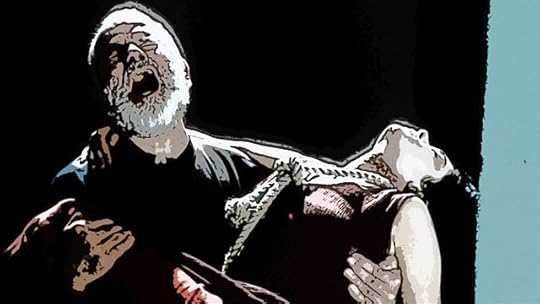
Original take on the history of a pivotal British year through the lens of the words of Shakespeare, contemporaneous sermons, and a few diarists (in an era when critical words in a secret notebook were treated as treason). James Shapiro--a retired Shakespeare professor--begins the previous November 5, 1605: the exposure of the Gunpowder Plot. After the Kingdom first is relieved by the deliverance of the King, his family, the aristocracy and Parliament from being atomized, repercussions soon divide the England. It turns out the Catholic plotters used a Papal-sanctioned technique called "equivocation" that allowed them to lie, even under oath. Suspicions, including of witches and demons, soon swept the kingdom.
All this at a time when King James is seeking to consolidate his grip on the throne as a legitimate Tudor successor (through his mother-in-law), and dim the memory of Good Queen Bess. He also wants to unite the thrones of England, Ireland, Scotland and (rump) France into a single "Great Britain"--as James believed were united by God in his person.
The national mood found its way into Shakespeare's 1606 trio of plays: Macbeth, Antony and Cleopatra, and King Lear. (Keep in mind that 1606 also was the year of the King James Bible--quite an English language milestone.) Although Shakespeare starts writing Lear in expectation of Union, the play isn't performed until December 26, 1606--by which time Parliament had rejected accepting Scotland. Given Lear is about dividing a kingdom, Shakespeare likely originally intended it as warning against disunion. By December, it's astounding the play survived--because the message received was not to tinker with borders. Unsurprisingly, the play's brutal ending has been altered continuously since it first was published.
Lear and Macbeth each includes ample equivocation, a word not even in the language (much less Shakespeare) before 1606. Equivocation is the signature device of Macbeth: it makes the dialogue a "mentally exhausting experience for most playgoers". The Sisters' advice is the most famous equivocation, though nearly every line of Macbeth is equivocal. Still, no one can forget Macbeth's astonishment when "Great Birnam Wood . . . comes to Dunsinane" (in the form of cut branches) and Macbeth is attacked, though safe from any man "of woman born" (Macduff had a caesarean birth):
"equivocation of the fiend/
That lies like the truth."
Lady Macbeth equivocates plenty on her own; even Macduff.
Also common to Lear and Macbeth are quotes from books about demonic possession (most obviously, Macbeth's Three Sisters). Shapiro traces this to where the blame for evil lay:
"[A]fter November 1605, the dynamic [of blaming human frailties] shifted. Perhaps it was the shear magnitude of the threatened destruction from the vault below Parliament that led to the demonization of the plot. In the first official sermon after Guy Fawkes was caught, William Barlow had spoken of a 'fiery massacre [that didn't occur, of course] kindled and sent from the infernal pit.'… By the time we get to young John Milton's poems on the Gunpowder Plot, human responsibility hardly figures, the focus almost exclusively on evil's satanic origins. The increasing weight given to diabolical forces suggests that the executions at St. Paul's and Westminster that stretched from late January into early May of 1606 served, in part, as a kind of public exorcism meant to rid the kingdom of that devilish evil--A RITE RECALLED AND SYMBOLICALLY REENACTED EVERY FIFTH OF NOVEMBER." (Emphasis added.)
Shapiro makes a similar connection later:
"Though no destructive attack took place on the Fifth of November, something had changed irrecoverably in the culture, a change registered in Macbeth. Its moment of creation may partly explain why Macbeth's ending feels so unsatisfying, its hasty restoration of order so flimsy and inadequate. [NOfP note: Shakespeare HAD just killed off a Scottish King; perhaps it was a requirement of the royal censor.] … Social historians tend to fix 1615 as the moment when the great hopes for King James's reign ended… Literary historians would probably locate the end of high hopes for James's reign as early as the spring of 1606, and Londoners who saw Macbeth and passed below the severed heads [of those executed for the Gunpowder Plot] likely would have agreed."
Given the increased suspicion after the plot, it is surprising, on its face, that Shakespeare would have devoted the latter part of 1606 to writing a sequel to Julius Caesar. Although, obviously, Shakespeare make a living off of history play sequels (there are how many parts of Henry 4th?), history had not treated Antony or Cleopatra well, and reminding audiences about a powerful Queen who was beautiful even as she aged was an unlikely topic for a member of "The Kings Players." But Shakespeare didn't hesitate, so "Antony and Cleopatra" is best seen as a "nostalgia play"--all but wishing for return of the now spent Tudor line.
As a result, rather than treating Antony as debauched and effeminate, Shakespeare made him seem even greater than Caesar--sending gold to the Roman soldier who betrays him, and telling Cleopatra not to mourn, for he was bested by the best, a Roman soldier. Shakespeare then re-invents the famous death scene by transferring the snake's bite to her bare breast (easier to do with boy actors playing women's parts) where it has remained in popular thought ever since. Indeed, he even provides Cleopatra with the noblest of motives: she dons her crown and takes hold of the asp that will kill her "to meet Mark Antony."
Shakespeare would write again after 1606, including great works such as "All's Well That Ends Well" and "The Tempest", and some very good plays, including "Coriolanus." But it took until 1776 for the world to turn on its literary AND political axis in the same way as it did in The Year of Lear.


 http://www.bbc.co.uk/programmes/b06gqdwm
 1/5: The Theatre: The ferment in the country and King James' insistence on an Oath of Allegiance brings religious tensions to the fore in 1606. Anyone refusing to take communion (and therefore presumed to be Catholic) was fined. These matters come very close to William Shakespeare when a member of his family refuses communion in Stratford Upon Avon.