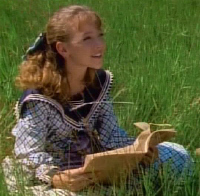
Tyron Dunham agrees to help a young woman to safety after she approaches him at a train station, but she disappears before he can learn anything about her and he tries desperately to find her and determine her true identity
also wrote under the pseudonym Marcia MacDonald also published under the name Grace Livingston Hill Lutz
A popular author of her day, she wrote over 100 novels and numerous short stories of religious and Christian fiction. Her characters were most often young female ingénues, frequently strong Christian women or those who become so within the confines of the story.
A funny thing happens to Tryon Dunham on the way home from work one evening: he gets the chance to be a hero and save an actual damsel in distress! No, really! And he's even able to secure more time with her, if only to get her to accompany him to a stuffy dinner party. He doesn't even know her name and rushes to come up with one with which to introduce her around at the dinner. Afterwards he helps her continue her escape. "Did that really happen?" he wonders that night, the next morning, the next week. But it must have happened: he cannot forget her, he can't stop wondering what her situation was or what will happen to her "from now on."
Thanks for reading, and I hope you'll "try on" this mystery and it will fit your reading taste.
4.5 stars We listened to this on a too-long road trip. It's engaging and the Librivox narrator did an excellent job. Tryon is out walking toward his home when a girl asks for his help. Circumstances throw them together for the entire evening, and by the time he bids her goodbye, she's carved out her own special place in his heart. Mary won't give her last name and says she is in danger, and pretty soon he can't help himself from trying to find her in Chicago and help her out.
A bit fluffy, but entirely enjoyable. Also, if you're expecting to find the strong Christian influence that is normally in her writing, this one mostly just mentions that they are people of strong faith, and that's it, so don't go into it expecting more.
What I didn't like: Tryon lies to his family outright and has no qualms about it. Thus, not suitable for younger children who don't yet realize it's wrong to lie and that consequences usually ensue.
This is a rather lightweight romantic mystery that does not require too much of the reader. It is relatively short, and progresses quickly and smoothly through an interesting plot. The stereotypical main characters -- "damsel in distress" and " knight in shining armour" -- were fairly shallow. It is an entertaining, rather than an engaging, story. The saving grace for me, though, was that the "damsel", in spite of her sheltered upbringing in society, was very strong when faced with an impossible situation. I was rooting for her as the end drew near.
I decided to listen to a Librivox recording of this book because the reader is one of my favourites (Lee Ann Howlett -- she always does a terrific job!) and the author's birthdate qualifies her for my literary birthday challenge.
Meh. I wasn't too fond of this old novel. It was just okay. I thought I'd like it more by the synopsis. It began well enough. I was curious and intrigued toward the beginning. I wondered who was this mysterious Mary and what was her story? Tryon was so nice and gentlemanly. I thought people aren't like this anymore. But toward the middle it begun to drag and by the end I really could have cared less who Mary was or wasn't. And thought Tryon was tiresome. Tryon loved her?! He didn't even KNOW her. That annoyed me to no end and made the story EXTRA unbelievable. I did some fast forwarding.. The equivalent of skimming pages and was glad for the end.
A day after finishing A Christmas Carol on LibriVox(an audiobook app), I was searching for a new book to listen to. I generally read two books simultaneously, audiobook and another conventional one. And I found a writer, Grace Livingston Hill and her great deal of contribution to literature. When I went through her novels list, I realised that she had written 100+ novels and stories in her lifetime. What a wonderful find I thought. From her vast list, I chose The Mystery of Mary as my first read, and it turned out to be so good. Needless to say, great job done by the reader, Lee Ann Howlett.
The story begins with a young gentleman Tyron Dunham meeting a estranged woman Mary at the station. She seemed to be followed by someone. She might be a lunatic fled away from asylum. She might be a murderer. There were endless possibilities but Dunham being gentleman and intrigued by the mysterious woman, he decided to help the lady with all his might. With progress of the story, they fell in love. But it's not typical mushy love story.
The love story of Mary and Dunham(the protagonists) progresses with tinge of mystery until the last line. Each time some romantic lines came in, I thought Mary would harm him the next. That was the binding of the story. You can't leave it midway until you know what happens at the end. The character of Dunham is a pure gentleman in every way, a dying breed with time. Mary's character seems interesting, beautiful and mysterious at the same time. Okay, I should admit, sometimes you would feel you're reading Agatha Christie's.
I won't say the story was extraordinary but it was worth the time because of Hill's impeccable writing and gripping tale. The plot could have been stronger in my opinion, but it was sufficed by the great character development and dialogues. One should definitely give this book of hers one chance it deserves.
Lastly, I'm so glad that I discovered GLH. Gonna read more of her. :)
Mr. Dunham, handsome and wealthy (of course), helps a lovely young stranger escape from some dastardly pursuers through a dark train tunnel. He keeps her safe that first evening by including her in a private dinner party he was invited to, then helps her catch a train to Chicago. She keeps her identity a secret, yet her earnest spirit, masterful musical talent, and quiet beauty stir his heart. Months later he is able to visit Chicago to search for her, and learn the rest of her story. In some of Hill's books the characters share their faith often, in others, like this one, their integrity is just lived out in their character. I am so glad I stumbled upon her treasury of wholesome, earnest, interesting novels. I listened to this as a free audiobook download from LibriVox.org. Copyright 1910.
I believe this is the first Grace Livingston Hill novel I've read, though I own many of her books. It was an enjoyable story, definitely dated but that was a lot of the fun. I enjoyed seeing how people behaved over a hundred years ago. Tryon was a good character, I didn't like his lying to cover his behavior but his caring side trumped that. Will definitely be reading more by this author.
Short and sweet; I loved it. Once in a while, I enjoy reading a sweet, fluffy, romantic story that just makes one sigh contentedly. The mystery-like aspect thrown in with the romance was also very nice.
This is the shortest of Grace Livingston Hill's stories that I read, but it is no less delightful as a result! Believe it or not, this 127 page story is full of action and romance, mystery and intrigue, and from start to finish Hill does not We witness wealthy young lawyer, Tryon Dunham, on his way home after a journey. He's expected at a party that he's not keen on going to, but he's a man of his word so he has to make it. Whilst looking for shortcuts across train tracks so he can get home faster, a figure in the dark approaches him and begs him for help. Lo and behold, a mysterious young woman in a strangely fancy dress seems to be in need of his help, and from there our story begins on the mystery of "Mary".
In terms of how this story flows, it's more or less 99% action with just a teeny tiny touch of faith with one or two short Biblical references, and also the confirmation that Tryon is a member of the church and that he feels it's his "God given" duty/pleasure/etc. to seek Mary out and protect her. Otherwise though, faith plays virtually no role in this story, which, out of all the stories that I've read by Grace Livingston Hill so far, may actually be the least that I've ever encountered. Maybe this makes sense in how it's also the shortest story?
In any case, I quite enjoyed it and if I'm ever looking for a short Grace Livingston Hill read, either this or Exit Betty will be my go-to.
If you can overlook the sexism/classism/racism, you will also have to overlook large plot holes. The book was first published in 1912 so I didn’t expect it to match modern thinking but this was just too much. I found myself yelling at the book about how pretentious it was, the entire time. I have a bad habit of not being able to stop reading a book once I start, and this really showed me that my habit of finishing all books is stupid. It is short, so I gave it one star for that. Otherwise thumbs all the way down.
This is a rather short novel, and it is, indeed, a mystery. But, c'mon, it's Grace Livingston Hill, so it is also a romance, of course.
It's set in the 1930s or 1940s. It starts with a young man getting off the train in a suburb of Philadelphia, who is late for a dinner engagement and cuts across the tracks to save time. A young woman comes up behind him and asks for his help, since he looks like a gentleman. She has no hat or gloves--scandalous at the time--and will not tell him what her problem is, but seems quite frightened by something. He has her get into his cab and has it wait with her in front of his home while he changes for dinner. His hostess calls, and she's short a female guest: can his mother or his sister come in her stead? They're not available, and he tries to beg off, claiming he has to help a friend who is traveling. Oh! Can she come? The hostess also lets him know a man who might lure him to a better job might be there.
He brings the mystery woman, whom he calls Mary Remington (the first name he found in the phone book while trying to put off the hostess) to the dinner, wearing his sister's hat and gloves, and his mother's raincoat. The man who might offer him a job met Mary earlier, when she disappeared, and she strives to pretend to be someone else.
After the dinner our hero takes the mystery woman to the train station, gets her on a sleeper to Chicago, and has his man bring his suitcase which he had packed for a trip that had not happened. He's bought her a small change purse and puts every nickle he has on him in it. She insists on giving him one of her rings in exchange and promises to return his things as soon as possible.
The book chronicles her finding employment that will not give way who she is, with no references at first--quite a feat in that day and age. She gets new, cheaper clothing and sends everything back to her benefactor: hat, gloves, raincoat, her original costume, and the contents of his suitcase. No address.
Our hero is rather frantic that he has no idea how she is.
I won't tell you more. How he eventually finds her and what she is running from make a really, really good story.
This is the first time a Grace Livingston Hill book has let me down.
The story starts on a good note. Tryon is traveling home and in a hurry so he cuts across a train yard where he meets a woman fleeing in the dark. This sweet lady is frightened out of her mind. Things fall apart from there.
Tryon being the gentleman offers to help her. Somehow in this single night of being together (not in any crude way, mind you. Tryon is always a gentleman),
Wait...what?
Okay, the plotting here was pretty weak. I'm thinking Grace must have been having one of those years where she just felt like she needed rescuing. Given she was generally fairly prolific with 2-3 books out per year and this was the only book she wrote in this particular year I'm going to say she had Stuff Going On and really did her best. What happened was this short book which just really was over the top romantic / sappy / a little creepy because it was the story she had the ability to write that year.
With this in mind, I can forgive her this one. Not the greatest book by her, but it had an interesting start and who knows, maybe a couple can be fated to be together from one singular meeting. Who am I to say?
Still, this isn't one I'm going to rush out to read over again.
Hill was a very prolific author during her lifetime, 1865-1947. This is just one of more than 100 novels. It's a typical Hill romance but may have more mystery than some.
A beautiful young woman leaving the train station asks a young man if she may walk with him. Obviously she's afraid and is running from something. Her dress and manner indicate she comes from wealth, but she has no purse or money. She won't tell the young man why she's running but he helps her make her way to Chicago. Being unable to get her off his mind, he decides he must find her again and help her. He doesn't even know her name, so finding her seems impossible.
I devoured Grace Livingston Hill books like candy during my pre-teen and teen years. As an adult with a Kindle, I discovered them all over again since so many are now in public domain and available for free download. This one was first published in 1912. They're not great literature, but Hill could spin a great yarn. Her books continue to be my go to for pure entertainment, a story I know will have a happy ending. This one was also a quick read, only 120 pages, so I didn't have to put it down.
This is a romantic mystery from another time and place.
Tryon Dunham, a wealthy attorney is approached by a young woman who is running from some unknown danger. She is beautiful, well dressed and obviously educated. Because he wants to help her, he arranges to take her along to a dinner party.
She plays the piano beautifully. She charms his hostess and the other guests. But, she is desperate to escape, so he provides her the means to get on a train to Chicago. He still does not know her actual situation. Nor does he know her name.
Eventually, he is able to go to Chicago and by amazing circumstances he finds her.
This is a book from a time when the class system in America was quite definite. With the obvious differences from our present day customs, this plot is remains interesting but rather unbelievable.
The characters of Tryon and Mary are well done. As the story progresses, the reader gets to see thought processes, true character and determination of both of them.
I enjoyed the book as a journey back in time which is rather like a fairy tale. It is a quick read which is well written.
Not sure if it's shorter than usual or if this edition uses smaller print than usual, but it was a quick read. Nothing here to surprise a GLH fan. Starts out adventurous, then much of it is the heroine surviving poverty on her own while the hero searches for her. A little more awkwardly paced than some -- one of the last chapters is kind of an extended flashback, which slows things a bit I thought. Still managed to enjoy it.
I love G.L. Hill and her sweet romances. I like this book a lot because it is a mystery and it keeps you reading till the end. It is a relatively short book and easy read. You have an idea in the beginning what the outcome might be but it was not what I expected. A short mystery romance with a classic ending.
This is a quick little romance taken sort of "backwards", with the romance happening first, the getting to know Mary's story at the end. Some loose ends were not tied up, and it troubles me to know what happened ... otherwise a lovely and quick read.
A romance with some aspects of mystery. I liked it very much when I read it. After reading a biography of Grace, I wondered if this is the kind of author for me. Still, I liked this book very much, so who knows. I can stongly recommend this book.
Tryon is approached by a woman in need of help. She is obviously in trouble and dressing inappropriately (without a hat). But he is drawn to the young, beautiful woman...
This is a fast read. And nothing is better than a mystery/Romance!
I read many books written by Grace Livingston Hill when I was a teenager. It was so great to find some of them now. I enjoy reading books that I enjoyed years ago. May you enjoy them now.
Sweet, romantic mystery. Very fast read and truly enjoyable. Sometimes I like to read a well written, pleasantly crafted mystery...with ( what I will call wholesome) romance.
I liked this book. It kept the mystery going right to the end. A different era with different social graces then. Too bad we have lost so much of that in our own day.
This isn’t one of Grace Livingston Hill’s better novels, but it’s still worth reading. A young man getting off a train runs across the tracks to the other side, not the safest thing to do, and he meets a young woman who has just done the same thing. They barely miss being hit by the next train, but in spite of the danger, they fall madly in love. The girl, “Mary,” is being chased by two bad guys, and that’s most of the plot. Needless to say, it all works out in the end. One mark of mediocre fiction is that ugly people are nearly always bad and beautiful people are nearly always good. A woman trying to recruit “Mary” to a house of prostitution is described like this: She was flabby, large, and overdressed, with a pasty complexion and eyes like a fish, in which was a lack of all moral sense. Of course you know she’s really bad. But you put up with this sort of thing because you’re really hooked into the story and you want to make sure everything turns out OK.
Grace Livingston Hill's "The Mystery of Mary" is truly a romantic mystery and has me wondering and trying to guess. There is only a brief religious element, good verses evil is ever present.
Story in short-Tyron helps a young woman who is running from someone or something and is quite scared but of what?
"Please don't stop, nor look around," it said, and the owner caught up with him now in the shadow. "But will you kindly let me walk beside you for a moment, till you can show me how to get out of this dreadful place? I am very much frightened, and I'm afraid I shall be followed. Will you tell me where I can go to hide?"
"Come this way, quick!" he urged, helping her in. He gave the driver his home address and stepped in after her. Then, turning, he faced his companion, and was suddenly keenly aware of the strange situation in which he had placed himself."
I was happy with the ending and a few times I was worried and wanted Mary and Tyron to live be happily ever after.
"The girl was speaking again: "But I must not trouble you any more. You have been very kind to get me out of that dreadful place. If you will just stop the carriage and let me out, I am sure I can take care of myself." "I could not think of letting you get out here alone. If you are in danger, I will help you." The warmth of his own words startled him."
"I am glad I happened to be there," breathed the young man fervently. "It would have been dangerous for you to enter that tunnel. It runs an entire block. You would probably have been killed." The girl shut her eyes and pressed her fingers to them. In the light of the street lamps, he saw that she was very white, and also that there were jewels flashing from the rings on her fingers. It was apparent that she was a lady of wealth and refinement. What could have brought her to this pass?"
"As he closed the door, there flashed over him, the sudden possibility that the girl had gone. Well, perhaps that would be the best thing that could happen and would save him a lot of trouble; yet to his amazement he found that the thought filled him with a sense of disappointment. He did not want her to be gone. He peered anxiously into the carriage, and was relieved to find her still there, huddled into the shadow, her eyes looking large and frightened. She was seized with a fit of trembling, and it required all her strength to keep him from noticing it. She was half afraid of the man, now that she had waited for him. Perhaps he was not a gentleman, after all."
Tyron Dunham wanting to get home quick takes a dangerous path by a train tunnel and a young woman follows him looking for help. She had not wanted to go back to the station and needed help finding her way to the street. Tyron notices that she is dressed nicely but without a hat or coat. She asks to be dropped but Tyron offers to help the pretty girl who is alone in the city. He returns home and the dinner he is invited to needs another female to make it even, so Tyron is told by the hostess to bring his friend. He finds a hat, coat and gloves for her to wear.
"But I cannot possibly go there to dinner," she gasped, her hand going to her throat again, as if to pluck away the delicate lace about it and give more room, for breathing. "I must get away somewhere at once. I cannot trouble you in this way. I have already imposed upon your kindness. With this hat and coat and gloves, I shall be able to manage quite well, and I thank you so much! I will return them to you as soon as possible." The cab began to go slowly, and Tryon Dunham noticed that another carriage, just ahead of theirs, was stopping before Mrs. Bowman's house. There was no time for halting decision. "My friend," he said earnestly, "I cannot leave you alone, and I do not see a better way than for you to go in here with me for a little while, till I am free to go with you. No one can follow you here, or suspect that you had gone out to dinner at a stranger's house. Believe me, it is the very safest thing you could do. This is the house. Will you go in with me? If not, I must tell the driver to take us somewhere else."
"When Judge Blackwell was introduced to the girl, he looked at her with what seemed to Dunham to be more than a passing interest; but the keen eyes were almost immediately transferred to his own face, and the young man had no further time to watch his protégé, as dinner was immediately announced."
"At length the Judge turned to the girl and said: "Miss Remington, you remind me strongly of a young woman who was in my office this afternoon." The delicate color flickered out of the girl's face entirely, leaving"
"The other guests crowded out into the hall to bid them good-by and to tell the girl how much they had enjoyed the music. Mrs. Blackwell insisted upon kissing the smooth cheek of the young musician, and whispered in her ear: "You play very nicely, my dear. I should like to hear you again some time." The kindness in her tone almost brought a rush of tears to the eyes of the weary, anxious girl."
Mary Remington is the name that Tyron had given the girl when talking to Mrs. Bowman on the phone inviting his friend to join them. Tyron had found gloves and a coat of his mother's to give to the girl who had none and a hat that his sister was going to return. They are greeted and Tyron able to see Mary better and sees how pretty she is but also she seem startled when she scans the crowd. Judge Blackwell who Tyron was to meet there, is seated next to the girl and tells her she reminds him of a young lady who was at his office today conducting business but suddenly disappeared, without taking her hat and coat. Tyron starts to wonder about this and hearing some men were looking for her. Mrs. Bowman starts asking questions so Mary decides to play and everyone is amazed at her ability but Tyron seeing her anxious when more questions asked tells all that Mary is needing to take a train.
"Now, what may I do for you?" asked Dunham in a quiet, business-like tone, as if it were his privilege and right to do all that was to be done. "Have you thought where you would like to go?" "I have not been able to do much thinking. It required all my wits to act with the present. But I know that I must not be any further trouble to you. You have done more already than any one could expect. If you can have the carriage stop in some quiet, out-of- the-way street where I shall not be noticed, I will get out and relieve you. If I hadn't been so frightened at first, I should have had more sense than to burden you this way. I hope some day I shall be able to repay your kindness, though I fear it is too great ever to repay."
"Forgive me," he murmured. "I see it distresses you. Of course it is unpleasant to confide in an utter stranger. I will not ask you to tell me. I will try to think for you. Suppose we go to the station and get you a ticket to somewhere. Have you any preference? You can trust me not to tell any one where you have gone, can you not?" There was a kind rebuke in his tone, and her eyes, as she lifted them to his face, were full of tears. "Oh, I do trust you!" she cried, distressed "You must not think that, but—you do not understand."
"But I do not know when I shall be able to repay it," she faltered, "unless"—she hastily drew off her glove and slipped a glittering ring from her finger—"unless you will let this pay for it. I do not like to trouble you so, but the stone is worth a good deal."
"My father," she answered briefly, "and he would want me to use it this way." She pressed the ring into his hand almost impatiently."
"You need not do that, for I shall not claim it," she declared. "You are at liberty to sell it. I know it is worth a good deal."
"I shall certainly keep it until I am sure you do not want it yourself," he repeated. "Now let us talk about this journey of yours. We are almost at the station. Have you any preference as to where you go? Have you friends to whom you could go?"
"Chicago will do," she asserted with relief. Then the carriage stopped before the great station, ablaze with light and throbbing with life. Policemen strolled about, and trolley-cars twinkled in every direction. The girl shrank back into the shadows of the carriage for an instant, as if she feared to come out from the sheltering darkness. Her escort half defined her hesitation."
"You see," explained Dunham, "it wasn't exactly the thing for you to be travelling without a bit of baggage. I thought it might help them to trace you if you really were being followed. So I took the liberty of 'phoning over to the club-house and telling the boy to bring down the suit-case that I left there yesterday. I don't exactly know what's in it."
"I had the man pack it and send it down to me, thinking I might stay all night at the club. Then I went home, after all, and forgot to take it along. It probably hasn't anything very appropriate for a lady's costume, but there may be a hair-brush and some soap and handkerchiefs. And, anyhow, if you'll accept it, it'll be something for you to hitch on to. One feels a little lost even for one night without a rag one can call one's own except a Pullman towel. I thought it might give you the appearance of a regular traveller, you know, and not a runaway."
"Then the young man walked through the train to interview the porter and the newsboy, and in every way to arrange for a pleasant journey for one who three hours before had been unknown to him. As he went, he reflected that he would rather enjoy being conductor himself just for that night. He felt a strange reluctance toward giving up the oversight of the young woman whose destiny for a few brief hours had been thrust upon him, and who was about to pass out of his world again."
"The last car was almost past when he made a daring dash and flung himself headlong upon the platform, to the horror of several trainmen who stood on the adjoining tracks."
"The brakeman, coming out of the car door with his lantern, dragged him to his feet, brushed him off, and scolded him vigorously. The young man hurried through the car, oblivious of the eloquent harangue, happy only to feel the floor jolting beneath his feet and to know that he was safe on board."
"Please don't say that," he went on eagerly. "I can get off later and take the down train, you know. Really, the fact is, I couldn't let you go right out of existence this way without knowing more about you."
"Don't feel that way," he said. "I'm not going to bother you. You couldn't think that of me, surely. But isn't it only fair that you should show me a little consideration? Just give me an address, or something, where I could let you know if I heard of anything that concerned you. Of course it isn't likely I shall, but it seems to me you might at least let me know you are safe."
"He looked at her anxiously as he handed over the pocketbook. It seemed a ridiculously small sum with which to begin a journey alone, especially for a young woman of her apparent refinement."
Tyron helps settle Mary in a train and she wants him to take a ring her father gave her for payment which he refused but she insisted. She decides to go to Chicago and after getting off the train, he realised she needs some money and he needs to stay with her a little longer, so he jumps on the train. He gives her $9 wishing he had more and trying to see if she would let him accompany her further but she refuses. He gives his address so she could write to him if anything is needed. He tries to get her real name but she tells him, he had already given her a name. He does not want her to disappear from his life.
The story was a light romance from the early 1900s.The story was sweet, wholesome and well-written. The characters were good or bad, without many mixed traits.
I found the hero to be rather controlling and paternal, and I did not feel satisfied with the romance between the hero and heroine.
The class consciousness was interesting from a historical perspective, but I found it difficult to empathize with a heroine who could not master basic household tasks, and was on an intrinsic level "above" them. It seemed to put the rest of us to shame who have to clean our own houses and cook food for ourselves, as though in so doing we are incapable of higher feeling or thought.