A few years ago it became somewhat fashionable for like a month or two to talk about how Stephen King deserved to win literary awards. Because I'm lazy I'm not going to look it up, but I think he was even given some kind of lifetime achievement award from the folks who provide us with the National Book Award. It was around the same time that McSweeney's and Michael Chabon were flaunting their genre fiction cred and releasing the pretty much unreadble anthology of adventure stories.
It's been longer than some of the people I'm 'friends' with here on goodreads have been alive since I've read a Stephen King novel (that wasn't the fairly unimpressive Colorado Kid), so I don't really know what the literary merits of his novels are (and I don't trust my teenage self to have any opinion worth having, since this same person thought that Motley Crue was the height of musical excellence), but I don't have the feeling that his novels were that good, I could be wrong though.
If I were going to lead a campaign for a popular genre writer deserving of mainstream literary accolades I don't think I'd use the mega-best-selling Stephen King as the person to rally around. Personally, I'd go for someone like Lawrence Block or James Ellroy.
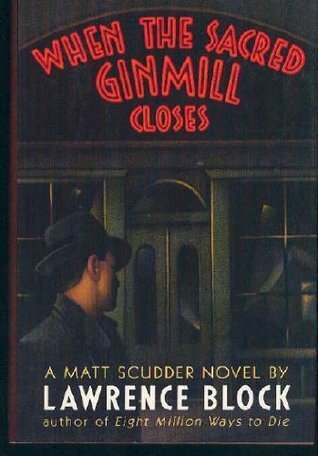
Lawrence Block is surprisingly pretty amazing.
This is the sixth novel in his Matthew Scudder series of novels.
Who likes the sixth of anything in a series? By that point the author should just be phoning in stories, working the tried and true formulas and selling his books to the ever dimininsing group of readers who are still along for the ride. Generally no one is going to pick up a sixth book in a series and start reading from there. Right?
Who would think that the sixth book in a series would rival the first one for being up there with the series best? The first one the is like a first date with someone that you are trying to impress, you know where you do whatever it is that people who date do to impress someone. By the sixth you're in a routine, maybe falling asleep in front of the TV at some point.
This one doesn't start off all that strong. It kind of feels like other Scudder novels. There's a problem or two, some people need some help so they get a favor out of Scudder in exchange for some money that he gives a tenth of to some church that he passes by. He works on the problems, eventually figures out to some degree a solution and the book wraps up.
This one starts like that, but slowly turns into a bitter melancholy love story of the past.
Scudder doesn't really give a shit about the cases he's working. He drinks a lot and spends days wandering through parts of New York that no longer existed in the late Mayor Koch era that the novel was written in, and are now like ancient history to the present cartography of New York City.
The novel takes place in the mid-70's, when New York was a much shittier place than it is now (or better depending on your outlook, but shittier in terms of seedier, poorer, more dangerous). You can't really walk the streets that Scudder moves about in and feel like you are walking in the same world. Hell's Kitchen today is not exactly a place where dive bars and drunks make up the dominant landscape.
The novel comes in between (what I'm guessing, I haven't read the next book in the series yet) the moment when Scudder decides that he has to quit drinking and the first present day novel where he makes his way through his day to day activities without many coups of coffee with a liberal shots of bourbon in it. It's a flashback to ten years earlier, a time when he was drinking too much, not caring about much at all, and most likely on the verge of drinking even more after the events that take place in this book.
Like the first novel in the series, the book doesn't start to shine until the last third or so, and as it moves towards the last pages it just gets darker and better with each chapter.
Most of the city portrayed in this novel no longer exists. The neighborhoods are cleaner. Certain big buildings have collapsed, even smaller insignificant scenes, like the place in Sunnyside where Scudder and some friends go to see a few fights on a Thursday night is only remembered by a small plaque in front of a Wendy's fast food restaurant now. Like other Scudder novels, Woodside is home to a seedier element than I can imagine being here when I walk around doing my day to day chores.
The book is partly a melancholy send off of the good old days, which maybe weren't so good, or good at all, and which maybe it's for all the best that they are gone, but which still sometimes hurt to to see gone.
I'm not sure why I did, but I jotted this passage down while I was reading the book, so I'll share it:
She extended a painted nail, touched my chin. "You don't want a man that's too cute, you know?"
It was an overture, and one I somehow knew I didn't want to follow up on. The realization brought a wave of sadness rolling in on me out of nowhere. I had nothing for this woman and she had nothing for me. I didn't even know her name; if we'd introduced ourselves I couldn't remember it. And I didn't think we had. The only names mentioned had been Miguelito Cruz and Mickey Mouse.
I mentioned another, Angel Herrera's. She didn't want to talk about Herrera. He was nice, she said. He was not so cute and maybe not so smart, but maybe that was better. But she didn't want to talk about Herrera.
I told her I had to go. I put a bill on the bar and instructed the bartender to keep her glass full. She laughed, either mocking me or enjoying the humor of the situation, I don't know which. Her laughter sounded like someone pouring a sack of broken glass down a staircase. It followed me to the door and out.