A joyous exploration of the cultural phenomenon that created Mario, Zelda and Pokémon, and an ode to our love of gaming, by one of the most trusted voices in video games writing.
'Here is a book bursting with love. Bop your head against it and see if a shower of gold coins comes out.' SAM LEITH, THE TIMES
'Superb.' GUARDIAN 'Heartfelt.' FINANCIAL TIMES 'Fascinating.' MAIL ON SUNDAY 'Affectionate.' IRISH INDEPENDENT
'MacDonald writes brilliantly . . . A great book.' CHARLIE BROOKER
From the instant classics to the hidden gems, Nintendo's video games occupy a special place in the hearts of hundreds of millions of people around the globe. Every player has forged a unique connection with a beloved game, feeling that rush of awe and wonder as they immersed themselves in a virtual world in pursuit of that most human of the desire to have fun.
Super Nintendo finds lifelong gamer Keza MacDonald exploring Nintendo's legendary roster of games - as well as consoles such as the SNES, Gameboy, Wii and Switch, and a host of other quirky inventions from the Power Glove to Nintendo Labo - drawing from decades' worth of exclusive interviews with their creators and the people whose lives have been changed by them. Along the way, she tells the story of how this unassuming playing card company, founded in Kyoto in 1889, became one of the dominant cultural forces of the twenty-first century.
Offering unparalleled access to the company and its fun-filled world, and written with warmth and wit, Super Nintendo captures the love that so many of us feel for video games - and reveals just what that love tells us about being human.
FEATURING CHAPTERS ON Ultrahand, Donkey Kong, Super Mario, The Legend of Zelda, Metroid, Pokémon, Kirby's Adventures, Wii Sports, Animal Crossing, Nintendo Labo, Super Smash Bros, Splatoon
'Delightful . . . a vivid picture of the most important company in video games."' JASON SCHREIER, author of Blood, Sweat, and Pixels
'Among the best things ever written about Nintendo.' TOM BISSELL, author of Extra Lives
i genuinely don’t think i’ve been this touched by a book in years, i’m so emotional right now i feel slightly ridiculous
i think it’s interesting that this book touches on nintendo’s incredible ability to utilise nostalgia, whilst also highlighting the need for community, friendship and need to share joy with one another
all i could think about is my older brother letting me sit next to him whilst he played legend of zelda, mario, animal crossing etc - they’re some of my fondest memories and this book brought me back entirely to when he’d let me borrow his pokemon cards so i could show off at school
whether you’re a gamer or not, this book is a must read and I couldn’t recommend it enough. it was both informative and warm, the perfect setting for a book about the world’s sweetest gaming company
Something I love about Nintendo games is that they bring people together so easily!
I really respect Nintendo’s choice to continue releasing family-friendly games in the early 2000s, especially when their competitors started to venture into more “mature” games. It was fascinating to learn about just how revolutionary the release of the Wii was for the industry. A one-handed controller was unheard of on its own, let alone such immersive experiences like Wii basketball
Overall, I learned a lot about the history of Nintendo and of the creation and legacy of many games and consoles. It was fun to reminisce on many games I grew up playing with my siblings!
This millennial author really loves Nintendo, this book is a love letter to the company and how they do business. It’s rather wholesome. She’s also trying to make a case for video games and she’s holding her tongue about what she finds unethical— games on your phone meant to simulate gambling games. It is food for thought!
Many thanks to pantheon for the free book in exchange for a honest review. #pantheonpartner #gifted
I really enjoyed this trip through the history of Nintendo and its most popular games. I remember my first Nintendo, playing Super Mario Bros, and even receiving a free copy of Legend of Zelda through an ad in some free magazine we received when we bought the console. The book really brought those nostalgic feelings out of me. The format of the book is wonderful. Readers learn about the behind the scenes console and games inspirations, creations, and ultimate reception. MacDonald really has a love for Nintendo and its catalog of games, sharing personal experiences mixed in with historical information. Overall, I think this is a great read whether your are a gamer or not.
i’m not a huge gamer, but this was a super fun book! i learned a lot about games that i literally knew nothing about, and it definitely made me want to play all of them. excited for my #gamerera
Tl;dr --> Neat way of describing how fun can be a business model for people not necessarily enamored with videogames, and an enjoyable read for those who are. 3.75/5 ///
This was admittedly catnip for me as someone whose first experience with gaming was a hand-me-down SNES, and who now marvels at the fact that Donkey Kong remains cool enough for her nephews.
But I do think it's an enriching read for anyone with a different experience, if they're interested in an exploration of why play matters and how a company can flourish and create costumer loyalty by seeking to provide actual fun even when sales aren't the most spectacular.
I quite liked the conceit of focusing on each franchise per chapter to highlight the evolution of the company and its impact. And it worked especially well when lending space to interviews with collectors, players and fans (and not just the creatives behind the games, whose voices are also great to have) in a way that helps spotlight why Nintendo encapsulates geeky awesomeness.
I will say that some parts of the chapters felt perhaps a bit meandering or with one too many names; the Zelda section, for example, is somewhat rambly in the middle until it finds its point again once it gets to "Breath of the Wild". The tone is also maybe slightly rose-tinted glasses, with just passing references to a possible rivalry between some unit directors and a super short mention of the Wii U's flop.
I also wished we could get photos to accompany the text, say to better illustrate the descriptions of the early toys Nintendo made before consoles or the Labo section. But that's probably a rights issue, so.
However those are overall nitpicks, as this book did offer fun, random facts and heartfelt tidbits alongside with its recapitulation of why a little plumber with red overalls is recognizable and loved worldwide.
[thanks to the publisher, author and netgalley for access to an e-ARC to form an honest opinion.]
I think this is the first time I’ve ever read an in-depth examination of a giant multinational corporation and actually liked and respected it more after knowing more about it.
This is a fun nostalgia trip if you grew up in the Nintendo Generation, and also an interesting deep dive into what makes the business continue to be so successful at what they do.
I’m not a gamer, just someone with some fondness for the “glitter games” of my youth, but this made me want to borrow a Switch 2 from one of my kids to see what Nintendo is up to these days.
The creativity and innovation of the minds behind Nintendo is fascinating to read about, and I love that they still consider themselves a toy company rather than a tech company.
*I received an ARC of this book in exchange for an honest review.*
If you are into video games AT ALL, I think you will like this book. I grew up around the same time as the author and have found myself really relating to the feelings she has towards a lot of this game titles referenced in this book. This is a pretty detailed history of Nintendo and the games that changed the world and created a lot of the mechanics we know today. As of right now, I am 75 pages in and it is chalked full of detail.
At the end of the day, the developers strive for fun and I think they've continued to try to push that into the world.
Update: I have finished this book and while I really did love it, there were some parts of it where I felt a little overwhelmed by the detail. This is written as a love letter to Nintendo with some emotional sections as well as some factual ones. It details how Nintendo strives for wonder and the various games that delivered that wonder.
When people hear the word Nintendo, they fall into one of two camps: the first, complete joy and nostalgia for a fun gaming company, and the second, scoffing at a childish brand. I fall into the first, having played Nintendo video games for as long as I can remember. I grew up with Pokémon Red and brain-training my way through The Legend of Zelda with Link as my avatar. I befriended countless forest friends in Animal Crossing: Wild World and my siblings and cousins and I hosted endless Mario Kart and Super Smash Bros. and Kirby championships. During lockdown, I built a community of over 400 devoted (and many new!) Animal Crossing: New Horizons players. Even today, you’ll find me curled up on the sofa with my Nintendo Switch, when I’m not reading, writing or cooking! As you can imagine, I was more than delighted when Faber Books sent me a proof of this upcoming book that is a love letter to Nintendo.
Super Nintendo is a joyous celebration of the Japanese company that helped the world have fun. Whether you’re a casual gamer or an avid Nintendo collector, this book contains all you need to know (and then some) about the legendary games company. I completely loved getting to know more about the origins of Nintendo, but also of each mastermind behind their keystone game franchises. Of course, I simply adored the Super Mario, The Legend of Zelda, Pokémon, Animal Crossing and Super Smash Bros. chapters and their deep-dives, but the book as a whole is truly a wonderful, escapist and uplifting read. I am filled with endless nostalgia and whimsy, having finished this, and Super Nintendo has only served to deepen my adoration of this wall-breaking, generation-crossing, genre-defying gaming company.
Super Nintendo is a book exploring the history of Nintendo and their consoles and games. Keza MacDonald combines a concise history of the company and its employees with personal reflections and a look at the cultural impact of Mario, Link, Pikachu, and more. Each chapter focuses on a particular development or game series, and the book is carefully structured to unfold Nintendo's direction from hanafuda cards to the Switch 2.
As someone for whom Nintendo has been the game company of choice ever since watching my friend play Pokemon Red on a Game Boy Colour as a young child, I really felt this was a love letter to the company that also taught me a lot about the development of the company and games. My interest in Nintendo has waxed and waned over the years (I read the official Nintendo magazine avidly c.2004, but didn't play a console between my family's Wii and finally buying a Switch in 2022), but this book felt like catching up with Nintendo across all of that time. I liked MacDonald's personal anecdotes, which felt similar to my own just a little earlier, and details like discussing the competitive playing of Super Smash Bros Melee that prevailed for a long time.
This is a book for fans, seeing a company as something bringing joy or sparking innovation rather than about the money. For me, it was an emotional read, thinking about my own history with these consoles and games and the fact that so many other people have these histories too.
Thank you to NetGalley and Faber and Faber Ltd for providing this book for review consideration. All opinions are my own.
I love works like these - delving headlong into iconic pop culture, this does a great job of chronicaling the history of the Nintendo company and some of its most notable staff members, and deep diving into the likes of Mario, Link and Zelda and Kirby. The author explores why such characters and games came to be so popular, along with the emotional and societal reactions when they became timeless hits. Some chapters were of more interest to me than others due to my personal preferences for certain franchises - highlights included the origins of the company, Mario, Pokemon and Animal Crossing.
The author's enthusiasm for the subject and impressive research really shines. However, the whole piece feels like it was written as an essay - with some structural issues within many of the chapters as it jumps back and forth between points and timelines. I do think that this could make a rather effective audio book which might make this structure work better.
This will be great for people who have played many Nintendo games on numerous consoles over the years and want to delve into the lore, or want to have a great feeling of nostalgia. I certainly envisage myself returning to particular sections of this book in the future.
4.75 stars! This is a must-read for anyone who grew up with any iteration of Nintendo consoles/games! The author clearly did a lot of research about some of their most popular games including Pokémon, Mario, Animal Crossing, and Super Smash. I loved getting to learn all the behind the scenes info on the inspiration for some of these games, the different iterations before it hit the public market, and the overall reception. I was actually quite shocked to hear that some of the things that we consider classics of the company didn't always get incredible reception on day one! I will say that if you listen to this an audio, the author does have a slight accent which takes some getting used to but once you move past that it is a great listen. My only complaint is that there were some games I wanted to hear more about, like Nintendogs, that were only lightly touched on. But otherwise, definitely worth your time!
Super Nintendo explores the long and fascinating history of one of the most beloved gaming companies. Walking readers through some of Nintendo's most significant games, MacDonald discusses not only the games themselves but the people who imagined, developed, and designed them as well as how those games or systems changed the gaming world. The in-depth focus on the various minds behind the games is especially interesting (although I could've used a "cast of characters") since game developers don't usually get their time in the spotlight. And as someone who has played many of the games mentioned in this book, I appreciated getting a behind-the-scenes look at how those games came about. Super Nintendo is the perfect book for any gamer as well as for anyone interested in Nintendo's unique outlook and business philosophy.
i loved this because of course i did. the author masterfully blends research and history with analysis and reflection based heavily in her own experiences; the author's personal connections don't take away from the book, but add to it. the reader has their own experiences with all of the games discussed in the book, and are able to compare their own experiences with the author's. some are vastly different, as many of them were for me as a child of the 2000s for whom i discovered many of the games well past their debuts, but some of them are exactly the same, such as the author's experience escaping into animal crossing new horizons during the pandemic. i have so much love for the games discussed here and think that the fun and connection they inspire in people of all ages and all over the world is truly something special; this book wholeheartedly agrees.
The most fascinating and detailed book about Nintendo I’ve ever read. Each chapter focuses on a different series or product, and through them, the author sheds light not just on how they were made, but on how Nintendo operates. If you know anything about Nintendo, you know it’s a secretive company that’s protective of its practices and customs. I came away from this book feeling like I’d learned a ton, all while finding the stories entertaining.
A must-read not just for Nintendo fans but for anyone who appreciates how creative people build things.
In a time where the industry is struggling, this book will remind you of the joy of play and make you feel nostalgic for your favorite Nintendo game. On top of that, a fascinating look inside one of gaming most secretive and influential corporation.
Very cute, very fun, VERY super fan & rose colored. Made me want to download the newest Kirby game after never owning one. I loved it and would recommend to anyone who is interested in the story of Nintendo’s start or wants to feel a little nostalgic
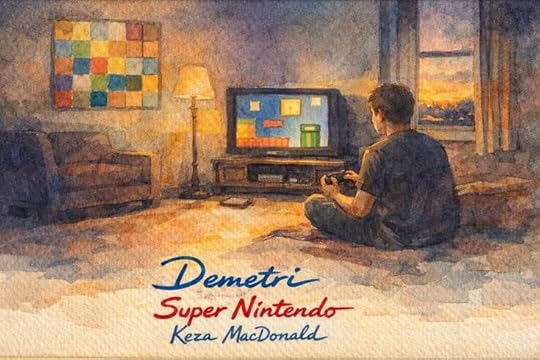
Why “Super Nintendo” Is Really a Book About Loneliness, Belonging, and the Architecture of Joy By Demetris Papadimitropoulos | January 27th, 2026
Watercolor Piece by Demetris Papadimitropoulos
In “Super Nintendo,” Keza MacDonald writes about Nintendo the way a good critic writes about an artist who has accidentally become an institution: with affection that refuses to curdle into worship, with enough skepticism to keep the lights honest, and with a novelist’s instinct for the scene that reveals the whole philosophy. This is not the kind of book that lingers on silicon and sales charts, the lugubrious porn of specs. Its great wager is that the true unit of measurement in games is not pixels per second but people per room, and that a controller’s most important feature is the ease with which it can be handed to someone who doesn’t think of themselves as a “gamer.”
MacDonald’s method is disarmingly simple. She places an object in your hand – a toy, a cartridge, a clamshell, a plastic remote – and asks what kind of feeling it was designed to summon. The trick is that she makes this sound like nostalgia until you realize she is writing about design the way one might write about public health or architecture: as a system that shapes behavior, that builds a little world and then persuades you to live inside it. The early chapters move with the brisk confidence of a museum tour that knows exactly which display case will make you stop. The “Ultrahand” is not merely an oddity from a pre-console era; it’s a thesis in plastic, the toy-maker’s credo that play begins with touch and surprise, not spectacle. Donkey Kong arrives as an arcade fever dream, a cultural outbreak measured in quarters and obsession. And then, with “Super Mario Bros.,” the book finds its central metaphor: movement as meaning, the clean joy of a body learning the grammar of a new space.
A lesser writer might treat that joy as self-explanatory. MacDonald insists on its craft. She understands that Nintendo’s genius has often been a willingness to trade power for clarity – to make a device that looks underwhelming on a press-release bullet list and feels irresistible in a living room. Her prose tends toward the bright and unpretentious, but she has a critic’s ear for the odd syllable that suddenly deepens into something like grief: the way our memories of games are less about what we did in them than about the light in the room, the time of day, the person on the other side of the couch. Nintendo’s hardware becomes, in her telling, a series of little domestic revolutions. Not the grand history of technology, but the intimate history of households.
Watercolor Piece by Demetris Papadimitropoulos
The chapters are organized around franchises, but the deeper structure is emotional. MacDonald is writing, quietly, a theory of play – a taxonomy of why people return to certain kinds of imaginary spaces when the real one is too much. “The Legend of Zelda” is not just a landmark in game design; it’s the moment Nintendo begins to understand freedom as a feeling. The story she tells is familiar – childhood wandering, the romance of caves and secrets – but she uses it to make a larger point: that the most powerful technologies are often the ones that manufacture permission. Permission to roam. Permission to be lost. Permission to proceed by curiosity rather than instruction.
Then comes the exquisite tonal pivot of “Metroid,” Nintendo’s “black sheep” and, in MacDonald’s hands, a lesson in loneliness. Where Mario is crowded with momentum and color, Metroid is a corridor with the lights dimmed. It is the series that proves Nintendo can do atmosphere, can make solitude into a mechanic, can let dread bloom in the negative space of a map. Reading this chapter now, in an era when we speak casually about isolation as a public condition – a thing measured in surveys and ER visits and the dull ache of an evening spent scrolling – it’s hard not to hear Metroid’s quiet as prophetic. MacDonald doesn’t overstate it. She doesn’t need to. She simply shows how the company that has made cheerfulness a brand can also construct a world that feels abandoned, and how that abandonment can be strangely compelling – a rehearsal, perhaps, for the private rooms we all sometimes inhabit.
If the book has a hinge, it’s the chapter on controllers – the moment Nintendo decides that the most radical innovation might be to make the interface disappear. The Nintendo DS and Wii era arrives as a kind of anti-elitist manifesto: touch and motion as a vernacular language, a redefinition of “skill” that makes room for the grandmother who bowls and the friend who says they don’t play games but somehow ends up laughing with a remote in their hand. MacDonald’s admiration here is not just for the cleverness of a device but for the humility behind it. In a culture addicted to frictionless expertise – to apps that optimize, platforms that rank, and feeds that reward fluency in the latest micro-genre of being online – Nintendo’s choice to privilege the obvious over the advanced feels almost moral. The body already knows how to swing. The hand already knows how to tap. The challenge is not to impress the initiated but to invite the excluded.
Watercolor Piece by Demetris Papadimitropoulos
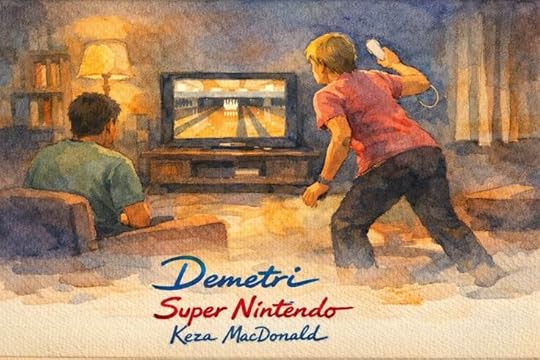
That invitation becomes explicit in “Wii Sports,” a game MacDonald treats less like software than like social infrastructure. She captures the way it turned living rooms into small theaters of participation: spectatorship with laughter, competition without cruelty, the kind of play that leaves room for the awkward and the tentative. It’s easy, with hindsight, to see the Wii as a fad or a punchline, but MacDonald argues persuasively that it was a demographic event – the widening of a category. “Gamer,” that increasingly narrow identity, briefly became porous. The fact that such porosity now feels newly urgent – in a media landscape that often rewards tribalism, gatekeeping, and the idea that everything must be won – is part of what makes her book feel contemporary rather than archival.
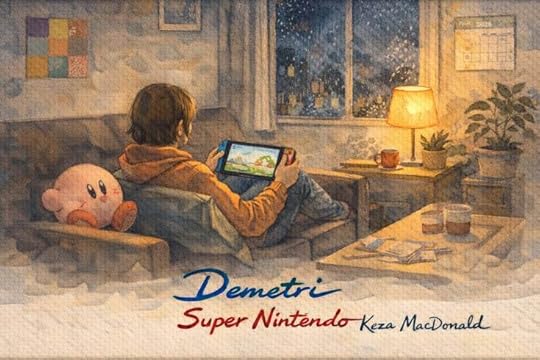
MacDonald is at her most tender, and most quietly persuasive, when she writes about games that are not built to be conquered. “Animal Crossing: New Horizons” arrives as a work of emotional engineering: a world running on real time, a village designed around ritual, a domestic space where nothing terrible happens unless you count the gentle tyranny of debt to a raccoon landlord. During the pandemic, people used the game as a substitute for touch – weddings held in pixels, birthdays celebrated with digital cake, visits made possible by a code. The cultural fact is widely known; MacDonald’s contribution is to show that the series’ origins already contain that need, that the fantasy of being accompanied was there from the beginning. When a book about Nintendo makes room for loneliness not as a punchline but as a serious human condition, it stops being a niche chronicle and becomes something closer to social criticism.
This is also where MacDonald as a writer is most visible: a gentle, self-aware humor that never sneers at the reader’s sentimentality, paired with an ability to name why certain forms of gentleness matter. She has the rare capacity to treat coziness as a design achievement. In an era saturated with loudness – games that demand seasons of your attention, platforms that monetize outrage, media built to keep you tense – her attention to comfort reads as quietly radical. She is writing, in effect, about the aesthetics of relief.
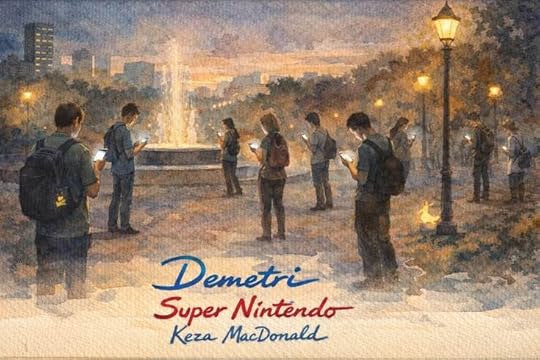
The book’s chapter on “Pokémon Go” and the larger Pokémon ecosystem frames another form of relief: community not as a brand slogan but as a mechanic. Pokémon’s original genius, MacDonald argues, was social by necessity. You needed another person – a link cable, a trade, a battle – to complete the dream. Long before the internet turned everything into a network, Pokémon made the network the point. That idea feels newly resonant now, when “community” is often something platforms claim while quietly eroding the conditions that make it possible. MacDonald’s writing reminds you that communities can be built out of playful constraints – a creature you can’t obtain alone, a ritual that requires a friend, a small inconvenience that produces a reason to meet.
Watercolor Piece by Demetris Papadimitropoulos
If there is a late-book argument about Nintendo’s present and future, it is that the company’s defining talent may be its willingness to look faintly ridiculous in pursuit of a better feeling. The most charming creation myths in “Super Nintendo” are stories of ideas that start as embarrassments: prototypes that resemble tofu, controllers that resemble TV remotes, consoles that look like toys, games that look like chores. Most corporations fear looking foolish. Nintendo, in MacDonald’s portrait, survives because it can tolerate the awkward stage where innovation has not yet acquired prestige. That tolerance is, arguably, a form of cultural courage – a willingness to be uncool so that other people can feel unafraid.
The chapter on “Splatoon” makes this argument explicit by showing Nintendo inventing a modern multiplayer hit that sidesteps the usual militarized vocabulary of the shooter. Ink replaces bullets. Turf replaces bodies. Style replaces grit. It’s as if Nintendo asks: What if competition could be colorful? What if a genre built on hostility could be redesigned around expression? In a moment when online spaces are often engineered for escalation, this seems less like a novelty than like a philosophy with stakes. Splatoon, in MacDonald’s telling, is both a proof of life – Nintendo can still create something new – and a manifesto about what kinds of “new” are worth making.
“Super Nintendo” is, at heart, a humanist book, and humanism can have blind spots. MacDonald’s warmth is one of her strengths – it keeps the prose supple and the reading experience generous – but it sometimes means the hard edges of corporate life remain mostly offstage. This is not an investigative account in the manner of “Blood, Sweat, and Pixels” or the labor-centered chronicle of “Press Reset.” Nor is it a boardroom epic like “Console Wars,” with its operatic rivalries and macho myth-making. MacDonald is writing something closer to cultural criticism – a curated gallery rather than a courtroom. Readers seeking the full severity of the industry – the crunch, the compromises, the politics of intellectual property – may find the tone a little too forgiving.
But to call that a flaw is also to misunderstand the book’s ambition. MacDonald is not trying to prove that Nintendo is good. She is trying to explain why Nintendo has mattered. Her ideal reader is not the person who already knows every release date, but the person who remembers what it felt like to be eight years old in front of a TV, or twenty-five and newly lonely in a new city, or thirty-five and exhausted by the world’s constant demand to perform competence. In that sense, her closest comp might be a book like “The Tetris Effect,” which treats a game as cultural artifact and emotional engine, or even “The Design of Everyday Things,” which insists that the deepest technologies are the ones that disappear into ordinary life. She shares, too, something of the spirit of “Homo Ludens,” the classic argument that play is not a childish extra but a foundational human mode.
Watercolor Piece by Demetris Papadimitropoulos
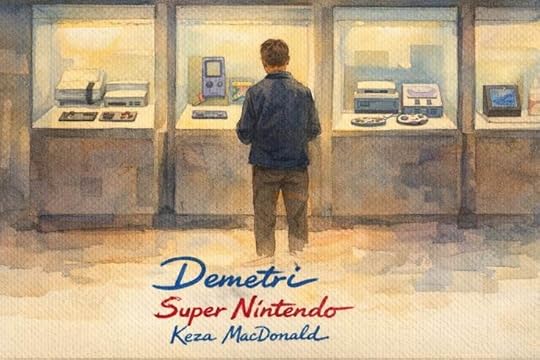
MacDonald’s finest move is to treat Nintendo as a maker of time. Not time in the technical sense – frame rates, clock speeds – but time in the human sense: seasons, eras, phases of a life. The early Nintendo years are short, loud, competitive – arcade time, coin time. The great console games create immersion time – the suspended afternoons of exploration. The DS and Wii era invents social time – parties, families, living rooms. Animal Crossing offers ritual time – a daily check-in, a little world that keeps its own schedule. The final pages, set among museum exhibits and the soft glow of remembered plastic, arrive at memory time: consoles as portals to who we were when we held them.
This is where the book becomes unexpectedly moving, and unexpectedly relevant. We live in an age when many of our technologies are designed to keep us anxious – perpetually notified, perpetually behind, perpetually measurable. Nintendo, in MacDonald’s telling, has often done the opposite. It designs tools that make us less afraid of being unskilled, less alone in a room, less trapped in a self. Even its most commercial instincts – the polished nostalgia of re-releases, the steady drip of familiar characters – can be read as an attempt to provide continuity in a culture that feels increasingly discontinuous.
None of this is to say MacDonald is writing propaganda. She is too wry for that, too clear-eyed about the company’s secrecy and conservatism, too aware of the risk of becoming a museum piece in love with its own past. Her final chapters hover over the question of whether Nintendo can keep its appetite for foolishness – for the awkward, half-formed idea that looks silly until it changes everything. It’s a question that extends beyond Nintendo. It’s a question for any institution that has survived long enough to acquire reverence: how to stay inventive without turning innovation into brand management, how to remain playful without becoming a nostalgia factory, how to keep making new memories rather than selling old ones back to us.
That “Super Nintendo” can ask these questions while remaining, page by page, a pleasure to read is its quiet triumph. It is a book that treats play as serious without becoming solemn, that respects the reader’s intelligence without demanding expertise, that uses the language of cultural criticism while never forgetting the tactile joy that started it all – a hand closing around a controller, a body leaning forward, a room briefly transformed. My rating: 89 out of 100.
*Advanced Copy Received from Publisher through NetGalley*
Level-up the nostalgia! Keza MacDonald’s Super Nintendo: The Game-Changing Company That Unlocked the Power of Play is an engaging and satisfying look at one of the most influential companies in gaming history. Super Nintendo is packed with fun trivia, cultural context, and behind-the-scenes insights that are sure to appeal to longtime fans and curious newcomers alike. MacDonald is an engaging writer and her genuine enthusiasm for games, gaming, and Nintendo in particular shines through very clearly. As someone personally who didn't get the childhood with gaming as a major part of it until much later, this was truly an informative and entertaining read for me. I learned so many things that I never knew. I feel that this will catch the attention of old and new gamers alike.
Did you spend hours refining your pokemon team so you could hook up a link cable and own your friend in a pokemon battle? Did you start to question your friendships after someone stole your star in Mario Party for the *thousandth* time?
If so, do a barrel roll, and let's-a-go on a ride down memory lane.
In this book, Keza MacDonald has assembled a history of Nintendo and their creative process, told through their landmark franchises. She emphasizes their commitment to fun and innovation beyond just the newest, shiniest tech. As a tech-adjacent worker, I can't help but smile at the stories of Nintendo's creatives working to innovate with what they already have.
As someone who lived through the heyday of Nintendo in the US and still plays their games today, this was a great way to revisit memories and hear a few new tidbits about the games I know and love. Occasionally, I also got to read about some of the games that caught fire in Japan but never really made a splash in the US. Alas, looks like I've got to book a flight to hit up a Kirby cafe.
The book sometimes spent a lot of time on stories about the people behind Nintendo, including beloved exec Satoru Iwata and the legend Shigeru Miyamoto, at the expense of discussing more games within that chapter's franchise, but these stories offered intriguing insight into the creative process of some of the greatest game devs of all time, and I never found myself disinterested while reading.
As an appendix, the artist gives us a blurb of her 50 favorite Nintendo games, accompanied by a blurb about the significance they held for her. I would definitely recommend checking this out, as there were a few hidden gems I hadn't heard about.
I'd love to go check this out physically when it releases, because I'm hoping there might be pictures or other addenda to add to the nostalgia, but we'll see what the publisher decides to do. Either way, this is a fabulous tribute to a company that helped define video games as they are today from someone who clearly loves this field and the work that Nintendo has put forth.
*Advanced Copy Received from Publisher through NetGalley*
Super Nintendo is a well written book about Nintendo that uses an interesting framing device to discuss the games, figures, and philosophies of the 130+ year company.
Each chapter is based around a game/game series and uses that to furthor delve into the other topics. There is a slight issue with this, in some chapters the balance of the discussion can become quite lopsided in some which can be a little disappointing at times. It is usually the games in question for those chapters that take a backseat. One chapter abandons the game it is named after quite early though the figure of Nintendo's history it goes on to discuss is quite an interesting and important one.
While those chapters can feel unbalanced in that regard, MacDonald's decades of experience in games journalism shines through to keep them engaging. They have an especially great knack for pulling from past interviews to tell a great historic narrative. MacDonald also does a great job balancing personal experience with the topics being discussed.
The only other con I could say that this book has is it left me wanting for more. With each chapter focusing on a game/series, there is a lot of information not covered. There are several facts and pieces of Nintendo trivia I expected to see that were not included in the book (and one former Nintendo employee I expected to see was only briefly mentioned in passing twice). But, there a other books that focus more in on specific games (like the Boss Fight Books line) as well as ones that dig more into just the history of the company (like the very informative, though out-dated Game Over by David Sheff). I'm also sure MacDonald has even more books, if not several in them after seeing their past works and enthusiasm for both Nintendo and gaming as a whole in this book.
Absolutely loved this book! Which really, really surprised me. I'm in my sixties, and pretty much missed the entire gaming boom, My era consisted of pinball, Superman/Batman cartoons, and at the end of my childhood, Pong. No, I requested an ARC of this book from NetGalley and the publisher because of my son. Now 38 years old, he grew up in the height of the boom. From the first Mario Games to today, he has been enthralled by video games. So much so that he went to college for Computer Science, worked at both Google and Amazon, and is now independently designing and publishing his own video games. I never really understood the appeal, so I hoped this book would help. And it definitely did! It was very enjoyable for me to read the history of the industry. The author has a way of making complicated concepts easy to understand, and a manner of writing that is easy to follow and enjoy. She covers a great deal of information and history, and I was very surprised at how much I enjoyed reading it. It goes without saying that I learned a lot. And that I can now converse with my son about games and gaming without sounding like a complete fool. That means a lot! Thank you, Ms. MacDonald, for that gift! If you have any interest in gaming, or the history of it, I can only imagine you would love this book! As a final note, in the beginning of the book the author discusses how the original Nintendo company was a playing card company. They produced an ancient card game called Hanafuda. I found the game on Amazon, and ordered it for my son for Christmas. I'm very happy to report that he was thrilled with the present! He had heard of the game, never knew where to get it or if it was still being made, and was amazed that his father found it, and kept it a secret until Christmas! Score one for the Boomers! Seriously, find this book and read it. It's very good.
Keza MacDonald’s Super Nintendo: The Game-Changing Company That Unlocked the Power of Play is an engaging and largely satisfying look at one of the most influential companies in gaming history. MacDonald traces Nintendo’s long and surprising journey from its origins as a playing card company to its rise as a cultural powerhouse, using games, people, and ideas as the backbone of the story. The result is a book that feels both informative and deeply nostalgic.
One of the book’s strengths is its structure. Each chapter is framed around a specific game or game series, which then opens into a broader discussion of Nintendo’s philosophies, key figures, and business decisions. This approach works especially well when MacDonald draws on decades of games journalism and past interviews to build a lively historical narrative. The writing is clear, confident, and enthusiastic, and MacDonald balances personal experience with solid research in a way that keeps the book moving.
That said, the structure sometimes leads to uneven pacing. Certain chapters linger a bit too long on individual games, while other areas of Nintendo’s history feel underexplored. A few chapters even drift away from the game named in the title, though the historical figures discussed are usually compelling enough to carry the detour. I also found myself wishing for illustrations or photos to accompany the text, especially when iconic games and consoles are being discussed.
Still, Super Nintendo is packed with fun trivia, cultural context, and behind-the-scenes insights that will appeal to longtime fans and curious newcomers alike. It may leave readers wanting more, but that is a testament to how enjoyable and absorbing the experience is overall.
Our family loves Nintendo and I grew up with it so this was a fun learning and nostalgia experience!
Now I’m armed with more facts and fun insights to talk to my Switch/Mario loving kids! I also appreciate that they talk about the foundations of Nintendo and help me understand why these games are made for fun and not necessarily addiction to the screen like many other games are now designed to be. I loved hearing about the beginning of Mario, how it is intentionally built to reward curiosity and fun, while Zelda is built for adventure and exploration. My kids now like Pokemon characters but I loved learning the emphasis on community and teamwork. I didn't know so many things shared in this chapter and it made me appreciate the company so much more. Plus the origin of being created because he was inspired by catching bugs in Japan was so sweet. You really never know what inspires you in life - our life experiences matter!
My kids also love Splatoon so I loved hearing how it came about as a result of multigenerational brainstorming. I love how they treasure young, new, old people alike. The way that the head of the company will step in to do what's needed or listen to the young new guy is inspiring and makes me love the company even more. They have stayed true to their core values and the results show their love for their products and customers.
Video games will be a part of our lives forever, but reading books like this help make more informed decisions on which games we want to bring in the house and which ones we don’t. I'm happy to keep supporting Nintendo, plus it’s a fun walk down memory lane!
Ahhhhh this book was so good! I am a lifelong Nintendo gamer; this is primarily as I was raised as a handheld gamer - a way for me to be left to my own devices whilst my parents watched TV. This book was a fascinating journey through the history of the Japanese entertainment company, from its humble beginnings as a playing card manufacturer, all the way up to its most recent device release, the Switch 2, and the author’s thoughts for the future.
I don’t read a lot of non-fiction, and I’m always concerned I’m not going to be immersed, but this wasn’t an issue here at all! The author makes the context easy to understand; it helps that it was a subject that I’m deeply invested in, plus I learned SO MUCH! I loved the way that the book’s chapters centred around specific games and how those franchises and the designers and coders behind them shaped the company.
Overall a really great read for Nintendo gamers and anyone interested in video games and tech in general! Easy to understand and super engaging, definitely recommended by me!
Read Super Nintendo for: ✨ Non-fiction; the history of Nintendo ✨ From humble beginnings to greatness ✨ The people who made and make the company great ✨ Why it has always stood out from it’s competitors ✨ Key franchises; why people love Mario, Zelda, Pokemon and more ✨ Engaging and non-complex writing ✨ Perfect for all types of gamers
Thank you so much to the lovely folks at Faber for sending me this absolutely gorgeous holographic foiled physical proof! The book is available on 12th Feb 2026 ⭐
I was pretty excited when I saw this title. I remember getting my first game boy in elementary school, and my husband has a picture of him receiving his first NES framed on our wall. Needless to say, I was pretty excited to read an in depth history of the company.
MacDonald does a good job of telling the complete history of the company, from when it opened in the late 1800's making Japanese playing cards, through the technology era that shaped the company we know today. Included in the book were excerpts from old interviews, both with employees and designers, as well as others close to the company and collectors.
Where the book fell short for me was how disjointed it felt. When I saw that each chapter was named after a specific game or series, I was excited to delve into each, chronologically, to get a better sense of the history and evolution of Nintendo. However, each chapter seemed to touch base on the game, but branch off into other topics, though vaguely related. They would jump timeline, so even within a chapter, it might not be chronological. This made it harder to grasp a sense of what happened when, which felt just like a lot of information that I wasn't able to absorb the way I was hoping.
It is, however, a great in depth history that I was excited to read about, especially since it was such a huge part of my childhood. If you've ever played anything by Nintendo, I highly recommend you give this a shot.
**Thank you NetGalley and Knopf, Pantheon, Vintage, and Anchor for sending this book for review. All opinions are my own.**
I absolutely loved this fun Well I absolutely loved this nonfiction book about the history of Nintendo! As a life long video game player, this book was so nostalgic. Keza MacDonald clearly knows her stuff, and I loved the way this history was infused with personal gaming anecdotes. Super Nintendo: The Game-Changing Company That unlocked the Power of Play starts at the beginning of the company and then goes chapter by chapter highlighting different eras and also specific landmark games like Mario, Zelda, Kirby and Animal Crossing. Each chapter is full of trivia, insights and interesting quotes from Nintendo leaders and game designers. I learned so much about games I know and have loved and also games I’m excited to go out and try!
Gaming is so wrapped up in nostalgia, and I had so many great feels like while listening to this book. It really reminded me so much of getting that first Nintendo console. After listening to the chapter on Zelda I immediately wanted to go back and play Ocarina of Time with my son (and I was so proud when he made it through the Great Deku tree!)
MacDonald has jam packed her book full of interesting facts, trivia and tidbits, I learned so much and it gave me a greater appreciation for the company that has filled my life with fun since childhood.
Thanks so much to Libro.fm and Penguin Random House Audio Publishing Group for the ALC of this book in exchange for an honest review.