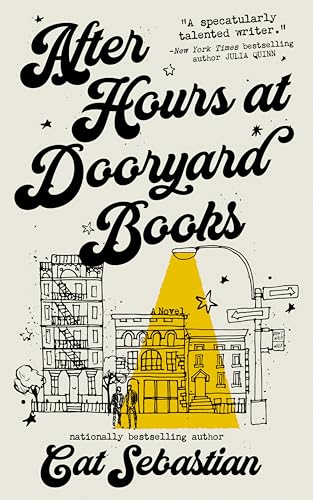
News about the war might be keeping Patrick up at night--news in general might be keeping Patrick up at night--but he's doing fine. He's sure of it. He gets to spend his days selling books in the gayest neighborhood on the East Coast and his nights merrily sleeping his way through the rare book community. But when he takes in a drifter who seems to be hiding something, and his best friend and her newborn move into the apartment upstairs, his life gets turned on its head.
A sleepy little bookstore should be the perfect place for Nathaniel to lie low, waiting for his past to catch up with him, but it turns out Dooryard Books is full of political radicals and anti-war agitators. If the FBI isn't actively surveilling this place, it will be. Nathaniel should go anywhere else. The last thing he expects is to like these subversives. There's a grieving folk musician and her baby--a demon of a child who will only sleep if Nathaniel, of all people, holds her. There's a pair of rabble-rousing teenagers who, upsettingly, seem to be right about everything. And then there's Patrick, who can't walk past anyone who needs his help--and who is perplexingly determined to help Nathaniel.
As the world balances on the precipice of something new and scary and maybe even hopeful, Patrick needs to decide what he's willing to risk for this chaotic new community he's accidentally created. And Nathaniel needs to figure out whether he has a place in this messy, flawed world--and whether he can believe he deserves it.
Cat Sebastian has written sixteen queer historical romances. Cat’s books have received starred reviews from Kirkus, Publishers Weekly, Library Journal, and Booklist.
Before writing, Cat was a lawyer and a teacher and did a variety of other jobs she liked much less than she enjoys writing happy endings for queer people. She was born in New Jersey and lived in New York and Arizona before settling down in a swampy part of south. When she isn’t writing, she’s probably reading, having one-sided conversations with her dog, or doing the crossword puzzle.
The best way to keep up with Cat’s projects is to subscribe to her newsletter.
Married in the darkness on the evening of the morning we first met / Laughin', jokin', lovin', smokin' / Honey, I can taste you yet (Watercolor Canvas – Bobby Darin).
Want to hear something cool? After Hours at Dooryard Books is the best book I’ve ever read! And I reckon it will remain so until the next best book I’ll ever read. Yeah, I said it! I remember when Maisie Williams, the actor who played Arya Stark on Game of Thrones, was promoting her movie New Mutants, she very proudly proclaimed that it had the best dragon she ever worked with (the joke being that she was on Game of Thrones), and then she ended the promo by saying "yeah, I said it!" and it was really funny because everybody already hated Game of Thrones by that point and only three people watched New Mutants. Sorry, I don't know why that popped into my head. Anyway, because of my intense adoration for this book, I’m afraid we’re in Song of Achilles or Circe territory, in which I like it so much that I get a bit tongue tied, as seen in how I randomly went on an unrelated tangent. I mean, what else is there to say about this wonderful story other than tell you that it’s a ten out of ten, perfect book. I could talk about how it feels like a place of refuge or how it allows its readers to feel seen in a way that's both revealing and transformative, or I can just go on and on about how much I loved the low-key, low-stakes romance between Patrick and Nathaniel and the way it starts off all calm and collected to how quickly it becomes all-encompassing and full of hunger and lust. Man, I can honestly say that this book was a trip and a half despite the fact that it really only taking place at one location the whole time. It's like that one movie that takes place in one room over the course of several generations of this one family's history... well, maybe it is, I've never actually seen that movie. But I have read this book, so I can say that it's also powerfully effective in using their relationship as a juxtaposition against the hectic whirlwind of paranoia, war, and distrust going on in the country at the time, and I can only marvel at how this book is both a fascinating examination of the turbulent year of 1968 while also remaining eerily topical to today’s political climate. Do the Right Thing, Like Home by Louisa Onomé, West Side Story, and now After Hours at Dooryard Books, all of these have one thing in common, and that’s evoking an almost overwhelming sense of comfort and safety in community against the backdrop of a fearful age. This book is a snapshot of the way queer lives have both changed drastically (sometimes being able to live openly and proudly) and how our struggles have very much stayed the same (being forced to hide in plain sight, living through ever-encroaching self-hatred, or knowing that despite wanting safety and comfort, there comes a time when we need to do something). After Hours at Dooryard Books isn’t just a genre defining work of art, but also a beacon of light on the distant shore calling out to everyone who’s ever felt lost that they aren’t in this alone. This book isn’t just the best “found family” story I’ve ever read, but it’s also become both a place of comfort as well as a call-to-action.
So yeah, maybe I should stop espousing rhetoric and talk about After Hours at Dooryard Books now, don't you think? Sorry, I keep saying the title in the hopes that if nothing else, it'll become a kind of Winter Soldier activation code that will get everybody to stop what they're doing and go order this book from their local library. Anyway, we follow Patrick, a calm and collected man who doesn’t realize that he’s desperately lonely in a very House in the Cerulean Sea kind of way, but what makes him different than Linus is that Patrick has all the correct opinions on the classics, as seen here: “Off the top of my head–Moby Dick? The Great Gatsby? Those are gay on the page. No fancy interpretation required. You don’t even need to work hard. And if you include poetry, there’s Whitman, of course.” Agreed, agreed, and agreed, my man! I remember watching this video where there were these two dudes talking about Lord of the Rings, and one of them said this thing that I really liked that whenever Aragorn showed up, it felt like a blanket of comfort was put over the scene because he felt way more "put together" and collected than any other character. Like, he gave the film a "oh good, an adult is here!" kind of vibe that I also attribute to Patrick from this novel. But as I was saying, his life is one of predictable chaos in which he cares for every stray that happens to end up on the doorstep of Barnyard Books. Don't worry, he's not saint, but as he himself was in the very same situation not too long ago, he can't help but feel like it's only right to offer others the same grace that was given to him. But even he’s surprised with the one-two punch of ending up with both an out-of-place and clearly-using-a-fake-name smartly dressed man with a mysterious past named Nathaniel and his Daisy Jones & the Six folk singer sister-in-law holding a baby who shows up soon after with the news that her husband (Patrick’s brother) had died in the Vietnam War. What follows is a story about broken people trying to pick up the pieces and regain some semblance of normalcy in a world that seems to be losing its mind. So basically, this book is like that one SpongeBob meme where Squidward is wearing that huge pin that says “I really wish I weren’t living in unprecedented times right now,” and that’s part of what makes this book feel so topical despite taking place decades back. Wait... not the meme bit, but the part about not wanting to live in times where terrible events keep happening and having to soldier on regardless. Because when you don’t fit into the mold of what society deems “correct” and “safe,” you will always exist on the outside until you’re able to create or join your own community of like-minded folks. It's a story as old as time, and it’s just the same now as it has always been. So yeah, I guess what I’m trying to say is that Cat Sebastian, like, gets it… ma~an. Have I ever told you that she’s the only author who’s ever done a “commoner and royalty” type romance where the lordly lord man abdicates from his titles at the end? Now that’s true romance, that’s a true test of love!
“But change can only happen if individual people know how to find one another and become a collective, a movement.”
Yup, The Queer Principles of Kit Webb and The Gentleman's Guide to Vice and Virtue are two of a kind in that regard. Finding your own way and all that. And just like every other book I’ve read by Cat Sebastian, I found myself glued to every word on every single page of After Hours at Dooryard Books. You know that one freak on Instagram who “reacts” to other people’s content by staring wide eyed at it in the corner while adding nothing of substance to the original video? He has glasses and I hate him? Yeah well, "React Videos" are the worst, but also... that dude's intense stare is exactly how I must have looked while reading this book. I had A Clockwork Orange eyes simply because I couldn't take my eyes off the page, lest I miss a single word. It's a bit embarrassing because this quickly became one of those books (like Circe and Song of Achilles, as I’ve already said) where I just wanted to underline the entire thing. And normally you can tell when a book is trying to be quotable for the Insta reels or BookTok because they sound like like they're coming straight out of Thanos' mouth, but this book is naturally poignant in the same way Circe could have had a line about doing laundry and somehow still came across like it just imparted knowledge on the secrets of the universe. Remember in school when the teacher would tell everyone to only highlight the most important information available? Yeah well, I was never good at narrowing down what exactly was the most important info, so instead I’d always end up with entire pages filled with neon yellow highlights smelling a whole lot like marker! Ugh, that was the worst. Anyway, what I’m trying to say is that I could fill this entire review with just quotes from the book that I really loved and it’d probably do a better job at selling it to you than anything I could possibly end up saying! This is my second plan to get you to read this in case my Captain America: Civil War tactics haven't worked yet. So yeah, take a gander, “Some people are fine with a person being discreetly queer, but change their tune as soon as that person stops hiding. Even some queer people think everybody belongs in the closet.” oh, here's another one, “Nathaniel has never had tofu, and had vaguely supposed it to be an ingredient you succumbed to only after prolonged exposure to drugs and radical politics, but what have the last six months of Nathaniel’s life been if not prolonged exposure to drugs and radical politics? It tastes like meat from the future. He helps himself to seconds.” Woah, pretty good, huh? I mean, I like it! But wait, there's more… like this, “Patrick almost doesn’t blame him; he’d climb out a window if he had to hear about a straight person’s sex life.” but I’ll give it a rest for now. Besides, I didn't read this on an e-reader, so I have to save all my favorite quotes somewhere!
Let’s see, what else is there to say? Well, there’s a scene at the end of Before Sunrise during the credits that always fills me with melancholy where it shows all the places that Jesse and Céline had spent the evening crafting their new and beautiful relationship, but now shown in the plain daylight, there’s only a sense of deep sadness as the understanding dawns on us that things will never actually be the same. They might meet up again, but it won't be the same. That’s the role Dooryard Books takes on in this novel, as even though it feels like a magical place during the story proper, the real reason it becomes a place of comfort and refuge is because of the people who made it a home. It’s both sad and heartwarming in coming to the understanding that even though queer folk are often made to feel unsafe and are in constant danger (in 1968 or 2026, whenever), we’re still able to create lives full of happiness with the people we love regardless. Despite the oppression, not because of it. We'll always have a place, just as long as we’re brave enough to make it by looking out for each other. Because if we don’t, then there’s truly nothing. Unfortunately, this “crabs in a barrel” mentality has a habit of rearing its ugly head around again and again all throughout, and it becomes especially pronounced whenever the culture finds itself in a conservative rut. This happened in the 80’s, it’s happening now, and I'm sure it'll happen again and again in the future. A big problem is that this puritan zeitgeist ends up influencing the communities its out to ostracize. For example, we get members of the LGBT+ community talking some crazy shit about “I may gay, but I’m not like them!” and it’s just sad to me because that’s exactly what they want us to do. By seeing members of our community as the other, we lose focus on the fact that we’re all in this together. Sorry, but if they can go after some of us, then they can go after all of us. The sooner we acknowledge this, the sooner we can get to work on protecting each other. Progress is always a hard thing to gauge in real life; whether it’s happening, whether it’s not happening, and you never know whether doing good is doing any good at the end of the day. You just go about your day, read the news wondering whether or not the changes happening are good or bad, and then look up and realize that you have to go figure out what to eat for dinner. It can feel thankless, but you keep doing it because there's a small chance that you just might change the world. That’s what’s so beautiful about After Hours at Dooryard Books; it’s counterculture and radical as all hell, but the story is rooted in a deep sense of empathy that lends itself to the narrative’s romantic nature. In other words, it’s bloody and raw, but I swear it is sweet.
An afternoon in Big Sur on the way from San Francisco to L.A / A brief and fleeting vision of the hallowed halls of Heaven, what a day! / Conversation dancin' to the music of the ocean keepin' time / These are pastel pieces of the pretty pictures painted on the watercolor canvas of my mind.
After a couple of heavier reads recently this book was the literary equivalent of putting cool moisturiser on fresh sunburn.
I feel like at this point I don’t need to say anything about the quality of Cat Seb’s skill as a writer, and especially her mid-century books. They just reliably a good time.
This quiet little romance had a deep emotional core that was an ode to finding kindness, generosity and grace in times when it feels like the world is falling apart and to look to the future with optimism. I cant help but feel that there is perhaps a particular sort of relevancy in the messaging to todays global landscape. This was also a story about community and unconventional families and the joy that those connections can bring.
I was completely tuned in to the romance between Patrick and Nathaniel and whilst the spice was fairly mild, the chemistry between them was delicious, filled with a slow burn of yearning and the build of a relationship which encouraged safety, trust and love. There’s a bit of an age gap between Nathaniel (39) and Patrick (27) but the age difference is balanced by the experience gap, with Patrick being significantly more experienced and self assured in his identity as a gay man.
While I enjoyed Patrick as a main character, I found him to be perhaps a bit too easy to love? Especially when it came to the romance? I think his character actually was at its best when viewed through his relationship with Susan and the processing of their shared grief. A number of the moments between Patrick and Susan had me literally tearing up.
Nathaniel on the other hand, I found was a character I resonated much more deeply with and was so invested in getting to witness his journey of growth, healing and acceptance. It is just too easy to see how societal pressure and compulsory heterosexuality of the 50s/60s lead him to suppress so many elements of himself and to see him start to unpack what that means to him and his happiness and that its never too late to make a change.
Interesting that this was another book that incorporated elements of moral injury again (although in a much softer dose than some of my other recent reads) and I think obviously this theme is a prominent topic tackled in stories set during this political landscape.
I fluctuated between a 4.5 stars ✨ rounded up or down and ended up rating down mainly cause I am unsure how likely I am to seek this out for a reread, but I reserve the right to change my mind down the line hahah
I basically demolished this in single sitting. Very cozy, sweet and like a warm hug for my heart ❤️
Lovely, funny, touching, exquisitely painful for anyone grieving a NYC that once was; also 1968 is terrifyingly relevant to 2025. Just about perfect, no damn notes.
Set in 1968 against the tumultuous backdrop of the Vietnam War, violent riots, civil rights protests, the rise of the Black Panthers, the assassinations of MLK Jr. and RFK, counterculture zines, CIA surveillance of American citizens, and the gay liberation movement, After Hours at Dooryard Books is a political novel first and foremost; a story about an unconventional found family second; and a romance a distant third.
There are in essence three MCs: Patrick, the manager of the book store, who is friendly and open and has slept with the entire gay male population of Greenwich village; Nathaniel, the new arrival, who is snarky, secretive, and anxious, clearly hiding an unsavory past; and Susan, a performance artist and Patrick's sister-in-law, who arrives with a fallen soldier telegram in hand and a week-old baby in tow.
Numerous secondary characters come through the revolving doors, including brilliant 15-year-old Puerto Rican twins, quirky sellers/clients, and the kindly Jewish lady who owns the store and takes in strays.
Brilliantly written, meticulously researched, with a cast of misfits so real, they could walk off the page and shake your hand, this book is fully character driven, with almost no narrative momentum.
What my rating comes down to is that despite the many, many positives, I found the romance underwhelming and struggled to stay engaged. The story was crowded with too many characters, never-ending political discussions, and all things baby.
The tragedies, sadness, and angst piled up. Every once in a while, some light peeked through, but it was stifled by shadows all too soon.
America's current political climate is proof that the more things change, the more they stay the same. I read to escape the misery, not drown in it.
While I generally enjoy Cat Sebastian, I've often had cause to complain about the timing and structure in her books, but not this time. This is wonderfully done. Of the eleven books I've read by her now, this and You Should Be So Lucky are definitely the top two, and by some distance. Glad I didn't let this one languish in the pile.
This was wonderful. OMG she upleveled from an already amazing level.
But first a warning, while this is so completely totally a Cat Sebastian (of the modern 20th century kind, subgenre the NY ones) romance it is also a bit something more. Not because it breaks romance expectations but because the focus on the relationship is soft and slow burn and there are kinds of historical layers and of deep deep other characters, each with their own cargo of sadness, ambitions, morality, hope. TLDR: it's very slow burn, the sex very out of focus, and all so much about the emotions, and the characters (not just the romantic pair) trying to build a happier future (not just romantically) one brick at a time.
It's kind of a slice of life cozy historical fiction set in a grim year that seemed hopeless to them - with so many books being read (and characters thinking and talking about the books) and people being decent human beings to other human beings (I just loved Mrs Kaplan) and it was all so lovely throughout and so hopeful and rewarding because losses get processed and things keep getting built for the future. And as a bonus you know that things will get better (one of the things starting with an event just a couple streets from this location and just a few months after the ending of this book) and that is a great lesson to be reminded of in 2025.
I will probably be pushing this at many non romance reader friends. Though there still is one and I liked it and I was so rooting for them, it's just that there are more layers to it all.
The writing was fantastic at least for my tastes, the descriptions, the dialogue, the pace that is slow but just right.
Great cover which really gets the mood of the book.
Very lovely and different, a bit on its own category.
Cat Sebastian has cornered the market in queer twentieth century historical romances, moving from the 1940s-set Page & Sommers mysteries to the Cabotstories of the sixties and seventies and then to late fifties for We Could Be So Good and You Should Be So Lucky. I’ve thoroughly enjoyed all of them and am delighted to be able to add After Hours at Dooryard Books to their number. It’s a gentle, low(ish)-angst story for all that it’s set during a time of great unrest and upheaval; the central slow-burn romance is tender and lovely, and I loved the focus on community, on people coming together, learning how to take care of each other and allowing themselves to be cared for in return.
February, 1968: the war in Vietnam shows no signs of ending anytime soon, public disaffection is growing, and in New York City, the garbage is piling up in the streets because of a strike by sanitation workers. Patrick Fitzgerald is contentedly working on fixing the binding on a first edition he recently picked up at an estate sale, when Mrs. Kaplan, the owner of Dooryard Books (where Patrick is the manager) breezes in accompanied by a stranger, a man several years older than Patrick’s twenty-seven, and whom he immediately realises is her latest ‘project’. Patrick should know what that looks like; a decade ago he was one of her projects himself, and in the intervening time, he’s been there to help lots of Mrs. Kaplan’s other waifs and strays to get back on their feet before making plans of their own and moving on.
Mrs. Kaplan introduces Patrick to Nathaniel Smith (Smith? Yeah, sure) who is even more dubious looking than her usual strays – tall, thin, pale, with too-long brown hair and eyes that keep darting around as though he’s expecting to be arrested any minute. But Patrick knows better than to judge. He welcomes Nathaniel, shows him where he’s to sleep and returns downstairs to the shop to ask Mrs. Kaplan what he should know about his new guest – but she’s surprisingly cagey, saying only that he may be a bit skittish but that he’s getting better - before she heads out.
A day or so later, Patrick and Nathaniel are sharing a somewhat dismal dinner of badly cooked eggs when the shop doorbell rings; expecting a late delivery or something Patrick runs downstairs and opens the door, shocked to see not a delivery man, but his best friend and sister-in-law Susan, carrying a single suitcase – and a very young baby. Patrick is trying to make sense of it all – Susan and his brother live in California, although Michael was drafted and is currently serving in Vietnam – when she holds out a crumpled piece of paper and Patrick’s brain stalls as his heart sinks. It’s from the Department of Defence; Susan must got it that morning, packed a suitcase, grabbed her guitar and the baby and gone straight to the airport. And now they’re here – which means there are now three people counting on Patrick to know what to do. In a way, he’s glad to have so many things to think about; it will at least stop him dwelling on the fact that his brother is dead.
After Hours at Dooryard Books is divided into five sections of several chapters each (plus an epilogue), which relate the unfolding events from Patrick’s and Nathaniel’s perspectives. It’s very much a character driven, slice-of-life story as these three very different people form strong bonds and become a chosen family, working through grief, guilt, anger and shame against a meticulously researched historical background that encompasses political protests, civil unrest, music, literature and a city that is changing around them.
Patrick’s backstory emerges slowly as the story progresses, and we learn that he was taken in by Mrs. Kaplan when his family disowned him after he was beaten up and arrested during a raid at a gay club when he’d just turned eighteen. She gave him a place to stay and eventually employed him to be the manager of the second-hand bookshop she and her husband had opened in 1920, and Patrick loves what he does. He spends his days selling books in the gayest neighbourhood on the East Coast, checking the classifieds and scouring estate sales for rare books, and his nights happily sleeping his way through the local network of “homosexual literati”. He’s kind, generous and funny – he’s clearly taken the lesson about paying it forward to heart and does what he can whenever he can, whether it’s looking after Mrs. Kaplan’s strays or making sure a working girl can afford a cup of coffee and a cab fare.
Nathaniel is a mess when he arrives at the shop. He’s nervy and obviously hiding from something, waiting for whatever that is to catch up with him; but he’s also in need of help and sympathy and companionship, and the warmth and unconditional generosity of spirit he encounters from Patrick is impossible to resist. Dooryard Books isn’t the sort of place he’d have thought he’d go to in a million years – it’s a den of political agitators and subversives – but because of that it’s also a really good place to hide out while he takes stock and works out what’s next. And as his already changing perspectives continue to shift, he comes to see that these are good, decent people doing the best they can in difficult circumstances, and he can’t do anything but admire them for that. As he slowly begins to find himself again and to realise that he can choose who he wants to be and how he wants to live, he also discovers that perhaps the hardest, most important kind of forgiveness is the one you afford to yourself.
The romance between Patrick and Nathaniel is beautifully developed, a lovely slow-burn full of chemistry, mutual caring, support and gentle humour. Patrick is delighted to discover the caustic wit that lurks just beneath Nathaniel’s surface – an irritable bastard with a pretty face is his catnip – and for Nathaniel, being around Patrick, who is so open about his sexuality, is something of an eye-opener, especially when he’s tried to stuff the truth about himself into a locked box and throw away the key. Despite very different backgrounds and life experiences, Patrick and Nathaniel are perfect for each other; they’re both lonely (Patrick’s revolving bedroom door notwithstanding) and grieving, struggling to process the anger, the sadness, and the helplessness that accompany loss at the same time as they’re working out how to support others going through the same thing.
The secondary cast is superbly drawn and adds considerable depth and vibrancy to the story, notably the bright, brilliant Valdez twins, Hector and Iris - who often do their homework in the back of the shop after school and have the makings of a pair of real radicals – and Susan, a well-known recording artist who has made a career of singing angry protest songs. The platonic friendship that develops between Susan and Nathaniel is one of the best-written male-female friendships I’ve ever read in an m/m romance; I loved the way they find common ground through music and how music plays such an important part of helping Nathaniel to work out who he wants to be.
After Hours at Dooryard Books is a compelling read, a beautiful story about finding family and finding love, about shared grief, forgiveness, the importance of community and finding the good where you can, of making space for happiness and peace for yourself and your loved ones, even when things seem hopeless. It’s undoubtedly one of Cat Sebastian’s best books and I recommend it without hesitation.
So good, but a warning, it's different, kind of unique a very slow slowburn romance, historical fiction, full of other characters and books and world events and getting over grief and so hopeful but real. Pretty special.
This was absolutely brilliant. The historical immersion in 1968 NYC. The bookstore. The regulars. Patrick and Nathaniel. Susan. Eleanor. The twins. It’s about love, loss, found family. Vietnam. Human rights, protests. Queer culture and community. Hope. Doing the right thing. Doing your best, day after day. Fighting for what you believe in. Falling in love. Parenting. Building a life. I loved every page, slowed down, reread to savour it. I’m sad it’s over, I’m going to miss every single character.
Nothing like starting off the new year with a five star read. I will admit I was hoping for this outcome when I picked it for my first book of the year. Cat Sebastian is increasingly becoming known for atmospheric, historically rich, community-focused, and quietly revolutionary little books. I wanted a lovely time full of lovely people that would take me away to a time in history that reflects pieces of our own Current Times while still being an escape hatch from reality. You don't pick up her books for an exciting romp, you pick them up so as to feel like you have been wrapped in a warm blanket and someone is petting your hair. And maybe you just had a good cry, but you feel better now.
This particular blanket takes place in 1968 at a New York bookshop run by Patrick, a queer man, formerly down on his luck, who was taken in by Mrs. Kaplan, the owner of the bookshop. While not running the bookshop and tracking down rare editions of books to sell or restore, he spends his time helping her with her "strays", people who like he once was, who are down on their luck and need a fresh start. Mrs. Kaplan owns the entire building the bookshop resides in, including several apartments. Patrick lives in one, the Valdez's live in another, and there is a revolving door of strays who occupy the last apartment.
The "plot", as it were*, starts up after not only Nathaniel, but Patrick's lifelong friend and sister-in-law Susan shows up on his doorstep with a week-old baby, and a telegram saying that Patrick's brother Michael has been killed in Vietnam. The Vietnam War and the cultural reaction to it shadows this whole book, which is basically about doing the best you can amidst some really hard shit, and the way that community can help deal with grief, even if the thing you're grieving never stops being missed.
*You don't come to Cat Sebastian for plot. See above.
I actually have quite a lot of Cat Sebastian books to catch up on, since I haven't been reading romance in the last year. I'm still not in the best place for it, but her books are exceptions for me, because they always feel so grounded and lived in, and the characters and their interactions with each other never feel fake, and always have a core of something real holding up them up.
Fun note: both the title of the bookstore and the title of my review are nods to Walt Whitman, who is the secret underhero of this book.
Ohhhh what a beautiful book. I actually was given this one in e-ARC but (as has been my way this year, sadly) didn't read it on time, so the edition I read was the final, published book that I bought for myself - and I'm so glad I did. It was just exactly what I needed to read during a rough month - it's so full of kindness and compassion and a grounded hope that feels true even in the worst of times. Cat Sebastian's writing is always beautiful, and this book in particular was just a perfect mix of vibes-with-plot for me, with a deep coziness around the beautiful found family built across the book in a used bookshop in 1968 New York City. Obviously I was not alive at the time so can't speak personally to the accuracy of the setting, but every detail felt vivid and lived-in, and I loved every single bit of it. Every adult member of the found family is dealing with some kind of tragedy in their past, and that's treated with gravity and sensitivity, but the way they build their new life together is just beautiful.
This ranks for me as one of my very favorite novels by Cat Sebastian (up there with Hither, Page), and I know I'll be re-reading it many times in the future.
This book is swoony and tender and poignant but above all it is SMART. About the genre and history and counterculture and so so many other things that I think my brain might actually explore
Sadly, After Hours at Dooryard Books didn't hit the mark for me but even a meh Cat Sebastian is honestly pretty good.
This book sort of almost wanted to do something, a lot of somethings, but it never fully committed and instead ended up doing very little.
My feelings towards Dooryard Books lean much more toward apathy than dislike. It was a cozy read and I liked the characters fine. Nothing about the book was bad, it was well-written as all Cat Sebastian's books are, and none of the main characters were unlikeable. However, I also felt like I never really got to know them and I also didn't much care.
It was like everything was somehow told behind a veil of detachment. It might've been because there were such important issues at play and then also a bit of romance, and love in various ways. None ever got the chance to shine or to be properly delved into because the book obviously couldn't do all that.
I did like the found family in this. That, more so than the romance, was the book's strongest point for me and I really enjoyed Susan's character in particular. Her friendships with the mcs were really lovely and interesting, and in a lot of ways she felt like the glue holding them together.
I've been so excited for After Hours at Dooryard Books and it's a bit of a bummer that I didn't end up loving it but I'm so glad Cat Sebastian is back to writing!
Cat Sebastian made me cry in public transportation This is about love and grief and family, about books and forgiveness and hope. About how things have been shit since the beginning of time, and they may continue to be shit, but at least we have each other.
Do you ever read a book you don’t want to end, and then start crying because you see the book percentage nearing 100. This was me from 70% on.
I adore Cat Sebsatian novels and this was no different. I’ve always appreciated the queer joy portrayed in a time when that love and joy was to be forbidden.
I also found myself crying at times because who’d have thought a novel set in 1968 would also apply 2025. ( I knew this would be the case, I was being delusional).
I ended this book, feeling hopeful, that no matter how awful it can be, it will get better eventually.
Cat Sebastian has become an autobuy, top 5 favorite author for me. Her writing and storytelling is outstanding. Of the 15 books I’ve read by her, I’ve 4 or 5 starred all but one. Among those 15, After Hours at Dooryard Books now stands at the top of that epic pile of brilliance. It is, in fact, probably in my top 5-10 favorite books of all time.
Few stories have ever resonated with me as profoundly as this one does. The sociopolitical climate of the time, 1968, echoes today and while so much of the last 2 decades+ I’ve felt like I’ve been screaming into the void, more and more voices are finally joining in. Reading these characters I realize, no cast of characters has ever felt so like ‘my tribe’ as this one does, their social and political ideology and advocacy feels like home, like being seen and heard and understood in a really deep, rare, comforting way.
“Outside these doors is chaos. Appalling men are elected president. Every day’s headlines are worse than the last. All year, it’s been like that, and it isn’t getting better. But it will. Meanwhile, there are donuts and a pot of coffee and work to be done: maybe not enough to tip the scales, but there anyway. Dooryard Books is here anyway.”
Maybe the era is a part of what resonates as well. Though I was just 2 years old when the story takes place, I was definitely shaped by the political and social upheaval of the period and well remember the adults in my life being glued to the news. Though my dad wasn’t as hardcore “weirdo wing of the anti-war movement” as Patrick and Susan, Iris and Hector, he was always much, much more progressive and left leaning than any of my friends’ parents or other adults I knew. So this, again, felt like home.
Love the story! Love the characters! Especially Patrick, whose kindness and generosity of spirit I’ve long striven to embody.
In a historical note Sebastian concludes: “Writing this in the United States in 2025, it’s difficult to be optimistic about the direction this country is headed. Reading personal accounts of 1968, there wasn’t a lot of optimism going around then, either. And that, in a small way, makes me hopeful that whatever’s on the other side of this at least points us in the right direction.”
This story inspired a similar feeling of cautious hope in me as well. I appreciate Sebastian giving me that. It’s been really hard for me to read at all this year and I will fall far short of my Reading Challenge. This book has been a joy to read and a balm to my spirit.
Finally, as long as Joel Leslie doesn’t do the narration, I will definitely add the audiobook to my library!
I think this one may be closer to a 3.5 - despite the heavy themes, it may have been a smidge too cosy for me. I still inhaled it like my life depended on it, but the story felt very detached and the characters didn't make me feel much. There was a lot of potential in each character and plot point, but it all felt very underutilised.
There's no doubting that Sebastian is a good writer. Her prose is lovely. She has a deft hand with character. Her ability to immerse the reader in the historical setting is almost unmatched.
However, with this book it didn't feel as though she wanted to be writing genre romance any longer. It felt like what she really wanted to write was literary fiction, and she stuck to romance out of... familiarity? desire to capitalize on her existing reader-base? a secret third thing?
Whatever the reason, this book ends up being an awkward, neither-fish-nor-fowl amalgamation of genre romance and litfic that fails at being either. The romance between the protagonists, while lovely, isn't the central focus of the story, but rather something that happens in quietly in the background, without much - or even any - conflict. But for litfic the book really doesn't delve into the psychology of the characters nearly deeply enough and in any case the narrow focus on Nathaniel and Patrick feels all wrong for it. This is as much Susan's story as it is theirs. As much Iris's. If this were litifc, they'd get a pov too, and the book would be better for it. But it isn't, and it doesn't, and so it isn't.
In the running for my favorite book of the year. I cannot be objective about this at all- it was so much NYC nostalgia (in the actual Greek sense of feeling a pain for home), a NYC I caught glimpses of on its way out in the early 2000s. Also the analogues to our current harsh fucked up times brought a weird amount of comfort- everything was terrible, everything is terrible, we still love and survive. This book made me cry multiple times, including on the subway, so it’s NYC bonafides are ensured. Loved it.
It's astonishing how much better and better Sebastian gets. From Hither, Page to her latest mid-century romance, You Should Be So Lucky her command of 20th century queer history as well as the ways those stories parallel who we are today has been expanding. This latest, about the terrible ways that historical forces and political monsters destroy people (and force people to destroy themselves) is a powerful reminder of how things can get better even when the whole world looks like shit. Stonewall is just around the corner!
As always, the found family (and place is again crucial to CS's utopic vision) is compelling and nuanced. I loved Jerome and Viv especially, but even annoying characters like John were drawn with sympathy. The Suzie Larkin storyline (and the murder ballads!!!) was rich, and I loved how Susan was able to immediately accept Patrick even though Michael was not.
The love story takes a back seat to all us, but I can't complain. This is a nearly perfect book.
i really tried to push through to the end but im just soooo bored. i have never in my life enjoyed any book described as "cozy" and this is definitely a "cozy" book. it's just too quiet of a story. i need highs and lows, conflict, angst, something. cozy slice-of-life just doesnt work for me (and i feel like at this point ive read enough of these stories to know that it never will).
Cat Sebastian delivers again. This is a gorgeous slow burn, with grief as a significant theme, and yet still manages to feel like being wrapped in a cozy blanket.
This is a lovely, quiet-veering-on-melancholic NYC histrom. It’s similar in many ways to Sebastian’s midcentury series, but also distinct, particularly in terms of the 1968 setting. (cw for grief and loss, which I thought was handled gently and with care).
The story takes place in and around Dooryard Books, a secondhand store in the village that’s home to Patrick, who runs the shop, and a rotating cast of characters in search of a soft place to land. Which brings us to Nathaniel, and our love story.
“Patrick doesn’t know what went wrong for Nathaniel…but he can see the shape of a life divided into before and after, and he knows how hard it is to figure out what you still have in common with the person you used to be. Maybe that’s why Nathaniel fits in here.”
Next to arrive is Susan, Patrick’s sister in law, and her newborn baby, and her heartbreak. After that it’s mostly how each of these three will find their way, how Patrick and Nathaniel will find their way to each other, and how anyone finds joy and peace amidst ordinary and extraordinary hardships.
Historical events simmer under the surface throughout, boiling over into the plot at various points. There’s the war, and the assassinations, but also smaller things like the sanitation strike (I remember my grandparents talking about living through this). The baby, Eleanor, is present on page, but she didn’t bother me (she doesn’t sleep, so she does bother the characters). And it’s Cat Sebastian, so there’s crying, and coffee, and books. I cried. I loved it.
“Through the open window comes the sound of “Little Green Apples” playing on somebody’s radio, along with a breeze that cools the sweat on their skin. Everything is lush and slow; they’re spending time like it isn’t something that ever runs out. And maybe it won’t. Maybe it doesn’t. Maybe they get to have this for as long as anyone gets to have anything.”
I think this is Cat Sebastian's best book to date even though the romance was less central than in her others. That's not because the romance was lukewarm or anything, it's because she's created a whole world in this book where it feels like society is falling apart, the characters are dealing with the hardest of hard things, but people are good and kind, and refuge and belonging can be found in good people and community. This is really a hopeful book despite the fact that it doesn't at all deny how bloody hard life can be. I'm already looking forward to rereading it.
i don't know if it's the bronchitis in my system or if it's just cat sebastian being amazing yet again (it's probably both), but after hours at dooryard books just felt so.... perfect. it takes cozy romance and age gap romance, two things i typically do not like at all, and handed me the perfect 24 hour read on a golden platter. i feel like goldilocks finally settling into the bed that's juuust right.
absolutely lovely. made me laugh. made me ugly cry. cat sebastian owes me another box of tissues after some of that.
I already knew I loved Cat Sebastian's writing, but this is by far my favourite book of hers so far. Set in 1968, this book feels more current than ever. It's a very hopeful story, but firmly rooted in reality, which made it feel all the more hopeful. I especially connected with Nathaniel, who I thought was both very relatable and very funny. The elements of found family and supporting people in their time of need made this book feel so comforting, as well as the bookstore setting.
I have so many thoughts about this book that I can't really fit them into this format. This was slow, moody, maybe depressed, ultimately hopeful? I really enjoyed it.
I do think Cat Sebastian really understands found family better than a lot of writers working today, because she has constructed something that is clearly not the same as friendship but also does not reproduce heteronormative roles for everyone. Also, she is the best at the "no plot just vibes" book, because she understands how to explore the inner landscape of a character so well. Massive props.