Jump to ratings and reviews
Rate this book

The Divine Cities #2

City of Blades

Rate this book
A generation ago, the city of Voortyashtan was the stronghold of the god of war and death, the birthplace of fearsome supernatural sentinels who killed and subjugated millions.

Now, the city’s god is dead. The city itself lies in ruins. And to its new military occupiers, the once-powerful capital is a wasteland of sectarian violence and bloody uprisings.

So it makes perfect sense that General Turyin Mulaghesh — foul-mouthed hero of the battle of Bulikov, rumored war criminal, ally of an embattled Prime Minister — has been exiled there to count down the days until she can draw her pension and be forgotten.

At least, it makes the perfect cover story.

The truth is that the general has been pressed into service one last time, dispatched to investigate a discovery. For while the city’s god is most certainly dead, something is awakening in Voortyashtan. And someone is determined to make the world tremble at the the city’s awful power again.

484 pages, Paperback

First published January 7, 2016

847 people are currently reading
18061 people want to read

About the author

Robert Jackson Bennett is a two-time award winner of the Shirley Jackson Award for Best Novel, an Edgar Award winner for Best Paperback Original, and is also the 2010 recipient of the Sydney J Bounds Award for Best Newcomer, and a Philip K Dick Award Citation of Excellence. City of Stairs was shortlisted for the Locus Award and the World Fantasy Award. City of Blades was a finalist for the 2015 World Fantasy, Locus, and British Fantasy Awards. His eighth novel, FOUNDRYSIDE, will be available in the US on 8/21 of 2018 and the UK on 8/23.

Ratings & Reviews

What do you think?
Rate this book

Friends & Following

Create a free account to discover what your friends think of this book!

Community Reviews

5 stars
7,720 (39%)
4 stars
8,984 (45%)
3 stars
2,691 (13%)
2 stars
330 (1%)
1 star
65 (<1%)
Displaying 1 - 30 of 2,004 reviews
Profile Image for Nataliya.
985 reviews16.1k followers
February 25, 2024
Violence begets violence. War begets war. And pain and trauma is what remains. And there must be a way out, or at least the way to minimize the casualties and the fallout.
“What wild promises we make in order to justify the worst of decisions.”

This is a very dark book, relentlessly somber and serious. But not dark in the almost-gleeful violence way that so many fantasy books adopt to seem “dark” and “gritty” but real dark, the kind that comes from somber resigned contemplation of the worst in us, but thankfully punctuated by the occasional light that at least some carry. It’s sad and emotionally exhausting in its bleak moments, and yet has a slight hopeful note that stops me from reaching for a stiff drink in the end.
“Ah, there’s that word.” She looks out at the ocean. “ ‘Deserve.’ How preoccupied we are with that. With what we should have, with what we are owed. I wonder if any word has ever caused more heartache.”


This is a book focused on the vicious cycle of war, violence and trauma — the cycle that we seem to be doomed to repeat over and over again, with the hope that there will be those who dare to break it. Even if it takes sacrifice.
“In the dark, General Turyin Mulaghesh tries to make herself whole.”

Former General Turyin Mulaghesh is forced out of retirement to take on a secret operation in what remains of Voortyashtan, a former stronghold of the Divinity of war and death, now - like Bulikov in the first book - destroyed and devastated after the former Continental oppressor nations have been conquered and ruled by their former slaves from Saypur. Something strange is afoot in Voortyashtan, and it ends up being messier and more sinister than even Mulaghesh would imagine, and Mulaghesh has seen it all. Mulaghesh, who is not only a scarred war veteran suffering from trauma and PTSD but is also wracked by serious guilt which is well-deserved (her past is dark and she, unlike so many others, actually accepts responsibility for it and tries to do better now). She seems like a good person to shake up a nest of snakes and set things right.

What Mulaghesh ends up uncovering though is worse than a proverbial viper’s nest. And nobody will escape unscarred. If they escape at all.
“A sword. Not a sword, the sword: bound up in that blade is the soul of every sword and every weapon that has ever been, every bullet and every bolt and every arrow and every knife. When the first human raised a stone and used it to strike down its kin this sword was there, waiting to be born: not a weapon, but the spirit of all weaponry, harm and cruelty both endless and everlasting.

Do I, the sword asks her, belong to you?”

What makes Mulaghesh such a compelling character is her decency and clear-headed realism. Having been through war and slaughter (and not the honorable kind), having herself dealt nightmares as basically a child soldier, she does not glorify war, does not see peace as ”but the absence of war.” And moreover, she sees her role as a soldier as the one who serves and gives and not the one who takes and forces others to serve. It’s an unusual view, and that’s what makes all the difference.
“She oversaw executions of her own in Bulikov, of course, but they were far more ceremonial affairs, attended and supervised by civilian officials. What she just witnessed felt as mundane as taking out the day’s trash.”
———

“I wasn’t…I wasn’t supposed to die like this,” he says softly. “I was supposed…to have a hero’s death. I’m *owed* a better death.”
“There’s no such thing as a good death, […],” she says. “It’s just a dull, stupid thing we all have to do eventually. To ask meaning of it is to ask meaning of a shadow.”

This book was even better than City of Stairs, stronger and more confident, with a more mature writing voice, structured seemingly simply but in the way that slowly immerses you into more and more complex web of secrets and revelations. It’s streamlined compared to its predecessor, actually. The worldbuilding continues to shine, this time infodump-free. The relationships between the Continentals and the Saypuri are strained and complex, and subtlety is not lost here. And without any sentimentality or maudlin melodrama or preachiness Bennett rips the readers heart to shreds and delivers gut punches without flinching, mercilessly puts you through a meatgrinder, and it’s masterful, really.
“Yet I now ask of you—are you marauders or are you servants? Do you give power to others, or do you hoard it? Do you fight not to have something, but rather fight so that others might one day have something? Is your blade a part of your soul, or is it a burden, a tool, to be used with care? Are you soldiers, my children, or are you savages?”

5 stars. This will be in the running for the favorite read of 2024, even if it’s still February.

———

Buddy read with Alexandra, Carol and Jonathan (a.k.a. the Blinkovskis). We may need a post-City of Blades PTSD support group, you guys.

——————

Also posted on my blog.
Profile Image for Petrik.
771 reviews62.1k followers
May 5, 2023
I climbed the City of Stairs happily, and then I stumbled a bit in the City of Blades.

City of Blades is the second book in Robert Jackson Bennett’s The Divine Cities trilogy. It’s overall a great book but in my opinion, this was a far cry from the greatness of City of Stairs. There are several reasons for this so let me begin with the problems I had on the book first.

Out of the three main protagonists in the previous book, Mulaghesh was the one that I care the least. She was interesting when she’s a side character around Shara and Sigrud, but to have her be the main character all by herself with several new characters for almost the first half of the book was not a good experience for me. She didn’t get interesting for me until the halfway point of the book and this brought me again to my other reason. Except for Signe, all the new characters were really bland and not interesting, the villain was also predictable right from the start. Structure-wise, this was almost a complete copy of City of Stairs storytelling structure; this is both a good and bad case but I’ll get into it later.

The first book was also a slow burn but at least it established the main compelling mystery plot immediately right from the first chapter, making the reader know that there will be a grand conclusion to the plot from the get-go. The mystery in the first book was really well-written and well-paced, this one just seems directionless for the majority of the time. The first half comprised of only Mulaghesh exploring the city of Voortyashtan and it felt so damn long. The plot was also very straightforward where City of Stairs was more multi-layered and complex. In conclusion, my main problem with this book is that nothing grabbed my interest in the first half. It’s really not until Sigrud appears in the book (around 40%) that the book finally grabbed my attention.

Up until today, I have only DNFed one book and I’ll admit, I have considered DNFing this book in the first half. I usually don’t read any reviews of the book I’m reading but I just had to for this one, I’m glad I did because apparently a lot of readers feel the same the book: a boring first half and a great second half; because of this, it pushed me to stick through it and I’m happy for it because oh boy, that turning point in the halfway mark of the book was amazing, turning everything I previously disliked about the book into something good. I'm not kidding, that event in the halfway mark was simply jaw-dropping.

“Lonely places draw lonely people...They echo inside us, and we cannot help but listen.”


The story took place five years after the end of City of Stairs and like I said earlier, not only this time the main character is different, the setting of the plot is also different. We’re not in Bulikov anymore but in the city of Voortyashtan. City of Blades is very similar to its predecessor in terms of storytelling structure, the good thing about this is that it still works. Why change something that’s not broken, right? The bad thing about this though: there is almost nothing new in this sequel and I was hoping for more variety.

Picture: Voortya Sentinel by Mblank17


One of the main difference in the story is that the theme of this book focused more on war, its effect, and the meaning of it, meanwhile the first book focused more on religion. This makes for a fresh experience, especially when all the discussion on war and PTSD were just irresistible and applicable to our world.

“I was taught that peace is the absence of war. But I wonder if these days we’ve simply replaced conventional war with a war of paper. I’m not so sure which is better.”


In terms of world-building and prose, there are no complaints from me here. Although the new city in this book isn’t as fascinating as Bulikov, Bennett’s world-building skill remains top-notch. The prose was still really enjoyable to read and I just love reading about the world, divinities, and cities that Bennett created within his trilogy. Plus, I think it’s been a while since I highlighted so many passages within a fantasy series and I just love how thought-provoking Bennett’s prose can be at times.

“Do you not enslave people now?” asks the man. “Chains are forged of many strange metals. Poverty is one. Fear, another. Ritual and custom are yet more. All actions are forms of slavery, methods of forcing people to do what they deeply wish not to do.”


Although I’m a bit critical towards this book, overall I do think that City of Blades was a great sequel. It’s just a shame that in my opinion, it wasn’t up to the standard set by City of Stairs. To sum up what I think about this sequel: Bad first half, incredible second half. I will continue to the last book immediately I can’t wait to find out how this trilogy will end. I just hope City of Miracles will deliver a satisfying conclusion that this trilogy deserves.

“Deserve.' How preoccupied we are with that. With what we should have, with what we are owed. I wonder if any word has ever caused more heartache.”


You can find this and the rest of my Adult Epic/High Fantasy & Sci-Fi reviews at BookNest
September 13, 2024
💥 Sept. 13, 2024: only $2.99 today!


Previous rating: 10-12 pathetic little stars.
New rating : 22.245668963 stars (and a half). Now that’s more like it.

And the moral of this reread is: I want to be Voortya when I grow up. Just so that my epitaph can read:
EMPRESS OF GRAVES
MAIDEN OF STEEL
DEVOURER OF CHILDREN
QUEEN OF GRIEF
SHE WHO CLOVE THE EARTH IN TWAIN
Sounds much grander and a lot more nefarious than “Requiescat in Boring Pace,” methinks.


See what I mean?

A Very Private Message to Robert Jackson Bennett: it’s the third time I read this book. Maybe it’s time you stopped breaking my black withered heart into tiny little pieces? Thank thee kindly.

Book 1: City of Stairs ★★★★★
Book 3: City of Miracles ★★★★★


[April 2017]

Damn it All to Subaquatic Hell my Despicable Reading Buddies Actually Enjoyed Book 1 and Want to Read this One Too The End Must Be Near Buddy Reread (DiAtSHmDRBAEB1aWtRtOTTEMBNBR™) with some people of uncharacteristically good taste over at BB&B •

And the moral of this reread is :

If

a = I want to marry General Turyin Mulaghesh

and

b = I want to marry Sigrud je Harkvaldsson

and

c = I want General Turyin Mulaghesh to marry Sigrud je Harkvaldsson

then

a + b + c = Houston, we have a problem we need a harem. Oh wait, I already have one. Ha.


[Original review: February 2016]

Yet another Wow BR with my Wow Girls Choko and Maria over at BB&B

Actual rating: 10 stars? 12 stars? Who the hell even knows?

No, City of Blades wasn't as mind-blowingly amazing as City of Stairs. Except that it was. Yep. This doesn't make any sense? It shouldn't. Especially since City of Blades was actually even more mind-blowingly amazing than City of Stairs. Except that it wasn't. Still not making sense? Good. Death by confusion, that's what I'm aiming for here. But anyway. The difference between the two instalments in this OMG-you-have-to-read-it-now series is: City of Stairs left me speechless -as proven by my Super Short I Have Nothing To Say Review (SSIHNTSR™), while City of Blades left me emotionally drained. And man, how I love feeling like I've been punched in the gut repeatedly. Makes me feel alive and stuff, you know.


Please note I am slightly less hairy than the guy getting delightfully punched in the gut here. Because yes, you can be both nefarious and hairless. I mean, I do have hair on my head. It's the rest of me that's slightly less hairy. Just thought I'd let you know.

By the way, did I mention this was going to be another SSIHNTSR™? I did? Good. I lied again. In my defense, I'll have you know I really really really wanted to write a short review here, but couldn't (yes, this is a message from Sarah from the Future. The Sarah that just finished writing this could-have-been-short-but-wasn't-review.) I couldn't because this book is so AWESOME-AMAZEBALLS-DANG-I-LOVE-IT-SO-MUCH-RIGHT-IN-THE-FEELS-THIS-IS-SO-BLOODY-BRILLIANT-I-THINK-I-STOPPED-BREATHING-FOR-A-WHILE-THERE (AADILISMRITFTBISBBITISBFAWT™) that I couldn't keep my big mouth shut. I just felt it my duty to try and convey how exactly AADILISMRITFTBISBBITISBFAWT™ this book is. Kind of like my new mission in life and stuff. Anyway, I'm awfully sorry about this. I promise I'll behave from now on .

Okay, let's do this. Take a big breath, people, this one is going to be long and boring. Or boring and long. Take your pick.


What made City of Stairs Bloody Amazing were the unique, complex world-building and extremely thought-provoking themes developed by RJB. And the very cool characters. And the intriguing, fast-paced plotline. And the twists and revelations. And stuff. What makes City of Blades Bloody Amazing? Bloody Amazing Characterization, that's what. Complex doesn't even begin to cover it. Gut-wrenching either. I don't know how to explain it, really. RJB is so talented he makes you feel like you ARE the characters. I think Choko said it best when she mentioned being viscerally connected to them. And that is why, dear friends, the book is so emotionally draining. Because, let me tell you, this is no Fluffy Bunnies and Pastel-Colored Rainbows Land. Here the characters have been broken and traumatized (both physically and mentally) by years of war and soldiering. The atmosphere is dark. Much darker than in City of Stairs. And the mood is very reflective. You get to the heart of the characters, of their innermost feelings and motivations. Don't get me wrong, I am not saying that this book is all Blah Blah Blah Heaven, please-someone-kill-me inner ramblings, and zip zilch nada zero fun. Do you seriously think I'd be fangirling about this book, had that been the case? Don't you know me at all? Think, people. Think. There is a LOT of action here. There are uber cool gruesome fights. And a very intriguing plot that keeps you guessing until the very end. And this is where RJB excels. He manages to mix thought-provoking themes, action, deep insight on his characters and pure entertainment. Let me tell you, this guy is a genius.


So I was looking for a gif to illustrate the fact I might be getting a tinsy little bit carried away and found this. It doesn't have anything to do with anything but I kind of like the "a lazy lobster is an endangered lobster" philosophy. Besides, how often to you come across Filipino proverbs?

Would you look at me?! I was going to talk about the newest member of my Cool Chicks Harem and got lost along the way. Shame on you, RJB, for writing such awesome stuff and making me get off track. Not that I need awesome stuff to get off track. I mean, even Mermen manage to get me off track. And we all know how NOT awesome these Mermen wannabes were, right? Right. My point is, getting off track is my other missions in life. But I digress. So. The newest member of my Cool Chicks Harem? Who made it directly to my top 10 favorite heroines of ALL TIMES? Ladies and gentleman, please meet retired General Turyin Mulaghesh. You gotta admit, the woman has seen better days: she's past her prime (a female heroine who is past 50? I LOVE you RJB) and is one-armed. She is damaged, blunt, badass, heart-breaking, ass-kicking, disenchanted, lonesome, fierce, sometimes lost, ever-cursing and deliciously grumpy. But most importantly, you know what she is? Seriously amazing AMAZING. The other characters in the story are all pretty awesome but General M. here? The woman is seriously amazing AMAZING. Ooooops, did I say that already? Too bad. So one question remains unanswered here. Which one? This one: Turyin Mulaghesh, will you marry me? Very private message to all my Goodreads Wives (GW™): don't worry, I still love you. You're no longer #1 is my heart, that is all. Please feel free to sob and despair now.


Just one more thing before I let you resume your boring daily activities: what I love most about RJB's stories is how thought-provoking they are (I know I've said this before but I don't care. Ha.) There aren't as many underlying themes in this book as there were in City of Stairs, but they are just as absorbing. I've mentioned before that City of Blades was about war and soldiering. It is not only about how wars affect soldiers, but also how it affects populations and to a greater scale, humanity. It is also a reflection on what is justifiable when it comes to war, and what isn't. Is anything justifiable? Can bad deeds committed in the name of the greater good be forgiven? Is redemption possible? Can one ever forgive his/herself for his/her past actions, no matter how disreputable? What does being civilized mean? Who are we to say what cultures are or aren't more civilized than we are? DAMN. I LOVE THIS STUFF.


You knew this was coming, right? Sorry, I had to let it out at some point.

What makes all this even more AADILISMRITFTBISBBITISBFAWT™ (please don't tell me you forgot your acronym dictionary again?!) is that you can feel this amazing world growing one page at a time. RJB builds it brick by brick, adds layer upon layer, and makes it more complex and more fascinating as the story develops. Did I already say this guy was a genius? I guess I did. Do we need to talk about sleeping lobsters again? I think we don't

I have the feeling that some people will think this is a disappointing follow-up to City of Stairs. The mood is more contemplative, more intimate. It is more sober, too. Some people are probably going to think the pace is slower. Some people might even think it boring. HAHAHAHAHA. Well some people are hilarious. And some people are so dead wrong it must hurt. What disastrous lives they must lead. It's so good to be me, and be right all the time.

So where does that leave us? That leaves us at me starting to feel the Divine Cities withdrawal symptoms kicking in. RJB, you better start writing the next instalment SOON. Otherwise I might consider going all Hamster Ninja Bitch on you. And believe me, that is not a pretty sight, and definitely not something to look forward to. As for you, dear people who are still with me and surprisingly alive after holding your breath for so long, all I have to say is:

Profile Image for Bradley.
Author 9 books4,866 followers
February 10, 2017
Thanks goes to Netgalley for the advance copy!

We're not in Saypuri anymore, Toto.

Oh, Shara, Shara, what have you done?

I'll do my very best to not reveal any spoilers, but a few things might be helpful. Shara is no longer the main character, and while Sigurd does play a pretty major role, it is General Mulaghesh that gets all the glories, glories, and ten-times the glories. I loved her nearly as much as Sigurd in City of Stairs, but she outshines even Sigurd in this book.

I had some reservations about the first book. I admired the very thing that made me dislike it. Bennett is pretty much a master at blending genres, and I didn't know whether I should applaud or despair the mixing of mystery and epic fantasy and mythos the way he did.

That was then. This is now. And now I'm a total convert. We've got Shara being an ass, Mulaghesh being strong-armed by her friend, and a ghost story. Sounds pretty simple, right?

No. The tale is pretty straightforward compared to the twists and turns and big reveals of the previous novel, and the end of this one does have a truly Divine Epic Resolution that is nearly as satisfying as that we achieved in City of Stairs, but what I was most genuinely impressed with was the Soldier's Tale. I thought it was pretty damn heartfelt and beautiful as hell.

Is it as good as the first? I think it's better as long as you're not hoping for sneaky twisty-turny plots. It's certainly more accessible, and it does have its share of great surprises.

The one thing I ought to stress, though, is that this is a Bennett novel. He generally writes rings around lesser writers. What I am comparing is this novel versus the one prior. We can't go around comparing works of facile brilliance and creativity with creatures utterly unlike it, now can we?

These, I can safely say, are works of true Originality, if only in the unique blends and surprising allocations of genre, character, and plot. I love it. I'm seriously impressed as hell. :)

Thanks for a winner, Mr. Bennett!
Profile Image for TS Chan.
817 reviews952 followers
August 31, 2021
City of Blades was one of the best sequels I've read; it has everything I could ask for that expands upon an already fantastic start to a trilogy.

It is a rare occasion that a middle book makes it into my favourites shelf, and to think I've almost decided to put aside reading The Divine Cities. Then again, City of Blades does not feel like a middle book because the previous story in City of Stairs is self-contained and had its resolution. By now, it appears to me that each book is like a stand-alone in a series with a fairly significant time-jump in between. The political landscape has progressed, and the characters whom we have met in the earlier book have moved on with their lives.

What made the sequel work so well for me is that the main character dominating the narrative is not someone new but one who I am already invested in from the first book. Mulaghesh, the jaded ex-general has been persuaded to perform one last operative, purportedly to serve out her incomplete tenure to earn the full pension payouts of her position. When I first picked up City of Blades, I wondered how I would take to having Mulaghesh as the main POV in this volume. As much as I enjoyed her parts in the earlier one, I was not certain having her dominate the narrative will work for me.

Truth be told, in short order, I loved it! Bennett brought something different to the table by giving us the perspective of a much more mature character in Mulaghesh. From an hyper-intelligent political spy moving to the peak of her career to an accomplished, steadfast but tired ex-soldier who reluctantly comes out of her secluded retirement, I am yet again astounded with the stellar characterisation in these books.

Mulaghesh shares a common trait with Shara, and that is the dogged determination to get things done, and done right because she cares. However, while Shara is a scholar with more knowledge of the Divine than most people do, Mulaghesh does not have that advantage. As she delves into the mystery of the missing ministry operative, Mulaghesh uncovers unsettling and portent signs of that which cannot be explained, or in other words, Miracles. A disturbingly dark past event in her life - one Mulaghesh prefers to keep buried and forgotten - is brought squarely into focus in a former Divine city of the goddess of war and death, Voortya. Mulaghesh is still a highly competent and tough fighter in her 50's and her POV is so engaging because her demeanour belies what she truly is on the inside. Perhaps I can use the analogy of crusty bread - a hard and thin outer layer protecting a soft fluffy centre (I wouldn't let her hear me call her fluffy though).

And this is why I believe that Bennett is such an incredible author. Mulaghesh didn't just miraculously appear as a character in City of Blades simply because she was the perfect choice to carry off the book's gritty commentary on war and death, and what it means to be a soldier. Her introduction in the City of Stairs showed who Mulaghesh is as a person; we can appreciate her concern and care for the soldiers and people under her watch. And who she is, plays a very crucial role in the culmination of the plot in this book.
"This is the service, and we soldiers are servants. Sure, when people think of a soldier, they think of soldiers taking. They think of us taking territory, taking the enemy, taking a city or a country, taking treasure, or blood. This grand, abstract idea of ‘taking,' as if we were pirates, swaggering and brandishing our weapons, bullying and intimidating people. But a soldier, a true soldier, I think, does not take. A soldier gives."

As much as I was already enjoying the book right from the start, I was thrilled when Sigrud finally made his appearance. Without a doubt, the most badass scene belonged to him yet again, but that's not all there is to this intimidating man. I don't want to spoil anything except to say that the character development in Sigrud is taken to another level by the end of this book and it was quite a hard-hitting one.

Lead characters cannot stand on their own and to fully expand on their identities as realistic and relatable individuals, the supporting ones need to be equally and empathically developed. Suffice to say that it is the manner in which these side characters bring out the nuances of Mulaghesh's and Sigrud's personalities which made our main characters so compelling. And a crucible of violence, death and unrelenting grief pushes their boundaries to the limits.

The rich, vivid and evocative worldbuilding continues to fascinate me to no end. Through the perspective of Mulaghesh, we see how the Blink altered another Divine city. The co-existence of the Miracles and the mundane result in the most surreal and bizarre outcomes when the Divinities died.

I also absolutely adore mystery plots that are rooted in lore, religion and mythology. Just in this one book, I was treated to an absorbing mystery of my favourite kind, 'real' characters who I feel so much for, a world and its lore which I cannot get enough of, and loads of thought-provoking passages that highlight allegorical themes so relevant to our real world.
Deserve. How preoccupied we are with that. With what we should have, with what we are owed. I wonder if any word has ever caused more heartache.

The Divine Cities is shaping up to be one of my favourite series with its exceptional characters, captivating stories, lush worldbuilding and impeccable writing in a genre-defying narrative. I am craving for more and hope that the final book, City of Miracles, will live up to this excellent sequel.

You can purchase the book from Blackwells | Bookshop.OrgAmazon UK | Amazon US

You can find this and my other reviews at Novel Notions.
Profile Image for Philip.
574 reviews847 followers
April 27, 2017
4 stars.

A completely unexpected sort-of-sequel to a great book that I didn't think should have a sequel. City of Stairs displayed some incredible world-building and an interesting plot that came to a very logical end. I had serious doubts about the necessity of this book but, upon reading, have decided that it is quite necessary.

The book takes place five years later in a different setting with a different main character and only weaves a few plot points into a story that could more or less coincidentally take place in the same world. Consensus seemed to be that this is superior to the first book and for the first half or so I couldn't see why. It's much more straightforward in the beginning and, despite being a "mystery," there isn't a ton of suspense. I even found myself getting a little (gasp!) bored. But after the stage was set, BOOM. The second half came out of nowhere and sucker punched me.

As with the previous book, this is quite a blend of genres- mystery, military fiction, fantasy- but first and foremost I think it's a character study. Bennett plucked out a relatively minor character who I felt very little connection with and turned her into an incredibly fascinating human. I remember not being particularly impressed with the characterization in general in City of Stairs. On the cusp of being three-dimensional but never quite reaching that bar. Here, not only is Mulaghesh transformed, even the tiny bits of Shara we glimpse gave me a lot more insight into her. We're also introduced to some other wonderful characters, not least of whom is Sigrud's daughter, Signe. Bennett has a lot to say on the nature of war and heroism and, as in the previous book, I found this to have some (interesting? Uncomfortable? Coincidental?) parallels to actual world history.

With a last act that floored me and a solemn, heartbreaking but somehow hopeful ending I'm again inclined to say, why not end things here? This is a perfectly sensible place to end. Why write a third novel? But if this book is any indication, I'm sure City of Miracles will justify its existence completely.
Profile Image for Adina.
1,287 reviews5,496 followers
January 16, 2025
When I wrote my review of City of Stairs, aka The Divine Cities no 1, I said that the book has a perfect world building but it has some flaws, especially with the flow of the story. Since that flaw is gone, we can call this book perfect and be done with it. Ok, nothing is perfect but I was so in love with this novel. The fact that General Turyin Mulaghesh was the main character here was a definite plus. I loved that the author was bold enough to change the focus on another character, especially an older one. Also, some years have passed after the 1 st volume which alters with the continuity but the transition was smooth.
Profile Image for carol. .
1,752 reviews9,980 followers
February 26, 2024
This was not what I expected.

Enchanted by City of Stairs (my review), I worked my way backward through some of Bennett’s earlier books, including American Elsewhereand The Troupe. Solid writing chops, vivid imagery, stellar characterization, and clear improvement with each published book. To say I was looking forward to City of Blades was an understatement.

“Though he’s never been involved in an operation–besides Bulikov, which he feels doesn’t count–he can’t help but be a little concerned about how all this is starting. And he’s not sure why a letter containing only the words ‘Make it matter‘ could have any impact on whether it starts at all.”

City of Blades begins on a small island where General Turyin Mulaghesh has retired from the Saypuri Military Council. A note from current Council President Shara along with a threat to her pension brings her out of retirement for a short term posting to the Continent, to the would-be seaport “Voortyashtan, ass-end of the universe, armpit of the world.” With the cover story of a temporary posting until meeting retirement qualifications, Turyin is to investigate the disappearance of Special Investigator Choudhry, herself posted there under subterfuge. Unfortunately, the outpost is on the edge of unsecure territory. There is the protection of a military fort, ostensibly working for peace between themselves and the hill tribes, while a team from the Dreyling States is building a seaport that’s destined to make the port a crucial player in international economics. The port requires excavation of a former god's city that is now underwater, and people are nervous about the potential of the Divine–even if all the gods are dead. Except as Turyin now knows, there’s been a discovery of a miraculously conducting metal that might mean the gods aren’t completely dead.

While it is a complicated story, the reader is eased into it, first through meeting Turyin and then as she gets more information on her assignment. Flashbacks come naturally to Turyin as she travels, meeting people she used to know early in her career. The story takes place five years after City of Stairs, so while it may help to have read it in order to understand the complex history between the Saypur people and the Continentals and the Continental relationship to the Divine, it isn’t strictly necessary. However, there’s a lot of subtleties to these relationships that add tension and emotion, so I’d recommend it.

Unsurprisingly with Bennett, characterization is well done. General Turyin is rough, unskilled in diplomacy or in undercover techniques, in chronic pain, and feels vastly inadequate to the task. Verbally, she’s a little bit shocking, although her internal dialogue gives her greater subtlety. Strangely, it’s hard to get a sense of the missing agent Choudhry, although perhaps it is because as everyone says, she was going mad. But the character of Turyin dominates:

“Mulaghesh walks to the railing. ‘You want to know why I’m here? Here of all places on this damned world?’ ‘Tell us!’ shouts one of the men below. ‘Tell us!’ ‘Fine!’ snarls Mulaghesh. ‘I’m on vacation, you dumb sons of bitches."

Plotting was a tad dizzying, but it comes together at the end. If I had any complaint, it would be that certain peripheral characters occasionally seemed forced to act in order to move a plot point forward rather than story-built motivation.

“Biswal told them over and over again it was to be a civilized, strategic procession… But it quickly became such a hard thing, executing a civilized war. The people in these villages did not evacuate quietly, no matter how much Yellow Company ordered them to.”

The hardest part for me was the emotional tone of the book. If Stairs was about the relationship of people to their divine, Blades is about soldiering and promises. It is hard hitting, a commentary on politics, violence, and bloodshed and it goes on to make the point again. And again. And again. While brutal and relentless, the General remains resolute. Near the end, it hit a little too closely to my own personal life, as well as our cultural lives as Americans, the idea of incremental, partial gains instead of winning the whole battlefield. The best Turyin can hope for is to minimize the number of deaths. Along these lines, there’s an authorial choice for a character that I vehemently disagree with in terms of hope and the future. Unlike Bennett's other books which tend to have strong hopeful notes, this feels grim-noble, resolute to stay the ethical course but ultimately doomed to unsuccessful struggle.

Above all, the writing is stunning.

“And this realization, this bright, brittle memory, formed a tiny crack insider her, and suddenly she understood what she’d done, what they’d all done, and she burst into tears and sank to the ground.”

Ultimately, highly recommended. But read City of Stairs first, and prepare to have your gut wrenched.


Re-read 2/24 with the amazing group of Alexandra, Jonathan and Nataliya. I benefited so much from reading this so soon after the first book. I also have to say that the way RJB ties all the threads together is astonishing. A solid five traumatized stars.

**************************************
Many thanks to NetGalley and Crown Publishing for an arc of this book. Note that while the quotes are taken from an advance copy and are subject to change, they give the flavor of Bennett’s powerful writing.


Cross posted https://clsiewert.wordpress.com/2016/...
This entire review has been hidden because of spoilers.
Profile Image for Gavin.
1,070 reviews446 followers
April 13, 2017
I felt like this was a worthy sequel to the excellent City of Stairs. It is thought provoking fantasy set in an original, well crafted, fantasy world. Just like the first book the story was a murder mystery with plenty of intrigue and personal dilemmas for the characters to deal with.

We got a new Continental city and a new lead character for this second book. General Mulaghesh takes star billing on this one. She had retired after her heroics in the battle of Bulikov but Shara manages to convince her to take an off the books assignment in distant Voortyashtan to investigate the disappearance of a missing spy. Voortyashtan's Goddess Voortya is confirmed as dead but a few mysteries soon have Mulaghesh wondering if the city still has some Divine attention!

The story was decent. It was more intriguing and interesting than truly exciting but it was decent enough. There was a slight lull in the middle stages where I felt like an action scene dragged on just a touch too long but this did start and finish strongly. If I had another tiny criticism it was that Bennett just went a bit too bleak with this one. I think one death less might have resulted in a better balance between the hope/despair ratio of the story. I do not mind dark reads, and this definitely had some dark moments, but I'm not a fan of unremittingly bleak tales and towards the end this one just inched a tiny bit close to that for my liking.

The new city and the new lead character worked quite well. Voortyashtan itself was not so fascinating as Bulikov but it did provide plenty of interesting characters and some fun intrigue in its local politics. Mulaghesh was a big hit as a lead character. Her no nonsense style combined with her efforts to redeem herself from some past mistakes made her very easy to root for.

All in all I did enjoy this one. I probably liked the first book a touch better but I suspect that is because of the freshness factor of the world building. Some of that wonder was lost in this instalment but the characters and the story were just as strong.

Rating: 4 stars.

Audio Note: I felt like Alma Cuervo did a good job with the audio.
Profile Image for Mogsy.
2,265 reviews2,777 followers
January 18, 2016
5 of 5 stars at The BiblioSanctum http://bibliosanctum.com/2016/01/18/b...

City of Blades is the second novel in Robert Jackson Bennett’s The Divine Cities sequence featuring my favorite character from City of Stairs…and it might surprise you to know it’s not Sigrud! I know the big Dreyling was a fan favorite from the first book, but for me personally, the most intriguing and admirable character has always been and will always be General Turyin Mulaghesh. I was already waiting on pin and needles to get my hands on City of Blades after the amazing time I had with City of Stairs, but my excitement went through the roof after the publisher description came out and I found out that the good general was going to star as the main protagonist.

Anyway, you’ve been duly warned. I promise I will try and make this review more than just a love letter to Mulaghesh. But no promises.

Taking place approximately five years after the first book, City of Blades opens in a tropical paradise where General Turyin Mulaghesh has quietly retreated to after her retirement from the Saypuri army. But thanks to a bureaucratic mishap, she finds herself pulled back into the service of Prime Minister Shara Komayd, who sends her to the ravaged city of Voortyashtan on a covert mission. Once the home of a death goddess and her legions of fearsome warriors, the city has become a stricken ruin after the downfall of its Divinity. Now it is the site of much change but also rising tensions: the construction of a new harbor has the caused violence to erupt among the local tribes; the Saypuri military presence is on edge trying to keep the peace; and unknown to all but a few, a seemingly miraculous new type of metal has been discovered in Voortyashtan whose properties may potentially alter the face of the world.

Mulaghesh has been tasked to not only investigate this new ore but also to track down the last ministry agent who traveled to Voortyashtan to poke around only to end up missing. But while the general knows she’s been thrown into a veritable rat’s nest of secrets and lies, her loyalty has always been to Saypur and her fellow troops. Justifiably miffed that she’s been dragged out of her isolation and retirement, Mulaghesh is nonetheless determined to get down to the bottom of this mystery, because deep down in her heart of hearts she is still a true soldier—and a true soldier knows what it means to serve her country and her people.

However, the more she digs, the more dark secrets she unearths about Voortyashtan, and the more unpleasant memories resurface from her violent past. What I love about this book is that there are so many significant revelations about my favorite character, some of which were interesting to discover, and others which may chill your blood. In City of Blades readers get to see a whole different side to Turyin Mulaghesh, one that we never knew existed. At the end of the day, she’s a much deeper and more complex character than even I gave her credit for, but Robert Jackson Bennett also did a great job moderating her development, keeping her genuine and flawed. Mulaghesh is in Voortyashtan to do what needs to be done, but once you peel back the layers you can’t help but think there might also be a part of her seeking some kind of redemption for the atrocities she once committed.

This should come as no surprise, but I liked City of Blades even more than the first book (and I liked City of Stairs plenty, so that’s really saying something). Structurally, I felt this sequel read more like a mystery, with Mulaghesh reluctantly playing the detective/secret agent role—an idea that appealed to me immensely—but thematically I also found the story to be heavier and more profound than its predecessor. There are important moments in this book that touch upon topics like post-traumatic stress disorder, the price of victory, and what it means to be a soldier. Philosophically, it goes deeper in exploring the individual and collective beliefs related to the divine and to the afterlife, and this is also where the author greatly expands upon the world building. Bottom line, Bennett pulls no punches in this one, and City of Blades is bolder and harder hitting in almost every aspect.

Still, for me it all comes back down to General Turyin Mulaghesh. In fact, Bennett does a fantastic job with every single one of his characters, as we’ve seen we’ve seen with Shara and Sigrud from the first book, both of whom make appear in City of Blades again along with a fascinating new cast of supporting characters. But Mulaghesh? Mulaghesh is in a league of her own. She is simply—bar none—the best character I have ever encountered. It’s so rare to find a fantasy novel with a middle-aged woman as the protagonist, rarer still to find one who is also a veteran living with a disability. Not that a losing her hand has slowed her down one bit, of course…and she’s liable to punch me in the face for even suggesting that might be the case. To be honest, I can’t remember the last time I’ve felt such appreciation for a character in a fantasy novel, and it’s a true testament to Bennett’s talent for building such a strong, believable and engaging protagonist.

What more can I say? I know it’s only January, but I am already sure this book will end up being one of my favorites of 2016. It was everything I hoped for and more, giving me so many reasons to be happy that I got to revisit The Divine Cities. In a word, City of Blades is perfection. This one gets full five stars and my hearty recommendation.
Profile Image for Celeste.
1,221 reviews2,547 followers
July 29, 2018
You can find this review and more at Novel Notions.

“Dying nobly is preferable to living savagely.”


I’m completely blown away by Bennett’s world building. City of Blades thrilled me and surprised me and cut me to the quick with its rich character development and lore. I cared so much about the characters, and felt every emotion they felt as I read. Bennett’s world is unlike any I’ve ever come across; he absolutely excels at creating both empathetic characters and compelling mythology and history to add a depth and uniqueness to his writing that I believe to be rare.

“O, the things we kill for our dreams, forgetting all the while we shall wake up to find them naught but dust and ash!
What fools we are to pretend that when we walk to war we do not bring our loved ones with us.”


City of Blades picks up five years after the events of City of Stairs. General Turyin Mulaghesh has retired at long last. Or, at least, she thought she had. She’s roped into one final job by a friend who won’t take no for an answer. Against her better judgement, she returns to a part of the world she hoped to never revisit, in order to investigate a mystery completely outside her realm of expertise.

“Chains are forged of many strange metals. Poverty is one. Fear, another. Ritual and custom are yet more. All actions are forms of slavery, methods of forcing people to do what they deeply wish not to do.”


Mulaghesh is a complete different main character from Shara in City of Stairs. Where Shara has made a weapon of her wits, Mulaghesh is herself a weapon. After enlisting in the military at the tender age of sixteen, Mulaghesh has spent the rest of her life in military service and retains the body of a fighter despite her years. But while Mulaghesh isn’t Shara, she’s no slouch in the mental department. She’s a straight shooter and a clear thinker, and all she wants to do is serve and protect. I found her to be the epitome of who a soldier should be.

“A soldier serves not to take, they don’t strive to have something, but rather they strive so that others might one day have something. And a blade isn’t a happy friend to a soldier, but a burden, a heavy one, to be used scrupulously and carefully. A good soldier does everything they can so they do not have to kill. That’s what training is for. But if we have to, we will. And when we do that we give up some part of ourselves, as we’re asked to do.”


Books from the perspective of a warrior of Mulaghesh’s type and caliber rarely make it into my list of favorites because it’s not a lifestyle I can at all relate to, but this book is definitely an exception. And while she is a warrior, she is first and foremost a soldier, and she does an exemplary job of demonstrating the difference. The inner struggles Mulaghesh deals with regarding her past and what it means to be a soldier really resonated with me, and I found her incredibly compelling. Middle aged women of the armed forces aren’t often represented as main characters, and I loved the life experience she brought to the table. She wrestled with remorse and duty and honor, and those struggles were deep and real.

“Killing echoes inside you. It never goes away. Maybe some who kill don’t know they’ve lost something, but they have.”


While Mulaghesh is the central character, she is by no means the only one. We have return characters from the previous book as well as brand new characters. I won’t reveal any names, but I was incredibly impressed at the depth and development Bennett wrested from side characters in this story. There were events I found completely shocking because of how well developed some such characters were. This isn’t a world where departed loved ones spring back to life or where the consequences of your actions are wiped away because you perform a heroic deed. Bennett’s world is gritty and dark and real, and sorrow doesn’t pass you by just because you’re important. Everyone has demons they’re fighting and struggles they might never overcome.

“‘Deserve.’ How preoccupied we are with that. With what we should have, with what we are owed. I wonder if any word has ever caused more heartache.”


Once again we are presented with a mystery that remains a mystery until Bennett is ready for his reveal. I appreciate so much that so far, there is nothing remotely predictable about this trilogy. We also get more background of the fascinating mythology of the Divine. The religious element of this series feels so original to me, and is more thought provoking than any other fictional religion I’ve come across.

“People often ask me what I see when I look at the world. My answer is simple, and true. Possibilities. I see possibilities.”

I highly recommend this series if to any fantasy fan, and if you enjoy more philosophical, cerebral fantasy, this is definitely the series for you. Rarely have I read such a strong second installment in any trilogy. I can’t wait to see how Bennett concludes this story in City of Miracles.

Another buddy read with the ever lovely TS. Happy to report that we both enjoyed this installment as much as we did the first!
Profile Image for Em Lost In Books.
1,057 reviews2,273 followers
October 15, 2018
I have been meaning to write about this book for last few weeks but my laziness always got better of me and I pushed forward writing a review to next day and then another day. Looks like today is the day when I will finally succeed in my attempt to write a not so long review here.

This book starts five years after the events of City of Stairs and we see General Turyin Mulaghesh called back from her retirement to investigate the disappearance of a Saypuri agent in Voortyashtan. But when Mulaghesh reach Voortyashtan, she finds herself at the center of something bigger than the disappearance of the said agent. Amid the political tension, discovery of a new ore, and multiple mysterious murders, Mulaghesh sees Voortya, the goddess of war and destruction, trying to contact her making the whole situation more complex.

After the fantastic City of Stairs I was hoping to see an appearance from Shara but she has retired, though Sigrud was there but the true hero of this story was Mulaghesh. From her past to what she was in present, her story was told in a way that made us understand the kind of woman she was now. Tough yet kind, bitter yet soft, she was the strength of this story who led the investigation and unearthed something that would destroy the whole city.

I liked how the author featured a different city here, thus giving us a different history, a new set of divinities and all the myths related to them. Reading about them was quite an experience specially when I compare it to Indian mythology where we have millions of gods and billions of stories about them. This is a rich world with some amazing story telling and I must say fantasy at its best.
Profile Image for Phrynne.
4,030 reviews2,726 followers
January 16, 2018
Oh yes! This is how you write the second book in a series - you make it as good or even better than the first one. And that's so even when you totally change the main character. Of course Shara and Sigrud do appear and Sigrud in particular has quite a large role but it is General Mulaghesh who steps up front and centre in this book and she is oh so good. She reminds me a little of Joe Abercrombie's Glokta - someone who is actually pretty bad and quite ruthless and yet still likeable and frequently humorous.
As with the first book, great world building, a clever magical system, plenty of action and many interesting and entertaining characters. The author is not afraid to kill off his characters either and there was one death towards the end that really surprised me. Really looking forward now to the next book :)
Profile Image for Mayim de Vries.
590 reviews1,169 followers
November 11, 2017
There are some authors who only know how to write one book. And so they write it over and over again under different titles.

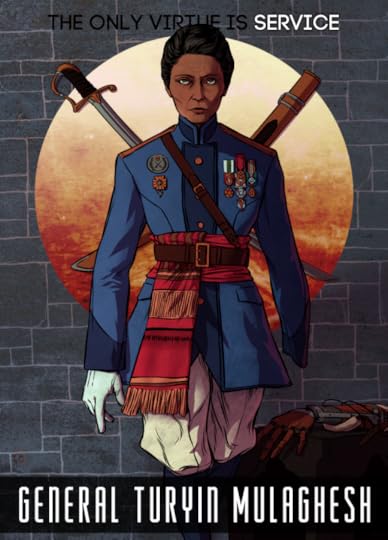
General Turyin Mulaghesh “a woman whose glance was so bright and piercing you almost wanted to check yourself for bruises after she looked at you” is not what she used to be. If you remember the description from the City of Stairs, you see her

”dressed in her uniform which is pressed, polished, spotless. Her hair is tied back in a brutal bun, and her knee-high black boots boast a mirror shine. Her left breast is covered in medals; her right handles the considerable overflow. Overall, she does not look well dressed, but rather carefully assembled.”

description

In the "City of Blades", Mulaghesh is our main protagonist. This once belligerent and obnoxious woman is in the process of slow decay after deliberate withdrawal from public life. She is pulled out of her early retirement by no-one else than Ashara Komayd, the Prime Minister of Saypur, and sent to ”Voortyashtan, ass-end of the universe, armpit of the world” where a person is shipped to only if they "sleep with or kill the wrong person” on an undercover mission, i.e. a thing that she is the least predisposed and trained to do. But Turyin Mulaghesh is someone who has chosen to live her life for the safety and betterment of others. She has chosen, in a word, to serve. And so, serve she goes.

The present city of Voortyashtan is but a sad remnant of the ancient oceanopolis, capital of the goddess of war and death Voortya. Festering resentment against Saypuri occupation, clan feuds, an ambitious construction project that can alter the life of the whole continent, worrying miraculous substances, and a missing agent is what Mulaghesh dives into. Head first. And one-handed.

At its most basic this book is about promises. After all, as Mulaghesh notes, ”that’s what the whole civilised society is founded upon, isn’t it?” Not so much the easy, daily ones (I promise you will like this book), rather those stronger than ourselves (I will love you until the eternity and one day longer).

“What wild promises we make in order to justify the worst of decisions.”

How to make those promises matter? What kind of promises will be kept even after we perish?

“Deaths of all kinds echo on. And sometimes, it seems, they drown out all of life”

At its most basic this book is about war. Not so much war as an absence of peace (this tends to be trivialised in the age that invented PTSD), rather war conceived as the essence of peace, its absolutely inevitable element. The war between Saypur and the continent continues; it is a quiet one, but still deadly.

“And there are lots of ways to win a war. A war isn’t between armies, it’s between nations.”

‘Are you a part of me? Am I a part of you?’ This is the question war asks the mankind and the City of Blades tries to answer to. Voortya is a goddess born of the Hobbesian part of human soul where the perpetual bellum omnium contra omnes (war of all against all) has always been and will always be the natural state of things.

And this, we can see war either as the inevitable or the inexcusable.

“War and conflict form the sea through which nation-states swim…war is momentum. War is natural. And war makes one strong.”

If it is the former, “A soldier does not give, they take! A soldier does not serve, but forces others to serve! A soldier does not cede power, but wields it, wrests it from the hands of any who dares lay claim to it! A soldier never gives, a soldier never serves! A soldier fights only to kill, to claim, to take, to conquer! That is what we are!’ If it is the latter, war is simple service and
“a true soldier, I think, does not take. A soldier gives…And a blade is not a happy friend to a soldier, but a burden, a heavy one to be used scrupulously and carefully…And a blade isn’t a happy friend to a soldier, but a burden, a heavy one, to be used scrupulously and carefully.”

At its most basic this book is about life. And love, about defiant love.

“We are beautiful, strange creatures of heat and noise, of sudden, inscrutable impulses, of savage passions…Yet when we consider our own existence, we think ourselves calm, composed, rational, in control . . . All the while forgetting that we are at the mercy of these rebellious, hidden systems – and the elements, of course. And when the elements have their way, and the tiny fire within us flickers out.”

In this respect, Signe Harkvaldsson is one of the best characters I came across the numerous pages of fantasy books I have read. And while sometimes I had a feeling that the book drags a bit, the passages she featured in left me with wanting to know her more, know her better.

“Mulaghesh sees many things in that smile. She sees charm, wit, and a roiling sea of cleverness; she sees a sharp, diamond-hard attention, recording everything that’s witnessed; but what Mulaghesh sees most in that broad, white smile is an unshakable, concrete confidence that its owner is at any given moment the smartest person in the room.”

description

My objections to the book are not many, but they are substantial. Mainly, while City of Blades tells a different story than the City of Stairs, it does so in the same way, using the same means, the same pathways.

“So if this stuff is miraculous, thinks Mulaghesh, then maybe yet another Divinity isn’t as dead as we’d like it to be.”

In short, the reader has a feeling that it is the same book with a recurring pattern, circling repetitions of something that should have been a unique and one-of-a-kind occurrence, i.e. the emanation of the divine.

“There’s a place below this one, floating on an ocean underneath reality” and the boundaries are beginning to blur. Voortyashtan is yet another Bulikov, a scar in reality, Mulghesh stands in for Shara, Shara becomes Vinya, and only Sigrud remains more or less himself.

Overall, if you liked the first part of the Divine Cities, there is no reason for you to dislike this one provided that you do not expect anything more and anything different. After all, we love the books we loved already.

--

Other Divine Cities:
1. City of Stairs
2. City of Blades
Profile Image for CC.
120 reviews293 followers
February 22, 2023
I feel a bit conflicted about this book. It was a great read, but somewhat tricky to get through... And even more so to review.

The first book in the series, City of Stairs, was an excellent blend of high fantasy and supernatural mystery, and I loved it. I was expecting a very similar read in this sequel, especially since it seems to follow almost the same plot track, revolving around another mystery that threatens to reveal divine schemes hidden beneath the surface. And in a way, I did get what I wanted: City of Blades is even more epic than City of Stairs, and I loved every scene of those godly encounters. The imagery it invokes in the mind is grand and beautiful, filled with overwhelming senses of awe. The mystery is also more intriguing---after getting past the first 30% which was a bit slow, I found the story increasingly atmospheric and tightly paced, and the ending twists were both well hinted at and not overly obvious.

However, it was much harder to feel satisfied while reading this book, compared to the first one, because of the drastically different emotional journey that they take us on. While City of Stairs is about the wonders and costs of history and culture, City of Blades is about war. At the heart of it, it is about the cruelty and atrocities of conquest, the "echoes of death" that haunt the living in more ways than one.

I don't like war fiction. Or maybe "like" is the wrong word here, since I can't imagine anyone would "like" such a thing. To me, it is a topic too heavy and real to touch upon, and it can easily feel too wrong when taken lightly or simply. So at least I'll applaud Bennett for doing that part right: never once did I feel troubled by the way he treated this theme. He didn't trivialize the impact of any actions, or attribute everything to a villain's innate evilness. He showed us war for what it is, showed us how isolation and survival instinct bring out the worst in the best of us. Not every aspect of it was done perfectly, of course, yet I appreciate the approach.

But that is not to say that it sparked enjoyment. It made an otherwise fun read a bit too serious, in a way that didn't quite fit either. For one, Bennett's writing has a strong humorous tone. To have something this heavy be the central piece of a book peppered with so much comical relief... is perhaps necessary for emotional health, but somewhat unexpected. For two, the war theme didn't seem to tie in too well with the fantasy side of the story. Sure, it all goes back to Voortya, but the message of her doctrines and beliefs didn't fully manifest in any real-world conflicts, and the ending left too much unresolved, such as .

Would I have liked this sequel as much as City of Stairs if the theme of war wasn't so dominating? Maybe, though it'd still be hard to beat the deep connection and understanding between Shara and Vohannes that I absolutely loved there, which, despite a more rounded and fully-developed main protagonist, is missing in this book. It also doesn't help that I hate single-minded and short-sighted characters, which there are way too many of in the Saypur Military. Perhaps that's even an accurate depiction of real life ... but again, that doesn't precisely make the story enjoyable.

Despite striking the wrong chord with me though (and, in a way, with itself), City of Blades is still an expertly-written book, done with great intentions. I found it a worthy read nonetheless and will be interested enough in the third installation of the trilogy. Hopefully Bennett will surprise me.

(Thanks Hirondelle for the great buddy read! See her review here.)
Profile Image for Hannah.
648 reviews1,199 followers
August 8, 2017
I am in love with the world and the mythology Robert Jackson Bennet created and very much in awe with its intricacy and originality. I was getting a bit disillusioned with the genre but this fantasy trilogy is making me a very happy fan. If you haven't already: go and read it!

Set several years after the events of the first book, the world has not changed as much as Shara wanted it to. When a Ministry operative disappears in Voortyashtan (the city created by the now dead Goddess of War), Shara manipulates Turyin Mulaghesh to go and try to find her. Mulaghesh is still struggling with the awful things she has done in life and feels like she has to atone.

I adored this theme of atonement and of doing better and of trying to leave the world a better place. This book is decidedly darker than the first; Turyin is a lot more hardened and she has done some truly terrible things in the past wars. I loved spending more time with her and this book manages to make her even more badass than the first while also rendering her more human and fragile. She is a brilliantly done character - which is important to me because I always struggle when series shift to a new view point.

What makes this book stand out even more is the absolutely stunning way Robert Jackson Bennet has with words - he creates wonderful sentences and turns of phrases that lift this already brilliant book even higher. His descriptions of the otherworldy settings are a beauty to behold and I cannot wait to see what he conjures up in the next book.

First sentence: "Somewhere around mile three on the trek up the hill Pitry Suturashni decides he would not describe the Javrati sun as 'warm and relaxing', as the travel advertisments say."
Profile Image for Jonathan O'Neill.
249 reviews582 followers
February 26, 2024
5 ⭐

Equal to the many highlights of City of Stairs and further strengthened, judiciously, in areas of the former’s weakness; City of Blades is a streamlined, well executed and emotionally erudite 2nd offering in Robert Jackson Bennett’s ’The Divine Cities’ Trilogy.

Fast forward 5 years from book 1’s climactic Battle of Bulikov and General Turyin Mulaghesh is coerced out of retirement with the purpose of investigating the disappearance of Saypuri Ministry of Foreign Affairs’ Sumitra Choudry who was charged with observing and reporting on the properties of a newly discovered material, in the City of Voortyashtan (“ass-end of the universe, armpit of the world”) , said to have perfect conductive properties and potentially divine characteristics. Not a clear-cut homicide case as in the first of the series, the details of Choudry’s disappearance only become hazier and more alluring as the story progresses.

Bennett goes to darker places with this one. The tone throughout is rather bleak and oppressive but not without its moments of well-weighted relief. This foreboding atmosphere stems from several things but not least of all the environment in which it takes place. Voortyashtan, as the name suggests, was once home to Voortya: ”Empress of Graves, Maiden of steel, Devourer of Children, Queen of Grief, She who clove the earth in twain” The Goddess of Death and Warfare… A real sweetheart. She is dead now and her City reduced to ruins thanks to the Saypuri but her presence is still felt in the ways and the beliefs of her followers lending the story a strong sense of impending doom.

”Why do you deny what you are? […] This life beyond death is one you deserve”

Into the darkness comes Mulaghesh and there couldn’t really be a better suited protagonist for the aforementioned environ. In many ways she seems the only sensible choice. I didn’t dislike Shara Komayd as the protagonist of the first novel, in fact, when I first found out she wasn’t to lead this instalment I was taken aback, however, I quickly found Mulaghesh to be less stiff, pleasantly imperfect and therefore much more relateable than the very clinical and perfectly competent Komayd. She has a mouth like a sailor (she drinks like one too) and a general lack of patience for stupid people and distasteful situations but what makes her the perfect fit here is her dark military past, long-term unresolved PTSD and heart-wrenching pursuit for hitherto elusive self-forgiveness and redemption.

“In the dark, General Turyin Mulaghesh tries to make herself whole.”

The subject is not broached in a nauseatingly explicit or generic fashion as I have seen in other Modern Fantasy novels but is rather treated as an integral aspect of both the personal and the divine elements of the story. Mulaghesh’s violent past, from which she struggles to escape, is the very chain that binds her to, and sees her accepted by, the Goddess of Death and her followers. The implications of this, she will be forced to confront head on. As a counterpoint to Mulaghesh’s trajectory along the path from broken war veteran to being made whole again, Bennett gives us Lalith Biswal, Turyin’s former Commanding Officer. Through his arc, we see an alternate, albeit highly plausible, trajectory. A multifaceted exploration of themes that I’m beginning to recognize as a signature RJB trait.

"When the world grinds you down, you pick a handful of fires to hold close to your heart"

By way of a returning favourite and their offspring, we are treated to an emotional examination of family estrangement; the dynamics between a parent and their child when, after an extended separation fraught with complicating factors, they face one another again. When one discovers that a memory they presumed shared, kept aflame, and warmed themselves by in their darkest hours has very little value in the mind of the other and they, in fact, know little of the person they’ve become. Will the hand of forgiveness be proferred? Is their time for reconciliation?

”I used to chase her through the forest”

This hits in several places where ‘City of Stairs’ missed. One of which is emotional payoff. ‘City of Blades’ is capable of tugging on the reader’s heart strings in a way that the first book never was, largely due to inferior secondary character work.

I’m not entirely sure by what Wizardry this was achieved but the sparing use of humour during otherwise incredibly grim moments also worked here despite, as far as I can tell, being essentially the same as in the first book. Possibly just a bit more finesse/fine tuning regarding the timing.

Finally, I appreciated the efficiency/economy of words here. This is a book that will work well for those who like to have a solid idea of a novel’s locales but don’t enjoy overly descriptive writing. Bennett trusts his reader’s imagination to fill in the gaps, giving just enough description to offer a clear picture while not bogging one down with superfluous information.
Fantasy-lovers, if the first 2 books are anything to go by, you’ll want to get to this one sooner rather than later.

“Ask a person what they want most desperately and they will say a child, a home, a fortune, a power over their fellow men.
These are all variations on the same thing — a wish for lasting influence, for legacy, for eternity.

We wish to be remembered.”


Shoutout to the Blinkovskis (Nataliyatnikova, Carolovich and Alexandrova) for another excellent buddy-read with typically great insights from you all! :)
Profile Image for Scott  Hitchcock.
796 reviews261 followers
October 17, 2017
There were portions of this book I loved and portions I found tedious. The recap of the action from the last book too way too long to deliver as did the setup for this book. Then in the middle it was awesome. Then it went back to sleep. The ending again was awesome although one of the key moments left me wanting a different writing. Still a good series. Looking forward to book 3 in May.
Profile Image for Melissa ♥ Dog/Wolf Lover ♥ Martin.
3,633 reviews11.6k followers
January 29, 2016
MY BLOG: Melissa Martin's Reading List


This book was sooooooo good! My freaking hero is General Turyin Mulaghesh! She is older and still bad to the bone, puts up with nothing.. well until they force her out of retirement, which makes her mad as hell.

 :

I think I'm just going to put in a few excerpts first from my hero and then get on with the review.

 :

"The first murder took place deep in disputed territory, General. It's not safe."
"Neither am I. I can handle myself."


****

"Leave now," says Signe, "and you'll only inspire more questions."
"She leaves because it's true!" shouts Balakilya, striding to stand in the central aisle. "She fears the truth, so she flees from it!"
"See?" says Signe.
"General Mulaghesh," says Biswal, looking up, "perhaps if you could spare a few words for-"
"She's come to murder whatever's left of our culture!" cries Balakilya.
"She's here to force us to bow to the whip of Saypur!" shouts another man.
"Oh for the love of..." Mulaghesh walks to the railing. "You want to know why I'm here? Here of all places on this damned world!"
"Tell us!" shouts one of the men below. "Tell us!"
"Fine!" snarls Mulaghesh. "I'm on vacation, you dumb ass sons of bitches!"
A loud silence echoes over the Galleries. Mulaghesh turns and strides away. As she walks through the door she hears someone say, very quietly, "Did she say vacation?"


****

I just loved her throughout the whole book. I'm not going to tell you what it's about, you can read the blurb. But I just found another hero in this woman, she's older, she has one arm and a wooden one that works okay for her, she is awesome with weapons and she's got some snark that cracks me up.

There are some crazy stuff going on in this city, Mulaghesh would never have guessed the evil place she just got dropped! There are different groups of people, there are evil beings, ghosts, different realms, crazy people doing crazy things to each other, some magical ore, and the list goes on and on.

I was so glad to find that Sigrud was back and he's just as cool as ever! I love him too :-)

At times I got confused in the book and it came back around and I got an idea of what was going on. But it as so freaking good, magical...fighting...killings...divine things...... I believe the author weaved a wonderful tale with this one. I think I like this one better than the first one and I'm thinking/hoping there is going to be another one! I can't even imagine where that one will take us.

There are some sad things that happen in the book as per the norm, there are also a few gruesome things, but it all makes sense in the end, oh.. and the end! I was like.. I knew something wasn't right with that person and what the......

I'm not one that is good with words so let me just say again, the book is awesome and read it :-)

*I would like to thank Blogging For Books for a free print copy of this book in exchange for my honest review.*
Profile Image for Terence.
1,169 reviews390 followers
February 15, 2016
Five years after the Battle of Bulikov, retired General Turyin Mulaghesh is called on once more to serve Saypur. Prime Minister Shara Komayd has an off the books mission for her, find a missing ministry official and investigate a miraculous substance. The worst part of all is Mulaghesh has to travel to Voortyashtan otherwise known as The City of Blades. Voortyashtan was the land of the divinity of war and death Voortya and despite being a ruin since the blink, it's still a dangerous place.

The City of Blades was surprising in many ways. The biggest surprise was that the author decided to make a sequel to City of Stairs. It was surprising, not because City of Stairs was a bad book, but because the events that unfolded were so monumental that it seemed unlikely a sequel could be as good as the original. Unfortunately I don't believe the sequel was as good as the first book. The main reason for that is it was just too similar to the original. The events in City of Stairs should have been a one time event, not something that could happen again...ever. Yet that's what happens in many ways.

The next large surprise was using City of Stairs support character Turyin Mulaghesh as the main protagonist. I know many people loved Mulaghesh, but all I remembered about her was that she was a foul mouthed woman who was in charge in Bulikov. I didn't dislike her, but I certainly didn't feel she should be the main protagonist. I'll admit I did grow to appreciate her as the story went along, but I still would have preferred Shara Komayd and Sigrud running the show.

Not only is Shara Komayd not the main protagonist, but she is relegated to a similar role that Vinya Komayd played in City of Stairs. She's calling the shots, but unlike Vinya, Shara has lost the support of seemingly everyone and she's certain she'll be out of office soon. I really missed Shara's presence.

In the end I have to say, City of Blades was just not as good as City of Stairs.

3 out of 5 stars

I received this ARC from NetGalley in exchange for an honest review.
Profile Image for Robin (Bridge Four).
1,940 reviews1,658 followers
March 17, 2019
Buddy read with the peeps at Buddies Books and Baubles starting 1/16/19
a slave will use any tool to escape their slavery, even those of their masters.

City of Blades is a fantastic follow up to the City of Stairs set five years after the events of City of Stairs and my things have changed. This book doesn’t feature Shara, heroine of the previous book and I thought I’d miss her, but Mulaghesh was a fantastic character to follow and see this world through. She filled the void of Shara not being the main character beautifully and with the addition of Sigrud’s daughter Signe and Sigrud himself this was again an intelligent, insightful, intriguing, with some action and mystery to be solved that might even be better than City of Stairs.

description

The Premise:

Mulaghesh has retired and is pretty much just wasting her life in a sleepy little town when Shara pulls her back into service to go to a place Mulaghesh hates, with a man in it that Mulaghesh has a bloody history with to find out what happened to an agent who has gone missing.

description

Mulaghesh it seems has quite a past and it is teased out little by little. It really makes her the perfect person to be on this mission and in this place. She knows how sometimes the good intensions you start out with go to hell in a war and how quickly it can all go off the rails.
What wild promises we make in order to justify the worst of decisions.

Voortyashtan is a place trying to rebuild itself. It again use to be the master and is now at the mercy of the former slaves. Voortya was the first god to fall and she was the god of death who promised her followers an afterlife where they would gather until the final war where they would be reborn to fight in it until the end of the world.

What I really like about the writing of Robert Jackson Bennett is how smart it is. There is this huge world full of fantasy and wonder and there is a mystery. Everything is done well; the history of the people, the politics, the magic, characters and everything else that goes into this story. I’m really in awe of the big twists that I didn’t see coming but made perfect sense when they happened.

Mulaghesh is a wonderful main character. I few of the things I love about her:
1. She is a 50 something war veteran with one hand (not your typical heroine)
2. She has a BLOODY past

“You've always believed war to be a grand performance. But to me it's just killing, just the ugliest thing a person can ever do...So when you need to do it, there's no need to make a show of it.”

3. She is smart, but not cocky and definitely has some issues because of her past.
4. She has a clear sense of right and wrong and the greater good and knows her part in all of it.
5. She makes no excuses; not for her past, her present or plans of the future
6. She is friends with Sigrud (that is kinda a big deal)


Sigrud on the other hand is just as fantastic. He is more complex than the killer on the surface would suggest. He has very deep thoughts and now has be reunited with his family after years apart. It isn’t all rainbows and sunshine because he has a strong willed daughter who grew up without him and is angry that he could have come back years before but instead worked with Shara.
And, later, when I was in prison…when I thought I would go mad…I held on to this very tightly, this memory of the little blond girl laughing as she ran through the forest. This tiny, perfect creature, darting among these great big trees. When the world grinds you down, you pick a handful of fires to hold close to your heart.

It is hard to realize that the memories that were so important to you are not as important to those around you. Signe doesn’t remember that father and she will not let him forget it. But it seems the apple doesn’t fall far from the tree and Signe is just as smart and cunning as daddy dearest. I loved the dynamic this brought to the story.

The only bad thing is that with so much going on there were some times that the story lulled a little. But then there would be a huge fight scene or big reveal that made that lull totally worth it.

This is a little bleaker than some books in there are a few deaths that really hurt in it. The ending was also a little hard on me as some of the characters have to face new challenges and we know that they are not all in good positions. Sigrud for instance I feel for the most, especially after all the pain he has already endured. But I totally look forward to the conclusion to this series and hope that my summer heart can take it.
Profile Image for Eon Windrunner.
468 reviews532 followers
April 13, 2017
The story picks up five years after the events of City of Stairs and present us with a different viewpoint in the form of Mulagesh who is sent to investigate the disappearance of a Ministry agent in the fabled city of Voortyasthan. Once the domain of the goddess of war, Voortya, the city is still a very dangerous place and Mulaghesh, assuming the role of the reluctant and grumpy makeshift detective, has her work cut out for her in furtively investigating the mystery. She soon realizes though, that there is something or someone sinister at work behind the scenes and that there might even be a divine influences responsible.

Let’s stop right there.

This book is good. Really good. But I had problems with it.

I expected things to pick up right where we left off, but instead, boom, five years later. Oh, well then I expected the author to say the shit had hit the fan divine-wise and things had escalated rapidly and look where we are now! Nope, politics seems to be all that has happened in the passing time. Ok, well at least I have Shara and Sigrud to get things going. *author shakes head at me. Not? Damn. Mulagesh is pretty cool though so I guess I can’t complain too much about that one. Right, onto the new story then. Except it feels as though we are pretty much exactly where we started the first book. Slightly different, disappearance instead of a murder, but another secret investigation, some more divine involvement. Feels like more of the same, but definitely slower and without my favorite characters. Even though the fantastical action was great when it arrived, I felt that it was not able to ascend to quite the same level that RJB set the bar at in the first book. The writing was brilliant as before, if not a touch improved, and there were some interesting explorations into deeper issues such as the long term effects of war on soldiers, but overall I was slightly disappointed.

As I said though, this is still a very good book and you should not be deterred from reading it and depriving yourself from the writing of RJB, who is clearly one of the most exciting new authors in recent years. Expectation can be a bastard though!
Profile Image for Justine.
1,419 reviews381 followers
February 17, 2017
This is a very well written and intense tale, and in my opinion, it surpasses the first book, City of Stairs.

Turyin Mulaghesh, pulled out of retirement after the Battle of Bulikov returns to the Continent, this time to the city of Voortyashtan to investigate the disappearance of a Ministry official and of course, other strange occurrences. But being in Voortyashtan brings back a host of combat related memories for Mulaghesh in addition to being a veritable powder keg of its own.

Within this fantasy tale, Bennett has much to say about the nature of war, soldiering, and being an occupying force. He fills the pages with as much humour as philosophy and melancholy, which keeps the characters realistic and alive rather than simply preachy. While it is certainly filled with horror and heartbreak, Mulaghesh in particular offers this hopeful insight on what it means to be a soldier:

"But a soldier, a true soldier, I think, does not take. A soldier gives."

"A soldier serves not to take, they don’t strive to have something, but rather they strive so that others might one day have something. And a blade isn’t a happy friend to a soldier, but a burden, a heavy one, to be used scrupulously and carefully. A good soldier does everything they can so they do not have to kill. That’s what training is for. But if we have to, we will. And when we do that we give up some part of ourselves, as we’re asked to do."


This gives some idea about the standard that Mulaghesh is setting for herself and others and definitely sets the tone for the story, as her vision of the role of a soldier is clearly not shared by everyone, and that sets the stage for a great deal of conflict. Not for the faint of heart perhaps, but Bennett definitely put his own heart into this one.
Profile Image for Deborah Obida.
701 reviews696 followers
May 5, 2020
Ask a person what they want most desperately and they will say a child, a home, a fortune, a power, or an influence over their fellow men.
These are all variations on the same thing—a wish for lasting influence, for legacy, for eternity.
We wish to be remembered.


I'm one of those people that don't like it when a protagonist of a series change mid series but this author did such a good job that it made me wonder why I don't even like this style. Mulaghesh the protagonist isn't exactly a new character, she was one of the supporting characters in City of Stairs the first book in the series.

I was taught that peace is the absence of war. But I wonder if these days we’ve simply replaced conventional war with a war of paper. I’m not so sure which is better.

Its five years now after the war of Bulikov that gods that everyone thought dead came back. After the war Mulaghesh retired from the army but Shara pulled her back from retirement for a supposed one last mission in Voortyanshanti a place that it's people are worse they Bulikovians. Voortya their Divine is the goddess of war and death so they revel in death.

The plot is too much like that of the first book, a foreign affairs minister disappeared in Voortyanshanti and Shara sent Mulaghesh because before the agent disappeared she suspected some divine interference.

“I don’t deserve such kindness.”
“Ah, there’s that word.” She looks out at the ocean. “ ‘Deserve.’ How preoccupied we are with that. With what we should have, with what we are owed. I wonder if any word has ever caused more heartache.”


I like the world building in this book, environments and battles were well depicted but the writing was hard to get into, the first 40% of the book was so boring, the remaining 60% was action packed and it was near impossible to put the book down. Mulaghesh was the major narrator but a few other characters has a few POV.

The characters in this book are well developed with layered personalities. Mulaghesh suffers from major PTSD which only got worse after the battle of Bulikov. I love the way the author depicted that part of the character. She is also in her 50s but still a badass even though she now has one arm. She hates killing and hates to loose a soldier of her country, she considers them her children. Her moral compass works so well.


To live life, one must accept that one was already dead. Every morning, one must arise and m-make peace with death, accept that it was coming.” Her words grow stronger as she speaks. “He said, ‘Time is a river, and we are but blades of grass floating upon its waves. To fear the end of the river is to fear being on it at all. And though we may look ahead, and see countless forks, when we look back we see only one way things ever could have gone. All is inevitable. To argue with fate is to argue with a river.’ ”


Biswal is the opposite of Mulaghesh, he loves killing he basically have no moral compass, whether civilians or army he doesn't care. He thinks that people should serve the army not the other way around.

Signe Harkvalson is the daughter of Sigrud, she is so smart that she is in charge of a Dreyling company.

Sigrud went back home and turned the country into a democracy but he'd rather be out fighting than politics.
Profile Image for Choko.
1,497 reviews2,685 followers
February 4, 2016
*** 4.5 ***

Another amazing buddy read with my favorite BB&B posse!


This is the second book in this understated, but absolutely intriguing new series by Robert Jackson Bennett. General Turyin Mulaghesh is the one that is stuck with the unpleasant and unwanted mission to get back to the Continent, after being somewhat retired, and find out what is going on with some questionably amazing, possibly divine new ore that was mined there. She is also tasked with finding what happened to an operator from the ministry who has disappeared close to 3 months ago. So Mulaghesh and we are thrown into a part of the Continent where nationalist tensions are at an optimum and the occupiers very trigger happy and fast to jump to violence.

This second book has a different feel to it than the first. We see it through the eyes of a tired, physically damaged, chronically hurting, and PTSD suffering soldier, who had had her hopes for a better tomorrow dashed, is left disillusioned and feels lonely and abandoned. ... The mood is introspective, profoundly intimate, and manages to be detached at the same time... And all of this the author achieves with sparse language, austere descriptions, and a studied understanding of the guilt which follows those who have been made to kill... I am in awe of the insidious way RJB sneaks little touches that get under your skin and you KNOW how this character feels... From the start Mulaghesh broke my heart!!! My skin went all goose-bumpy and my chest tightened with sadness just by couple of sentences!!! It always takes time for everything to fit into the right place. She knows it’ll never be perfect. In the dark, General Turyin Mulaghesh tries to make herself whole.

All secondary characters were crafted just enough to make the situation cleared, to crystallize the main content and lead us with the General into the core of the investigation. The political currents are a vivid background to the story, weaving in and out of front and center, making the atmosphere tangible to the reader, feeling known and familiar. The passages from one reality into another flowed smoothly into each-other, building on our previously acquired knowledge about the magical rules of this world.

Being a slower, more contemplative read, this book may seem to be a let-down after the first, but I just think it switches pace due to the different POV. The tough, gruff, one armed old soldier does not experience things same as the young Shara Komayd, who during book one still envisioned the future in rose colors and rainbows. I thoroughly enjoyed this and am once again grateful to my buddies at BB&B for holding my hand through some of the more emotional from me parts.

I hope we all have more books and even more ones that resonate with us in such an emotional way! Happy reading to all!
Profile Image for Metodi Markov.
1,726 reviews435 followers
December 20, 2025
Страхотно продължение!

Бенет залага на рядко срещан вариант за разитие на историята си - сменя главния герой. Шара Комейд, отстъпва мястото си на генерал Малагеш. И това му се оплаща богато!

Книгата е много интересна, култът на богинята Воортя към смъртта и войната не е нещо, което може да се пренебрегне с лека ръка!

А свети Жургут си има нов почитател! 😂

Третата част - "Град на чудеса", я започнах на английски.

Цитати:

"Всяка смърт отеква неспирно. И понякога сякаш заглушава всички звуци на живота."

"Да харесваш не е същото като да обичаш."

"Вериги се коват от различни и чудновати метали. Бедността е един от тях. Страхът също. Както ритуалите и обичаите."
Profile Image for Rob.
892 reviews584 followers
February 7, 2016
Executive Summary: The sequel I wasn't sure I wanted turned out to be the best read of the year so far.

Full Review
Before my book club did a read of City of Stairs a year and a half ago, I had not heard of Robert Jackson Bennett. It ended up being one of my favorite reads of 2014.

Not only was it well written and engrossing, but it was a stand alone! Who does that? No one anymore it seems like. While the world Mr. Bennett built was fascinating and large enough to accommodate many stories, I didn't feel I needed another one.

So when I found out he was going to be writing a sequel to it after all, I was apprehensive. Would riding the popularity of the first book lessen it? If an author writes a book as a stand alone, would a sequel he never intended to write be any good? In this case, the answer is it turns out to be even better. At least for me.

I found Mulaghesh to be an excellent supporting character in the first book. I was intrigued by the idea of her being the protagonist. Of course it didn't hurt that the rumor was we'd get more of Sigurd as well.

The change of protagonist and location made this book feel mostly like another stand alone story set in the same world. However, unlike the first book, I don't think you can just pick this up on it's own. It still builds on the foundation of the first book, while largely being it's own thing. Also, unlike the first book, it does a lot more to set up another book which looks to be on the way sometime next year.

I found the city Voortyashtan just as fascinating as Bulikov, while being completely different. City of Stairs hints at a larger world of fallen cities built by vanquished deities, and this book shows us just another small part of that.

I really enjoyed most of the new characters, but I especially liked Signe. She was a good compliment and contrast to Mulaghesh. Both are smart, capable and determined, but Signe is much more an intellectual. It helped (though not enough) to offset the lack of Shara.

This was one of those books I had a hard time putting down, and would have read it far faster if "real life" hadn't kept conspiring to take up my reading time. It's for that reason I ended up giving it a very rare 5 stars. My typical criteria for 5 star books are those I can't put down and stay with me when I do. This book definitely fit that. It's the sequel I didn't know I wanted.

Now I just hope that Mr. Bennett can pull it off again with a third novel, because after this book, I definitely want another.
Profile Image for Althea Ann.
2,255 reviews1,209 followers
March 17, 2017
One of my Hugo Award nominees, novel, 2016.
____

The sequel to 'City of Stairs' open with what's likely the most entertaining 'calling-a-character-out-of-retirement' scene I've ever read. General Mulaghesh has tried to leave war behind and purchased a cottage on a remote beach. However, we quickly begin to suspect that her retreat isn't quite the haven she imagined. And now, an envoy has been sent from Saypur with a message for her - and a mission.

After the initial scene, the POV switches - it initially feels like a disappointment, because the opener was so strong. I also missed the brilliantly realized city of Bulikov that 'City of Stairs' introduced us to, even though it's clear from the titles that each book in this series is intended to focus on a different locale. But soon enough I was won over by the new perspective and the new setting.

The 'City of Blades' is Voortyashtan. At times (and I'm not concretely sure why) it reminded me of an evil Gondor. Voortyashtan was largely destroyed by the 'Blink' - the cataclysmic battle in which all the gods and all their associated miracles were destroyed. The bulk of the city, once suspended by Divine power, has sunk below the waves. The surviving inhabitants are in conflict over the remaining bits of arable, livable land. Meanwhile, Saypuri politicians from overseas seek to maintain political control, and a force of Dreylings, also from overseas, are working on an engineering project to clear the harbor, which has the potential to become a key spot in international commerce.

Among both Dreylings and Saypuri, Voortyashtan has a reputation as being the ass end of nowhere - and dangerous, to boot. It's the sort of place where half-discredited military officials are shoved out of the public eye. But now, a bizarre discovery has been made - one that's either an amazing discovery that could revolutionize new technologies, or a disconcerting sign that the gods might not be as dead as everyone assumed. (And, considering that Voortya was a goddess of death and war, she's maybe not a deity you really want to have around. Especially after you killed her.) In conjunction with this, an agent has disappeared. Rumor has it that before vanishing, she went insane. General Mulaghesh is asked to investigate...

It's a great setup for a murder mystery in an eerie, fascinating world. And indeed, the story unfolds with plenty of twists and action. However, as it progresses, somehow the book also becomes a truly insightful meditation on war, the multitudes of costs it inflicts on all parties, the place that violence holds in human society, and what it means to be a soldier. All this without in any way sacrificing the flow and tension of the plot. An impressive achievement.

Many thanks to Crown Publishing and NetGalley for the chance to read this excellent book. As always, my opinions are solely my own.
Profile Image for Hamad.
1,316 reviews1,625 followers
May 10, 2024
“There's no such thing as a good death ... It's just a dull, stupid thing we all have to do eventually. To ask meaning of it is to ask meaning of a shadow.”


City of Stairs ★★★★
City of Blades ★★★★

"City of Blade" is the second book in the "Divine Cities" trilogy by Robert Jackson Bennett. Set in a world where gods were once alive and have now been killed, leaving their cities and miracles behind, this series combines elements of fantasy, mystery, and political intrigue.

In "City of Blade," Bennett continues to explore the complex dynamics between the conquered and the conquerors, as well as the consequences of historical events. The story follows protagonist Mulaghesh as she navigates the treacherous streets of Voortyashtan, a city once ruled by gods and to its new military occupiers, the once-powerful capital is a wasteland of sectarian violence and bloody uprisings.

Bennett's world-building is exceptional, immersing readers in a richly detailed setting filled with unique cultures, religions, and technologies. The city itself feels like a character, with its intricate history and hidden depths. The author skillfully weaves together multiple plotlines, keeping readers engaged with twists and turns until the very end.

I think the shift of protagonist came unexpected for me and I don't remember reading many series with such a formula. I think this makes the books feels like standalones rather than a series although the storyline is indeed connected despite the shift in time and person. Mulaghesh took some time getting used to specially with the new side characters, but it gets better so I won't complain much.

Overall, "City of Blade" is a gripping read that will appeal to fans of fantasy, mystery, and political intrigue. Bennett's masterful storytelling and vivid imagination make this series a must-read for anyone looking for a unique and immersive literary experience.
Profile Image for Sherwood Smith.
Author 168 books37.5k followers
Read
May 4, 2016
“I was taught that peace is the absence of war. But I wonder if these days we’ve simply replaced conventional war with a war of paper. I’m not so sure which is better.”

City of Blades is structurally similar to City of Stairs: we get an outside agent sent to a hellish locale to solve the mystery of a missing person (in the first book, a death, in the second, no one knows what happened to the agent), meeting people from their past as well as new people, everyone with secrets that get peeled away one by one as the stakes accelerate.

But there the similarities end.

To say that City of Stairs is about anti-colonialism and City of Blades is about war is like saying the Sistine Chapel is about plaster, or Hamlet is about royalty. Yeah, both those elements are fundamental—vital—but so much else is going on.

For one thing, both books deal with religion, specifically dead gods, whose powers were real, warping reality beyond comprehension for the practical, religion-banning Saypuri.

"The word everyone forgets," says Mulaghesh, "is ‘serve.’ . . . This is the service, and we soldiers are servants. Sure, when people think of a soldier, they think of soldiers taking. They think of us taking territory, taking the enemy, taking a city or a country. This grand, abstract idea of ‘taking,’ as if we were pirates, swaggering and brandishing our weapons, bullying and intimidating people. But a soldier, a true soldier, does not take. A soldier gives."

"Gives what?"

"Anything," says Mulaghesh. "Everything, if asked of us. We are servants, as I said."


I enjoyed all the characters in City of Stairs, but my favorite was the squint-eyed, foul-mouthed, cheroot-smoking career military colonel Turyin Mulaghesh. She’s the central character in this second book, now a general a few months from retirement. Shara sends her to Voortyashtan, a harbor city with a deeply troubled past, fierce people warring with everyone else, and a whole lot of secrets, to find out what happened to an agent sent there.

Again we get mysteries, secrets, powerful flashbacks, and a headlong clash with the Divine, which is far from absent from the world. But worked through this book are difficult questions about what it means to be a soldier, and why we go to war—why humans glorify war, when its results are so obscenely hideous, not just to individuals, but to families.

Bennett examines the cost of violence, not just to the victims, but to the perpetrators, as individuals, and as a culture. It’s hard hitting, with one scene that drives an ice pick straight through the heart, narrated in language so absent of easy, sentimental metaphor that the effect is pretty devastating, but the plot does not linger—it is satisfied to leave the memory as it moves on, exactly as life does for the living.

It’s an elegiac book, rising to a powerful climax, resolves what must be resolved, and yet laying groundwork for the next—which I wish were available right now.

I received my copy of City of Blades from Blogging for Books, which only asks for a review, content up to the reader.
Displaying 1 - 30 of 2,004 reviews

Can't find what you're looking for?

Get help and learn more about the design.