René Goscinny (1926 - 1977) was a French author, editor and humorist, who is best known for the comic book Asterix, which he created with illustrator Albert Uderzo, and for his work on the comic series Lucky Luke with Morris (considered the series' golden age).
Desta vez, os nossos dois indómitos gauleses têm de encontrar um escudo, o escudo de Arverne, símbolo da resistência gaulesa perante o invasor romano.
Depois de umas voltas pelas termas, muito em voga na época em que este livro foi publicado, e pelas tabernas, em que não faltaram ânforas de vinho e javalis, os nossos heróis reconstroem a viagem do escudo até chegar às mãos do seu atual possuidor.
E foi surpreendente, e até caricato, perceber onde raios andou o famoso escudo este tempo todo. O melhor esconderijo é às vistas!
PT Mais uma aventura divertida dos nossos inseparáveis companheiros gauleses.
Júlio César procura o lendário escudo de Arverne, perdido após a derrota de Vercingétorix e o consequente domínio romano na região.
Em paralelo, o destemido chefe Matasétix enfrenta problemas de fígado, sendo obrigado a cumprir uma dieta rigorosa — algo particularmente penoso para um gaulês.
As duas linhas narrativas acabam por convergir, dando origem a uma aventura leve, bem-humorada e fiel ao espírito clássico da série.
--
EN Another fun adventure with our inseparable Gallic companions.
Julius Caesar is searching for the legendary Arvernian shield, lost after the defeat of Vercingetorix and the subsequent Roman domination of the region.
Meanwhile, the fearless chief Vitalstatistix is suffering from liver problems and is forced to follow a strict diet — a particularly harsh fate for a Gaul.
The two narrative threads eventually converge, resulting in a light, humorous adventure that remains true to the classic spirit of the series.
I’ve always found Asterix and the Chieftain’s Shield to be a bit more of a serious entry in the series. And no, I’m not referring to the effects of overindulgence on the human liver.
There’s a bit of a melancholic streak in this story, which is difficult to qualify in an Asterix book. It references the defeat of the Gauls at the hands of the Romans at the Battle of Alesia, and the title refers to the shield Vercingetorix “threw at Caesar’s feet” after the battle. Now, I don’t want to go into detail here, because it’s out of place in an Asterix review, but if you were to go read up what happened to Vercingetorix afterward it will likely leave a bad taste in your mouth. This theme is underscored in the book, with the Gaulish people, and especially the veterans of the Battle of Alesia, getting all riled up when the affair is mentioned.
”What do you mean, Alesia? I don’t even know where Alesia is! Nobody knows where Alesia is!” - Chief Vitalstatistix
Something funny pertaining to that last quote: it seems that this was intended more literally than I initially suspected. Apparently scholars have been speculating about the location of Alesia for many years until finally settling on a location near Dijon in the 1990s. This book was published in 1967. You do the math.
Anyway, more serious matters aside, this is still an Asterix book, with all the comedic trappings we have come to expect. I appreciate the main plot thread of this story, since it is a good reflection of the never-say-die attitude of the little Gaulish village. In a nutshell: Caesar wants to be carried on the shield of Vercingetorix, to rub the Gauls’ faces in it. The Gauls aren’t having any of it. The shield has gone missing (of course), so the race is on to find it before the Romans do. Expect the usual antics and a whole lot of fun.
Bonus: this one also contains a really nice twist at the end.
“Alesia? Ich kenne kein Alesia! Ich weiß nicht, wo Alesia liegt! Niemand weiß, wo Alesia liegt!“
Es ist einer der running gags aus Asterix und der Avernerschild, daß die bloße Erwähnung der Stadt Alesia durch Asterix bei den angesprochenen Galliern stets zu diesem lauthals und wütend vorgebrachten Disclaimer führt, ganz einfach weil – so macht es das Album in seinen ersten beiden Panels klar – hier die entscheidende Niederlage des Avernerfürsten Vercingetorix gegen die Römer stattfand. Mithin, in den Augen der Gallier, kein Ruhmesblatt für die eigenen Leute. Allerdings, in meinen Augen, auch kein Ruhmesblatt für Caesar selbst, denn es war bei der Schlacht um Alesia, daß Caesar die Greise, Frauen und Kinder, die Vercingetorix beim Zurneigegehen der Vorräte aus der Stadt schickte, kaltblütig im Belagerungsring vor den Augen der gallischen Krieger verhungern ließ. Dieses grausige Vorgehen Caesars findet, ebenso wenig wie das tragische Schicksal des Vercingetorix – jahrelange Kerkerhaft und dann ein Meuchelmord durch Erdrosseln – in dem Asterix-Album natürlich keinerlei Erwähnung, was für ein Comic vom Schlage Asterix‘ auch ein wenig viel verlangt wäre.
Was der geneigte Asterix-Leser sich von einem Gallier-Abenteuer versprechen kann, das wird durch den elften Band der Reihe allerdings auf jeden Fall erfüllt, denn die Geschichte um den verschwundenen Schild des Vercingetorix, auf dem Caesar zur Einschüchterung der Averner in einem Triumphzug durch die Stadt Gergovia getragen werden möchte, läuft zwar verhältnismäßig langsam an, bietet indes einen spannenden Plot sowie ein unerwartetes Ende, von dem man aber schließlich wohl sagen wird, daß man es hätte vorausahnen können. Zwar geht die Suche nach dem sagenumwobenen Schild erst so richtig in der Mitte des Bandes los, aber dennoch trägt auch die eher unspektakuläre Einleitungsstory des wider Willen zwecks Diät einen Kurort besuchenden Majestix das Wohlwollen des Lesers über viele Seiten hinweg. Dies ist übrigens auch der Band, in dem Gutemine, die Gattin des Häuptlings, zum ersten Mal größere Aufmerksamkeit bekommt und in ihre endgültige visuelle Form gegossen wird. Sehr amüsant ist es auch, wenn Asterix und Obelix sich miteinander überwerfen, sich dann gegenseitig anschmollen, um sich am Ende dann doch wieder freundschaftlich in den Armen zu liegen, was Idefix dann zu einer normalerweise von Obelix angewandten Geste bringt. Meine Lieblingsfigur in diesem Abenteuer ist ganz klar der Legionär Gaius Faulus, der durch seinen Namen hinreichend charakterisiert ist und nach dem nicht unsympathischen Motto lebt: „Nur keinen Eifer in der Armee, das gibt bloß Scherereien.“ Sehr schön ist es, wenn er, als Arbeiterdenkmal beim Straf-Hofkehren, zu seinem Vorgesetzten gerufen wird und dann grummelt: „Ich lasse meine Arbeit nicht gern im Stich!“ Einen besonderen Reiz erhält dieses Album dadurch, daß oft in Rückblenden erzählt wird und wir die handelnden Personen in älteren wie in jüngeren Jahren sehen, was ja fast schon die Schlußpointe andeutet.
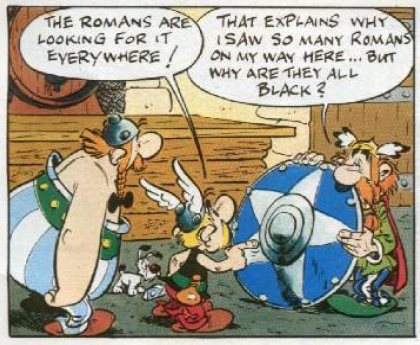
Meine beiden Lieblingspanels (S.22) haben auch wieder mit Gaius Faulus zu tun: Im ersten Panel sehen wir vier römische Legionäre zum Durchsuchen eines Kohlenkellers schreiten, wobei der letzte Legionär mit pflichtbewußter Miene dem herumlungernden Gaius Faulus den Weg in den Keller weist. Im nächsten Panel kommen dann alle Römer kohlegeschwärzt wieder aus dem Keller heraus. Alle Römer? Nein, einer, nämlich Gaius Faulus, der Mann des schlurfenden Schrittes, ist noch picobello sauber.
Rund 20 Jahre ist sie Schlacht von Alesia, bei der die Gallier unter der Führung des Kriegers Vercingetorix den Römern unterlagen, nun her. Nach dem Sieg der Römer legte Vercingetorix seine Waffen vor Cäsar nieder.
Jetzt, wo die Bewohner Gergovias langsam wieder aufmüpfiger werden, hat Cäsar eine Idee: Ein Triumphzug durch die Stadt, der alle Bürger daran erinnert, wer hier die große Schlacht gewonnen hat. Dabei möchte auf dem berühmten Avernerschild Vercingetorix getragen werden. Doch nirgendwo in den Schatzkammern ist der Schild zu finden – er scheint in Gallien geblieben zu sein. Julius Cäsar entsendet einen Sonderbeauftragten, der ihn ausfindig machen soll.
Als Asterix und Obelix davon hören, ist ihnen klar: Sie müssen den legendären Avernerschild finden, bevor es die Römer tun. Wer wird die Suche gewinnen? Es beginnt eine Art Schnitzeljagd um das Kriegsrelikt, denn der Schild ist schon durch viele Hände gewandert.
__________________
Dieser Band hat mir zu Beginn richtig gut gefallen. Ich mochte, dass es diesmal ein konkretes historisches Ereignis im Kern der Handlung gab. Auch die Rahmenhandlung mit Majestix und der Kur fand ich ganz cool.
Meine Begeisterung wurde dann jedoch bei folgender Szene getrübt: als Asterix und Obelix einen Reifengroßhändler aufsuchen, hat der in seinem Betrieb ein neues Kommunikationssystem. Kleinwüchsige Schwarze, die in einer Kiste unter dem Schreibtisch sitzen und darauf warten, dass ihnen über eine Sprechmuschel Notizen eingesagt werden, die sie dann zum nächsten Hanswurst befördern, der natürlich ebenfalls wieder so eine Kiste unter dem Schreibtisch hat. Ja, war ne andere Zeit zu Veröffentlichung, aber das war auch in den 60ern schon rassistisch und ich finde es traurig, dass ein derart gutes Autoren-/Zeichnerduo sich auf so ein Niveau herabgelassen hat.
This one features Asterix, Obelix and Chief Vitalstatistix, on an adventure, our heroes take their beloved chief to a Hydro Spa in the countryside, near Gergovia, as he's got some intestinal issues... While touring, they meet a Roman envoy, who gets smacked, and a coal merchant named Winesandspirix. There's a connection between the new friend and their chief, but not known to anyone yet. Meanwhile, the envoy meets with Caesar, who decides he doesn't like the natives of that particular area getting restless (check your history!) and demands the Shield of Vercingetorix, which he was presented after defeating the Great Gaulish/Celtic chief. This sets off a long chain of events, a race to find where the shield is, who has it, and of course, it should transpire that the shield belongs to. One other than Chief Vitalstatistix, who was given it by a young Winesandspirix after the Battle of Alessia and defeat of Vercingetorix, to help the young warrior lift his spirits. In fact, it's the same shield our chief is already paraded around on by his long suffering shield bearers.
This leads to the humiliation of the Roman garrison at Gergovia, and Caesar punishes them all, after seeing Vitalstatistix triumph on the shield of Vercingetorix.
Although it features Caesar, he's not the main antagonist, and though he's embarrassed, as usual, he doesn't punish or attack the Gauls. Goscinny and Uderzo didn't seem to hate Caesar, and there is a begrudging respect between our Heroes and Julius, which developed over the series. This makes him a far more interesting character.
Not to,forget our chief and his health issues, when he arrives back from treatment at Winesandspirix place, he's skinny as heck, which is how the coal merchant recognized him from all the years back. Of course, things are what they are, and by the time they return to our village, the chief is back to his robust self, and even though the compulsory feast is held, his wife refuses to allow his attendance!
At first reading, I didn't find much interest in #11 of the Asterix collection. The Story lacked the usual bite and humor which made the previous entries endearing. In fact, with its plot felt like it was going from one place to another, literally, in search of clues and McGuffins like some badly made adventure movie.
The reason why I felt that the story was more on the serious side was because it was. Being an utter novice in regards to ancient Rome and the Gallic war, I had to look up several aspects of the story, such as Vercingetorix (who I actually thought was a made up name, and was hence trying to figure out what the pun was), and the Battle of Alesia.
Perhaps because Goscinny himself held some sympathies for the tragic hero, his loss and ultimate fate, or for whatever other reason, the mood got quite somber whenever someone talked about him or Alesia. Characters in story get mighty upset when someone so much as mentions the battle of Alesia (which, no one even knows where it was at the time)
Which is sort of hard since the mystery of the week, was for our duo to search out the lost shield of the Gaelic hero Vercingetorix which he had thrown in anger at Caesar's feet. At the anniversary of the victory, the C-man himself wants the shield to ride with it through the vanquished city, and hence reaffirm his dominance.
Asterix and Obelix who visit the city to Arvenian to cure the chieftain Vitalstatistix of his liver ailment, take up the task so as to rub it in the face of those snooty Romans.
The story itself is nothing much to write home to. If you've read the title, you can already get a pretty good guess as to where the shield ends up found in.
Even though it doesn't hold up that well for me story wise, for the interesting history lesson I deem it 4 out of 5
Ø The Hurricane of puns ○ Vercingetorix ○ Diagnostix ○ Noxius vapus ○ Wineanspirix ○ Circumbendibus ○ Therapeutix ○ Titus crapulus ○ Thermostatix
Yet another rollicking Asterix adventure, taking place in the provinces of Gaul . When Chief Vitalstatistix takes ill, Druid Getafix suggests that he go to a health spa at Aqua Calidae in the Arvenian countryside. While leaving Vitalstatistix at the spa, our friends decide to tour the Arvenian countryside, and in the process, deal a humiliating blow to Julius Caesar's special envoy, Tribune Noxius Vapus. When Vapus goes to Rome to report his defeat to Caesar, he is ordered to find the famous shield of Gaullish national hero, Vercingetorix. The result: a race against time with Asterix and Obelix searching for the shield and the Romans searching for the shield, as well as our heroes. Once more Asterix and Obelix get up to some fantastic escapades and as always, this adventure is filled with wit, puns and double puns, including a reference to Lug the Gd of Business and Industry.
Abraracourcix, șeful satului galilor invincibili, nu se simte bine și trebuie să meargă la băi, pentru tratament, în Gergovia. Asterix și Obelix îl însoțesc și, în lipsă de altceva mai bun, se distrează cum pot - ceea ce implică și caftirea unor romani sus-puși. Asta atrafe mânia lui Cezar, care vrea să-i umilească pe locuitorii Gergoviei afișându-se pe scutul lui Vercingetorix, ajuns în posesia romanilor după predarea marelui șef gal. Doar că scutul respectiv... nu se mai află în visteria romană. Așadar, începe o cursă între romani și cei doi eroi gali pentru a se găsi respectivul obiect care are o încărcătură simbolică deosebită.
Fa-bu-los! Am apreciat în primul rând că aventura reală a celor doi nu e legată de acțiunea principală, ci e una conexă, pornită din faptul că cei doi eroi... n-aveau altceva mai bun de făcut. Pentru prima oară în disputele dintre Asterix și Obelix, cel dintâi greșește. Prietenii se ceartă și, astfel, apare singurul momentul în care mi-e simpatic rolul cățelului Idefix (v-am mai spus că potaia mi-e antipatică). Din nou, jocul lingvistic e delicios - arvernii vorbesc stâlcit, dar când Obelix începe să vorbească precum ei, îl privesc șocați și-l întreabă ce-i cu el de pocește cuvintele. Rezolvarea intrigii e genială, iar finalul este, din nou, unul superb.
Dawno temu, pod Alezją, Wercyngetoryks rzucił do stóp Juliusza Cezara pewną tarczę, która miała zostać symbolem poddaństwa. Tarcza po pewnym czasie zaginęła, a Cezar domaga się, by ona się odnalazła. Natomiast w naszej małej wiosce, wódz Gallów cierpi na bóle wątroby i podejmuje się przejść kurację, w czymś na wzór sanatorium. W podróży do Aquae Calidae będą mu towarzyszyć Asteriks i Obeliks.
No co ja mogę powiedzieć. Kocham Asteriksa i Obeliksa. Lubię ten specyficzny humor, tę znaną mi z dzieciństwa kreskę oraz to jak fabuły poszczególnych części są poprowadzone. Ocena nie będzie inna.
Chief Vitalstatistix has been overindulging himself and developed a sort of liver trouble. The druid send him off to a health spa for a cure; Asterix and Obelix drag along. Meanwhile, Ceasar decides to show the rebellious Gauls who's boss by being carried on the shield of the lost Gaulish king, Vercingetorix. Of course, the shield has disappeared and it is now a race between the Ceasar's men and our duo to find it.
I thought this was rather weak in the laughs department. There were few puns of quality and some of the regular characters were missed (especially the pirates!). I found that the storytelling dragged.
There were interesting references to French history, which is probably the only appeal of this book. Though the plot was pretty well developed and had interesting twists, I found my attention wandering in places, practically impossible with these comics otherwise. It's not a bad comic, just not up to the standard one has come to expect with Asterix.
Uiteindelik maak die tydlyn van die storie vir my sin: ek is seker nie altyd 'n ewe skerpsinnige leser nie, of daar is iets in hierdie vertaling wat die saak verhelder. Nou is die verhaal meer pret as tevore. Die vertaling is - soos feitlik deurgaans in hierdie reeks - knap, en weer is die name die hoogtepunte. Gerugtus Doenirondus, Houjoufix, ensomeer. Die humor oor die taalvorm en dialek is baie interessant en dwing weer 'n vergelyking met die Engelse vertaling af, wat soms hiervan wegbeweeg - as my geheue my nie in die steek laat nie.
Fun as always, but for some reason this version makes sense to me in terms of the timeline, which does not happen in the English - or I'm not always the observant reader I think I am. The translation and the choice of names for the characters deliver verbal hilarity, as usual in this set.
Chief Vitalstatistix has had one too many banquets, so the druid orders him off to a spa for a healthy dose of exercise and boiled vegetables. Asterix and Obelix go for the journey, if not for the treatment. They run into a Roman envoy whom they beat up. The envoy reports that the Gauls are as rebellious as ever. Julius Caesar decides to come show who's boss, especially by showing off the Shield of Vercingetorix, the Gaulish chieftain who was the last to surrender, thus completing the conquest of Gaul (never mind Asterix's village). But the shield is missing. The envoy is sent in search of it. When Asterix and Obelix get wind of the scheme, they also search for the shield.
The plot runs around in a great big circle with plenty of comedy along the way. This particular volume has lots of Latin puns (one drunk fellow is always going, "Hic, haec, hoc!"). It's a lot of fun.
Юлий Цезар още не се е възстановил от поражението си от Верцингеторикс. Сега, години по-късно, Цезар иска да спаси наранената си гордост, като демонстрира триумф с щита на Верцингеторикс. Но дали ще успее, или галите ще го намерят първи? „Арвенският щит“ е единадесетата част от вечната класика Астерикс, дело на неподражаемите Рене Госини (сценарий) и Албер Юдерзо (илюстрации). И в това издание от „Artline Studios“ поддържат високите стандарти на българската колекция по отношение на превода и графичната адаптация. Прочетете ревюто на „Книжни Криле“: https://knijnikrile.wordpress.com/202...
One of the best Asterix stories, it spins a mystery whose answer is revealed from its very first page.
The defeat of the Gauls by the Romans is a sore point - perhaps the darkest expression of psychology in Asterix - and raises the issue of how human inability to acknowledge defeat can actually wipe knowledge from History.
But it is all hugged in humor, from becoming filthy due to coal dust, to the chief's diet regime. Asterix and Obelix begin a quest with a most surprising outcome - which I should not spoil.
This book was new to me. In this new adventure Asterix and Obelix accompanied their chief Abraracourcix to the health spa, in order to cure his liver after years of over indulgence.
While on the spa and waiting for their chiefs recovery Asterix and Obelix decided to visit Gergovia and see the sights. While visiting they’re literally thrown into a new adventure - searching Kings Vercingetorix’s shield, so Cesar can’t use it to show the Gergovics who rules them.
This book is funny (as all Asterix books), tho the plot twist is kinda obvious. The Gaul defeat in Alesia is very present in this book, tho is treated a little more lighthearted. Still it focus on a very important point from our history, the fact that historians didn’t know the exact location of Alesia (they ended up settling on a place, but...)
Gostei da forma como o facto da narrativa só conseguir arranjar um propósito passado um bom tempo é escondido pela página inicial. Através dessa página é conferida uma dimensão de sentido e quase que mística para a história, o que é engraçado porque a narrativa não apresenta toda a dimensão épica que aquele início cria. Para além disso, começo a pensar se os romanos não são claramente uma representação dos nazi e os gauleses da aldeia do Astérix não são total fantasia de resistência foda. Edição com partes completamente racistas então deixo o -rep
The eleventh volume in the series, originally published in 1967. The book is inspired by the battle of Alesia, however, only the very end of the actual battle appears in the book – the main plot concerns what happened after the battle. The story is plotted like a detective novel, with the mystery of the whereabouts of the shield solved at the very end.