Tomie dePaola and his work have been recognized with the Caldecott Honor Award, the Newbery Honor Award, the Laura Ingalls Wilder Award, and the New Hampshire Governor's Arts Award of Living Treasure.
This is an interesting story about a German family who moved to New Hampshire in the days before they celebrated Christmas in this area. The family became known as he Christmas Family and soon their ideas for celebrating caught on.
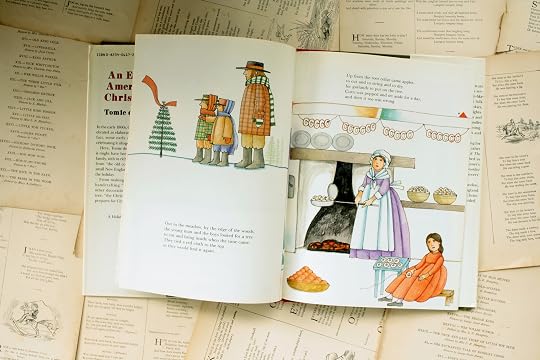
There are so lovely illustrations and descriptions of food harvesting, candle making, decoration making, baking and decorating the tree and home for Christmas.
There's a page about the facts behind the story at the beginning.
I loved this look at a German family bringing their Christmas traditions to their new life in Pennsylvania. Splendid use of pattern in the illustrations, too, and the perfect final page.
There was much I enjoyed about this look at a Christmas long past: I enjoyed sharing in all the exciting preparations for the family's celebration, and Tomie's no-nonsense illustrations are always a treat, but I felt there could have been much more to the book. Why not feature patterns for some of the lovely cut-paper ornaments featured in the book, or instructions for making the folded paper stars . . . or at least print the decorated cookie recipe.
This could have been a five-star book with a little more attention to detail.
Author's Note: "At Christmastime, in the New Hampshire town where I live, it is traditional for white electric candles to be put in house windows and in the windows of the Baptist Church. It is a beautiful sight. But the early residents of this New England town and other villages weren't always so festive. Although Catholics, Episcopalians, Lutherans and some other settlers celebrated Christmas in church and out, the early Baptists, Presbyterians, Quakers, and Puritans tended to avoid any observance of the holiday whatsoever. In fact, one source tells of an Irishman being chased out of a New England town in 1755 because he was 'a Christmas Man.' All of this set me to thinking, 'What might have happened in the early 1800s if a family accustomed to celebrating Christmas moved into a New England town?' Using historical fact and my research as a departure point, I began to imagine that it could have happened this way . . ."
A family moves from Germany to Pennsylvania to New England; they become known as "the Christmas family." They make bayberry candles, harvest apples, carve figures for a nativity set, cut out paper figures, and bake cookies. They cut a tree, pop corn, and bake pretzels. On Christmas Eve, they read Luke 2, sing carols, and put candles in their windows. Over the years, other neighbors put candles in their windows too.
My Gerhart relatives moved from Germany to Pennsylvania.
A German immigrant family move to a small New England town still dominated by the Puritan ethos in this lovely picture book from author/illustrator Tomie dePaola. Although no one in their new town celebrates Christmas in any visible way, the family are not deterred, making all of the necessary preparations—creating bayberry candles, gathering foodstuffs, carving a Nativity scene, making decorations, choosing a Christmas tree and greens, baking many kinds of cookies—in order to celebrate in their traditional way. With the house beautifully prepared, the family gather on Christmas Eve night to read the story of Jesus' birth from the Bible, and to sing their songs. Neighbors, listening and watching this odd "Christmas Family," are eventually inspired to adopt some of their traditions...
As a long-time fan of Tomie dePaola's work, I was not surprised to find myself enjoying An Early American Christmas immensely, although I do regret encountering it first as an adult, as I believe my childhood self would have loved it even more! I greatly enjoyed the way in which dePaola chronicled all of the many customs and activities engaged in by the family, and I found the overall theme of the book—an immigrant family bringing their own holiday customs to a new land, changing that land's customs for the better (I believe!)—both inspiring and valuable. Many young children today might not be aware that many of the customs we associate with Christmas today, here in the states, were not observed by many of our earliest settlers, particularly in New England. dePaola's book therefore provides an important history lesson, in addition to spinning a charming holiday tale, and teaching the value that immigrants can bring to their new countries. The accompanying artwork here, done in trademark dePaola style (one would recognize his illustrations anywhere!), is every bit as delightful as the story, making this a wonderful package, overall. Recommended to picture book readers looking for Christmas stories with a historical, American setting.
What a lovely way to learn about an immigrant family in America, and also to learn how bayberry candles are made.
Oh, the decorations made of popcorn and apple rings: Even more sumptuous was the holiday baking, all so beautifully illustrated by Tomie dePaola, with every type of treat showing so clearly, so easy for children to sort through and admire.
My favorite illustation shows the family singing. (Everybody singing, except for a somewhat puzzled-looking cat.)
Here's to the love of God, whatever we call that, however we sing!
I am a huge Tomie dePaola fan and this book has the amazing artwork we have all grown to Love. In this story the New England settlers did not have a tradition of celebrating Christmas as we do today. An immigrant family came to the village and brought their customs and traditional festivities. They were known as the Christmas family and soon the town embraced the good cheer. This book is full of subtle history in the pictures. Enjoy.
The story starts by introducing how they used to prepare for the winter season by making candles, cookies, and vegetables to last through the winter. It continues to go through all of their preparations and notes them as preparations for christmas and when it is time for christmas there are no gifts given, but instead the family sings songs and comes together as a family. A really adorable book.
The Author's Note at the beginning has information that I'll share with kids before reading the book aloud. The kids may have a hard time believing that in some villages, long ago, Christmas wasn't celebrated. What do they think will happen if a family moves in who does celebrate the holiday?
The creatures don't want to review this book. They'd rather eat it and I had to remind them that it is a library book and therefore not to be damaged in any way. They still want to eat it and I had to throw hay at them to distract them. Well, the guinea pigs anyway. The Rabbit didn't care at all.
A German family, known as the Christmas family, moves to New Hampshire, then to Pennsylvania. They are originally from Germany. The Christmas family shares their German traditions during the holidays.
You could do an entire series during the holidays just on the amazing works of Tomie dePaola. I am thankful the “Christmas Family” shared their traditions and helped share the holiday spirit.
A family that originated from Germany moves to a small village in New England. No one in the village celebrates Christmas. This family moves to the village and changes Christmas forever. The family shared their christmas traditions with the people of the village. They shared the candle making they did and other traditions like making popcorn to string. This family from Germany shows the village what Christmas is all about.
This book takes place in the early years of America. America was just becoming one in the 1800s. New traditions from all over the world were being brought to America to be shared. This book captures a tradition that a family shares and allows the whole village to enjoy the same traditions they do. The illustrations in this book capture the style in this time period and also how different tasks that are not performed now were performed. The style of clothes in the 18000s is presented in this book. The illustrator uses numerous lines and boarders throughout the book. This helps separate some of the pictures. In some pages there is a picture at the top divided by a boarder for text and then another picture at the bottom to capture the story. The illustrator used a pencil to draw out the story and then add color. This book allows readers to see how new traditions were formed in America.
This is a nice story about how an early Christmas celebration in the New England states of the United States may have been like. As with all Tomie dePaola books, the illustrations have a clean and simple feel to them. They move the story along nicely and are just pleasing to the eye. In the story a family from Germany immigrates the the U.S., bringing the way they celebrate Christmas with them. They make and light candles in the window, decorate a tree, make a manger scene and make paper and fruit ornaments. They spend family time together baking cookies, reading the Bible and singing. What makes them different? No one in the village they have moved to have ever done any of that to celebrate Christmas. Soon more villagers join them in welcoming the Christ Child in a festive way. This is an AR 4.2 level book.
This entire review has been hidden because of spoilers.
The An Early American Christmas story is about this villege that didn't celebrate Christmas. but this one family that moved to the villege celebrate Christmas they make candles in sell them to people love them they say they sell really good. when they meet everybody the family was happy to meet them because its always good to meet new people they was happy cause Christmas was almost coming finally the month came they started drawing they made angels , white horses, pomegranates, hearts of the men , long bands and then they made cookies in painted the nuts into golden fruit then everybody started celebrating Christmas now thanks to that family. Now everybody loves & likes Christmas in that one little city
Christmas was not elaborately celebrated in the early 1800's; in fact, many Americans did not celebrate Christmas at all.
A German family moves into a small New England town and brings their Christmas traditions with them. This book focuses on early American Christmas preparations: Bayberry candles are made from scratch, apples and other fruits are stored in root cellars, popcorn and dried apple rings and formed into garland. This "Christmas family" is the only family celebrating Christmas in this village. At least, for now!
This work of historical fiction was written and illustrated by Tomie dePaola.
This is an interesting story. Not all Christian religions celebrated Christmas as they do now. This story takes place in the early 1800's, in a New England town, whose residents don't celebrate the holiday. A new family from Germany via Pennsylvania moves to town. The new family celebrates Christmas. Their traditions of bayberry candle-making, tree-decorating and cookie-baking are recounted. The illustrations that accompany these traditions are true dePaola at his best. dePaola's words and pictures are getting me into the holiday spirit this year!
We liked this. First of all- it had lots of pictures of cookies. Cookies are good. Secondly, our mom explained that this is often how traditions are passed and cultural exchanges are made- so that was pretty cool. Third, we really liked hearing about how early Americans would decorate their trees and houses, and we compared it to how we decorate today. It was a pretty neat book! **Next time, maybe the author could add recipes, or finish some Christmas songs, or something like that?