A surgeon lifts his scalpel and begins to cut. A woman cleans her house with meticulous, loving care. A young stud, hormones raging, launches himself across a crowded dance floor with a beautiful babe in his sights. The scenes are almost normal, almost everyday. Except nothing is what it seems . . . .
When the surgeon is done, the patient will be eviscerated. When the house is clean, the woman will see the beasts lying in the corners, and little fingers groping toward her flesh. When the pickup artist makes his come-on, the feverish sex will end in all-too-human terror.
Beneath the surface of our lives, in the confusion of cells, muscle, and blood, Michael Blumlein’s masterful stories explore the stuff of terror: of humans trapped like rats in a world where healers are killers, families are strangers, and lovers are enemies . . . .
I didn't expect to be so moved and so challenged by a story collection with a title like "The Brains of Rats"... although I'm not exactly sure what I was expecting either. I knew the author was a physician and I first heard of the book in the Goodreads group Horror Aficianados, so maybe something with a lot of body-based horror, perhaps similar to Barker or many of Cronenberg's films.
I was so wrong. so very, very wrong! even the synopsis of the collection gets it absurdly wrong, with its doltish description of "we enter the darkest corridors of America's hospitals" as if the stories were about linking primary care to secret horrors. The Brains of Rats is not about hospitals (or rats); Blumlein's clinical experience as a doctor may inform how his characters pathologize themselves (a common theme in the book) - but it is his life experience as a human being, as a man, and as a person who engages with people at their most vulnerable that give his stories true depth and resonance. these are stories about the ambiguity and inflexibility of gender, the permeability of reality, the mystery of emotions, the fragility of persona, the inevitablity of change. Blumlein's stories are by turns unreal, surreal, hyperreal, and beautifully, terribly realistic.
UNREAL
"The Brains of Rats"... you are not simply your gender. oh yes you are, society says so; okay, time to change society so you can change yourself. "Drown Yourself"... you are a human. no you are not, you only think you are like everyone else; okay, it's time to pretend, again and again. "The Wet Suit"... father has no secrets. oh yes he does, and we all know about them too, those dirty funny strange little secrets; okay, maybe the best way to understand those secrets is to live in them.
SURREAL
A refugǝ for children is created by ʇhat odd man who lives down the hall: "The Dømino Master" . A certain author's cer ʇain mystique is certainly conf◎unding: "Interviǝw with C.W." .. A nap in the sun is ʇhe best thing in the w⊙rld, ǝspecially for your reptile brain: "The Promise of Warmth" ...
HYPERREAL
"Bestseller" because YOU DO WHAT YOU HAVE TO DO TO SURVIVE UNTIL WHAT YOU HAVE TO DO BECOMES WHAT YOU WANT TO DO "The Glitter and the Glamour" because FAKE IT 'TIL YOU MAKE IT 'TIL WHAT IS PAST BECOMES PRESENT 'TIL PERCEPTION BECOMES REALITY "Tissue Ablation" because WE WILL ALWAYS HAVE USES FOR YOUR BODY, BODIES ARE THE BUILDING BLOCKS OF SOCIETY!
REALISTIC
"Keeping House" has a woman slowly going insane ↹ and "Shed His Grace" has an insane man becoming more so. ↹ "The Thing Itself" is both death and love, the insane normality of the former and the transcendent insanity of the latter. It is about journeys beyond and despite our bodies.
as Michael McDowell writes in his introduction, Blumlein's technique is superb. each story is its own little world with its own set of rules, its own prose style, its own special entrance into or exit from reality. "Drown Yourself" is hip and happening and science fictional and sad beyond belief. "The Domino Master" had me waiting for something horrible and sickening until I slowly realized I was reading something wonderful and humane. "The Brains of Rats" has some of the most nakedly honest ruminations I've ever read on what it is like to be a man and on a man's perspective on women - wrapped up in a sly mad scientist narrative. "Tissue Ablation" is a freezing blast of dark sardonicism by way of J.G. Ballard's The Atrocity Exhibition. "The Thing Itself" is a quirky yet intensely moving and achingly real story of a woman in love with a dying man; tears were shed.
The Brains of Rats is so many things! and all of them surprising.
Michael Blumlein is not only an author, he's a doctor too. His medical background influences a lot of the stories in this collection.
A few of these tales really knocked me back-most especially "Tissue Ablation and Variant Regeneration: A Case Study." It was told in Blumlein's crisp, cold, prose and I think that made the story even more horrific than it already was.
Tissue Ablation was the second story in this collection and it was so good, my expectations were raised,(perhaps unreasonably high?), for the rest of this book. I didn't feel the remaining stories lived up to the promise set by the first few tales.
The remaining stories were well written, (I did enjoy the one with the talking cat, though in the end, it was very sad), but they didn't have the impact on me that Tissue Ablation did.
Overall I enjoyed this collection and I'm glad that I read it, but I'm not sure if I will track down any of Michael Blumlein's novels. If I do, it will be at a later time anyway, as I'm still in the midst of this novel reading slump.
Recommended to fans of weird tales and medical fiction!
The Brains of Rats by Michael Blumlein was originally released in 1989 and then re-released by Valancourt books with an introduction by Michael McDowell in May 2015. The author uses his medical background to stunning effect in twelve stories that certainly give pause for thought, chilling in its entirety, intelligent and horrifically memorable.
The second story the politically charged 'Tissue Ablation and Variant Regeneration: A Case Report' describes in absolutely chilling and impersonal detail a surgeon’s evisceration of President Ronald Reagan. This story incorporates a barrage of medical terminology, clinical and cold blooded, there's an absence of feeling, detachment even but if there's one story I will remember for years to come, it's this one.
In 'Bestseller,' a struggling novelist unable to sell his books, receives terrible news when his son is diagnosed with cancer and out of the blue he is presented with an opportunity to arrest their bad fortune. He must sell something else unthinkably horrific and from the first there is no end, almost like an addiction What greater act of creation than to create ourselves'.
The 'Wetsuit' tells of a family recovering from loss, victimized by her husband’s eccentricity, his brutal singularity, Cam's Mother always assumed he knew of his Father's ways of coping with the stress and strains of life. Cam is shocked at the discovery of what his Father did and starts his own journey of discovery with an intense need to understand 'One lie, one secret like that makes you wonder if everything else didn’t have some other meaning to it. It makes you doubt your own life'.
Valancourt Books is an independent small press specializing in the rediscovery of rare, neglected, and out-of-print fiction. Founded in 2005 to restore many of these works to new generations of readers and primarily focused on Gothic, horror, and supernatural fiction encompassing both 18th and 19th century classics and more modern works.
Great collection, tales of the power and powerlessness of human desire, stories of how science and medicine are constantly teetering the edge between a hopeful future or a hellish one. The standout story is "Tissue Ablation and Variant Regeneration: A Case Report." Such a mundane title does not prepare you for the absolutely horrifying and jaw dropping narrative that awaits. It is one of the best short stories I've ever read, and possibly the scariest. Other good ones in the mix include "The Brains of Rats", "Shed His Grace", "Keeping House" and "Bestseller", these remaining stories include a good mix of sexuality, horror and medical intrigue.
I can't think of the last time I encountered a collection of dark fiction as imaginative and skillfully crafted as this. Goodreads' book description is rather ridiculous, making it sound as if the collection depends on gruesomeness and cheap horror for its effectiveness, whereas the most unsettling aspects of these stories revolve around the loss of one's sense of identity and the unreliability of our perceptions. Blumlein's background as a physician has clearly led him to wonder about the reality of the connection between our corporeal selves and our "real" internal sense of self.
He writes with precision, and his plots are anything but formulaic. "Bestseller", sensibly held to the end of the collection, is the strongest of the stories, to my mind.
It's hard to categorize this book, certainly a mixture of SF, horror and most certainly weird fiction. It is however memorable with some of the stories so vivid and shocking in their imagery that they stay long in the mind after completion. Having learned that the author Michael Blumlein is by profession a physician it is not surprising that the content of many of the stories showcases his background, and this alone makes them all the more difficult to read and digest!
"The Brains of Rats" is an analysis of our genetic makeup, "Around the fifth week a single gene turns on, initiating a cascade of events that ultimately gives rise to testicle or ovary. In the male this gene is associated with the Y chromosome; in the female, with the X. An XY pair normally gives rise to a male; an XX pair, to a female." It is difficult to understand if the narrator is more male than female and in the same way his wife causes concern over the nature of her own sexuality..."My wife, a laborer, wear only pants. She drives a truck."
"Tissue Ablation and Variant Regeneration: a Case Report" This story has a real disturbing edge, it is the harvesting of a human body whilst the donor is kept fully awake and aware of the process. The coldness and the narrator's total lack of empathy with the patient Mr Reagan makes for very uncomfortable yet memorable and essential reading..."The patient was offered the choice of an Eastern mode of anesthesia, but he demurred. Mr Regan has an obdurate faith in things American." "Shed His Grace" Once again the narrator in this story appears to have issues with his sexuality and gender and the fact that he is only ever referred to by the letter "T" adds an eerie detached quality to the writing. The story is set during the Reagan administration of 1984 an ostentatious and extravagant time as the US is represented to the rest of the world by an actor and his equally flamboyant wife, the demure and sensitive Nancy. As we begin to understand the life of "T" this odd individual living a lonely existence is soon to shock us with a conclusion of some defiance. He has an almost obsessive (and possibly unhealthy) fascination with Nancy Reagan her slim, petite, nubile body occupying his thoughts often.."She wore a purple silk dress with a pink floral pattern across the bodice. The neck was high and ruffled, the sleeves short. Around the wrist she wore a gold bracelet...Her lips were red and smiling, her eyes bright. She made a demure gesture and turned down a long hall. The hem of the dress brushed against her calves, stroking them only inches above the mound of her heels." This is also the time of the 1984 Olympics and "T" has a a preoccupation with the well muscled and toned athletes on display. His use of a razor to mark and shape his body leads to a disturbing final scene.
"The Wet Suit" is a gentle memorable story about family, love and death. Cam's father has died and his mother Fran wants him to help maintain/repair the family home and to inspect a rather odd cardboard that his father kept. This is a story that openly states we are all not what we seem, we all keep secrets from our loved ones....but at the end of the day does that really matter? We all need time out, our own space to indulge in our own pastimes and not be judged by others. What does it matter if it makes us happy, harms no one and helps maintain family harmony.
"Bestseller" continues the theme of selling/harvesting body parts. The narrator, an unsuccessful writer, slipping into poverty, is faced with a difficult decision when his son Nick is diagnosed with cancer. How can he afford the treatment? By chance he sees an advertisement "Donors Needed" and when a delightful woman answers the phone he is intrigued enough to agree to visit her medical organisation, as she only requires a survey to be completed and for this privilege he will be handsomely remunerated...."she explained that their research was in the field of organ transplantation , though she was quick to reassure me that the study only required a questionnaire and simple blood test. They were offering two hundred dollars to all those who enrolled." The allure of easy money persuades our narrator to return many times to the medical centre where the lovely Devora convinces him that if he continues to help them with their studies/program he will be richly rewarded. Events appear now to spiral out of control when his body parts are sought.....but he has a wife Claire and a sick son to support..how can he refuse! The horror creeps in as the story reaches its inevitable conclusion.
I judge a good book often by its ability to make me think and ask questions. There are many stories in this collection that are highly visual in the message they are promoting. At times uncomfortable to read, sometimes a little perplexing and puzzling but equally very memorable. A great thanks to the good people at Valancourt books for supplying me with a gratis copy. They are doing so much to promote and publish rare, neglected and out of print fiction and for their kindness I have written a fair and honest review.
What a disturbingly strange and oddly enjoyable collection of shorts. I am rarely at a loss for words when reviewing a work. This was good. Maybe even better than that.
The narration for this one was excellent. Seemed to fit the stories perfectly and I think really added to the dark and brooding atmosphere. Well done.
"I was given a free review copy of this audiobook at my request and have voluntarily left this review."
In this early short story collection, Blumlein shows that he can write all over the place – and does. His work is often shoved into the "horror" category, but the material here snoops into corners that defy characterization. SF yes, bizarre suppressed humor certainly, psychedelic explosion definitely. But his best booms an almost deadly factual voice, an unsettling remove that makes you want to scratch places that don't usually itch. From what I've seen of his later stories, he isn't fully developed in this collection, which means that he's only twice as effective as the average horror/SF writer. There's a lot that looks back, I think, to J.G. Ballard – but there's nowhere better to look. (Though "Drown Yourself," his most drug-tumbled, off-the-wall entry, reminds me of a bizarre piece by Eudora Welty.) Some stories, like "The Wet Suit," will leave you scratching that itch to find some kind of ending or meaning, but that's OK. Life may have an ending, but it often lacks meaning. Blumlein is an M.D. His knowledge and outlook infuse many of the stories, no more so than my favorite, "Tissue Ablation and Variant Regeneration: A Case Report." This one may have you wondering, confused, even offput, but carry on. I guarantee the "appendix" will dump you flat on your ass.
review just for “The Brains of Rats”: 10 - I don’t always read my fiction closely. Maybe not the best confession for someone who writes words about books, but there it is. Not all stories require it though. Admit it. Not all stories reward deep reading with deep insight. And why should they? It’s fiction; distraction’s a selling point. Let the story wash over you and give thought to the parts you give thought to. This is by no means a foolproof approach, however. Were we not to give it willingly, Michael Blumlein’s “The Brain of Rats” would wrest attention out of us through sheer force of will. And all the better for it.
The story features a scientist ruminating over the space between sexual/biological difference and gender expression, interspersing “scholarly” observations* with anecdotes about his patients and his own struggles with gender identification. Significantly, our protagonist is a man who “acts” feminine yet moderately desires to be a woman, whereas his wife “acts” masculine – presenting as quite masculine as well – and works conventionally masculine professions.
Beyond the hazy dreamstate in which some interactions occur (thinking especially of the scene where he tells that woman about his one-time homosexual encounter), there is but one sfnal element at play here: the ability to turn the whole world either all male or all female. Quite the MacGuffin for a novum, and one Blumlein treats in a dis-interested manner. It is a trigger for the plot, as all MacGuffins are, but only insofar as the story is gentle and meandering and said device is most accurately described as an afterthought in the story itself. Fairly wonderful. Indeed, the “point” of the story is, more than anything, a rejection of the device’s powers. Blumlein has thus worked an impressive philosophical bait and switch, for, in a story ostensibly describing one man’s apocalyptic ability to separate sexes definitively, he instead spends his time blurring all lines between “male” and “female” (albeit, yes, in that gradualist, 1980s-ish way). This is to say nothing of the prose, which was sparse, sometimes beautiful, often counter-intuitively astute, and always indicative of a deep intelligence behind the words. After some of the tepid dreck on offer, it was refreshing—and a necessary reminder of the possibilities of genre fiction and the boon that is a voice with teeth.
While not essential for enjoying the story, reading this first and foremost through a 1986 filter is key to more fully appreciating all that Blumlein’s up to here. On the one hand, thinking of Foucault and publication dates and such, that chronological frame tempers any over-enthusiastic claims to its revolutionary nature. At the same time, it helps explain elements that might be otherwise dismissed as crude or even bigoted in their own right now, namely the need to demonstrate these fluidities through and against particular gendered stereotypes, which might strike some today as laughably essentialist. You can’t win, can you? Regardless, that 1986 filter underscores, in literary terms, the quite impressive things his gender play is doing within the fiction itself, considering the parameters and expectations within which he must work (something as true in mainstream circles as it was in genre). And lastly, from my own aesthetic perch, and for this particular story doing this particular thing, it helps that the narrative is grounded a bit more than it might have been had it appeared a decade earlier, given the disjointed, clipped ponderousness of much 1970s sf (with much love to them!).
* Fairly pat and often a-historical, but fine for a genre story.
The Brains of Rats and Bestseller are the two best stories in the collection. I barely remember what the former was about, but I do remember liking it a lot. The latter is a kind of 'Survivor Type' story about a writer selling parts of himself. The ending's a bit goofy, but it held my attention.
As for the other tales, some people seem to like Tissue Ablation. It's about Reagan being dissected. That's it. It's just an old guy being surgically dismembered; there's not much too it beyond whatever your interpretation. Left me indifferent.
The Domino Master was okay, a kid gets shrunken down and enters his neighbour's fantasy world to escape his parents. The Wet Suit is about a dude who learns his dad used to dress up in a wet suit and flagellate himself out back and everyone was just chill with that for some reason. The Promise of Warmth had some good descriptions of lethargy-inducing weather.
I only vaguely remember the others.
All in all, I'd recommend reading the first and last stories in this collection and based on those, maybe try out the others. Blumlein's prose is kind of unique. None of the stories were bad, but a lot of them just weren't for me.
It isn't surprising that Michael Blumlein is a doctor. His prose style is spare and somewhat clinical and has an unflinching quality which pairs nicely with these mostly disturbing stories.
There is a heavy emphasis on medical themes, more specifically medical horror, but there is more "whimsical" material in the collection as well. Those feel more old fashioned, lyrical, of the Mid-Century, Twilight Zone era. Even stories that seemed familiar also had a freshness about them (the story House Keeping had a Yellow Wallpaper feel to it, but Blumlein followed the story down a different dark hole.)
Based upon a heavy recommendation from Will Errickson from Too Much Horror Fiction, I picked up Michael Blumlein's short story collection with fevered anticipation. Yet, the more I read, the colder I felt, and I ended up coming out of it with a profound feeling of indifference. Certainly, Blumlein is a talented writer, his experience as a surgeon lends a macabre clinical detachment to his work, and when he's firing on all cylinders he writes with a surgeon's precision. Unfortunately, nearly every story in this collection left me disappointed. Stories like "The Wet Suit", "Drown Yourself", and "Shed His Grace" are such vaguely written, self-consciously surreal oddities that they left me scratching my head rather than quaking in fear. Others, like "The Brains of Rats" and "Tissue Ablation," while weird and creepy, come off slightly gimmicky and forced once you take a step back from them. The one bright, shining spot in this collection is the closing story, "Bestseller," about a struggling author forced into a bizarre and macabre means of making money. In this 40 page novella, Blumlein plumbs the depths of financial worry, the sacrifice of dreams for comfort, and the fear of impending death, all in a neat, steadily mounting roller coaster ride of suspense, culminating in an ending so chilling that I visibly shivered after finishing. That such a disappointing collection should end on such a high note only makes the disappointment worse. I'll be interested to read the novel Blumlein wrote for the Dell-Abyss line, but I don't hold out too much hope.
While the violence was a little unpalatable for my tastes, I am extremely pleased that this was passed to me by Daniel. I don't have the book with me- which prohibits my preference with reviews marked by quotes- but this book marks one of the best ways to learn about a person: by sharing literature.
This definitely conforms to The Weird (occasionally skirting Bizarro), and is recommended for all who wander that territory. So many of these precision-crafted stories focus on identity and belonging. “The Brains of Rats” was a clinically uncomfortable perspective on gender and what must be done to conform and be accepted in society. “Keeping House” was like a bizarro version of Shirley Jackson. “The Wet Suit” was a deeply uncomfortable consideration of our protagonist grieving his father, wondering if he had ever truly known him, and the damage that does to his self-identity.
While the collection is largely timeless, one bit of evidence of when it was written is the recurring returns to unsettling fascination with the Reagans. For example, “Tissue Ablation and Variant Regeneration: A Case Report” was deeply clinical and aloof torture porn, but I don’t think the dry aged political commentary enhances the dish more than it distracts. “Shed His Grace” was self-flagellation about media consumption in front of a stack of old CRT’s while watching newsreels of the Reagans.
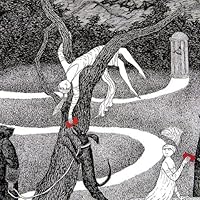
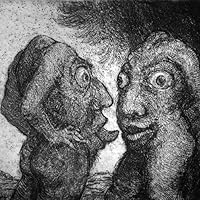
The hardcover is a thing of beauty with unsettling images before each story, plus some barely visible dried blood on black frontispieces.
The current issue of Locus magazine has an interview with Dr. Michael Blumlein about his fiction. I had never read him before but remember people being impressed about 30 years ago. He had the reputation of writing horror, but in the interview he said he never thought of himself as writing horror, but as a doctor he wrote about the body and body parts with a clinical detachment that some people saw as chilling.
That piqued my curiosity, so I picked up this original fiction collection from 30 or more years ago when he made his reputation. I was startled to find that it holds up well today, and deals with topics that have recently been written about. The title story has a genderfluid protagonist and deals with radical genetic engineering. The last story, “Bestseller”, prefigures the plot of Nobel laureate Kazuo Ishiguro's 2005 book, “Never Let Me Go”. In between are stories about oddities, fetishes, fixations, creepy and mundane. He said in the interview that his agent called one of his books "psychosexual horror". Psychosexual is a good term for a broad range of themes here.
Is it horror? It is if you want to read it that way. What it is, is extremely well-written speculative fiction.
This ones been on my to-read list for years as its reputation (at least among horror and sci-fi fans) precedes itself. Now that I've read it, I can see why. I look forward to reading some of Blumlein's novels in the future and was saddened to see he passed away a few years ago when looking those novels up. Most of the book's reputation comes from the Reagan horror-satire "Tissue Ablation and Variant Regeneration: A Case Study" which truly is a humdinger of a story, but I'd say the title story and "Bestseller" are just as good. A handful of other stories are just a slight step down but greatly entertaining ("The Wet Suit", "The Promise of Warmth") and none are flat-out clunkers. Blumlein has a unique, strong voice and perspective though at times I do feel he shared a literary kinship with early Clive Barker. Blumlein's occupation as a medical doctor is apparent in many ways throughout this collection if not always in the ways you'd expect. His stories are deep in the weeds of gender, sexuality, psychology, and dread and while I can see how some of his themes and points might rub some readers the wrong way, I think even if you disagree with what might be perceived as his views in some areas you can appreciate the way in which those views inform the stories themselves.
I'll admit that I didn't quite get all of the stories in this collection, but even among those stories that eluded me, there was a sense of strength in them that made me pay attention to them, as if to say, "There's something important here, if only you dig to find it." The stories I did get, though, were powerful, with an imagery that will linger for weeks, if not years.
"Tissue Ablation and Variant Regeneration: A Case Report" is the story most people know (and for good reason), but they shouldn't overlook the title story, "Drown Yourself", "Shed His Grace", "Keeping House", "The Wet Suit", "The Thing Itself", or "Bestseller". They're all powerful in their own ways, moreso because Blumlein has a clinical, straightforward way of telling the stories that makes their emotion that much more effective when they sneak up on you. You feel like you're reading clinical reports, not stories, but then he surprises you.
We lost Blumlein last year. I don't just mean he died; I mean we lost a talent way too soon.
This is one of the most unique collections I have ever read. As they are madly quirky, they might not be for you; so beware. For me, two stories stood out, the brains of rats and bestseller are pure genious. I think that what makes Blumlein special is that he focuses on details that everybody else overlooks; so the stories hit you in places you never expect. Also he does not shirk from writing rather politically incorrect and downright awkward things even though being a hospital resident. That kind of lack of self-consciousness resonated well with me.
The rest of the stories are interesting but they do not have the same punch as the ones I mentioned before. The Reagan dissection one was rather special also. After reading this collection, I think that Blumlein does not get enough credit for Beetlejuice and Nightmare before Christmas; what makes those movies special beyond Burton's visual style lies in the story creation style of Blumlein.
I ended up liking all the stories, because there's things to like in each of them. Some were a little more obtuse than I could handle, and might benefit from a reread after putting together what I think they might be about (particularly Drown Yourself, thanks to Michael McDowell's hint in the introduction, and The Glitter and the Glamour) but still every story is engaging, and have elements of totally unsettling the reader. The Domino Master and The Wet Suit were very evocative. Favourites were Tissue Ablation and Bestseller, but I think Shed His Grace got the most visceral reaction out of me.
This was an interesting collection, and I wasn't sure how I felt about it when I started reading. The stories seemed to lean towards sci-fi, which is a genre I don't care much for. But Blumlein has a way of overlapping genres that worked well. Not every story impressed me, but the ones that did blew me away. My personal favorite was 'The Wet Suit,' a story that brought with it a sense of quiet dread similar to Brian Evenson, or even Raymond Carver's darker works. This is a good choice for fans of weird, unsettling fiction that doesn't stay married to genre.
i admire the originality on display, Blumlein’s medical background lets a lot of these stories take a very clinical and calculated approach, and are interesting explorations of gender, bodies, emotion, manhood, etc etc not an ounce of the goofy hospital horror dreck that was being advertised on the back cover lol
not every one is a hit for me and i do feel most couldve gone further but im not disappointed at all, i have one of his full length novels (X,Y) on my shelf and im looking forward to digging into it soon to see how i prefer his longer fiction
I wasn't able to get into this book. Each story was really well written and performed, but it wasn't for me. Maybe I was distracted by the fact that it was an audio book and I could not get into the rhythm of each story. I don't know for sure. My favorite tales were The Promise of Warmth and Bestseller. My least liked were The Brains of Rats and The Wet Suit.
This book was given to me for free at my request for my voluntary and unbiased review.
Ballardesque in more ways than one. Like Ballard, Blumlein's language is cold and clinical. Both cause a similar level of frustration in me by presenting brilliant elements and concepts but losing me with their remote view of humanity.