Outlaw journalist Spider Jerusalem attacks the injustices of his surreal 21st Century through black humor as an investigative reporter for the newspaper The Word in this critically-acclaimed graphic novel series written by comics' superstar Warren Ellis, the co-creator of PLANETARY and THE AUTHORITY.
In this volume, Jerusalem targets three of society's most worshipped and warped politics, religion, and television. When Spider tries to shed light on the atrocities of these institutions, he finds himself fleeing a group of hitmen/kidnappers in possession of his ex-wife's frozen head, a distorted creature alleging to be his son, and a vicious talking police dog.
Warren Ellis is the award-winning writer of graphic novels like TRANSMETROPOLITAN, FELL, MINISTRY OF SPACE and PLANETARY, and the author of the NYT-bestselling GUN MACHINE and the “underground classic” novel CROOKED LITTLE VEIN, as well as the digital short-story single DEAD PIG COLLECTOR. His newest book is the novella NORMAL, from FSG Originals, listed as one of Amazon’s Best 100 Books Of 2016.
The movie RED is based on his graphic novel of the same name, its sequel having been released in summer 2013. IRON MAN 3 is based on his Marvel Comics graphic novel IRON MAN: EXTREMIS. He is currently developing his graphic novel sequence with Jason Howard, TREES, for television, in concert with HardySonBaker and NBCU, and continues to work as a screenwriter and producer in film and television, represented by Angela Cheng Caplan and Cheng Caplan Company. He is the creator, writer and co-producer of the Netflix series CASTLEVANIA, recently renewed for its third season, and of the recently-announced Netflix series HEAVEN’S FOREST.
He’s written extensively for VICE, WIRED UK and Reuters on technological and cultural matters, and given keynote speeches and lectures at events like dConstruct, ThingsCon, Improving Reality, SxSW, How The Light Gets In, Haunted Machines and Cognitive Cities.
Warren Ellis has recently developed and curated the revival of the Wildstorm creative library for DC Entertainment with the series THE WILD STORM, and is currently working on the serialising of new graphic novel works TREES: THREE FATES and INJECTION at Image Comics, and the serialised graphic novel THE BATMAN’S GRAVE for DC Comics, while working as a Consulting Producer on another television series.
A documentary about his work, CAPTURED GHOSTS, was released in 2012.
Recognitions include the NUIG Literary and Debating Society’s President’s Medal for service to freedom of speech, the EAGLE AWARDS Roll Of Honour for lifetime achievement in the field of comics & graphic novels, the Grand Prix de l’Imaginaire 2010, the Sidewise Award for Alternate History and the International Horror Guild Award for illustrated narrative. He is a Patron of Humanists UK. He holds an honorary doctorate from the University of Essex.
Warren Ellis lives outside London, on the south-east coast of England, in case he needs to make a quick getaway.
This might surprise some people, but dark and angry as his work often is, I think of Ellis as a very hopeful writer. So often his work seems to say, "Look at this. Look how awful this is. Look how shitty people can be. We can do better than this. We're all better than this."
The adventures of our unorthodox Journalist continues!
Spider Jerusalem is a certified douchebag. But like every celebrity douchebags, he is also a huge hit. Everybody loves his gloriously controversial column "I hate it here": A Column which spider uses to tear a new one for some unlucky sap or a corporation. So yea, he had made some enemies. But that's the life of a journalist.
But today, Some of his enemies are going to fight back.
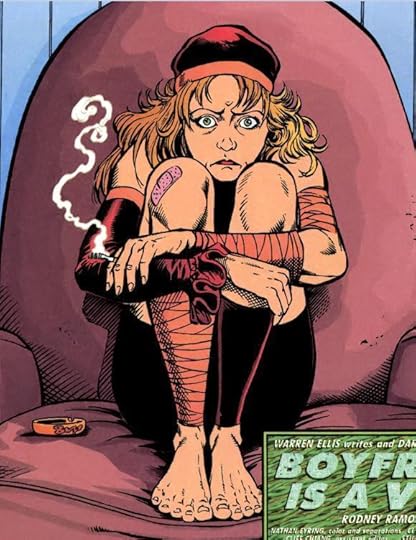
Remember Channon? Spider's Assistant. The first chapter kicks off with her boyfriend's transformation to a pink cloud.
Don't even ask. The future world is too damn crazy to make any sense of. Because this is the world where nothing is impossible and everything is wrong. A place where the human population is in billions, but humanity is scarce to find.
The main story arc spanning three parts is one hell of a ride, a reminiscent of Guy Ritchie's movies like Snatch and it is filled with unique characters and absurd situation.
For example, there is a genetically enhanced police dog who has a bone to pick with a spider. (Whoa, is that a pun?!)
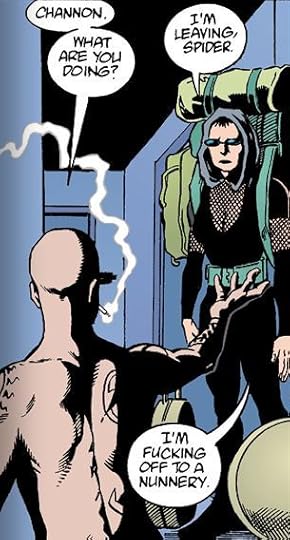
Anyhow, It all started with Channon fucking off to the nunnery.
And then, out of nowhere Spider's wife's head gets stolen, a kid turns up in spider's editor's office claiming to be his son and couple of guys turn up at Spider's house to shoot him in the face.
So basically, it is a regular Monday morning in Jerusalem's life.
This is one of the best written graphic novels I have ever read. Waren Elis have done more than a spectacular job with this story. One of the standalone stories features a hard-hitting report on the modern cryogenics program and their odd clients is a fine example of extraordinary storytelling fueled solely by the strength of words.
Overall, It can be vile at times, but it's so well-written that it would be a criminal offense not to read this!
This second volume delivers some of the most memorable short stories of the series (feat. nanotech consciousness downloads; human culture reservations; people awaking from cryogenic freezing to a hostile future: “Fuck off back to your freezers!”), as Ellis and Robertson are firing on all cylinders. It may not be perfect, but it’s the kind of wild ride that doesn’t have to be. The one thing that actually bothers me is the story’s underlying macho ethos: “How do you know I can’t kill you by staring hard?” Then again, this macho ethos probably allowed the series to succeed in an industry obsessed with superheroes.
Warren Ellis and artist Darick Robertson team up for another round of an alternate reality future where outlaw journalist Spider Jerusalem prowls the underworld chronicling the havoc that has become our world.
Ellis’ writing and Robertson’s cacophony of visual sensation reveals a world that has exceeded in excess to the detriment of all, this was like a kaleidoscopic representation of a William Burroughs nightmare, and with the science fiction savvy of John Varley.
Some of these scenarios are golden, others kind of languish in a mess of the narrative but its all good.
This second volume is where we really see the series find its feet and we launch fully into the weird and wonderful world of Spider Jerusalem's with a tale about humans wanting to turn into sentient gas clouds, the harrowing story of the cryogenically unfrozen, synthetic reservations where you could choose to live in a past civilisation, and finally a three part story of Spider's ex-wife's revenge.
All of the stories have the verbal acrobatics and freewheeling genius level writing of Warren Ellis in every panel helped along with Darick Robertson's superb artwork. All of the stories have elements of originality, humour, and artfully expressed bile through the increasingly more interesting figure of the most hateful man on the planet, Spider Jerusalem. The book serves to introduce the reader more fully into this world where the grotesque and comical elements of society converge joyfully on the page and shows the reader that in this series anything can happen.
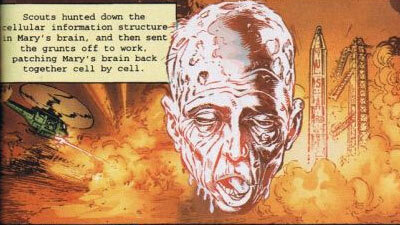
The three part story that closes this book, "Freeze Me with your Kiss", is fantastic and worth buying this book for alone. Spider's ex-wife (a frozen head) manages to organise a hit on him before she froze herself so Spider goes on the run from a squad of assassins who hate the outside world. Throw in a headless child bomb, an allusion to a war against France where the loser lost the ability to speak French, ever, and a castrated police bulldog with brain damage who only lives to murder Spider, and its amazing how much brilliance Ellis and Robertson cram into a short story and turn it into pure reading gold.
If you've never read "Transmetropolitan" go back and read the first book then dive headfirst into this second one. I'm re-reading the series and can tell you every book is worth reading, and "Lust for Life" is Spider Jerusalem at his filthiest best.
Like the first collection, the second volume of Transmetropolitan is imaginative and acerbic, often funny, often bitter, sometimes brilliant. There's an amazing story tucked in the middle about a woman who's been awakened from cry-freeze into a world that could care less about her that's astonishingly moving, fully imagined, and simply one of the best things I can ever recall reading by Ellis. This volume would be worth reading for that one story alone, and it's absolutely the high point.
The rest is nothing to sneeze at. To me, the two most striking things about Transmet is how bitter it often is, and how deeply imaginative it is. It's not just that he writes about fascinating new technology, but that he also thinks through the societal implications. So, for example, he doesn't just write about the ability to move your consciousness into a cloud of technology, but about the impact it would have on the people left behind. It makes the world feel more full, more real, even as it's often intentionally very absurd.
I tried to read Transmet years ago, and didn't like it at all. I suppose I wasn't yet mature enough to really "get" where Ellis was going with this, or to appreciate how well he was accomplishing what (I believe) he was aiming for. I'm glad that I decided to revisit the series.
This collects issues 7-12 of Transmetropolitan. Either I got used to the feel or it just reads better than the first volume did. Someone wants Spider dead and he goes on the lam while trying to figure out who is gunning for him.
Like I said, I found this to be much better than the first volume. It didn't feel like it was trying to hard and was a genuinely entertaining story. Spider is still a dickhead but everything happens more organically than the first book.
Much as I do like the comic, it's pretty obvious - and indeed he's on the record saying as much - that Warren Ellis is using it as a mouthpiece, Spider's character mostly always agreeing with his views and ranting them to his audience. Most of the time it's not to the comic's detriment, given how entertaining he manages to be about it - but the religion chapter in this volume really didn't go much anywhere and had very little of worth to it, not even ending properly.
But it bounces back with a couple insightful and occasionally poignant stories about nanoclouds and revivals, so it's all good.
Story: This volume actually gives us a lot of world building. Spider takes his assistant to her boyfriends download. Which basically means his body burns up and his soul is downloaded into the world of the internet or computer. Then we have a hit out on Spider! That's right. Someone didn't like what he wrote about them. Not only that but you have the dog police force after him. One individual dog is really pissed with Spider for having his balls cut off. Yep. You read that right.
Art: Love it. Everything is so unique here. The designs of the characters, the ugly yet somehow beautiful city, oh and the facial emotions are funny as hell. This is one of the most unique looking comics in the best way.
Enjoyment: Tons of great world building, getting to know Spider a bit more, and plenty of hilarious moments. I really loved the pacing here too. Splitting this book into giving us amazing world building and well made dialogue, this book is nearly flawless in the way it works. Politics, satire, funny as hell characters, this book has it all.
What didn't work: Everything worked TBH.
Overall, fantastic. This is shaping up to be one of my favorite series of all time.
Warren Ellis has so much talent in him. Volume two felt like he could have been an effective journalist as well, a crazy one for that matter.
Volume two fleshes out some more about Spider Jerusalem, the past that still haunts him today with a bodiless wife, a headless kid and one woman and a talking police mutt whose lives he has messed up before.
Lust for Life did a bit a meandering before it actually develops into a cohesive story, though it does it well with the benefit of spanning for more issues as compared with the three-issue first arc. As his past is being fleshed out (I wonder now who is worse, Spider or Preacher's Cassidy) Channon, his assistant was brokenhearted because her boyfriend left her to become, err, a fog. The crazy things do also build up like a crazy conference of religions, reservations within the city and a radioactive suit-clad men who have a rather weird perception of taboos.
I loved the writing, though I think it would take a couple more volumes for me to truly dig the journalism-based plot of Transmetropolitan.
Definitely a very interesting series. This volume fills us in a little bit more Spider's past and some of it is soooo not good. He's a hard guy to like sometimes but I think that so far Ellis is doing a pretty good job of walking the line between edgy asshole and guy who is trying to do the 'right' thing [at least as he sees it]. I think mostly he just has problems visualizing future consequences for anyone who is not himself [and sometimes even for himself].
Favorite panel:
I mean on the one hand poor Spider but on the other hand some dudes just cannot take no for an answer and you never know which is which so like ... #relatable
Lust for Life collects issues 7-12 of the Transmetropolitan graphic novel series, which follows edgy Gonzo journalist Spider Jerusalem after he has returned to the large metropolis known as City after a long stint living in the mountains. He is contracted to write two novels, and takes a job as a journalist to support himself while he writes them. The series so far follows Spider, his assistant Channon, and his editor Mitchell Royce as Spider goes on a variety of crazy adventures, trying to get stories for his weekly column.
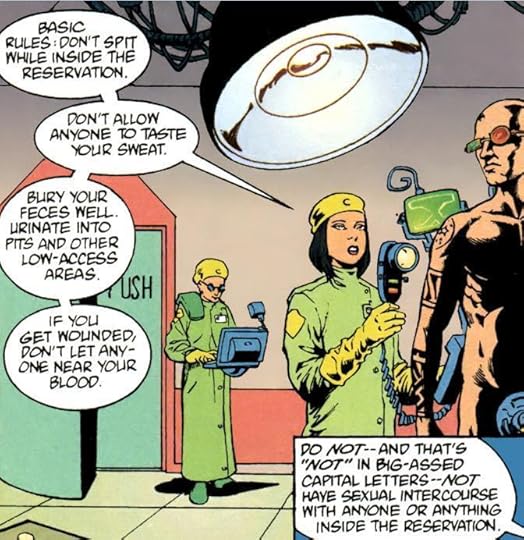
I enjoyed the opening issues of this collection, some of which involved things like Reservations, areas where people have decided to spend their lives that are different from city life and that try to preserve world culture. For example, you can live in a Reservation that imitates life in the ancient Inca culture. I thought this was a fascinating exploration of segregation and the independent, sometimes isolated evolution of peoples from different cultures.
In the waning issues, however, the story goes completely off the rails in a way that was noticeably incongruous with all previous issues in the series. We find out that dogs and cats can talk, and some issues follow a talking dog police officer named Stomponato, who goes by "Stomp". He hates Spider and wants to get revenge on him, and that whole side story was really weird and just seemed very random and out of place. It seemed like the authors just didn't know what to do next and so wrote some random issues with bizarre storylines that didn't fit with the rest of the narrative up to that point.
Given this, I don't think I'll continue with the series. It just seems to be going in a weird, aimless direction that I don't find particularly interesting. It probably gets better in later issues, I just have little desire to read them after the final issues in this volume.
Unlike with other comics, I've decided not to read this one at all unless I've got a real copy of it in my hands.
I loved it from the very start and I'm still fascinated by it, despite its often too disgusting depictions of horrible things. Basically, it explores various ideas of our future. Obviously we'd have progressed in technology and medicine, allowing us to live longer and to alter our physique to our likings. We got a good saying in Bosnia going: "once you have the finger, you want the whole hand" and that's exactly how humans work. Of course we wouldn't be satisfied with just living longer or altering our looks in cases of terrible accidents. We'd want a third tit, 2 meter penis, no digestive system; no, wait, no embodiment of ourselves at all! We'd want to be but a pink fluff cloud, sparkly and dreamy! Our boyfriends would masturbate over vending machines, our women would switch off their entire reproductive system to the non-existence of any sexual organs whatsoever. Some would download their minds and replace themselves with whatever else, upload themselves onto whatever elses and continue their existence like that. Okkay.
Some of us would simply not be able to cope with it. Any of it.
We'd abuse whatever we come up with because we get so quickly bored with everything. Why are there such explicit, bizarre ero guro things in Japan culture (spreading elsewhere now too)? It's because they progressed faster than the rest, got quicker bored and it just had to become sexually attractive to fuck someone with their entire intestines out. Hot. Not only that exists, but it's become pretty normal, everyday stuff now. Yeeap.
The picture above is pretty much how I feel about things happening nowadays and when I see the comic exploring it further, so much further into the future, I'm glad my lifespan wont be longer than 60ish years.
Whatever I just said, doesn't change the fact that the comic is amazing. It's the content of the story that disgusts me and that is all. The way it is told, the way the main character is developed, the way that Channon is everything but annoying is brilliant! In this volume, we got Spider somewhat accepting and being fascinated by the new tech (remember, he was up on the mountains for years himself, totally cut off from the civilization).
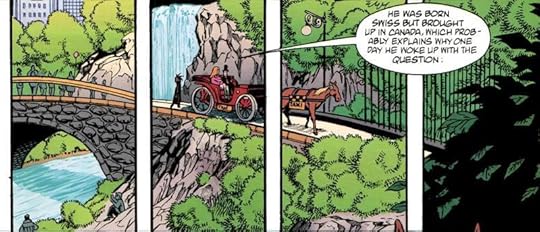
Spider: It really all got started with a guy called Hans Moravec. It's him who coined the word "downloading". He was born Swiss but brought up in Canada, which probably explains why one day he woke up with the question: Would intelligent robots be like people? Or would they be people? Moravec was queer for robots in the worst way, which explains why he woke up with that question, rather than beating down his morning hard-on like the rest of us. Well, he got to thinking: if a guy has a prosthetic leg, is he still human? Sure. It still does the same job, does what you tell it to. So how about it if he had two artificial legs? Artificial arms? A plastic heart? Carbonfibre bones? Artificial neurons? Where do you stop being human? Moravec figured you just didn't, then made the next leap: you could put a human mind into an entirely artificial body--and that person would still be a person. You could download a mind from out of its--let's face it--eminently crappy, badly designed human body and into a seriously useful and functionally immortal artificial form.
Then, in the next few issues, the volume explores the possibility of freezing oneself and what happens once you awaken, suddenly in a completely changed world. Then how old cultures could be preserved in different reservations:
then how possibly animals (or humans who changed forms) could be the police enforcement..Well, lots of food for thought, lots of action, lots of low lives, awesome main character and a great story.
Warren Ellis, Transmetropolitan: Lust for Life (DC, 1998)
The great thing about Transmetropolitan is that Warren Ellis seems to remember something that no satirist since Mark Twain has gotten right; while the heart of any satire is soaked in acid, the surface is supposed to be funny. It's not satire if it doesn't make us laugh at it (the humorless bastards who can't find anything funny in “A Modest Proposal” notwithstanding). And while Transmetropolitan mirrors most modern satire in that the heart is certainly soaked with acid, it is that rarest of commodities in that it also gets the surface bit right; it's damned funny, even as it wants to break our hearts. We're not supposed to like Spider Jerusalem all that much; he's addicted to everything, he treats his assistant like pure-D crap, he's misanthropic (though one thinks he takes entirely too much glee in his misanthropy to truly be a misanthrope). He's just plain not likable. And yet we can't help feeling for the guy, who just wants to make the world a slightly better place—even if his idea of how to go about that would involve tactical nuclear weapons. But really, haven't we all felt that way sometimes? (Hint: if you haven't, and you're considering purchasing this, you're in the wrong place. I'd suggest considering the equally brilliant, but far more optimistic, Bleach, or maybe Hikaru no Go.) Transmetropolitan is satire at its finest, all the more so because Warren Ellis has never met a line he doesn't want to cross. I mean, come on, Spider Jerusalem's wife's severed, cryogenically-frozen head is kidnapped and still comes back to terrorize him like a penanggalan? Beautiful! ****
Absurdities abound. I really enjoy this post-tech world Ellis creates here. It's zany and over the top but with just enough grounding to somehow feel realistic. Plus, for a book from '99 its wild how he foreshadows stuff like smart homes, AI, and potential uses of tech like Twitter.
Jako zabavan strip, pun interesantnih vizija budućnosti. Jedino bih više voleo da svaki volume ima jedinstven zaplet, ovako je pre zbirka kratkih priča.
I was afraid to be let down by volume two, but I was agreeably surprised to find a completely different angle on Spider Jerusalem and his own brand of social criticism. LUST FOR LIFE is more character oriented, but it's also going deeper into how the City is affecting him and driving him to great streaks of chaos and violence. LUST FOR LIFE is about humans going insane trying to find their rightful place in a world that they've driven off the rails and the embodiment of intellectual integrity that is forever condemned to report on their demise in order to make a living. Maybe less mind blowing, but more heartbreaking than the first volume.
I'm not sure why the first 69 pages of this volume were essentially a recap of volume one, but . . . whatever. Plenty of good and crazy times to be had in this one. I can't even begin to imagine what's next.
There's not much I can say about this. I'm rereading it for the first time in about 8 years, I'll be reading all 9 (10?) collections and I imagine I'll feel the same as I did the first time, it's one of the most insightful, impressive, damming, polemic critiques of modern society you'll read. Just because it is in comic book form doesn't make it any less a work of art and insight on the level of Catch 22 or 1984 or any other great work of satire and commentary. And in the days of the Orange Cheeto President, this seems actually more pertinent than it did the first and second times I read it all those years ago. This is not our future, it's basically our now.
Story: This volume actually gives us a lot of world building. Spider takes his assistant to her boyfriends download. Which basically means his body burns up and his soul is downloaded into the world of the internet or computer. Then we have a hit out on Spider! That's right. Someone didn't like what he wrote about them. Not only that but you have the dog police force after him. One individual dog is really pissed with Spider for having his balls cut off. Yep. You read that right.
Art: Love it. Everything is so unique here. The designs of the characters, the ugly yet somehow beautiful city, oh and the facial emotions are funny as hell. This is one of the most unique looking comics in the best way.
Enjoyment: Tons of great world building, getting to know Spider a bit more, and plenty of hilarious moments. I really loved the pacing here too. Splitting this book into giving us amazing world building and well made dialogue, this book is nearly flawless in the way it works. Politics, satire, funny as hell characters, this book has it all.
What didn't work: Everything worked TBH.
Overall, fantastic. This is shaping up to be one of my favorite series of all time.
In this second volume, we get a bit of Spider's history, go through a wild roller coaster of a ride with his new assistant and see more of his incredible talent for pissing people off.
I believe it's the longest volume in the series and it's easy to see why. This volume does a great job giving you an idea of the kind of person that Spider is and it isn't always pretty. There's a dark side to a man who won't let a story go once he's gotten ahold of it and Ellis isn't afraid to show you every shade of grey in Spider. But honestly? It really just made Spider more appealing to me as a character. I like getting to see the bad parts as well as the good parts of characters I care about and this volume gives you that without making you hate Spider, which is no easy task.
All told, it's another brilliantly written and illustrated chapter in Spider's story and I'm excited to see where it goes next!
So in this volume Spider Jerusalem manages to not come across as such a jerk probably because he tries to help his assistant come to terms with losing a boyfriend and more importantly because several people are trying to kill him. Oh he also crashes and burns with some women, too. Some of the ideas within are intriguing even if not fully detailed yet: fogletting (your life essence is put into a nanobot cloud), cryogenic preservation (with a focus on 20th century types awakened and in for a major culture shock), more sentient animals and the like (one being a bulldog cop that wants to kill Spider for neutering him). The artwork was much improved and not so confusingly shoved tightly into frames. I will continue with the series but it's not on my “A” list.
ARTWORK: B; STORY/PLOTTING: B minus; CHARACTERS/DIALOGUE: B minus; OVERALL GRADE: B minus; WHEN READ: end of March 2012.
I liked the first half of Vol 2 more than the second. It was very imaginative stories, such as a man being turned into a tiny cloud of nanobots, a woman coming back from cryogenic freezing to find out she's unwanted and alone (this is my favourite piece of the book, and one of the most powerful ones Ellis has written in my opinion), Spider Jerusalem visiting 'reservations' where people live as though they were in other native cultures, as a way to preserve them for eternity. It sure is a lot to take in, and feels like Ellis sure isn't lacking for things to observe about our modern society. Even though it's set in the future, this is a commentary on our own society, and it isn't written by someone who likes the new technologically advanced but humanity deficient world.
Looking forward to keeping along with the next volume. Ellis is a must read author in this medium.
Everything i remember of this series (apart from the Smiler stuff) seems to be from this volume. It has so much to say, the issues about the culture reserves, downloading, religion, tv, cryo-stasis, all really interesting but the episodic nature was only leaving it on a 4.5. Until the last story... (despite disliking the way that last issue was edited), learning just how much of an ass Spider can be was enough to push it to 5.
Ellis calls this volume ‘Lust for Life’, but it ought to be titled ‘Lust for a Different Life’, because that’s precisely what his characters do in this book... They hanker for the past or they yearn for the future. Even in a world of infinite possibilities and near-interminable life spans, no one is content. Can anyone ever be? Ellis doesn’t think so. His world is vast, varied and vibrant, yet everyone feels trapped in a reality that they wish would just end already.
SPOILERS
There’s the man who gets “downloaded” into a gaseous substance, because he never felt like he belonged in his body. At what point does he stop being human? There’s the heart-rending story of a woman who’s revived from a cryogenically frozen state and cast into a world so incomprehensibly advanced that it drives her insane. Not quite the future that she’d envisioned. There are people who are so exasperated with the present that they retreat to accurate imitations of past civilisations, forfeiting their lives to disease and infection. There’s the frozen head of Spider’s ex-wife who chose to die in the hopes of returning someday to a world sans Spider, but her plan doesn’t exactly work out—like most things in life (or death!). Then there’s the woman whose life Spider destroyed; hers is an undignified existence of someone else’s making, one she couldn’t have imagined, born of circumstances outside her control.
... Be careful what you wish for, they say. Doesn’t matter; life is hell either way, Ellis says. This book is a powerful meditation on human nature: our greed, selfishness and steady state of dissatisfaction. It’s also a keen look at how much in the world lies out of the realm of choice, how much is left up to chance: “The Law of Unintended Consequences”, as we call it. But what’s truly fascinating about this volume is that it’s so funny throughout, and the philosophy that’s cleverly concealed in witty and searing dialogue dawns on the reader only after you finish the book... Everything fits into place and you go “Ohhh!”
This second volume is where we really see the series find its feet and we launch fully into the weird and wonderful world of Spider Jerusalem's with a tale about humans wanting to turn into sentient gas clouds, the harrowing story of the cryogenically unfrozen, synthetic reservations where you could choose to live in a past civilisation, and finally a three part story of Spider's ex-wife's revenge.
All of the stories have the verbal acrobatics and freewheeling genius level writing of Warren Ellis in every panel helped along with Darick Robertson's superb artwork. All of the stories have elements of originality, humour, and artfully expressed bile through the increasingly more interesting figure of the most hateful man on the planet, Spider Jerusalem. The book serves to introduce the reader more fully into this world where the grotesque and comical elements of society converge joyfully on the page and shows the reader that in this series anything can happen.
The three part story that closes this book, "Freeze Me with your Kiss", is fantastic and worth buying this book for alone. Spider's ex-wife (a frozen head) manages to organise a hit on him before she froze herself so Spider goes on the run from a squad of assassins who hate the outside world. Throw in a headless child bomb, an allusion to a war against France where the loser lost the ability to speak French, ever, and a castrated police bulldog with brain damage who only lives to murder Spider, and its amazing how much brilliance Ellis and Robertson cram into a short story and turn it into pure reading gold.
If you've never read "Transmetropolitan" go back and read the first book then dive headfirst into this second one. I'm re-reading the series and can tell you every book is worth reading, and "Lust for Life" is Spider Jerusalem at his filthiest best.
Volume 2 was a bit of a mixed bag for me to be honest. First of all there were three beautifully written standalone stories that really got to the heart of what is must be like to live in The City. The story of a cryogenically frozen woman who is revived into a future that has obliged itself to revive her but neither likes or wants her was particularly poignant. Our protagonist and main POV character Spider Jerusalem comes across really well in these stories. He may be a generally nasty piece of work but he actually cares about people in his own twisted way.
The City itself is also fleshed out in these stories as a Mega City One for grownups where anything goes, anything is possible, anything can happen and often does, and how you choose to live your life is up to you. Of course, even in a world where cancer is cured, anything can be grown from thin air (even a new body), and there are no boundaries except the ones you set yourself, there are still the haves and the have nots, and money is still the language of choice.
The rest of the book is taken up by a three part story where some of the more unsavory elements of Spider's past catch up with him in the form of a group who were attacked by his ex wife and are looking for revenge on him because his wife chose to have her head frozen. Some of the story takes the recent shine off of Spider because he does not come off well here. There was also some stuff with a talking police dog that is trying to track him down, bit it wasn't an enjoyable tale.
So, 5 stars for the first half, 3 stars for the second.
Well this is not what I expected the next part to be! It was good still, will admit to that, but the formatting of the story in to little parts that are a couple of pages long each, but are still stringed together in a single narrative was both brilliant and a pain, but after finishing the book, I'd side more with brilliant... In this part, there are no crusades for Jerusalem, this round is a satyrical book about the dystopian fictional culture that he lives in, is it a critical view of the human civilization of today based on the projection of where we are heading? The bleak future of humanity as portrayed here, evidenced by the shock that waking cryogenics receieve upon realizing what future they woke up to, is all the book can say about the deplorable path humanity is taking. Maybe...
Off-the-wall, inane, and at times completely immature, but always fun. Within the hyper-gonzo ramblings of anti-just-about-everything-but-the-truth journalist, Spider Jerusalem, lie powerful social critiques that leave very few unscathed. When it comes to Transmetropolitan, Warren Ellis' modus operandi can be described quite well by a single line from "Wild in the Country." While visiting the Farsight Community, an otherworldly reservation for "a culture yet to happen," Jerusalem finds that the denizens, through their relationship with technology, "try to learn the lessons of the future before it arrives."
We'll see where the series goes from here, but so far, I can do nothing but highly recommend it.