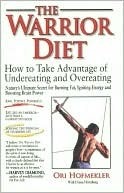
Are you still confused about what, how and when to eat? Despite the diet books you have read and the programs you have tried, do you still find yourself lacking in energy, carrying excess body fat, and feeling physically run-down? Sexually, do you feel a shadow of your former self? The problem, according to Ori Hofmekler, is that we have lost touch with the natural wisdom of our instinctual drives. We have become the slaves of our own creature comforts-scavenger/victims rather than predator/victors. When to comes to informed-choice, we lack any real sense of personal freedom. The ill-advised eating and lifestyle habits that leave us vulnerable to all manner of disease-not to mention obesity and sub-par performance. The Warrior Diet presents a brilliant and far-reaching solution to our nutritional woes, based on a return to the primal power of our natural instincts. The first step is to break the chains of our current eating habits. Drawing on a combination of ancient history and modern science, The Warrior Diet proves that humans are at their energetic, physical, mental and passionate best when they "undereat" during the day and "overeat" at night. Once you master this essential eating cycle, a new life of explosive vigor and vitality will be yours for the taking. Unlike so many dietary gurus, Ori Hofmekler has personally followed his diet for over twenty-five years and is a perfect model of the Warrior Diet's success-the man is a human dynamo. Not just a diet, but a whole way of life, the Warrior Diet encourages us to seize back the pleasures of being alive-from the most refined to the wild and raw. The Warrior Diet is practical, tested, and based in commonsense. Expect results! The Warrior Diet covers all the bases. As an added bonus, discover delicious Warrior Recipes, a special Warrior Workout, and a line of Warrior Supplements-designed to give you every advantage in the transformation of your life from average to exceptional.
Full of pseudoscience and emotional writing. He makes it very appealing to a younger male audience by selling it as the way the spartans, and other warrior cultures ate, which is pure bs.
Do you really think spartans, roman legionaires and the like were concerned about meal timing and ate the highest quality food they could obtain at times that fit in with their special fasting schedule?
Like any army, they ate what was available, cheap, produced and distributed en mass amongst the troops. Which yes, probably included a lot of rice and wheat unfortunately. I don't think they turned down lunch because 'oh dear, I can't break my fast until my 4 hour window starts, so maybe I'll just wait for a few hours. Maybe ask me again after our 3 hour forced march?' I'm sure they had tubs of Ori's 'Warrior Whey', 'Warrior chocolate' and 'Warrior EFAs' in their packs too.
It's as ridiculous as writing a book about how Genghis Khan and the horde lived on yoghurt and beef jerky which caused them to conquor the world from horseback. I can just see the Mongol Probiotic Conqueror Yoghurt being marketed now..
Don't get me wrong, there are benefits to fasting for sure. But not in the way Ori presents it. Anybody I know that's athletic and active has failed miserably on Ori's diet(I worked at an MMA gym for 3 years in the past). The athletes I knew lost energy and gassed quickly when they trained or competed. The bodybuilder/weightlifter types lost hard earned muscle mass or strength. Try it for yourself and see. Really give it a serious shot for a month or two, and see if any of your athletic abilities or strength & conditioning improve, stay the same, or become worse.
Ori's taken a beneficial practice (fasting) put his own twist on it, wraps it up in pseudo warrior-spartan-hua marketing myth, and then of course sells his own line of special warrior supplements. This type of blatant BS really gets to me. If you're interested in fasting that works, without having to swallow a load of marketing - look into Brad Pilon's Eat-stop-eat, or Leangains (which you can pretty much find for free online).
I'll start with a bit of a disclaimer - I usually frown at The *insert word here* Diet because it sounds like a fad, magic pill diet derived from Cosmo. Warrior Diet is not just another gimmick, it's a concept that has been part of common sense of old civilizations like Sparta or Roman Empire, and modified to suit the modern man.
Basically, The Warrior Diet is about undereating during the day with live food to reach a fight-or-flight state (alertness, more energy, "hunger for life") and detoxify the body. This puts the body into a highly metabolized state, setting the stage for assimilating the nutrients at a much greater rate. When the day is done, you have a huge feast, combining as much textures, flavors and colors possible to reach satisfaction and satiety and eliminate any cravings. It's the way that hunters and warriors lived throughout the ages. The moment the food was made a convenience, people of developed countries started to get soft, tired and at an all-time impotency high and fertility low (yes, there is a section on that kind of fitness performance too), just like captive animals.
It's the opposite of the good old 6 small meals per day plan, and it is argued that many meals during the day give you bloating and don't give a chance for your body to cleanse and rest from all of the digestion, not to mention the inconvenience.
Some people may think it's a bit of a detour, but I loved the history part and ended up copying a fair chunk of it in my notes. I'm fascinated about depictions of everyday life, customs and beliefs that took part back then. Besides, this being non-fiction, you can always skip the sections that you don't like, right?
Of course, what would a book about warriors and diet be without a workout section? Ori is not a fan of bodybuilding (rightfully so), preferring functional strength instead. He tries to decipher how the lean and light soldiers of the ancient managed to lug so much weight over ridiculous distances every day. Not only that, but they were always ready to fight and bring it on for hours on the battlefield. There is an emphasis on explosive, high-resistance workouts.
There is a recipe section, but there were no particular takeaways for me as I already have the idea of what to cook and I'm a vegetarian (so I just skipped recipes with meat/fish).
I would love to see an updated version, as this book was released a decade ago.
There's some good information if you can wade through the bad tips. I'd call this the bro diet. He lost me when he suggested using a proprietary protein powder blend with cow colostrum. I'm also not keen on his likening eating pizza to a "fresh kill." Nah, man. Oh and there was the suggestion to take estrogen blockers.
I'd recommend reading the Complete Guide to Fasting by Dr. Jason Fung instead of this book.
The author has some quite interesting ideas on how far modern man has 'strayed' from the way he used to eat, fight and live.
I would have enjoyed the book more if he had stuck to facts instead of hyperbole and didn't constantly try to up-sell his own protein powders and vitamin supplements.
It is among the few modern books that touch the subject of fasting and its benefits. Bit of a touchy subject and people who practice it face skepticism and criticism. The book challenge the norm of the traditional 3 meals a day approach and slowly lure the reader into realizing how much freedom and health benefits can be associated with this fasting approach.
I would however say that Ori Hofmekler approach is more lenient as he suggests that eating small healthy snacks wouldn't harm during the fasting period. I've been researching the topic for quite sometime and discovered that the best result comes from complete caloric restriction during the day (water and zero calories beverages like coffee and tea are allowed), there is no limitation when this is practiced, not mentally nor physically because the body turns to the reserves to feed itself (body fat), furthermore, as long as the individual is drinking enough water, there are no restrictions and the body is adequately supplied.
I really enjoyed this book and would recommend it to anyone brave enough to undergo this ancient eating method.
Probably one of my favorite nutrition books I've read! I read this, staying up until 3 AM, jolting out of bed at 7 AM, excited to finish it.
Whatever you think of the approach, you've got to admit it's out-of-the-box and daring. The "Roman Warrior" thing is a bit gimmicky. I am sure that meal times vary greatly from culture to culture across time - and plus, I think there's a lot of individuality here too.
But as someone who always thought of food as a necessary evil - something that drains energy for the short term in order to sustain my body long term, it's a very intriguing idea to eat one big meal a day in the evening. Seems like, at least for me, this is the perfect solution.
The book has tons of nutritional and health information, which is really valuable even if you decide the meal timing isn't for you.
An example of an interesting idea was that rate of metabolism adapts not to the total amount of food for each day but to each meal, so bigger meals are ideal. He makes the analogy of marathon sprinters who don't build muscle but sprinters who do.
The only thing I disliked about the book is that while he advocates meats, he says, "According to studies, vegetarians live longer than meat eaters." This frustrates me beyond belief. Show me ONE study where meat-eaters ate organic, grass-fed, non-processes, and organ meat instead of sausages and hamburgers.
Update 7th May. It's been approximately a month since I started The Warrior Diet.
What I do:
I did a relatively long water fast first, and that helped the transition to eating one meal a day. I work out in the morning - intensive weight training with fairly high volume, and I drink a fruit juice with ginger as a post-workout, occasionally some berries too. It feels wrong not to take advantage of the insanely high insulin sensitivity post-workout. It feels like the food gets sucked into the muscle because I cannot tell I've eaten anything. I also consume some fruit mid-workout on leg days for the same reason.
I eat dinner around 6-7 PM - primarily meat, fish, and chicken with potatoes and rice. Most of my meals include organ meats (liver and heart) so I can feel satisfied faster and so that my belly doesn't explode afterward by the sheer volume of food.
I eat about 1 - 1.5kg of meat a day, ~500g of carbs, and cook with copious amounts of butter, olive oil, or coconut oil. I almost always include carrots and sauerkraut. I add some vegetables for the sake of taste (Cabbage, broccoli, tomatoes, spinach).
I sometimes eat beyond the point of satisfaction, as I believe that the Supercompensation Principle applies to the volume of food.
So - I train on an empty stomach and do not consume any protein for typically 8+ hours or so post-workout.
The results:
It has taken some time before I get used to eating once daily. Throughout my life, my stomach has been a spoiled child, and my mind a submissive parent. Eating once a day has made my stomach less spoiled, but the main difference is that the parent has become much more resilient to the nagging. The child occasionally nags but shuts up once it realizes it will not get its way. I imagine this will just get easier and easier.
A big benefit I've gained is the sense of freedom of not being restrained by food to the same degree. There are two aspects to this; one is that I do not necessarily have to go home after training to eat a proper meal - and secondly, I "master" my hunger on a daily basis, and therefore, I'm able to operate fine physically and mentally in situations where I would before would be crippled by the hunger.
The main reason why I like this is that I've always felt restrained by food in that I cannot perform optimally after eating. I'm always ready to go for a run, do yoga, meditate, fight, and be energized throughout the day. I've always thought of eating as a necessary evil that sucks energy out of you... Now that I eat 1-2 hours before bed, I only get two hours of restraint in total.
The mastery of hunger leads to more economical eating as well as healthy eating. Many of the things we "eat on the go" are often not the most healthy food. Since you're not bound to the spoiled child's whims and wishes, you can skip the suboptimal convenient choices and can instead focus on preparing dinner with the optimal foods. You eat a good steak instead of a protein shake and potatoes instead of bread.
Not consuming protein after a workout, especially on an empty stomach, is a bodybuilding heresy. But I'm recovering fine, and I'm able to build strength. I'm not unhappy with the direction of my physique. I've gone down a couple of kilos and don't restrain myself when I eat my dinner, so I don't feel like I'm on a diet. I don't know yet if I can regain my strength levels (before a period of sickness and fasting), so time will tell. If I had to become as strong and build as much muscle as possible, I would eat more meals during the day. However, I can't complain about my physique and strength progress, and I enjoy eating one meal a day.
An additional relevant factor is that I believe I spend less time cooking/cleaning in total - which is nice.
There are, of course, challenges with eating once a day - you do not always have a two-hour window in the evening in your home to make and consume a giant meal - and it is sometimes suboptimal to be packed with food for the rest of the evening.
I believe the most important thing is having a clear set of priorities regarding your eating when deciding on dealing with these challenges. For me, my priorities are Freedom & Flexibility, Personal Growth, Athletic Performance & Strength, Physical aesthetics, Longevity, Health, Morality, and Economy.
For that reason, I like to have 1 day a week where I eat nothing, to train myself to skip meals when it's inconvenient, and still be fine. I'm not super concerned about not having optimal recovery from my workouts or reaching calorie goals, as I prefer to err on the side of eating less - thus getting leaner instead of more muscle.
I'm not following the "program" 100% because I wanted to try it to have more freedom, not less. And therefore, I do eat lunch and breakfast socially, for example, on occasion. The most important thing is that you don't get neurotic about a "one meal a day" thing or a "2-hour feeding window" but can still default back to the program.
Update 3, as of 10.10.23 It’s been approximately 6 months since I started doing the warrior diet. I am now eating one to three meals a day, typically two.
The reasons for eating more frequently is twofold. One, I have become more concerned about optimizing my strength gains than “health” and two, I have found a way to eat that doesn’t drain my energy to the degree it has before.
My diet consists of chicken, rice, potatoes and almonds, primarily. And I have found that I can eat large amounts of these foods without having my energy drained during the day, which was my primary motivation to going over to the warrior diet.
Secondly, you can eat more food during one day if you split up the meals, this is relevant for maximizing strength gains.
Having said that; It’s a great relief to know you can maintain and build a great physique only eating once a day. I still eat occasionally once a day simply out of convenience and do not think much about it. The flexibility and control is really what’s important.
You'd probably benefit more by reading a book geared exclusively towards fasting, but it's a worthwhile read nonetheless. I find the principle of one-meal-a-day, in practice, to be very healing on both a physical and spiritual level. Highly recommend the practice of fasting!
Many years ago when I was a young man I followed a diet similar to the one recommended here by Ori Hofmekler. It wasn't something that I planned or followed with any kind of rigor. I just more or less fell into it. I would get up in the morning and have coffee and toast with peanut butter and preserves or honey. (Of course Hofmekler's "warrior diet" does not recommend bread during the "undereating" phase.) I would then go most of the rest of the day without eating anything. In the evening I would reward myself with a huge meal. Sometimes I didn't eat that meal until sometime after midnight.
I was never hungry during the undereating phase. As anyone who has ever fasted can tell you, when you have eaten nothing for a while and are burning fat, you experience no hunger. You are serene. I also maintained the same weight for many years following this habit of only eating one large meal a day.
If looked at closely it can be seen that the essence of the warrior diet is mini-fasts and the avoidance of carbohydrates, especially the processed kind. Hofmekler is not entirely rigorous in that recommendation however, allowing one to eat fresh fruits and vegetables or even some protein during the undereating or fasting phase. Notice that this diet is similar to some of the low-carbs diets currently fashionable. Note also that mini-fasting results in a period of time in which the digestive system is given a rest. With no food in the system, the body is forced to burn fat. Fat burns clean, relatively speaking, as Hofmekler explains. This is quite a change from the days when we were taught that fat was the culprit. Today we know that concentrated, processed carbohydrates and such things as corn syrup are what is making America fat and frankly sick.
In essence the warrior diet is a return to the natural diet of humans as it was (per force) practiced in the Pleistocene prior to the rise of agriculture. When one looks at such a diet, which included, small animals, insects, roots, tubers, fruits, vegetables, and the occasional large animal, it is easy to see that it was almost impossible to get fat or at any rate stay fat for any length of time. The two main foods that are making Westerners fat are readily available carbohydrates and an abundance of fats and oils. In the prehistory there were oats and wheat and barley and such, but the seeds were relatively small and to make a meal required a lot of hand processing. I have experimented with some of the natural foods found here in California, acorns, black walnuts, pine nuts, wild oats, wild grapes; and the striking thing I have discovered is just how much time and energy it requires to process these foods. Using hand tools and existing on these foods along with fish and whatever meat I could get, I could never get fat.
So what Hofmekler is recommending is a return to such a way of living. Since the foods for us are readily available with little processing, the time that would have been spent in hand processing should now be spent in fasting (which was the case in the prehistory).
There is an incredible amount of detail in this book as Hofmekler compares his diet to other diets, as he incorporates workouts, food preparation and recipes, and gets specific about all kinds of foods; but the hard kernel of truth here, in my opinion, is simply this: eat less, eat less often, exercise, and avoid denatured foods. Note that "eat less often" implies mini-fasts. Perhaps the biggest mistake we make is to eat from habit, to eat when we are not really hungry. If we always waited until we were ravenous before eating we would both enjoy the food more and be healthier.
I also like the idea of seeing oneself as something other than a couch potato, indoctrinated by corporate interests to a life of relative passivity and constant consumption. So the metaphor of "The Warrior Diet" is welcome in a marketing sense and more appealing (and sexier!) than what I think is more accurate, which is "A Hunter-Gatherer Diet." One of the reasons that Hofmekler uses the term "warrior" is to suggest in a somewhat subliminal way one of his prescriptions, that is to avoid what he considers estrogen-promoting foods such as "processed soy products...conventional produce, meats, poultry, and pork" and other foods. (See e.g., page 154, or better yet his previous book "The Anti-Estrogenic Diet" for the full story.)
By the way, I still practice a one square meal a day diet, although I must confess that I snack a little too much in-between! Hofmekler's book (incidentally in its second edition, which suggests its value) has come along just in time to inspire me to return to a more rigorous practice. This morning as I write this, 15 hours have passed since I ate anything. I am not the slightest bit hungry and this is after walking an hour in the rain and doing some chores. However I will enjoy my coffee and homemade bread soon.
--Dennis Littrell, author of “The World Is Not as We Think It Is”
I really like Mr. Hofmekler's theories on dividing up the stress you put on one's parasympathetic and sympathetic nervous systems. One does this by dividing a single day up into an under-eating (fasting) phase and over-eating phase. Each phase has its rules and guidelines and after following them for about a month now I can say this diet really suits me well. No more afternoon slumps. And I can still eat as much healthy food as I want. This diet to me doesn't really feel like a diet so much as a life style! Much of this book immediately made sense to me from what I know about human physiology, and I learned a lot of things about supplements, phytoestrogens, and so on...
Most things about good diet and nutrition are repeated on here plus a glimpse at Greek and Roman and few others history to further explain why he chooses to eat like them. Not sure how accurate all that is but it makes sense. Overall its a interesting and entertaining book. You might even find somethings you did not know about nutrition, I know I did.
I have been following the warrior diet for nearly two years and got the great results. This diet focuses on Undereating and Overeating phase. In undreating phase one should eat light meals throughout the day - preferably fruits, veggies, nuts, seeds and small amount of protein. In overeating phase all food groups are allowed except refined carbohydrate such as sugar, molasses and pastry cake. There is a specific rule to eat in overeating phase though.
We have been taught "fear of hunger" when we were kid or teen. The author Ori Hofmekler debunks this myth and shows the benefits of undereating phase. We are far more stronger both psychologically and physically when our stomach is almost empty. Our brain works better in this way. Our body replenishes during overeating phase. Too much intake of foodsaps our energy. We all experience drowsyness after lunch. This is becuase brain goes to "rest" mood when stomach is full. This should be done at night time.
Ori Hofmekler, a former Israeli special forces operator draws this diet from both scientific studies and history of Greek Spartans and Roman soldiers who were in peak mental and physical shape in their prime time.
However this diet is not an optimum choice for building muscle, but it certainly boosts brain power and increases strength.
Good idea but with oodles of padding. The principle of this diet is a good one, however I think the simplicity of the idea works against this book and the author has had to pad out the book with masses of waffle (the 'historical' section is particularly vacuous) and the multiple forwards/introductions/prefaces are completely unnecessary. My advice would be to skim the headings/chapter beginnings and not to read in depth as there is little beyond the headline points. This feels like a negative review but I support the idea and just think that if the book had been half the length it would have been twice as good.
Fascinating in-depth look into the Roman and Greek civilisations in terms of what and when they ate, together with the types or training they partook in. The essence of the book is to eat ‘light foods’ such as raw fruits and vegetables throughout the day followed by an ‘overeating’ phase in the evening where you are encouraged to eat to your heart’s content (vegetables, meat, grains, dairy etc). For me personally, I still need to eat protein and complex carbs during the day but I do feast just like he suggests at night. Really worth the read as he covers food, exercise, sexual health and the accounts of various Roman and Greek leaders
there's a lot of sense to this... a little harder to follow if you're in muscle building mode, you may want more protein during day..
the biggest issue i have with the revised version is that the last line says something like "i no longer eat meat because i question if the body can really process meat well" .... meanwhile the entirety of the warrior diet, referring to ancient romans and greeks, was predicated on meat consumption for protein.
sometimes ideologies get in the way of good ideas. regardless, i gathered some useful tips and tricks to tweak and optimize my body and routine.
It has some good tidbits for sure. For me, there was just too much pseudoscience and not enough mentions of sources. Just saying "Studies showed..." isn't really worth anything if there is no way to find out which study he meant. The general notion of the diet - only eating once a day and eating a lot of natural foods - isn't too bad, I just would have liked more scientific facts (with references) and less "I thinks".
An early version of what later came to be called Intermittent Fasting, OMAD, and the importance of multi-colored food (Yes, I'm looking at you, Noom). Subsequent works by other authors have ending up being much better than this one at elucidating those notions. This one is pretty full of the author's wholesale suppositions. While that should be expected from early work in any field, other than my own curiosity, I don't see a lot of reason for people to read this one nowadays compared to other works.
Then again, I'm not quite done with it, so maybe something new and explosive will yet arise.
The simple and fast way to read this is to hit chapter 5 and 6 to immediately apply the principles to your diet. If you want to learn the benefits of fasting, read from the beginning. Overall, a great program and solid ideas. The author was ahead of his time when he wrote this in 2001.
The idea is very interesting and inspiring. I'm on my first week of warrior diet (the 4th day!) However, the book has too much irrelevant information. Too much on supplements and workout routine. I ll give a higher rating if the author focus on the implementation of the diet.
I admit to having no clue if the teachings in this book are scientific or not. I also admit that there *might* a hair too much machismo rantings strewn about. And, I do not care. Loved the book, and practicing the diet. ...best way to find out, for me!
La idea central es buena: Una comida principal en la noche donde se consumen la mayoría de las calorías, y ayuno el resto del día con sólo unas pequeñas colaciones de proteínas y vegetales.
Lo malo es que para apoyar su teoría usa demasiada pseudo ciencia y dudosas reconstrucciones históricas.
I read this book quite some time ago and I re-read it again recently. Ori was ahead of his time to be sure. I love the direct and simple presentation. An easy read and very caveman-ish, in a good way! :-)
My intro to anything "nutrition" - one of the first books I read after I commissioned - I followed this for the first several months and most of the latter half of 2007 while I was doing mainly kettlebell work. I stopped following this in early 2008.
This book might not be everyones favorite, but for me it did confirm lot of information i knew by common sense and by observing my dad who died in his 70s, was applying lot of things from the book since it was part of his trive heritage and remained strong anx healthy till he died.
Woefully out of date and badly written. Intermittent fasting / time restricted eating has a lot of benefits however I recommend you consult more dispassionate and science based sources. This is mainly misleading guff, wild claims, pseudoscience and, yes, the odd nugget here and there.
A lot of pseudoscience bunk in this one. Has some interesting things to pull out and some eating tips that are helpful. But mostly just a lot of crock.