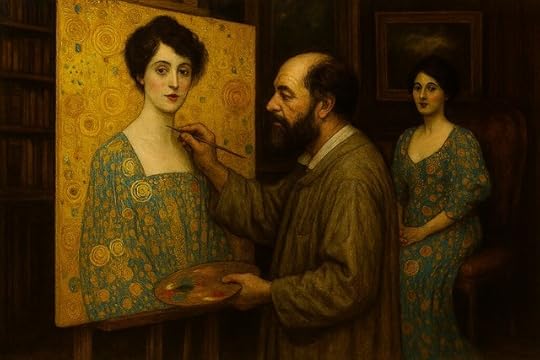
From New York Times bestselling author Christopher Moore comes a hilariously deranged tale of a mad scientist, a famous painter, and an undead woman’s electrifying journey of self-discovery.
Vienna, 1911. Gustav Klimt, the most famous painter in the Austrian Empire, the darling of Viennese society, spots a woman’s nude body in the Danube canal. He knows he should summon a policeman, but he can’t resist stopping to make a sketch first. And as he draws, the woman coughs. She’s alive!
Back at his studio, Klimt and his model-turned-muse Wally tend to the erstwhile-drowned girl. She’s nearly feral and doesn’t remember who she is, or how she came to be floating in the canal. Klimt names her Judith, after one of his most famous paintings, and resolves to help her find her memory.
With a little help from Sigmund Freud and Carl Jung, Judith recalls being stranded in the arctic one hundred years ago, locked in a crate by a man named Victor Frankenstein, and visiting the Underworld.
So how did she get here? And why are so many people chasing her, including Geoff, the giant croissant-eating devil dog of the North?
Poor Things meets Bride of Frankenstein in Anima Rising, Christopher Moore’s most ingenious (and probably most hilarious) novel yet.
Librarian Note: There is more than one author in the Goodreads database with this name.
Christopher Moore is an American writer of absurdist fiction. He grew up in Mansfield, OH, and attended Ohio State University and Brooks Institute of Photography in Santa Barbara, CA.
Moore's novels typically involve conflicted everyman characters suddenly struggling through supernatural or extraordinary circumstances. Inheriting a humanism from his love of John Steinbeck and a sense of the absurd from Kurt Vonnegut, Moore is a best-selling author with major cult status.
Christopher Moore has written a lot of strange stuff, but Anima Rising definitely takes it to a whole new level. Imagine a novel that mixes Victor Frankenstein and his monstrous creation Adam, Gustav Klimt, Carl Jung, Sigmund Freud, a croissant-loving demon dog, a few gods from the Underworld, a drowned zombie girl fished out of a Viennese canal, and, well … you have this book. There are also some intriguing characters that I had no idea were actual real-life women until after I finished this novel – Moore has included a super interesting afterword that gives some biographical information about each, as well as the more famous individuals mentioned above.
This book contains all of the humor and wit that you'd expect from a Moore novel, but it's also much darker than most (all?) of his other works. If you're squeamish about rape/sexual assault, this probably isn't the book for you. There's a lot of sexual violence in this novel and a lot of mistreatment of women. There are also a decent amount of animal deaths, including dogs, in one section of the story but nothing graphic. If you have a thing for Malamutes, though, a bunch of them get eaten and occasionally even made into broth, so … yeah.
Other than the above-mentioned trigger warnings, however, this book really is delightful and quirky. It took several chapters for the characters to grow on me and there are a few instances where the storyline drags a bit, but is it actually possible to dislike a book that includes a croissant-obsessed Malamute? I think not. I loved Judith, Wally, and Gus as characters, and it was entertaining (and also a little sad) watching Judith slowly discover who she was before her drowning in the canal. And, like most Moore books, the humor is really top notch (although not particularly high brow) and the dialogue is witty. It's a chaotic and outlandish story, and it's entertaining in the most ridiculous way possible.
My overall rating: 3.7 stars, rounded up. If you've enjoyed Moore's previous novels and appreciate his deranged sense of humor, you should definitely consider giving Anima Rising a read. It's a wild and pastry-laden ride.
Many thanks to NetGalley and William Morrow for providing me with an advance copy of this book to review. Its expected publication date is May 13, 2025.
"Geoff horked up a whole baby walrus on Sigmund Freud's rug?"
Yeah, that’s how you sum up this book, chaotic and quirky, as usual for Moore’s work. In this one, you’ve got Frankenstein's bride, Gustav Klimt, Sigmund Freud, Carl Jung, and even Hitler making a cameo. I went into it without reading the blurb, so imagine my surprise when Freud popped out of nowhere and then Hitler got roasted. Not complaining, though.
This is your typical quirky Moore book. Yes, it’s quirky, but I didn’t find myself snorting and laughing as much as I did with Lamb. (Granted, I’ve only read two of his books: Lamb and this one.) I loved Lamb, but this one? Not so much. I enjoyed it, sure, but there were parts where I found myself a bit sleepy. Also, the number of nude women scenes was a bit much , were all painters in history really like that? Kind of a "yikes" for me. But hey, I’ll take it as a new perspective on art.
One highlight for me was the afterword, where Moore delves into the history and explains the inspiration behind the book. It added depth to the chaos and tied everything together nicely.
Note: Thank you to William Morrow and Christopher Moore for the ARC! My opinion is, of course, my own.
I have read some of Christopher Moore's books before, and I found in this one the same style of banter and nonsensical humour, which I really like. But here the themes are much much more darker than in his previous work. Women condition and sexual abuse are big themes of the book, and it makes for some bleak moments. Nevertheless, I found it really interesting and loved the use of historical figures.
3.5 stars, rounded up for the concept. I’ve read Christopher Moore before and I knew this new title "Anima Rising" might be a bit over the top - it was like a historical-horror mash-up, “fever dream” kind of a story, which was sorta hard to follow at times and rather absurdist too. But I did like the historical figures - Klimt & art, Freud & Jung, all good & I liked the inclusion of the art work. The Bride of Frankenstein (Judith’s story) was less successful, but I get the underlying message, though could do without the overt misogyny. Overall, it was an okay read, though slow at times, but I'm not mad at it.
__________________________ I was shocked. I wish I had worn rubber boots and electrical lineman’s gloves when I was reading Anima Rising.
I wrote the bold text above all by myself. I’m not bragging. I often write down my thoughts while reading. I’m old, that’s why. My thoughts often get misplaced along with my glasses and TV remote. I had only read about 30 or 40 pages of Anima and I couldn’t believe what I was reading. I’ll tell you why toward the end of this review, but first I’m going to tell you about an even bigger shock that occurred a few pages further. Here is what I read.
Judith: I was shocked by a dwarf. Carl Jung: You were frightened by a dwarf? Judith: No, shocked. With electricity.
The author had used a version of the same “shock=fright/electrical” pun I made in reference to the same book I commented on, but in a totally different context. Quite the coincidence. Oh, I know that you are probably thinking” OK, fine! But you need to realize that this is double Jungian cosmic coincidence whammy were talking about. Carl Jung was a real-life psychologist who Christopher Moore shanghaied—along with other historical figures—and used as characters in this book. It was real-life Jung’s theory that all human consciousness is connected in some way in a universal consciousness and that coincidences that can’t be explained logically are the results of people making a connection that with that cosmic consciousness—just like my writing the shock joke in reaction to something disturbing I read in this book and then shortly afterwards running across the a close cousin of that joke in the same book a few pages sooner. That’s weird stuff. If you are interested in reading more about this weirdness, you may wish to read my review of Carl Jung’s Synchronicity. If you are interested in reading more about this weirdness, you may wish to read my review of Carl Jung’s Synchronicity. https://www.goodreads.com/user/show/3...
Anima Rising is partially a retelling of Mary Shelley’s Frankenstein. Mainly it is the tale of the Bride of Frankenstein, who Gustav Klimt, another real-life historical figure and a renowned artist—finds unconscious, nude, undead, and suffering from amnesia on the riverbank. Adventures ensue, and the Jungian universe acts as a scaffolding for the plot.
SHOCK SHOCK SHOCK—Here’s the dirty part I promised you earlier that caused my eyes to flash like Christmas tree lights and my hair to burst into flames. Where to begin? Real-life Gustav Klimt turns out to be an early 20th century Harvey Winestein. He apparently required that the artistic models who posed for him share his bed. I’m not a prude. I don’t object to a little consensual artistic expression among historical figures, but many of Klimt’s models were still teenagers. In fact, one 15-year-old is pregnant with his child. In Moore’s Afterwood to Anima, he justifies this appearing in the book by saying that it was historically true and that the age of consent in Austria at the time was 14. He even uses some real-life brother/sister incest of a different young artist and his younger sister for humorous purposes. And while there is no explicit boinking (as his models call it) described in the book, including these facts shows a lack of judgement on Moore’s part. This is a book about Frankenstein, giant shapeshifting, people-eating puppy dogs, the undead, and physical immortality, Chris: it wasn’t your duty to report every salacious fact you discovered in your research just because it is “true.” Anima isn’t a tell-all biography, and this material wasn’t in any way essential to the story, it shocked your 21st century fans and probably lost you some of your loyal readership. You need a new editor who isn’t afraid to tell you these things. Call me.
🌟🌟 🌟 Stars. I’ve always been a fan of Christopher Moore, but this one was too many for me. In addition to the ill-considered “facts” I complained about above, much of the humor consists of running gags that have run a marathon, collapsed at mile 26, and are now wheezing in the gutter. For example, the main female character--the one who was talking to Carl Jung above--is constantly offering to murder virtually every male she meets. Also, the Klimt‘s models are constantly making their private parts public like it was a Madri Gras parade. This kind of thing is amusing the first couple of times you read it, but after it is repeated a dozen or so times, it becomes rather grating. In the end, Anima Rising left me more scorched than electrified: the book short-circuited and acts of Christopher Moore aren’t covered by my fire insurance.”
Who but the inimitable Christopher Moore would (or could) write a novel in which the Austrian painter Gustav Klimt finds the unconscious body of the Bride of Frankenstein, takes her to Vienna to meet the fathers of psychoanalysis, Sigmund Freud and Carl Jung, and is chased by a two-centuries old madman bent on stealing her blood? There is also a lovable Malamute named Geoff (with a "G", thank you) who is possessed by an ancient demon who likes to eat rapists.
Moore's latest novel, "Anima Rising" is as crazy, funny, and surprisingly moving as one has come to expect from Moore, who is, by turns, clinically insane, hilarious, brilliant, and a strong social activist who manages to disguise his social activism in his satirical fantasy-science fictional universes. He is a modern-day Mark Twain fused with Franz Kafka, blended with Kurt Vonnegut and a soupcon of Carl Hiaasen. He is often referred to (by probably nobody but me) as the American Terry Pratchett.
That first paragraph says enough of the storyline without giving spoilers, so I won't add anything else, other than to say that if you've never read Moore before, this one would not be a bad one to start with. By the way, he's never written a bad one.
I stopped reading this book at around 30%. I was so excited to read this book because I am a huge fan of Christopher Moore, but this book seems to be full of all the worst parts of men. It includes themes of domestic violence, Sexual Assault, pedophilia, and Incest. In classic Christopher Moore there attempts of humor within these dark themes, however the jokes fell flat to me because the whole book is centered around how oppressed and abused women and teen girls were at this time.
There are trigger warnings in the beginning of this book. I thought it would be fine as I am not usually so sensitive to darker themes. Those dark themes aren’t just sprinkled in they are the entire theme of the book. As a woman and a mother, especially in this current political climate, I could not make it through the book. It was upsetting to read.
It is still written in classic Christopher Moore style and there were moments I found funny, but for me the underlying theme was too serious to make light of. It will probably appeal to readers who aren’t as sensitive to the darker themes of this book as I am.
Thank you to NetGalley and the publisher for providing me an advance copy of this book.
What a wonderful gem of a novel. I had never heard of Christopher Moore, but the cover intrigued me, and I picked up the book to flip through it. Immediately, I was interested in the art (all works of Gustav Klimt). So I snagged the book, and I am glad I did. So what's this about?
"Anima Rising" is a darkly humorous story that is set in Vienna, 1911. Gustav Klimt, a famous symbolist painter, discovers a corpse floating in the Danube Canal. Entranced by the artistic setting, he proceeds to sketch the scene. Yet, it turns out his model is not dead at all. Carrying the body back to his studio, she recovers with a remarkable story to tell.
"Judith", named by Klimt, tells the story of what she remembers of her limited memories of the past. As the story develops, it turns out that she was meant to be the bride of a man named Adam. Klimt, intrigued, decides to take her to his friend, the renowned psychologist Dr. Sigmund Freud to recover her memories. During these sessions, we find Adam is a creation of Dr. Viktor Frankenstein and that she was to be the bride.
As we realize Judith is a nearly immortal being (as is Adam-or the Frankenstein's monster), and she has been to the Underworld, Freud sends her to his colleague Carl Jung to deal with the symbolism of her trips to the Underworld and the gods who occupy her body.
If this doesn't already interest you, then there is more. As these sessions are happening, in the background, various characters are searching for Judith and access to her magical blood. This story has cameos by many real people from this era of Vienna, including Egon Schiele, and Gustav Mahler's widow. Moore captures the strange stew of ideas that were brewing in 1911-era Vienna and the beautiful architecture of this city.
Yet this is a humorous story and quite adept at it. If you are looking for a funny story where Klmit, Freud, and Jung meet the Bride of Frankenstein, then look no further. I really enjoyed this book and will look for more of Moore's novels. Also, for my money, my absolute favorite character is the awesome Malamute dog known as Geoff the Croissant-Eating Demon Dog of the North.
The book also has many of Klmit's famous artworks inside, and as an afterword, there is a brief, but fascinating, look at 1911 Vienna and the many famous people it produced.
It has been a long time since I've read a Christopher Moore novel, and even longer since I enjoyed one this much.. While I enjoy the Shakespeare forays, the art world is of more interest to me. At first glance, I thought it entirely unnecessary to include the Bride of Frankenstein in this story (that's not a spoiler, it's on the cover) but for me she was absolutely the best part. It was pretty genius actually and it allowed to the story to go so many interesting places.
I didn't laugh as much as I typically do in a Moore novel, and I'm not sure if I've changed as a reader of if the voice of this book was different. I did laugh out loud 3 times during the afterward, and the voice I know and love was there. The story was so good it made up for the missing laughs.
This book was creative and fun and had some amazing characters, including another great Moore "hell hound." The way Moore wove together Jung, Freud, the artists, the bride of Frankenstein and Inuit lore was remarkable!
Anima Rising is a wild, weird, and twisty ride through 1911 Vienna, filled with artists, mad scientists, Freud jokes, and a croissant-eating demon dog. To my vast surprise, it all works.
Let’s start with a confession - I DNFed this book the first time. The opening chapters were just too much, wall-to-wall jokes, constant banter, and a chaotic energy that felt like it was trying too hard to be funny. But I’m glad I came back and gave it another shot, because once it settles down, this book is incredibly fun and creative.
The story kicks off in Vienna, 1911, with Gustav Klimt finding a naked woman floating in the canal. Naturally, instead of calling for help, he sketches her. The woman turns out to be alive, feral, and amnesiac. Klimt brings her home. What follows includes Sigmund Freud, Carl Jung, a bunch of misbehaving artists, the literal Bride of Frankenstein, and a croissant-obsessed demon dog named Geoff. Yup.
As Judith (that’s how Klimt called her) starts to recover her memory with help from Sigmund Freud, Carl Jung, and a bit of hypnosis, she recalls a chilling past involving Victor Frankenstein, his creature, and the Arctic. We discover her backstory slowly, and it’s extremely well done. She’s a character with trauma, rage, and an engaging personality. Her friendship with Klimt’s model Wally is the highlight of the book. Wally is great too, by the way. Full of street smarts and charm.
This book is stuffed to the brim with historical characters, gothic horror references, psychological theories, and absurd comedy. Freud is obsessed with penises. Jung is all about archetypes. Alma Mahler, Egon Schiele, and even a young Hitler wander through the story. And yet, Moore somehow keeps everything coherent and even gives depth to almost all characters.
Now, Anima Rising gets dark. There’s sexual violence in Judith’s backstory, and while Moore handles it with more sensitivity than you might expect from such a wacky book, it’s still heavy stuff. The same goes for animal death, but it’s not gratuitously graphic.
That said, the humor lands most of the time. Geoff the demon dog steals every scene. And the dialogue is packed with ridiculous, sometimes brilliant exchanges. The pacing dips a bit here and there, and the humor can be a little much early on. But once the story finds its groove, it’s all hilarious and oddly moving.
If you like your historical fiction with monsters, Freud jokes, dad jokes, and demon dogs, Anima Rising is for you. It’s chaotic, clever, and creative. Once I gave it a second chance, I didn’t want to put it down.
Literally a book about Gustav Klimt, S Freud, C Jung and Mrs. Frankenstein. (This equation had me – irresistible.)
That said, it must be stated that this is not a book for families, children (which for me is anyone under 21), pregnant women (or pg men, or anyone/thing pregnant). It is not for anyone older than me, or who may have suffered traumatic anything. C Moore says it himself BEFORE THE FIRST PAGE. There is your warning, friends. I can barely believe I’m going to review this tale of murder, slaughter, violence of all kinds, and any kind of sex there ever has been, is now or will be. . . .into the breach go I. . .
Anima Rising by Christopher Moore lines up all the planets if the planets are defined as the above-mentioned luminaries plus Judith (the bride – she has her own fully fleshed sidebar of Victor Frankenstein’s efforts in the Artic), Wally (a model of Klimt’s – she’s deserving of her own book), a demon dog named Geoff who is hungry but can be distracted by croissants, Hitler cameos, Alma Mahler and Egon Schiele peek in as well.
There’s lots of penis talk (Freud’s obsessed) and so many french baked goods. There's the banter, asides and corny jokes that had me barking out loud with laughter. It was weird, but I was laughing hard. So one part of me got the serious – turn your back on this, immediately urging of an earnest shoulder angel, but there’s this place CM gets you to where you see all the crazy, can feel CM pushing your buttons – and then turning it all around so you can see from that point of absurdity where all feels curiously relevant and notable.
C Moore certainly got my attention. I’ve not ever made it through one of his books, and the fact that I got through this one – surprises the hell out of me. Maybe that was the point. (I will try another, said she.)
AGAIN. I recommend this with cautionary Huzzahs. Heads will roll (along with all other sundry parts and pieces). If your eyebrows are raised right now. . .hands off your mouse and back away from this review . . .forget you ever saw it. . .
*A sincere thank you to Christopher Moore, William Morrow, and NetGalley for an ARC to read and review independently.* #AnimaRising #NetGalley 25|52:51f
American humorist Christopher Moore has delivered a historical "what if " novel that combines literature, art and history . ANIMA RISING IS HIS 19th work of fiction and probably his most complex to date. He's come a long way since my personal favorite,THE STUPIDIST ANGEL.
Gustav Klimt, Egon Schlie, the bride of Frankenstein, the reanimated monster, Freud and Jung headline. There is even a cameo by Hitler. If you're a fan of Mel Brooks and YOUNG FRANKENSTEIN, you will probably feel right at home. Until you get to the serious parts like sexual abuse, misogyny, psycho-analysis and immortality. Originality of story unfortunately loses something due to repetitiveness or inactivity. Happily there is an afterword following the text where much like the extras on a DVD Moore explains his research and tries to separate fact from author's license. Casual, informative and brief.
The languge is raw, the sex varying from casual banter to brutal rape. The violence in contrast is comic in treatment and more "off stage" than graphic. Moore's Author's Note actually says :
"Finally, and I can't sress this enough, if you are listening to this book in audio format in the car, with a kid or your grandma, turn on something else. Now."
The last book by Moore that I read was Razzmatazz in 2022. I have read 16 of his books. I guess you could say I like his work. Moore is clever; he researches his subject matter; his humor is earthy, sometimes vulgar; and his stories are way interesting. This book, Anima Rising, reminded me of some of his earlier works. Let's look at the characters in this one: Gustav Klimt and his immediate circle of friends, Sigmund Freud and Carl Jung, Egon Schiele, Adolph Hitler, Victor Frankenstein and his creations - Adam and his bride (THE Bride of Frankenstein!) and many more. The time period in which the story takes place is just prior to the Great War. The place, Vienna, Austria. Gus Klimt is featured. He and his many underage models, of whom he is continually sketching. So, how does THE Bride of Frankenstein insert herself into the mix of Bohemian artists? Klimt, on returning from a night at the opera, sees her naked body, lying half in a canal on a dark street, drowned. Being an artist of a particular type, he pulls out a small sketch pad and starts to draw the unfortunate Bride. Just then, she coughs and pukes up a bunch of canal water, which I'm sure was not quite spring water. So, being a gentleman, Klimt helps the "young" lady literally back to life. So, how does a woman from a story written 100 years before end up in what was then modern day Vienna? Her story provides the basis for the rest of the book. She goes by the name of Judith, which was given to her by Klimt. Not just any Judith but one from history. Her personality is complex and only reveals itself after sessions with Freud and Jung. We meet Geoff, with a "G", her croissant-loving Malamute protector who stays loyal to Judith throughout the story. Anima Rising is filled with the history of that time and the lives of Klimt, Schiele, Freud, and Jung. The genius of Mary Shelley is brought to light through the characters of her seminal novel, Frankenstein. Because that book begins and ends in the frozen Arctic regions, we learn a great deal about the Inuits and their mythology, which connects directly to Anima Rising. I originally gave this book 4 stars but as I was writing this review, I realized that it was more than that, thus the 5 star rating. It is funny, not roll on the floor funny, but still sharply sarcastic. It is informative, it is honest, and it is entertaining.
Took me a bit to decide I liked this one, but when it's all said and done, Christopher Moore's Anima Rising is quite brilliant.
This book is a strange mix of real-life artists and their models, famous historical psychoanalysts, fictional characters from Shelley's Frankenstein, and Inuit lore and culture. It's weird, but somehow, it works. It all comes together quite beautifully in the end.
If I could complain about one thing, it would be that Klimt was known for sleeping with his models, so a lot of time here is spent on who's "shagging" who and I just... grow weary of that kind of thing very quickly. Sex isn't described graphically on page, but the fact that it was in the forefront of most of the discussion here was annoying for me, personally.
Christopher Moore is one of my sister's favorite authors, so I actually met the guy at a book signing a couple weeks ago. He is SO cool and down-to-earth and funny. By the time we left, I felt like I had attended a comedy show, not a just a book release party.
I've only read two other books by Moore. One I didn't care for, but the other, Lamb: The Gospel According to Biff, Christ's Childhood Pal is one of my all-time favs. If you need a good laugh and aren't offended by religious humor, then definitely check that one out.
And maybe also this one too. I don't think it will be for everyone, but I had a good time.
It’s a tradition when a Christopher Moore book is released that I read it aloud to my partner. There is nothing quite like the sight of partly-chewed bright-orange lamb korma flying through the air when a joke lands, or coffee spraying across the room. While this novel did not provide quite as many spit takes as the previous three, it still was a laugh-filled, if darker and more analytical in some ways, story. I enjoyed it thoroughly, especially the bits with Freud and Jung, who are both excellent subjects for comedy. Moore is the best at what he does, equal parts Stephen King and Douglas Adams. Highly recommended, as with all his books.
My first book by Christopher Moore. The research was pretty impressive. It's really something to take a look at the figures of Klimt and Freud, and very humorous to watch the way they get played by the bride of Frankenstein. I read some of Freud's notes on his early patients, and Christopher Moore really captures the disturbing quality of those notes. I think the character's name Judith was a deliberate nod to Freud's early work that reeked of misogyny. I love how the character Judith tested Freud and Klimt, and challenged Jung.
The tone of this book is so singular. It's funny and disturbing. So if you are ready to juggle both those extremes, you will probably enjoy this. There's a lot of smart and dry humor.
If anyone is looking for more research on early psychotherapy after reading this, Judith Hermann does a great job in pointing out the limitations of Freud's perspectives in her clinical work Trauma and Recovery.
This is my second attempt at C Moore and I guess he really isn’t for me. His humor doesn’t hit. I respect that he attempted such audacious historical fiction/magical realism, but his portrayal of the famous characters seems thinly conceived. Anyways, quirky stuff.
Christopher Moore is a writer of literary humor since it goes beyond simple jokes by using humor in complex ways. The author himself describes his humor as a blend of three genres: comic fantasy, horror, and absurdist fiction. Regardless of what you call it, I have enjoyed his writing ever since I read Bloodsucking Fiends.
This tale is set in early 20th century Vienna and begins with the artist Gustav Klimt's discovery of a very beautiful, pale lavender-colored, nude woman apparently drowned in the Danube. As he begins to sketch her, she coughs and comes to life. Since she has amnesia not knowing who she is or how she arrived in her current situation, Klimt names her Judith. Eventually, he engages the services of first, Sigmund Freud, and later Carl Jung. Under hypnosis, all discover that she was created by Victor Frankenstein to be a companion for "Adam", his initial creation. The remainder of the story is learning who she was before this genesis and how she ended up in Vienna.
Christoper Moore's humor tends to be irreverent, which draws some readers while repelling others. I was particularly drawn to this book with its satire of psychoanalysis and psychology. The depiction of fin de siècle Vienna was so evocative as to be a character in its own right. The number of thematic threads detailed above did add some complexity to the plot, which made it difficult to read at times. Although initially humorous, the jokes appeared to be repetative and I soon tired of them. Overall, I enjoyed the read with its supernatural and artistic references.
Only Christopher Moore would think to ask “what if the bride of Frankenstein’s monster became an Inuit deity and then the muse of Gustav Klimt?” and then write a novel about it.
I really loved Moore’s early work, and some of that wacky, absurdist humor is present here. Judith and Wally were great main characters, and while the conceit of using Freud and Jung to get Judith’s backstory felt a little on the nose, I DID want to know what had happened to her. I hadn’t known anything about Gustav Klimt before this (other than a few of his famous paintings) so it was interesting to learn about his life.
There were parts of this I really liked (the MCs, the humor, the Inuit mythology), and parts that didn’t work so well for me (the sexual trauma, casual misogyny, too many historical figures). The author’s note at the end helped clarify Moore’s approach but I’m still a little 🤷♀️ about it.
For me, Christopher Moore is back. I have been a big Moore fan back to the olden days, my favorite being Lamb. Sometime around Sacre-Bleu & Shakespeare for Squirrels, I lost interest. The books got too convoluted. This one was convoluted too & I had a little trouble keeping up in the beginning with the letters from the Arctic, but once the story got going in Vienna, I was all in. I love the way real world people were interspersed into a fanatical tale & I loved Moore's footnotes afterwords. If you like art history, sarcasm, & fantasy, you will love this book.
Another funny and clever comic novel from Mr Moore ! I’ve read all his many books and this one is a hoot! It’s really well narrated in audiobook form which made it even more enjoyable. It’s a re-working of Frankenstein’s monster interwoven with early 20th century Austrian art and psychiatry- it’s terrific!
Christopher Moore’s Anima Rising (2025) is a dazzling and macabre comedic fantasia that collides fin de siècle Vienna with gothic horror, Freudian psychoanalysis, and feminist retribution. Channeling the ribald irreverence that defines his earlier works like Lamb and Fool, Moore delivers a genre-bending tale of trauma, identity, and resurrection that is as unhinged as it is intellectually provocative. In this novel, Moore not only resurrects a literal Frankenstein’s bride, but also history itself—reimagined with wit, grit, and grotesque delight.
Setting the Stage: Vienna, 1911
Vienna at the dawn of the twentieth century was a city in the throes of intellectual, artistic, and political upheaval. Moore reanimates this world with his trademark absurdism, situating readers among figures like Gustav Klimt, Sigmund Freud, and Carl Jung, each rendered with outrageous charm and darkly comic insights. This is not a mere historical backdrop—it is a character in itself, buzzing with electric thought, erotic tension, and existential dread.
The story opens with Klimt discovering a nude, seemingly dead woman in the Danube canal. Instead of summoning the authorities, he sketches her. She wakes. Thus begins the journey of “Judith”—so named after Klimt’s own painting—an amnesiac woman who is anything but ordinary.
Plot Overview: What If Frankenstein’s Bride Survived?
As the narrative unfolds, Judith begins to piece together her origins. Her story, filtered through surreal hypnosis sessions with Freud and Jung, reveals she was created by Victor Frankenstein, abused by the patchwork creature Adam, and cast off into the Arctic ice. She dies, is reborn, dies again, and returns again—each time gaining more sentience, rage, and supernatural insight. She journeys through a mythic Underworld populated by Inuit deities like Sedna and Raven, absorbing their wisdom and power.
Eventually, she becomes an iconoclastic presence in Klimt’s Vienna—a muse, a menace, a myth—and is relentlessly pursued by enemies both literal and metaphorical, including a croissant-eating demon dog named Geoff, various henchmen, and her monstrous past.
Characters That Defy (and Define) Archetypes
Judith: The Reborn Feminine Fury
Judith is one of Moore’s most complex creations. Initially feral and memoryless, she becomes the novel’s intellectual and emotional core. She challenges the male gaze that created her—Klimt’s sensual art, Frankenstein’s grotesque science, and Adam’s domination—and reclaims autonomy through pain, wit, and transformation. Her journey is harrowing, filled with physical and emotional abuse, but Moore gives her sharp teeth and sharper comebacks. She is both victim and avenger, goddess and girl.
Gustav Klimt
Rendered with satirical affection, Klimt is a paradox—a hedonist with a moral compass, an artist obsessed with beauty yet fascinated by death. His relationship with Judith is one of mutual curiosity, bordering on co-dependence. Unlike Adam, he does not seek to possess her, but he is nonetheless complicit in her objectification.
Freud & Jung
Moore lampoons the gods of psychoanalysis with surgical precision. Freud is pompous, dismissive of women, and entirely uninterested in the mystical or spiritual. Jung, in contrast, is open to the numinous and becomes a compassionate listener to Judith’s layered tale. Their intellectual tug-of-war becomes a meta-commentary on the limits of psychology in explaining trauma.
“I was more focused on filling out my notes than on treating my patient.”
Themes: Electric Souls and Dead Gods
1. Resurrection and Reinvention
Judith’s literal rebirth from the dead mirrors her psychological resurrection. Moore uses the Frankenstein myth not to rehash Mary Shelley’s story but to ask: What happens when a woman created for another’s purpose finds her own?
2. Trauma, Memory, and Myth
Judith’s story operates on both literal and symbolic levels. Her past abuse at the hands of Adam—a soulless, patchwork brute—mirrors how patriarchal systems commodify and mutilate women. Her healing occurs not through psychoanalysis alone but through myth and communion with feminine archetypes like Sedna.
3. Art and Objectification
Through Klimt’s art and Vienna’s bohemian culture, Moore explores how women are muses, models, mistresses—but rarely narrators of their own story. Judith’s transition from Klimt’s model to the novel’s moral center upends this trope.
4. Humor as Survival
Despite the horror, Anima Rising is riotously funny. Moore deploys sarcasm, absurdity, and slapstick to offset the violence, making the novel accessible even as it navigates dark psychological terrain. Geoff, the croissant-eating demon dog, and penis-necklace jokes may not be for everyone, but they serve an important role in undercutting gothic melodrama.
Moore’s Prose: Literary Mischief and Wordplay
Moore’s writing in Anima Rising is saturated with intelligence, irreverence, and a deep love of language. He blends period authenticity with modern wit, creating a voice that feels timelessly anachronistic.
Readers familiar with Lamb, Fool, Sacré Bleu, or Noir will recognize Moore’s signature style—comic yet poignant, sharp yet sincere. His prose is lean where needed, lush where it counts, and punctuated with delightful absurdities.
He also demonstrates surprising restraint when the subject demands it. Judith’s recounting of her abuse is handled with care and nuance, never played for shock or humor. It’s this tonal balance that elevates the novel beyond parody or pulp.
Historical Intersections: Real Lives in a Fantastical Frame
Much like Sacré Bleu, Moore populates Anima Rising with real historical figures—Klimt, Freud, Jung, Egon Schiele, Alma Mahler—and reimagines their lives with mischievous liberty. However, he does his homework. From accurate references to Schiele’s rejection from the Vienna Academy (while Hitler was denied just a few lines down) to Alma Mahler’s turbulent love affairs, Moore treats his source material with unexpected reverence beneath the satire.
Highlights and Lowlights
Highlights
- A genre-blending triumph: Gothic horror meets historical satire meets feminist revenge fantasy - Memorable characters: Judith is unforgettable, and even side characters (like the demon dog Geoff) are vividly drawn - Historical depth: The blend of real and surreal events makes for a richly immersive world - Humor with purpose: Laughs come not from ridicule, but from resistance, subversion, and survival - Unflinching exploration of trauma: The horror elements are anchored in psychological realism
Lowlights
- Not for all tastes: Readers uncomfortable with explicit references to abuse, sex, or profanity may find some sections disturbing - Genre whiplash: The narrative shifts between horror, absurdism, and historical fiction can feel jarring - Density of references: Those unfamiliar with Freud, Jung, or early 20th-century Vienna might miss some deeper layers of satire
Final Verdict: Electrifying and Unapologetically Bonkers
Christopher Moore’s Anima Rising is a triumphant resurrection of myth, horror, art, and satire. It is not an easy book—its humor is biting, its themes unflinching, and its protagonist wounded yet wild. But for readers willing to plunge into the icy depths of trauma and emerge electrified by feminist fury and comedic genius, Anima Rising offers a singularly strange and satisfying read.
It is Moore at his most deranged—and most brilliant.
I love Christopher Moore’s books but this one just didn’t work for me like some others.
Normally I love the mix of serious and silly but I don’t think this one meshed. It spread itself out a lot and at some points lost focus. Klimt, a major character, gets forgotten about at times? There are so many women to keep track of that I definitely mixed them up. And while the audiobook narrator did AMAZING accent work here - sometimes, it was hard to understand the accents.
Still, I enjoy Christopher Moore’s sense of humor and will continue to read his books. And one day I will learn perfect Fucking French.
This was my first Christopher Moore, and I’m impressed. His blend of dark humor and chaotic storytelling is refreshingly unhinged. Klimt and Wally were an absolute delight, but it was Judith who stood out the most. Her sarcastic comments on Freud’s infamous “penis envy” theory had me cracking up!
"I know what you're thinking. You're thinking, Oh, great job, butt puddle, how did you manage to ruin history, literature, and art in one short novel? First, there's no need to use that kind of language, and second, it went like this."
So starts Christopher Moore's afterword of Anima Rising, and here starts my review of said novel. Let me preface this by saying I love Christopher Moore. I love his sense of humor, I love that squirrels are hands down his favorite rodent, and I love his work....for the most part. Not all of his books have hit with me, but the ones that do hit me so hard I am forever changed.
Honestly, for a while I thought this book was going to be in the former category. I had read some of the other reviews where people could not handle the treatment of women in this novel. Absolutely valid. It is hard to combine humor on the same page atrocities are happening. And if you have sensitivity to reading about sexual abuse, rape, and other horrendous treatments of women by men, please choose another Moore book to try. This one is not for you.
However, I do believe the overall treatment portrayed is probably fairly accurate for the late 1700s to early 20th century Vienna. Or let's be honest, fairly accurate for the entire world. So if you are able to stomach the heinous acts, and view in the time period given, you will be rewarded with a wonderful story. This is pure Christopher Moore zaniness that weaves and bobs and gets more interesting the further you get in. Like in Sacrè Blue, I love how the author took real figures and real events from history and weaves in both plausible and insane aspects to make a compelling story. Like Freud and Jung ending their friendship over a horked up baby walrus on Freud's rug. Or one of my lol moments, Hitler interrupting Schiele and Klimt's coffee, wanting Schiele to introduce him to Klimt so the master could look at his portfolio. *Awkward*
While the story is fantastical and wonderful, what really turned this around to the "fave" Moore pile is the characters. Wally, Judith....and of course Geoff the Croissant-Eating Demon Dog of the North. I really came to love this trio, along with Emilie, and even with his flaws, Klimt. They will stay with me for a good while. I hope Moore continues with this real artists/fictional story theme. I can't wait to see what's next.
I received this book from NetGalley in exchange for an honest review. The book will be released on May 13, 2025.
It is Vienna, 1911. Gustav Klimt, a famous painter discovers a woman’s nude body in the Danube canal. He pauses to sketch her when he hears a cough. She is alive! He takes her back to his studio where he and his muse Wally tend to her as he plans to sketch her. She has no memory of who she is, but with the help of Sigmund Freud and Carl Jung, she begins to recall her history that starts with a memory of being stranded in the Arctic and locked in a crate by a man by the name of Victor Frankenstein. As we go we get answers to the question of why she is there and why so many people are looking for her.
I was very excited to get this book. Christopher Moore is one of my favorite authors. I was a little worried at the beginning that I would not be able to give it a rave review. I was interested in the story of Klimt, Wall, and Judithm but when it switched over to the letters from a ship captain to his sister detailing his account of Frankenstein on the ship my interest waned a little. Luckily, the letters ended and we got deeper into the story of Judith and her origins. Also, we discover that the letters a more than just a recap of events on the ship.
It was chock full of what you expect from Moore. Interesting characters, Moore’s signature humor, and a well-researched book that is more intelligent than you would expect given how funny it is.
I would highly recommend it to fans of historical fiction and humor