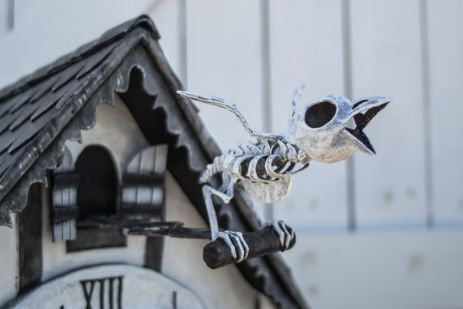
"Did you ever wonder at the lonely life the bird in a cuckoo clock has to lead --" wrote the editor of "Fantastic Universe" in January, 1954, blurbing this tale "-- that it might possibly love and hate just as easily as a real animal of flesh and blood? Philip Dick used that idea for this brief fantasy tale. We're sure that after reading it you'll give cuckoo clocks more respect."
This collection of several of Philip K Dick's short works, including the title story, all published in now-defunct science fiction pulp magazines, is a slice from his early career. Many of these stories explore the themes of war and whether humanity is intrinsically violent and conflict-torn. Each of them is a fascinating jewel of speculative fiction.
Philip Kindred Dick was a prolific American science fiction author whose work has had a lasting impact on literature, cinema, and popular culture. Known for his imaginative narratives and profound philosophical themes, Dick explored the nature of reality, the boundaries of human identity, and the impact of technology and authoritarianism on society. His stories often blurred the line between the real and the artificial, challenging readers to question their perceptions and beliefs. Raised in California, Dick began writing professionally in the early 1950s, publishing short stories in various science fiction magazines. He quickly developed a distinctive voice within the genre, marked by a fusion of science fiction concepts with deep existential and psychological inquiry. Over his career, he authored 44 novels and more than 100 short stories, many of which have become classics in the field. Recurring themes in Dick's work include alternate realities, simulations, corporate and government control, mental illness, and the nature of consciousness. His protagonists are frequently everyday individuals—often paranoid, uncertain, or troubled—caught in surreal and often dangerous circumstances that force them to question their environment and themselves. Works such as Ubik, The Three Stigmata of Palmer Eldritch, and A Scanner Darkly reflect his fascination with perception and altered states of consciousness, often drawing from his own experiences with mental health struggles and drug use. One of Dick’s most influential novels is Do Androids Dream of Electric Sheep?, which served as the basis for Ridley Scott’s iconic film Blade Runner. The novel deals with the distinction between humans and artificial beings and asks profound questions about empathy, identity, and what it means to be alive. Other adaptations of his work include Total Recall, Minority Report, A Scanner Darkly, and The Man in the High Castle, each reflecting key elements of his storytelling—uncertain realities, oppressive systems, and the search for truth. These adaptations have introduced his complex ideas to audiences well beyond the traditional readership of science fiction. In the 1970s, Dick underwent a series of visionary and mystical experiences that had a significant influence on his later writings. He described receiving profound knowledge from an external, possibly divine, source and documented these events extensively in what became known as The Exegesis, a massive and often fragmented journal. These experiences inspired his later novels, most notably the VALIS trilogy, which mixes autobiography, theology, and metaphysics in a narrative that defies conventional structure and genre boundaries. Throughout his life, Dick faced financial instability, health issues, and periods of personal turmoil, yet he remained a dedicated and relentless writer. Despite limited commercial success during his lifetime, his reputation grew steadily, and he came to be regarded as one of the most original voices in speculative fiction. His work has been celebrated for its ability to fuse philosophical depth with gripping storytelling and has influenced not only science fiction writers but also philosophers, filmmakers, and futurists. Dick’s legacy continues to thrive in both literary and cinematic spheres. The themes he explored remain urgently relevant in the modern world, particularly as technology increasingly intersects with human identity and governance. The Philip K. Dick Award, named in his honor, is presented annually to distinguished works of science fiction published in paperback original form in the United States. His writings have also inspired television series, academic studies, and countless homages across media. Through his vivid imagination and unflinching inquiry into the nature of existence, Philip K. Dick redefined what science fiction could achieve. His work continues to challenge and inspire, offering timeless insights into the human condition a
First published in Fantastic Universe (January, 1954), this strange little story about a bad marriage, an adulterous liaison, and a little birdie who lives in a cuckoo clock and just may have a mind of its own, is just—for want of a better term—kinda “dumb”. Dick, who by this time had become an accomplished professional hack, develops the idea well, but I doubt if the idea was worth developing in the first place. Taken as a whole, it feels like a third-rate episode from a half hour 50’s anthology TV show: Alfred Hitchcock Presents, or maybe The Twilight Zone.
Still, I have to admit I enjoyed it. Dick—who sometimes sincerely believed household objects were conspiring against him—gives this story a genuinely paranoid atmosphere.
What can I say about a story, a really, really short story that is shorter than most of the conversations I get pulled into by any of my family members? That's what Beyond the Door by Philip K. Dick is, not a conversation with my family, a short story. I was sitting here thinking that he must not have got much done around the house because he was busy writing, and writing and writing. Short stories, longer stories, books, he kept writing. So who cut his grass, who washed the car, did he take his wife out for dinner or go to his kids school programs? I don't know if he had a wife or kids I didn't look it up yet. All I know is he wrote a lot of short stories that I can read filling in the time between one big book to another.
The next thing I was wondering was about the name of the book, Beyond the Door. I don't quite get it, I suppose I could read the story again to see if I'm missing something, it would only take a few minutes, but I don't feel like it at the moment, so I don't know what the door had to do with the story, other than the clock had to be in some room or other with a door. A better title would have been something like: "Cuckoo Clocks May Not Be The Perfect Gift", or how about: "Don't Wind The Cuckoo Clock", which wouldn't work I supposed if the thing is battery operated, it seems like everything is battery operated. Then there's: "If You Hate Your Spouse Get A Cuckoo Clock". Then there's "One Flew Over The Cuckoo's Nest" that occurred to me, but it's already taken.
Here's some advice; if you ever get your spouse a Cuckoo Clock, or any other present on earth, don't tell him or her what a good bargain it was, how much money you saved type of thing. My ex-mother-in-law was absolutely amazing the way she managed to do that. I once told her what sneakers my husband wanted for Christmas. Knowing her very well, I wrote down the type, the size, the color, the name of the company, anything I could think of, and off she went. Christmas morning arrived and he opened a box with shoes in it. The only thing these shoes had in common with the ones I told her is that they were white. She went on to tell us she had the other ones in her hand when she saw a bargain table, and these shoes looked just like them and were only five dollars. When you tell your wife you did that she won't be thrilled, neither will the cuckoo.
Finally, I've always wanted a Cuckoo Clock. I don't have one because I haven't always wanted to pay the price they want for them. Now after reading this story I find I still love Cuckoo Clocks, but if I ever get one I will pay special attention to how many times he comes out the door an hour, it could be important. Happy reading.
I got this short story for free in my e-book reader application. I think even short stories are ought to be well written. This one failed to satisfy my taste. The language is poor, the end is predictable, and the characters are lame (well, except for the cuckoo in the clock which had a more interesting character). However, I've read worse before.
La desintegración de un matrimonio que está en sus horas más bajas, los celos y la desconfianza de la pareja salen a relucir cuando el marido le regala un reloj de cuco a ella. El reloj es un destestabilizador que colma un vaso que estaba lleno. Un cuento con una violencia soterrada.
The cuckoo clock is the object of a struggle between two régimes: the mechanical and the machinic (in the sense of Deleuze and Guattari's "desiring machines"). Larry embodies the mechanical régime: the clock is an object of consumption, the acquisition made in a favorable economic transaction. It has a job to do, and should respect its specifications, or be coerced into doing so. For Doris the clock is an experience tied to memory ("like my mother had") and to desire. Larry's expectations are prosaic, the clock should tell the time correctly, and Doris should be glad to have got what she wanted. Doris's approach is animistic, she immediately has an emotional reaction, begins to fantasize, personifies the cuckoo, desires to associate Bob with the experience. As the clock is an antique and Bob is interested in antiques (and in Doris) perhaps Larry was not being totally utilitarian in his choice of present, perhaps the clock was part of an erotic contest with Bob to win Doris's desire. Bob seems to be younger ("that young punk"), to have lots of free time (he accompanies her to the stores while Larry is working) and to have an expensive hobby ("antiques") and a time consuming one ("books"). Larry works hard, including doing overtime, and would like to be admired for his business acumen in acquiring the clock "wholesale". The playing out of the plot seems to be a repetition of a preceding triangle. Doris's mother had such a clock "when Pete was still alive". Larry sees his wife, Bob, and the clock as forming a triangle of desire: "They would be quite happy together, Bob and Doris and the cuckoo". Larry too has begun to fantasize around the cuckoo. Doris is not innocent in all this. She does not regret that Larry works to much, but is upset that he sometimes breaks routine by calling to see if everything is alright. She flirts with the cuckoo just as she flirts with Bob, and puts up no protest when Larry kicks her out, presumably just moving in with Bob. The cuckoo fulfils her wish of being rid of Larry, just as her mother (perhaps) got rid of Pete. So Doris has a cuckoo aspect too, in that the cuckoo female is alleged to change its mates frequently. When Bob, at the end, wonders if Larry's death was not an accident but "something else", we automatically think that the missing term is deliberate (i.e. murder), but another antonym to accident could well be "law". In which case he should beware of what happens next. Doris may be following a law of her nature even more stifling and imperious than Larry's mechanical routine, and more dangerous; Doris feels her reactions are fair self-defence against Larry's patriarchal monologue: "After all, she couldn't keep listening to him forever without defending herself; you had to blow your own trumpet in the world". The cuckoo too couldn't listen to Larry's threats forever, and "defended" itself. The title phrase "beyond the door" is associated with the behaviour of the cuckoo, remaining inaccessible and aloof: "someplace inside the clock, beyond the door, silent and remote". This inside space it withdraws to connotes domesticity, whereas Larry is subject to the law of the outside, of the workplace, which involves renunciation and compromising of desire: "But it isn't fair. It's your job to come out. We all have to do things we don't like." The cuckoo, like Doris, does not wish to bend to this law. Doris wishes to defend herself and to "blow her own trumpet in the world".
There is something about his style that I like, there is a comical air and satire mixed with the Sci fi elements and I'm sure that if I visit and read his biggest works, I'll probably find some favourites among science fiction.
This story I actually really enjoyed the concept of, but it barely scrapped the surface and fell flat for me. I'd love the concept of a cuckoo bird being "sentient" in all its mechanical ways, forming likes and dislikes for the people who own the clock it resides in. It's just the story was so abrupt that it felt more like a quick draft of something that was meant to be written. I wish that the phenomenon would be explored, that the characters would be given depth and that there would be something more which is what frustrates me about this. I loved the concept, I wish I'd see it come to fruition as a whole, take it to the next level, show everyday machines and objects show signs of sentience and people questioning their sanity, their behaviour towards those objects and each other.
So frustrating you see!! This could have been a fully explored concept for a novella and i think I wound have loved it. I'm giving it 2★ only because the concept captures me. (I'm a fan of non human POVs, sentience, gaining consciousness and awareness)
Not worth reading unless you want to get frustrated by how good the idea is but how flat and short it ends up being.
I do feel more compelled to read his novels though, I think the numerous pages will give room for this in genius little concepts to take full form.
But Then You Have to Spoil It All by Saying Something Stupid Like Cuckoo
Beyond the Door is an eerie-sounding title, whisperings of realms yet undiscovered abounding, and yet this little story, published by PKD in January 1954, never leaves its domestic setting. It is based on a tongue-in-cheek idea when Larry gives his wife Doris a German cuckoo clock as a present to patch up the fissures showing on the veneer of their relationship, and when we later find out that Larry is actually a cuckold. The dialogue at the beginning of the story establishes the characters well: Larry, a no-nonsense, down-to-earth man is gullible enough to reveal to his wife that he bought that present, which has long been one of her heart’s wishes, wholesale so that she needn’t worry about the price, and Doris, of course, reacts as most people would do, by feeling hurt and disappointed. Which leaves Larry clueless because after all, Doris got what she wanted, and shouldn’t she be happy?
You already see that the characters may be drawn from real life and that their problems are such as every reader might have experienced themselves, to a stronger or lesser degree. However, the story soon starts becoming absurd, or downright silly, if you ask me, when we learn that the cuckoo inside the clock has some kind of life of its own. But then maybe it hasn’t and we are just being led up the garden path by Doris’s childish anticipations with regard to that wooden bird and by events that can be explained as accidents.
All in all, by PKD standards I find Beyond the Door rather disappointing and inane even though the characters are cleverly and promisingly drawn.
This entire review has been hidden because of spoilers.
An uncharacteristically weak Dick story from 1954. It is in the fantasy genre rather than his usual science fiction territory. It is 'low fantasy' in which a cuckoo clock intrudes into a troubled marriage and becomes an actor in a drama that is essentially about a male bully.
Once again we see Dick's 'simpatico' attitude towards women but, although the characterisation is good, the plot hangs on a thread because Dick is not good at the atmosphere, required in a fantasy story, that would permit the suspension of belief necessary to allow a wilful cuckoo clock to exist.
Good science fiction requires plot and characterisation and above all 'ideas'. Fantasy needs atmosphere which science fiction does not. Fantasy is certainly rarely about 'ideas', being much closer to the Wildean world of art for art's sake.
Not a 'bad' story (Dick would find it hard ever to be bad) but sadly rather dull and I, for one, am grateful that he stuck as far as possible to science fiction and then allowed the fantastic to come through his 'visionary' side rather than attempt to create fantasy from reasoning out his tales.
again, not comparable to his grand later works, or other short stories of his such as 'The Second Variety' (which, ironically, was published in 1953, one year before 'Beyond the Door').
overall rather flat storyline, not engaging or thrilling at all, doesn't really leave the reader guessing (other than "ok, why did I just read that?")
to be fair, I read this as a free ebook, so nothing's lost by reading it, other than maybe ten minutes of my life. it's not THAT bad either, in the grand scheme of bad literature, but quite frankly not what I've come to expect from K. Dick.
সায়েন্স ফিকশানের প্রতি কখনোই তেমন আগ্রহ ছিলো না। "বিজ্ঞানযাত্রা"- নামক ফেসবুক পেইজে সায়েন্স ফিকশন লেখক হিসেবে ফিলিপ কে. ডিক কে পরিচয় করিয়ে দেওয়ার পর তাঁর লেখা নিয়ে আগ্রহী হয়ে উঠি। তাঁর লেখা প্রথম পড়া গল্প, "Beyond the doors"। ল্যারি তার স্ত্রীর জন্য কিনে আনে এক পাখির এলার্ম দেওয়া ঘড়ি, ঘন্টা পড়লেই কাঠের পাখি দরজা খুলে বেরিয়ে এসে গান শুনিয়ে যায়। কখনো কি ভেবে দেখেছেন, এই কাঠের পাখির ও থাকতে পারে মানুষের মতো অনুভূতি, নিবিড়ভাবে পর্যবেক্ষণ করতে পারে মানুষের নিত্যদিনের সংসার? অন্তত আমি ভাবিনি। আর এখানেই লেখকের সার্থকতা। এমন অভুতপূর্ব আইডিয়া নিয়ে পাঠকের সামনে দাঁড়ানো। গল্পটা ছোটো, সুখপাঠ্য, ফিকশন বটে, তবে একে সায়েন্স ফিকশন মানতে নারাজ আমি
From The Crystal Crypt & Beyond the Door Read by Phil Chenevert Starts at 48:22 Length 15:39 Story also in “Short science fiction collection 016” - LibriVox. Read by Greg Margarite always great. I enjoyed this comic madness immensely, err by which I mean, 92% ! Short Story PKD imbues a humble Cuckoo Clock with menace: (a study of the essence of Jealousy ?) suspect I'm unworthy to judge. Lost 10% for being too short, I wanted a much much longer story, gained 2% for me being totally unfair. Cuckoo Clock exposes tension in 3 way relationship. Funny...
This entire review has been hidden because of spoilers.
Audio Book MP3 downloaded from http://librivox.org/short-science-fic... Public Domain stories from Project Gutenberg, that are read by volunteers. I listen to these short stories while walking to and from work.
قرأتها باللغة الصينية على تطبيق يتيح معرفة معنى الكلمة ونطقها بمجرد الضغط عليها وهو ما سهل قراءتها كثيرا بالمقارنة مع ما كنت أضطر إليه من نسخ الكلمة والبحث عن معناها في القاموس وما يتبعه من الانتقال من نافذة إلى أخرى...انتقال حعلني أعزف مؤخرا عن متابعة التعلم وكانت هذه السهولة هي الميزة الوحيدة في القصة أما غير هذا فلم أجد لها أي قيمة
I'm quite torn between appreciating the story but not really liking it. I sympathize with Larry, who was a bit the antagonist in the story (or was he not?). But then I decided to simply tribute my torn feeling as a Philip K. Dick thing.
I do wish a few things had been flushed out a little more but over all I found this to be an enjoyably creepy tale. The use of the cuckoo clock was superb and I definitely look forward to reading more work by Philip K. Dick.
It is a little difficult to classify this short story. It is probably science fiction since the clock is mechanical and probably an artificial intelligence. On the other hand, the clock might be magical. Either way works for the story.
The Story: A husband buys a cuckoo clock for his wife as a present, but then cheapens the gift by saying that he bought it wholesale. (FYI, my wife would be delighted to get a cuckoo clock as a present from me, and even more if I said that I got it wholesale.) Nevertheless, the cuckoo will only come out for his wife. Apparently it hates the husband. Meanwhile it becomes apparent that his wife has been cheating on him, and the cuckoo is siding with his wife. Out comes the hammer and you won't believe what happens next.
Any problems with this story? It was too short a story to get a good feel for why the cuckoo (artificial intelligence or magical being) would side with the wife at all.
Any modesty issues? Obviously adultery was the subject matter at hand. No sex was described.
The ending was satisfying, but I doubt I will read this story again.
Larry Thomas bought his wife, Doris, a cuckoo clock. It is a fairly small one that can be runged up in your hand. Larry explains that a friend of us found the clock and got it at a cut rate deal which was the only way he could afford to buy it. This doesn't really set will with Doris but she is still glad to have it because it is just like one her family got before she left home.
The clock seems to react differently to whoever is there to listen to it. It barely responses to Larry at all. One day a friend came over and Doris shared the next hour of the clock's tolling with Bob. The clock does a wonderful job. But then Larry comes home and finds Doris and Bob listening to the clock and orders Doris and Bob both to leave.
A few days or a week or so later, apparently Larry challenges the cuckoo to come out on the hour, it does, and that is the last time Larry experiences that.
I recommend these to those that enjoy science-fiction and odd objects that seem to have unexpected talent.