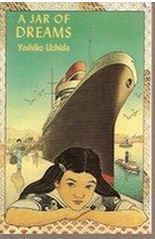
"An ingenious simplicity and grace mark the first-person telling of the story of eleven-year-old Rinko and her Japanese family in Berkeley, California. Times are hard for everyone in 1935, but being Japanese is for Rinko an added burden. . . . Compared with the many worldly-wise contemporary book heroines, Rinko in her guilelessness is genuine and refreshing, and her worries and concerns seem wholly natural, honest and convincing."--The Horn Book.
Yoshiko, born on November 24, 1921, was the second daughter of Japanese immigrant parents Takashi and Iku. Her father worked as a businessman for Mitsui and Company in San Francisco, and Iku wrote poetry, passing along her love of literature to her girls. Though the Great Depression raged, the Uchida family enjoyed comforts because of Takashi's well-paying job and their own frugality. Yoshiko loved to write, and her stories played out on pieces of brown wrapping paper. She also kept a journal to record her thoughts and events.
Enveloped in love and tradition at home, Yoshiko weathered the prejudice she sometimes faced. Many white students at University High School in Oakland didn't invite her to their parties and wouldn't socialize with her, deeming her a foreigner. Even while attending the University of California at Berkley, Yoshiko often faced the same dilemma of being ostracized. She found friendships with other Japanese American students and was preparing to graduate when Pearl Harbor was bombed, changing her life.
The United States government rounded up 120,000 people of Japanese descent and put them into camps. The Uchida family first resided in a horse stall at a racetrack in California, surrounded by barbed wire and armed guards. Though difficult to endure, the next move was worse. Almost 8,000 Japanese were sent to a relocation concentration camp called Topaz in the Utah desert. The detainees suffered from violent dust storms, scorpions, snakes, and exceedingly poor living conditions. Yoshiko taught second grade children there until she received a fellowship from Smith College to earn a master's degree in education.
Yoshiko and her sister both left the camp in May of 1943, with their parents gaining release later that year. Teaching for several years in a Quaker school outside of Philadelphia, Yoshiko decided to quit teaching and find work that allowed more time for writing. She moved to New York City and began as a secretary, penning stories in the evenings. Asked to contribute to a book about Japanese folk tales, Yoshiko discovered that though the book didn't come to be, with time she could create a full collection of folk tales. Writing a few pieces for adults, Yoshiko realized she was better suited for children's books.
A Ford Foundation fellowship sent her to Japan to research the culture and their stories. Spending two years, Yoshiko found her time to be healing as she learned about her own ancestry. The pain of the concentration camps lessened, and she began writing about the experiences in fictional books such as Journey to Topaz and Journey Home. Her career as an author soared as people regarded her as a pioneer in Japanese American children's literature. The author of almost forty works, including Japanese folk tales and stories of Japanese American children making their way in the world, Yoshiko traveled extensively, lectured, and wrote. After suffering from a stroke, Yoshiko passed away on June 25, 1992, in Berkeley, California.
a simple little piece of middle grade historical fiction, set in the 1930s in california. it's about a resilient japanese american family, and it's very hopeful. but i find it unsettling within the larger context of history, since we know the family would likely be stuck in internment camps in the next decade.
a simple little piece of middle grade historical fiction, set in the 1930s in california. it's about a resilient japanese american family, and it feels very hopeful. preteen rinko is a second generation immigrant, and much of the book is about her grappling with her japanese american identity when her aunt comes to visit from japan.
many concepts, such as assimilation and even racism, are clearly alluded to but never referenced by name (which i guess makes sense for a childrens book from the 1980s). there is some talk about the "true self," since kimono-wearing aunt waka feels like someone else when she wears western clothes. meanwhile, rinko's first generation immigrant mom has a chest of her old things from japan, and she says the box also contains her japanese self. presumably this is a version of herself that must be locked away so she will be respected as an american.
the resourceful family is targeted by bigoted people in their neighborhood . but it's all resolved fairly quickly, and finishes off with a bright future for them all. which is unsettling within the larger context of history, since we know the family would likely be stuck in internment camps in the next decade.
A Jar of Dreams is set in the 1930s during The Great Depression. The location is Berkeley, California and our main character is Rinko Tsujimura, an 11- year old Japanese girl that is having a hard time fitting in. Rink does not like her name (she wishes it were easier to pronounce and one that people would remember), and she does not like her hair or her face, the clues that give away her Japanese connection. Rinko wishes she could be just "like everybody else" as she is tired of her classmates teasing her teasing at school and the awful stares she and her family receive from others when she is out in public with her family. The setting is so important for the reader to understand as it explains the treatment Rinko and her family are victims of and defines the issues the family is faced with. Japanese immigrants faced pressure and discrimination within their communities and neighborhoods. Many Americans were resentful of their presence and did not trust them. In addition, many felt threatened by the economic competition from Japanese companies.
The story is centered around a problem Rinko's father is faced with that could financially affect the family. The family is in the process of trying to determine the best way to move forward, when Aunt Waka, Rinko's mother's sister, arrives from Japan, with some wisdom that not only reminds Rinko of the importance of her cultural heritage, but the importance of standing up for what one believes in and pursuing their dreams.
A Jar of Dreams is a middle grade reader, but this book not just for middle readers. In this era, the theme is familiar and the plot is easy for young children to follow. The content is strong and engaging that adult readers will enjoy the storyline. Though Rinko is the main character, and it is expected that she well grow from her experience, there is character development for all the characters in the story. The storyline also demonstrates how one person's action can affect others.
Author Yoshiko Uchida did a great job writing a plot centered around a conflict that affected each character in a unique way. Though the story is told through the eyes of Rinko, who many adults would assume is too young to understand what is going on, it is evident in Rinko's tone that she is very well aware of the social climate and can perceive the hurt and frustration the conflict brings to her family and other members of her community. This makes it easy for the reader to relate and connect with her. The structure of the story is developed and well written.
As a child born in America to parents that immigrated to the United States. I shared many of the feelings Rinko talked about. I can remember as a young child telling my teachers to call me "Dorothy" instead of my name, because my name was the subject of harsh jokes on the school playground. I read this story with my daughter because I wanted her to understand the importance of cultural heritage and identity. This is a good book to use to engage young readers in discussions regarding immigration and stereotypes, especially with what is transpiring in the U.S.as depicted in the media.
I truly recommend this book. Again, it is an easy read- roughly 136 pages. Uchida has two other books that follow Rinko. They sit in my Amazon cart now, ready for purchase.
What a sweet book. Slow in the beginning, but then it picked up and became a winner.
A young Japanese girl named Rinko lives in Berkeley, CA during the depression years of 1935. She is mocked at school, her family is having a hard time making ends meet, people want them to go back home to Japan, they are threatened, and her aunt is coming from Japan to visit them. This is a visit that will change their lives.
This book has a good lesson for children to learn. And I have yet another one to teach: I was talking with a friend that I have known since the 3rd grade, and we graduated from high school together. Well, we were not popular; I was teased like Rinko was, only for different reasons. Those feelings stayed with me many years. My friend and I talked about how we knew which kids in high school were popular, and how we had envied them. Since then several of them have talked with her because they all still live there. They, too, were hurt by other kids. Some had hard home lives. My friend also attends the high school reunions and learns from some of the others that attend, and they told her how badly they were treated by other kids. Some even refuse to go to the reunions because of this, and here it has been 55 years. It was hard to imagine this because, well, they were popular.
Anyway, Rinko is lovely. And if others made friends with her they would find this out, plus they would learn a lot of about a new culture.
Interesting, quick read, not too intense though some very bad things happen some good ones do, too. Not too much focus on school, but rather more on neighbors. Probably especially valuable to children of immigrants who can directly empathize with the need to adapt to a new culture.
( So sad to think that in a few years these people will be sent off to internment camps. )
I was surprised to discover what a lovely story this book contains. The main character is a young girl named Rinko who lives in Berkeley, California with her family and visiting aunt from Japan. Early on in the story it becomes readily apparent how Rinko feels about herself and her Japanese culture. She feels different and wishes that she “could be like everybody else.” She painfully discloses how other children hurt her not only with words—but by talking “over, around and right through me like I was a pane of glass. And that makes me feel like a big nothing.” After I read this dialogue, I was hooked. I wanted to find out how this young girl would fare in a world of prejudice and injustice. The author entices readers with the delightful cuisine of Japanese-American foods, describing them in delicious detail. Since Rinko’s mother was a woman married through the use of a “go-between,” the reader gets many details of Japanese clothing such as kimonos, and learns of their importance. Rinko’s aunt points out to her when she wears a ceremonial kimono that “a part of you will always be Japanese too even if you never wear a kimono again.” Japanese heritage is proudly preserved in this kindhearted, loving family. I would suggest pairing this book with the non-fiction book, Japanese in America because in this novel the characters endure racial slurs and physical violence that occurred before the internment of Japanese Americans during World War II. I would read parts of this book aloud to my high school classes to illustrate several historical themes present during this time period. I think that elementary and middle school students would enjoy reading this book themselves.
I was impressed with the story I found in this book. Before reading it, I wasn't expecting such a dramatic story. Now that it is over, I wish there was a sequel!
Rinko is a young, Japanese girl. She lives in California with her parents and two brothers. There are two important parts of American History that are hurting Rinko's life. First, it's the Depression, and lack of money. Secondly, and more painful to Rinko: it's how the Japanese are hated among people.
This summertime story brings out and shows meaningful changes in Rinko's life, and how she things about the world around her. I really recommend reading this book!
Set in the great depression of the 1930s, A Jar of Dreams is what I term the first book of the Rinko trilogy. Rinko Tsujimura and her parents live in Berkeley California. As any of us who live in an alien country, Rinko wants to fit in school very badly, but her very straight black hair and her black eyes do not help her much. She has a very hard time with her classmates. Rinko wishes she could be just ‘like everybody else’. Her family too is not exempt; they are treated with great disrespect. Her Father runs a barber’s shop which is not thriving, her Mother worries incessantly about bills and feeding four children. When things get bad and money is really tight, Rinko’s Mother decides to start a small Home Laundry, it is now that they face threats from a large laundry service, The Starr Laundry. They threaten Rinko’s family and even kill their pet dog. But the family does not give up.
It is at this time that Aunt Waka comes from Japan to visit the family. Aunt Waka has had her own share of problems; she had been a cripple and lost her husband and son too. But quiet Aunt Waka is extremely resilient, she urges Rinko’s Father Mr.Tsujimura, to face the Starr Laundry owner which they do, they stand up to him and explain that their small home based laundry could never ever be any competition to the Starr Laundry, the very large machine-run-laundry.
The background is extremely important for the reader to understand that Rinko Tsujimura and her family were victims of discrimination because of their background. Americans were resentful of their presence and did not trust them. This was before the Second World War, it must have been worse during the War and soon after it.
A Japanese neighbour tries to get Aunt Waka to marry a Japanese man settled in the United States and is very surprised that Aunt Waka has no desire to live in the United States, she values the culture and traditions of her own country and she is comfortable in her kimono which is her second skin...
The novel a jar of dreams by is about a Japanese went to the United States and lived there, but some Americans did not like them. at first Rinko's father started doing some business, and an American thought he would made more money than they did, so the American started to be very unfriendly to them. Later, rinko's aunt came to visit them and taught rinko and her family to learn to be brave.
At the beginning of the story, Rinko is a Japanese girl living in the United States. Rinko's parents tried to do some business but finally gave up everytime. Rinko's mother opened a laundry, and the laundry often have threats from others. Later, Rinko's family heard that aunt Waka is coming, so they are very much looking forward to it.
In the middle of the story, the Rinko family often meet many bad things because of the laundry business. At first, Rinko's brother's favorite dog was shot and killed by someone's gun. The wall of the house became red because someone painted it. The mailbox have a threatening letter. Rinko's brother even wanted to make money and didn't want to go to college. Rinko's aunt saw it and told Rinko's father to go to the Americans talk to them.
At the end of the story, Rinko's father found the American and said no to them. Rinko's brother returned to college, and his mother's laundry went smoothly. Dad and others opened a repair shop. Aunt Rinko also returned to Japan and welcomed Rinko's family back to Japan to play.
Rinko is a girl 11 years. She moves to California, but She desperately wants to adapt and be like everyone else, but she is laughed at and feels different because she is Japanese. Her aunt come and tell her some japan knowledge, and Rinko knows The importance of Japanese tradition, as well as the value of her own strengths and dreams.
I read this book in 2 day it was such a sweet story! The book is about a Japanese girl named Rinko and her family. The book takes place during the great depression and at that time Japanese would get a lot of hate. The book tells the story of what it feels like to be an immigrant in the US and how people look down on the minorities. So one day Rinkos mom gets a letter from her sister in Japan. Aunt Waka is coming to visit Rinko's family. Aunt Waka's visit changed the lives of every person in the family by giving them the courage to stand up for themselves and be proud of who they are. Basically every time Rinko's family would get insulted they would just ignore and let it go but deep inside they would feel really sad. Aunt Wake came to open the families eyes to what it feels like to follow your dream and be who true to yourself no matter where, when and how.
I believe this is a great multicultural book to read in the classroom because it meets the criteria. It avoids stereotypes, the author is from the same culture, good story telling, accurate to the historical time, include words from the culture, reflects values of cultural group and acknowledges diversity within group.
Final thought: I loved this book, it made me lol and tear up a bit, the message about "importance of an education " and "work hard and your dreams will come true" and "family sticks together though think and thin" its like so many lessons in such a simple book. :)
A Jar of Dreams is written by Yoshiko Uchida. This book is a tale about a little girl that lives in California during the depression. During this time Rinko suffers from being a Japanese girl that just wants to fit in. Due to the events that took place Rinko is ridiculed and made fun of to feel different from her other peers. However she receives a visit from her Aunt from Japan and it taught and explained the importance of her Japanese heritage and background.
This book shows the hardship that an Asian student goes through due to a historical event that they themselves are not part of. The story shows that we need to respect other and their culture and understand and respect where they come from. This book teaches one to know and have pride of one's own culture.
The most obvious theme in this book is discrimination, which is about a Japanese girl gets treated like an outcast in California, People see her as an outcast because of her race. I really do not like this situation to happen because I do not think race is the aspect to think of when you make friends. For me, race is just a characteristic of a person, it does not mean anything, what I mean is also included what race has a higher value in the society or what race is the lower class. I do not understand why people sometimes think they have higher value and others are lower. All of us are human, no one is exactly the same, so why is race so significant while seeing a person?
The novel A Jar Of Dreams by Yoshiko Uchida, tells the life story about Japanese -American girl Rinko Tsujimaru .At the beginning of the story, Rinko was told that her mother's sister -Aunt Waka was coming to visit Rinko's family in America. At the middle of the story, Aunt Waka came with a lot of present and also things to tell Rinko's family .Together they went and show their courage to a racial washing shop which obstruct their business. At the end of the story, Aunt Waka went back to Japan and Rinko finally understand the importance of her Japanese identity. The story tells us wherever you are, whoever you are ,you should never give up you dreams.
I just read this with my 5th graders. A Japanese-American girl learns to take pride in herself and her heritage in a time when immigrants were hated for taking American jobs (has anything changed?). I couldn't help looking around the table at the children reading the book. What a cultural mix we have in our school - children from Turkey, Russia, Mexico, Sudan, Burma, Iraq, Somalia, Native American, South American... (the list goes on and on). Each is unique, each is precious. If only we could see ourselves as we are - priceless children of God.
for me it was one of the best stories that i have read because the same story happen to me i came from El Salvador 3 years ago it was hard for me because to read everything i did not knew anything so i like this story A Jar of Dreams and now i know everything i need to know that is why i like this story.
I love Yoshiko Uchida's book. I read this book twice just because I love her writing and how she discrived the life during WWII. As a Japanese, I respect her and I appreciate she left great stories to next generations.
I am not a middle school literature reader, and this ended up on the pile because of a book club selection. I'm beyond being a young adult (on the other end of the chart), but I will try to answer the discussion questions posed with this book (read in a few hours). This title is deceiving as it is not about A JAR OF DREAMS. Everyone has wishes, dreams, expectations, goals. This book is about a family's growth, courage, sense of place, paths taken.
1. What was your expectation about the book before you read it? Putting wishes in a jar. Of course middle school readers would have as simplistic an expectation. One of the librarians told me it was about the Japanese interment at Topaz, Utah. Not, that occurred in 1942. This book occurs 1935 (Berkeley/Oakland, California).
2. Is this a book you would recommend? Why or why not? Not to an adult. I would to anyone teaching middle school students that do NOT have to explain the history in order to put the book in context. I'd recommend if they had any idea of the restrictions placed on immigrants migrating to the USA in the early part of the century. The Papa in the story speaks of it.
3. Did this book bring out emotions in you? If so what were they? Papa speaks of this as he wishes to become an American citizen if given a chance. The phrase is also mentioned, "it's a country that he loves, but doesn't love him back". This phrase can still be uttered today by many that have served, loved, and been loyal, and yet, their difference, otherness isn't noticed until their service is no longer needed, and they are back with the ordinary citizens they sort to protect, giving them the freedom to be disrespectful and hateful, showing their true self. What emotion did it bring out? Embarrassment. Shame. Sadness.
4. What do you think of the author's writing? The voice narrative/observations of Rinko the 11 year old daughter.
5. Do you have a favorite character from this story? I so which one and why? Aunt Waka. While she is obviously the outsider, and different in every way. She's got great insight because of this. She is seeing both cultures and as an observer she has a unique prospective on what is right, respectful, and dignified. The woman has integrity.
6. Does the setting of the book fit the story? Appears to be a small section of town where children can walk to shops, and yet big enough Papa can drive to the hills and deliver laundry and experience the view of the Pacific. The farm country of Stockton where son Cal picks fruit for the summer (less than 90 minutes away). There is a diverse population (still minorities, always a caste system).
7. How do you think the story would be different if it was set in today's world? That would mean things have changed. They haven't not enough. There is still the little man threatening the power elite...as a result hate spews forth from what they don't know, don't care to understand, and wish to put back into a box. That is a stupid, ignorant question. What rock are we suppose to live under?
8. Is there anything you would change about the story? No. It is what it is. Exposing our bigoted thoughts, ideas, and actions is always best. Best to expose to the young while young enough to change. Old bigots are too set in their ways.
9. What were the primary themes running through this story? Racism. Cultural differences. Assimilation. Arranged marriages. Pride. Courage. Change.
10. Does this book contain hidden messages and lessons? Mama's truck contains her life in Japan. Not to be incorporated in America. Her photos, letters, books, school notebooks, and her Japanese silks, obis, Kimonos. When she closes and puts back she puts back her former life.
Aunt Waka brings all those hidden things with her on her trip to America, and she doesn't feel in her skin when Mama puts western clothes and shoes on her. To assimilate her as they step out in the community.
The uncomfortableness is felt by both. What does still connect them is food and language. Some how food, music, and family tales and smells unite them. It universally unites all immigrants.
There is a courage for all new immigrants that have left behind their country, friends, family, everything that's made them who they are to dare to settle in a new land. One that doesn't always welcome their difference, and their needs for a better life, and the desire to contribute to society to be rewarded with a better, safe, good life.
"It made me really mad, but it also made me feel as though I was no good. I felt ashamed of who I was and wished I could shrink right down and disappear into the sidewalk." - Rinko "And more than anything, I wish I could just be like everybody else."
"Just because you're different from other people doesn't mean you're not as good or that you have to dislike yourself" - Aunt Waka "Rinko, don't ever be ashamed of who you are. Just be the best person you can. Believe in your own worth. And someday I know you'll be able to feel proud of yourself, even the part of you that's different...the part that's Japanese.". Every person could learn from this experience and dealing with prejudice is hard especially as a child. This book could help not only to proud their own heritage but to be mindful and respectful of other people's culture/heritage.
This book name is A Jar Of Dreams by Yoshiko Uchida talk about a girl came out of depression and found her strengths. The character about this book is Rinko. She was born in Japan but now live in America. She has depression and although Rinko want to make friends but in the school no one want to close and talk to her. One day her aunt Waka come. Aunt Waka tells Rinko a lot of good things that are in Japan. Little by little, Rinko come out of depression and find her strengths. The title of the books is A Jar Of Dreams. I think that Rinko’s dreams was imprisoned in the jar, aunt Waka opened the jar, making Rinko’s dream bloom. Waka changes Rinko’s lives.
Rinko is a eleven-year-old girl who lives in California during the Great Depression. Rinko wants to fit in, but no matter how hard she tries she still gets humiliated whenever she goes out of her house. When Rinko's Aunt Waka comes to visit her family, she teaches Rinko about her Japanese Heritage. Aunt Waka managed to change the way Rinko thinks and changed Rinko's perspective of living in America.
I enjoyed this book immensely and I recommend this book to people who like old fashion stories and who are 9 and older.
I read A Jar of Dreams for the Battle of the Books. It is one of 45 books the students will be quizzed on starting in February. This is a beautiful story of a Japanese family that immigrated to the United Stated around 1935. They struggle to make their dreams come true in this new country , they find it hard to be accepted. Both the parents and the children have to be brave enough to stand up for themselves against the bullies in the community and at school. It is an amazing ⭐️⭐️⭐️⭐️⭐️ story and I highly recommend this book.
This is truly a very sweet book. The story of a little girl getting bullied all because she is different, can touch the lives of so many children. Children's books that talk about real life problems that children face are very important. Children need to see that they are not alone in the fight. For girls that are different in anyway, they can use this book to understand that it is okay to be different because no one is the same.
As a Japanese American, I always appreciate reading stories that focus on a Japanese-American experience. Many of those books understandably revolve around WWII, but I appreciated that this one took place in the time period before that. The writing felt a bit stilted and not immersive, and I didn't really feel that the main character's conclusion about the impact of her Aunt Waka was fully earned. I liked the premise but not the execution as much.
Touching historical fiction that will give young readers much to ponder and talk about. Younger readers will benefit from a heads-up regarding the historical setting (especially some of the derogatory language used), the prejudices and cruelty. A wonderful tale about accepting and celebrating who you are are and where you come from.
Read this book because there was a quote from it in "Simple Abundance, a Daybook of Comfort and Joy. "Sunday is sort of like a piece of bright golden brocade lying in a pile of white muslin weekdays."
I liked the imagery created in that sentence, I also like the concept of setting aside a personal sabbath.
This book is call “A jar of dream” by Yoshio Uchida. This book talked about a girl from India lives in California. At first, she is very not gregarious, school mates always say bad things to her. But after, when her aunt come, she learned about many inelegant and become much better.
This is a wonderful story about a Japanese family making a firm stand against prejudice in the early 1900s. I love how the Aunt touches their lives, reminding them to be proud of who they are and not to let anyone walk over them.