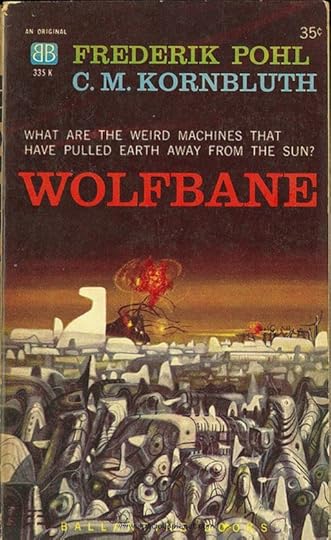
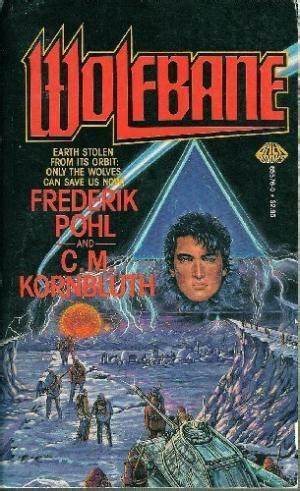
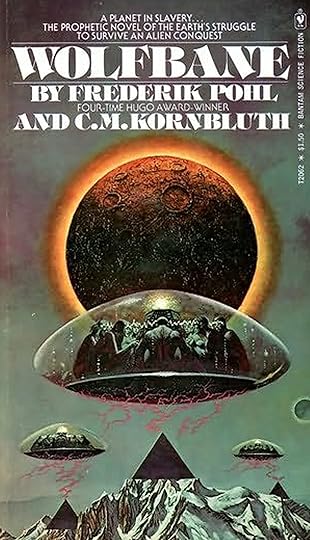
Ballantine's second paperback printing. Something of a minor sf classic, by the heralded team of Pohl and Kornbluth. First serialized in Galaxy Science Fiction, October and November 1957. The Earth has been torn away from the Sun, kidnapped by a runaway planet , whose inhabitants - enigmatic, utterly alien Pyramids - have their own plans for Earth's resources. And humankind, depending for warmth on a constantly renewed but woefully inadequate Moon, wracked by hunger and ruled by a slavish conformity to tradition, is dying out. But there are those who defy convention and refuse to give in. Feared and persecuted by the ordinary citizens, these 'Wolves' are preparing to fight back against the Pyramids.
Frederik George Pohl, Jr. was an American science fiction writer, editor and fan, with a career spanning over seventy years. From about 1959 until 1969, Pohl edited Galaxy magazine and its sister magazine IF winning the Hugo for IF three years in a row. His writing also won him three Hugos and multiple Nebula Awards. He became a Nebula Grand Master in 1993.
The Earth is a prisoner in the cold dungeons of deepest space . . the human race barely survivies beneath the pale artificial sun that is now its only source of heat and light and life . . one man still fights the awful domination of the Pyramids - a fugitive escaped from execution, a dead man with a living super-brain . . a wolf in sheep's clothing.
On Meditation and its unknown danger It was the time appropriate to meditation on the properties of connectivity. Citizen Germyn was skilled in meditation, even for a banker; it was a grace in which he had schooled himself since earliest childhood.
Citizen Germyn, his young face composed, his slim body erect as he sat, but in no way tense or straining, successfully blanked out, one after another, all of the external sounds and sights and feelings that interfered with proper meditation. His mind was very nearly vacant except of one central problem: Connectivity.
Over his head and behind, out of sight, the cold air of the room seemed to thicken and form a blob; a blob of air. . . .
There was a name for those blobs of air; they had been seen before; they were a known fact of existence in Wheeling and in all the world. They were recognized as something associated with meditation on connectivity. They came. They hovered. Then they went away...and often did not go away alone.
If someone had been in the room with Citizen Germyn to look at it, he would have seen a distortion, a twisting of what was behind the blob, like flawed glass, a lens; like an eye. And they were called Eye.
Germyn meditated...
The blob of air grew and slowly moved. A vagrant current that spun out from it caught a fragment of paper and whirled it to the floor; Germyn stirred; the blob retreated as his meditation, for a moment, was disturbed.
Germyn, all unaware, disciplined his thoughts to disregard the interruption, to return to the central problem of connectivity. The blob hovered...
The old world drifts away and a new sun is created In a week astronomers knew something was happening. In a month the old Sun was perceptibly farther away, tinier, less warming. There was panic about that—added to all the other panics that swept the globe.
Then the Moon sprang into flame.
That was a problem in nomenclature, too. What do you call a Moon when it becomes a Sun? It did, though. Just in time, for already the parent Sol was visibly more distant, and in a few years it was only one other star among many.
When the inferior little sun was burned to a clinker they—whoever “they” were, for men saw only the one Pyramid—would hang a new one in the sky; it happened every five clock-years, more or less. It was the same old moon-turned-sun; but it burned out, and the fires needed to be rekindled. The first of these suns had looked down on an Earthly population of ten billion. As the sequence of suns waxed and waned there were changes; climatic fluctuation; all but immeasurable differences in the quantity and kind of radiation from the new source.
The changes were such that the forty-fifth such sun looked down on a shrinking human race that could not muster up a hundred million.
War on the planet of the Pyramids More of the quiescent machinery that littered the bleak planetscape stirred. From under a battery of dead, abandoned electrolysis cells crawled the primary food-main repair machines. They had not been in hiding. They were universal environment equipment; it did not matter where they waited until summoned by pressure drops in the main and the breaking of circuits built into the main’s fabric. They had done their last job an earth-century ago, the meteorite-hole repairs to the riser. They had waited nearby since then and when the lead cells of a chlorine-factory complex wore out, the repair machines had suffered the cells to be dumped on them by disposal machinery. They could dig out on signal, and the signal had come.
There were about one hundred of them. They resembled hugely oversized tank-dozers to which had been fitted a variety of material handling accessories: extensible cranes, pairs of hands, lift forks. They were not fighting machines, but by the nature of their mission they were built to survive natural damage and bull their way through to the injured mains against any conceivable opposition by earthquake, meteor, flood or lashing broken electric cable.
But not by man.
. . . “Give me that damned thing,” Gala Tropile said, wrenched the rocket launcher from him and shouldered it inexpertly.
“My God, be careful!” Germyn screamed. “They’re atomics!”
“I know,” she said shortly. She steadied the fore-end of the tube on a hummock, got her sight-picture, and put her finger on the button. A woman who had stood foolishly in line behind her and caught the rocket’s exhaust blast clapped her hands to her burnt-away shoulder and collapsed, writhing. Nobody paid the slightest attention to her; their eyes were only for the little fireball that streaked into the leading repair machine and turned it into a big fireball. A red-purple mushroom cloud leaped into being above it, but before the cap formed Gala Tropile was snapping at Germyn: “Load! Load!”
Hard science fiction from the Golden Age by two of the leading writers
This is the third Pohl and Kornbluth collaboration novel I've read thus far. It was much better than "Search the Sky" yet not as good as "The Space Merchants". It's a cool abduction story - the whole planet is abducted, in fact. It is a well put together story and well worth the time - this may vary depending on which version you read, there are three: a two part magazine version (1957) and two expanded book versions, an extra 20 000 words by Kornbluth for the 1959 publication and then one more revision by Pohl sometime in the 80's (I might be wrong about this - please correct me if so) I listened to the LibriVox version which clocks in at just under four hours, so I will assume this was the magazine version. I will try and seek out the last version and compare.
Update: Yes, the 1959 version does much to improve upon the original magazine edition. Especially in the second third. Much more development with characterization and the crucial action during concluding segment. You get a good sense of what Kornbluth might have evolved into as a writer had he lived long enough to develop his career. This, expansion of Wolfbane, as I understand it, was his final work.
Every now and then I like to re-read an SF classic, and there are rarely safer hands to be in than those of Pohl and Kornbluth. I was surprised as I got into it that I couldn't remember a thing about this book - I suspect it's because despite featuring a number of 'adventure' scenes, it is so cerebral. And that is a limitation - but its one that reflects a daring and impressive piece of writing.
Wolfbane starts with what seems to be a fairly straightforward 'rebel in a straight laced society of the future' storyline, with the 'What's in it for me?' main character Glenn Tropile getting in trouble in a society where everything is buttressed by ritual and formality - but that's just the beginning. We get an Earth that has been ripped away from the solar system, just about kept alive by the Moon, recreated as a sunlet every few years. And we have some of the most enigmatic and alien aliens I've come across, pyramids that rarely move and that harvest people to use as components in their technology.
There is drama here, when Tropile is threatened with death by having his spinal fluid drunk - and when the main characters are taken to the aliens' base and attempt to win back control of their world and lives - yet even that battle for survival has a strangely detached character, in part because, by now, some of those people have ceased to be truly human.
So don't pick this book up if you want a page turner or beautifully crafted characterisation, but as a science fiction novel of ideas, despite its inevitably dated feel - the original version dates back to 1959 - it is up there with the best. Writer and SF enthusiast Edmund Crispin comments on the back that it combines 'Pohl's sensibility and Kornbluth's ruthlessness' - I'd say that Kornbluth had the upper hand if that's the case, as this one of the purest and most ruthless pieces of science fiction writing I've ever encountered.
The Earth is crushed in the implacable grip of... um, I can't quite remember. Giant killer robots from outer space, I believe, but I could be mistaken. Anyway, people are being strongly encouraged to understand that Resistance is Futile and concentrate on spiritual things instead.
The hero initially buys into this mindset, and meekly accepts his fate. He does this Zen-like exercise where he watches water boil and tries to observe all the Eight Boiling Stages, becoming one with the water and all that shit. But then he's contacted by the Resistance and things change radically for him.
The rest of the novel is pretty good, and the way the Resistance fights the alien tyrants is much more imaginative than is usual for this kind of book, but I recall the early part better. I often think of it when waiting for a saucepan of water to boil.
This novel is a collaboration between C.M. Kornbluth and Frederik Pohl, and is an expanded version of a Galaxy magazine story from 1957. It's an odd story, and to me has much more the ring of Kornbluth's style than the other collaborative novels of theirs I've read, which I thought were more infused with Pohl's touch. It opens in the unlikely setting of Wheeling, West Virginia, and we have a bit of cosmic pinball like Space:1999 before it gets really stranger and we see a reality reminiscent of The Matrix. It's a neat idea story, but a little short of character development or even good dialog. It's a short, interesting read, but not their best work.
Plot summary: We pick up the scene a few years after Earth has been pulled out of the solar system by a rogue planet. It's determined that some intelligence was behind the deed, as evidenced by the appearance of enigmatic mobile Pyramids, which have set up shop at several places around Earth and are impervious to mankind's weapons. To provide heat, the Pyramids towed the moon along and are burning it in a controlled way to act as a "mini-sun" - but it must be re-lit every five years. Most of earth can't survive on such little heat and the population has dropped to 100 million. Those that do live subsist on only 1,000 calories a day, which means (according to a Maslow's Hierarchy-like equation promulgated by the book) that mankind loses nearly all its culture and economic activity. Society is split into two groups: a meek majority (sheep) and a fiesty minority like the old US military 'hawks' (wolves). One man, Glenn Tropile, leaves his wife and his sheep tribe and approaches the Wolf pack to take on the Pyramids. They are a formidable enemy, but the wolves do put an end to their control and figure out how to reverse the propulsion, getting en route back to their own Sun.
I won't go into the what's and how's of the way in which they defeat the pyramids, because there's really a deeper point here. It's as much about how controllable people are. The book shows how a single-being can harness humanity's mob-mentality. The first time it's done, humanity is turned upon itself in order to enforce the status quo. The second time, this phenomenon is used by Glenn and the wolves to destroy the alien forces in their own backyard.
Comments: Throughout this fanciful book, we are met with wild notions, some mechanical and some metaphysical. They are probably what make the book so great, because they're all crammed into one story. The authors definitely do this at the expense of developing characters, but I don't mind that. It's a novel of ideas and concepts, like 'what would happen if man borrowed alient technology to create a snowflake-shaped group mind?' In that case, something very cool is done and it's written very convincingly. I'll hold this book up as a classic example of speculative fiction; that's what really has me praising it.
What didn't I like? Well I'll confess that I found the last 20 pages confusing. I think humans hobbled the pyramids' power before they shot them and that's why they succeeded like never before, but that's almost the only fuzziness in an otherwise clearly written work. Oh, and by the way, explaining the title, the bane that keeps Glenn from becoming 100% wolf...is his spouse.
This entire review has been hidden because of spoilers.
The Earth has been ripped from the Solar System by a rogue planet. Humanity is in decline and anyone who exhibits any sense of selfishness is branded a wolf and executed for the good of the citizens. Meanwhile, a network of pyramids and all seeing eyes monitor the planet and occasionally "translate" citizens, removing them by some strange technology from the world. When a wolf is translated, he leads a war against the Eyes to liberate all the people.
Kornbluth and Pohl have written an interesting piece which echoes Clarke's "The Sentinel" by having a pyramid send a signal when humanity had evolved to a certain level and presages 'The Matrix', where humanity becomes a cog in a giant machine. Well worth a read, even if the characters are somewhat corny.
Based on the publication year, I'd guess this started out as something of a critique of communism or socialism (in this case, illustrating that there will always be selfish wolves doing whatever they can to exploit the mass of cooperative sheep). It kinda goes in a different Orwellian direction but mostly it goes ultra weird, into all kinds of novel SF turf that seems decades ahead of its time. Elements of The Matrix, Lord of the Flies, William Gibson, rogue AIs. In 1957! And just 140 pages. Wild.
It's maybe a little too weird really, sacrificing some readability and storytelling for effect. I liked it though. I maybe understood it.
After being utterly blown away the last time I read a collaboration between these authors, The Space Merchants, I had high hopes for this book. However, where that book felt timeless and avoided so many of the pitfalls that befell many of its comtemporaries, this feels like it was very much written in the period in which it was (late 50's), sharing many of the weaknesses so prevalent in SF at that time.
There are undoubtedly many interesting ideas touched upon here but the way they were delivered lets it down. At only 160 pages, this is a short novel and it felt rushed. The story doesn't progress, it lurches from one part to the next. The characters are flat and uninteresting. The points the authors were trying to make were garbled and confusing.
I don't mean to sound too negative but this is all about expectations and I know these writers were capable of so much better. Perhaps I'm also becoming less tolerant of poorly written SF now as well?
Really, I would have given this three and a half stars. It is well written but a bit dated. All S.F. is really about the present day and this book takes place on an Earth that has been conquered and enslaved. Society is run on a kind of half-Japanese Zen culture (very formal, with rituals and meditation) and half Totalitarian indoctrination (China / Russia) - so a kind of mash-up of the societies that Americans found alien.
Our hero is a rebel and the tale follows his expulsion from the society and... well, I won't spoil it, but it's a good story.
Quite a weird little book, expanded from a 1957 Galaxy Magazine story. My copy was the 1976 Bantam edition, which my 10-month-old puppy actually shredded. She ripped the crap out of it, but thankfully all the pages I hadn't read yet were (mostly) intact so I was able to finish the book, though in a state of shocking disrepair. Aside from that the book was a little dated in the tech and a lot dated in the gender roles, but something tells me it was a significant inspiration behind The Matrix. The similarities are striking.
Starting off in a typical late-fifties alternative human society, this becomes truly odd, evoking an alienness like little other sf. For me its always stood apart even from the pairs' other novels together as strange and special. Though the denouement, okay in itself, becomes more conventional I'm always left appreciating the astonishing and brutal alien vision of this last novelistic collaboration of Pohl and Kornbluth.
This very short sci-fi novel was written in the mid-50s and first appeared in Galaxy magazine. While the novel has been somewhat expanded over the magazine version, it still only totals 140 pages. I cite this number because Pohl and Kornbluth try to cover a lot of ground in detailing the liberation of the planet Earth from a rogue planet that has created a dyadic bond and moved Earth far beyond the solar system. After 250 years, the human population has fallen to 10 million, and a culture of austerity, submissiveness, and mysticism prevails. To the tiny minority who come to be known as wolves, the rest of the 9.9 million are sheep. In contrast to the decorous and resigned behavior of the majority, the wolves are competitive and wish to retake control of the planet. The sole sign of the beings who’ve taken the Earth is a pyramid lodged on the flattened peak of a mountain in the Himalayas.
Pohl and Kornbluth drop us in the middle of things by focusing on a single character, Glenn Tropile, who lives among the sheep, but on the fringes. When his behavior rises to the level of Wolf, he is condemned to die, escapes, and is taken in by the planet’s only Wolf community, hidden and unknown to the rest of the world. Tropile is translated to the second planet, installed as a switching component in an elaborate array of flesh and blood circuitry that controls the planet’s systems, all at the behest of the seven remaining tetrahedral beings that inhabit the planet. Tropile somehow wakes to his unconscious role as one of eight humans plugged into his particular circuit, and after he becomes aware that he is sharing all their dormant thoughts, he wakes them one by one. This is probably the most intriguing part of the novel, how Tropile and the other seven are used as component circuitry, the totality of their brainpower increased exponentially. By continuing to comply with their routine switching tasks, they work sub rosa to translate more humans to the planet, though not as components. The hundreds of humans lurk like mice amidst the machinery of the planet, able to feed comfortably due to Tropile and his cohorts.
The free, mice-like humans are given enough instruction to know that they are to destroy the pyramid’s mechanical lifelines, and they do so, finally freeing Tropile and his companions from their tethered existence. Even as everyone celebrates their liberation from the master planet, and they begin to make plans to somehow move Earth back to its rightful place, Tropile is suffering pangs of loss, regretting the dissolution of the group mind that had given him and the others of his octal group so much intelligence.
The novel’s economy proves useful in sketching out several fascinating ideas, and the same sketchiness also serves to mask difficulties of exposition/explanation that would be necessary if the story had been more fully developed. While the abduction of Earth from the solar system is itself pretty spectacular, it’s the vignettes that describe the sheep society and the vivid, poetic descriptions of Tropile’s mental expansion that are most compelling. Also interesting to consider is how the pyramid’s translation of humans, an infrequent event, is considered by the sheep a spiritual, meditative goal attained only by the most virtuous. This underhanded irony is surely Kornbluth’s invention, a sardonic implication that people are willing to subscribe to any blandishment in the face of the unknown.
This story had a very intriguing premise and was jammed pack with sections on meditation, genocide, and biochemistry. My imagination was captured with this story, even when sections showed up that became hard to picture. This will be worth revisiting at some point. I definitely want to check out more from both of these authors. I’ll also never think of Mount Everest without imagining eight sentient and hungry pyramids terrorizing humanity!
The premise for this book is one of the most original I've encountered. Heck, I wouldn't think of it myself if I was given a task to think of SF premises for a hundred years.
It's also short and to the point, which gives it the fourth star all on its own. Given its length, it's reasonable that the characters really aren't very interesting (or well rounded) and that the some parts seem a bit rushed. Still, it's worth the (little) time it takes to read.
This being a '59 book translated in '80, the language feels antiquated, but this somehow fits the old-school feel.
This novel originally appeared as a serial in the magazine GALAXY SCIENCE FICTION. It is quite original for its time, and the plot premise is thoroughly modern:
An advanced alien civilization called "the Pyramids" has invaded the Solar System, and has stolen Planet Earth - and all of humanity with it.
Hundreds of years into the future, a remnant of humanity survives on a runaway Earth that is warmed by a tiny artificial sun -- still under occupation by the mysterious aliens. Life is harsh, and the inscrutable, apparently invincible Pyramids regularly abduct humans - for some unknown purpose...
The protagonist Glenn Propyle, a rebel in his own society, is also abducted. He finds himself in a very strange situation where he must redefine his identity -- both as an individual and a human being.
In some ways, WOLFBANE is an early novel about Transhumanism. This is entertaining "highbrow" SF -- deceptively accessible and easy to read, but actually rather sophisticated. It has also aged fairly well, considering when it was written.
WOLFBANE has probably inspired later novels and stories about humanity under occupation by aliens and/or machines. (One scene in particular strongly reminded me about THE MATRIX.)
Highly recommended for SF readers who may have missed out on this classic novel.
(See also, by the same authors: THE SPACE MERCHANTS.)
Summary The Earth has been captured, the Moon turned into a makeshift sun, and the whole system driven into space. From a partner world, mysterious Pyramids control everything. With resources low, humans have become quiet, unassuming, their interaction ritualized and efficient. Except for the Wolves - humans who refuse to follow the rules.
Review Wolfbane is a bit of a dry read - I always felt a bit distant from the characters, and the plot a bit of an intellectual exercise. Despite that, the story works fairly well, and it is interesting intellectually - how Glenn Tropile goes from nervously acknowledged Citizen to publicly denounced Wolf.
The technology of the whole thing doesn't bear much looking into, nor does the resolution. But the process for getting there, and Tropile's drive to succeed, are what keep the book moving.
The gender relations are interesting but uneven. Tropile is an acknowledged manipulator intent on breaking the conforming spirit of his wife. Yet she sticks with him, in an ending flourish that feels a bit tacked on.
All in all, worthwhile for a quick, moderately thoughtful read.
I wanted to like this novel because I've enjoyed everything else I've read by Kornbluth and Pohl. The first part was a little hard to get into as it shows weird behavior of future citizens before explaining it. This gets a lot better when it starts following the "wolf" character - someone who doesn't conform, and escapes persecution to seek more of his own kind. In the second half of the book, taking place on the world of alien invaders, I just don't like the style: Page after page of narrative, rarely broken by dialogue, describing machinery and it's functions. This goes on for most of the book and to me reads like a gadget story from a 1930s pulp. However, there are numerous interesting ideas crammed in there, certainly enough to make it worth reading to anyone interested in science fiction or just exploring new thoughts and ideas. If you like those 1930s gadget stories, you'll probably love this one.
I read this classic book many, many, years ago in Dutch translation when I was a teenager and fond of science fiction. At the time I thought it was the best SF book I ever read. When I discovered that the original version was still available I couldn't wait rereading it. The Dutch translation, in Meulenhoff's famous SF series, was entitled "Wolfsklauw", but a more correct translation would have been "Wolvengif" (Monnikskap), as it is the wolf poison impersonated by the main character, Glenn Tropile, that is crucial in conquering the vicious alien pyramids that have hijacked the earth. The pyramids have made a mistake in recruiting a wolf like Tropile as a component in their matrix: he destroys them from within. In rereading the book I felt the same tension and wonder although the simple and curt style of writing disappointed me.
The Earth has been torn away from the Sun, kidnapped by a runaway planet , whose inhabitants - enigmatic, utterly alien Pyramids - have their own plans for Earth's resources. And humankind, depending for warmth on a constantly renewed but woefully inadequate Moon, wracked by hunger and ruled by a slavish conformity to tradition, is dying out. But there are those who defy convention and refuse to give in. Feared and persecuted by the ordinary citizens, these 'Wolves' are preparing to fight back against the Pyramids.
One of the things I love about sci-fi is the way it incorporates themes of the time of writing taken to a logical futuristic conclusion. The idea of calories, and caloric counting, as a sociological backbone, runs throughout this in a curiously interesting fashion. The fairly detached storytelling, which shifts and drifts about our world, another world, and through various narrators' eyes, is pleasingly generic, and there's enough originality and quirk, especially in the final few pages, to make this a very satisfying trawl for a wet weekend.
Plenty of people have mentioned the plot so I won't repeat it. This was the first SF book I ever read. I read it in about 1969. I was only about 11 or 12. My brother had the book and I probably read it because it was fairly short and I liked the cover. I have no memory of it from then. I have sought it for some time to read again. When I found it I couldn't put it down. It is masterly SF of a kind you seldom find these days. I cannot fault it. Even its small size is perfect. I'm getting pretty sick of these huge tomes SF and fantasy authors seem compelled to write these days.
A very complex little book. What originally appeared to be a couple of hour read (140 pages) got all complicated and jumbled. Mostly you were trying to figure out what was being referenced by a society that had been destroyed 2 centuries earlier when the Earth and moon were ripped from their orbit by another planet and hurled into the cosmos. Don't try to read this one tired, you'll get lost by page 10.
An enjoyable enough book which looks at conforming and rebellion within the context of a human race under the control of a strange alien pyramid. seemingly attaining a higher level leads to humans being taken from the earthly realm and from this point the book starts to take on a more complex nature. So brimming with ideas was it that at points it did start to lose me..however I did get snared back in and do feel that for all this was a challenging read it was a satisfying one.
Not my favorite Pohl--maybe a 3 1/2. It's an interesting premise, but the story is too disjointed to have the desired impact. Pohl and Kornbluth's natural writing talent salvages the whole thing. If you're looking for a 'We' or '1984' read alike, this'll do.
At times this book was fun and interesting, mainly in the middle section, but the opening and closing third of the book are so dull and uninteresting. The climax was a slog to read through because the writing is so bland and over bloated.