Jump to ratings and reviews
Rate this book

The Night Ocean (Fantasy and Horror Classics): With a Dedication by George Henry Weiss

Rate this book
This early work by H. P. Lovecraft was originally published in 1936. Born in 1890 in Rhode Island, USA, Lovecraft began writing at a very young age, quickly developing a deep and abiding interest in science. In 1913, Lovecraft joined the UAPA (United Amateur Press Association) but it was four years later, in 1917, that he began to focus on fiction, producing such well-known early stories as 'Dagon' and 'A Reminiscence of Dr. Samuel Johnson'. However, it was during the last decade of his life that Lovecraft produced his most notable works, such as 'the Dunwich Horror' and 'The Call of Cthulhu' which subsequently earned him his place as one of the most influential horror writers of the 20th century. Many of the earliest books, particularly those dating back to the 1900's and before, are now extremely scarce and increasingly expensive. We are republishing these classic works in affordable, high quality, modern editions.

34 pages, Paperback

First published January 1, 1936

12 people are currently reading
308 people want to read

About the author

H.P. Lovecraft

6,482 books19.5k followers
Howard Phillips Lovecraft, of Providence, Rhode Island, was an American author of horror, fantasy and science fiction.

Lovecraft's major inspiration and invention was cosmic horror: life is incomprehensible to human minds and the universe is fundamentally alien. Those who genuinely reason, like his protagonists, gamble with sanity. Lovecraft has developed a cult following for his Cthulhu Mythos, a series of loosely interconnected fictions featuring a pantheon of human-nullifying entities, as well as the Necronomicon, a fictional grimoire of magical rites and forbidden lore. His works were deeply pessimistic and cynical, challenging the values of the Enlightenment, Romanticism and Christianity. Lovecraft's protagonists usually achieve the mirror-opposite of traditional gnosis and mysticism by momentarily glimpsing the horror of ultimate reality.

Although Lovecraft's readership was limited during his life, his reputation has grown over the decades. He is now commonly regarded as one of the most influential horror writers of the 20th Century, exerting widespread and indirect influence, and frequently compared to Edgar Allan Poe.
See also Howard Phillips Lovecraft.

Wikipedia

Ratings & Reviews

What do you think?
Rate this book

Friends & Following

Create a free account to discover what your friends think of this book!

Community Reviews

5 stars
69 (19%)
4 stars
113 (31%)
3 stars
109 (30%)
2 stars
50 (14%)
1 star
16 (4%)
Displaying 1 - 30 of 48 reviews
Profile Image for spillingthematcha.
740 reviews1,158 followers
September 20, 2021
Przeraża i fascynuje mnie to jak pisze Lovecraft, jaką wprowadza atmosferę od pierwszych stron. Czytanie tej historii nad morzem, w nocy, było złym pomysłem, bo mam wrażenie, jakbym to ja była bohaterem.
Profile Image for ᴥ Irena ᴥ.
1,654 reviews246 followers
February 14, 2017
by H. P. Lovecraft and R. H. Barlow

A story of an artist who comes a remote village to wait for the results of an artistic contest. Right away he tells you something weird happens to him but he admits that it 'may have grown solely from the mental constitution' caused by loneliness.
People drown in the village, he sees strange things on the shore from his window. And near the end he even sees something he fears might be a man or something like a man. The reader is never told what exactly the narrator saw.
Read this only when you are in the good mood. Otherwise it has a suffocating effect.
Profile Image for Doug H.
286 reviews
March 14, 2017
I liked this moody meditation on loneliness. New research indicates this was actually written by Robert Barlow (a 16 year old prodigy) with only a couple of sentences added or changed by Lovecraft. The author's penchant for elevated language and big vocabulary words as well as the psychological approach to the story (are the events real or just happening in his imagination?) reminded me a lot of The Willows. Gothic creepiness.
Profile Image for Netanella.
4,804 reviews50 followers
March 22, 2026
I was engulfed by a piteous lethargic fear of some ineluctable doom which would be, I felt, the completed hate of the peering stars and of the black enormous waves that hoped to clasp my bones within them—the vengeance of all the indifferent, horrendous majesty of the night ocean.

I picked this up because one of my GR groups is reading Paul La Farge's The Night Ocean, and I wanted to read its predecessor first, a short story written by a young prodigy, Robert Barlow, and then edited by H.P. Lovecraft.

I have a thing for the dense, purple prose of Lovecraft and his scions, so reading story felt oddly like coming back home to a good HPL tale. There's not a lot that really happens here, and there's a complete lack of dialogue - if this had been made into a movie, then the silent films of the 1930s would have fit it perfectly.

An artist rents a lone cottage on a secluded beach near an itty bitty tourist town, where he stays most of the year to await the results of an art contest. Over that time, as he swims and beachcombs, he finds a strange, small metal ball engraved with fish symbols and seaweed, learns that several people have drowned, finds a human hand in the flotsam of the shoreline, and finally, thinks he sees strange humanoid creatures rising and walking out of the sea.

Our unnamed narrator is certainly glad when the results of the contest are announced and he hightails it out of there! After all, the creepy dread that comes with the confluence of sea, land, and sky on this desolate shoreline surely turned his stay into a claustrophobic and cloying nightmare.

...but in that brief evening hour when the sun left a gore-splattered decline and darkness lumbered on like an expanding shapeless blot, there was an alien presence about the place: a spirit, a mood, an impression that came from the surging wind, the gigantic sky, and that sea which drooled blackening waves upon a beach grown abruptly strange.

Profile Image for Peter.
374 reviews36 followers
January 4, 2022
An arrogant young aesthete takes a seaside holiday in a lone house far away from the ”disturbing clamour” of the local resort, “where raddled puppets performed their summer antics.” He enjoys sunshine and solitary swimming…but since Lovecraft is co-author, this doesn’t last much more than a paragraph or two.

The young man appears to have rented the House on the Borderland between earth, sky, and sea and, being an aesthete “always susceptible to morbid emotions”, the night and the ocean become vast, ancient, and monstrous.

The prose turns so thickly purple it could be eaten with cream. But it sometimes works. I particularly liked “ the sea which drooled blackening waves upon the beach” and the concept of the ocean having “an alien air, as if something too vast to have shape were lurking in the universe to which [it] is a door.” The final vision of a “dying world” where “silent, flabby things will toss and roll along empty shores” while “the sea will thunder through the dismal night” is quite stirring, even if Wells had already taken us there.

There are enough adjectives in this short story to fill half a dozen more conventional works - but that’s Lovecraft’s trademark style. It is undoubtedly cloying, but without it you’d miss the occasional sentence where it comes close to hitting the mark…where you look into “the indifferent, horrendous majesty of the night ocean” and almost glimpse the abyss.
Profile Image for Cora Pop.
Author 6 books65 followers
November 30, 2019
Ah, my beloved ocean... As always not a story, only a vignette, a glimpse into a deeper level of reality that leaves us uneasy and yearning for more... And fabulous descriptions:

"...but in that brief evening hour when the sun left a gore-splattered decline and darkness lumbered on like an expanding shapeless blot, there was an alien presence about the place: a spirit, a mood, an impression that came from the surging wind, the gigantic sky, and that sea which drooled blackening waves upon a beach grown abruptly strange."

It is noticeable that Robert H. Barlow is the author here rather than H. P. Lovecraft, and I'm only saying this in a good way. I was not familiar with him or his work before reading this. A very intriguing character...
Profile Image for Jerry Jose.
379 reviews62 followers
March 21, 2017
What if the artist in this story is Pickman himself (from Pickman's Model) and “The Night Ocean” is his super-weird origin story ?

Weird, verbose and moribund. Might as well be a throw back to the elder legends in Shadows over Innsmouth. Actually Lovecraft and Barlow, in their effort to alienate all hopes of understanding the mystery, have alienated the readers from reading itself.
December 18, 2019
Wordsworth Editions
London 2010.
A very atmospheric and smooth language. The most "high literature" text of Lovecratf that I have ever read. It is cowritten with this guy Barlow, I do not know who was more important for this text.
It is very introspective so in that way it has a proustian vibe in it.
Modernistic to the maximum!
The content of a loner who resides in a cottage near the sea reminds me of this cool film: https://www.imdb.com/title/tt7984734/. The freudian subtext and the open ending of the film are lame but the vernacular, footage and acting are very nice.
Read it!
P.S.
To my Udbaland readers one note.
Soon I will publish a review of the first book of Summa Contra Gentiles, I am writing it now.
It will probably be my best review so far because it is the first time that I am writing a review for a couple of days in a Word document.
¡Hasta luego!
Profile Image for Marco.
1,267 reviews58 followers
November 20, 2016
Lovecraft and Robert Barlow were close, and co-wrote many stories together until Howard's death (he committed suicide when a [deplorable] student threatened to out him as gay). This is considered one of their best.
The tones are definitely different from a standard Lovecraft's story: a lot is hinted, very little is seen here. The story did not age well though, the pace is too slow for modern readers (well, at least for me).
Profile Image for Tom.
718 reviews41 followers
January 31, 2018
An ode to the strangeness of the ocean and the first hintings of the sinister dwellers beneath the waves explored in Lovecraft’s Cthulhu Mythos stories.
Profile Image for Alaíde Ventura.
Author 6 books1,673 followers
July 25, 2020
Me encantó este libro y eso que no soy fan de Lovecraft.

(Pero ahora estoy leyendo aquí mismo en Goodreads que no lo escribió él sino un adolescente prodigio, Robert Barlow, mmm, a lo mejor por eso).
3,517 reviews46 followers
January 21, 2022
This tale was too lugubrious for me.
Profile Image for حسام.
694 reviews22 followers
October 21, 2024
فكرة جميلة لكن اقرب للتلميح منها لقصة ..
Profile Image for Mary Overton.
Author 1 book60 followers
Read
March 18, 2020
The Lovecraftian universe:
The narrator finds on the beach "a small object like a hand .... indeed a piece of rotten flesh.... Certainly, no fish, or part of one, could assume that look, and I thought I saw mushy fingers wed in decay." He is "sickened by the presence of such an object amidst the apparent beauty of the clean beach, though it was horribly typical of the indifference of death in a nature which mingles rottenness with beauty, and perhaps loves the former more.... I was ridden by a feeling which was not of fear or despair, or anything akin to these, but was rather a perception of the brief hideousness and underlying filth of life... I felt, in brief agonies of disillusionment, the gigantic blackness of this overwhelming universe, in which my days and the days of my race were as nothing to the shattered stars; a universe in which each action is vain and even the emotion of grief a wasted thing."
Profile Image for James Hold.
Author 153 books42 followers
September 19, 2018
The Night Ocean, by HP Lovecraft and RH Barlow
Are we sure this is Lovecraft? It's so different. Lovecraft, generally a writer of all things dark and mysterious, here pens an ode to sun and ocean, the joys of swimming and collecting flotsam. Really, that's it. The unnamed narrator occasionally feels the tug of darker forces from the mysterious depths, but there is so little of it. If chiefly reflects on man's insignificance compared to that of the ageless ocean. I've no idea who RH Barlow is but he must have had a great hand in turning Lovecraft's POV away from the dark realms of elder gods and to look at and appreciate nature for what it is.

Profile Image for Typhon.
15 reviews
January 29, 2019
Together with The Colour out of Space and one or two others, this is one of the literary summits of Lovecraft's career.
In this collaboration with Barlow, the writing is more atmospheric and subdued, to great effect. Instead of telling the reader in actually non-equivocal terms that there is something unspeakable about, the horror here is completely unspoken and indeed might be purely psychological. This suggestive approach lends itself to a greater literary ambiguity and the result is a masterpiece of sinister and depressive atmosphere, along with a meditation on the loneliness of a creative artist.
Profile Image for Sarah.
519 reviews23 followers
July 13, 2012
Mood piece about an artist who spends some time in a small cabin by the ocean. Behaves sensibly for once (which is a distinct change for a Lovecraft character) and thus avoids all entanglements with true horror.
Profile Image for Sohail.
473 reviews14 followers
March 20, 2016
Extremely boring, and quite pointless. Not recommended to anyone.
Profile Image for Morgan Heckerd.
83 reviews1 follower
September 25, 2024
The writing was gorgeous, but the plot and narrator failed to capture my interest. Might read passages with my students as examples of detailed description of setting and mood.
Profile Image for Keith.
997 reviews12 followers
June 3, 2022
Lovecraft #104 of 104: The Night Ocean (with R.H. Barlow)

“Now that I am trying to tell what I saw I am conscious of a thousand maddening limitations. Things seen by the inward sight, like those flashing visions which come as we drift into the blankness of sleep, are more vivid and meaningful to us in that form than when we have sought to weld them with reality. Set a pen to a dream, and the colour drains from it. The ink with which we write seems diluted with something holding too much of reality, and we find that after all we cannot delineate the incredible memory.”


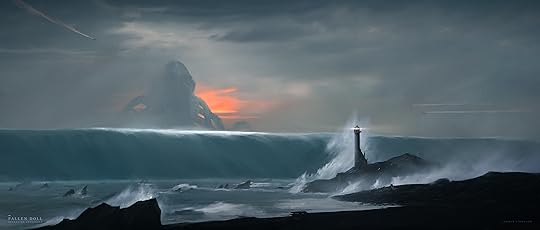
[Disrupted Tides by Roman Likholob]

The Night Ocean is a beautifully written horror tale that is focused on atmosphere over plot. It is filled with poignancy because it is the last story that H.P. Lovecraft (1890-1937) ever had anything to do with.

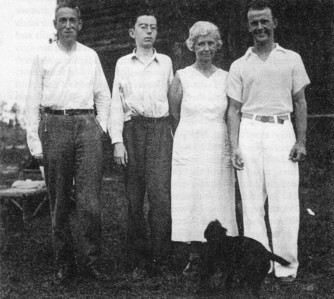
[Circa June 1935: Lovecraft in Florida with Robert H. Barlow, along with Barlow’s relatives Mrs. Bernice Barlow and Wayne Barlow.]

The Night Ocean was a collaboration with HPL's younger friend R.H. Barlow (1918-1951). I have been reading all of Lovecraft’s fictional works in chronological order this year to see his development as a writer. In fact, it appears that Barlow wrote most of the plot and prose, with Lovecraft revising the language throughout but, according to Joshi & Schultz (2001), “contributing perhaps less than 10% to the overall story” (p. 189). In the last decade of his life, HPL spent a great deal of time and effort supporting other writers, including younger authors. Even if little of the story was actually written by HPL, Derie (2021) makes clear that“‘The Night Ocean’ is Barlow at his most Lovecraftian.” The story never goes into the Cthulhu Mythos, with perhaps some oblique references to The Shadow Out of Time, nor does he refer to any other subject matter that HPL delved into. Barlow does reproduce “the atmosphere and themes of Lovecraft, tries to capture and express the cosmicism—perhaps in homage to his mentor, perhaps as a reflection to how much of an influence Lovecraft had on him” (para. 10).

Joshi & Shcultz (2001) describe The Night Ocean as a “finely atmospheric weird tale” (p. 189), coming close to “capturing the essential spirit of the weird” (p. 189) as HPL conceived of it. In his introduction of the second edition of Lovecraft’s great literary essay Supernatural Horror in Literature, Joshi (2012) stated that to HPL these are “the aesthetic foundations” (para. 17) of well-written horror fiction: “the importance of ‘atmosphere,’ the cosmic point of view, the superiority of impressions and images over ‘mere mechanics of plot’” (para. 17). In chapter 10 of the essay itself, Lovecraft praises stories of Algernon Blackwood in which plot “is everywhere negligible, and atmosphere reigns untrammeled” (para. 12). Indeed, there is not much action in The Night Ocean, but it does evoke a palpable mood of melancholy and dread that is powerful. Lovecraft praised Barlow’s efforts in letters before his own untimely death in March 1937. HPL was only 46.

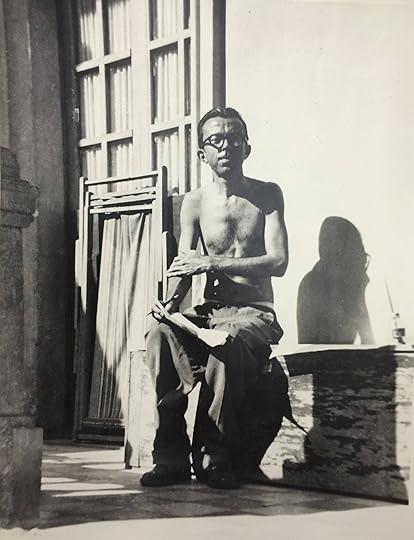
[Photograph of R.H. Barlow]

Lovecraft assigned the 18-year-old Barlow to be his literary executor, perhaps because Barlow was kind enough to type many of HPL’s stories, thus preserving them for posterity. He also donated many manuscripts to the John Hay Library at Brown University in Lovecraft’s hometown of Providence, Rhode Island. Le Farge (2017) in an article for the New Yorker notes that the honor of being named HPL’s literary executor turned out to be a “disaster” (para. 9) for the poor young Barlow. Two of Lovecraft’s older proteges August Derleth and Donald Wandrei wanted the honor for themselves, doing much to destroy Barlow’s reputation. The young man became
exiled from the literary universe that had been the focus of his life. He thought about killing himself, but instead he went into anthropology, enrolling at schools in California and Mexico before ending up at Berkeley, where he studied under Alfred L. Kroeber, whose work with Ishi, the last of California’s Yahi Indians, had made him famous. In 1943, Barlow moved to Mexico and began a period of furious activity that lasted for the better part of a decade. He traveled to the Yucatán to study the Mayans, and to western Guerrero, where he studied the Tepuztecs. He taught anthropology at Mexico City College, founded two scholarly journals, and published around a hundred and fifty articles, pamphlets, and books. (La Farge, 2017, para. 10).

Barlow even went on to be a professor to the future beat poet William S. Burroughs (1914-1997), although they apparently were never very close . After Barlow apparently committed suicide in January 1951, the future author of Junkie wrote:
A queer Professor from K.C., Mo., head of the Anthropology dept. here at M.C.C. where I collect my $75 per month, knocked himself off a few days ago with overdose of goof balls. Vomit all over the bed,” he wrote, in a letter to Allen Ginsberg. “I can’t see this suicide kick,” he added. (La Farge, 2017, para. 17).

Barlow is largely forgotten today, but he certainly deserves credit for helping to keep Lovecraft’s writings in existence, along with having an interesting life in his own life. He was homosexual in a world that was extraordinarily homophobic, and this likely led to his suicide at tragically young age of 32. As La Farge (2017) writes, “Barlow’s story reminds us that there is just as much wonder, and horror, in the damaged world [writers] leave behind” (para. 18).

Derleth and Wandrei went on to publish collections of Lovecraft stories, and they deserve our gratitude too for keeping the author’s work in the public imagination, even if they were unnecessarily competitive with Barlow.

Well, this is the end. I have finished writing reviews of all 104 surviving stories that Lovecraft worked on. It has certainly made me appreciate his work more. It has also inspired me to continue to read weird fiction. I have also changed my mind about short stories as a medium. They are distinct from longer works such as novels and feature-length screenplays. Plot and structure are not absolutely necessary to a great short story.

Title: The Night Ocean
Author: R.H. Barlow with H.P. Lovecraft
Dates: Summer or Autumn 1936 (written), Winter 1936 (first published)
Genre: Fiction - Novelette*, prose poem
Word count: 9,840 words*
Date(s) read: 5/26/22-5/27/22
Reading journal entry #167 in 2022

Sources:
Link to the story: https://hplovecraft.com/writings/fict...

First publication citation: The Californian vol. 4, no. 3 (Winter 1936): [41]–56.

Derie, B. (2021, June 5). “The night ocean” (1936) by R. H. Barlow with H. P. Lovecraft. Deep Cuts in a Lovecraftian Vein. https://deepcuts.blog/2021/06/05/the-...

Lovecraft, H. P., & Joshi, S. T. (2012). The annotated supernatural horror in literature (second edition). Hippocampus Press. https://www.hplovecraft.com/writings/...

Joshi, S. T., & Schultz, D. E. (2001). An H.P. Lovecraft Encyclopedia. Greenwood Press.

Pillsworth, A.M., & Emrys, R. (2016, August 3). Maybe rethink that trip to the beach: Lovecraft & Barlow’s “night ocean.” TOR.COM. https://www.tor.com/2016/08/03/maybe-...

La Farge, P. (2017, March 9). The complicated friendship of H. P. Lovecraft and Robert Barlow, one of his biggest fans. The New Yorker. https://www.newyorker.com/books/page-...

Links to the images:
https://www.artstation.com/artwork/yJ...

https://www.hplovecraft.com/life/gall...

https://www.newyorker.com/books/page-...

*The difference between a short story, novelette, novella, and a novel: https://owlcation.com/humanities/Diff...

Vignette, prose poem, flash fiction: 53 - 1,000 words
Short Stories: 1,000 - 7,500
Novelettes: 7,500 - 17,000
Novellas: 17,000 - 40,000
Novels: 40,000 + words


Review written on 6/3/22
Profile Image for Anne.
1,180 reviews12 followers
June 4, 2017
I feel like I should put that I read this three times because I had to read most paragraphs that many times before the content sank in. I mean, there was much to potentially like but it just failed so hard in execution. Essentially, there was too much description and too little action for my poor little brain to really take it all in. Even if much of the description happened to be delightfully (almost) creepy.

At one point I was wondering if this was CSI: Ellston Beach as the character attempted to diagnose the horror he found on the beach. But after a thorough rolling of my eyes, I remembered this was published long before forensic science really became a thing. So, yeah, he totally diagnosed that just fine... for the times.

Not sure why I'm giving this three stars, except maybe for the memories it evoked of my own recent awesome beach vacation (that had super old timey trees and creepy botanical gardens to liven things up even more). And hopefully I'll be able to pick up and read that other Night Ocean book that relates to this. Ha! (not likely)
Profile Image for Larry.
801 reviews2 followers
December 11, 2020
This is very short, barely novella-length. The moody protagonist comes to the seashore on vacation. What starts as a time of rest and healing from his recent overwork turns ominous and dark as the season turns. He's a solitary figure, an artist with a rich inner life who looks down on the petty amusements of 'normal' people. His aloofness from human society leaves him lonely. Being untethered from everyday concerns makes him vulnerable to dramatic mood swings and experiences that are perhaps hallucinatory.

There are two frightening incidents which leave him badly shaken, and he departs, a broken man.

Update: I have read this before, in The Loved Dead and Other Revisions. It seemed slightly familiar, but I couldn't place it.
Profile Image for Israeliano.
127 reviews1 follower
March 29, 2024
In this story, mostly written by Barlow with a few corrections and additions by Lovecraft, nothing much really happens. It is, I think mostly a story about the mood of the main character, maybe a reflection of the mood of the author, who knows?

While no Mythos's god is being invoked and no researcher going mad, the general sense of dread, of being so unimportant, to be surrounded by forces we cannot comprehend and which really don't care if we do it at all, is so perfectly put, that I couldn't but be capture by the whole story.

As I said at the beginning: nothing really much happens, but the narrator says it so well, that this cannot be anything but a must read.
Profile Image for Filbi.
80 reviews
December 28, 2024
A breath of fresh air after reading Medusa's Coil. More of a mood piece, or even a prose poem, than a horror story, though it connects thematically (if not textually) with The Shadow Over Innsmouth. (Are those shadowy figures in the surf deep ones? We'll never know.) Revised by Lovecraft, the outline was devised by Robert H. Barlow, a teenager at the time, and though HPL was probably unaware that Barlow was gay, the story's exquisite loneliness speaks to a sense of alienation inherent in queerness.
Profile Image for Oleksandr Fediienko.
665 reviews76 followers
June 8, 2019
Перекладаючи це оповідання, я переклав кожну піщинку-слово з пляжу біля Еллстона на уявний пляж в своїй голові. Яке ж щастя, що Лавкрафт знайшов цього самородка Роберта Барлоу. Цей підліток згодував нам натяки так тонко, як це не вдавалося впертому королю жахів. Він створив настільки химерну атмосферу, що текст обійшовся майже без сюжету, цей твір читається радше як картина. Багато про "Нічний океан" написали тут: https://www.instagram.com/explore/tag...
Profile Image for LucianTaylor.
195 reviews
May 16, 2019
My all time favorite Lovecraft short story. What beautiful mysterious and awe and reverence inspiring vision on the Ocean and the insignificance of mankind compared to the scales of time and space regarding the cosmos.
Displaying 1 - 30 of 48 reviews