Elderly Miss Ophelia, the prompter in a failed theater, collects shadows that do not belong to anyone and teaches them to perform the greatest comedies and tragedies of the world.
Michael Andreas Helmuth Ende was a German writer of fantasy and children's literature. He was the son of the surrealist painter Edgar Ende.
Ende was one of the most popular and famous German authors of the 20th century, mostly due to the enormous success of his children's books. However, Ende was not strictly a children’s author, as he also wrote books for adults. Ende claimed, "It is for this child in me, and in all of us, that I tell my stories," and that "[my books are] for any child between 80 and 8 years" (qtd. Senick 95, 97). Ende’s writing could be described as a surreal mixture of reality and fantasy. The reader is often invited to take a more interactive role in the story, and the worlds in his books often mirror our reality, using fantasy to bring light to the problems of an increasingly technological modern society.
Ende was also known as a proponent of economic reform, and claimed to have had the concept of aging money in mind when writing Momo. He was interested in and influenced by anthroposophy.
Die unendliche Geschichte (The Neverending Story) is Ende's best known work. Other books include Momo and Jim Knopf und Lukas der Lokomotivführer (Jim Button and Luke the Engine Driver). Michael Ende's works have been translated into more than 40 languages and sold more than 20 million copies, and have been adapted into motion pictures, stage plays, operas and audio books.
With his 1989 picture book Ophelias Schattentheater (which is titled as Ophelia's Shadow Theatre in its English language translation by the late Anthea Bell and which I have not yet read) German author Michael Ende (of course most renowned for Die unendliche Geschichte, for The Neverending Story) presents a pretty densely and intricately worded, rather mature with regard to thematics and contents featured storyline. And thus, while I do (with an admittedly majorly biased opinion) think and have always thought since first encountering Ophelias Schattentehater in the late 1990s during a longer sojourn in Germany to both visit family and also do research for my PhD dissertation that Ende has most definitely beautifully and delightfully created and made bloom a lastingly sweet and hugely emotionally satisfying (although sometimes also a bit exquisitely painful and heart wrenching) textual gem with Ophelia's Schatttentheater, the above mentioned wordiness and occasional thematic heaviness certainly makes Ophelias Schattentehater most suitable for older children above the age of eight or so onwards (but with the caveat that readers or listeners must be both willing and also able to handle that Ophelias Schattentheater openly presents and approaches topics such as being unwanted, poverty, death and also what comes or might come after death, sensitively, sweetly and empathetically penned and shown by Michael Ende to be sure, but yes, there is no way to deny it that death and other rather philosophical and even potentially religious questions are definitely an important and continuous theme in Ophelias Schattentheater).
So with a voice too soft and not verbally strong enough to be an actress, the rather shy and retiring main protagonist of Ophelias Schattentheater (and whose parents named her Ophelia after the character in William Shakespeare’s Hamlet) has instead become the main (and also the only) prompter in her town's theatre, committing to memory the world’s greatest dramas and working very happily and with much joy and personal fulfilment at this career (and yes, although Michael Ende does not ever really specifically state in Ophelia’s Schattentheater just how essential and necessary prompters are for theatrical productions, this certainly and clearly is gloriously shown throughout the entirety of Ende’s story). But when the theatre is forced to close due to financial woes and a lack of attendance, Ophelia (bereft, getting older, jobless, but first and foremost mourning the loss of her one joy, since being a prompter at the theatre was her all and everything), she encounters one of the world's unwanted shadows (named Schattenhelm) in the shuttered theatre and gives him a home, and with Miss Ophelia soon making friends with and taking in more and more unattached shadows and also teaching them her beloved plays. When an increase in rent causes Ophelia to get evicted from her lodgings and to become despondent and not knowing what to do next, how to proceed, her collected shadows as a group come to the rescue of their benefactress by performing the dramatic works she has taught them as shadow puppets to and for paying and adoring, appreciative audiences, with the fame of Ophelia's Shadow Theatre growing and growing (and both Miss Ophelia and her shadows being very happy, they as performers and because Ophelia has given them a home and her friendship and Ophelia because once again she is able to pursue her career as prompter during the shadows’ performances). And when finally, at the end of Ophelias Schattentheater a now very elderly and increasingly physically fragile Ophelia is approached by one last shadow seeking a home (namely death), Ophelia readily and without fear takes him in and soon meets all of her dear shadows again at the gates of heaven and where in what is now called Ophelias Lichtbühne (Ophelia’s Theatre of Light) they perform for the angels (and with Ophelia of course and wonderfully still acting as prompter to her group of abandoned and found/claimed shadows even in the afterlife, even in heaven).
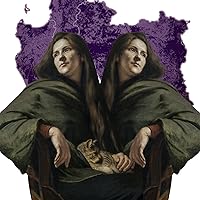
Finally, just to most definitely say that for me Ophelias Schattentheater is solidly and totally five stars, on my favourites shelf and as such also highly recommended, not to mention that I also do expect to hopefully equally enjoy Ophelia’s Shadow Theatre and Anthea Bell’s translation once my recently ordered copy arrives. So yes indeed, Michael Ende has with Ophelias Schattentheater truly penned and crafted an absolutely superb story where good triumphs, where artistry and humanity reign supreme and where the essence of Miss Ophelia’s fragility is wonderfully textually combined with her will to endure and her desire to extend her friendship to every unattached and abandoned shadow (even death) with simple and delightfully moving words. And wow, Friedrich Hechelmann's mystical paintings, they are an aesthetically magical visual joy in and of themselves, with their colourful esoteric loveliness radiating emotion and magnificently both mirroring and also expanding on Ende’s words. And honestly, when I claim that Hechelmann’s artwork in general and not just his illustrations for Ophelias Schattentheater very strongly remind me of German Romanticism artist Caspar David Friedrich, well, that is the highest praise possible from me (considering that the latter, that Caspar David Friedrich is one of my absolutely favourite visual artists, period).
EDITED TO ADD ON MARCH 23, 2024
And the English language translation by Anthea Bell of Michael Ende's Ophelias Schattentheater (titled Ophelia's Shadow Theatre), it is totally and utterly marvellous, showing thematically and content wise pretty much and wonderfully exactly what Michael Ende presents in his German original, in Ophelias Schattentheater but also and thankfully NOT sounding like a translation at all but rather like an original story in and of itself (and that yes, Friedrich Hechelmann's illustrations also work just as well with Anthea Bell's rendition, work just as well with Ophelia's Shadow Theatre as they do with Ophelias Schattentheater). Very highly recommended, and yes, if I were to do a separate star rating for Ophelia's Shadow Theatre, my rating would also be solidly five stars, and which does not in fact happen all that often for me with regard to translations, but indeed, how Anthea Bell has rendered Michael Ende's German words into English is simply and utterly glorious and totally makes me smile.
So much beauty hidden in an unusual book... "Ophelia's Shadow Theatre" is exceptional, like a visual poem, like a warm sweet melody which surrounds you gently. I am so glad that i could find a copy.
A lonely woman, her love about theatre and her rich inner world. The shadows... who seek for company and get attached to Ophelia... A little bag full of lonely shadows... The people... who are cruel and find Ophelia weird... The shadow theatre... the shadows perform plays and give Ophelia joy... A journey... which never ends...
The illustration is enchanting...
Πόση ομορφιά μπορεί να κρύβεται μέσα σε ένα βιβλίο... Πώς καταφέρνει πάντα ο Michael Ende να γεμίζει την καρδιά μας με ζεστασιά και να μας κάνει να σκεφτόμαστε διαφορετικά. Δυσκολεύτηκα να βρω το Θέατρο Σκιών της Δεσποινίδας Οφηλίας, όμως άξιζε με το παραπάνω.
Η μοναξιά, η αγάπη, η συντροφικότητα. Μια ηλικιωμένη κυρία που αγαπάει το θέατρο, δουλεύει σε αυτό, αλλά χάνει τη δουλειά της. Οι σκιές που αναζητούν έναν άνθρωπο να τους κάνει παρέα. Μια μικρή τσαντούλα με ένα σωρό σκιές μέσα της. Οι άνθρωποι που βρίσκουν την Οφηλία πολύ παράξενη... Το θέατρο σκιών που δίνει τόση χαρά στη δεσποινίδα Οφηλία... Και ένα ταξίδι... που δεν θα τελειώσει ποτέ... Με εικόνες που σε μαγεύουν...
My latest incursion into a bookshop was not of my own making. I was asked by my mother to get her a book for a little girl's birthday. So, as you see, I'm completely innocent! How was I suppose to know that while looking for a children's book I'd find a book by one of my childhood's most beloved authors? And at such a price! I had to get it. So I left the bookstore with three children's books, and one was for me :D However I must say that Ophelia's Shadow Theater is not really a children's story? It's disguised as one, like Grimm's Faerie Tales nowadays, but it feels like a story for older readers. I quite liked it!
Such a beautiful story! It's the very first Michael Ende book I've ever read, and I'm glad I read it in German straight away. As a big fan of The Neverending Story, I'm now super-curious to tackle his other books. It is indeed heart-warming to know that authors such as Ende, or Moers, still express that magical side of the German psyche that has unfortunately remained hidden from the world's perception for the past century.
Also worthy of notice are Friedrich Hechelmann's illustrations, botg hyper-real and diffused, slightly scary, very dreamy. I don't think I've seen anything quite like it in a children's book.
I read this while visiting the Michael Ende Museum, located in Blutenburg Castle in Munich. I was quite moved by Ophelia's story and her big heart with which she adopts all lost shadows. I was especially moved by the ending though, hen Ophelia dies and meets her shadows again, but in the brightest of lights: heaven.
This entire review has been hidden because of spoilers.
Ich hab echt keine Ahnung, wer die Zielgruppe ist, außer Leute wie ich, die Bilderbücher mit erwachsenen Themen lieben. Aber ich hab auch keine Kinder und muss nicht entscheiden, wie viel ich ihnen zumuten könnte. Ich bin selbst ein Kind der 80er und hätte es wahrscheinlich damals schon geliebt. Das Ende ist mir etwas zu religiös, aber Thema, Sprache und - gosh! - die Bilder!
What an enchanting, hauntingly beautiful story! Delicate like a forgotten shadow fluttering in the wind... A theater of lost shadows adopted by Opehlia, an old lady who used to work as a prompter. A newfound purpose, a rekindled passion, a love for words that goes beyond time and space...