School Library Journal Best Book of the Year NSTA/CBC Outstanding Science Trade Book American Farm Bureau Foundation for Education Recommended Book
Besides being a general and the first president of the United States, did you know that George Washington was also a farmer? Here's a look at America's first President as he's rarely seen.
George Washington was the first leader of our country—but he was also an inventor, scientist, and the most forward-thinking farmer of his time. As he worked to make the new country independent, he also struggled to create a self-sufficient farm at Mount Vernon, Virginia. Excerpts from Washington's writings are featured throughout this nonfiction picture book, which also includes a timeline, resource section, as well as essays on Washington at Mount Vernon and his thoughts on slavery. Both the author and illustrator worked closely with the staff of Mount Vernon Estate & Gardens to render an accurate portrait of Farmer George at work.
Nebraska Farm Bureau Children’s Agriculture Book of the Year Ohio Farm Bureau’s Children’s Book Award A Wisconsin Ag in the Classroom Book of the Year Kansas State Reading Circle Recommended Reading List
Forget war and politics, according to this examination of George Washington’s life, his passion and pursuits were all about agricultural.
And considering the evidence presented, you really wonder when on earth he had time for any of his national work, considering he seems to have spent so much time doing botany experiments. It’s all interesting, yes, but acts as an odd counterpoint to all the events going on his life.
And of course there is the elephant in the room of slavery, addressed in an author’s note at the end, who argues that Washington thought ending slavery would tear apart the “fragile nation” (making the US sound like an ugly little hairless baby bird, IMO) and, she tells us, reaching for something positive, at least he freed some of his slaves when he died, which no other slave owning president did… so there’s that. Um, yay?
A fascinating look at a side of our first president that I knew nothing about. He composted, invented a more efficient plow, designed a 16-sided barn for threshing wheat, strived to make Mount Vernon self-sufficient (or at least not dependent on Britain), and "thought a lot about manure, too."
In April 1794, while serving as president, he wrote in his journal that "Nothing is more wanting in this Country, than a thorough knowledge of [manuring]."
I love that this book uses quotes from Washington's journals, and shows how he was at heart a farmer thoughout his life. It made me want to visit Mount Vernon and see the trees that he planted.
This book just really touched me because it showed the outstanding character of George Washington by focusing on his dedication to his farm and not on the war or his Presidency. It showed that he cared just as much about the small "unimportant" things of life as he did about the big things.
I really enjoyed reading this to my younger kids, and I think they enjoyed it too. While it does cover the American Revolution and the presidency, it focuses a lot on Washington's interest in farming. It discusses improvements he made in plowing and other farming methods, how he did experiments and learned about soil improvements, some of his animals, etc. There is a map of Mount Vernon, a timeline of his life in the back, and quotes from his writings throughout, which I found interesting. The illustrations are well done. There is also a brief discussion about his views concerning slavery at the end of the book, which I appreciated. I thought it was handled well and could be followed up with additional discussion if desired. There are slaves pictured working throughout the book, so questions about the subject are likely to arise naturally in readers' minds long before the end. You could flip to that section if it comes up. The book has more text than many picture books, but it is fairly typical of some other picture book biographies we've read. It could be read in one sitting if your children have enough attention span, but we used it for school and stretched it out. I had the kids narrate from shorter readings. It worked well for this. It's a lovely addition to our library that is likely to be revisited and enjoyed in other contexts as well.
[Edited to add: I just discovered that the author has a website with ideas for educators to use with her books. How nice! Mentioning here in case others would like to know before they read. I got to her site by linking to her Goodreads Author page, where she has a website link.]
This was used as a Read Aloud for ages 5-13. I found it flowed well when I was reading and it kept the interest of my boys, for the most part. I would not have read it if it was just for the youngest, it is probably best for ages 7+ unless your younger child likes hearing about History.
I really liked the approach of looking at George Washington's life through the view of his love of farming. It was nice to hear of his interests instead of just the facts of wars and his presidency. I also really liked that they included snippets from his journal and letters. The back few pages had some background information that I did not read aloud. This book would be a wonderful addition to a George Washington Unit Study.
Biography 2nd-5th grade I loved how this book focused on a different aspect of Washington's life-his farm. This was a huge part of his life (as demonstrated through the book) that is rarely mentioned in comparison to his time as general and president. There were so many interesting new facts and I liked how it included some of Washington's own words. It doesn't ignore his time as general and president, but ties them into the theme of planting-in those cases he was planting a nation. However, the majority of the book is focused on his farm and the ideas he had for improving it. I loved this book's unique description of Washington's life and think this would be a great way to introduce a different side of the first president to children.
This biography takes us through the life of George Washington from his younger years all the way up to his death in 1799. It goes through his younger years when he was a farmer to his days as a general onto becoming the first ever president of the the United States of America. The book mainly focuses the theme towards Washington's farming days and what he does after his presidency.
I would recommend this to older readers who have to do a project on George Washington as it contains materials important for knowing the life Washington led. Though this is not something I can in good conscious advise a young reader to take a look at for fun.
Loved this book on George Washington's true love--his home of Mount Vernon & the many ways he improved farming, his interesting & clever inventions, complete with quotes from his diaries. An interesting note is the way the author described her visit to Mount Vernon while researching the book--I had the same exact feelings she did while sitting on his veranda & gazing out over the Potomac. Great book.
Beautiful illustrations and a lot of information I didn't know about George Washington as a farmer and inventor. I kept thinking of George Washington Carver as I read about how Pres. Washington sought to really understand soil and how best to grow things. He did so much in his life, I can't even begin to comprehend farming that much land. Very informative, an enjoyable read.
I absolutely loved the detail given in this book about George Washington's accomplishments in the Agriculture Industry. However, I don't recommend it for grades lower than 3rd because of the in depth detail and paragraphs.
This book would be excellent to read before heading to Mount Vernon. I loved the focus on a lesser-known aspect of George Washington's life. Nearly every page had direct quotations from George Washington. Yay for primary sources.
This was a great introduction to George Washington, with details that I didn't even know. I enjoyed reading about how much George Washington enjoyed his farms at Mount Vernon.
When I think of George Washington, my first thoughts are of his presidency, my second thoughts of him as a general in the Contintental Army, and my third thoughts are about his teeth. Fourth comes questions about his hair, fifth about his cherry tree chopping, and sixth about why he has to share a birthday with Abraham Lincoln. Pretty far down the list, you get "George Washington was a farmer." Some of that has been rearranged by Peggy Thomas' 2008 picture book, Farmer George Plants a Nation.
In the hardcover book with beautifully painted illustrations by Layne Johnson, we get to see George Washington in a role that seems unusual from our perspective: as a farmer at Mount Vernon. I visited Mount Vernon for the first time two years ago, and loved the experience. The book begins with George at the age of 27, fresh off of the French and Indian War. He takes over Mount Vernon, and sees immediately that changes need to be made to make the plantation successful. He orders books from England, seeds from around the world, and begins experimenting. Really, the book could just as easily be called "George Washington, Inventor," because his inventions and innovations transformed Mount Vernon. He invented a new plow that would "automatically" plant seeds as the harrows turned the soil. He experimented with raised seed beds and "square foot gardening." He encouraged the use of mules instead of horses or donkeys, changing the way farmers used animals in the country. One of his most interesting inventions was the building of a treading barn that would use horses to separate the wheat grains from the stalks. A sixteen-sided barn with two levels, it wasn't entirely successful, but was a fascinating experiment.
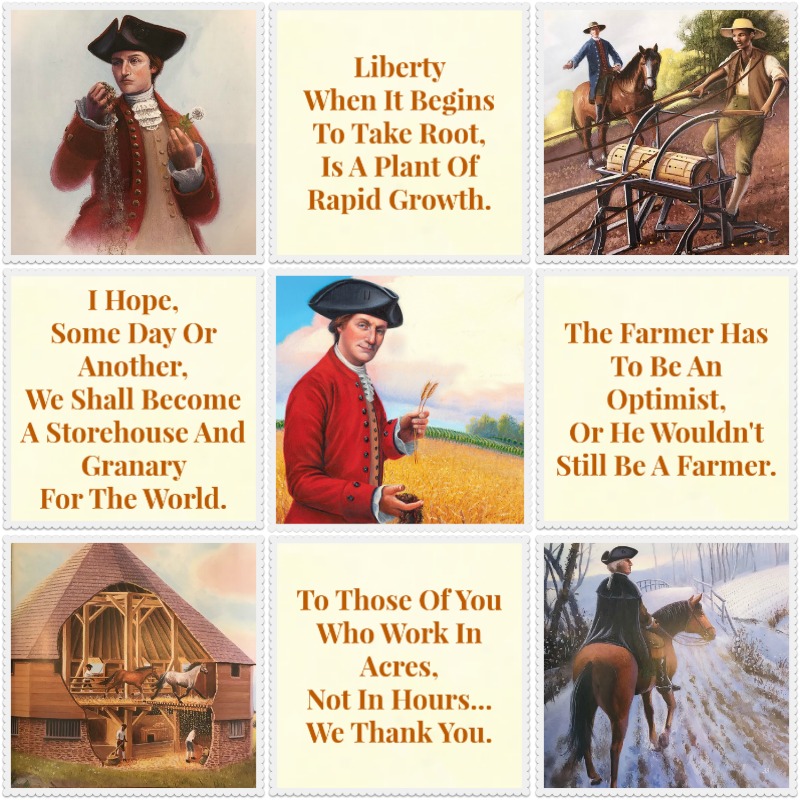
Interspersed with the stories about his farming are the major events of George Washington's life, including his role as general in the Revolutionary War and his years as president. Even in the midst of the most trying times of his career, Washington's thoughts turn back to Mount Vernon, and he keeps careful track of what's happening at home. Eventually he's able to return back to the farm, and his ingenuity and hard work has paid off. Quotes from Washington's letters and journals are in dark red script throughout the book, and relate to either his own farm or to agriculture in this new country. Some are simple questions about how things are going at the farm while he's away, others are more loosely related to the farm, but with a bigger vision: "Liberty, when it begins to take root, is a plant of rapid growth."
The oil paintings are bright and richly detailed, with views of Mount Vernon that reminded me of my short visit there. Watching Washington as a giant of a man, aging through the years as farmer, general and president is nice, but the pastoral scenes around him are beautiful. Johnson does a good job of showing us how George's inventions work and change Mount Vernon, and bring Washington to life beyond his appearance on the dollar bill.
The book did surprise me, in that it depicts the slaves that Washington held. Usually books like that this that are meant to build up our Founding Fathers as heroes shy away from that issue. It only uses the word "slave" once, but African Americans are shown as the real workers on the plantation on almost every page. It's not excused away, it's simply a fact of life. That could open up a nice discussion about history and slavery with children or students, and it's a good reminder that among the many other things that Washington was, he was also a slaveholder. The author does include a page in the notes at the end of the book, "George's Thoughts on Slavery," that explains his opinion, including a 1786 quote: "I never mean...to possess another slave by purchase; it being among my first wishes to see some plan adopted, by which slavery in this country may be abolished by slow, sure, and imperceptible degrees." Cop-out? Maybe. But he did take steps as a private slave owner to free his slaves upon his death. It's a complicated issue, and it won't be solved here.
The book closes with a timeline and a page of text about George Washington at Mount Vernon, and some recommended reading in books, websites, and a bibliography. Whether you're looking for a book for children or adults, Farmer George Plants a Nation is an impressive look at the father of our country.
Title: Farmer George Plants a Nation Author: Peggy Thomas Illustrator: Layne Johnson Genre: Biography Theme(s): History, George Washington, Farms and Farm Life, United States Opening line/sentence: George Washington dug his hand into the newly tilled earth and let the hard, dry clay crumble through his long fingers. Brief Book Summary: This story goes into depth about how president George Washington not only was an actual farmer of the field, but also the farmer of our country. Throughout this story we read how George Washington planted the seed of freedom, and how he did so. Professional Recommendation/Review #1: With big, lush oil paintings and a detailed text, this picture book for older readers celebrates George Washington s role, not as victorious general and first president, but as lifelong farmer, who learned all he could about agriculture. He planted trees, bred mules, designed a barn, switched from growing tobacco to wheat, and experimented with all kinds of field crops, mixing fertilizers and compost to grow shrubs and vegetables. With quotes from Washington s diary and letters, the hands-on account of the great leader who was also a pioneer farmer will inspire young gardeners. Unfortunately, the idyllic pictures of smiling field hands (who are, of course, slaves) will jar children who know the tragic history and are reading this today. Thomas addresses this in a final note, explaining that Washington believed that slavery was wrong, but kept his concerns to himself. Includes a bibliography and a Mount Vernon Web site. (CLCD) Professional Recommendation/Review #2: (4) K-3 Illustrated by Layne Johnson. Readers may be surprised to learn that George Washington was a dedicated farmer with a fervor for agricultural experimentation. This book uses speculative third-person narration ("George's thoughts were never far from home") and includes excerpts from Washington's letters to help elucidate his enthusiasm. Rich-hued oil paintings (some of which are stiff) and back matter help extend and clarify the text.(Hornbook) Response to Two Professional Reviews: The second review was very interesting to read, because it brought in the aspect about how readers may be surprised that George Washington was an actual farmer too. Most readers know that he was a president, but it is interesting how it brought up that readers will be interested in the fact that he wasn't only a president but also a farmer. I also enjoyed how the first review talked about the illustrations throughout the book. The oil paintings throughout this book are so pretty to look at and I am glad that this review brought that up. Evaluation of Literary Elements: I thought that it was very neat how Peggy Thomas brought in actual quotes from George Washington. Not only did she bring in actual quotes, but also had them displayed in cursive handwriting, which made it seem more real. I also thought that it was interesting and helpful that she put a timeline of Washington, summary of Mount Vernon, and a summary about Washington's thoughts on slavery at the end of the book for readers who wanted more information about George Washington. Consideration of Instructional Application: It would be interesting to use this book to talk about another subject other than the obvious (history). After reading this book the teacher could give each student a pot with soil and a seed, and the students could bury their seeds and see how their plants grow over time. Students could also read this individually and use the information and facts in this book for a book report on George Washington.
This book tells the story of the life of George Washington before, during, and after his presidency. It begins by telling about Washington's life as a farmer in his early years. George Washington found many ways to make crops better by changing the way the seeds were planted and the fertilizer that was used. In June 1775 he left to fight in the American Revolution, not returing to Mount Vernon for eight years. The book goes on to tell about Washington as the first president of the United States and how he kept up on his farming even during the presidency. After being president for eight years, Washington returned to his home in Mount Vernon to continue his work as a farmer. This book provides actual passages from letters and diaries that were written by George Washington. The book helps students to understand who George Washington was outside of being the first president of The United States.
Activities: 1. Jigsaw - Break the class up into three groups and have each group focus on one part of the book. The sections will be George Washinton's life before presidency, during presidency, and after presidency. Have each group create an organized list of facts from their designated section. A couple of members from each group will then join a different groups to tell them what they learned. When students are all completed, each student should have organized lists of each section.
2. KWL chart- Before the book is read have the class work together to create a chart showing what they know about George Washington and what they want to know. After the book is read and discussion has been done, the class can fill in the section on what they learned as a result of reading the book.
Another Children's Book Award nominee from our state. This biography of George Washington concentrates on his farm concerns, just as the title indicates. If you're looking for Valley Forge, you've opened the wrong book. President? He seems to use the position to further his farming interests. He visits each state and quizzes people on their farming. Oh, sure - he does other things: wins that pesky revolutionary war thing and approves laws, but the main story here is the way he coped with taxation without representation. His tobacco crops being overtaxed? Cease to grow tobacco - it sucked the life out of the soil anyway. Cloth from England taxed? Grow your own flax and have your own slaves weave it for you. Being named a general and then elected president probably annoyed him and he wrote home all the time with advice for his farm. All in all, it's a new facet on an old, familiar character, but it's just a facet. Don't expect to read anything about his home life, although there is an addendum on his views on slavery, which he kept pretty much to himself for fear of breaking apart the new union he'd worked so hard (taking him away from his great love, apparently, farming [sorry, Martha!:]) to help create. He had too many left over from tobacco planting, but was loath to sell them and break up any families. He wanted to free all slaves in some subtle fashion over time that would not rile up other slave owners and was, according to this book, the only slave-owning president who freed all his slaves upon his death. No word of what he arranged for them afterward.
I love how sometimes "cluster reading" several books at the same time seems so serendipitous. While reading this book, I was also reading Made from Scratch: Discovering the Pleasures of a Handmade Life by Jenna Woginrich, where in she describes gardening as "peaceful sedition." Well, isn't that was George Washington was doing as he "planted less and less tobacco so he did not have to ship it to England. Instead he grew more and more wheat to sell to other colonists.... Soon Mount Vernon was like a little village." (p. 12)
And I'm also re-reading Food Not Lawns which is allll about gardening as peaceful sedition. Why do I romanticize the idea of rebellion? It just seems to fun!
But on the other hand, sometimes a little "civil disobedience" is called for. Isn't that what the Revolutionary War was all about!?
Most children know George Washington as a president; some know him as a general; but few know him as a farmer. But that is the one occupation that followed him throughout his adult life. When he first came to Mount Vernon, he tried to grow crops that were less dependent on England as the market. This was a time when the colonies were becoming disenchanted with their relationship with the mother country and Washington was eventually called away from Mt. Vernon to lead the American army. He was gone for 8 years, but he continued his oversight of the farm through letters back home. After he returned and then left again upon his election as the first president, he continued his management from afar.
This was a very interesting book with curriculum tie-ins to science, social studies and writing. Many quotes from Washington's journal are sprinkled through the narrative. Several of his experiments to improve plant growth and his inventions are highlighted, also. At the close of the book is a page using more journal excerpts to explore Washington's dislike of the slavery system and his refusal to sell his own slaves because he couldn't bear breaking up families.
This book truly broadened my appreciation for America's first president.
This book focuses on George Washington's agricultural pursuits and the advancements he made in farming. I first learned of them after visiting Mount Vernon, so if you can't visit, this book is a nice alternative. The illustrations of his grounds are pretty accurate.
Ages: 9 - 12
Cleanliness: tobacco fields are mentioned.
**Like my reviews? Then you should follow me! Because I have hundreds more just like this one. With each review, I provide a Cleanliness Report, mentioning any objectionable content I come across so that parents and/or conscientious readers (like me) can determine beforehand whether they want to read a book or not. Content surprises are super annoying, especially when you’re 100+ pages in, so here’s my attempt to help you avoid that!
So Follow or Friend me here on GoodReads! And be sure to check out my bio page to learn a little about me and the Picture Book/Chapter Book Calendars I sell on Etsy!
This is a wonderfully written and beautifully illustrated book that focuses on George Washington's life as a farmer. My 9 year old daughter and I both enjoyed reading about the inventions he made, such as the combo plow & tiller, and the compost tests he conducted in his home garden. We also enjoyed reading the diary excerpts - a nice touch to read his thoughts on farming and Mt. Vernon. The author provides some extras at the back of the book: a timeline, a note about George Washington's thoughts on slavery, information about Mt. Vernon, and a bibliography. We've read a lot about President Washington, especially since we live near Valley Forge, but never really knew this environmentally friendly side of him. While some may be disappointed because it barely touches on issues of politics and slavery, keep in mind that the book is called Farmer George and its intent is to shed light on "Washington's legacy as a founding farmer" (back cover).
This book fills a much neglected niche in how children are introduced to George Washington. We think of him first as the bullet-proof soldier and general and second as the creator of the office of the President of the United States of America. Here we receive a glimpse of him as a farmer. Indeed, this story is full of suggestions for exploring gardening here and now. Like "Farmer George", we can think about improvements to existing tools, use the scientific method of experimenting, keep a journal, share our results and discuss our concerns. I was fascinated to learn of his "improved plow", his "treading barn", his efforts to strengthen his soil by abandoning tobacco as a cash crop, his compost experiments, and much more!
We all know George Washington as the first President of the United States and a great general during the Revolutionary War; what we don't know is that his first love was farming and he was really just a farmer at heart. This picture book biography explores that aspect of Washington's life. It teaches us about how he revolutionized his farm and made it a model for other farmers. It talks about his inventions and innovations in farming. He was really quite a brilliant mind and not just where war is concerned. I enjoyed this look into an aspect of our first president's life that is not often explored.
"I thought this was a lovely book. History was never my strong point, but I loved reading books like "Dear America,"--stories about the daily life of a person in a certain time period. This book was not about George Washington as our first president, but rather as a farmer. I had no idea George Washington was such a passionate farmer (and I've been to Mount Vernon! History just doesn't stick.) In the back of the book, there is a timeline, Washington's thoughts on slavery, and information on learning more about GW. The book has beautiful illustrations & excerpts from GW's diary throughout the story. Quite lovely. "
The illustrations are wonderful, and the story seems spot on accurate! However, I'm not sure who exactly the audience is that Ms Thomas is looking for. Whats the age range? My 2 1/2 year old didn't understand or care about any of it, and I dare say that an 8 year old would not care for it either. In any case, it is a great book, and I hope I someday read it to my daughter when she can follow along and enjoy it as much as I did.
This was a wonderful look at our nation's first president as a farmer. Along with beautiful artwork, this book showcases George's love for experimenting, his ingenuity, and the deep love and care he felt for his land. While most studies of Mr. Washington cover his military service, this book is a wonderful tribute to the man behind the uniform.
This book reveals the farmer in George Washington. Washington was really into farming in a big way. This book outlines just how far he went in his farming pursuits. It's an extremely thorough book. Every sentence seems to be meticulously fact-checked. It also doesn't hide the fact that Washington was a slave owner. It is a very honest portrayal.