The rollicking true story of the legendary writer and editor who ruled over America’s fantasy and supernatural pulp journals in the mid-twentieth century, and shaped today’s UFO and sci-fi cultures: Ray Palmer.
Meet Ray Palmer. A hustler, a trickster, and a visionary. The hunchbacked Palmer, who stood at just over four feet tall, was nevertheless an indomitable force, the ruler of his own bizarre sector of the universe. Armed with only his typewriter, the Palmer changed the world as we know it – jumpstarting the flying saucer craze; frightening hundreds of thousands of Americans with “true” stories of evil denizens of inner earth; and reporting on cover-ups involving extraterrestrials, the paranormal, and secret government agencies.
As editor for the ground-breaking sci-fi magazine Amazing Stories and creator of publications such as Other Worlds, Imagination, Fate, Mystic, Search, Flying Saucers, Hidden World, and Space Age, Palmer pushed the limits and broke new ground in science fiction publishing in the 1940s and 1950s—and was reviled for it by purists who called him “the man who killed science fiction.”
In the first-ever biography devoted to the figure who molded modern geek culture, pulp scholar Fred Nadis paints a vivid portrait of Palmer—a brilliant, charming, and wildly willful iconoclast who helped ignite the UFO craze, convinced Americans of hidden worlds and government cover ups, and championed the occult and paranormal.
Palmer overcame serious physical handicaps to become the most significant editor during the “golden age” of pulp magazines; he rebelled in his own inimitable way against the bland suburban vision of the American Dream; he concocted new literary genres; and he molded our current conspiracy culture decades before The X-Files claimed that the truth was out there.
One of the better biographies I've read in recent years, it's actually the first biography I've ever read about someone I actually knew and met, albeit just in passing.
The Man from Mars details the life and publishing career of early science fiction writer, editor and fan Raymond Palmer. He was a somewhat divisive figure in early science fiction, which really took itself far too seriously for the pulp magazine roots that spawned it. Palmer was an editor for a popular pulp, Amazing Stories, as well as having written (and edited) for the legendary Hugo Gernsback (known as the Father of Science Fiction). He was there almost at the beginning, but is relegated to a much-diminished position in history because of fandom's ire. After being a major proponent of the legendary Shaver Mystery, as well as being (rightly) called "the Man who Created Flying Saucers", there was quite a bit of ostracism leveled toward Palmer. He delved into many new age, occult and "Psi-Fi" topics over the years, all of which were usually derided by the majority of SF fans, who apparently preferred way too much "science" with their "fiction".
This biography is excellent in that it takes no sides, and strives to give a very balanced view of a very interesting individual. It's quite sad that little of his original fiction is readily available today - you have to search hard to find any of his fiction on the internet - considering the man had his own little publishing empire in Amherst, Wisconsin.
One of the major disappointments of my life was not to realize who that little hunchbacked man was, and believing the rumors about him being an angry old nut. I've always been a science fiction aficionado, and into UFology since I was a wee lad. How was I to know that that one of the guys responsible for two things I love doing was in my very backyard?
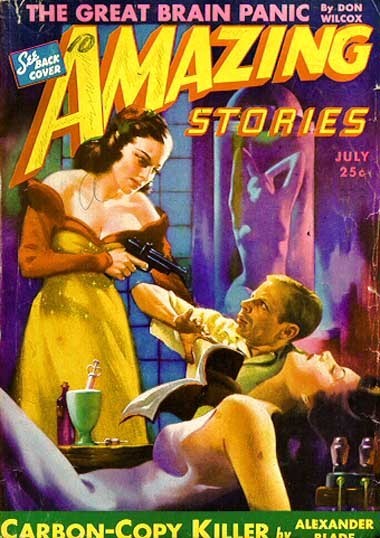
War Hugo Gernsback als Herausgeber der AMAZING STORIES der "Father of Science Fiction" (Gernsback hätte noch von Scientification gesprochen), so wurde Ray Palmer 1937 in der Nachfolge zum "Son of SF", nachdem er sich als Pulp-Autor und vor allem als Begründer des "organized fandom" verdient gemacht hatte. Palmer, 1910 geboren, wurde als 7-Jähriger von einem Lkw erfaßt und war für den Rest seines Lebens verkrüppelt. Später wettete er, der an Selbstheilungskräfte glaubte, mit einem Arzt um 5,- $, dass er entgegen dessen Prognose nicht sterben würde, und gewann. Seine Mutter starb, als er 12 war, sein Vater sprach reichlich dem Alkohol zu. Trotz seiner schwersten gesundheitlichen Beeinträchtigungen arbeitete Palmer auch als Handwerker, bis er sich ganz auf seine Herausgeber- und Schriftstellertätigkeit beschränkte und das Evangelium der SF predigte. Er wuchs in Milwaukee auf, wo "The number of the pulp magazines published there could be counted on the fingers of one sardine" (Robert Bloch), machte aber bei den Fictioneers die Bekanntschaft von Bloch, Weinbaum und Ralph Milne Farley. Letzterem verdankte er es, Herausgeber der AMAZING STORIES zu werden, deren Auflage immer weiter gesunken war. Palmer vertrat einen ganz andere Ansatz als Gernsback, dem das wissenschaftliche Element der SF wichtig gewesen war, und konkurrierte nicht mit John W. Campbell, der mit ASTOUNDING mehr auf anspruchsvolle Stories setzte. Palmer kam von den Pulps und hatte auch "scarlet" stories geschrieben, Stories also, die erotisch-pornographisch waren. Um die Auflage der AS wieder in die Höhe zu treiben, riet er seinen Autoren: "When a story stops moving, that is the exact spot where the writer should drop a corpse through the roof". Der Verzicht auf schriftstellerischen Anspruch und die ausschließliche Fixierung auf Action verärgerte viele der ernsthafteren SF Fans, aber AS wurde wieder eines der größten Magazine. Palmer, der unter vielen Pseudonymen schrieb und Spaß an fiktiven Biographien hatte, ließ sich auf dem Juli-Cover der 1943er Ausgabe von H. W. McCauley als Bösewicht darstellen:
"Palmer and Shaver were ahead of the curve ond cultural paranoia and conspiracy theorizing. Wartime America had had its share of panics, including concerns about children being kidnapped or molested, and of course the threat of a Japanese-American fifth column intent on undermining the war effort. The explosion of the atomic bombs over Hiroshima and Nagasaki did nothing to soothe the public´s nerves. The ensuing Cold War, however, ushered in a golden age of paranoia as sthe United States and Soviet Union splintered the world into zones of influence. Reports of Soviet espionage were on the rise as were concerns with loyalty in the United States and possible Communis infiltration of institutions. In 1947, while Rap was prepping the all-Shaver issue, the House of Un-American Activities Committee´s hearings questioned the loyalty of the screenwriters and directors known as the Hollywood Ten. Similar inquisitions were carried out not only on the federal but the state level and let to shattered careers and boycotts. Soon came additional panics over rock ´n´roll and the link between juvenile delinquency and comic books. As pulp author Hauser had pointed out, who wouldn´t want to crawl back into the "Mother" at a time like this?" Und die unterirdischen Höhlen, von denen Shaver besessen war, waren sie nicht auch eine Metapher für den Mutterleib?
Sehr spannend fand ich das Kapitel über Kenneth Arnolds UFO-Sichtung, die den Mythos UFO begründet hat, vor allem über die Ereignisse, die sich der Sichtung anschlossen. Diese hätten das Zeug zu einem klassischen Mystery-Thriller. Eine sehr akribische Studie über den Bericht von Kenneth Arnold hat übrigens Martin Shough ins Web gestellt: http://www.nicap.org/reports/arnold_a...
This is a biography of one of the legendary figures in the history of science fiction fandom, who went on to become a professional editor and publisher of both fiction and pseudo-scientific fact and speculation. In the '40s he was known for promoting the Shaver "mysteries" in Amazing Stories, and later in his own magazines, is credited for coining the phrase "flying saucer," and is responsible for promoting all manner of "out-there" theories and fringe ideas. It's a fascinating story, and the book reserves judgment on just how much of the ideas he published he actually believed. He always challenged his readers to question, which strikes me as a very good thing. The book includes many interesting photographs and reproductions of magazine and book covers. The middle part of the book seemed to me to bog down a bit in too much exploration of Shaver, and I felt the whole volume lacked a little depth in so far as Palmer's relationship with his family and personal life. The DC Comics Atom superhero was named for him, and I suspect that he would have gotten a kick out of seeing Brandon Routh playing Ray Palmer on television every week. One side-note I'll offer about something that struck me from the book is that several pages are devoted to discussing Bea Mahaffey, a young lady from Cleveland who was a science fiction fan whom Palmer hired to work for him as an editor. She did a very good job, secured many fine stories despite a low budget, and was well-respected as an intelligent, sharp, and accomplished professional. She was also famous in the field for being extremely attractive, and Nadis mentions some of the lengths her many fans went to to express their admiration of her beauty. She apparently accepted all of these attentions with a mixture of quiet pride and good humor. What struck me about that was remembering an article by Mike Resnick which was published in the science fiction writer's Bulletin a few years ago in which he mentioned her editorial skills and good looks for which he was criticized and castigated and many people circulated petitions demanding that he apologize for demeaning the woman by sexualizing her, etc. It went on and on and turned into quite a row; apparently it's all a matter of context. Anyway, this is one of the more interesting biographies I've read in years.
It was . . . OK. Palmer is a difficult subject to write about exactly because he has so many contradictions. He can be dismissed a hoaxster or a true believer--but that requires throwing out too much evidence. Nadis reaches this conclusion in the last couple of pages of the book, which are by far the best.
The rest fo the book never rises above summarizing (the admittedly vast) research Nadis did. But there's the rub, again. A lot of the book depends on Palmer's accounts, but we can't always trust his accounts. All the childhood stuff is tainted by Palmer's weird reconstructions of his history (and interviewing his children doesn't really get around this problem). More generally, the book is poorly sourced, which makes it frustrating at times.
There's also the problem of contextualization. Nadis only does this in the most general ways (The Great Depression was hard, the post-War years paranoid, the sixties the Age of Aquarius) and he reifies a lot of the subjects. Science fiction is a 'thing' (mostly it is what was being published in Astounding) and Palmer's career is judged by how well he approached this standard--poorly when he was editing amazing and publishing the Shaver Mystery stuff, much better when he was publishing pro-gay stories in Other Worlds. But clearly science fiction was more heterogenous than this history suggests; it privileges the 'fans' too much and the audience not enough.
Nadis reports the story that while Palmer was pushing the Shaver Mystery, Amazing's circulation reached 185,000. First off--I have yet to see good sourcing for this and Nadis does not offer any. Second, if it was selling that well, then it did reach an audience, even if self-identified fans hated it.
Any biography of Palmer is going to hav to challenge our conventional notions of what biography can be, and also the lines between fact and fiction. Nadis has given this a start, but this should be far from the last word.
Ray Palmer overcame severe injury and a lack of formal education to be a shaping force in the history of science fiction publishing.
Author Nadis takes us from the origin of pulp magazines focused on crime, romance, and sex, through the rise of scientifically minded readers who didn't mind some sex and adventure, but also wanted exploration of real scientific possibilities. It starts out fun, but takes a dive.
I had hoped that this book would be so exciting! A huge chunk in the middle, and again at the end, gets utterly mired in a monotonous blow-by-blow of the Shaver mystery, involving an underground civilization of aliens who control our fortunes and believe in weird sex torture. It is important to Palmer's story, as Shaver became one of his most used story writers for his magazines and also a very close friend. It s not especially interesting reading beyond the first few pages.
I side with the readers who felt that Palmer was taking science fiction in the wrong direction. I don't enjoy the ravings of mystics and madmen, I never got enthused about 'racial memory,' 'alien astronauts,' or abduction stories. I lived through the 80s and did not succumb to New Age floof. I love my science fiction laced with plausible science and a titch of exploration into the nature of human society.
Great and engaging bio on Ray Palmer, former editor of Amazing Stories, Fate, and a multitude of other pubs.
The mid-point of this book almost lost me as it became as much a bio of Richard Shaver as it was of Palmer (suitable given their intertwined publishing ventures & interests), but it got back on track and kept me reading.
A bit meandering toward the end, but so was Palmer, so it's fitting. Still, the man's impact on science fiction & publsihing should not be underestimated (even if it has been maligned for quite some time).
I'm embarrassed that I originally only knew Palmer's name as the secret identity of the Silver Age Atom. I now stand corrected.
If you want a book about a fascinating and sometimes conflicting man, give this a look. If you're a sucker for books about writers & publishing & editors, this should also get on your to-read pile.
A fascinating tour of one science fiction pioneer’s adventurous publishing career, the namesake of DC superhero The Atom, Ray Palmer.
Palmer’s wild and varied interests are themselves a talking point (and by the time Fred Nadis gets into them, his writing improves and his own interest peaks), including a life-changing association with an even wilder personality, Richard Shaver. Palmer, who was crippled as a child and spent some of his formative development strapped immobile (sort of like the fictional Lisbeth Salander, also an eccentric), began a quest to figure out why the world presented such unexpected developments, that led him, among other pursuits, to being an early champion of the UFO phenomenon.
Nadis is driven to distraction trying to keep up with Palmer. He entirely loses sight of whatever real impact Palmer had in the golden age of modern science fiction, as editor of pulp magazines. Did Palmer publish any major stories? Nadis drops names he sometimes barely seems to know (he keeps referencing Otto Binder, a recognizable name in comic book lore, in relation to his brother), but is far more interested in Shaver than, say, Julius Schwartz (another comic book figure and one many fans would know instantly).
Palmer emerges as a type very similar to Stan Lee (there’s the comic book link again, which Palmer himself, at least as far as Nadis is aware, seems to have never crossed into except to inspire the secret identity of the Atom), famous and infamous as a shameless self-promoter, who built up Marvel as a house of fandom in part thanks to his endless series of “soapbox” editorials. Where did he get such an idea? Or where did the letters columns that graced the back pages of comic books for decades find their origins? From the works of men like Ray Palmer.
Palmer has become all but forgotten in popular lore. His legacy easily, without him, slipped into the hands of others who pursued similar paths, many of them at the fringes of society, what today would include the ranks of the flat-earthers (it’s very easy to assume that if he were alive today, Palmer would be among them). His greatest calling card was his earliest, the science fiction pulps, and like Palmer himself, Nadis cast off those shackles eagerly, alas.
This book, and Palmer’s legacy, would be better with more emphasis on that. This book, though, remains valuable as insight into subcultures exotic, fleeting, alarming, fascinating, and always, always otherworldly. Which was kind of the point.
Ray Palmer, onetime editor of Amazing Stories and Fate, was the ultimate freethinker: any belief, however bizarre, is worthy of consideration, and no belief should go unchallenged.
Maintaining a balance between credulity and skepticism, he leaned in favour of outré beliefs because of a questing temperament and a fondness for underdogs, being an underdog himself: at the age of seven a crippling accident left him a stunted hunchback.
Palmer somehow emerged from years of physical agony with a cheerful and confident disposition, and biographer Nadis is quite unable to resist his quirky charm and earnest drive to push the boundaries of orthodox thinking. There is none of the malignancy and sneering of a Martin Gardner here. But Nadis is himself a believer in certain orthodoxies and gets upset when Palmer goes too far: ironically, one of the things that bothers him is Palmer's uneasy prediction of a global surveillance state that actually sounds, well, fairly prescient: Everyone would have to carry a "global credit card . . . . Police will have scanners that they can aim at you as you walk down the street, or pick you out of a crowd; they will read your number, which will be fed into a computer terminal in their car. Within an instant the TV screen in the patrol car will begin to pour out data about you …." Not too bad a guess for 1975, but beyond the pale for Nadis in 2012!
On the whole, though, Nadis does justice to Palmer's peculiar integrity and sincerity, which was not without a touch of P.T. Barnum.
A fascinating look at the entwined careers of Ray Palmer and Richard Shaver. Highly recommended for fans of unexplained phenomena and the eternal search for truth.
I guess it's not too strange that, while I tend to dislike biographies, the ones I'm most drawn to are ones about outsiders, about those on the fringes, and/or those who aren't afraid to upend the standard conventions of the time. I can't remember when I first heard of Ray Palmer, science fiction publishing forefather, or of The Man From Mars which tells his tale, but it's a solid workmanlike reading about a man who deserves more acclaim than he got.
The book is very straightforward, taking us from Ray Palmer's childhood throughout his professional activity, from publishing weird tales and pulpy science fiction to his social polemics. The story does a decent job covering them, and is not afraid to present many of the personalities as they were in terms of the more paranoid types that Palmer appealed to and drew in.
If I have one complaint, it's that it almost feels as if Nadis has taken the more real-world conspiratorial beliefs toward the end of Palmer's life (he was especially fond of many right-conspiracy theories as he got on in years) and applied that same sort of paranoia to his earlier life. Palmer, at his core, seemed to be a Babbian showman in a sense, and was willing and able to go along with any claim or belief in order to get more stories and sell more periodicals. Without being able to significantly examine the cited works, it almost feels as if Nadis, at times, actually came to believe a lot of what he was publishing in these fictional magazines. If Palmer truly did, the book doesn't do a great job showing that shift in belief. If Palmer didn't, as I suspect, Nadis has done Palmer's legacy at least one disservice in not making that expressly clear.
Regardless of my complaints, this is a really solid, worthwhile history of a man deserving of a lot of attention. A mandatory read for people interested in the history of science fiction, of sci-fi publication, or of the odd forgotten types of popular culture history.
Great subject matter, but the treatment is uneven. I knew a fair amount about Palmer, Shaver, and company before reading this but definitely found some wonders new to me...such as the idea that Palmer and Shaver may have wished to create Shaverite Utopian communities. The image of Palmer's son and Shaver working the backwoods of Wisconsin to collect rock books is like a Norman Rockwell painting from an alternate universe. I was also unaware of Palmer's latter day right-wing fixations, which sound remarkably like the preaching of some of our more prominent modern pols. The flaws in the book include odd repetitions of facts, sometimes within a few pages of each other, which a good editor should have caught and some careless errors -- examples include "Atom Link" for "Adam Link," the identification of the comic book Journey into Mystery as being about mysteries in the Shaverian sense, etc. A few errors of that sort add up fast and reduce the overall credibility of the other research. Again, a good editor would have made all the difference. Still a worthy book about a fascinating subject and a fair entry in the history of alternate world views in an age of conformity.
Can't put it any better than the reviewer Rich Meyer. Palmer's life was always a challenge and was surely shaped by his back accident and operations as a child. Most interesting is the drive he had in life to be successful and prove doctors wrong. From his Wisconsin youth to bringing sci-fi/UFO/occult stories to life from Chicago publishing was a feat. The turbulent pulp and paperback market caused him and a co-publisher to venture into selling a "skin" mag and a series of (they say) poorly written but successful pornographic paperbacks that resulted in historic acquittal. I never had an inkling of that or of the later famous sci-fi writers who tried their luck in the sleazier erotic line. Palmer's life, tho an outcast in the sci-fi circles for often leaving out the "science" from the stories and bringing in the unknowns of weird "what ifs?" is still worthy of praise for expanding the market and fighting the decline as pulps died the era of post WWII modernity and television. Bravo for this readable, enjoyable life of the four foot seven inch giant. 4 big stars!
When I first heard about Ray Palmer I mistook him for the "The Atom". This book covers all about Palmers interesting life including his connection with the superhero. I also did not expect to learn about who the original inspiration for Clark Kent was but it was included. I enjoyed the setting of what the 1940's science fiction reading crowd was like.
This was a book I found at the local dollar store, and bought it to read based solely based on the cover. Until reading the book, I had not heard of Ray Palmer. I gave the book 3 stars, but would have given it 2 1/2 stars if I had the option.
Ray Palmer was a man who had a deformity with a hunchback, who did not let that stop him from becoming an editor for Amazing Stories. Along the way, he wrote outlandish stories that would establish him as a premier science fiction writer and publisher, essentially becoming a precursor to the tabloid magazines at supermarkets. He "reported" in many of his stories the "true" facts that frankly were difficult to believe, though many people accepted them as fact. He expanded what was considered science fiction, and by doing so, incurred the wrath of purists who felt that he was killing science fiction.
He wrote about evil denizens living inside the earth, who not only controlled people with their powers, but whose lair was also able to be broached via an entrance at the North Pole. He also "reported" about various government coverups, including the cover up of extraterrestrials, UFO's, and secret government agencies and areas, such as Area 51. He is credited with his writing of started the UFO craze.
Ray Palmer was a man of many contradictions, and this book does a pretty good job of outlining them. It was an interesting read, though I do not have an interest in rereading the book. I would recommend it to people who like pulp stories about UFO's, government conspiracies, and extraterrestrials.
Ray Palmer was severely injured when young, leading to a deformed body. He stood about four feet tall and had a hunchback. While he was unable to do many physical activities, he more than made up for it in his work as an author and editor in the area of pulp literature. The list of his achievements is considerable, a partial list follows:
*) He edited “Amazing Stories” from 1938 through 1949. *) He created the magazine “Fantastic Adventures,” which ceased publication in 1953. *) He cofounded/edited the occult/supernatural/paranormal magazine “Fate.” *) Palmer was a major promoter of the flying saucer craze, he created the magazine “Flying Saucers.” *) He published “Marooned off Vesta,” Isaac Asimov’s first professional story. *) He wrote many stories of fiction/pseudofact form.
This biography is very interesting and demonstrates how underappreciated Palmer is as a mover in the often-shady world of pulp “fiction.” Many things that he was involved in were presented as “facts,” stated as “not known to be false.” While none of his stories were particularly memorable, his impact on the genre was considerable, likely greater than that of any other personality. If you are interested in either the history of science fiction or paranormal literature, then this is a book you should read. The term “character” simply does not do justice to Palmer’s amazing life and achievements.
I knew nothing about this man, Ray Palmer, until I was handed this book. Now that I have read it, I believe I have learned about a crucial figure in American cultural history. I have quibbles with the author, sure:
* am annoyed by his political slant — even if delivered in scant dosages — * found a few weird repetitions, * an error that is so obvious as to do no harm (probably editor-introduced), and * judged the later chapters ill-organized.
But so what? Piffles and smoke. The book is good. It is not merely interesting, the subject is important — at least if you want to understand pop culture and the spirit of the age, and also if you are the teensiest bit interested in the Biggest Mystery of our time, UFOs.
And now I need to read Richard Shaver’s visionary paranoid fiction! I knew nothing sbout it going into this biography.
As preface to fake news designations flying around, Ray Palmer's life and work is a superb revelation of ground work toward present day wobbly adherence to truth (in fact it's a perennial... some quotes about unreliability of truth, and telling it even if you knew it sounds like great pre-Socratics, Pythagoras and Gorgias. Seemingly well-researched and respectful, this history of the grand flam-flam man of pulp magazines is entertaining and gets into areas of American history of pop culture that I have not seen before .. my interest was particularly drawn by flying sauces phenomenon, more extensive and laid at his door than I knew. Really wonderful ...
While not a page-turner, this is a fascinating look into the editor of Ray Palmer's career and his influence in early science fiction and fantasy. There's also a valid argument that if not for Mr Palmer, we would not have experienced the UFO craze of the 1950s--1970s. It took me quite some time to finish this book. Most chapters took two days to complete and I'd often go several days between starting the next chapter. The information should be of interest to anyone who enjoys reading pulp-era stories, but there is much to absorb, so I doubt most will finish the book within a week or two.
A fascinating biography about a fascinating man. I vaguely knew of him but I had no idea just how central and instrumental he was in so many ways to various fields. The biography did a good job of not making him seem too perfect and without-fault while maintaining honesty and balance. Neither saint nor devil, liberal nor conservative, fabulous mess of a man.
A great overview of a great science fiction author. Raymond Arthur Palmer (aka "Rap") was a man that would have excelled in the political, social and cultural turmoil we live in now. 'The Man From Mars' gives keen insight to a man that would've ostensibly made an apt drinking buddy for David Icke. Absolutely great read!
Nicely done bio, evenhanded treatment of Palmer's place in popcult history, but one does hope the Bizarro World treatment of the 1968 election gets reconformed to our branch of the Continuum in future editions.
Fred Nadis has written a fascinating true story about a man I had never heard of, but who subtly guided what I read in the 50s and early 60s. Ray Palmer was a guy who reinvented himself time and again to make his way in the world. As a child, Palmer had run out into traffic and had been hit by a car. After his surgery, he was in so much pain that he had doubled up in his hospital bed. Nobody had told him not to move.He damaged his spine and wound up with what is commonly called a "hunchback". His adult height was less than 4 feet tall.
During long and painful multiple convalescences, Palmer read and wrote science fiction stories for "pulps", popular magazines of the era.As an adult, he became editor of several of them, most prominently "Amazing Stories".The UFO craze was just beginning and Palmer took full advantage of it to boost sales and circulation.His magazines became blends of stories of demonstrable scientific fact and breathless tales of alien races living inside the earth from readers letters.
I enjoyed Ray Palmer's story. He was a mixture of autodidact intelligence, curiosity, carnie barker and pot-stirrer. I think he realized early on that he would have to rely on his wits rather than physical labor to support himself.He was the right man at the right time.
In this biography of a man, Ray Palmer, by name, who broke open the conventional notions of science fiction and fact back in the 1940s and 1950s to include spiritualism, the idea of hollow worlds as articulated by a man showing signs of schizophrenia, and, for the first time, in our nation's history, the flying saucer culture with its weird conspiracy theory-laden foundation, Mr. Nadis shows the shifting grounds, not only of our perceptions of reality, but of sanity itself that Ray Palmer exploded with his publications, including Fate and Amazing Stories. For when the number of people who believe in UFOs shifts from a handful of eccentrics, sometimes judged delusional, to what recent surveys show to be the majority of Americans, who is to say what is sane and what is not? It is hard to tell whether Ray Palmer did good or ill with his editorship. On the one hand, he opened up[ the field of fantasy to all manner of outsider artists including the mental ill and that may go to the good. But, on the other hand, he broke wide the gates of the gullible and that may count to the bad. Hey, I could go either way. But, in any case, this was an enjoyable read. I give it five stars.
One substantial complaint about the book is its occasional tendency to present Palmer’s accounts of his adventures as though they’re true, chiming in only later to concede that this notorious promoter of dubious tales may have exaggerated or invented a detail or two. ... But these are minor defects in a deeply interesting book. The Man From Mars is smart and engrossing, and it expands our understanding of the nuts and carnival barkers who have done so much to cultivate America’s homegrown mythology.
Most mentions of Ray Palmer that I have read treat him as a sidekick to Richard Shaver and the "Shaver Mystery". There is plenty about it here, but the author gives us a more comprehensive biography of the misshapen "Martian" who had so much more influence than that. Palmer, as presiding genius of AMAZING, shaped the entire field of magazine SF in the pulp era. AND spurred the genesis of the "flying saucer" phenomenon. Many of us who likewise feel that we are cast as "Martians" among "normal" society will appreciate the big picture.