Jump to ratings and reviews
Rate this book

The Flame Alphabet

Rate this book
A terrible epidemic has struck the country and the sound of children’s speech has become lethal. Radio transmissions from strange sources indicate that people are going into hiding. All Sam and Claire need to do is look around the In the park, parents wither beneath the powerful screams of their children. At night, suburban side streets become routes of shameful escape for fathers trying to get outside the radius of affliction. With Claire nearing collapse, it seems their only means of survival is to flee from their daughter, Esther, who laughs at her parents’ sickness, unaware that in just a few years she, too, will be susceptible to the language toxicity. But Sam and Claire find it isn’t so easy to leave the daughter they still love, even as they waste away from her malevolent speech. On the eve of their departure, Claire mysteriously disappears, and Sam, determined to find a cure for this new toxic language, presses on alone into a world beyond recognition.

304 pages, Hardcover

First published January 1, 2012

267 people are currently reading
9373 people want to read

About the author

Ben Marcus

67 books480 followers
Seemingly the most conspicuous aspect of Ben Marcus' work, to date, is its expansion on one of the most primary concerns of the original Surrealist authors -- perhaps most typified by Benjamin Péret, husband of the acclaimed painter Remedios Varo -- this being a very deep interest in the psychological service and implication of symbols and the manners by which those symbols can be maneuvered and rejuxtaposed in order to provoke new ideas or new points of view -- in other words, the creation of, in a sense, conscious dreams.

While Marcus' writing plays similarly with the meanings of words by either stripping them of their intended meaning or juxtaposing them with other words in critical ways, it also abandons the 'experimental' nature of so much of the Surrealists' writing for stories that describe human psychology and the human condition through a means that has in later years become notably more subjective and sensory in nature than that used in the broad range of fiction, both 'conventional' and 'nonconventional'.

The surreal nature of Marcus' work derives in part from the fact that it comprises sentences that are exact in their structure and syntax, but whose words, though familiar, appear to have abandoned their ordinary meanings; they can be read as experiments in the ways in which language and syntax themselves work to create structures of meaning. Common themes that emerge are family, the Midwest, science, mathematics, and religion, although their treatment in Marcus's writing lends to new interpretations and conceptualizations of those concepts.

Marcus was born in Chicago. He attended New York University (NYU) and Brown University, and currently teaches writing at Columbia University where he was recently promoted to head of the writing MFA program. He is the son of Jane Marcus, a noted feminist critic and Virginia Woolf scholar. He is married to novelist Heidi Julavits.

Ratings & Reviews

What do you think?
Rate this book

Friends & Following

Create a free account to discover what your friends think of this book!

Community Reviews

5 stars
604 (11%)
4 stars
1,147 (21%)
3 stars
1,540 (28%)
2 stars
1,278 (23%)
1 star
849 (15%)
Displaying 1 - 30 of 1,098 reviews
Profile Image for Glenn Russell.
1,512 reviews13.3k followers
Read
January 29, 2025


The Flame Alphabet - novel as wild SF. That's SF as in speculative fiction, as in science fiction, as in singularly freaky, as in supersonic futuristic.

On the first page, the tale's narrator, a middle-aged husband and father, a gent by the name of Sam, double-bolts his bedroom door, packs up sound abatement fabrics, anti-comprehension pills, child's radio retrofitted as toxicity screen and Dräger Aerotest breathing kit.

What's going on here? As we discover very quickly, mom and dad must protect themselves against the toxic words coming out of fourteen-year-old daughter Esther's mouth.

The Flame Alphabet quakes and jives at the impossible intersection of Philip K. Dick (dry humor, bizarre technologies, oddball twists), Cormac McCarthy (violent post-apocalypse), Thomas M. Disch (diabolic experiments in concentration camp), Thomas Ligotti (hyper weird horror) and Gary Lutz (exactitude of language).

But fear not as there's good news for fans of straightforward, linear narrative: The Flame Alphabet is a science fiction thriller from first page to last, a tale of ghastly global catastrophe brought about when language spoken by children suddenly becomes toxic for adults.

With its unifying plotline and articulate protagonist, The Flame Alphabet is much different than The Age of Wire and String, an earlier work by the author that features narrator as slightly confused recent arrival, an outsider cataloguing a remarkable stringy, wiry age in his own personal, jumbled language.

However, there are several important points of overlap - a prime example: in the prelude (Argument) of Wire and String, a philosopher by the name of Sernier demonstrates "the outer gaze alters the inner thing, that by looking at an object we destroy it with our desire, that for accurate vision to occur the thing must be trained to see itself, or otherwise perish in blindness, flawed."

Our Flame Alphabet narrator also references Sernier, this time as a philosopher of the deadly crisis who vehemently objects to personal stories and anecdotes replacing hard facts. And narrator Sam goes on to relate that according to Sernier, "as soon as we litter our insights with pronouns, they spoil. Ideas and people do not mix."

Thus, The Flame Alphabet is a more detailed report, an insider's account, from the age of wire and string. “This has led to a fatal toxicity.” - so proclaims the outsider in his Wire and String catalogue. How fatal; how toxic? Family man Sam gives us nearly 300 pages of an alphabet aflame.

Since we're talking intricately constructed thriller here, so as not to give away too much, I'll make an immediate shift from arc of plot to eight Flame hot spots:

LANGUAGE
Following formal announcement that the words of children are causing all the sickness in adults, Sam studies Esther's handwriting: "Each piece of the alphabet that she wrote looked like a fat molecule engorged on air, ready to burst. How so very dear."

It's that 'how so very dear' that lets us know Sam can still lace his personal tragedy with dry, black humor, as dry and as black as burnt toast. Although Sam never tells us his academic background or profession, it's obvious he's an expert in language - among other linguistic talents, he can write a Chinese script.

LOVING PARENTS
Major tension, especially in the longer first part of the novel: Sam and wife Claire become progressively sicker when in the presence of daughter Esther, yet, as Esther's parents, the last thing they want is to be separated from her; rather, Sam and Claire yearn to hug and support Esther in any way they can.

Like Sam, Ben Marcus is both husband and father. In an interview, he reflected: "There's that incredible loyalty you have as a parent. And it's a loyalty that to me is almost biological, which allows us to love our children unconditionally. I was interested in that conflict — the cause of your sickness is there in your home, but it's also the cause of your greatest love."

TO BE JEWISH
Sam and his family are Forest Jews. In this America of wire and string, such Jews possess a special, hidden hut out in the sticks. "The technology of the hut was a glowbug setup. The hut covered the hole and the hole was stuffed with wire. From our own hole came bright orange ropes of cabling, the whole mess of it reeking of sewage, of something dead beneath the earth." One of the kookier SF elements in the tale.

Ben Marcus told an interviewer: "I did a lot of research into Christian and Jewish mysticism, which is very much, in some sense, opposed to language, or it sees religious experience as being above or beyond language, Language can't reach that ineffable feeling we might have in a religious sense. So I wanted to wonder what we'd be like if we couldn't communicate with each other. Is it a desperately lonely experience, or is there something possibly religious to it?"

I suspect many readers will find this whole Jewish, Kabbalah mystical aspect of the novel a chaotic tumble, alternating between fascinating and utterly wire and string confusing.

PALMER ELDRITCH REDUX
As PKD had his Palmer Eldrich, so Ben Marcus has his redheaded Murphy/LeBov. Paranoid, power hungry, manipulative, cunning, calculating, sinister - Sam warns us about this larger than life creep with a foreshadowing zinger: "In the end our language is no match for what this man did."

INTERNAL LANGUAGE
Amid all the sickness, disease and death, Sam recognizes the irony of spoken and written language spreading mayhem since, ordinarily, it is the unspoken words, our own internal dialogue, that poison our human, all too human lives.

MARCUS SPARKLE
According to Gary Lutz, we can tell if a writer is intent on creating sentences that are themselves works of art by turning to any page of the writer's work and spotting such sentences. Here's one from a chapter opening:

"Claire and I traced our lethargy, the buzzing limbs and bodies that we dragged around like sacks, to a trip to the ocean, where we succumbed to illconsidered napping atop a crispy lattice of seaweed and sand gnats that left us helplessly scratching ourselves for days."

Gary Lutz alludes to an author's attention and use of stressed syllables, monosyllabic words, alliteration, assonance and ending with the forceful punch of a word of one-syllable - all qualities present here.

FAR OUT FLASH
Why, oh why is this happening? Sam and others recognize the language fever makes absolutely no logical sense. I find it curious that nobody either in the novel or reviewing the novel has offered the suggestion (after all, this is science fiction) that perhaps an alien invasion is under way. In other words, more subtle than Jack Finny's Body Snatchers or John Wyndham's Midwich Cuckoos, aliens have finally figured out how to effectively eliminate adult Earthlings.

FLAME ALPHABET
And what is the flame alphabet of The Flame Alphabet? A clear, definitive answer is provided - but you'll have to read this extraordinary novel to find out.


American author Ben Marcus, born 1967-
Profile Image for Nicole.
199 reviews1 follower
February 23, 2012
70 pages in and this is the most boring "thriller" I've ever read. The premise is amazing, language that kills!, and apparently it's a true story because reading this is a slow painful death. I'm not usually a quitter when it comes to books, but I don't think I'm going to make it. I keep skipping whole, useless paragraphs. Ben Marcus is clearly trying too hard. There's a point where flowery prose must end and make way for an actual plot, but apparently Marcus doesn't agree.

The Jewish subplot, if you can call it that, is completely unnecessary, unless the author's point was to simply alienate most of his audience. In that case, he has succeeded marvelously. I have no idea what all the religious subtext has to do with the story, and since I don't know a lot of Jewish mythology, I'm left wondering what of this is based on fact and what of this (I have a feeling most) is bizarrely exaggerated fiction.

Maybe it's just too heady for me. Either way, there are so many better books to be read. Why should I waste any more of my time on this one?
Profile Image for Cecily.
1,324 reviews5,344 followers
January 12, 2025
Imagine knowing that you could become severely, maybe terminally, ill, just from a loved one opening their mouth. There is no reliable cure or treatment for this new disease, but children are least affected. The contagion is spreading. There are quarantines and travel restrictions. Its causes and mechanisms are unclear and controversial, feeding conspiracy theories. You can’t speak freely about it.

In May 2021, that doesn’t require imagination. Although the UK is slowly lifting lockdown restrictions, Covid is raging worse than ever in places like India, and new variants raise the possibility of locking down again.

However, this 2012 novel concerns a very different pathogen. One we’re addicted to: language becomes literally, lethally toxic.


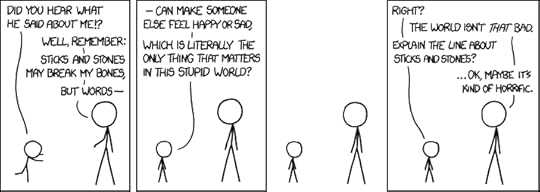
Image: “Sticks and stones may break my bones, but words can never hurt me” has always been a damaging lie. (Source - with extra mouseover text.)

We had to prepare for a time when communication was impossible.

The mind-warping idea of a world without language is the best aspect of this book. It’s also the one that requires the greatest suspension of disbelief: the inherent paradox of writing about the loss of language, at length, using elaborate and florid style. Marcus admitted in an interview that it’s “a gift to a reviewer who didn’t like the book”. As with many of the apparent plot-holes, there is eventually a partial explanation.

Although animals and maybe plants have means of communicating with each other, the ubiquity and complexity of human languages is part of what makes us human - as individuals and as communities.
The absence of language… had turned us into a king of emotive cattle… our faces… had atrophied into slack, piggish masks.

The necessity to communicate starts from birth: eyes, cries, and then language. Even the shyest person knows “The craven desire to speak, to write, to be heard”. Just recall the frustration of trying to communicate with someone when you don’t have a common language, if you’ve had laryngitis so badly you couldn’t speak, or when you lose your phone and internet connection. We may complain of information overload, but better that than nothing at all.

When you’re craving language, and the loss is triggered by those you love the most, who you have a duty to care for, it pushes the limits of unconditional parental love, and any means to cure the disease seem justified. Child’s play?


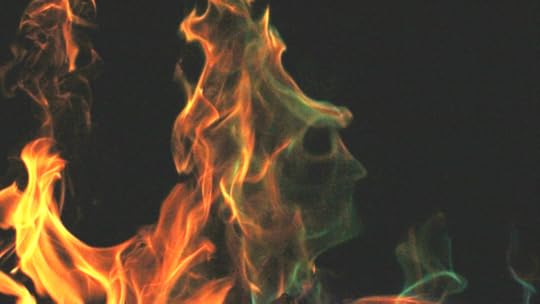
Image: Face in the flames? Our compulsion to seek meaning is what causes pareidolia and is arguably at the root of all religions and supernatural beliefs. (Source)

Before, during, and after

The book opens with drama, fear, and pseudoscience:
We left on a school day, so Esther wouldn’t see us… I stashed field glasses, sound abatement fabrics… anti-comprehension pills, a child’s radio retrofitted as a toxicity screen, an unopened bit of gear called a Dräger Aerotest breathing kit, and my symptom charts… [and] a personal noise dosimeter, hacked to measure children's speech. I wanted to be able to hear them coming.
It continues in that vein, interspersed with backstory.

The middle section felt much longer (it’s actually slightly shorter) and is set in LeBov’s research lab in “the year of the sewn-up mouth” (the disease causes progressive facial smallness and rigidity). They research treatments as well as alternative forms of communication: ancient scripts, codes, and ciphers, using tools to see only part of one character at a time. They wear goggles to avoid eye contact and when someone gestured with their hands, a blanket was thrown over them. There are echoes of Nazi concentration camps (especially a brief shower scene).

A very short final section is gloomy, shocking, and although it answers some questions about possible plot holes, it raises new and bigger ones that left me doubting the narrator’s reliability more than I had previously. A bird falling from a tree is a powerful symbol.

Judaism

Sam and Claire are Reconstructionist Jews, aka Forest Jews who listen to Rabbi Burke’s weekly sermons via an unreliable radio in the “Jew hole” of their cabin in the woods. It’s “an entirely covert method of devotion”, not even to be discussed between husband and wife, and the message is “skeletal, in bones of language that often could not be joined for sense… meaning ripped out”.

It’s a fictitious, mystical, and secretive sect, and initially the plague is blamed on Jewish children. I was uncomfortable, but reassured when I found Marcus’s father was Jewish, he had a Bar Mitzvah, and the book has been reviewed in the Jewish press. After that, I was merely conscious of how little I know about Judaism and Kabbalah.

The sect is perfect for this dystopia because it has already dispensed with language and comprehension to some extent, and doesn’t seek converts, so doesn’t need to explain itself.
Worship without the pollution of comprehension of a community.

Quotes

• “We feasted on the putrid material because our daughter made it. We gorged on it, and inside us it steamed, rotted, turned rank.”

• “I was bracing for her [teen daughter’s] ambivalence to mature into a more liberal hostility.”

• “Deprived of all communication, a father dissolves… Perhaps it is better now to liken a father to an animal parent.”

• “Gelatinous bird sounds flowed out, half-words and astringent syllables that produced a low-grade menace.” [Teenager in her room]

• “Engorged medical waste canisters.” [School bus, used for evacuation]

• “Personal stories… are the most powerful impediment to any true understanding.”

• “Earshot. Such a true word.”

• “The trees stood bloodless, barely holding the wind.”

• “It was early December. The year of the sewn-up mouth. The last December of speech. If you were not a child, safely blanketed in quarantine, bleating poison from your little red mouth, you were one of us.”

• “One of those languages unsuited to describing anything but itself.” [Constellations]

• “Spreading messages dilutes them. Even understanding them is a compromise.”

• “Judaism to me, as badly as I practiced it, what I’ve always loved about it was its total embrace of complexity, its admission of unknowability.” [Ben Marcus, in an interview]

In a lighter vein

This is not a funny book - except for the most revolting birthday cake:
There wasn’t much food left in the cupboard, just some pancake mix and a blend of baking powders… From the meaty, mineral smell I figured this would give a lift to the cake… For liquids I had an egg and some buttermilk, the custardy sludge from the bottom of the carton. I could boil the buttermilk to kill off bacteria, then flash freeze it before dumping it into the batter. The egg, too, would need flame, because it was likely spoiled by now. I broked it into a pan, stifled a gag, then whisked it… Mostly it did not congeal… For sugar I reduced the last of the orange juice until it thickened into a syrup.

Anyone who knows Monty Python will, or should, immediately have thought of their sketch about The killer Joke . You can read the script HERE and watch it HERE.

A very different novelistic take on limited language is Mark Dunn’s Ella, Minnow, Pea (see my review HERE). I hated it, but if I’d read it as YA humour, rather than adult dystopia, I might have been slightly entertained.

A really good novel on the theme is Yōko Ogawa's The Memory Police. See my review HERE.

In a darker vein

There's a story in Daisy Johnson's Fen about someone's speech causing physical pain, though that's a more mythical and less dystopian setting. See my review HERE.

For a really gory take on the pain of language, read Kafka's In The Penal Colony. See my review HERE.
Profile Image for B0nnie.
136 reviews49 followers
August 3, 2012
The novels Nineteen Eighty-four and A Clockwork Orange are dystopian, and about language. The Flame Alphabet falls into that category as well. The dust jacket promises much, "The Flame Alphabet invites the question: What is left of civilization when we lose the ability to communicate with those we love? Both morally engaged and wickedly entertaining, a gripping page-turner as strange as it is moving, this intellectual horror story ensures Ben Marcus’s position in the first rank of American novelists."

And the little promo video is very intriguing.

description

But alas, the book fails to deliver. It is not a bad book. There is some good writing, and the basic idea is one I could totally believe in. It's the everyday human stuff that I could not buy into. For one thing, their relationships were just so unhealthy. Who needed a language apocalypse when everyone is already so fucked up? And I don't mean in a good way. Their lives and thoughts just did not make sense.

"Our daughter seemed not to care who was listening, and we were ready at hand, ready to service her needs. We stood up to it and took it like parents, because doesn’t the famous phrase say: shit on me, oh my children, and I will never fail to love you?"

No. It does not.

This daughter, Esther, I would gladly let die, even if she were mine. Oh, that's a bit harsh - but you need to meet her. And the narrator, her Father. If only he would just shut up. Right. He was supposed to. But even this sickness couldn't cut through his bullshit.

I did not like the total earnest tone of the writing. I did not like the characters. The writing is so noisy. I did not like the overuse of the word "small". The italics are masturbatory. I couldn't even stand the typeface. Caslon! Bah humbug! The cover is overrated. I got a crippling paper-cut from the sharp edges. The ISBN is phony. Ben Marcus has no tattoos or piercings. There are almost no references to Star Trek.

I guess this is not the book for me.
Profile Image for Joshua Nomen-Mutatio.
333 reviews1,021 followers
February 7, 2012
This is undoubtedly the magnum opus of the three books Ben Marcus has released through the porous borders between the self and the world. The Age of Wire and String (1995) left me baffled and pretty impressed by its unique indexical acrobatics and budding vision of where to take the avant garde programme. Notable American Women (2002) detonated in my brain and dazzled me senseless with its maturing grip on how to show and not tell, and transfigured the form of the metafictional autobiography with both dynamite and surgical incisions. The Flame Alphabet (2012) ascends to magisterial heights, melding the mindfuck detailings that he'd previously coerced into a second nature with a form of storytelling as ancient as the first primordial grunts of mythology. It embeds a staggering amount of content concerning The Human Experience in its deceivingly spare frame (289 pages) and plotline, and does this through deftly swept-together piles of kindling for potential blazes of deep thought rather than direct philosophizing. Characters almost never pontificate and the narrative point of view is more about struggling against the ravages of disease than uncovering and tying together the essential natures of big ideas and difficult questions. It's as deep as you want it to be. And all this flows through the plot's main artery: Language is literally a virus that can strangle and bludgeon and infect the deepest reaches of human biology with horrific decay and there are various ways different factions of people try to remedy (or not) the problem. In the beginning, only the children wreak this havoc upon the adults and this set-up alone is remarkably nerve-shattering to follow. From there, things get decidely more dark and strange beyond all strained reaches of language—to say the least.

An Anxious Inquisition

I may've just been having a random explosion of anxiety, which wouldn't be totally uncharacteristic, or maybe I just had to pee or needed to put on a sweater or turn up the heat, or some combination of these and many other possible culprits of causality, but there were times during my navigation of the masterful slowburn of suspense and transcendently eerie foreshadowing that made my heart race and my palms fall atremble and clammy with cold sweat—which rather uncoincidentally brought to mind the whole central idea about language having direct effects on human physiology. Urgency and Yearning and Seeking are so tightly and expertly threaded through this from open to close—manifesting a finely-tuned dread married to a wide-eyed, page-flipping curiosity. This is a book that'll make terrified but forward-marching explorers of many who engage it.

A Few Words on the Words: Sastrean Cerebral Materialism
"Words are memes that can be pronounced."
—Daniel C. Dennett

My wiser elder brother from another mother—Chris Sastre—was kind enough to look over some infant-stage writing of mine and one of his points caused me to try to further form words for what exactly it is I'm trying to do or am doing when writing in a certain style that seems to flow unconsciously (sometimes against better instincts) from my head to the screen; a style and tone which he whittled down to the words cerebral materialism.
CS: There's a cerebral materialism to your stories that keeps me at a chilly distance upon first exposure—but they invariably warm and reward the more with each subsequent go through.

JN-M: Part of the 'cerebral materialism' is that I like breaking things down, through slow motion, zooming in on them, etc, because it gives me a deep warmth of greater understanding, I guess. Basically, I'm compelled to do this when I try to write. Same goes for the clinical or baroque or purple language. I think the point isn't to alienate or show off, it's to cast things in a different light than normally seen, because it's novel and because it's oftentimes funny, and because it makes me rethink things in a way that gives them more gravitas. It's the whole idea of 'making the strange appear familiar and making the familiar appear strange' that I think has some real emotional-intellectual value and that's the whole point of sometimes casting things clinically or purple-y or whatever.

I feel that this snippet of an exchange partially gets at the effect of the tone and style that Marcus pulls off so flabbergastingly well, and has more or less molded into perfection in this most recent effort. In other words, I found it inspiring to see someone doing something I struggle and aspire to do, giving me some sense of hope that it can be pulled off and not merely be an alienating or derivative disaster, as I often self-loathingly worry about when I make my little unhoned fictional fragments of late. It made my attempts look weak and sloppy (as they very well should, considering the lack of time and effort and the brand-newness of the whole enterprise) but in a tough love kind of way that I'm a big enough boy to be able to appreciate. Thank you sir, may I have another?

As I gazed into the gorgeous abyss of turning pages, Sastre's incisive comment about cerebral materialism gazed back at me, over and over again, each time I found myself stunned by the impressively economical and varied sentences, the elegant precision and the soothing hum of the tuning fork Marcus dings summarily upon every page. To breathe one more breath of symbols at describing the nature of this cerebral materialism: It has the effect of making the normal way we're usually unknowingly immersed in language and perception seem more comforting and appreciated by contrast, like jumping from ice cold lake water into a hot bath--the shivers of the insightful estrangment melting into a newfound sedated bliss of the familiar. Rinse, repeat.

Unfolding Themes

This is the kind of book that is, in a counterintuitive way, about Everything. Not in the way that the gigantic, 1000+ page, information-dense postmodern classics are about Everything, but in, again, that show-not-tell way that Creative Writing 101 courses preach about with regards to scenic descriptions and character traits—but The Flame Alphabet does this with underlying themes and in an ingenious way.
"Speech is civilization itself. The word, even the most contradictory word, preserves contact—it is silence which isolates." —Thomas Mann

This seems to all flower out from the fact that its central and most explicit theme is language itself and language is more all-encompassing than tends to meet the casually observant eye. Once this organizing principle was latched onto it made it hard not to be jolted by nearly every other sentence; instantaneously, vast networks upon the map of Human Experience lit up before me: The struggles and triumphs of striving to communicate exactly what we mean and how we feel to others, or even to ourselves within our own language-saturated inner monologues; the evolution of human beliefs and knowledge through religion and science; certitude v. uncertitude; the relentless mystery of consciousness; the building up and breaking down of social bonds—from the family unit to the whole of global civilization; the ills of dogmatic authoritarianism however well-intentioned; the dangers in having too much available information or not enough.

Despite all these grand, sweeping things being blared through my current mania and ecstatic praise, it should be pointed out again that this is not a book of brittle intellectual curiosities, instead it is one that plunges deep into the heart of the most central human concerns with a highly focused and sharpened plot. It is not meandering in any way shape or form. Every letter and punctuation mark feels essential and carefully plotted. It is not a philosophical wankfest at all; the author strategically creates space where such wankery is possible and the subtext brilliantly juggles the big important themes, but the story is still very much a story, packed with suspense and drama as good as any. Even in its perpetual Lynchian strangeness and White Noise-like familial dynamics, we can see our own experiences of being alive, which is basically the point of fiction and art generally, if forced to comment on that ol' "X is all about Y" scenario.

Solitary Confinement
"Dr. Lester: I've been very lonely in my isolated tower of indecipherable speech."
—Charlie Kaufman

There's an interesting fact to consider about prison. Even in the relative hell of such a place, solitary confinement is used as a punishment. Human beings are rather reliably shown to react in a less than mentally healthy way when isolated from other people for extended periods of time. There's an analogous phenomenon to be seen in the individual human mind itself; it is by its very nature a place of isolation, because despite all attempts to bridge the chasm between itself and others it ultimately cannot be shared, only approximations can be given as to its contents through two basic means—language and non-linguistic behavior. This troubles people who think too much and makes for great film premises (e.g. Being John Malkovich) but it also has broader effects. Everyone knows what it's like to feel misunderstood, whether it be through a casual conversation, a work of art, a book review, or whatever. And most people also know what it's like to feel lonely, whether through actual social isolation or a more complicated kind of loneliness usually found through mental health problems like clinical depression, in which the sense of loneliness only increases as more people gather 'round.

The fixation on language in The Flame Alphabet carries itself into a concern with these issues as well. There's a kind of palpable ache to be felt here in the yearning to connect with others as seriously and fully as possible. I've had the image cross my mind before—when feeling this combinaton of frustration and longing—of wanting to bash my skull into anothers and let our brains comingle, finally achieving a full, glorious, mutual understanding. Of course this is grotesque, but as a symbol it gets me one step closer to accurately attaching a series of words to a powerful feeling. So while our minds are inherently private things there are still degrees of feeling isolated and connected to be sought out and experienced; it's not an all or nothing situation. The most isolated end of the spectrum can actually drive people to true madness, while our strongest feelings of connection, however imperfect, are the most important and healing things in our lives. The Flame Alphabet brought all of this into a new focus, with a new heft, and all—counterintuitively, again—through its dark chambers of incredibly inventive narrative, largely drained of sentimentality and optimism. To quote a line that struck me as a teenager while watching Chris Nolan's debut flick, a little indie/arthouse effort called Following"You take it away, and show them what they had."

A View From The Beginning of The End of The World

So it's 2012, the Year of Our Lord Conspiracy Theory. Fuck the Mayan calander bullshit—humanity is more than capable of carelessly dethroning itself into oblivion or being consumed by natural forces beyond our defenses and this has nothing to do with an old collection of arbitrary dates written by people who would be stunned by technology such as the butterchurn or the printing press. But more importantly, who needs boring and wackadoo "theories" when our planet has been graced with two infinitely superior and mesmerizing apocalyptic-minded tales at the front end of the year: Ryan Boudinot's Blueprints of the Afterlife and The Flame Alphabet by Ben Marcus. Both are extremely unique in their own right but are bonded in their profoundly effective explorations of humanity's capacity for self-annihilation. Flame is an inexorable crescendo of dread and entropy, a merciless savaging of the human experiment, whereas Boudinot gives one room to breath while contemplating the prospect of humanity's final wave goodbye. Both are jaw-droppingly great books to kick off yet another year that end times prophets have marked as our last. If it must be so, at least we got some good reading in beforehand.
Profile Image for MJ Nicholls.
2,277 reviews4,859 followers
sampled
August 6, 2012
I managed twenty-five pages of this recent GR fave, but too many aspects of the style infuriated me to want to carry on. Compiling a mental dossier of things you dislike about the book as you’re reading it, in my experience, ends in messy disaster. Some of these points are personal niggles but some must (surely!) stand as legitimate annoyances.

First page:

sound abatement fabrics
anti-comprehension pills
Dräger Aerotest breathing kit
Lebov’s needle
copper powder for phonic salting
bootful of felt
noise dosimeter
facial calipers
(p1)

I understand the need to establish the otherness of this other-world in the language and description on page one, but this belch of invented technical terminology seemed unnecessary. It’s more a list of cool-sounding phrases than a successful situator in this strange fictional landscape. Some of these terms don’t make sense except within the parameters of Marcus’s poetic-phrase licence, which he keenly abuses throughout, i.e. “phonic salting” (putting salt in someone’s mouth to shut them up?), plus having both a German (with umlaut so it must be German) and Russian faux-scientific names is trying too hard.

Style nitpicks:

(1) These I sealed in the woollen dossier because I could not look at the writing anymore without feeling what I could only call the crushing. Pain is too soft a word for the reaction. Crushing was more accurate, an intolerable squeezing in the chest and hips, though I didn’t have measurements to support the claim. (p2)

Seems like an attempt to get in the phrase “the crushing pain” and excuse its cliché to me. This business with “measurements” doesn’t quite work as pain wouldn’t reduce his waistband. Plus, what claim?

(2) The style is peppered with nifty little phrases, some on stand-alone paragraph lines, that have that frustrating “slick” feeling. This is problem I have with Marcus as a whole, especially in The Age of Wire and String—a whole book of words that sound nice together. For example.

Conversations from the museum of the uninformed. (p15)
Making mimes out of all of us. (p9)
But our neighbourhood was failing to foreshadow. (p9)

(3) The Narrator & Tone

Having opted for first-person narration Marcus restricts his book to one voice, one register. The narrator here comes across as extremely bland and unfocused. His narration is larded with rhetorical questions and there’s the throbbing logical problem: why is he choosing to narrate this story with such self-consciously poetical language? If you’d been besieged by a language plague, would you put such effort into crafting poetic sentences, or wouldn’t you write in frantic shorthand? You may ramble, I concede. I also find his tone inconsistent—he fluctuates between a clinical, smart Ballardian narrator and some sarcastic dude whose swears are awkward. These seem at variance with each other.

One should not look too closely at a spouse’s back. (p14)
Do the math on that. (p11)
maybe this was the quiet before the really fucking quiet. (p23)
so they could take her away for a while and we could fucking breathe (p22)

(4) Word choice and lyricism

blacklisted claims of weakness (p18)
our bodies cleaving into fuzz (p17)
noxious oral product (p16)
sweetly deluded phase of recovery (p22)
her lips dragged across my back like a rough little claw (p24)
she shuffled through the house with the clownish features an undertaker smears on his bodies (p17)
a plague of deafness, as if an unseen bunting smothered everything, drinking noise, so we could hear nothing. (p9)

I don’t see the attraction to all these little phrases. How does a “body cleave into fuzz” exactly? Do undertakers smear “clownish features” when embalming bodies? Most of these feel like failed attempts to create an original poetic language. I concede this dislike might stem from my lack of immersion in poetry, but I have read bagloads of poetic prose. The trick with musical, poetic prose is to sweep the reader along in its euphonious wake. Not leave them questioning the logic of your imagery. How can a phase of recovery be “sweetly deluded,” exactly? And “as if unseen bunting smothered everything” is simply weak. In that quote there’s also a tic of Marcus’s, which is to tack on two additional clauses to string out the poeticism of the preceding clause, or add an wholly unnecessary clarifying detail, i.e. if you’re written “a plague of deafness . . . smothered everything” do you really need to add “we could hear nothing?”

(5) Appended snarks

white noisery (p1)
felt unterrible (p24)
so her head, did not look, in her words “like a tube” (p23)

Invented words that aren’t better than their dictionary alternatives. Why, if he’s written “in her words,” does he need to put her words in quote marks? Why not simply put her words in quote marks? He also overuses the simile favourite “as if.” I didn’t mean for this review to sound so snarky, but this thing is crawling with problems and I haven’t even finished chapter five. But the plot works, right? Did I miss anything else? Will I be burnt at the stake for this heretical slapdown? Hope so.
Profile Image for Greg.
1,128 reviews2,146 followers
February 20, 2012
"I received 500,000 discrete bits of information today, of which maybe 25 are important." -- David Foster Wallace

Words kill.

John 1:1 might be a mythological fabrication, but in the end there will be the word, some word and then the end. Lights out humanity. Some hateful word, or rhetoric, or bottom line on a profit report, or words about imaginary superiority, (mis)perceived threats, words from fictional gods passed down through books filled with words, words that poison and kill. People die everyday from words, stupid things said, things thought in words, yeah, there are lots of other ways to go, but maybe almost everything that is really fucked comes down to words. All those fucking words.

Just about anything in the world taken in too high of a dose is bad for us. What if this were literally, I mean medically, true of language, what if we passed a point where we became drunks with the DT's on language? That's what this book is simplistically about. How do we live in a world where we have to be post-language, post-meaning, where members of our family have the ability to poison us with their language.

Language kills. Maybe I'm in a minority, maybe I'm an anomaly but I'm the only person I personally have experience about what actually goes on inside the head of. I'm not privy to anyone else's thoughts (thankfully. I can barely bear my own). Everything, aside from some physical pains and future aliments (most likely), that is wrong with me is because of words. Words that have fucked up my way of thinking, words that defeat and cut me down, words that have warped my perceptions of the world, the words my brain taunts me with, the words other people have said, words in songs, in books. Sticks and stones might break my bones but words have seriously fucked me up.

Thinking is the first poison...Why the person himself not gutted of thought? Who cares about the word made public, it's the private word that does more lasting damage, person by person. The thinking should have stopped first. The thinking. Perhaps it is next in the long, creeping conquest of this toxicity, another basic human activity that will slowly be taken from us.

Oh, I fucking hope so.


And even if they don't fuck up directly there are just so many of them out there, so much language screaming at you from all kinds of sources. An almost white-noise of endless chatter with mixed levels of meaning. Endless strings of warnings, and news and attempts to call your attention to them, half-heard conversations in public places, deliberate words you seek out and all the ones you can't avoid. Words written with random bits screaming out boldly saying, LOOK AT ME!!! LOOK AT ME!!! PAY ATTENTION TO ME!!! I'M MORE IMPORTANT THAN ANYTHING ELSE!!! WHO THE FUCK CARES IF I HAVE NOTHING WORTHWHILE TO SAY, JUST FUCKING PAY ATTENTION TO ME!!!!! HIGHEST RECOMMENDATION POSSIBLE!!!!
just shut the fuck up already and stop your constant bombardment on trying to get my attention.

And here I am contributing to more words. More pollution of bullshit bits of information that I'm asking you to slog through to see if maybe there is something important, something worthwhile contained in it. How fucking vain of me. A worthwhile message? Ha!

"Spreading messages dilutes them. Even understanding them is a compromise. The language kills itself, expires its host. Language acts as an acid over its message. If you no longer care about an idea or felling, then put it into language. That will certainly be the last of it, a fitting end. Language is another name for coffin."

Lines like this show up frequently in the book. I've read this quote over probably fifty times. I've been slogging about this review for weeks now. Looking at the quotes I culled, trying to figure out what I mean to say about them, what I think they mean. Read it over again, I just did and it's a quandary, what is the message without language? The primordial, or a priori, or whatever the fuck big word you want to use, message that comes before the word. The feeling unthought, the thought that flutters without being cognizant, the moment of doing versus thinking? I think about how to do something and become frozen in inactivity unable to move. Too often I find myself muttering to myself after a pitiful performance in fighting that I started to think too much. When I don't think everything just flows, incredible shit happens, when I think, it all falls apart, I find myself muttering excuses that have to do with thinking. Ben Marcus couldn't have meant this, could he?

"'Understanding itself is beside the point...Do not make of it a fetish, for it pays back nothing. That habit must be broken. Understanding puts us to sleep. The dark and undesired sleep. Questions like these are not meant to be resolved. We must never believe we know our roles. We must always wonder what the moment calls for'"

We want stories with nice endings. We want mysteries resolved. I can remember spending most of one day in September about ten years ago watching endless tv, probably doing what most of America was doing, and I wanted to stop, I wanted to go do anything else, I was tired of seeing the re-runs of destruction played back over and over and over again, I wanted the images out of my own head, but instead I was having them further embedded, changed by the seemingly endless repeating shots of personally witnessed destruction. I kept watching because I wanted answers, I wanted someone to tell me this is who did it, this is why, I kept watching like I'd watch a movie to the end that I'd grown tired of just because I felt like I needed to be rewarded with some understanding, to know why. I thought I needed these words to put everything in order, to put back together what lay broken and destroyed, not on the streets of downtown but in myself, to let me know that the words that ran through my head didn't make me a total shit, that there was a reason, even if it were a bad one but a reason for what had happened.

With understanding there came no difference.

Socrates, or Plato or someone writing with those names blabbed about Know Thyself, understand yourself. I've spent at least two decades of my life trying to understand myself, trying to self-analyze, look for answers to the why questions, figure out this and that, and all I've done is drowned myself out in the feedback of self-consious and self-referential noise. It would have been better if I never gave 'myself' a thought, the unexamined life might not be worth living, but the examined life is fucking hell. Understanding? Ha!

When Esther was finally old enough to walk to school by herself, she still wanted approval for things that were to basic to be considered talents. Eating an apple. Standing on one leg. Soon she'd want to be congratulated for waking up, leaving a room. Once she sat on our windowsill--she must have been eight or nine already. She was very pleased with herself, swinging her legs back and forth.

Do you know, Dad, that I can do a trick?

Oh yeah?

Yeah!

I can make my legs to this way and that, that way and this!

I see that.

Do you see?

I do.

You're not looking. Why aren't you looking?

I'm looking. I see it.

You're not, though. You're not.

I should have congratulated her. Who was to say this wasn't extraordinary? What did I really know about extraordinary things?


I joke sometimes about children and the things they are congratulated for doing, the simple things like walking, standing up, speaking a word, shitting in a toilet, the things you and I do everyday without much fanfare. I joke that I want this kind of praise, I want to be made to feel good about myself with kind words for doing the unspectacular, and I joke that kids shouldn't be praised for things like this, because they aren't that difficult, they will eventually figure out how to do all those things, so save the praise for really worthy deeds, like solving world hunger or curing cancer or something.

I think I'm joking.

It made me smile and even laugh a little bit to find this passage in the book. Maybe the joke isn't that we should hold off praise for the important things, but that just living and being able to swing your legs like this deserves some praise. Maybe those kind words are just an antidote to all the shitty words out there that we have to do nothing at all except to continue breathing to encounter. I don't know. I'm probably just an asshole for my 'joking' about wanting to be praised each time I succeed in not shitting myself and holding in a bowel movement till I get to the bathroom.

I should have congratulated her. Who was to say this wasn't extraordinary? What did I really know about extraordinary things?

This fucking review has been haunting me for a few weeks now. It's not the only one, I have four half-finished reviews I can see on my desktop, all opened with their words taunting me to add more words to them to make them mean something and maybe get read and earn some much coveted goodreads votes.

I meant to say big important things in this review but then other words got in the way, I meant to use some carefully chosen quotes to spark lines of thought that would be interesting to myself and hopefully other people as well, instead I got into a narcissistic rambling, using the book as a springboard into the most boring topic imaginable. Fucking words. Blame them. I'm walking away scot-free on this one.

Below are a couple of other quotes I was going to do something with. You should read them, and if they inspire any kind of thoughts they are probably better ones than what I would have written.

Because restoring language to a people was only one small piece of his work. Child's play, I bet. Smallwork is right. In the end it's too small, isn't it? Easy enough to shoot everyone with a fluid so they could shout insults at each other again, launch their campaigns of vocal blame. Easy. He would do more than that. LeBov would also erase a belief system, remove love from the air as if it were only an atmospheric contaminant. Love was just a pollutant you could blow clear of a person, right, LeBov? If only you had the proper tools.

If you listened so intently into nothing, using gear like this, you might hear anything you desired. It made you think we were still being sickened from some language we didn't even know was out there. Inaudible, sub-whispered, mouthed by an enemy from so far away, it could not even be measured. Still it pulsed some toxic on us that made us all crawl on our bellies and choke.
Profile Image for BlackOxford.
1,095 reviews70.3k followers
December 30, 2021
The Un-Disclosing God of Language

Overall an interesting premise but a very weak and amateurish development. There are just too many issues/themes/styles swirling around randomly - Judaism, language, generational gaps, sociology, parenthood, pointless sex, science fiction and magical (sur)realism, among others - none of which are resolved satisfactorily. By the end, the author runs out of steam and seems to simply give up on the whole enterprise. Disappointing. Here’s one interpretation of a chaotic book:

What does a Jewish family do in adversity? It talks of course. Among its members. Then with other congregants at the synagogue. With the rabbi. They analyse the situation. They figure things out. They may even write to The Times or circulate a plan.

But when the adversity in question is language itself, what happens? If language causes mass illness, terminal illness, what can be done? And if it appears that one’s children, although immune from the illness, become the willing vectors for spreading it, what hope is there for the family itself?

Under such circumstances society cannot exist, at least not a society built on the premise of language - in law, in commercial activity, or as the basis of obligation of any sort. Memory and feeling tend to dissipate and eventually disappear. Such a society would require not just silence but the strict self-censoring of all thought so that it never reaches the level of speech or writing. In other words all of us would have to commit to a radical unknowing. As in the biblical prescriptions, the word would literally be “buried in the heart” so deeply that it could not be found much less expressed.

Recovery from the disease of language would, of course, be no mean accomplishment. Like any detoxification, it is a lonely, confusing, and painful process. Even more so since there is no possibility of communicating the experience to anyone else. Language is poison no matter what it might be used for. Even sign language can be lethal if not handled(!) properly. Authorities are obliged to act in such circumstances, procedures established, experiments run.

Sight of one written letter at a time - and even then only in fragments - might be permissible, for a sort of Cabalistic analysis of a script - potentially lethal as soon as it was whole enough to suggest comprehensibility. This technique allows writing/reading without the introduction of meaning by the writer/reader - an environment of controlled ignorance, as it were. A real composition/exegesis, therefore, without the danger of interpretive pollution either in the text or the writer/reader. This allows the search for an alternative alphabet without an inherent toxicity to proceed without unacceptable casualty levels.

Then again the business of script, not just the alphabet, is a tricky matter: “If we hid the text too much, it could not be seen. If we revealed it so it could be seen, it burned out the mind. No matter what. To see writing was to suffer.” Large numbers of test subjects did indeed suffer. Sometimes this led to “acoustical expiration. Suicide by language.” Unfortunate but merciful in the circumstances.

It turns out the the Book of Genesis had correctly diagnosed the human condition: “This was not a disease of language anymore, it was a disease of insight, understanding, knowing.” And to this there is a solution. Unfortunately it’s pharmacological not linguistic. Even more unfortunately it involves the bodily fluids of immune children. Bad news for one’s progeny.

And bad news even for the adult forebears. “We make the language in our own image and the language repulses us… We thought the world we lived in could be hacked into pleasing shapes simply by what we said.” says the protagonist, Samuel. His rabbi is even more critical:
“… language kills itself, expires inside its host. Language acts as an acid over its message. If you no longer care about an idea or feeling, then put it into language. That will certainly be the last of it, a fitting end. Language is another name for coffin.”
Ultimately, according Samuel, now a hermit, language leads to despair,: ”I found I could do without more things to misunderstand.”
That’s a good summary of my appreciation of the book.

Postscript 30Dec21: Although the protagonist in Flame Alphabet has no luck in finding differences in the way people respond to different sorts of writing, this is very clearly a ‘thing.’ See: https://www.goodreads.com/review/show...
Profile Image for Jenn(ifer).
192 reviews1,015 followers
June 14, 2012

I’m not sure how to write this review sans spoilers, so here’s the spoiler-free version:

This book is one of the most original, intriguing novels I’ve ever read and if one more person gives it 1 lousy star I will find them, pin them to the ground and scream in their face until they keel over convulsing from the crushing!! Of course I'm over 18, so that means I would probably die too, but it would be worth it!!

Okay.
So.
The Flame Alphabet.

Man, what a great concept! Read on for the actual review (with some spoiler-ish details) The first chapter is jammed with important information, so pay close attention. It is here that we are given an idea of what the world has come to as a result of speech toxicity. In the beginning, it is only children’s language that is toxic, and it is only toxic to adults. However, not only is sickness caused by speech, it also comes from reading what children write and being around children who are lost in thought.

Imagine the scene. All children are kept in fenced off locations. Radio stations have gone mute and white noise is being pumped into the streets from huge sound systems. Officials who are in charge of keeping the peace are swathed in foam padding. Newspaper bins are now filled with anti-speech agents. Adults roam for miles from their homes in order to breathe in the absence of children, lugging oxygen tanks and breathing apparatus behind them.

Like most plagues, the language sickness starts off in isolated areas. Adults with children begin experiencing vague symptoms such as lethargy, tingling limbs, strange red marks on the body. The book focuses mainly on one particular family: Samuel, Claire and their 14 year old daughter Esther. Esther, they notice, is unaffected. The doctors and scientists don’t know what to make of this illness so they blame it on animals, allergies, pollutants. Soon, researchers are forced with facing the undeniable; the illness is caused by something coming from the children’s mouths. Marcus really makes the reader feel like they are part of what’s happening. His language is sickening. The “porridgy loaf… oozing over (his) plate like the inner mush of an animal.” The “gelatinous bird sounds.” The “small wound on (his) leg… opened like the mouth of a baby; from the gash came the faintest wheeze of a sound.”

.......

Let’s get back to Sam, Claire and Esther for a moment. They are members of an obscure Jewish sect who worship alone in huts in the woods. In these huts, they (Sam and Claire) listen to broadcasts of the mysterious Rabbi Burke’s sermons. They are not allowed to talk to one another or anyone else about the content of these sermons. This is a place of enforced silence. I enjoyed this idea of not being “allowed” to discuss what they heard. As Marcus says, “there was nothing to debate, nothing to say, and the experience remained something we could share that would never be spoiled with speech.”
........

When Esther goes away to camp, Sam and Claire experience a remission of symptoms. Sam seems skeptical, “maybe this was the quiet before the really fucking quiet.” When Esther returns, Sam knows that things are about to go from bad to worse. The kids made the camp counselors sick; not only that, Marcus’s descriptions will tell you that the sickness goes beyond humans. Birds are sick. Trees are sick. “Evergreens hung skeletal and brown, with sick branches that looked burnt by wind.”

Without giving too much away, there is a fantastic character, LeBov, who is sort of the premiere researcher into the language toxicity. If there was a film version of this novel, I would cast Phillip Seymour Hoffman to play the role of LeBov. He has just the right amount of cocky, sarcastic cynicism to play the role nicely. LeBov is a bulldozer of a man, and Sam is a pawn in his game, or so it may seem. Dun da duuuuuuuuuuuuuun....

Famous last words: if you like a dark, macabre, mind-fuck of a novel like me, you will love this.
Profile Image for Paul Bryant.
2,413 reviews12.6k followers
January 12, 2015
Possibly because I’m engrossed by (and grossed out by) The Walking Dead (now there’s a dystopia worthy of the name); possibly because in the last couple of years I’ve stumbled over a bundle of great American writers with beautiful styles (Smith Henderson, Junot Diaz, George Saunders, Alissa Nutting, you know – “round up the usual suspects”); possibly because I just read two whopping novels (Fourth of July Creek, The Book of New Strange Things) which effortlessly demonstrated what novels are capable of (gee, so that’s how it’s done, why doesn’t everybody do that??); possibly because another deadly-ironic-black-humour dystopia based on a gigantic metaphor (the actual spoken language of our children is killing us slowly) is overly familiar to us from J G Ballard (High Rise, Concrete Island, Cocaine Nights) and really, do we need any more giant metaphors?, I dunno; possibly because I found The Anchor Book of New American Short Stories edited by Ben Marcus to be mostly composed of the opposite of stuff I like to read; and possibly because no bout adout it Ben Marcus can string an unusual sentence together, and can infuse a sense of morbid dread into his prose which I’ve previously only encountered in HP Lovecraft and some of Ted Bundy’s interviews, but which, only too intensely successful, escaped the book itself, permeated my entire house, and made it advisable to read The Flame Alphabet wearing an ebola-style space suit, I found the idea of continuing with this intentionally dreary deliberately nonsensical beautifully contrived concoction frankly unbearable. Don't shoot me, o ye slightly avantgardist fans!

So, in the time honoured manner, when giving up a novel I actually have a lot of respect for, I did not hurl it but reverently propped it against the wall.

1 star represents the fun I had with this novel i.e. none.

(Note : If you are looking for gonzo absurdist futurama wild gorgeous bad craziness with a whack fol the diddle-oh I recommend Blueprints of the Afterlife by Ryan Boudinot.)
Profile Image for switterbug (Betsey).
936 reviews1,501 followers
September 21, 2013
This is an extremely dark and ultimately enervating dystopian novel full of disturbing contrasts and ontological concepts. It's the ripest prose I've read this side of China Mieville, but Marcus's story drags on with an all-encompassing dread and relentless anguish. Numerous and grotesque images, made of organic, gelatinous substances, squirm and squall through the narrative like a howling of the soul. There is no doubt that this author has an uncommon talent and imagination. He was so effective in engulfing me in his gnomish, visceral landscape that I felt swallowed and forced into an intestinal vacuum.

In this futuristic story, the sounds of children's voices make adults ill. Etiology unknown, but it is blamed on the Jews, at least initially. I don't have the aptitude to distill this story into its many-faceted parts/themes/concepts. However, it is apparent that Marcus's esoteric reach goes back to ancient Jewish mysticism. Even some of the words he often uses--shard, shatter, fracture, etc. brings to mind the breaking of the vessels and other Kabbalistic teachings.

How far, deep, and wide does he take it? That is for the reader to determine. One theory that I have is that the reader's religious or secular beliefs take part in individual interpretation of the text, so that there is not just one meaning to ascribe to the deeper context of the story, (although knowledge of the Kabbalah would definitely be helpful). In other words, the story addresses the question of one's faith.

The title of the story refers to the 22-letter Hebrew alphabet, its unfurlment, and its nature. As in the novel, "The Hebrew letter is a form of nature." For example, the lamed (pronounced lah-med) letter's appearance is a flame being reflected right back into your eyes. Lamed means "into me" and is the flame of consciousness; it is the letter of learning. (This is knowledge outside of the book's source, but relevant to the narrative.) Reading this story will increase your knowledge of the mightiness and personification of the Hebrew alphabet and its affinity to the concepts of creation and destruction, of diaspora and absorption, and more.

The book reminded me of a David Lynch movie. If this actually were a movie, and not a book, I would watch it several times in order to get closer to the meaning's core. But in its current written form, I would have to commit to multiple readings. I am unwilling to submit to the time and effort required. Alas, the failure may be mine. There are other densely philosophical books, such as Ada, or Ardor: A Family Chronicle, by Nabokov, that I am willing to re-read, that engage me fully. This book is far too agitating and agonizing to repeat.
Profile Image for Manny.
Author 48 books16.2k followers
May 20, 2021
The Flame Alphabet by Ben Marcus

by J.G. Ballard

They had now reached an area where the desert gave way to salt dunes and then to a substantial expanse of water that Travis tentatively identified as the Dead Sea. His wife at first disagreed, but the Jeep contained no maps, and her knowledge of the local geography was even less certain than his; given a lack of alternate hypotheses, she accepted the label he had given it. The bitter, salty, undrinkable quality of the water was at least consistent with the fragments of knowledge they did possess. The roads had decayed with startling rapidity since the Event, and Travis negotiated his way, at a crawl, around frequent pot-holes. Towards the end of the afternoon, they came to a motel which seemed relatively undamaged. Travis stopped, neatly parking inside a space whose boundary lines were not quite obscured by the drifting salt. The water was still visible, perhaps half a mile away, though the light made it hard to judge distances.

Inside, they followed their new routine: Travis searched for tools, jerry-cans and an unlocked room, while Marta located the kitchen's store of canned food and bottled water. They met at the reception desk to compare their respective hauls. In addition to the usual material, Travis had found an old mechanical typewriter and a ream of paper. Marta looked at them expressionlessly.

"I thought I would write a novel," Travis said. She shrugged, and began preparing a basic dinner which they ate in silence. Since the Event, there was less to discuss; Travis tried to remember what they had once talked about during meals. When they could no longer force themselves to eat any more of the tasteless kosher meat, he pushed aside their half-empty plates to make room for the typewriter, then fed in a sheet of paper. His hands apparently still found this a familiar routine, and began to type without further prompting. As he began the fourth page, Marta picked up the ones he had already completed.

"The Flame Alphabet, by Ben Marcus," she read slowly, peering at the smudged letters. "Why?"

"Why not?" replied Travis; he gave the impression of having stored up this reply, savoring a little conversational victory before he went back to typing.

After the sun set, they moved by common accord to the bedroom he had picked out for them, and undressed. Marta attempted once again to coax some kind of sexual response from his body, alternately using hands and mouth; Travis waited patiently until she tired of her unsuccessful ministrations, accepting the empirical fact of his unchanging flaccidity. He noted with satisfaction that she no longer felt her failure as a personal one, but appeared to consider it simply as part of the day's schedule. Perhaps, in a month or two, they could consider reducing the length of the sessions. Without any formal leave-taking, they each rolled over to their respective sides of the bed. Marta's breathing soon became shallow and regular, but Travis remained awake. As soon as he was convinced that his wife was asleep, he extracted the candle he had found from its hiding place in his rucksack, then went back to the typewriter. The pile of paper on the right grew steadily.

Profile Image for Ian "Marvin" Graye.
948 reviews2,786 followers
June 30, 2021
CRITIQUE:

"When we came out of the mud we had names": William Burroughs

Language is potentially the skeleton that keeps human beings upright and together, both individually and collectively. Language might have helped us to rise and remain out of the mud.

What are the repercussions if we lose the capacity for language?

We obviously can't talk and converse with each other.

Can we think? Can we understand? Can we care? Can we love? Can we like? Can we share? Can we control? Can we manipulate?

Ben Marcus raises all of these questions in "The Flame Alphabet", either explicitly or implicitly.

Perhaps these questions are raised by language itself.

description

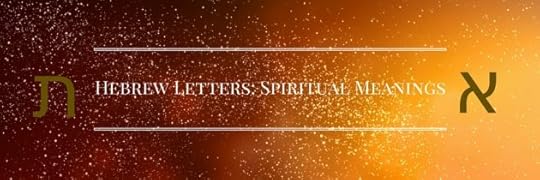
"Aleph is the first letter of the Hebrew alphabet and signifies the number one. Aleph indicates the Oneness and Unity of the Creator. It hints that beyond the illusion of separation and duality is underlying Oneness – that nothing is separate and the Creator is the source of everything." (Source: Walking Kabbalah)

Illness as Metaphor

Marcus constructs this dystopian novel on the premise that language is a virus that has become toxic to adult humans, plunging them into "wordless despair...[during which] silence was enforced by the speech fever". Children are immune to its effects, but are nevertheless carriers of the language virus.

This places adults and children in opposition to each other. Adults must avoid contact with children, because the words of children could kill them (the adults). It's not clear to what extent this is a metaphor for the estrangement of adults and children from each other, particularly as a result of their different social habits and practices.

Children lose their immunity to the virus, as they eventually become adult and vulnerable to it. However, in the meantime, it's possible that they might be the ultimate source of a serum or vaccine ("the Child's Play serum"). Will adults be saved by Child's Play?

Flaws in the Metaphor

It's arguable that the language as virus metaphor is flawed, in that it's not clear whether language is inherently a toxic virus in its own right, or is it merely the host or carrier of a toxic virus? Is language itself a victim of the virus? In other words, has language been attacked by a virus? Has it been turned into a deceptive flame alphabet?

These are both threshold questions, and questions that started to preoccupy me as the novel worked its way towards its conclusion.

Initially, I found the novel quite frustrating. It swirled around without apparent purpose or direction, and therefore, potentially, without a satisfactory outcome. In the first two (lengthy) sections (45 out of 57 chapters), the discussion of symptoms and causes and cures never seemed to get anywhere. The accumulation of detail didn't seem to result in a clear course of action or a satisfactory outcome, or even the possibility of an outcome.

However, this might be because both the narrator (Sam) and the readers (us) are (or are potentially) victims of the virus, we readers are equally attacked or trapped by the toxic language virus that has taken over control of the novel.

Maybe, this is just what it feels like to suffer from the virus?

Another potential flaw in the metaphor is the question whether the virus/toxin is the general structure of language, or spoken language (and by extension, the hearing of language, sounds or "acoustically delivered words"), or written language (and by extension, the reading of language, where "to see writing was to suffer, [because] it burned out the mind"), or thought language (our internal thought process, interior speech or inner life)?

The Language of Love and Intimacy

The final section is concerned more with the last alternative. It posits that, without a language with which to think and feel, we cannot care or experience intimacy. Sam's greatest concern is the loss of his relationships with his wife, Claire, and their daughter, Esther, with whom he already has a fractured relationship.

Erasure and Omission ("Thank god the language had died between us.")

We also learn more about the outcome of the virus, how it works, and what happens as a result. The virus cuts up text, swirls it around and erases vowels (below is my illustration of the effect on the reader, using Marcus' text):

"The night before, I went to the coffee cart and, from behind, tapped Marta, maybe a bit too hard. We'd not been together since I had repelled her from [my] bed with language."

"Not a blow to knock Marta down, although it happened to do so, and not a blow to injure her, because that was not a desire I knew about having, even though I had recently caused her pain in pursuit of a broader curiosity, but a firm tap of the sort one delivers to an object to keep it from moving. An anchoring gesture, one might call it."

"Marta was not long for a posture of collapse.

"When she stood up to join me, showing no distress at having been knocked down, I saw that it wasn't Marta I had tapped...It was Claire."

"Poor Claire did not really struggle. She gave me such a trusting look as I restrained her, a shy smile to suggest she would have done anything, anything. And so would I, I tried to silently say back...

"This was me-right now-doing anything-I sw--r I'm d--ng th-s f-r y--...

"I kn-w, sh- w-nt-d t- s-y. I kn-w, H-n-y, I d-. I kn-w..."

"W- h-d n-t s--n --ch -th-r -n m-nths.

"-nt-m-cy -v-rp-w-rs s-ch l-t-r-l -mp-d-m-nts, d--s -t n-t? H-v-n't th- gr--t l-v-s c-nq--r-d f-r m-r- th-n th-s, s-rp-ss-d d-ff-c-lt--s th-t m-d- - l-t-r-l l-ng--g- b-rr--r, s-ch -s wh-t w- s-ff-r-d, s--m tr-fl-ng?"

"Th-nk g-d th- l-ng--g- h-d d--d b-tw--n -s. S-m- th-ngs sh--ld g- w-th--t s---ng f-r-v-r."
"

As language fractures and disintegrates, it ceases to be a vessel of communication, intimacy becomes problematic, we two - a couple - (or more - a family) cease to be one, and we're left trapped in our own solipsistic void.

The virus could "erase a belief system, remove love from the air as if it were only an atmospheric contaminant. Love was just a pollutant you could blow clear of a person..."

You'll have to read the novel, to learn whether the Child's Play serum arrives early enough, whether you need one or two jabs, and whether two jabs are (or just one jab is) effective. First published in 2012, pre-Trump and pre-COVID 19, who could have guessed the extent of the metaphor?


SOUNDTRACK:
Profile Image for Szplug.
466 reviews1,513 followers
March 2, 2013
WARNING: The following has spoilers almost from word one

Ben Marcus wrote an outstandingly cerebral, uncomfortable, and moving novel with The Flame Alphabet—factor in that chromatically angular cover, of whose fiery upthrust I simply cannot tire of beholding, and it approaches that rare point of fictive perfection. So when I survey its remarkably low average rating, the legion of single and double stars ranged against it, I'm left at a loss for an explanation. GR friend Knig calls it Jewish Sci-Fi, which seems as apt to me as anything, though, within a relatively short span of pages, Marcus covers a fair bit of genre ground: elements of the horror, thriller, and dystopian apocalypse raise their heads while eminently fitting and adapting themselves to the coherent and harrowing drive of the author's unique, intelligent, and searing vision. Aware of those poor reviews (though set against near-universal acclaim amongst the members regularly appearing on my update feed) I will admit to entering this tale with a backwards lean; but it mattered naught. Almost immediately I was sucked into the confusing, but tantalizing, intimations of an America ravaged by a linguistic virus, one which rendered the word—spoken or written—a lingeringly fatal construct for adults through some awoken or arisen venom within its meaning. And by the time, just over a score of pages in, of the interplay between father Samuel, mother Claire, and precociously radical (and honest) daughter Esther, at a family picnic near the mysterious hut of the Reconstructed Forest Jews, I was smitten by the entirety and in like Flynn.

Every aspect of Marcus' depiction of this mysterious and lethal incursion which morphs language from being a vital constituent of human communication to an airborne assassin armed with sonic or visual toxins is first rate. I particularly liked the physical deterioration that accompanied the loss of the ability to speak: the facial skin emaciated and tautened in around the skull; the LeBov Mark, a hardened bump that develops beneath an atrophied and sluggish tongue; the production of saline crystals that sweep across a dying world like the arid sowing of a vengeful god; the reduction of parents to invalids hiding away from their children, while the latter—immune to meaning's fatal turn—range about their environs like packs of feral creatures, unleashing a torrent of words upon whatever adults they come across, a barrage of uttered ruin that lays the mature victim out upon the verge of death. And the brilliance of the Forest Jews and their guardianship of outlet points for the bundled strands of coated wire that, spread across the country in subterranean tunnels of unknown size, carry the frequency-bound sermons of a sect of radical Jewish sages—who have seemingly anticipated this speechless calamity—serves as the spinal cord for the religious and mystical elements the author parlays. Though I lack the depth of knowledge about the Jewish religion to have felt comfortable in parsing all of its meaning within the novel, that does not diminish my appreciation one iota for how the entirety unfolded.

At first, anti-Semitic strands appear to be developing, in that, at the onset of the language virus, only Jewish children are believed to be the carriers; and Sam and Claire, in greater and lesser degrees of faith, as members of their unusual sect—using saclike, gelatinous listeners as tools for accessing the cabled messages—serve the dual function of being both Jews set apart from regular society, and an exclusive minority within their own Judaic religion. There are also the portents of the ills of the spoken word in the Torah, and the wrathful, sudden onset of a confusing affliction, with its similarity to the crisis of Babel of old, seems to set the Old Testament God up as a focal point for an evolutionary development metastasized into lethal proportions. And yet, the truly isolated element are the children: their shrill, energetic vocalizings bring a death they need not fear; their very tones undergo a transformation from cherubic to malevolent; and they are the minority who, under the auspices of a desperate government, are rounded up and confined to camps muffled against the spread of their spoken toxicity. Bereft of their parents, left to their own devices, their immature bodies probed and exercised, their fluids forcibly extracted by agents seeking in flesh and bone both source and cure for the viral spread, they must pass the years in a strict, adult-barren environ until they arrive at the point when, already weakening from their newfound susceptibility to the deadly fruit of meaning, they are released to an outside world of predators and manipulators awaiting the opportunity to make use of their freshly-emerged forms. Indeed, in a brief portrait of Esther, caught on camera and seen by her father, all of this reality is crystalized by a forlorn pose and head buried in hands.

Then there's LeBov, one of those authorial creations who set off a charge whenever they grace the pages. A mysterious redheaded scientist who apparently warned of the virus' potential ere it broke out, LeBov is an energetic and enigmatic presence, both helpful and sinister, utterly ruthless in his determination to uncover the foundations of the disease and thus effect a cure. His manipulations and revelations to Sam shock the latter out of the smallwork with which he has both been passing his precious time, and estranging himself from wife (and child, though that began far earlier). The way Marcus depicts him late in the novel—at the Forsythe facility where the intense work of solving this linguistic nightmare reaches its amoral apex—oiled-up, aching, attended by technical and medical suitors, is just fantastic. In a way, I deemed LeBov as an updated version of Dostoyevsky's Grand Inquisitor, aware of the game that is afoot and striving to maintain hope when the latter seems utterly unfounded, while using morally questionable means in the furtherance of that cause. And in Sam, Marcus subtly portrays how the loss of language brings about a corresponding diminishment in one's humanity. While Sam uses the same calm, measured tone to portray the catastrophic events of which he is a part, the actions they are describing harden and set in stone before the reader's very eyes. His reunion with Claire within the confines of Forsythe is simultaneously touching and appalling.

Indeed, the reduction of everything and everybody to complete silence is eerily set against the inner voice of Sam that, of necessity, carries on as if nothing had changed whatsoever. It is quite amazing how much of the experience of human life requires communication, and how strikingly Marcus captures that aspect while yet recording the myriad ways that humankind, an adaptable species if there ever was one, manages to maintain the old routine by the adoptions of a new. And the oldest component of that overwhelmed routine is family—and perhaps Marcus' greatest achievement, in a book flush with many, is the depiction of the intimacy and interconnectedness and vitality of the nuclear family, even as he ranges about its inherent tensions, abrasions, and repulsions, the conflict between spouses who form a united core of separate, straining parts, between parents removed from the immediacy of urgent childhood and the ways in which comfort and routine can replace the honesty of addressing the immediate within its very presence. Esther, though with relatively brief page-time, is a potent creation on her own, conveying her striving spirit and rational outlook and unshielded, quailing immaturity in passages where she is forced to be silent, struggling mightily against unleashing her poisonous voice in crippling barrages towards her mother and father. The separation between this familial trio that comprises the second half of the novel is beautifully and poignantly conveyed: and never more than in the chilling final paragraphs, where Sam's changed nature and tunneled vision are enshrined in a steel set as barricade against the incursions of grief and loss.

Finally, there is the virus itself. Adept as ever, Marcus manages to endow its onset with both a biblical force that demands faith, contemplation, and inner struggle if it be solved, and one coeval that is fully explained and explored within science. Will the solution be found in the thrumming, cloaked voices alive within the orange-jacketed wire, or through the thorough investigation of biological change and alphabetical restructuring? It seems that perhaps neither suffices on its own. Early on, LeBov remarks to Sam that:
Since the entire alphabet comprises God's name, since it is written in every arrangement of letters, then all words reference God. That's what words are. They are variations on his name. Whatever we say, we say God.
God is in every particle of language. And yet he remains—most specifically of all in the Judaic belief—unknowable, even unapproachable. How can we then know whether, from the very start—from the very first instantiations of the mythologies in which we compressed the vital element of our primordial, language-birthed condition—that we haven't been misusing language altogether? At cross purposes to how its least component and entirety, which is God, would fain have us do? And this corruptive pride, engorged as our communications have encompassed every aspect of our lives, might perforce require that it be made malignant and deathly that we be purged of this misappropriated, meaning-imbued giant. Or perhaps, in the evolution of our brains, the neural configurations for a toxic reaction to an increasing bombardment of parsable vocalized and written codes have been set in place, to be set off by a chance chemical reaction that set fire to the wick of a millennia-forged mass of explosive.

Two curious omissions that I detected in The Flame Alphabet were that the internet—in which our linguistically-based interconnectivity reaches its highest and most immediate level—was nonexistent and our own inner voices—which, at least for me, conduct their circular bombardments in the English language—were non-lethal. Though Marcus stressed that it was meaning which laid adulthood low, do not our thoughts coalesce and enchain themselves with a meaning as discernible as that which we them compress and infuse into our spoken and diagrammed words? I don't know why these two components were not explored or used to the degree their potential implies. But what matter that? This is still fucking dynamite as far as novels go, and one that begs to be reread, and then reread again. This is a book made to be studied some of the more disparaging reviews have remarked, like that was somehow a bad thing. When the story that propels it is as magnificently carried out, as fully realized as this one is, studying it becomes but a further pleasure, and an anticipated avenue to a greater understanding: the sort of thing you would expect from a near perfect book.
Profile Image for L.S. Popovich.
Author 2 books461 followers
June 23, 2021
A brilliant premise, executed in an intimate way. Reminiscent of Fahrenheit 451. A rich commentary on our language-centric, media-absorbed, screen-focused, noise-cluttered, maximalist, data-encumbered, socially dependent, spectacle-obsessed, death-in-life, attention-hoarding, anti-filial, pseudo-environmental, chemically enhanced, status-updating, soul-denying, disengaging ubermodern lives. A slow burn of acidic satirical documentation. A writer to watch, with a grip on the societal pulse and a compelling voice. It could have played out in any number of ways, but the scientific and lingual investigation posited and answered most of my curiosity-bound questions about the incumbent crisis of the plot, the resonating consequences. The main character was desperate, denial-ridden, and offered a stilted perspective on the proceedings. I felt that it was an effective argument, lacking tonal relief, possibly overdeveloped, and he didn't allow the mystery to breath. Maybe too hurried or the concept was milked until it grew stale. Hard to pin down. In any case, I wavered between intrigued and pestered, settling somewhere in the neighborhood of impressed.
223 reviews189 followers
January 31, 2012
Jewish Sci-fi: a new genre? Not a problem theoretically. But in practice: the notion of exclusivity is hemming me in, reminding me that ignorance is bliss only so long as one doesn’t know one’s ignorant.

Impossible to gestate without deeper knowledge of Judaic doctrine: an author who turns the tableson a secular readership at large (you don't know judeism? well too bad) and finds purchase in judeo-mysticism: unapologetically and dispassionately, re-asserting with full force the tenor of a powerful religion which has succoured both Christianity and Islam (and paid a supreme price for its founding tenet).

So, I was beset throughout with niggles: am I missing something because I am not Jewish The fact that the disease is supposedly spread by Jewish children, that its cure might be found in Jewish lore (the message of Rabbi Burke’s listeners to the forest Jews) and countless other inferences which serve to carve a dividing line between those in the know and the prophecy uninitiated?

Human language is killing us, and apparently only the Hebrew alphabet might be able to save us: a pervasive meme until the very end. Now this turns out to be a red herring, but not before searing irrevocably the political message underscoring the travail: Hebrew is the oldest language in existence. You better remember it. It is the alpha, beta, and omega. And so it is. Point taken.

Does it matter though? Does one need to know the intricacies of religious innuendo to secure an ‘in’ here? Here being a place where language is toxic and the resurrection of philosophical debate on linguistics roars to the forefront of our consciousness in techno-colour glory?

At its narrative core this is an innovative take on linguistic relativity, and it begs us to take a stance on Whorfianism. No, it asks more: that we quietly contemplate and discover the premise of cognitive linguistics for ourselves: an inroad into our psyche and consciousness. But, always measured through the restorative powers of spirituality rather than the cold, hard framework of scientific dogma.

Of course the philosophical mantle hangs on a storyboard of sorts: here its the apocalyptic aftermath at some indeterminate point in the future through the eyes of Sam, who gets caught up with his wife and daughter in a pandemic of toxic language. Set out nicely in the style of Cormac McCarthy’s ‘The Road’ (which as it happens is one of Marcus’s favourite reads), the story does not trouble us too greatly with precise scientific or other details of the emerging reality. Sam seems busy throughout the first half of the book conducting scientific experiments to counter the disease: not one of these is described meaningfully. What we do have, though, is a lexicon of emotional language: there is no shortage of description of the despair and futility encountered when these experiments fail. Personally, this suits me just fine. Too often when I read sci fi my brain gets flooded with conjured words churned out from some cosmic dadadodo generator which flush out perfectly useful information so they can lodge their abeyante anguissettes* uselessly for posterity.


Throughout it all there are sinister political overtones: Murphy, a Svengali character of multiple names and personalities sets up a Waco style facility where the ultimate goal is to uncover the secrets of the Jewish forest transmitters. What hes after though, seems to be world domination rather than salvation.

It quickly becomes apparent that it is not language as a sound but rather language as meaning which was toxic (because sign language and the written word also kill), it raises the spectre of deconstruction of classical reasoning, calls for the unbundling of thinking in general and decoupling it from language. Is there meaning without language? I thought Marcus might go down the route where, the next step of the ‘disease’ is a person’s brain turning on itself, being poisoned by its own susceptibility to functioning within a language based paradigm. Obviously this didn’t happen, but the basic question remains: can there be consciousness without expression?

This is why it was such a disappointment, a cop out, a BETRAYAL, when Marcus abandons this line of enquiry ultimately and resorts to some sort of biological treaty denouement, where the synergy of language (the 2% difference of DNA that delineates us from our cousins the chimpanzees) is reduced to a serum to be extracted, Mengele style, from innocent children. Right at the moment where I was rooting for a Jewish prophecy coup d’etat, the mother of them all to atone for all the physical and spiritual and moral inequity that has been heaped on a long suffering zeitgeist, what do I get? Instead of spiritual redemption through the suffering of Babel, a man in a hut running around with a syringe and a bad haircut. Bahhumbug, too bad for the ending, but the rest was great.

*from Jacqueline Carey
Profile Image for reading is my hustle.
1,679 reviews347 followers
May 25, 2021
Strange and allegorical novel that was hard to read. The first half of the book was compelling and the second half was cruel in its details. I also spent a good part of the last half trying to figure out if I was understanding the metaphors and such & that always bothers me.

Three stars for writing style and concept- but a hard book to rate.
Profile Image for Drew.
239 reviews126 followers
April 6, 2012
I was unable to write a review for this immediately after finishing it. Words seemed to have lost their power to mean. Which is fitting, since that's sort of what the book's about. I suspect that the catalyst for this, though, had less to do with the book's effect on me (although I don't want to discount that entirely) and more to do with Josh's pretty exhaustive review. In other words, what am I to say now? I guess I'll just try to come up with a few scattered thoughts about it that I haven't seen elsewhere (though that hardly means they don't exist).

The Flame Alphabet could definitely be considered an apocalyptic novel, given that society is in the process of collapsing due to the language plague, if you want to call it that. So I was wary of a trap that I've seen other "literary" apocalyptic novels fall into: giving not enough attention to the causes and effects and details of the apocalyptic event itself, in favor of often-tiresome meditations on life, death, love, and other Big Questions. But The Flame Alphabet dodges this issue neatly in two ways. First of all, Marcus is a good enough writer to make said meditations interesting, and second, said meditations are intricately linked with the apocalyptic details, since the whole thing is about language. Language, it almost goes without saying, is a recurring theme with Marcus, so much so that I occasionally worry about his sanity.

But so where did this idea, of spoken (or written) language having deleterious health-related effects on people, even come from? Certainly I get that some language can be toxic; anybody who's been on the receiving end of rants, raves, tirades, lectures, beratings, or vituperations knows that. But what about its redemptive power, which Marcus seems to ignore? And why are children immune, and adults susceptible?

Well, look at the relationship between children and adults. It used to be that if a child disobeyed, he or she'd be physically punished in some way. You know, if you don't get in bed by the count of three, you get a spanking, or a whipping, or whatever. But since that's frowned upon now, the power, the threat has to be transferred into the language itself. If you don't get in bed by the count of three...well, who's ever found out what exactly will happen, if not physical violence? Language is the only form of control parents really have over their kids; at least, it's the only form the kids can't use back. You know - why is X the case? "Because it is." Or "because I said so." Somehow, these are valid, when you have language's power on your side. And doesn't it seem unfair that adults have this power over children just because they're more articulate, have better vocabularies?

But why stop there? If I had to say in a line what The Flame Alphabet is about, I'd say it's a rebellion against language as an instrument of power. The children are symbolic of the voiceless, the disenfranchised. And what's the best example of performative language (i.e. language that has, or is supposed to have, actual power)? Religion, of course. Few other entities have incited as much violence, caused as much death, just through the clever use of language. And naturally, religion pops up pretty often in The Flame Alphabet. Going much further into this comparison would necessitate some serious spoilers, not to mention an amount of mental effort I'm not willing to commit, so I'm going to leave it at that.

One last thing, though, for those of you who've already read it, and this is not rhetorical. Every time Murphy tells Sam he's surprised at how stupid he (Sam) is for not noticing something, I feel like Ben Marcus is calling me stupid. Because I have to say, I was hardly any smarter than Sam on the first read; the twists I'm talking about were at least mildly surprising - I did not manage to predict any of them. Did anybody else get this feeling?

Anyway, it's an awesome book, good prose on every page, and I wholeheartedly recommend it for anyone who's into this sort of thing. And if you've read and maybe disliked other Marcus stuff (like me), read it anyway. You'll not be disappointed.

Profile Image for Vit Babenco.
1,787 reviews5,800 followers
July 19, 2015
“Sweetie, talking to you isn’t just about gathering information.”
“Apparently not, because you don’t remember a single thing I say. Your gathering mechanism is fucked.”
The Flame Alphabet is a modern dystopia about an unbridgeable generation gap, a rebellion against conformity and hypocrisy.
“There is nothing like being profoundly misunderstood. Let others expose their secrets, advertise their identities, neutralize their mysteries with imprecise language. A Jew must project behavior distant from his aim, must cast up a puppet world for those who are watching. Puppets made of real flesh. Puppets who weep, bleed, die.”
The humankind is struck speechless and The Flame Alphabet is a tale of the Tower of Babel: act two, the final stage of cabbala…
“Bafflement is the most productive reaction. This is when the mind is at its best. This is all we are in the face of the Name’s mystery.”
The world is a hostile and ugly place and the less one tells the better… “Those people, with no stories to circle them, can die without being misunderstood.”
The Flame Alphabet is graphically surreal and grotesquely satirical.
Profile Image for Nate D.
1,654 reviews1,255 followers
July 17, 2012
Here, again, the dangers of language, of verbalizing meaning. Here, halfway between infectious zombie-ism of Pontypool and the destruction of memory through words in The Great Fire of London. As in all of these, Marcus' "language toxicity" is totally fascinating, both as horror storytelling, and as conceptual framework for strange and perfect riffs of thought.

Spreading messages dilutes them. Even understanding them is a compromise. The language kills itself, expires inside its host. Language acts as an acid over its message. If you no longer care about an idea or feeling, then put it into language. That will certainly be the last of it, a fitting end. Language is another name for coffin.


Incidentally, Marcus' style, his sense that the significances and cadence of every single word received due consideration, seems very well-suited to a book in which a careless word can kill. In this way, beyond being something of a philosophical thriller novel complete with all the pre-verbal gasps the genre must elicit, the book is a winking commentary on its own process. Neatly, this works in both the usual meta-sense we've seen before, but also within the book's own narative reality, if we consider that the narrator had to compose the thing at risk of his own life (and of how many others!) in order to get it to us. (And now, at what cost our implied reading?!)

In any event, all of Marcus' writing is about language, and his use of it is fantastic and uniquely his own. The addition of the stronger narrative drive only adds new means of being about language.

Some seem not to like the ordinariness of the semi-page-turner format, but I actually like seeing genre devices used to frame original ideas, new life breathed into old workings. This is a good example. The actual excitingness of the plot breaks down at a few points, or the needed motive-identification with the protagonist frays a bit, but on the whole it's a very successful repurposing.

On the other hand, the early breakdown of language is used to model how parents and teens just can't communicate, possibly the least interesting possible direction in which to take this. Especially since in cases like this, I still invariably side with the teens.

Oh, and did I mention that this is totally Jewish sci-fi? It won't actually satisfy anyone still waiting for Mel Brooks' Jews in Space, but it's got to be one of the stranger repurposings of the experience of Judaisism.
Profile Image for Jazz.
277 reviews41 followers
March 7, 2012
Flame Alphabet has all the elements it needs to be a thrilling narrative that could go in new and exciting directions. Instead, it never really goes anywhere except in a circle. This book suffers from a confused narrator with delusions that everything will be okay once his family is back together.

The big let down of this book is it doesn't deliver on its promises. The exciting premise of Flame Alphabet is that the voices of children act as toxin to adults. Not long into the story we find out the toxin is only coming from Jewish children. BUT THEN. The voices of adults are infecting adults, and not only Jewish people are the carriers of the toxin. But maybe folklore will cure everyone? They need to find a new way to communicate, a new form of language but...(yeah, all of the plot points fade away like that). Ben Marcus starts a lot of paths he never has his characters follow.

What grates me the most is Marcus' audacity to name a character Esther only to have her mope around, infect her parents by speaking to them, and do nothing to forward the plot. The only people who move the plot forward are two incredibly boring men. Sam, the narrator, seems to be sleepwalking through his life and never makes the right decisions because he is too busy thinking bad things can't happen to him. Even when he finally gets a clue as to how he has been manipulated, his long-winded narrative never results in any changes (except one big one that benefits him and only him).

I hoped The Flame Alphabet would be a profound comment on communication and religion, but it turned out to be unrefined.
Profile Image for Alison.
Author 4 books37 followers
September 2, 2015
This is more accessible stuff Marcus-wise, but if you don’t read experimental fiction on a regular basis, you should start elsewhere, or work your way slowly into this book, or else you’ll get infuriated and frustrated and start ranting about people who people who sit around in writing classes talking about writing. Of course, for some of us, there is pleasure in sitting around thinking and talking about words. We don’t do it to be superior; we do it because it stimulates and challenges us and makes us happy. More thoughts here:

http://alisonkinney.com/category/marc...

Thanks!
Profile Image for Jim Elkins.
361 reviews456 followers
Read
October 16, 2020
The Problem With Not Defining Allegories

This is an interesting hybrid between conceptual or experimental fiction and story-driven literary fiction. Or to be more exact: between Tom McCarthy's kind of conceptual fiction and Cormac McCarthy's violent narratives. There is strong writing here, even if it is a bit unremitting (everyone in this book is desperately sick, from the first page to the last, and Marcus loves nauseating descriptions, welts and odors and crusty sores and hemorrhaging bruises and seeping wounds), and there are also strong ideas, even if some are muddled. The book's central conceit is that the language of children has become toxic. At its best, in Part One, "The Flame Alphabet" is an interlocked series of allegories and parables about speech, articulateness, parenting, tolerance, belief, and Jewishness. At its worst, in Parts Two and Three, the details veer from literary fiction to genre or science fiction, because Marcus finds himself having to explain how mass evacuations work, or detention centers are kept secure, or the ways food can be scavenged, or how antidotes are manufactured, or how scientists explain the "virus," and so forth--a whole machinery of explanation, none of which feeds the allegories.

The book's uneven reviews are justified, because it slowly escapes its author's control. The cliche metaphor is that such a book is a train wreck. That isn't exactly the right image, because trains crash all at once. When a book's logical machinery goes wrong, it tends to happen in a series of small distractions, contradictions, and oversights, which build up in the reader's mind until finally it becomes impossible to suspend disbelief. A book that goes off the rails (in the accompanying cliche) is usually more like a car gradually breaking down: first a hum, then a funny smell, then a shudder, then a loud sound... until it just doesn't run anymore. The machinery of a complex book seldom breaks all at once. In hat sense, no review is long enough to describe a failed book, because its failure requires a map that is, in Borges's metaphor, the size of the book.

It's not so much the logical problems that bother me (how does the main character research ancient scripts when he can't read anything without collapsing in pain?) as the conceptual problems (it's never explained whether or not speech is painful because it has meaning or because it causes "understanding, knowing"; p. 196). It seems Marcus never really figured out exactly what his principal allegory is, or rather, he decided to let parts of it remain unanalyzed in the name of ambiguity and expressivity.

In that sense, too, this book deserves a much longer review than it has gotten in the press. Is the language "virus" like what happened in the Tower of Babel, or not? Is all language a disease, and has it always been (as he hints in a number of passages, even making up citations from actual authors; p. 84)? Is the mystical faith of the narrator a matter of not communicating truths (i.e., a classical mysticism), or an allegory? Is language a disease because it is ultimately comprised of the names of God (the flame alphabet, a 17th c. idea; p. 65)? Why, exactly, aren't internal representations of language painful, given that introspective life and inner monologues continue even when the characters are mute because their own speech hurts them? Does language act as an "acid over its message" (p. 44), or, as in most of the book, is the message the acid and language the medium? Or to put it more rigorously: is the polemic against sense, meaning, denotation, langue, or parole?

Other equivocations work better, because they're part of the book's ambiguous moral message: it's not resolved, for example, whether or not this is a specifically Jewish "virus"; it's not resolved whether or not the central character's moral passivity and confusion are related to his ability to survive, or his value for people trying to control the "virus"; and it's not resolved whether or not the mystical form of Judaism the narrator practices is genuine, valuable, or hopeful. Those kinds of ambiguity are compatible with allegory, but evasions and contradictions about the allegory itself are signs of a lack of control.

(The idea of the "forest Jews" here owes something to "hole worship," a 19th c. Russian practice described by Ceslaw Milosz; if Marcus doesn't know that, he should, because their anti-mimetic religion is close to what he's conjuring here. I wonder, too, in passing, if he saw my own book "Domain of Images," which has many of the obscure scripts he mentions, including Bamum and Alaskan pseudowriting.)

In terms of affect, the strongest passages are the brilliant conversations between the narrator, his wife, and their rude, clever, rebellious daughter. (For example p. 27.) But on p. 103, there's a passage that strongly suggests that the master metaphor, or the leading allegory, might be that bad parenting has caused the "virus," which might be a kind of unconscious collective retribution. Apparently Marcus decided not to develop this, and eventually it seems that the narrator hasn't been a particularly bad parent. But on the other hand, he is consistently depicted as oblivious of other people's thoughts... and so on. "The Flame Alphabet" could have been spectacular if Marcus had made a decision to control his allegories, or even to decide which ones are leading tropes, which ones might be proven false in the course of the book, which ones contradict which others, and which should be permitted to remain undefined. I think the general issue here is it has seldom been the case that undefined allegories are more expressive than more closely defined ones, or for that matter that ambiguity is itself automatically expressive.
Profile Image for Javier.
222 reviews82 followers
May 6, 2019
Este libro es una puta pasada, ciencia ficción de la que pensaba que ya no se escribía, y para mí se ha convertido instantáneamente en un clásico del (sub)género apocalíptico. Es una novela valiente, que desdeña los convencionalismos y fórmulas superventas que atestan de excrementos las mesas de novedades. Las malas críticas sin duda responden a esto, casi me hacen gracia: "muy desagradable", "muy aburrida", "escandalosa", "no se explica nada". Gente decepcionada que acudió a sus páginas debido a un gancho —"Una nueva epidemia global: ¡El lenguaje mata!"— que tan solo es la capa más superficial de una obra en la que hay que abrirse camino cavando con las manos desnudas hasta que queden convertidas en muñones sangrientos. Ciertamente es oscura, brutal, pero no de manera gratuita ni recreándose en ello. La trama exterior, el terrible "mal del habla", es suficientemente atractiva; Marcus no se queda ahí, ni mucho menos, y trata temas como el desplazamiento generacional, el fracaso del lenguaje como forma de comunicación (este mundo nuestro infestado de multimedia, en el que volcamos toda la mierda que llevamos dentro esperando que se haga viral, sin ningún tipo de intercambio valioso), la palabra como herramienta de destrucción (no solo de boca de los poderosos y los mass media, post-verdad y reescritura de la historia mediante, sino como algo inherente a todo el género humano: la maldad cotidiana), la soledad (entendida como la imposibilidad de ser comprendidos), la adolescencia y la parte más cruda de ser padres. Y luego están las idas de pinza conspiranoicas: todo el rollo críptico neo-judío, ese culto secreto que hace pensar en la búsqueda de privacidad que este tiempo nos ha extirpado (evocando, de la manera más literal posible, conceptos como la deep web), sin olvidar el componente histórico con referencias inequívocas a la persecución sistemática y al Holocausto.

Pocas veces estoy de acuerdo con las típicas frases promocionales que contaminan el envoltorio de un libro, pero en este caso hago mía una exhortación que puede encontrarse por duplicado en El alfabeto de fuego: "Lean a Marcus".
Profile Image for Ellen.
1,588 reviews459 followers
July 29, 2015
How do you write a book when language has become impossible? What do you make of a writer whose narrator says, “I am no fan of stories, perhaps because they seem more like problems that will never be solved.” Author Ben Marcus attempts to write this story, the story of language become lethal, language become impossible, in his book The Flame Alphabet. There is a plague in which language has become toxic. The epidemic begins within Jewish communities and has its source in the speech of children. Soon, however, the epidemic spreads everywhere and language kills.
This is also a story about family. Sam, Claire, and their child, 14-year-old Esther whose obnoxious adolescent speech has become literally lethal. Sam and Claire abandon Esther and seek refuge in a facility in upstate New York, a former school. There Sam joins in the search for an antidote to the disease. But the love they have for each other, and particularly for the child whose presence manifested in speech is killing them is a passionate and seemingly indestructible force.
This dystopian novel, set in a world that is similar to our own, reminded me of a Walking Dead in which the danger comes from within each individual. What kills is what people would seem to need most: the ability to communicate with others. But one point that the novel makes is that there may be ways in which language has always betrayed intimacy. It may be that that “emotional consideration of a person is best undertaken with sounds, and not images or language.”
The Flame AlphabetThe Flame Alphabet did seem to me to be a puzzle that I struggled to solve, to make sense of. It is as frustrating as a Zen koan, with meaning seeming both terribly close and impossibly far off. A story that says, “To refrain from storytelling is perhaps one of the highest forms of respect we can pay. Those people, with no stories to circle them, can die without being misunderstood.”
This book also seems to be about what it means to be Jewish. It’s a world in which every word is a manifestation of a God whose name must not be said. Ben and Claire worship in a temple/hut listening to the broadcasts of a rabbi. Only the two of them are allowed; not even Esther can attend. Sam experiences prayer that moves through him almost without his willing it. But the faith does not appear to help anything. “Why the Jewish feed is so long silent is a question I cannot resolve.”

The text considers how all speech, even inner speech, is dangerous: “Thinking is the first poison”
“Who cares about the word made public, it’s the private word that does more lasting damage….The thinking should have stopped first.”
Paradoxically, it is the language of this novel that kept me hooked. I often wanted to quit in frustration. The story felt just too sad, the world too frightening, and the puzzle, although tantalizing, impossible to solve. It felt like a lot of pain for no satisfaction. The story is both a thriller, at some points, and (ultimately) a kind of horror story, a nightmare from which it is impossible to awaken. I struggled with so many questions: What does being Jewish have to do with this story, why is it important? Why is there salt everywhere?
The book is full of powerful images, despite its disavowel of image as a way to function. I can see Sam and Claire escaping from their daughter, Sam at the Forsythe facility hunched over his work, Sam crawling through tunnels to reach his daughter again.
But ultimately what to make of these images? What to do with the seeming allegory of the story? I felt as though demands were being made of me as a reader that I was failing to meet.
“There were only so many words you could stand before you were done.”
Perhaps I have reached that point. I don’t know whether to recommend this book to others or not. It’s frustrating and sad and more than a little scary. But it’s also filled with powerful sentences, haunting images, and meaning that reaches out even as it withholds itself.
It was certainly a book that continues to stay with me. I have felt driven to read other reviews, reread great sections of the story, copy quotes, ruminate over and even meditate on its content. I found a short film, an animated summary of the novel, online that demonstrated the power of the story’s images.
I guess I would say that if you are someone who needs to read great sentences and enjoys stories that promise but do not spell out great meaning, this is something you probably should check out. Marcus is clearly a brilliant writer. I felt like maybe he was perhaps too brilliant for me, out of my reach. But I (sort of) enjoyed the challenge.
On the whole, I would describe this book as frustrating but fascinating. At different points, I thought I’d give it 2 stars or, often 3 stars. I ended up with 4 stars: it’s either amazing or disappointing. Maybe it’s both. I guess you’ll have to make your own decision about whether or not to read it.
Profile Image for Lobstergirl.
1,923 reviews1,437 followers
March 23, 2016

I had seen this book's cover everywhere for years and studiously ignored it. Then I happened to read Ali Smith's description in The Guardian ("In Ben Marcus's The Flame Alphabet .... parents begin to suffer terrible physical symptoms because they're being literally poisoned by the words used by their kids, a daughter talking "like a tour guide to nothing".) That intrigued me from two directions: I often feel like the conversation of young people is toxic, with their constant "like, like, like", and would like love to descend a silencing bell over them; and, I have misophonia.

This is a disorder in which people suffer enormous mental and/or physical irritation, even anxiety and anger, when they hear particular noises. The noises may differ from person to person but the most common are chewing, slurping, swallowing, heavy breathing, gum popping. These trigger a "fight or flight" response in the sufferer, who will usually do almost anything to get away from the noise, or will resort to noise cancelling headphones. It seems that for many sufferers, the most heightened anxiety and anger comes when the offender is someone they are very close to: parent, spouse, sibling, child.

So I thought the book might be up my alley. "I am not similarly ill with strangers," Marcus quotes a chemist, sickened by his family, writing in 1825. "Consider this an allergy to people," another expert says. I could relate.

But I quickly ran into problems, because this is the most viscerally disgusting book I've read since Henry Miller's Tropic of Cancer, and really, it tops that. It was like spending hours in the hospital ward where everyone has suppurating sores, projectile vomiting, explosive diarrhea, and never changes into a clean bathrobe.

He opened a tiny bottle, swished a mouthful, then spit a black mess into the bushes. From a small tin he scooped a grease with his finger, then smeared it inside his mouth, running it around with his tongue.

He picked clumps of a wet cheese from his face.

A brittle pillow bore the facial welt of the last patient who slept here.

A man's work shirt had been chewed, swallowed, spit up in a glaze of bile.

Mesh baggies of hair hung from the ceiling, repelling flies. Possibly the hair attracted them instead.


(Which is interesting, because my biggest phobia about library books is finding hair in them, and this book was not without hair.)

At the urinal I peed a heavy, white pudding.

Onto the stage came an old man, his head draped in testicle skin. When he rubbed it and blinked into the lights I saw it was merely his face, beset with a terrible, taffy-like droop.


The first section had some brilliant family scenes, with the narrator's toxic teenage daughter as the star. Everything she said made me cringe (I'm sure I saw some of my idiotic self in her ugly barbs), and made my heart ache for the parents who took it like troopers. But it was downhill from there, with the grotesqueness and the "forest Jews" with their huts and "listeners" and rabbis' sermons, which I couldn't sensibly fit with all the things Marcus was trying to say about language. When the scenery moved to a medical facility where patients undergo experimentation for treatments and cures, it simply became boring.

I remain intrigued by the idea of toxic language, though. Maybe we see (hear) some of that with Sarah Palin's "word salads" and Donald Trump's rambling, meandering, essentially nonsensical blather.

------------------------------------------
I'll be interested to see if the 2.88 average rating (with nearly 4,000 ratings, pretty rare) is merited. The premise is very, very intriguing.
Profile Image for Liam O'Leary.
553 reviews145 followers
December 16, 2020
Detailed Video Analysis
This is definitively the worst novel I have ever read.

The Flame Alphabet is a book that challenges what it means to write toxic language, and it does so itself, but it doesn't have a statement. The Flame Alphabet is an important experimental failure showing that if you abuse your readers, characters and plot, your story will be ruined.
Profile Image for brian   .
247 reviews3,896 followers
March 25, 2012
one of the threads in this ball-of-yarn of a novel involves a group of jews who visit secret holes dug deep in the forest from which sermons pour forth -- the holy cavities referred to as 'jew holes', a phrase which repeatedly pops up throughout the flame alphabet.

amongst my group of friends this phrase also reoccurs, albeit, in a slightly different context: working out latent homosexuality married to not-as-latent self-loathing jeweyness, we frequently urge the other to 'pound my jew-hole' 'ram it in my quivering jew-hole' 'stretch my jew-hole so bad i gotta wear diapers for a week' etc etc etc
Profile Image for Adam.
423 reviews181 followers
July 24, 2021
“The progression of our shared disability defied the going modes of understanding.”

Marcus is apparently an invidious figure, a lightning rod, for some a powerful transmitter absorbing and radiating the energy of the zeitgeist, for others just a self-indulgent stick in the mud. And good: we need polarizing stimuli. I believe that a meticulously historicized account of the ongoing imbroglio of The Word (re: Consciousness plus Language multiplied by Literature divided by History) would demonstrate the objective importance and necessity of Marcus’s efforts. But I won’t be doing that, not my department, above my pay grade. Somewhere between inflicting one’s opinion upon strangers and spoiling readers’ experience by giving away the interpretive elbow grease lies the purpose of a GR review. The sub-3 rating is deplorable but I’m not surprised and anyway numbers are stupid (for example: it deserves a 4 but I gave it 5 to skew the average). So this pseudo-jeremiad under 947+ others is unlikely to win hearts or change minds. Onward regardless.

Will you “enjoy” the book? Only to the extent you have enculturated your Self to abide disorientation, deliberate obscurity, manifest absurdity, and sundry other staples of experimental writing. And this is reputedly Marcus at his “more accessible.” Of enjoyment there is plenty, but thoroughly mediated. Entertainment gives us what we want, which is fine as long as the narrow limits are acknowledged as such; art’s remit—one, at any rate—is the interrogation of the libidinal economy of desire and knowledge itself, an inherently upsetting and alienating mission. This dichotomy is historically protean and the barriers sometimes more, sometimes less fluid. A nerdy slogan now popular has it that “science doesn’t care about your opinion.” I submit the corollary, “Art doesn’t care about your enjoyment.” The Point—always only obliquely approachable—is to develop through experience, to be incessantly galvanized by failure, incongruity, and error, and through the labor of mediation to contour one’s understanding with that which appears to exceed its grasp. Austere, demanding, and inventively disturbing, The Flame Alphabet offers no immediate solace: the narrator is unlikable, the setting dismal, and the plot impossible. There is only language, for those who like that kinda stuff.

In getting what we asked for, we are satisfied. When given more than we asked, some is necessarily unwanted. It bores, confuses, frustrates, chafes, and it is an indispensable component of the sublime experience. We demand of artists that they give us something transformative, that writers tell us something we don’t already know; the ones that really do can measure their success by the vehemence with which they are condemned as failures and imposters by those who deem the result unflattering of the way things are, unrealistic, crochety, or just plain mean-spirited. In this case, I applaud Marcus for refusing to settle somewhere in the doldrums of the possible and going once again through to complete unbelievability and inhabiting this protracted performative contradiction. The ways in which “nonsense” is organized lay bare what we unwittingly cherish as our normal ways of making sense. Nonsense this is not, no matter how much we may decry its putative failure to tidily resolve the wayward and ebullient elements into some edifying allegory. In fact, the sadistic skill with which the prospect of a gravitational center saturated with meaning is teased and denied reveals to the savvy reader the errata which clutter every hermeneutic horizon, through which we plod at the peril of our dear stolid self-importance, fiercely endeavoring to string together some facsimile of a necessary identity out of contingent differences, like Ariadne’s thread except we can never back out of this haunting, centerless, endless labyrinth.

What The Flame Alphabet is not is a vacuous encomium to “the genuinely deep deeps of the silent human spirit,” some nitwitted guru’s guide to a piously self-flagellating pilgrimage wherein the devil Language is exorcised and dumb preconsciousness deified. Only through the language we have can the heretofore unthinkable be rendered in allusion. All other obscurantist claims to possess some supra-linguistic truth can be dismissed and, if time permits, ridiculed, for their inevitable embarrassment is wondrous comedy. Spoiler: the flame alphabet is not a real thing, nor is it a manifesto calling for the seeking out of such a nothing. It—the novel’s Big Idea—is a tenebrous beacon sparked from the very elements that haltingly grope through the depths of the darkness in which, as second nature, we are ensconced. Such a procedure finds countenance in the critical methods of the dialectic of enlightenment. The Flame Alphabet intensifies the imagination of what we would like our current lexicon to achieve, like a mirror which reflects not only appearance but also essence. This is not a summons to get rid of deceptive appearances; it is an example of how to discern the unity of essence and appearance. The text installs itself confidently on a foundational performative contradiction: language kills, let’s get sick. Again, not as a frisson of self-indulgent decadence, rather the exact opposite: the cracking and peeling of dead husks as the first step of resurrection. Accept nothing as given, but never presume to start from scratch.

Inasmuch as there is a species of critical theory that aspires to the artful dexterity of aesthetic prose, so too there is exemplary literature that mobilizes a presumed familiarity, even expertise, in the areas of literary techniques and linguistics. These are not works that aim to please a lay readership, or even aficionados of traditional literature. At its best, it provides an arena for readerly expectations and writerly derring-do to mutually strengthen each other; at its worse, it comes off as bowdlerized propaganda for whatever theory the author wishes to dramatize. Marcus enlists the knowledge of the metafictional lineage while reasserting its vibrancy and audaciously expanding its vocabulary. It is not yesterday’s baldly ironic meta-mode of “I’m now going to write in thus-and-such a way,” a mode which still has its merits though it has had its day, but a mortifying effort to reasonably grasp the possibility of an end to comprehension. Hence the “post-apocalyptic” trope according to which “the unimaginable has already happened,” which the narrator explicitly acknowledges somewhere. I believe Marcus constellates brilliantly between Joycean rigor, Surrealist bravado, Oulipian estrangement, Brechtian refunctioning, and metafictional fabulism. Let me linger on that Joycean bit so it can move from vapid namedrop to significant precedent: if we can agree that Finnegan’s Wake remains the golden calf for a literature that does not want to represent or reflect the world as we know it but instead to simultaneously devour it within its orbit AND—as the literary object—stand inviolate outside it, as an impermeable (yet still intertextual) universe of its own, then we have an idea of what doggedly intrepid writers such as Marcus are attempting. In other words, what happens between the covers can only happen between the covers, but it’s everything.

The actual flourishing of the book does not occur until one is quite done, and then the chance may arise for the bizarre imagery to strobe and insinuate itself into one’s dreamscape, a febrile hallucinatory presage of a state of being only as unlike our own as our own is to our great-grandparents.
Profile Image for Travis.
838 reviews210 followers
February 1, 2012
The Flame Alphabet has an intriguing premise: adults are stricken ill by a once benign factor: language. Children and young adolescents are immune to this plague, but adults grow ever weaker, ever sicker, and even, after a time, die when exposed to either spoken or written language.

But a great plot device does not a great novel make. Ben Marcus is clearly a writer of no little talent, but this book, which does have a few flashes of brilliance, is rather difficult to digest.

To begin, the novel gets off to a very slow start. Throughout the first quarter of the novel, I was tempted to just stop reading it on numerous occasions because it was, quite frankly, rather stolid and boring, but the positive reviews that I had heard as well as the blurbs on the back cover praising it convinced me to continue reading. The middle third of the book did pick up and become more interesting, but overall, the story moves at a languid pace.

And the main characters--Samuel (the narrator), his wife Claire, his daughter Esther, and LeBov--are not at all endearing characters. Esther is a terrible, hateful brat. LeBov is a seemingly sinister character who seems to have nefarious motives and to be plotting nefarious ends, but we can't be sure of this because we know him only through Samuel, and Samuel is not an objective judge of LeBov's character. Samuel himself is all too selfish and is not in the least likable, and in the end shows himself to be a rather wicked person. Claire spends most of the novel too sick to really do anything to contribute to the story other than to serve as a motivating device for Samuel.

The ending of the novel is not unexpected granted where Marcus has led us, but it is an ending that is just dull and depressing. Would that Marcus had sent in a deus ex machina to rescue the finale!

It seems that Marcus is trying to write an allegory of some sort, but there is no clear interpretation, and perhaps that is Marcus's point: perhaps this is a postmodern novel intended to be subject to multiple interpretations. Such may be the case, but it doesn't make for great literature, although it is certainly fascinating.

As someone who likes to read while eating lunch and dinner, I found this book ill suited for that practice: so many passages are just ugly and gross that they almost make one ill: stomach-churning descriptions of the sickness, of the decaying constitutions of the adults who are suffering the woes of language's destructive power.

In the final analysis, I have to say that I'm glad that I read The Flame Alphabet because it is an interesting, though not fully and satisfactorily developed, story, but it was really not an enjoyable read.
Displaying 1 - 30 of 1,098 reviews

Can't find what you're looking for?

Get help and learn more about the design.