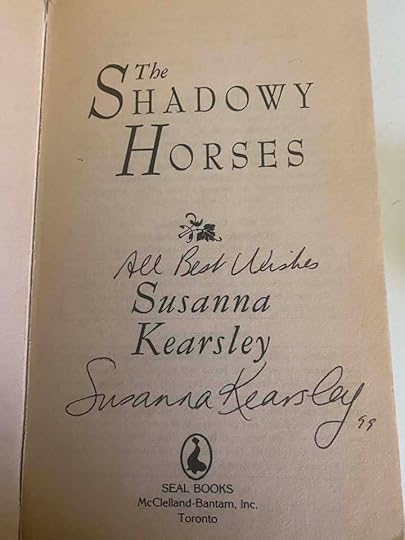
The Shadowy Horses, oddly enough, threw my preconceived notions regarding Kearsley's work right out of the window. After having read The Winter Sea, I expected Kearsley's prose, plot, and characterization to follow a similar pattern, but I found myself pleasantly surprised. While her writing style does, once again, transport readers into a rich, ethereal atmosphere, little else about The Shadowy Horses was similar to The Winter Sea. Yet, despite the fact that Kearsley lacks a formulaic approach, the way most authors with a large back log tend to have, I fell in love with The Shadowy Horses just as much as I did with The Winter Sea, albeit in a slightly different way.
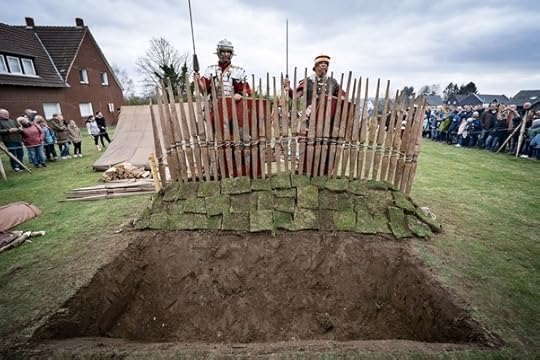
Verity, the protagonist of The Shadowy Horses, is a far cry from the gentle personalities shared by both Carrie and Sophie of The Winter Sea. Instead, I find her to be a much more modern, ambitious woman, driven by her passion for her history and her belief in the impossible. When she arrives in the Scottish Borderlands on an excavation, she knows nearly nothing about her mission. It isn't too long, however, before she realizes that this dig isn't for just a mere artifact or two, but rather for the lost Ninth Roman Legion. And, the only evidence substantiating that the army is, in fact, on this property? Merely the word of a young boy, Robbie, who claims to have seen the ghost of a Roman Sentinel roaming the grounds. Before Verity can dismiss the excavation as a fraud, however, and simply walk away, the ghosts around her force her to question not only her sanity, but everything she has ever believed to be true.
Oddly enough, I found the presence of the plot to be diminished in The Shadowy Horses. Although its premises is intriguing, as is the mystery contained within these pages, The Winter Sea seemed far more focused on a direct plot line than this novel did. Yet, that isn't a detriment in the least. The Shadowy Horses focuses on Verity and, moreover, her interactions with those around her. As Verity becomes part of the lifestyle at this excavation, forming relationships with those at the dig, she finds it harder and harder not to care and simply walk away. In fact, she eventually doesn't want to at all for she finds herself believing Robbie too.
What's more, the enigmatic presence of Davy, another archaeologist on site whose family ties him to the Scottish Borderland, is a little too distracting to turn away from. Despite the fact that The Winter Sea contained not one, but two, romances, The Shadowy Horses is the more romantic of these two novels, perhaps because the romance is not quite so understated or perhaps, simply, because there is space to focus largely on the development of one sole romance. Whatever the reason may be, I enjoyed the love story that played out between Davy and Verity far more than I did either of the romances in The Winter Sea - and I really adored those romances when I read them. Needless to say, there was something tangible about the relationship between Davy and Verity, something about the chemistry sizzling in the air between them, that made me fall head-over-heels for their slow-burn love. Or, perhaps, it is simply the fact that I enjoy Verity far more as a protagonist than I did Carrie or Sophie of The Winter Sea.
With The Winter Sea, Kearsley's driving purpose is to finish the story: finish the story Carrie is writing about Sophie, finish the story she herself is writing about these two heroines to give them an ending worthy of their distinct personalities. With The Shadowy Horses, however, the historical aspects are not so much the main focal point as much as the general atmosphere of the novel is. Verity becomes entrenched into this small town, complete with its belief in Robbie's "second sight" as they like to call it. For a practical, intelligent woman to succumb to local legend, all while falling for a born-and-bred Scot in the process, somehow appealed to my senses just a tiiiny bit more. It helps, too, that she fights off exes with ease, truly harboring no lingering feelings for them to the point where she can work comfortable alongside them to further her career. All the little aspects to Verity's personality molded together into a protagonist I truly did love and hold dear to my heart.
Nevertheless, it seems that with Kearsley one aspect of the story or another seems to be sacrificed along the way. As I mentioned, the historical aspects to The Shadowy Horses weren't as strong as they were in The Winter Sea, a disappointment due to the fact that I became intensely involved in the Jacobite Revolution while reading the former in a way I never became while reading the latter, concerning the Ninth Roman Legion at any rate. Still, both these novels are incredible works of historical fiction - beautifully written, richly crafted, and widely researched. In my eyes, no one book is better than the other, the positives and negatives of both neatly balancing one another. If it isn't already clear, Susanna Kearsley is a must-read for fans of historical fiction. (And, trust me, if you enjoy romance in any capacity you'll want to meet Davy...for sure!)