Silas Umber has finally come into his own as the Undertaker of Lichport when a mysterious invitation calls him beyond the marshes to Arvale, the ancestral manor of the Umbers. There, his extended family endures, waiting for a living Undertaker to return and preside over the Door Doom, an archaic rite that grants a terrible power to summon and bind the dead in judgment.
As Silas assumes the mantle of Janus, the Watcher at the Threshold, deep below the earth in the catacombs and sunken towers, grim spirits grow restless at his arrival—hungry for freedom and eager for vengeance against a family with a long history of harsh judgments. Now, Silas must right an ancient wrong and accept that even a house of ghosts can be haunted by its past—for in matters of family, we are who we were.
Ari Berk is a writer, artist, and scholar of literature, folklore, and myth. Former student of and assistant to Pulitzer Prize winning writer N. Scott Momaday, Ari has written everything from academic works on ancient cultures to popular books about myths and legends for children and adults and, most recently, a trilogy of novels. He works in a library filled to the ceiling with thousands of arcane books and more than a few wondrous artifacts. When not writing, he moonlights as professor of mythology and folklore at Central Michigan University. He lives in Michigan with his wife and son. Visit him at www.ariberk.com.
A superb ghost story and an excellent sequel, Mistle Child continues the story of The Undertaken, telling how Silas Umber takes the next step from being the Undertaker of Lichport to becoming the Janus of Arvale Manor, an ancient family position that wields extraordinary power and authority. Silas must live up to the obligations of his namesake, but in his youth and hubris perhaps creates more problems for himself that may have serious consequences. Silas continues to be haunted by an absence in his heart that he can all but name (and why can't he remember the name?). With an intriguing and unpredictable plot, fantastic imagery, and a spooky and entertaining cast of characters, including many of my favorite characters from Death Watch, Mistle Child is an exciting and lucid sequel in one of the most original series I've yet encountered. It evokes a desire to revisit the first volume and eagerly anticipates the next installment. What will become of Dolores Umber? Cabel Umber? Will Silas be able to satisfy the desires of his heart? Or will he like so many others, spend his life chasing ghosts? I give this my highest recommendation.
There is a genuine sadness to be understood while reading this series. I've found myself very much dealing with the post-read depression that occurs due to having immersed in Ari Berk's beautifully envisioned afterlife, where wrongs can be set right and the restless dead can find meaningful closure. Mistle Child is again no exception, and in this immersive sequel, one becomes lost in the mystery of Silas Umber's expansive ancestral home, Arvale, as well as the horrors buried and forgotten beneath it. Well-researched medieval ballads paint a sorrowful backdrop to the story of the Mistle Child, and an awesomely exciting cliffhanger make waiting for Lych Way, the sequel, that much more unbearable. This is excellent storytelling, all around; very much H.P. Lovecraft for the YA reader.
The first of this series became an immediate favorite and the second has not disappointed. I'm still not sure why this is listed as YA other than the protagonist is a young man, but I can see some goth/emo type loving it. The style puts me in mind of Neil Gaman or Charles de Lint.
Prose are beautiful, the story is both dark and funny, lots of quirky town characters, that behind their urban face are really ancient psychopomps plus a dash of doomed romance. Best of all there are lots of antiquated words that I had to look up (what fun!)
This book ends with a real cliff hanger so I'm committed to read #3.
The second in the Undertaken series, Mistle Child continues the rainy, soft meditation on loss and the thin wall between the living and the dead. More plot-driven than Death Watch, the story builds around Silas and his clan, both past and present, and his journey to become the judge of the great Doom Door of Arvale. Wrapped inside the shifting halls of his ancestral home, the crux of the story stands on the spirit with no name and the mystifying 'Mistle Child' of song and rhyme, which all comes together and culminates with a tender, painful sacrifice that reminds us of how complicated our bonds to one another can be. Excellent bridge to the third and last installment.
I started and stopped reading this book several times because I felt such a great sense of claustrophobia each time I followed Silas further on his journey. But I overcame my fear and what a delight this novel is! This is an evocative story and you will hear, see, touch and taste as you follow along. Very exciting to see Silas continue to grow into his new role as undertaker and the supporting characters are interesting. The only disappointment is that the novel ends and we have to wait for #3!
Another outstanding effort by Ari Berk. It turned out to be less scary than the first book (which meant I could read it at night.) There were some scary bits (it does involve dead people, after all!) but more poignancy, sorry and sacrifice.
As noted before, Berk is a masterful story-teller who makes the reader feel like. . . well, like one of the family.
Looking forward to reading "Lych Way" (update: which definitely did not disappoint!)
So coming off the first book, my main interest was in Silas and Bea's relationship. So I can't say I loved this side diversion to Arvale. Arvale was a lot of dream space and dream logic. I was never totally clear why Silas was here.
Characters: Silas ~ Main character. In the last book he was looking for his lost father. This time around, Silas is trying to remember something he's forgotten (with the help of some friends, unbeknownst to him). He is also on a mission to answer the call of Arvale, the ancestral Umber family home that exists both in our world, and in others. Lars Umber ~ Silas's guide through Arvale, only other living person in Arvale that Silas has come across. Lars is keeping secrets of his own though, and repeatedly states that he cannot return to Lichport. Beatrice ~ Ghost in millpond, Silas's love interest Jonas Umber ~ Ancestor of Silas, helps him become Janus Maud Umber ~ Ancestor of Silas, helps him become Janus, the one who called him to Arvale in the first place, she is one of the older spirits of the house. Ottoline ~ Silas's mysterious cousin, living at the "Summer House" within the grounds gates of Arvale with the other cousins. It's a good thing Silas never got around to dining with them. Mother Peale ~ An elderly woman, and one of the Narrows Folk (the Narrows being the part of town filled with people of the sea) Mother Peale is an old friend of Silace’s father and wise in the ways of those who have remained to wander the streets of this haunted town. Mrs. Bowe ~ A close friend of Amos Umber, Mrs. Bowe is a source of knowledge and support for Silas as he tries to walk in his father’s footsteps. She lives in a house connected to Silas's, and in this book, she and Silas have had a falling out, although she is still trying to protect him. Dolores Umber ~ Silas's mother, and much more likeable in this book than the last. For being in the book so very little, she plays a pivotal role twice. Cabel Umber ~ An Umber ancestor living in Arvale, Silas makes a pact with him before knowing all the details.
Story: Where last time around (in Death Watch) we were introduced to Lichport and its odd inhabitants, this time around we are introduced to more of the Umber family through the estate of Arvale. In the beginning of the book, Silas is summoned to Arvale by a messenger sent by one of his ancestors, Maud. Her exact motives aren't clear, although she wails about a child. Where Death Watch dealt heavily in paternal matters, Mistle Child deals constantly with maternal ones. Everywhere you turn there are mothers surrounding Silas. Male voices are drowned out by the needs of the mothers in this story... and sometimes even the voices of reason are drowned out as well.
Since Silas spends a good portion of the book in a sort of "World Between", the Death Watch itself is rarely utilized. Instead we find ourselves introduced to strange, mysterious objects of power to which we are given passing hints about what they might be. We are introduced to the strange inhabitants of Arvale. In particular I love the cousins who reside at the Summer House. They are almost exactly as I imagined them, if not a bit less malicious than I would have expected. It does make me even more curious about the Umber lineage, though.
Silas spends a lot of time in action, getting done what he came there to do, without really knowing what he was doing at all. While I kind of felt like he was taking some big chances, at the same time, it's good to remember that Silas is a teen, and therefore prone to making rash decisions, especially when people try to keep him from them.
The only complaint I have is that this book was too short. Length is not a detriment to the YA novel when you have the world building capabilities, and luxurious vocabulary of Ari Berk.
I find that I should also note that the one part of the book that has lodged itself in my brain is one tiny, odd little chapter about a stone lion. It was an aside that pointed out how quickly our mark on the world can be destroyed... and how callously. How, even when things are set in stone, they are still subject to change. The chapter niggles at my mind, I find my thoughts drifting back to it. I want to know if there is a true history there, what it references, where this little lion came from, to see his way onto the pages of the book.
Conclusion: Another beautiful, haunting novel from Ari Berk... and while I would have loved it to be longer, well, that's just me being greedy. I'll take what I can get, and revel in the fact that there is more yet to come.
This book was the sequel to "Death Watch", and I must admit, I liked it infinitely more than its predecessor. Probably due to the fact that this book was a lot shorter (333 vs 536 holy crap). It felt like more action was packed in this book, and aside from that, I was really glad to know more about Silas' family. I can't imagine having such an extensive family network. I see about 50 relatives every Chinese New Year, and I can barely keep track of all of them, much less a family of a few hundred. Their dining hall must be of at least this size and length in order to accommodate so many family members:
(Yes, I'm well aware that that's the Hogwarts hall)
The book sometimes gave me the creeps, with its really vivid descriptions and Gothic feel. It didn't help that I also read parts of the book at night. Can you just imagine reading this in the middle of night when the house is completely silent and dark?
There were bones in the corner, partially covered in rags, rotten and threadbare, perhaps once a garment. Next to the bones lay the desiccated corpse of an infant.
This scene was also proceeded by screams AND SOME WEIRD FEELING THING WHICH DID NOT HELP THE WHOLE CREEPY VIBE AT ALL. As you can tell, this book did a great job of freaking me out, which made me love it even more.
The only problem I had with the book was with Silas. I couldn't relate to him most of the time, and I didn't like him the rest of the time. He was just so... Infuriating. He didn't listen when the elders tried to warn him (specifically, Mrs. Bowe). He made a promise to Cabel Umber before he knew what it entailed. HE WENT TO GO REVIVE BEATRICE. USING SOME ANCIENT DARK SPELLS.
DARK SPELLS ARE NOT TO BE MESSED WITH. THEY ARE FORBIDDEN FOR A GOOD REASON. THEY GIVE YOU YOUR HEART'S DESIRE, BUT THEY ALWAYS HAVE A PRICE. AND THE PRICE MIGHT BE TOO HEFTY TO PAY. If I can understand this basic logic, I don't see how Silas can't understand it. Yes, it might give him Beatrice, but it will take away something else precious that he has. He has no clue what he will have to sacrifice in return, but he still decides to do that crappy thing anyway.
It's never a good thing when you like everybody else except for the main character. In fact, it is extremely ill-advised for authors to write about someone who is just generally... An annoyance to read about.
In conclusion, the book is creepy but also good, the main character sucks, the supporting characters are lovely (especially Silas' grandfather), the writing is LOVELY and y'all should read this book. I'll most definitely be picking up the final book of the series.
The Undertaken Trilogy: Mistle Child, by Ari Berk. It's the second novel in The Undertaken Trilogy. I previously read Death Watch and it was really good albeit a bit slow at times. But while reading Mistle Child it became obvious that Death Watch had worked as some sort of prologue for the series. There's a lot of action going on in Mistle Child and it becomes impossible to put down. The series is filled to the brim with mythology and folklore concerning death. Ghosts, living dead, shadowlands, Watcher of the Threshold etc etc. I love the characters and the scenery in this series, which is the reason why I continued reading it after Death Watch. The only thing I don't like about this book is the name. Mistle Child is only mentioned once in the beginning and then not again until the very end when suddenly everything is about this Mistle Child. I'd rather the book were named Arvale or Janus, but I can see a theme of naming every book in the series two words, so I guess that's why. In this book the main character Silas Umber has settled into his role as the new Undertaker of Lichport, a role carried down throughout his family for generations. Out of the blue Silas is called to Arvale, the ancient family house, which he discovers is neither here nor there, but rather seems to be it's very own shadowland host to several of his ancestors one of whom called him there. He is tasked with becoming the new Janus, the Watcher of the Threshold and during the ceremonies an ancient evil is let loose.
Ari Berk really outdid Death Watch. I was fairly impressed but not completely wowed with the first book in his series, but Mistle Child is a great book in general and an even better second-book-in-a-series. Why?
It definitely doesn't suffer from the second-book slump: while there are seeds sown throughout for the conclusion of the series, this book doesn't feel like filler. There is enough action that despite the handful of "hey, this is getting closer to the end of the series" mentions thrown in, it really excites me for the third book.
Berk's narrative has grown and expanded to include a wider array of cultural references, probably because he is feeling more comfortable with his setting. Including a wider variety of characters with whom Silas interacts is probably the best reason for and effect of this attention to detail.
And finally, most importantly, it tells a whole story within itself. Several times even within the most acclaimed series--and series I love!--I feel like the second book is more exposition ("this is stuff you're going to need to know for the third book but I don't want to make the final book too long!") rather than a story on its own. As a result, I find Mistle Child more satisfying than, say, Catching Fire.
Honestly, I would recommend this series to anyone who likes strong mythos and growing tales, as well as dealing with family and cultural issues--though I'd recommend reading Death Watch first.
I read the first book of this series back in late December and I was definitely left unsatisfied with the ending, and that being said (although I didn’t want to) pushed forward to read the second book.
In this book the main character, Silas Umber, is now the official Undertaker of Lichport and everything is going relatively well for him. Until his home is being etched with the strange name ‘Arvale’, which is a historic landmark for the Umber family.
Silas is being summoned to Arvale to take his place as rightful Janus of the threshold. When he makes it, he releases a ghost from the depths of the home restricting his return to the land of the living, Lichport.
I am curious to see how this series ends, and – much to my reluctance- I will be requesting the last book from my public library. - Krys
This sequel to Death Watch is absolutely wondrous. Ari has done more lovely things with Silas and his world and I loved it in almost every way possible.
I especially loved the addition of Silas's cousins and the moment the reader realizes WHO they are (which is easy from Ari's clues if you read the right sorts of folklore but not everyone will have) the way that he has portrayed them is SO perfectly delicious that I actually squeaked out loud.
I do have to say that a few parts felt a bit rushed, and (SPOILERISH) when a fairly important character dies my reaction was "meh." Never cared about the character as written, still don't, death was fairly unemotional. Though given the setting, just because the character is dead doesn't mean they won't still be in the next book!
SOOOO GOOD. If you haven't read Death Watch, read it and then read Mistle Child.
I really liked this book. I read it because my son wanted me to. It would have been better to read the first one, first, and have the others close by. The poetry and marginalia at the beginning of each chapter were beautifully written, but the horror of evil was only hinted at. Allusions run thick and deep, and the titular Mistle Child was deftly embroidered into the tapestry of this book. My son asked who my favourite character was, and it was definitely the great, great grandfather, a very unusual man, but a group of three women who were quick and busy with needles must have come a tight second. I am afraid to write too many spoilers, but this was an enjoyable book, and i would read the others in the trilogy, and others by Ari Berk.
Mistle Child is an incredible sequel to Death Watch.
Silas can't seem to stay out of trouble. Pain plagues his steps and even his closest friends cause him to long for Death. He is called to his ancestral home, Arvale, and once inside finds that his family history is much darker and much more heartbreaking than even he ever expected.
I feel that Silas's journey only gets darker from here and I have so many questions. I hope they will be answered.
TLDR: Mistle Child is amazing and a credit to Ari Berk's mastery of mixing family, heartbreak and folklore into a masterpiece of a tale.
Another fascinating installment in this beautifully written and wonderfully original series. The Mistle Child focuses less on Silas's duties as an Undertaker and more on his role as Janus. Also, this time most of the book takes place outside of Lichport in Arvale. This book was well placed and had plenty of plot twists to hold the readers interest. I'm anxiously awaiting the final book in the trilogy because of the shocking ending in book two. Excellent read! 4 stars.
This book sounded really interesting, but after getting through a few chapters I realized it wasn't as awesome as it sounded. I think the idea is a good one, and as good as the details and explanations are I think that maybe they were overplayed? There was just a little too much detail, so it bored me a little. Aside from that, the characters seem very interesting-especially Silas.
This book was really incredible. I was looking forward to reading this book. And I'm most certainly glad I did. It's even better than the first book(Death Watch). I simply cannot wait to read the third book Lych Way. Ari Berk is simply astonishing.
Silas is summoned to Arvale the ancistral home of the Umbers. The plot uses ancient Greek and Egyptian mythology as inspiration. In this way it reminds me of Ray Bradbury's: "From the Dust Returned," which also has a human boy who lives with some very dark characters.
This book wasn't as enjoyable as the first one, but it kept me interested in the characters. The ending picked up some speed and I'm looking forward to the next one.
This book was amazing!! My wife happened to buy the first book of this series at a used book sale because she thought it was something I may be into. I was just getting into reading books. I never thought I'd be able to read a book through and through with that amount of pages. I always struggled with reading with my ADHD. Reading itself is easy it's the retention of information I'd have problems with if I let a book stay idle or if too much was happening at once. I flew through the 500+ pages in a few days and was hooked. I finally got to this book and even though some time has passed between books this one hooked me right back in! Amazing story! I felt like I was whisked away into this world. Can NOT wait to read the last book! Especially since you reeled me in extra tight with the cliffhanger!!




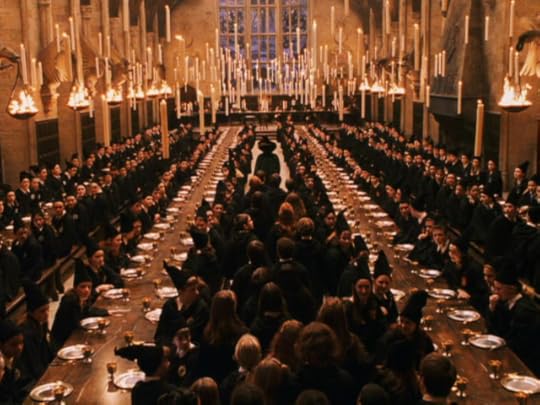 (Yes, I'm well aware that that's the Hogwarts hall)