Il s'appelle Dilvish de Sélar, mais les vieilles chansons parlent plutôt de lui comme de Dilvish le Libérateur. Vaincu par Jélérak, il a été exilé plusieurs siècles durant aux enfers. Un séjour qu'il a mis à profit pour apprendre les douze Abominables Formules de la magie noire. Chevauchant un sombre cheval d'acier capable de cracher du feu, chaussé de bottes d'elfe qui ne laissent aucune empreinte derrière elles, armé de l'Épée Invisible, Dilvish est de retour. Et la route qui le mène de la résurrection à la vengeance lui fera traverser un monde magique où derrière chaque rencontre se cache un danger mortel ou un faux-semblant. Dans ce volume est publiée pour la première fois en France l'intégralité des aventures de Dilvish le Damné, soit onze nouvelles et un roman. Au carrefour de la sword & sorcery classique et de l'hommage à H. P. Lovecraft, Dilvish le Damné fait partie des fantasies les plus assumées de Roger Zelazny.
Roger Joseph Zelazny was an American fantasy and science fiction writer known for his short stories and novels, best known for The Chronicles of Amber. He won the Nebula Award three times (out of 14 nominations) and the Hugo Award six times (also out of 14 nominations), including two Hugos for novels: the serialized novel ...And Call Me Conrad (1965), subsequently published under the title This Immortal (1966), and the novel Lord of Light (1967).
These Dilvish stories are among Zelazny's more accessible fantasy writings, more akin to the Amber series (of which I'm a big fan) than some of his more mythical stuff (or which I'm less of a fan). Dilvish has some unique abilities and possessions, including a limited knowledge of sorcery as well as of demon kind, an invisible sword and a sentient (and talking) metallic horse named Black that makes this perhaps the equine version of Knight Rider. All interesting, but as a hero he suffers from a fairly unremarkable personality.
Revenge is the recurring theme in these linked stories, with Dilvish on a quest to exact vengeance on an evil sorcerer who had sent him to hell as punishment for inadvertently interfering in one of his nefarious rituals. Most tales see Dilvish facing down an evil sorcerer/sorceress and/or minor demon/god that stand in his way. He's most inclined to use his sword, and Black's power, to confront threats, turning to sorcery only as a last resort. Lacking some of the verve and bravado you would typically see in pulpier S&S, it still makes for some entertaining sword & sorcery tales.
Dilvish is frequently overshadowed by Zelazny's many other fine and memorable literary creations, but he's a fine and fun favorite of mine. This book collects the eleven short works to feature him. (He's also the star of a good novel, The Changing Land.) The stories range from among Zelazny's earliest for Fantastic magazine in 1965 to a couple that were original to this volume in 1982. Dilvish returns from Hell for a series of adventures, after the evil Jelerak has turned him into a statue for a century or three. Part elf and part human, he's aided and assisted by Black, the coolest horse companion since Rod Gallowglass or The Lone Ranger. They're very cleverly and lyrically written stories with a decided sword & sorcery flavor. Good stuff!
It's Conan (without his beef bone) meets Elric (without Stormbringer), but featuring a green leather-boot-clad half-Elf main character and his talking metal demon horse sidekick. And it's slightly amazing, thank you very much.
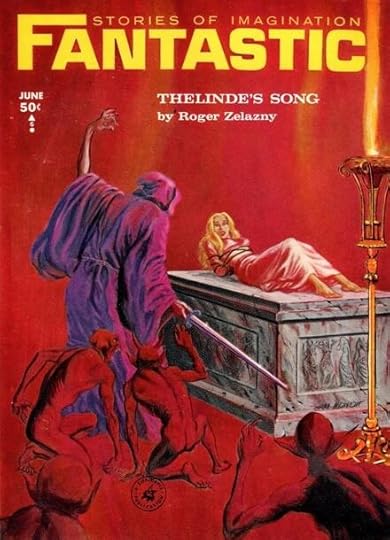
Also, some of the original covers for the stories in this collection are old-school fantasy perfection.
-De lo que se entendía por “evasión” en otras épocas.-
Género. Narrativa fantástica.
Lo que nos cuenta. En el libro Dilvish, el maldito (publicación original: Dilvish, the Dammed, 1982) conoceremos a Dilvish. Tras más de dos siglos convertido en piedra, y con su espíritu en el agujero más profundo del Infierno por la acción del mago Jelerak, Dilvish el Maldito está libre y busca venganza. El camino en busca de su enemigo será difícil, lleno de trampas y aventuras. Fix-Up de relatos sobre el protagonista escritos por Zelazny entre 1964 y 1982 y que continua en la novela La tierra cambiante.
¿Quiere saber más de este libro, sin spoilers? Visite:
Ovo delo se sastoji od 11 koliko toliko povezanih prica o Delvisu Prokletom; Junaku koji na sve nacine pokusava da se osveti zlom carobnjaku koji ga je u trenutku njegove najvece slave okamenio na 200 godina. Razbibriga za sve ljubitelje epske fantastike. Na trenutke fantasticna, na trenutke cist klise sve u svemu knjiga koja vuce da se cita.
Единадесет разказа, издържани в духа на фентъзи поджанра Меч и магия и развиващи се в обща вселена; откриващият, Пътят към Дилфар, се появява на страниците на списание Fantastic Stories of Imagination през февруари 1965, финалният, дал и заглавието на томчето, излиза за първи път именно в него (1982). Любопитен е и друг факт, романът Изменящата се земя, продължаващ приключенията на Дилвиш Прокълнатия, е публикуван година по-рано (1981) от сборника с предхождащите го във времевата линия творби (нещо абсолютно нормално за т.нар. fix-up писателски похват - произведенията са относително самостоятелни и завършени и могат без проблем да се четат изолирано).
Между историите, макар и условно хронологично навързани, са оставени доста празноти; биографията на главния герой също е небрежно щрихована, а информацията, се подава на разпилени дребни късчета: научаваме, че Дилвиш е аристократ, лишен от земи и титли, заради смесената си кръв (човешка и елфическа) и така принуден от обстоятелствата да стане наемник. Малко след голямата битка за освобождението на град Портароа, в която се е отличил, пътят му се пресича с този на злия магьосник Джелерак, Онзи, когото никога не бива да назоваваш (звучи ли ви познато?), в резултат на което е изпратен за два века в ада. Успял, незнайно как, да избяга оттам и сдобил се с верен съюзник - Черньо – свръхестествено създание в облика на стоманен жребец, Дилвиш тръгва по дирите на своя мъчител, а ние ставаме свидетели на задъхани приключения, описани с уникалния жив, пъстър и поетичен език на Зелазни.
В образа на човек, но един и половина пъти по-голям, Хохорга лежеше на плочките в двореца си и вътрешностите му изпълваха скута му. Трима от неговите стражи го крепяха, докато останалите бяха заети с убиеца му. В Книгите на времето се казваше, че Хохорга злия бил неописуем. Дилвиш видя, че това е хем вярно, хем не е.
Той бе красив наглед и с благородни черти; но толкова ослепителна бе красотата му, че всички очи стояха извърнати от неговия лик, сега изкривен от болка. Блед синкав ореол чезнеше около раменете му. Даже в предсмъртните си мъки той бе студен и съвършен като дялан скъпоценен камък, положен върху алено-зелената възглавничка на кръвта му; притежаваше хипнотичното съвършенство на пъстра змия. Говори се, че очите нямали собствено изражение и не можеш да бръкнеш в едно буре с очи и да отделиш тези на ядосан човек или тези на любимия си. Очите на Хохорга бяха очи на сломен бог: безкрайно тъжни и горди като океан от лъвове.
В заключение, ако си падате по многотомни епични фентъзи саги, където всяка незначителна подробност е разчепкана върху десетки страници, това твърде вероятно няма да се окаже вашето четиво, но ако, също като мен, сте влюбени в подобен маниер на разказване - стегнат и лаконичен, оставящ доволно количество изводи на читателското въображение, задължително издирете Залезът на Земята на Джак Ванс и Кларк Аштън Смит: Избрани разкази.
Авторите на фентъзи и фантастика от златните години владеят виртуозно кратките форми, и насищат малко страници с много атмосфера.
Дилвиш Прокълнатия шества из поредица от хронологично подредени разкази, които са завършени, но съчетани, образуват роман. Чудесно е усещането да се излезе през изхода на една история, за да се влезе през входа на друга, а те заедно да образуват трета.
Дилвиш и неговият говорящ демон (под формата на кон) Черньо никак не се вземат на сериозно, и ръсят каламбур след каламбур в неуморното си преследване на злия маг Джелерак. Неизменно ги разсейват магьосници, демони, призраци, девойки в беда и всякакви чудати създания и още по-чудати ситуации.
Не мога да оценя по-високо този приятен експеримент просто защото на Зелазни явно му е омръзнало да се занимава с Дилвиш тук и го е зарязал насред нищото, без да сложи поне подобие на точка, което е възмутително, защото Дилвиш е чудесен. И ако искам някакъв смислен завършек, ще трябва да прочета романа “Изменящата се земя”.
Ако това го бяха превели преди, да кажем доста години, може би щеше да ми е сред любимите книги. Но от друга страна вероятно в момента по-добре успявам да я оценя като сборник от разкази с общ персонаж, обединени като fix-up новела. Цялостното усещане ми е като за истории за Елрик от Мелнибоне, минати през стила на Роджър Зелазни и резултатът е много благ. Даже ще си препрочета "Изменящата се земя", реално излязлото преди този сборник продължение (но разказите в сборника май пък го предхождат, което е нормално), защото се оказа, че тотално съм го забравил...
Добре, защо по дяволите не е преведена на български? Питал съм поне 20 човека, които се занимават с преводи или книгоиздаване и не получих задоволителен отговор. Не е от най-големите шедьоври на Зелазни, но си заслужава. 11 истории свързани с общ главен герой, написани в невероятния, поетичен стил на Зелазни. Историите се развиват преди романа "Изменящата се земя," който е преведен 'щото е роман, ама е по-слаб от разказите. Има войни и магьосници, богове и демони, битки и бягства, омагьосани хора, градове градини, вампири и върколаци, елфи, проститутки и пирати. Накратко: 1. Passage to Dilfar. - Дилвиш и спътникът му, демон в образа на почти-кон, бързат да изпреварят армиите на врага и да стигнат до Дилфар. Пет конника му препречват пътя, отървава се от тях по пет различни начина. 2. Thelinde's song - Предисторията на Дилвиш, разказана на една млада послушничка от главната жрица. 3. The bells of Shoredan. - Дилвиш стига до целта си, но трябва да предприеме още едно пътуване, за да набави подкрепления за Дилфар. Омагьосани кули, жреци, един оживял стар мит и битка смитично същество пазител. 4. A Knight for Merytha. - Празен замък с затворена красива девойка, която се оказва, нещо друго. 5. The Places of AAche. - По пътя си главният герой среща странен крадец и преподава икономически урок на неговата богиня. 6. A city divided - Призрачен град, превърнат в игрална площадка на две сили, обаче на Дилвиш не му се играе. 7. The white beast - Нещо гладно обикаля в нощта. Дали ще е навито на сделка? 8. Tower of ice - Дилвиш стига до едно от скривалищата на врага си. Намира неочаквани съюзници и приятна компания.(Един от най-добрите разказа в книгата) 9. Devil and the dancer. - Демоните изпълняват желания, ако танцуваш за тях, но за по-големи желания трябва жертва. Гостът със странния кон няма да го позволи. 10. Garden of blood. - Спри и помириши цветята, само не заспивай. 11. Dilvish, the damned. - Един крадец със самоубийствени наклонности, натриса Дилвиш в конфликт между последователите на две божества, сливане на паралелни вселени и проклятие. Всички разкази са в хронологичен ред. Ако се беше поддал авторът можеше да хвърли пълнеж между тях и щеше да има среден роман, вместо отлични разкази. Добре че е Железен. Препоръчвам го. И вземете го преведете на български.
Of eleven stories, I most liked the first two shorts, 'Passage to Dilfar' which sets the mood and chivalric-adventure language, and 'Thelinde's Song'; for substantial stories, 'Bells of Shoredan' and 'Devil and the Dancer', and two other short pieces, 'The White Beast' for atmosphere and ambivalence, then 'Gardens of Blood', which got me with weird flowers and sad ghosts of history. Indeed those two last-named spoke the most to me. The final, later-written 'Dilvish, the Damned' annoyed me with jokes to the reader over the characters' heads, and though I don't mind modern slang in otherworld fiction, this too detracted. Because a lot of my enjoyment resided in the language, its 'wild romance and wizardry', imaginative and inventive.
As for Dilvish himself, may he always choose to succor a succubus in need or whatever, against the advice of his metal horse.
Još jednom - sjajan Zelazni s junakom koji balansira na razmeđi suprotnosti - polučovek-poluvilenjak, antijunak koji želi da čini dobra dela, dobročinitelj koji se rukovodi sopstvenim motivima - željom za osvetom, spadalo u smrtno ozbiljnim situacijama, s puno sjajnih avantura, neočekivanih obrta. Sve to upakovano u nekoliko povezanih priča kojima gradi sliku u Dilvišu na različite načine - direktnim opisom, vizijama, flešbekovima, pripovestima iz prošlosti. Sve u svemu, neodoljiv junak koji se lako podvuče pod kožu i o kojem odmah poželite još nešto da pročitate, naročito ako ste ljubitelj EF.
This... is pretty classic Zelazny. Well-written stories with a somewhat overpowered protagonist, and often a zany twist to them.
Not to say that Dilvish has it easy. Most of the stories put him in real danger, and he gets pretty beaten up during the longest short story of the set. But his constant companion is a demon in the form of a metal horse that is untiring, fast and nearly invulnerable. Dilvish has a supremely high pain tolerance (from having spent a couple centuries in the House of Pain in hell), boots of catfall, and of course is very good in a fight. But, the running thread of the series of short stories here is his hunt for revenge on the most powerful evil sorcerer in the world, so he's going to need some advantages in the long run.
The chronology of the stories is fairly loose, but mostly consistent. Dilvish picks up an invisible sword early on, which is important in the next story... and then disappears. Some time passes in here, and other events outside the focus of the stories are put to rest, but I don't see any reference to what happened to his special sword.
Past that nitpick, the stories are all good, though drift some in style, as they were written over a two decade period. The longer stories, near the end of the volume, are particularly good.
Dilvish remains one of Zelazny’s best characters. A hero who has the misfortune of stumbling across an evil wizard preparing to sacrifice a woman to some dark god, Dilvish is banished to hell where he spends a couple of centuries before managing to escape again. He returns determined to gain vengeance and in the possession of a handful of devastating offensive spells (but no little magics like unlocking a door). He also has a companion, a steel demon horse named Black who is by far the best character in the series.
Each “chapter” is a short story published over the length of Zelazny’s career and they get better as Zelazny developed his talent. The first I read was Tower of Ice and it remains my favorite, but frankly all are quite enjoyable. Ultimately this a story of a man consumed with vengeance who never quite loses the hero within him.
Written after 'The Changing Land' this book gives us several short stories about Dilvish before the events in 'The Changing Land'. For a first read, I'd do so in the published order. After, I think reading this one first is the way to go. While some of the wonder is taken from 'The Changing Land', the added depth to the story makes up for it.
It's a good sword & sorcery novel collection of short stories written in a mostly straight forward manner. One story is told in an epic mode. You can almost imagine a bard telling the story. Another tells us why & how Dilvish was sent to Hell. Others add on to the depth of the world as we find out something of Dilvish's ancestors & he meets a goddess in another. All very interesting & readable. Not his best work, but solid & enjoyable.
So what is Dilvish's damnation, anyways? He has (somehow) collected a demonic horse-robot whose rapport with Dilvish is palpable but whose attachment is a given rather than an explained thing. He pursues Jelerak the sorcerer for vengeance but is not particularly single-minded in this goal. He was trapped in some unspoken Hell but emerged remarkably unscarred. Much time has passed but he does not dwell on his losses. In fact, when it comes to it, his temporary companion Reena proves far more interesting.
It is an enjoyable read, especially when Zelazny is hitting on all cylinders.
I went through a fierce swords and sorcery phase as a pre-teen, as I think most American boys do. My local used bookstore had a musty back room filled with precariously balanced piles of sci-fi/fantasy books, lumped together roughly by genre and publisher. There was the TSR pile, where I got my Dragonlance titles. There was the Tor pile, where I found my space adventures. There was a miscellaneous short story and anthology pile where everything that defied easy categorization would end up. I'd go weekly with a few balled up dollar bills or pockets jingling with quarters and comb through for titles that weren't likely to be shelved at my local library. Everything started at a buck, some of the thicker tomes would go for two-fifty.
My selection system was pretty well-established. I'd find a cover that grabbed my fancy, flip to the back for the summary, page through the first couple paragraphs, and then open to a random spot farther along to check if it was "still good" as it went on (I'd been burned early on by too many authors who'd hook you with an amazing first chapter and then fizzle out long before the finale). The whole thing was much like fishing: some days you'd have a big catch, most days you wouldn't, but it was the quiet simplicity of the experience that was really the draw.
This was how I found Dilvish, the Damned.
On the cover was a tacky action scene, a common eyeball-grabbing tactic of the era's publishers. Frozen in mid-magic missile, a sorcerer-type lightning bolted a ranger-type. Pretty cool. On the back, a sampling of text to serve as a teaser that did less to tell you what the book was about than how it would feel. And right there, in the title, was a no-no word: "damned." And then the subscript, "The road to revenge was paved with obstacles that only a man from Hell could overcome." Are you serious? "Damned" and "Hell" right on the cover? With such ballsy language on the front cover, who knew how titilating the contents could be?
I plunked down my dollar and took it home.
I had a road trip coming up, an eighth-grade weekend stay-over field trip of some kind, and I figured I could use something to read on the bus. I read it through once, then flipped right back to page one and went through for a second go, back-to-back, which I had never done before and almost never have done since. Zelazny got me good with this one. He dumps you in the midst of the action, which barrels constantly forward with hardly a pause to catch your breath. Dilvish is a brashly confident badass who takes on any and all comers, equipped with a panoply of magic tools and the goods to put them to use. What was most captivating was the way Zelazny alluded to a rich and complex backstory that is all the more enticing for what it doesn't say.
5 stars out of 5. Equal parts Lord of the Rings and The Princess Bride with a measure of Conan the Barbarian to boot. It is an absolute tragedy that the ancient "date due" stampcard in my library's copy of this book has so few entries, and marked so far apart.
Dilvish es un tipo medio humano y medio elfo que ha pasado 200 años en el infierno por interrumpir un sacrificio del hechicero Jelerak. Ahora ha vuelto, con un caballo demoníaco hecho de acero llamado Black, y ganas de ajustar cuentas.
Con esta premisa, Zelazny nos presenta una serie de relatos breves, en la mejor tradición de la literatura fantástica, algunos de los cuales tienen que ver con esta venganza, y otros son simplemente cosas que pasan al protagonista mientras cumple su misión (que no acaba en este volumen).
Es una obra rápida y ágil, imaginativa e interesante, que se lee con disfrute. Un clásico en el que pasan más cosas en 300 páginas, que en 3000 de otros muchos. Recomendado.
A perennial favourite of mine, Dilvish is one of my comfort books, an old friend. For a series of short stories, it hangs together very well.
Dilvish is a bit of a mirror-hero, in that the reader can project their own aspirations onto him, rather than being subsumed by his drives. Dilvish's needs are simple: Find and defeat his enemy.
From some perhaps it makes the stories and characterization thin but for me, it adds to the richness of the storytelling and world building.
Some of the plot and other devices are perhaps overused (Dilvish's nature, the passage of time) but any jarring that takes you out of the story, is more than made up with the phrasing and word choice. While lyrical, I don't find it to ever be obscure.
In short, a set of classic fantasy adventure tales, hanging together because of the hero and the interactions with his sidekick, and the travels through the land, that can be as uncomplicated or complex as you choose to read into them. Okay, not so short.
This is a collection of stories which Zelazny wrote over a period of (at least) 14 years. As such, the flow of the writing tends to shift somewhat.
The earliest stories are the most spare and economical in terms of prose, and also the most lyrically written, being almost poetic at times. While the later stories tend more towards relaxed prose, and greater detail and nuance in the flow of the stories. All of them are good, but they do bear the hallmarks of the timeframe in which Zelazny wrote them.
Sadly, this collection also falls into the awkward grey limbo of copyright. The stories are still under copyright (as of this review), but they are old enough to have been written with analog manuscripts. As such (legal) digital copies do not exist. Additionally, Zelazny's heirs do not control the copyrights on his works. So, while traditional printed copies still exist, and the collection does (occasionally) get reprinted, in general, it floats in limbo. Too expensive to produce a digital manuscript, yet still legally restricted by copyright. It is a great misfortune that leaves this wonderful work largely inaccessible in an age where digital books are becoming more common.
The stories center around Dilvish, a character who is hard to define, not quite fitting in anywhere. (a typical character choice for Zelazny). He is at times a hero, at times a scoundrel or rogue. He can be moved to act by both the prosaic and the poetic. He comes to us consumed by a driving motivation, and laboring under a series of constricting conditions. Not the least of which is that he is outclassed by his enemy.
The stories fit into the context of Zelazny's peers (such as): Fritz Leiber, Robert E. Howard, Karl Edward Wagner, Harry Harrison being classical High Fantasy. However, Zelazny's characters always tend to be a bit more thoughtful, a bit less ... traditional in terms of their motivations and approach.
In the collection we track Dilvish as he works towards his primary goal, sometimes distracted by peripheral concerns, the cycle would be continued and completed in the full length novel The Changing Land.
Highly recommend for fans of Zelazny, or of classic fantasy stories.
I devoured Zelazny stories as fast as I could find them when I was younger. This is one of the ones I have read and reread many times, and still find myself turning to occasionally even now, decades later.
Utterly conventional fantasy from a master of the form. But is it really so conventional? Dilvish is a standard hero in many ways, chivalrous, courageous, a skilled swordsman, a rescuer of damsels in distress, and he is possessed of almost no cynicism or greed.
His deadly enemy Jelerak the sorceror is almost a textbook villain, utterly cruel, arrogant, supremely powerful and extremely evil. He imprisoned Dilvish in Hell for two hundred years after Dilvish unwittingly interrupted one of Jelerak's magical ceremonies.
But Dilvish escaped from Hell and now seeks vengeance. In this novel he doesn't get it. He helps to frustrate the ambitions of Jelerak but that's all he can manage so far. Jelerak is just too powerful. The lack of a resolution is one of the factors that makes this 'utterly conventional' fantasy less than conventional...
There are other quirks as well. Dilvish's horse is a living metal statue of a horse that seems both wiser and more dangerous than Dilvish himself. And then there's the comedy, little wry exchanges, that help to stamp Zelazny's personal vision on the unfolding story.
And there's the quality of the prose, of course... Far superior to most fantasy writers.
En esta obra, Zelazny nos presenta un héroe con un pasado terrible: condenado durante dos siglos en el infierno, Dilvish consigue liberarse para buscar venganza contra los que lo arrojaron a dicho tormento ayudado por un ser que asume la forma de un caballo de acero.
Dicho así, pinta más que bien, ¿verdad? Bueno, lo cierto es que la materialización no está tan conseguida fundamentalmente por dos cuestiones:
En primer lugar, a veces el tono es tan lírico, sobre todo al comienzo, que casi nos hace saborear la épica más clásica. Los primeros compases me recordaron un poco a La Espada Rota de Poul Anderson. Pero en otras ocasiones, sobre todo en los diálogos, pierde bastante ese carácter y desentona, especialmente al compararlo entre distintas partes del libro.
En segundo lugar, los capítulos son más una sucesión de relatos casi independientes que los apartados de un libro propiamente dicho y, además, pierden bastante consistencia entre sí: hay objetos que desaparecen como si se hubieran esfumado; personajes que, inexplicablemente, son incapaces de ciertas tareas cuando unas páginas más atrás parecían tener mucha más fuerza o poderes; comportamientos del héroe más bien incomprensibles...
Eso sí: hay que concederle al autor que nos ofrece un relato en el que las páginas pasan rápidas y donde algunos detalles del mundo y del propio héroe brillan en ocasiones en las cotas más altas.
Náramně užito. Sbírka povídek, které vycházely ve fantazáckých časopisech v letech 65-82 o týpkovi, který se vrací z pekla a baží po pomstě. Za parťáka má démonického, ocelového koně, který nahodile trousí ironické hlášky a s radostí hlavnímu hrdinovi říká, co kde posral. Nosí elfský polobotky a do problémů se dostává s vypočítanou pravidelností.
Úderný, dynamický, přímý, bez zbytečných odboček. Taková přílivová, mečomagie vlna. Ale čím víc si na ose roků ukrajujeme, tím víc jednotlivé dílky skládačky houstnou.
Nic obrovskýho, ani nabubřelýho. Zkrátka a dobře to baví.
Stručné, svižné, dobrodružné, magické a krásny jazyk ako čerešnička na torte. To je Zelazny v skratke. To som očakávala a to som dostala. S Dilvishom som strávila príjemné popoludnie a už teraz sa teším na naše ďalšie stretnutie. Ak sa k nám pridá aj Black, bude to o to lepšie.
A series of short works featuring the same character, mostly linear in timeline. Genre is Sword & Sorcery. New to Zelazny, I've been reading this alongside the Amber Chronicles. Of the two works, I generally find this the more compelling.
I've had this book for ages, but never read it because of the terrible 80s cover. I read the first few Dilvish stories while working my way through Zelazny's collected stories, and figured I'd finish out the book all at once.
On the whole, I enjoyed the stories, cover notwithstanding. In the collected stories, Zelazny notes this was his attempt at a Conan pastiche, and in that regard, I'd say it succeeds. Dilvish is a little smarter than Conan, and dabbles in sorcery, and has a few other Zelaznyan traits, but the stories have the same feel of those Robert E. Howard epics of the early 20th century.
It's interesting that the first few stories have more of the overwrought language reminiscent of Howard, while the later stories abandon this to some extent. (Zelazny set the series aside after the first few stories, coming back to it later after fan demand.) I prefer the later stories, although they perhaps don't feel as true to form as the earlier ones.
Overall, an entertaining batch of stories. Not Zelazny at his best, but certainly not him at his worst.
A perennial favourite of mine, Dilvish is one of my comfort books, an old friend. For a series of short stories, it hangs together very well.
Dilvish is a bit of a mirror-hero, in that the reader can project their own aspirations onto him, rather than being subsumed by his drives. Dilvish's needs are simple: Find and defeat his enemy.
From some perhaps it makes the stories and characterization thin but for me, it adds to the richness of the storytelling and world building.
Some of the plot and other devices are perhaps overused (Dilvish's nature, the passage of time) but any jarring that takes you out of the story, is more than made up with the phrasing and word choice. While lyrical, I don't find it to ever be obscure.
In short, a set of classic fantasy adventure tales, hanging together because of the hero and the interactions with his sidekick, and the travels through the land, that can be as uncomplicated or complex as you choose to read into them. Okay, not so short.
Dilvish mangages to escape Hell after 200 years and sets off with his metal steed Black to get revenge on Jelerak the sorceror.
3.5 stars - I probably read these stories about forty years ago and still remember bits and pieces of them. Dilvish is at heart a good person (though it sometimes gets him in trouble such as when he stops to help people on the road) who is now solely living to destroy Jelerak. His horse is awesome - he can talk, he can breathe fire, and he is a good companion. What more could you want?
I reread this book so that I can continue through to "The Changing Land" which I never got to previously.
There are two different styles to the stories that make up this book. The earlier ones, from the sixties, remind me of Lord Dunsany and Vance's the Dying Earth, full of a sense of humorous wonder. The others, from the late 70s, follow Leiber's fantasy and Lin Carter's version of Conan.
I much prefer the first kind, but the other stories are also quite entertaining, with Dilvish being often caught in events beyond his control, though not beyond his destructive abilities.
Black, his horse, is the best part of the whole stories.
A formerly cursed hero, arises from the beyond to a vastly different world. A sorcerer is on his immediate 'To kill' list. His trusty steed is a demon encased in the iron body of a black stallion. And he has a hellish sense of humor. This collection of short stories about the adventures of Dilvish and his quest for revenge takes him across his world and meetings with beings you could have dinner with enjoyably or be an enjoyable dinner! A splendid example of writing an epic adventure in a few pages.