

What do you think?

Overclocked: Stories of the Future Present
Have you ever wondered what it's like to get bitten by a zombie? To live through a bioweapon attack? To have every aspect of your life governed by invisible ants? In Cory Doctorow's collection of novellas, he wields his formidable experience in technology and computing to give us mindbending sci-fi tales that explore the possibilities of information technology, and its various uses, run amok. And yes, there is a story about zombies, too.
Contents:
* Printcrime (2006) / short story by Cory Doctorow
* When Sysadmins Ruled the Earth (2006) / novelette by Cory Doctorow
* Anda's Game (2004) / novelette by Cory Doctorow
* I, Robot (2005) / novelette by Cory Doctorow
* I, Row-Boat (2006) / novelette by Cory Doctorow
* After the Siege (2007) / novella by Cory Doctorow
Cory Efram Doctorow is a Canadian-British blogger, journalist, and science fiction author who serves as co-editor of the blog Boing Boing. He is an activist in favour of liberalising copyright laws and a proponent of the Creative Commons organization, using some of their licenses for his books. Some common themes of his work include digital rights management, file sharing, and post-scarcity economics. Doctorow began selling fiction when he was 17 years old and sold several stories followed by the publication of his story Craphound in 1998.
Contents:
* Printcrime (2006) / short story by Cory Doctorow
* When Sysadmins Ruled the Earth (2006) / novelette by Cory Doctorow
* Anda's Game (2004) / novelette by Cory Doctorow
* I, Robot (2005) / novelette by Cory Doctorow
* I, Row-Boat (2006) / novelette by Cory Doctorow
* After the Siege (2007) / novella by Cory Doctorow
Cory Efram Doctorow is a Canadian-British blogger, journalist, and science fiction author who serves as co-editor of the blog Boing Boing. He is an activist in favour of liberalising copyright laws and a proponent of the Creative Commons organization, using some of their licenses for his books. Some common themes of his work include digital rights management, file sharing, and post-scarcity economics. Doctorow began selling fiction when he was 17 years old and sold several stories followed by the publication of his story Craphound in 1998.
285 pages, Paperback
First published February 1, 2007
About the author
Cory Doctorow
260 books7,002 followersCory Doctorow is a science fiction author, activist, journalist and blogger — the co-editor of Boing Boing and the author of the YA graphic novel In Real Life, the nonfiction business book Information Doesn’t Want To Be Free, and young adult novels like Homeland, Pirate Cinema, and
Little Brother
and novels for adults like
Rapture Of The Nerds
and Makers. He is a Fellow for the Electronic Frontier Foundation and co-founded the UK Open Rights Group. Born in Toronto, Canada, he now lives in Los Angeles.
Ratings & Reviews
Friends & Following
Create a free account to discover what your friends think of this book!
Community Reviews
Displaying 1 - 30 of 252 reviews

August 15, 2007
I run hot and cold on Doctorow, sometimes he's really entertaining, and sometimes he doesn't do enough storytelling to cover up the fact that his books serve as a soapbox for him to share his opinions on technology.
This short-story collection contains 5 stories, and each star in my rating corresponds with each of the stories I liked. There were two I could have done without: "When Sysadmins Ruled The Earth" was too self-indulgent for my tastes, almost like it was fantasy wish-fulfillment for someone who takes arguing on the Internets way, way too seriously. "I Row-Boat" reminded me a lot of Doctorow's Down and Out in the Magic Kingdom, except Down and Out was actually well-written.
This short-story collection contains 5 stories, and each star in my rating corresponds with each of the stories I liked. There were two I could have done without: "When Sysadmins Ruled The Earth" was too self-indulgent for my tastes, almost like it was fantasy wish-fulfillment for someone who takes arguing on the Internets way, way too seriously. "I Row-Boat" reminded me a lot of Doctorow's Down and Out in the Magic Kingdom, except Down and Out was actually well-written.

June 21, 2020
Overall, well narrated, but fell way short of what I expected & the stories average out to under 2.5 stars. None were terrible, but just didn't live up to their potential by a long shot. Great ideas & interesting themes that weren't developed or were diluted. Each story is preceded by a short introduction about where the idea came from & where the story was originally published plus miscellaneous observations. They're often as interesting as the story.
Printcrime: Gee, who would have thought of that? Everyone, of course. Sigh. 2 stars He's against DRM & gave the Microsoft Research Digital Rights Management (DRM) Talk which I gave a 5 star review to. It was much better than this story.
When Sysadmins Ruled the Earth: I liked this more the last time I read it free online. 3 stars this time, but I gave it 4 stars in my original review. It does have a lot of heart, just doesn't bear rereading too often.
Anda's Game: a bit of "Ender's Game" & he explains how he likes to allude to a well known title, take the idea & change it. Not a bad idea. This is all on earth & it takes on the inequality of wealth plus a few other things. 3 stars
I, Robot: Using the same title as Asimov's book is just wrong & he could have made his point better by adding an 's' to the end of the title. I could really see Wil Smith playing the MC, so I guess the movie wasn't a complete waste - close, though. So was this story. He had a couple of good ideas threading through this, but never developed them. I prefer his shorter work where he has less time to dilute his themes. 2 stars
I, Row-Boat: Better title, but pretty much the same complaints from me. Good ideas that weren't well developed or diluted. There are also some huge holes that are just ignored with hand waving. 2 stars
After the Siege: Based on his grandmother's experience during the siege of St. Petersburg, this had a fantastic backdrop that was very well described, but he really screwed up the execution. Zombies were not needed & there's a huge hole that's just ignored. 3 stars
Printcrime: Gee, who would have thought of that? Everyone, of course. Sigh. 2 stars He's against DRM & gave the Microsoft Research Digital Rights Management (DRM) Talk which I gave a 5 star review to. It was much better than this story.
When Sysadmins Ruled the Earth: I liked this more the last time I read it free online. 3 stars this time, but I gave it 4 stars in my original review. It does have a lot of heart, just doesn't bear rereading too often.
Anda's Game: a bit of "Ender's Game" & he explains how he likes to allude to a well known title, take the idea & change it. Not a bad idea. This is all on earth & it takes on the inequality of wealth plus a few other things. 3 stars
I, Robot: Using the same title as Asimov's book is just wrong & he could have made his point better by adding an 's' to the end of the title. I could really see Wil Smith playing the MC, so I guess the movie wasn't a complete waste - close, though. So was this story. He had a couple of good ideas threading through this, but never developed them. I prefer his shorter work where he has less time to dilute his themes. 2 stars
I, Row-Boat: Better title, but pretty much the same complaints from me. Good ideas that weren't well developed or diluted. There are also some huge holes that are just ignored with hand waving. 2 stars
After the Siege: Based on his grandmother's experience during the siege of St. Petersburg, this had a fantastic backdrop that was very well described, but he really screwed up the execution. Zombies were not needed & there's a huge hole that's just ignored. 3 stars
February 15, 2025
Not as, well, radicalizing as Radicalized for me, this one leaned a little more into classic sci-fi themes and was markedly less Black Mirror-ish, even if it could get pretty dark in places, particularly when Doctorow explicitly mined his grandmother's memories of the Siege of Leningrad for one tale. The stories I actually listened to were all great though I confess to skipping Robbie the Row-boat as being a touch too silly for my tastes.
Audio note: a great selection of narrators this time, each suited the protagonist and tone of their story admirably even if the last one for The Man Who Sold the Moon inavertently sounded just like Bob Odenkirk as Saul Goodman.
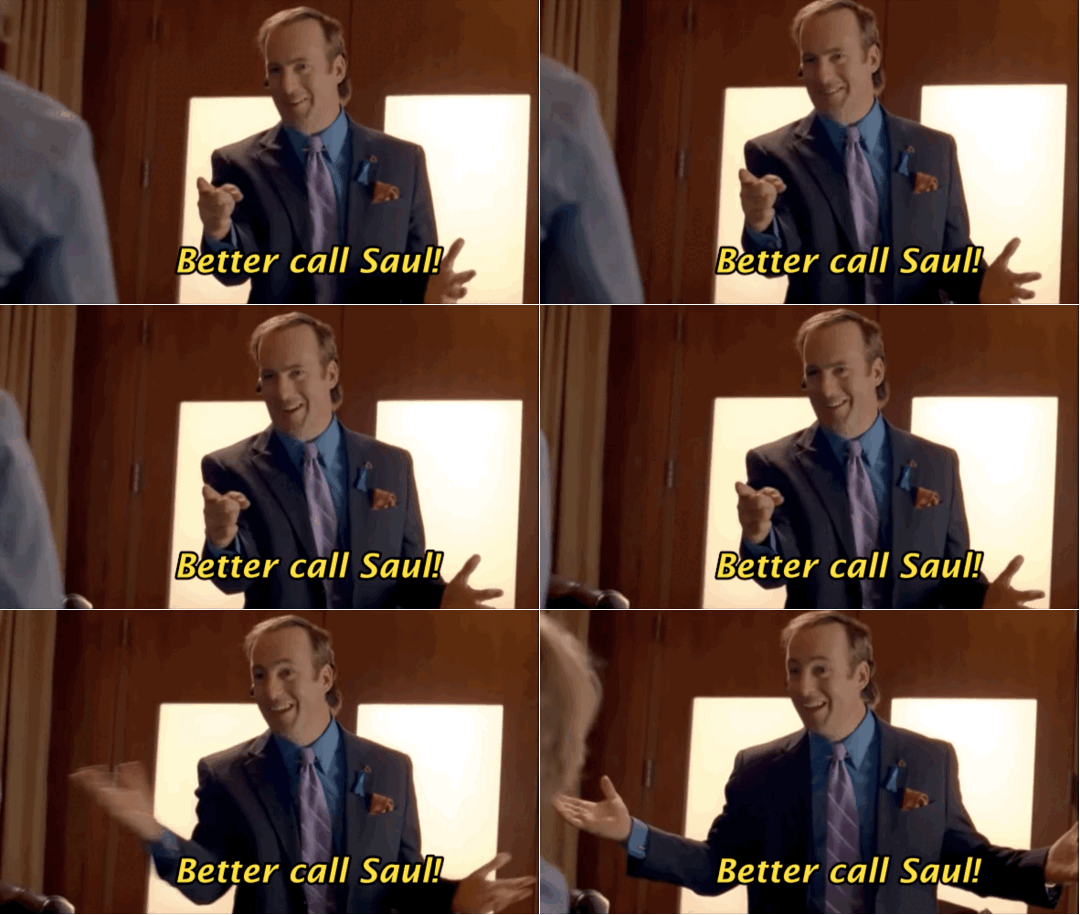
Audio note: a great selection of narrators this time, each suited the protagonist and tone of their story admirably even if the last one for The Man Who Sold the Moon inavertently sounded just like Bob Odenkirk as Saul Goodman.

December 8, 2008
Cory Doctorow is a nerd's nerd. As one of the founders of BoingBoing, he has been at the forefront of web culture, meme dispersion, and fair copyright advocacy. In his off-time he also writes some pretty decent science fiction.
His style is a familiar one- adopting netwide themes into stories to help explain these advances to those who spend less time fully immersed in the digital world. I imagine trying to explain the phenomena of gold farming to someone who has never played World of Warcraft would be difficult, but Doctorow manages to explain it in an engaging manner with his story "Anda's Game" (yes, that's a deliberate play on Ender's Game).
It's rare that we ever think of the server farms that allow sites like Goodreads, Google, or Facebook to function, but a reader swiftly realizes the importance of the System Administrators who oversee these well-oiled machines when a global catastrophe spares only the SysAdmins who were called from their beds in the middle of the night to take care of their servers in his "When SysAdmins Ruled the Earth."
And that's only two of the six stories that Doctorow offers up in this collection. I had heard most of these before because I subscribe to Doctorow's podcast, where he often reads his works-in-progress, but it was enjoyable to see them in print form for once, and I definitely did not mind reading them again. My only complaint is also a familiar one. Doctorow tends to get so wrapped up in his worlds and ideas that his characters feel like so much filler. The man has a nose for technical innovations (I'm still obsessed with seeing his concept of shared music libraries from Eastern Standard Tribes become a reality) but his characters just don't really leave much of an impact. At times it feels as if a person suffering from Aspberger's were trying to write a passionate love story- disconnected, stilted and a little confusing.
His style is a familiar one- adopting netwide themes into stories to help explain these advances to those who spend less time fully immersed in the digital world. I imagine trying to explain the phenomena of gold farming to someone who has never played World of Warcraft would be difficult, but Doctorow manages to explain it in an engaging manner with his story "Anda's Game" (yes, that's a deliberate play on Ender's Game).
It's rare that we ever think of the server farms that allow sites like Goodreads, Google, or Facebook to function, but a reader swiftly realizes the importance of the System Administrators who oversee these well-oiled machines when a global catastrophe spares only the SysAdmins who were called from their beds in the middle of the night to take care of their servers in his "When SysAdmins Ruled the Earth."
And that's only two of the six stories that Doctorow offers up in this collection. I had heard most of these before because I subscribe to Doctorow's podcast, where he often reads his works-in-progress, but it was enjoyable to see them in print form for once, and I definitely did not mind reading them again. My only complaint is also a familiar one. Doctorow tends to get so wrapped up in his worlds and ideas that his characters feel like so much filler. The man has a nose for technical innovations (I'm still obsessed with seeing his concept of shared music libraries from Eastern Standard Tribes become a reality) but his characters just don't really leave much of an impact. At times it feels as if a person suffering from Aspberger's were trying to write a passionate love story- disconnected, stilted and a little confusing.

February 24, 2018
Cory Doctorow has this thing he does. Reading a number of his stories in a collection together makes it more obvious than reading one here and another there, with long gaps between, so let's see if I can articulate what that thing is.
Firstly, he takes a big, unlikely premise based on exaggerating present technopolitical conflicts.
Then he pushes it all the way over the top, and takes it to an unrealistically dystopian place with no apparent way out.
Meanwhile, he distracts you with fireworks: bold characters being awesome (actually, his characters are all pretty much the same character, and I suspect that character is an idealized version of himself); big ideas that other writers might build a whole story around, thrown about like confetti as offhand mentions and background; highly condensed technopolitical arguments that sound convincing, but are so compressed, and so full of references, that you'd need to be deeply immersed in the same ideas and conversations as Doctorow himself in order to fully understand them, let alone engage with them.
And finally, he takes that unrealistically dystopian story and (madly gesticulating and setting off geek-culture flares to distract the reader from the improbability of everything) turns it around, ending with a clear note of hope and techno-optimism.
He does this with great verve, relentless pace, and usually not much in the way of actual plot. (There's always a lot going on, it's just that not a lot of it is plot-relevant in any traditional sense.)
I don't think anyone else could do it. William Gibson lacks the optimism, and Bruce Sterling the panache; Neal Stephenson lacks the pacing, and Rudy Rucker the discipline. Charles Stross perhaps comes closest to the blend of gonzo imagination and storytelling chops, but his work seems more considered and less showy, and his overall tone less hopeful.
It's an entertaining show to watch, even if I'm not always in the mood for it and can find plenty in it to criticize. For example, the bold flip where the (former) US is a dystopian society governed by Orwellian "social harmony" laws, and the (former) China is a techno-utopia, without crime, in which everyone is free to fulfill their potential. ("Social harmony" is a phrase used by the repressive Chinese government, in the real world, to control the populace.)
I did skip a couple of stories in this book; one, based on the Siege of Leningrad, because the introduction seemed to be warning of a darker story than I wanted to read, and one, "The Man Who Sold the Moon," because I'd read it before, relatively recently, and didn't love it so much that I wanted to read it again. It has what I sometimes describe as "not a lot of plot per thousand words".
Firstly, he takes a big, unlikely premise based on exaggerating present technopolitical conflicts.
Then he pushes it all the way over the top, and takes it to an unrealistically dystopian place with no apparent way out.
Meanwhile, he distracts you with fireworks: bold characters being awesome (actually, his characters are all pretty much the same character, and I suspect that character is an idealized version of himself); big ideas that other writers might build a whole story around, thrown about like confetti as offhand mentions and background; highly condensed technopolitical arguments that sound convincing, but are so compressed, and so full of references, that you'd need to be deeply immersed in the same ideas and conversations as Doctorow himself in order to fully understand them, let alone engage with them.
And finally, he takes that unrealistically dystopian story and (madly gesticulating and setting off geek-culture flares to distract the reader from the improbability of everything) turns it around, ending with a clear note of hope and techno-optimism.
He does this with great verve, relentless pace, and usually not much in the way of actual plot. (There's always a lot going on, it's just that not a lot of it is plot-relevant in any traditional sense.)
I don't think anyone else could do it. William Gibson lacks the optimism, and Bruce Sterling the panache; Neal Stephenson lacks the pacing, and Rudy Rucker the discipline. Charles Stross perhaps comes closest to the blend of gonzo imagination and storytelling chops, but his work seems more considered and less showy, and his overall tone less hopeful.
It's an entertaining show to watch, even if I'm not always in the mood for it and can find plenty in it to criticize. For example, the bold flip where the (former) US is a dystopian society governed by Orwellian "social harmony" laws, and the (former) China is a techno-utopia, without crime, in which everyone is free to fulfill their potential. ("Social harmony" is a phrase used by the repressive Chinese government, in the real world, to control the populace.)
I did skip a couple of stories in this book; one, based on the Siege of Leningrad, because the introduction seemed to be warning of a darker story than I wanted to read, and one, "The Man Who Sold the Moon," because I'd read it before, relatively recently, and didn't love it so much that I wanted to read it again. It has what I sometimes describe as "not a lot of plot per thousand words".

January 21, 2023
It starts off with some decent cyberpunk-ish storytelling...but then it takes off into the stratosphere with its exploration of AI...until it finally hits it out of the park and into the stratosphere with "I Row-Boat". This is easily the best sci-fi short story I have read in some time: joyous, funny, sad and sweet. Its adaptations of Asimov are like a candy to a fan of the author such as myself. If that part of the collection existed solely on its own, this would be 5+ stars.

February 17, 2018
What we have in “Overclocked” is a passionate, smart collection of shorts and novellas that plies the territory of speculative sci-fi with an absurdist, cyberpunk edge. It reminds one of the Netflix series “Black Mirror,” a sci-fi anthology that explores a twisted high-tech near future—except in “Overclocked” a ray of hope often pierces the darkness.
Some of these stories are vintage, dating back to 2005-2007 when the Web was still a gangly teenager, while other tales are more recent, but all take on a special resonance in today’s grim, chaotic online environment.
With the death last week of John Perry Barlow, the role of Internet freedom torchbearer has been passed to Doctorow, who mines the intersection of cyberspace and the physical world not through provocative manifestos but with stories of loss, dislocation and occasional redemption.
Sci-fi fans will recognize the knowing tributes to the genre’s masters, including Isaac Asimov, Robert Heinlein and Orson Scott Card (can you tell which ones by the titles?).
• “Printcrime” gives us a snappy takedown of the copyright cartel’s sometimes thuggish behavior. Are 3-D printers mankind’s last best hope to democratize technology?
• In “When Sysadmins Ruled the Earth,” you’ll find IRC chat rooms, Usenet newsgroups, Trojan bots, zombie computers, and blogs teeming with “millions of posts from scared survivors huddling together for electronic warmth” after an unnamed enemy unleashes a bioweapon pathogen that sends civilization reeling. While surviving techno-geeks debate whether to shut down the Internet or keep it running, Felix, our protagonist, doesn’t want to rebuild the old world. He wants a new one.
• “Anda’s Game” offers a take on cyber sweatshops where the schoolgirl Anda and other low-wage online gamers are exploited to generate in-game and real-world wealth.
• “I, Robot” transports us to a techno-totalitarian era when robots are at war and only one mega-corporation is allowed to produce anything and wields the power of the state, including a police officer sent to arrest anyone who pirates copyrighted goods. His daughter, a rebellious teen, takes up the cyberpunk mantle. Bad things happen.
• “I, Rowboat” takes a more fanciful approach, featuring a sentient rowboat with free will that heads out and disturbs a self-aware coral reef. The story explores the question: What is the nature of consciousness when all the people are gone?
• “After the Siege” is a reimagining and updating of the real-life struggles of the author’s Russian grandmother during the siege of Leningrad, though I’m guessing zombies weren’t as big a problem back then. It’s a bleak, powerful story where the horrors of war become fodder for a documentary crew’s infotainment.
• “The Man Who Sold the Moon,” a heartfelt riff on Heinlein’s 1950-51 novella of the same name, is updated for the age of Burning Man, where geeks and Burners ultimately come together to put a solar-powered 3D printing robot on the moon to convert sand into habitable structures. This one won the 2015 Theodore Sturgeon Memorial Award for best short science fiction.
• “Petard” features a young, personable hacktivist who fights shortsighted school administrators and corrupt corporations in an effort to return power to the people.
Bravo! Whether you’re a geek or not, prepare to be entertained and let Internet freedom ring with “Overclocked.”
Some of these stories are vintage, dating back to 2005-2007 when the Web was still a gangly teenager, while other tales are more recent, but all take on a special resonance in today’s grim, chaotic online environment.
With the death last week of John Perry Barlow, the role of Internet freedom torchbearer has been passed to Doctorow, who mines the intersection of cyberspace and the physical world not through provocative manifestos but with stories of loss, dislocation and occasional redemption.
Sci-fi fans will recognize the knowing tributes to the genre’s masters, including Isaac Asimov, Robert Heinlein and Orson Scott Card (can you tell which ones by the titles?).
• “Printcrime” gives us a snappy takedown of the copyright cartel’s sometimes thuggish behavior. Are 3-D printers mankind’s last best hope to democratize technology?
• In “When Sysadmins Ruled the Earth,” you’ll find IRC chat rooms, Usenet newsgroups, Trojan bots, zombie computers, and blogs teeming with “millions of posts from scared survivors huddling together for electronic warmth” after an unnamed enemy unleashes a bioweapon pathogen that sends civilization reeling. While surviving techno-geeks debate whether to shut down the Internet or keep it running, Felix, our protagonist, doesn’t want to rebuild the old world. He wants a new one.
• “Anda’s Game” offers a take on cyber sweatshops where the schoolgirl Anda and other low-wage online gamers are exploited to generate in-game and real-world wealth.
• “I, Robot” transports us to a techno-totalitarian era when robots are at war and only one mega-corporation is allowed to produce anything and wields the power of the state, including a police officer sent to arrest anyone who pirates copyrighted goods. His daughter, a rebellious teen, takes up the cyberpunk mantle. Bad things happen.
• “I, Rowboat” takes a more fanciful approach, featuring a sentient rowboat with free will that heads out and disturbs a self-aware coral reef. The story explores the question: What is the nature of consciousness when all the people are gone?
• “After the Siege” is a reimagining and updating of the real-life struggles of the author’s Russian grandmother during the siege of Leningrad, though I’m guessing zombies weren’t as big a problem back then. It’s a bleak, powerful story where the horrors of war become fodder for a documentary crew’s infotainment.
• “The Man Who Sold the Moon,” a heartfelt riff on Heinlein’s 1950-51 novella of the same name, is updated for the age of Burning Man, where geeks and Burners ultimately come together to put a solar-powered 3D printing robot on the moon to convert sand into habitable structures. This one won the 2015 Theodore Sturgeon Memorial Award for best short science fiction.
• “Petard” features a young, personable hacktivist who fights shortsighted school administrators and corrupt corporations in an effort to return power to the people.
Bravo! Whether you’re a geek or not, prepare to be entertained and let Internet freedom ring with “Overclocked.”

June 23, 2020
Good collection. As always, I liked some stories more then others (doh.) Whole collxn is available online at https://craphound.com/category/overcl... (incl audio version). So, definitely try them, see what you like. Zero risk!
October 24, 2019
I really liked this book. The stories in this book made me really rethink life and the future. The sci-fi stories were really interesting, and made me see life in another way.
August 20, 2022
3.5 bumped up—fair warning that this has some pretty violently triggering fatphobia in it

January 6, 2023
Novellas and stories. Range from good to very very good.

March 6, 2010
I spent a lot of time today, once I wandered over there somehow, on Cory Doctorow's site, looking at his opinions and downloading his books and thinking about it all. I decided I'd read Overclocked, since it's short stories and I didn't feel like reading anything long and drawn out. Of course, the short stories added up to more or less the same amount of reading time, but oh well.
There's six of them. I liked the first one, which is more or less microfiction -- I liked the end, anyway, and the concept. I'd have wound it tighter, hit harder, but I like the idea.
When Sysadmins Ruled The Earth made me laugh in places. I felt like it was a little dry in places where it could have been heart-rending, and skipped where it could have been interesting and got drawn out where it wasn't. Probably my least favourite of the six.
Anda's Game was quite interesting. The extra detail of Anda's life seemed a little dry, at times: it didn't live in my head, I couldn't really sympathise. I wish I had, it could have been awesome.
Next up, I, Robot. I liked this one a lot: it was a world I could get interested in and characters I could get somewhat invested in. I'd have liked more of it.
I, Rowboat made me laugh a good bit, at the start. I like the references to Asimov and the use of the three laws of robotics here. I also liked the introduction: "If I return to this theme, it will be with a story about uplifted cheese sandwiches, called “I, Rarebit”."
And After The Siege... I possibly liked the best. The version I downloaded was badly edited -- I don't know about all versions ever -- and there was some confusing name switching for some reason. But I liked the ideas, although again I felt like some of the emotional life of the story fell flat.
Definitely interesting, and worth spending the time with, but I probably won't revisit it. It feels very focused on the points Cory Doctorow's trying to get across, rather than the lives of his characters, but his ideas are interesting nonetheless. I did like that it's accessible speculative fiction -- no impenetrable technobabble.
There's six of them. I liked the first one, which is more or less microfiction -- I liked the end, anyway, and the concept. I'd have wound it tighter, hit harder, but I like the idea.
When Sysadmins Ruled The Earth made me laugh in places. I felt like it was a little dry in places where it could have been heart-rending, and skipped where it could have been interesting and got drawn out where it wasn't. Probably my least favourite of the six.
Anda's Game was quite interesting. The extra detail of Anda's life seemed a little dry, at times: it didn't live in my head, I couldn't really sympathise. I wish I had, it could have been awesome.
Next up, I, Robot. I liked this one a lot: it was a world I could get interested in and characters I could get somewhat invested in. I'd have liked more of it.
I, Rowboat made me laugh a good bit, at the start. I like the references to Asimov and the use of the three laws of robotics here. I also liked the introduction: "If I return to this theme, it will be with a story about uplifted cheese sandwiches, called “I, Rarebit”."
And After The Siege... I possibly liked the best. The version I downloaded was badly edited -- I don't know about all versions ever -- and there was some confusing name switching for some reason. But I liked the ideas, although again I felt like some of the emotional life of the story fell flat.
Definitely interesting, and worth spending the time with, but I probably won't revisit it. It feels very focused on the points Cory Doctorow's trying to get across, rather than the lives of his characters, but his ideas are interesting nonetheless. I did like that it's accessible speculative fiction -- no impenetrable technobabble.

July 12, 2019
I’ve read a couple of Doctorow’s novels and liked them, so thought I would also be enlightened by his short story collection. As with most such collections, some stories were hits and some were misses. I judge these by the story, and since we’re talking sci fi, by the worlds conjectured. Some of the stories seemed too weird to represent a future state, but were written to make a statement. I’m specifically thinking about “I, Row-Boat”. Not my favorite. I did enjoy “After the Siege” for its gritty take on future techno-enabled city siege warfare. I enjoyed “Anda’s Game” for the cute “turning on the head” of online work, which I suspect is pretty close to reality. And I got a bit of a thrill about “When Sysadmins Ruled the Earth” because I recognize the personality-type and can not imagine a whole bunch in the same place (it's kinda scary). I also appreciated “The Man Who Sold the Moon” as being one of those examples of how an organization can change the future, and how that organization can be driven by a few people with a vision. Kind of a Horatio Alger story, but instead of “rags to riches” we get “interesting idea to world-changing enterprise”. I’ll be reading more. I listened to the audio version with different narrators for each story. I found this a little uneven, needing to slow the playback on one story to maintain my understanding. YMMV.

December 7, 2025
Very Black mirrorish stories of dystopian scenarios for humankind
November 30, 2012
I'm almost certain I've read a few of Doctorow's stories before, likely in Asimov's SF magazine back in the days when it used to be produced in braille, but I don't recall my impression of him at the time other than a vague idea that he liked to play with the concept of technologically assisted evolution. Here I am with my first anthology of Doctorow shorts, some of which have ended up in some pretty mainstream magazines, as well as having a story featured in the Best American Short Stories anholoty edited by Michael CCabon.
The tales are interesting, sometimes even well written. I found myself really impressed by Doctorow's ability to think through a contemporary situation and extrapolate something that's so very close to what we know. The stories largely seem very probable, in other words, even if they deal with some far-flung concepts. His settings feel very real (two of the stories are set in my home city, which helped in my case, at least), and characters are nicely depicted in well-drawn shades of grey. Doctorow clearly has a few axes to grind with respect to the notions of copyrights, trademarks and technology's effect on economic futures all over the globe, and this is a theme that runs through most of the stories here.
Unfortunately Doctorow seems to have a problem with endings. Only the very shortest story in this book ends in what I would consider a satisfactory fashion, and to be frank it's barely consequential and more of an "intro piece" here than anything else. Conflict also doesn't seem very high on Doctorow's list of literary priorities, so that while the idea of conflict certainly exists in every story, said struggle is never really resolved in a way that seems credible, or is sometimes even glossed over entirely by the author merely telling us about what finally happened in the closing paragraphs.
The book is short, so I may as well talk a little of each story individually. Some spoilers, probably, but I'll try and keep them to a minimum.
Printcrime:
A short-short describing how replication technology (that is, the duplication of material objects through digital means) will impact intellectual property and law enforcement. The ending earned a nod from me. This little piece is an excellent way to start off the anthology.
When Sysadmins Ruled the Earth:
Here, Doctorow uses his background as a systems' administrator to hypothesise what would happen to the guys trying to keep the Internet up and running from their hermetic server cages while the world's infrastructure collapsed due to biological, nuclear and incendiary attack. The loneliness of these people, and their hope, are depicted with stark clarity, and not once did I get a sense that any of these things could never happen. Usually I don't give a toss for overblown efforts at realism in science fiction, but I recognise that for stories like this one, it's really important. Of course the ending is a rush job and the small conflict developing among the admins basically just simmers for a bit and then dies, but in this tale it's almost fitting and perhaps had to be this way.
Anda's Game:
The first of a few tributes to older writers' SF stories in here, twisting, of course, the title of Orson Scott Carde's famous depiction of a boy playing games to win a war, and in a way offering an answer or a different perspective on a similar situation. There are also a load of Ray Bradbury references in here, and though I haven't actually read a great deal of Bradbury, it was fun to spot them. This one's about a lonely, overweight English girl whose addicted to the rush of an online fantasy RPG, and how she discovers that little girls in a Mexican sweatshop are being used as wage slaves to click mice and generate gold which is then sold on EBay, and how a rival factory sends children like herself on quest missions in the game to kill their hapless characters. This story is quite cathartic and there are a couple of hearth-wrenching moments. It also seems to have gotten Doctorow a lot of attention in mainstream press. I found it ultimately a bit unsatisfying, though. Again, it's that sense of barely resolved and barely-accounted-for conflict, I think, and the fact that a couple of things about the story just don't seem to make a lot of sense. The big coup basically happens offstage and we never learn why, for example, the leader of the Farrenheit clan, who for some reason goes to schools and encourages girls to play RPGs, ends up supporting the cause of the two young friends fighting for the freedom of the Mexican workers, when presumably she sanctioned their kill missions in the first place. Apart from making young Anda a very sympathetic character, I was impressed by Doctorow's accurate portrayal of gaming culture in both its most positive and negative aspects.
I, ROBOT:
Obviously, this one plays a great deal with Asimov's tropes, but Doctorow has imagined a company like Asimov's US Robotics operating in a sort of dystopian North America. He also borrows some terminology and the eternal war situation from 1984. But while 1984 shows Eurasia and Oceana as basically being two sides of the same sort of scenario, Doctorow's Eurasia seems to be a heavenly utopia of technological, intellectual and artistic progress whereas the UNATS regions are backwards, sheep-like, supersticious and ruled by fear and repression. This one's protagonist is a divorced Toronto cop with a troublesome daughter who neglects her school and so forth so she can engage in illegal activities, much to her father's chagrin. The officer follows the party line implicitly until his daughter goes missing, which sets in motion a chain of events which will lead him to break a number of rules and ultimately to reunite with his defected ex-wife. I appreciated how Arturo, the cop in question, was shown to be a hardened and none-too-likable man, yet ultimately a well-intentioned one who really cared for his young daughter, despite his blustery threats and posturing. What I did not really take to was the simplistic nature of the revelations that come fast and furious by the end. It was particularly frustrating because the tone set in the first several pages is one of intrigue and tension, with a nearly dystopian-noir feeling that I found eminently appealing. But, damnit, Eurasia is just so perfect, and so far ahead of everyone else, and we should all, apparently, embrace the idea of multiple clones of ourselves running in parallel, and harmonious social matrimony with robotics, and in Eurasia they don't even have any crime. At one point the police find a robot assassins designed to disable UNATS robots, and upon capture it begins to spout slogans about the greatness of Eurasia and its achievements, and how well it treats defectors. One of the lab workers muses that the machines like to "drop into propaganda mode" when captured. Well, once Arturo's ex-wife shows up, I felt like Cory Doctorow had dropped into some kind of propaganda mode of his own. Call me a cynic, if you will, but I simply refuse to believe in this kind of dualism: This side, all bad, backwards and horrible; that side, a bastion of wonder and progress. The "estrange family reunited" maudlinness at the end made me feel a little queasy inside.
I, Row-Boat
Well, here we go: A story about a lonely robot-row-boat operating as an attachment to a ship that takes humans on deep-sea dives somewhere off the Australian coral coast. Machines have attained sentience, but most of them decide to shut down their awareness once humanity leaves the Earth and uploads its consciousness en masse to some kind of shiny digital wonderworld network spanning the vast solar system and all its satellites. Humans can download themselves into "body shells" at will to experience flesh sensations, and a religion called Asimovism has grown rampant among the remaining self-aware robots which operates on the precepts of Asimov's Three Laws. Animals have also been "uplifted" into intelligence (I believe this concept was borrowed from David Bryn), and the premise of this tale is that a coral reef has been "awakened" and is none too happy with humanity infesting its waters. it took me a bit to warm to this one, but I eventually grew rather fascinated by it. The philosophical discussions between Robbie the Row-Boat and the entity calling itself R. Daneel Olivaw, a sort of Asimovism guru (naturally), are quite interesting even if they ultimately don't seem to lead anywhere. I laughed at the notion of IMs and Wikipedia still being around in this hyper-evolved future time. What also fascinated me--and I may be revealing a little about myself by saying this--is that in my gut I feel rather apprehensive about the idea of these kinds of far-flung human evolutions. Would you jetison your body if it meant you could flit among the satellites and planets, existing inside servers and machines and capable of performing vast computations at the level of millions per second? I admit it, the "cybernetic future" unsettles me--I grew up with the kind of stories that were warnings about just this sort of thing: That it meant loss of individuality, emotion, that our bodies and earthly "meat" are of paramount importance, and that we should not put our faith in machines and their like. I suspect for people like Doctorow, quite the reverse is true--and he isn't necessarily saying we ought to put "faith" in machines, but rather that freedom from our earthly forms will mean we will be able to clean up the planet and reawaken nature to something like its former glory, only, perhaps, improved. What startled me I think was that this story made me pause and examine my own mindset, and wonder why it is exactly that I balk at the notion of such shattering techno-evolutionary changes. We may get there very, very slowly, and in tiny increments, but it seems very likely that humans will become more and more cybernetised in the coming centuries. To his credit, Doctorow does examine this issue in some depth and from more than one angle, so he doesn't really come across like a raving technophile. Again, the ending was simultaneously a bit too perfect and yet not perfect or satisfying at all.
After the Siege:
Using his grandmother's struggle in Leningrad of the 1940s as a basis, Doctorow weaves this tense and heavy story of a future city deemed guilty of some kind of intellectual property violation (they use "pritners" to copy vast quantities of matter so that everyone will be fed and so poverty will not exist) and placed under siege by a group of nations, led, apparently, by the USA. The country in which this tale takes place is never named, but the feeling is certainly rather Eastern european, and the society depicted probably communist. The protagonist is a young girl, again, and the story shows how she must struggle as her world dies all around her. Bio-weapon-inflicted zombiism runs rampant in the city, and food is scarce, power nonexistent, and the corpses of her family and friends pile up all around her. This is a grave tale and I found that, perhaps due to Doctorow's personal connection with the subject matter, his writing attained a peak here. There's a little more to the story, too: young Vale discovers a man living on the outskirts of the city with an unbelievable quantity of food, fine clothes, and other unheard-of amenities. Doctorow writes the story in such a way that for pages you think this "Wizard" is working for the city's enemy, but the truth is, in some respects, worse. Doctorow seems to be making some pretty pointed social commentary here, especially about the filthy nature of appeasement and the inaction of bodies like the United Nations. At one point a character of the Wizard's entourage says something like: "it's one thing to chastise your enemies for their slaughter, and quite another to put an end to it". A fine message; one which I agree with wholeheartedly. Unfortunately, once again, we have an ending that falls a bit flat for me, and even the elevated writing can't really prevent me from rolling my eyes when there's an inexplicably maudlin and pseudo-romantic last page. I would have also liked to have understood the conflict between the city and its rivals a little better. Presumably the enemy also have "printers", and the Wizard certainly does, so what's the problem, exactly? I suppose it's that the city wanted to make such technology available freely to all peoples, and the North Americans/EU, driven by corporate interests, wanted to force a high price for their product. Still, this could certainly have been more elucidated or discussed in the text. Good story though, up until the last few pages.
There you have it. I found this to be a very interesting read even though I feel like coming down hard on some of the tales. I don't think I'll be rushing out to buy more Doctorow books, but if another crosses my path I will probably read with engagement.
The tales are interesting, sometimes even well written. I found myself really impressed by Doctorow's ability to think through a contemporary situation and extrapolate something that's so very close to what we know. The stories largely seem very probable, in other words, even if they deal with some far-flung concepts. His settings feel very real (two of the stories are set in my home city, which helped in my case, at least), and characters are nicely depicted in well-drawn shades of grey. Doctorow clearly has a few axes to grind with respect to the notions of copyrights, trademarks and technology's effect on economic futures all over the globe, and this is a theme that runs through most of the stories here.
Unfortunately Doctorow seems to have a problem with endings. Only the very shortest story in this book ends in what I would consider a satisfactory fashion, and to be frank it's barely consequential and more of an "intro piece" here than anything else. Conflict also doesn't seem very high on Doctorow's list of literary priorities, so that while the idea of conflict certainly exists in every story, said struggle is never really resolved in a way that seems credible, or is sometimes even glossed over entirely by the author merely telling us about what finally happened in the closing paragraphs.
The book is short, so I may as well talk a little of each story individually. Some spoilers, probably, but I'll try and keep them to a minimum.
Printcrime:
A short-short describing how replication technology (that is, the duplication of material objects through digital means) will impact intellectual property and law enforcement. The ending earned a nod from me. This little piece is an excellent way to start off the anthology.
When Sysadmins Ruled the Earth:
Here, Doctorow uses his background as a systems' administrator to hypothesise what would happen to the guys trying to keep the Internet up and running from their hermetic server cages while the world's infrastructure collapsed due to biological, nuclear and incendiary attack. The loneliness of these people, and their hope, are depicted with stark clarity, and not once did I get a sense that any of these things could never happen. Usually I don't give a toss for overblown efforts at realism in science fiction, but I recognise that for stories like this one, it's really important. Of course the ending is a rush job and the small conflict developing among the admins basically just simmers for a bit and then dies, but in this tale it's almost fitting and perhaps had to be this way.
Anda's Game:
The first of a few tributes to older writers' SF stories in here, twisting, of course, the title of Orson Scott Carde's famous depiction of a boy playing games to win a war, and in a way offering an answer or a different perspective on a similar situation. There are also a load of Ray Bradbury references in here, and though I haven't actually read a great deal of Bradbury, it was fun to spot them. This one's about a lonely, overweight English girl whose addicted to the rush of an online fantasy RPG, and how she discovers that little girls in a Mexican sweatshop are being used as wage slaves to click mice and generate gold which is then sold on EBay, and how a rival factory sends children like herself on quest missions in the game to kill their hapless characters. This story is quite cathartic and there are a couple of hearth-wrenching moments. It also seems to have gotten Doctorow a lot of attention in mainstream press. I found it ultimately a bit unsatisfying, though. Again, it's that sense of barely resolved and barely-accounted-for conflict, I think, and the fact that a couple of things about the story just don't seem to make a lot of sense. The big coup basically happens offstage and we never learn why, for example, the leader of the Farrenheit clan, who for some reason goes to schools and encourages girls to play RPGs, ends up supporting the cause of the two young friends fighting for the freedom of the Mexican workers, when presumably she sanctioned their kill missions in the first place. Apart from making young Anda a very sympathetic character, I was impressed by Doctorow's accurate portrayal of gaming culture in both its most positive and negative aspects.
I, ROBOT:
Obviously, this one plays a great deal with Asimov's tropes, but Doctorow has imagined a company like Asimov's US Robotics operating in a sort of dystopian North America. He also borrows some terminology and the eternal war situation from 1984. But while 1984 shows Eurasia and Oceana as basically being two sides of the same sort of scenario, Doctorow's Eurasia seems to be a heavenly utopia of technological, intellectual and artistic progress whereas the UNATS regions are backwards, sheep-like, supersticious and ruled by fear and repression. This one's protagonist is a divorced Toronto cop with a troublesome daughter who neglects her school and so forth so she can engage in illegal activities, much to her father's chagrin. The officer follows the party line implicitly until his daughter goes missing, which sets in motion a chain of events which will lead him to break a number of rules and ultimately to reunite with his defected ex-wife. I appreciated how Arturo, the cop in question, was shown to be a hardened and none-too-likable man, yet ultimately a well-intentioned one who really cared for his young daughter, despite his blustery threats and posturing. What I did not really take to was the simplistic nature of the revelations that come fast and furious by the end. It was particularly frustrating because the tone set in the first several pages is one of intrigue and tension, with a nearly dystopian-noir feeling that I found eminently appealing. But, damnit, Eurasia is just so perfect, and so far ahead of everyone else, and we should all, apparently, embrace the idea of multiple clones of ourselves running in parallel, and harmonious social matrimony with robotics, and in Eurasia they don't even have any crime. At one point the police find a robot assassins designed to disable UNATS robots, and upon capture it begins to spout slogans about the greatness of Eurasia and its achievements, and how well it treats defectors. One of the lab workers muses that the machines like to "drop into propaganda mode" when captured. Well, once Arturo's ex-wife shows up, I felt like Cory Doctorow had dropped into some kind of propaganda mode of his own. Call me a cynic, if you will, but I simply refuse to believe in this kind of dualism: This side, all bad, backwards and horrible; that side, a bastion of wonder and progress. The "estrange family reunited" maudlinness at the end made me feel a little queasy inside.
I, Row-Boat
Well, here we go: A story about a lonely robot-row-boat operating as an attachment to a ship that takes humans on deep-sea dives somewhere off the Australian coral coast. Machines have attained sentience, but most of them decide to shut down their awareness once humanity leaves the Earth and uploads its consciousness en masse to some kind of shiny digital wonderworld network spanning the vast solar system and all its satellites. Humans can download themselves into "body shells" at will to experience flesh sensations, and a religion called Asimovism has grown rampant among the remaining self-aware robots which operates on the precepts of Asimov's Three Laws. Animals have also been "uplifted" into intelligence (I believe this concept was borrowed from David Bryn), and the premise of this tale is that a coral reef has been "awakened" and is none too happy with humanity infesting its waters. it took me a bit to warm to this one, but I eventually grew rather fascinated by it. The philosophical discussions between Robbie the Row-Boat and the entity calling itself R. Daneel Olivaw, a sort of Asimovism guru (naturally), are quite interesting even if they ultimately don't seem to lead anywhere. I laughed at the notion of IMs and Wikipedia still being around in this hyper-evolved future time. What also fascinated me--and I may be revealing a little about myself by saying this--is that in my gut I feel rather apprehensive about the idea of these kinds of far-flung human evolutions. Would you jetison your body if it meant you could flit among the satellites and planets, existing inside servers and machines and capable of performing vast computations at the level of millions per second? I admit it, the "cybernetic future" unsettles me--I grew up with the kind of stories that were warnings about just this sort of thing: That it meant loss of individuality, emotion, that our bodies and earthly "meat" are of paramount importance, and that we should not put our faith in machines and their like. I suspect for people like Doctorow, quite the reverse is true--and he isn't necessarily saying we ought to put "faith" in machines, but rather that freedom from our earthly forms will mean we will be able to clean up the planet and reawaken nature to something like its former glory, only, perhaps, improved. What startled me I think was that this story made me pause and examine my own mindset, and wonder why it is exactly that I balk at the notion of such shattering techno-evolutionary changes. We may get there very, very slowly, and in tiny increments, but it seems very likely that humans will become more and more cybernetised in the coming centuries. To his credit, Doctorow does examine this issue in some depth and from more than one angle, so he doesn't really come across like a raving technophile. Again, the ending was simultaneously a bit too perfect and yet not perfect or satisfying at all.
After the Siege:
Using his grandmother's struggle in Leningrad of the 1940s as a basis, Doctorow weaves this tense and heavy story of a future city deemed guilty of some kind of intellectual property violation (they use "pritners" to copy vast quantities of matter so that everyone will be fed and so poverty will not exist) and placed under siege by a group of nations, led, apparently, by the USA. The country in which this tale takes place is never named, but the feeling is certainly rather Eastern european, and the society depicted probably communist. The protagonist is a young girl, again, and the story shows how she must struggle as her world dies all around her. Bio-weapon-inflicted zombiism runs rampant in the city, and food is scarce, power nonexistent, and the corpses of her family and friends pile up all around her. This is a grave tale and I found that, perhaps due to Doctorow's personal connection with the subject matter, his writing attained a peak here. There's a little more to the story, too: young Vale discovers a man living on the outskirts of the city with an unbelievable quantity of food, fine clothes, and other unheard-of amenities. Doctorow writes the story in such a way that for pages you think this "Wizard" is working for the city's enemy, but the truth is, in some respects, worse. Doctorow seems to be making some pretty pointed social commentary here, especially about the filthy nature of appeasement and the inaction of bodies like the United Nations. At one point a character of the Wizard's entourage says something like: "it's one thing to chastise your enemies for their slaughter, and quite another to put an end to it". A fine message; one which I agree with wholeheartedly. Unfortunately, once again, we have an ending that falls a bit flat for me, and even the elevated writing can't really prevent me from rolling my eyes when there's an inexplicably maudlin and pseudo-romantic last page. I would have also liked to have understood the conflict between the city and its rivals a little better. Presumably the enemy also have "printers", and the Wizard certainly does, so what's the problem, exactly? I suppose it's that the city wanted to make such technology available freely to all peoples, and the North Americans/EU, driven by corporate interests, wanted to force a high price for their product. Still, this could certainly have been more elucidated or discussed in the text. Good story though, up until the last few pages.
There you have it. I found this to be a very interesting read even though I feel like coming down hard on some of the tales. I don't think I'll be rushing out to buy more Doctorow books, but if another crosses my path I will probably read with engagement.

Read
September 4, 2019I've only read two of Doctorow's novels, one of which expanded my mind such that I've read it three times and roleplayed in its world and used it as part of an aborted Kenneth-Goldsmithian mechanico-literary experiment (Down and Out in the Magic Kingdom), another of which I found competent but not worth pursuing as far as its sequel (Little Brother). I daresay that this collection is strong evidence that Doctorow provides more worth to the world when he's printing short stories in place of novels. Other than the weakpoint "I, Robot", every story is worth your time and worth your time again.
Doctorow has a facility with the present cultural moment and uses the illusion of the future and characters worth caring about to splay it out before us. "After the Seige" is particularly true, and beautiful, if you're looking to be economical.
(A part of the Shelf Love project: https://tinyurl.com/y5w8h4pa)
8W
Doctorow has a facility with the present cultural moment and uses the illusion of the future and characters worth caring about to splay it out before us. "After the Seige" is particularly true, and beautiful, if you're looking to be economical.
(A part of the Shelf Love project: https://tinyurl.com/y5w8h4pa)
8W
March 28, 2024
I thought they were all cool short stories which especially with the introduction had some relevant themes to discuss. Afterwards I read some critique and Doctorow is not the new Philip K Dick. But they are some decent thoughtful ideas. Especially the one on war seen from the inside of a low tech country was too relevant these days.

January 18, 2024
I so wanted to like this. Only one of the stories was any good. That first story was like...why? What purpose did that serve. Ugh.

August 19, 2019
I will give Doctorow credit that he tends to put his beliefs into practice in regards to copyright laws, releasing his books in electronic versions through Creative Commons licenses. He's a strong advocate for his ideas on how information should be handled in the 21st century and his essays on the role of digital media and our relationships to it are probably interesting reading.
I just wish he could make his stories more interesting.
Before this I had read one of his novels, "Eastern Standard Tribe", which I felt took the kernel of a quirky concept and then proceeded to spend a lot of its time having the man character prove his genius to us over and over again instead of playing with the consequences of its concept. With the book being fairly short to begin with, it didn't leave a lot of room for fascinating plot twists but you definitely left feeling that the main character was a rare man of independent thought, mostly because the book kept telling you that. Just my kind of novel.
Here, in a volume about the same length as that novel, he gives us six stories (really five, as one is too short to really count) with some context setting introductions. All were published in the couple years proceeding that novel and if it proves one thing, its that he was definitely consistent. But its up to you to figure out if it’s a kind of consistency you're going to like.
The stories here run the gamut, if the gamut only included "the sort of near future" and often are based around worlds that either a) a trend that worries Doctorow has run amok or b) are missing ideas of his that would make that world better, at least until that idea gets introduced. If that suggests to you that he's presenting essays disguised as stories, its not quite that bad since they have characters and plot (in other words, not "Atlas Shrugged") but because the story often assumes that we're going to find the core ideas as fascinating as the story itself does that fascination is going to do all the heavy lifting and make the story stand out. Unfortunately, too often it just makes you wish there was more story, or at least a better one.
The first tale "Printcrime" is a micro story that's about a page or two long and focuses on the impact of 3-D printers on trademarks. Telling an entertaining story about this in thirty pages would probably be tough unless your job is a trademark attorney but with only a very small space it barely makes an impact at all. Let's just say its no "For sale: baby shoes. Never worn."
"When Sysadmins Ruled the Earth" is the first proper story, basically telling the tale of the collapse of civilization and how its saved by your local IT department, how the Internet forms into different factions and eventually how a government of sorts reconstructs itself, probably along lines that Doctorow would find more palatable. Weirdly as much as the last story was too short to leave an impression, this one probably should have been longer for the type of story its trying to tell, never really conveying the horror of what appears to be a large population cut (one of the protagonists loses some family and I've grieved more upon finishing the last piece of a particularly tasty pizza) but not really tipping too far into hysterical satire as cyberspace pulls itself back together in the irreverent ways of the Internet we all know and love. Part of this might be because even though it was published in the far off time of the mid-2000s it feels somewhat dated in its mentions of newsgroups and the nature of the Internet itself (in its own way any given day on just about any social media platform is unbelievably more savage, like a game where everyone gets in a double-dutch with a jumprope made of hand grenades). Its not bad, it just feels . . . quaint, less informed by actual dread as much as focused on being a vehicle for the main idea (for my money, minus the computers Hector Oesterheld's Argentine comic strip "The Eternaut" captures more of the mood I was hoping for here, even as it acts as a critique on the political conditions of a country that would cause him to disappear and presumably die).
The "story as idea bus" takes center stage in "Anda's Game" as well, one of a series of stories that Doctorow uses to critique and respond to SF classics, in this case Orson Scott Card's "Ender's Game". Much like that story, it features a teenager who is good at video games who eventually finds that the boundaries between actions in the video games and actions in real life are a little blurrier than she'd like. This one is okay as well, part of the problem is that Doctorow's prose is routinely pedestrian, existing to move the story along without adding any kind of snap or verve. The story exists to get to Anda's central dilemma as she finds out what the "missions" that her friend Lucy has been recruiting her for are really about but the reveal isn't nearly as severe as the story its patterning itself after and the story doesn't seem as concerned with the consequences of what it reveals so much as Anda's reaction to it and how it teaches her what's most important in life, which felt . . . somewhat underwhelming, like finding out the charity you've been volunteering for has been funneling the money into clubbing seals and that makes you want to ensure you make your bed every morning.
In that vein we get to "I, Robot", named of course after the Asimov collection and not the Will Smith movie that figured that what Asimov stories really needed were action sequences featuring murderous robots (in all fairness, an action scene every so often would have been a nice change of pace). Here Doctorow seems to want to cram in every influence he can, using Asimov's works as a starting point but then seemingly cramming it into the Orwellian "1984" world that's always at war with Eurasia as a driven job searches for his runaway daughter (whose middle name is ha-ha literally "trouble") with the help of some really polite robots. What's supposed to feel like a studied critique often comes across as a pastiche and thus kind of weightless, especially when he does the Doctorow thing of pulling the curtain back and revealing that a perfect world exists that coincidentally has implemented all his ideas on the freedom of information, which makes it feel less like a story and more like wish fulfillment.
Even with that its still light-years better as a story than "I, Row-Boat" which I guess is another critique coming in from a different angle but feels at times like it was translated into another language and then translated back by someone who hasn't slept in a week. As best I can tell it deals with a robot boat named Robbie who runs into a human that has downloaded herself into another body and then is arguing with a guy downloaded into a different body, all the while fighting off a sentient cybernetic coral reef that is bent on killing everyone. That sounds like it should be fun but for some reason comes across as unbearably tedious, not serious enough to be engaging but not funny enough to be gut-busting, instead just existing until its over. When you're finding your sympathies lying with the coral reef, its probably not a good sign.
Fortunately he does end on a somewhat high note, with "After the Siege" based around his grandmother's experiences in the Siege of Leningrad (spoiler alert: they weren't good) but set in an unnamed country in the near future that has been sealed off from the world and has to fend for itself. Featuring another teenage protagonist, Valentine learns to grow up quickly as her parents are sucked into the war and it goes on and on without any seeming end to the misery. While most of Doctorow's stories in this volume left me cold as whether I should care or not about anyone in the story, given some room to stretch out here he manages to blend his grandmother's memories into a story about a girl whose world is falling apart and has to reconstruct herself in the process even as everything she loves is stripped away from her bit by bit. If it falters its in the usual place where Doctorow tries to slip in his ideas on copyright and patent laws (exemplified in a mysterious character who keeps managing to help Valentine out when things are dire, which is often) . . . the ideas themselves are worth debating but there's no real debate going on here other than to use the story to self-evidently prove their worth by showing an extreme alternative. The problem is, and maybe the problem with all these stories, is that it shows the world as it is in the story to be paper-thin, existing only as far as the underlying ideas inhabit them. All fiction in a way exists in its own bubble but the best writers make those worlds, no matter how outlandish, feel vital, places where people break a sweat, love, despair, see it in a way we can't from our vantage and still manage to convey the view. Doctorow's stories, at least here, are so intent on getting us to the text of the subtext that we don't see the colors of the world itself so much as a steady stream of black and white text. Its an experience perhaps meant to be more cerebral than passionate but more often it feels like that Werner Herzog film where all the actors were entranced, only instead of their lines they're reading white papers to each other. Maybe if you're lucky you'll learn something in the process, but chances are you're going to feel as numb as they come across.
I just wish he could make his stories more interesting.
Before this I had read one of his novels, "Eastern Standard Tribe", which I felt took the kernel of a quirky concept and then proceeded to spend a lot of its time having the man character prove his genius to us over and over again instead of playing with the consequences of its concept. With the book being fairly short to begin with, it didn't leave a lot of room for fascinating plot twists but you definitely left feeling that the main character was a rare man of independent thought, mostly because the book kept telling you that. Just my kind of novel.
Here, in a volume about the same length as that novel, he gives us six stories (really five, as one is too short to really count) with some context setting introductions. All were published in the couple years proceeding that novel and if it proves one thing, its that he was definitely consistent. But its up to you to figure out if it’s a kind of consistency you're going to like.
The stories here run the gamut, if the gamut only included "the sort of near future" and often are based around worlds that either a) a trend that worries Doctorow has run amok or b) are missing ideas of his that would make that world better, at least until that idea gets introduced. If that suggests to you that he's presenting essays disguised as stories, its not quite that bad since they have characters and plot (in other words, not "Atlas Shrugged") but because the story often assumes that we're going to find the core ideas as fascinating as the story itself does that fascination is going to do all the heavy lifting and make the story stand out. Unfortunately, too often it just makes you wish there was more story, or at least a better one.
The first tale "Printcrime" is a micro story that's about a page or two long and focuses on the impact of 3-D printers on trademarks. Telling an entertaining story about this in thirty pages would probably be tough unless your job is a trademark attorney but with only a very small space it barely makes an impact at all. Let's just say its no "For sale: baby shoes. Never worn."
"When Sysadmins Ruled the Earth" is the first proper story, basically telling the tale of the collapse of civilization and how its saved by your local IT department, how the Internet forms into different factions and eventually how a government of sorts reconstructs itself, probably along lines that Doctorow would find more palatable. Weirdly as much as the last story was too short to leave an impression, this one probably should have been longer for the type of story its trying to tell, never really conveying the horror of what appears to be a large population cut (one of the protagonists loses some family and I've grieved more upon finishing the last piece of a particularly tasty pizza) but not really tipping too far into hysterical satire as cyberspace pulls itself back together in the irreverent ways of the Internet we all know and love. Part of this might be because even though it was published in the far off time of the mid-2000s it feels somewhat dated in its mentions of newsgroups and the nature of the Internet itself (in its own way any given day on just about any social media platform is unbelievably more savage, like a game where everyone gets in a double-dutch with a jumprope made of hand grenades). Its not bad, it just feels . . . quaint, less informed by actual dread as much as focused on being a vehicle for the main idea (for my money, minus the computers Hector Oesterheld's Argentine comic strip "The Eternaut" captures more of the mood I was hoping for here, even as it acts as a critique on the political conditions of a country that would cause him to disappear and presumably die).
The "story as idea bus" takes center stage in "Anda's Game" as well, one of a series of stories that Doctorow uses to critique and respond to SF classics, in this case Orson Scott Card's "Ender's Game". Much like that story, it features a teenager who is good at video games who eventually finds that the boundaries between actions in the video games and actions in real life are a little blurrier than she'd like. This one is okay as well, part of the problem is that Doctorow's prose is routinely pedestrian, existing to move the story along without adding any kind of snap or verve. The story exists to get to Anda's central dilemma as she finds out what the "missions" that her friend Lucy has been recruiting her for are really about but the reveal isn't nearly as severe as the story its patterning itself after and the story doesn't seem as concerned with the consequences of what it reveals so much as Anda's reaction to it and how it teaches her what's most important in life, which felt . . . somewhat underwhelming, like finding out the charity you've been volunteering for has been funneling the money into clubbing seals and that makes you want to ensure you make your bed every morning.
In that vein we get to "I, Robot", named of course after the Asimov collection and not the Will Smith movie that figured that what Asimov stories really needed were action sequences featuring murderous robots (in all fairness, an action scene every so often would have been a nice change of pace). Here Doctorow seems to want to cram in every influence he can, using Asimov's works as a starting point but then seemingly cramming it into the Orwellian "1984" world that's always at war with Eurasia as a driven job searches for his runaway daughter (whose middle name is ha-ha literally "trouble") with the help of some really polite robots. What's supposed to feel like a studied critique often comes across as a pastiche and thus kind of weightless, especially when he does the Doctorow thing of pulling the curtain back and revealing that a perfect world exists that coincidentally has implemented all his ideas on the freedom of information, which makes it feel less like a story and more like wish fulfillment.
Even with that its still light-years better as a story than "I, Row-Boat" which I guess is another critique coming in from a different angle but feels at times like it was translated into another language and then translated back by someone who hasn't slept in a week. As best I can tell it deals with a robot boat named Robbie who runs into a human that has downloaded herself into another body and then is arguing with a guy downloaded into a different body, all the while fighting off a sentient cybernetic coral reef that is bent on killing everyone. That sounds like it should be fun but for some reason comes across as unbearably tedious, not serious enough to be engaging but not funny enough to be gut-busting, instead just existing until its over. When you're finding your sympathies lying with the coral reef, its probably not a good sign.
Fortunately he does end on a somewhat high note, with "After the Siege" based around his grandmother's experiences in the Siege of Leningrad (spoiler alert: they weren't good) but set in an unnamed country in the near future that has been sealed off from the world and has to fend for itself. Featuring another teenage protagonist, Valentine learns to grow up quickly as her parents are sucked into the war and it goes on and on without any seeming end to the misery. While most of Doctorow's stories in this volume left me cold as whether I should care or not about anyone in the story, given some room to stretch out here he manages to blend his grandmother's memories into a story about a girl whose world is falling apart and has to reconstruct herself in the process even as everything she loves is stripped away from her bit by bit. If it falters its in the usual place where Doctorow tries to slip in his ideas on copyright and patent laws (exemplified in a mysterious character who keeps managing to help Valentine out when things are dire, which is often) . . . the ideas themselves are worth debating but there's no real debate going on here other than to use the story to self-evidently prove their worth by showing an extreme alternative. The problem is, and maybe the problem with all these stories, is that it shows the world as it is in the story to be paper-thin, existing only as far as the underlying ideas inhabit them. All fiction in a way exists in its own bubble but the best writers make those worlds, no matter how outlandish, feel vital, places where people break a sweat, love, despair, see it in a way we can't from our vantage and still manage to convey the view. Doctorow's stories, at least here, are so intent on getting us to the text of the subtext that we don't see the colors of the world itself so much as a steady stream of black and white text. Its an experience perhaps meant to be more cerebral than passionate but more often it feels like that Werner Herzog film where all the actors were entranced, only instead of their lines they're reading white papers to each other. Maybe if you're lucky you'll learn something in the process, but chances are you're going to feel as numb as they come across.

January 28, 2021
What we have in “Overclocked” is a passionate, smart collection of shorts and novellas that ply the territory of speculative sci-fi with an absurdist, cyberpunk edge. It reminds one of the Netflix series “Black Mirror,” a sci-fi anthology that explores a twisted high-tech near future—except in “Overclocked” a ray of hope often pierces the darkness.
Some of these stories are vintage, dating back to 2005-2007 when the Web was still a gangly teenager, while other tales are more recent, but all take on a special resonance in today’s grim, chaotic online environment.
With the death of John Perry Barlow, the role of Internet freedom torchbearer has been passed to Doctorow, who mines the intersection of cyberspace and the physical world not through provocative manifestos but with stories of loss, dislocation and occasional redemption.
Sci-fi fans will recognise the knowing tributes to the genre’s masters, including Isaac Asimov, Robert Heinlein and Orson Scott Card (can you tell which ones by the titles?).
• “Printcrime” gives us a snappy take down of the copyright cartel’s sometimes thuggish behaviour. Are 3-D printers mankind’s last best hope to democratise technology?
• In “When Sysadmins Ruled the Earth,” you’ll find IRC chat rooms, Usenet newsgroups, Trojan bots, zombie computers, and blogs teeming with “millions of posts from scared survivors huddling together for electronic warmth” after an unnamed enemy unleashes a bioweapon pathogen that sends civilisation reeling. While surviving techno-geeks debate whether to shut down the Internet or keep it running, Felix, our protagonist, doesn’t want to rebuild the old world. He wants a new one.
• “Anda’s Game” offers a take on cyber sweatshops where the schoolgirl Anda and other low-wage online gamers are exploited to generate in-game and real-world wealth.
• “I, Robot” transports us to a techno-totalitarian era when robots are at war and only one mega-corporation is allowed to produce anything and wields the power of the state, including a police officer sent to arrest anyone who pirates copyrighted goods. His daughter, a rebellious teen, takes up the cyberpunk mantle. Bad things happen.
• “I, Rowboat” takes a more fanciful approach, featuring a sentient rowboat with free will that heads out and disturbs a self-aware coral reef. The story explores the question: What is the nature of consciousness when all the people are gone?
• “After the Siege” is a reimagining and updating of the real-life struggles of the author’s Russian grandmother during the siege of Leningrad, though I’m guessing zombies weren’t as big a problem back then. It’s a bleak, powerful story where the horrors of war become fodder for a documentary crew's infotainment.
• “The Man Who Sold the Moon,” a heartfelt riff on Heinlein’s 1950-51 novella of the same name, is updated for the age of Burning Man, where geeks and Burners ultimately come together to put a solar-powered 3D printing robot on the moon to convert sand into habitable structures. This one won the 2015 Theodore Sturgeon Memorial Award for best short science fiction.
• “Petard” features a young, personable hacktivist who fights shortsighted school administrators and corrupt corporations in an effort to return power to the people.
Bravo! Whether you’re a geek or not, prepare to be entertained and let Internet freedom ring with “Overclocked.”
Some of these stories are vintage, dating back to 2005-2007 when the Web was still a gangly teenager, while other tales are more recent, but all take on a special resonance in today’s grim, chaotic online environment.
With the death of John Perry Barlow, the role of Internet freedom torchbearer has been passed to Doctorow, who mines the intersection of cyberspace and the physical world not through provocative manifestos but with stories of loss, dislocation and occasional redemption.
Sci-fi fans will recognise the knowing tributes to the genre’s masters, including Isaac Asimov, Robert Heinlein and Orson Scott Card (can you tell which ones by the titles?).
• “Printcrime” gives us a snappy take down of the copyright cartel’s sometimes thuggish behaviour. Are 3-D printers mankind’s last best hope to democratise technology?
• In “When Sysadmins Ruled the Earth,” you’ll find IRC chat rooms, Usenet newsgroups, Trojan bots, zombie computers, and blogs teeming with “millions of posts from scared survivors huddling together for electronic warmth” after an unnamed enemy unleashes a bioweapon pathogen that sends civilisation reeling. While surviving techno-geeks debate whether to shut down the Internet or keep it running, Felix, our protagonist, doesn’t want to rebuild the old world. He wants a new one.
• “Anda’s Game” offers a take on cyber sweatshops where the schoolgirl Anda and other low-wage online gamers are exploited to generate in-game and real-world wealth.
• “I, Robot” transports us to a techno-totalitarian era when robots are at war and only one mega-corporation is allowed to produce anything and wields the power of the state, including a police officer sent to arrest anyone who pirates copyrighted goods. His daughter, a rebellious teen, takes up the cyberpunk mantle. Bad things happen.
• “I, Rowboat” takes a more fanciful approach, featuring a sentient rowboat with free will that heads out and disturbs a self-aware coral reef. The story explores the question: What is the nature of consciousness when all the people are gone?
• “After the Siege” is a reimagining and updating of the real-life struggles of the author’s Russian grandmother during the siege of Leningrad, though I’m guessing zombies weren’t as big a problem back then. It’s a bleak, powerful story where the horrors of war become fodder for a documentary crew's infotainment.
• “The Man Who Sold the Moon,” a heartfelt riff on Heinlein’s 1950-51 novella of the same name, is updated for the age of Burning Man, where geeks and Burners ultimately come together to put a solar-powered 3D printing robot on the moon to convert sand into habitable structures. This one won the 2015 Theodore Sturgeon Memorial Award for best short science fiction.
• “Petard” features a young, personable hacktivist who fights shortsighted school administrators and corrupt corporations in an effort to return power to the people.
Bravo! Whether you’re a geek or not, prepare to be entertained and let Internet freedom ring with “Overclocked.”

January 30, 2017
Colección interesante de historias, casi todas típicas de Doctorow en el estilo y las ideas.
Printcrime: 2/5
Demasiado corta, el mensaje demasiado directo. No es mala, y no vas a perder demasiado tiempo leyéndola, pero al final te vas a preguntar para qué te gastaste.
When Sysadmins Ruled The Earth: 4/5
Un grupo de sysadmins queda encerrado en un datacenter durante una serie de atentados terroristas y crisis a nivel global, y deciden hacer algo para intentar reconstruir lo que puedan.
Interesante, un poco sin rumbo el final, pero bien escrita.
Anda's Game: 5/5
Anda es la mejor jugadora en su juego (un juego genérico de fantasía en primera persona, basados en la descripción), y la contratan para atacar las operaciones de una fábrica de objetos baratos en el juego que esconde explotación laboral fuera del mismo.
Uno de los dos mejores de la colección, sin duda.
I, Robot: 3.5/5
Como el título lo indica, claramente inspirada por Asimov. En esta historia, a diferencia de las de Asimov, no hay sólo un fabricante de robots, y no todos los robots tienen las tres leyes. El conflicto es obvio e inevitable.
El tono asimoviano suena un poco artificial, pero está bien trabajado.
I, Row-Boat: 3/5
Un barco robot que lleva cuerpos humanos "vacíos" que pueden ser ocupados por conciencias humanas remotas, y que cree en la religión del asimovismo (básicamente, seguir las tres leyes), entra en conflicto con un arrecife de coral inteligente cuyo objetivo es erradicar a la humanidad y reclamar los mares del planeta para el coral. Después de eso, se vuelve todavía más raro.
Digamos que si me hubiera quedado sólo con el principio de la historia no llegaba ni a dos estrellas. Pero mejora.
After The Siege: 4.5/5
Una ciudad "pirata" (no respetan la propiedad intelectual e imprimen directamente todo lo que necesitan/quieren) es atacada y a nadie le importa porque son piratas y hay que darles su merecido.
Un poco demasiado directo el mensaje, pero está muy bien contada la historia.
En general, bien. Las historias de Doctorow sufren en cuanto a que la metáfora, o el mensaje que quiere transmitir, es demasiado directo, y estas historias no son la excepción. El problema es que esta característica se acentúa más cuanto más corta es la historia, y eso sumado a la repetición que supone una colección de historias similares lo hace más obvio de lo que es.
Printcrime: 2/5
Demasiado corta, el mensaje demasiado directo. No es mala, y no vas a perder demasiado tiempo leyéndola, pero al final te vas a preguntar para qué te gastaste.
When Sysadmins Ruled The Earth: 4/5
Un grupo de sysadmins queda encerrado en un datacenter durante una serie de atentados terroristas y crisis a nivel global, y deciden hacer algo para intentar reconstruir lo que puedan.
Interesante, un poco sin rumbo el final, pero bien escrita.
Anda's Game: 5/5
Anda es la mejor jugadora en su juego (un juego genérico de fantasía en primera persona, basados en la descripción), y la contratan para atacar las operaciones de una fábrica de objetos baratos en el juego que esconde explotación laboral fuera del mismo.
Uno de los dos mejores de la colección, sin duda.
I, Robot: 3.5/5
Como el título lo indica, claramente inspirada por Asimov. En esta historia, a diferencia de las de Asimov, no hay sólo un fabricante de robots, y no todos los robots tienen las tres leyes. El conflicto es obvio e inevitable.
El tono asimoviano suena un poco artificial, pero está bien trabajado.
I, Row-Boat: 3/5
Un barco robot que lleva cuerpos humanos "vacíos" que pueden ser ocupados por conciencias humanas remotas, y que cree en la religión del asimovismo (básicamente, seguir las tres leyes), entra en conflicto con un arrecife de coral inteligente cuyo objetivo es erradicar a la humanidad y reclamar los mares del planeta para el coral. Después de eso, se vuelve todavía más raro.
Digamos que si me hubiera quedado sólo con el principio de la historia no llegaba ni a dos estrellas. Pero mejora.
After The Siege: 4.5/5
Una ciudad "pirata" (no respetan la propiedad intelectual e imprimen directamente todo lo que necesitan/quieren) es atacada y a nadie le importa porque son piratas y hay que darles su merecido.
Un poco demasiado directo el mensaje, pero está muy bien contada la historia.
En general, bien. Las historias de Doctorow sufren en cuanto a que la metáfora, o el mensaje que quiere transmitir, es demasiado directo, y estas historias no son la excepción. El problema es que esta característica se acentúa más cuanto más corta es la historia, y eso sumado a la repetición que supone una colección de historias similares lo hace más obvio de lo que es.

November 16, 2018
A great collection of science fiction stories. Eight different stories of possible (I must say fascinating but improbable) futures on a variety of themes "ripped from the headlines" but inspired by previous works of science fiction. The prologues to the stories give their inspiration (and add to the enjoyment). Then they're extrapolated into the future, sometimes dystopian, sometimes optimistic. The results are all entertaining and thought-provoking. "Printcrime" deals with the future of 3-D printing (think of Drexler's nanotechnology assemblers) and trademarked/patented goods. "When Sysadmins Ruled the Earth" will be appreciated by Systems Administrators as the world suffers from global terror attacks and they hold it together. "Anda's Game" was a twist on "Ender's Game", with a very unlikely heroine, and is perhaps my favorite. "I, Robot" takes place in a world with competing robot manufacturers, each striving to become dominant. The Three Laws are invoked so you can guess Asimov was the inspiration, but it's a very different result from Asimov's vision. "I, Rowboat" takes place in the further future, when humans have instantiated themselves in the cloud, and only robots inhabit the Earth. Robbie is an AI that controls a rowboat for tourists who instantiate into "human shells" and want to scuba dive. Then a reef they are visiting becomes sentient, and things get very interesting. "After the Siege" was the saddest, dystopian vision of the future. "The Man Who Sold the Moon" was the most optimistic story, and had some very interesting characters. Imagine launching 3-D printers to the Moon to print panels from moon dust that would be assembled by future settlers! "Petard: A Tale of Just Deserts" has some of the most obtuse dialogue I've read in a long time. It's a tale of individuals joining together to "Fight the Powers". I'm still not sure if the ending was pessimistic or optimistic-will Lucas continue to work for the "little guy" or will he join the Powers?

September 9, 2011
I really, really liked this collection of science fiction. I should probably rate it a five-star, but I'm afraid I'll turn into a fiver or something, and give the books I read nothing but ratings of five and four will turn into an insult and that would just make me feel like a fool. Kind of like the way this review is doing. So, about Overclocked: I don't always like sci-fi books; I tend more towards the "fantasy" portion of the (somewhat illogical) "sci-fi/fantasy" genre pairing in the library. But Doctorow doesn't leave me feeling like I don't know what's going on, like some sci-fi does. Even though I know there were phrases he used in his stories, especially acronyms in "When SysAdmins Ruled the Earth", I got the point, and I didn't care if I didn't know exactly what everything meant. I spent two of my three hours of break yesterday reading these stories, and at no point did I feel like my brain was being beat into a pulpy mush by all the brainiac science stuff being thrown at it. I did, on occasion, stop and think of how much research Doctorow must have done to understand all the stuff he's writing about (again, especially the sysadmins story). But really, it probably doesn't feel like research to him, 'cause who would learn that much about this kind of stuff if it didn't interest them?
August 29, 2009
Each year, Drexel requires students to read one book together as a campus, and this year's book was Cory Doctorow's Overclocked. I was pleasantly surprised that this year's read was short stories, a fast read, and by someone who has invested a fair amount of time and effort into thinking about intellectual property issues. The stories that stood out to me were "When Sysadmins Rule the Earth," "Anda's Game" and "I, Robot". The latter are interesting because they are neither really rewrites or parodies of Ender's game and I, Robot. (Though "I, Rowbot," another story in the collection came pretty close). They strike me as simply doing what much science fiction does, borrows fairly broadly from conventions and story ideas of other authors, but with the assumption that its never apropos to reproduce something in its entirety. You have to make it new, and Doctorow does that, he's just more specific in identifying what author he's tipping his hat to. He also distributes his work online for free . Who knows? Maybe he'll be to science fiction what Linus Torvald was to operating systems.

Read
February 5, 2009Overclocked bears witness to Cory Doctorow's strong presence on the Internet and immersion in that subculture. With the stories (all previously published) set in the near future, the collection lends a terrifying "what if" quality to our present. Doctorow's intimate knowledge of the techno-cyberculture gives his stories more credibility than a casual reader might think: it doesn't take a hardcore SF fan to believe that zombies, invisible ants, a 3D-printer world, video-game sweatshops, and global catastrophe may be lurking just around the corner. Most critics agree that "After the Siege" is the best of the collection, but all of the tales contain provocative scenarios and believable, nonconformist protagonists. Smart, entertaining, and at the vanguard of the genre, "Doctorow is rapidly emerging as the William Gibson of his generation" (Entertainment Weekly).
This is an excerpt from a review published in Bookmarks magazine.

January 12, 2012
Overclocked, so far, is like most of Doctorow's work: some good ideas, some patchy writing and a lot of boyish enthusiasm.
The first story (Printcrime) was a miss for me - overly simplistic and soapboxy. The second story (When Sysadmins Ruled The Earth) Is better, but meanders quite a bit, and reads like an inside joke much of the time.
The first story was about a dozen pages long, the second is over 170 pages. I just wish he'd fall into some kind of consistency as a writer, and work on some of the more technical skills, like structure.
The lack of any sense of cultural relativity in Doctorow's work is starting to annoy me, particularly given his strident views on "open culture". I get the sense that he's not aware of his audience, that he is writing under the assumption that anyone reading will have the same cultural, social and geographical background as himself. In Sysadmins, there are references to San Francisco, and techie in-jokes that nobody outside these spheres could possibly decipher.
Anyway - I'll reserve my rating until the end of the book...
The first story (Printcrime) was a miss for me - overly simplistic and soapboxy. The second story (When Sysadmins Ruled The Earth) Is better, but meanders quite a bit, and reads like an inside joke much of the time.
The first story was about a dozen pages long, the second is over 170 pages. I just wish he'd fall into some kind of consistency as a writer, and work on some of the more technical skills, like structure.
The lack of any sense of cultural relativity in Doctorow's work is starting to annoy me, particularly given his strident views on "open culture". I get the sense that he's not aware of his audience, that he is writing under the assumption that anyone reading will have the same cultural, social and geographical background as himself. In Sysadmins, there are references to San Francisco, and techie in-jokes that nobody outside these spheres could possibly decipher.
Anyway - I'll reserve my rating until the end of the book...

October 25, 2017
You can summarize his writing as "anything he does not like, or does not benefit from, becomes a villain". The author comes across as so aggressively & blindly opposed to ideas such as capitalism, equal opportunity (he's only interested in equality of results, apparently), and America, that it's clear no dialogue with him would be worthwhile. In fact, I bet everyone but his hippy, tree-hugging, bleeding-heart, vegan friends would place him clearly in the "ahole" category.
Oh, and I would be remiss to neglect to mention the hypocrisy that he rails against capitalism, but *sold* all his stories originally. Then he packaged them together into a book and *sold* them all again.
Don't bother reading.
Oh, and I would be remiss to neglect to mention the hypocrisy that he rails against capitalism, but *sold* all his stories originally. Then he packaged them together into a book and *sold* them all again.
Don't bother reading.

March 9, 2011
Scifi short story collection with a social conscience. The first two stories in the collection seemed the weakest: "Printcrime" a mere two pages and a bit gimmicky, and "When Sysadmins Ruled the Earth" relied too much on geeky computer jargon, and that's saying something coming from someone who loves her geeky computer jargon. The rest of the stories were each better than the last, building to a brutal finish in "After the Siege" based on the author's grandmother's experience of the siege of Leningrad. Each story references well-known scifi (Anda's Game gives a nod to Orson Scott Card's Ender's Game, etc.); said references may be lost on a casual reader of scifi.

May 3, 2018
This book is a collection of short stories. Similar to most other books of that type, some of them are good, others, well... In general I really like Cory Doctorow's work. Most of the stories really hit on all eight cylinders and I enjoyed them a lot. The unfortunate thing is that the last story in the book kind of fizzled out at the end. It had an interesting premise, but I would have put it as one of the earlier stories so as not to end on a bad note. Anyhow, if your a fan of techie sci-fi, it's a good read.

Currently Reading
September 24, 2008I enjoy this so far - one story is if System administrators (Ogre: "NERDDDDS" comes to mind) ruled the world; another is a fun take on the realities of online gaming (poor countries actually hire people to churn boring quests, etc. in a game to get in-game gold, which they in turn sell for real money online) i've only read a few of the stories so far. I like that he purposely copies/parodies other sci-fi titles - his explanation why is very interesting
Displaying 1 - 30 of 252 reviews