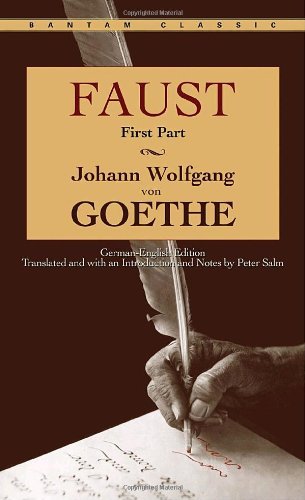
Goethe’s masterpiece and perhaps the greatest work in German literature, Faust has made the legendary German alchemist one of the central myths of the Western world. Here indeed is a monumental Faust, an audacious man boldly wagering with the devil, Mephistopheles, that no magic, sensuality, experience, or knowledge can lead him to a moment he would wish to last forever. Here, in Faust, Part I, the tremendous versatility of Goethe’s genius creates some of the most beautiful passages in literature. Here too we experience Goethe’s characteristic humor, the excitement and eroticism of the witches’ Walpurgis Night, and the moving emotion of Gretchen’s tragic fate.
This authoritative edition, which offers Peter Salm’s wonderfully readable translation as well as the original German on facing pages, brings us Faust in a vital, rhythmic American idiom that carefully preserves the grandeur, integrity, and poetic immediacy of Goethe’s words.
A master of poetry, drama, and the novel, German writer and scientist Johann Wolfgang von Goethe spent 50 years on his two-part dramatic poem Faust, published in 1808 and 1832, also conducted scientific research in various fields, notably botany, and held several governmental positions.
George Eliot called him "Germany's greatest man of letters... and the last true polymath to walk the earth." Works span the fields of literature, theology, and humanism. People laud this magnum opus as one of the peaks of world literature. Other well-known literary works include his numerous poems, the Bildungsroman Wilhelm Meister's Apprenticeship and the epistolary novel The Sorrows of Young Werther.
With this key figure of German literature, the movement of Weimar classicism in the late 18th and early 19th centuries coincided with Enlightenment, sentimentality (Empfindsamkeit), Sturm und Drang, and Romanticism. The author of the scientific text Theory of Colours, he influenced Darwin with his focus on plant morphology. He also long served as the privy councilor ("Geheimrat") of the duchy of Weimar.
Goethe took great interest in the literatures of England, France, Italy, classical Greece, Persia, and Arabia and originated the concept of Weltliteratur ("world literature"). Despite his major, virtually immeasurable influence on German philosophy especially on the generation of Georg Wilhelm Friedrich Hegel and Friedrich Wilhelm Joseph von Schelling, he expressly and decidedly refrained from practicing philosophy in the rarefied sense.
Influence spread across Europe, and for the next century, his works inspired much music, drama, poetry and philosophy. Many persons consider Goethe the most important writer in the German language and one of the most important thinkers in western culture as well. Early in his career, however, he wondered about painting, perhaps his true vocation; late in his life, he expressed the expectation that people ultimately would remember his work in optics.
Tuyệt tác kinh điển, có đủ cả hỉ nộ ái ố, tiếng cười của nhân gian, niềm hạnh phúc và những nỗi bi ai của tình yêu, sự giễu nhại xã hội và những suy tư triết học về ý nghĩa cuộc đời, bản tính con người…
Bản dịch tiếng Việt của Quang Chiến cũng quá xuất sắc.
Tác phẩm được coi là đồ sồ nhất trong văn học Đức và Goethe đã mất trọn cuộc đời mình để viết. Cuộc giao kèo giữa Chúa và Memphistopheles, cuộc đấu thầm lặng của Faust và Memphistopheles, hay đơn giản hơn là cuộc chiến giữa cái Thiện và Ác trong mỗi con người chúng ta.
9/10 Sự khai minh từ một cuộc giao kèo với quỷ dữ Trong 32 câu đề tặng có nêu lí giải vì sao Goethe viết tác phẩm. Trong bi kịch Faust, Goethe đã xây dựng và sáng tạo lại nhân vật Faust, một huyền thoại lưu truyền trong dân gian phương Tây, ngoài ra ông đã tiếp nhận và sáng tạo motif giao kèo giữa con người với quỷ dữ từ câu chuyện, lời răn trong Kinh Thánh (Thánh Cyprian và nàng Jusina). Đây là sự sáng tạo của một nhà văn lớn. Bản chất giao kèo giữa Faust và Mephisto đã thay đổi so với huyền thoại. Việc kí kết giao kèo trở thành một thử thách, đặt ra vấn đề về nhận thức của con người - khi Faust thỏa mãn với những điều quỷ dữ mang đến, Faust sẽ chết. Với luận đề này, bi kịch đã hướng đến sự khai minh mang tinh thần khai sáng: con người hành động để thay đổi thế giới. Hành trình của Faust là hành trình vượt qua thử thách để tìm kiếm chân lý. Lạc thú ăn chơi, tình yêu, cái đẹp cổ đại... không phải là thứ níu kéo chân lý, mà chân lý nằm ở thực tại, khi con người biết lao động. Ngoài ra, triết lý nhân đạo cũng là một triết lý nổi bật trong tác phẩm. Goethe không nhìn nhận con người trong thế nhị nguyên (thiện - ác đối lập) mà chấp nhận con người trong tính toàn vẹn nhất. Sau mỗi sai lầm, Faust đều tiến lên không ngừng. Faust nhận thức tội lỗi của mình, từ đó biết hoàn thiện để thay đổi. Đó là điều làm cho con người trở nên vĩ đại.