

What do you think?
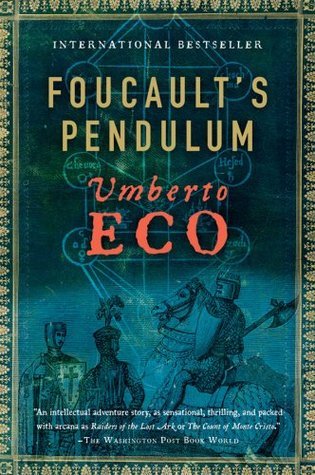
Foucault’s Pendulum
International bestselling and award-winning author Umberto Eco's Foucault's Pendulum is "an intellectual adventure story, as sensational, thrilling, and packed with arcana as Raiders of the Lost Ark or The Count of Monte Cristo" (The Washington Post Book World).
Bored with their work, three Milanese editors cook up "the Plan," a hoax that connects the medieval Knights Templar with other occult groups from ancient to modern times. This produces a map indicating the geographical point from which all the powers of the earth can be controlled — a point located in Paris, France, at Foucault’s Pendulum. But in a fateful turn the joke becomes all too real, and when occult groups, including Satanists, get wind of the Plan, they go so far as to kill one of the editors in their quest to gain control of the earth.
Orchestrating these and other diverse characters into his multilayered semiotic adventure, Eco has created a superb cerebral entertainment.
Bored with their work, three Milanese editors cook up "the Plan," a hoax that connects the medieval Knights Templar with other occult groups from ancient to modern times. This produces a map indicating the geographical point from which all the powers of the earth can be controlled — a point located in Paris, France, at Foucault’s Pendulum. But in a fateful turn the joke becomes all too real, and when occult groups, including Satanists, get wind of the Plan, they go so far as to kill one of the editors in their quest to gain control of the earth.
Orchestrating these and other diverse characters into his multilayered semiotic adventure, Eco has created a superb cerebral entertainment.
623 pages, Paperback
First published October 4, 1988
About the author
Umberto Eco
912 books12.5k followersUmberto Eco was an Italian medievalist, philosopher, semiotician, novelist, cultural critic, and political and social commentator. In English, he is best known for his popular 1980 novel The Name of the Rose, a historical mystery combining semiotics in fiction with biblical analysis, medieval studies and literary theory, as well as Foucault's Pendulum, his 1988 novel which touches on similar themes.
Eco wrote prolifically throughout his life, with his output including children's books, translations from French and English, in addition to a twice-monthly newspaper column "La Bustina di Minerva" (Minerva's Matchbook) in the magazine L'Espresso beginning in 1985, with his last column (a critical appraisal of the Romantic paintings of Francesco Hayez) appearing 27 January 2016. At the time of his death, he was an Emeritus professor at the University of Bologna, where he taught for much of his life. In the 21st century, he has continued to gain recognition for his 1995 essay "Ur-Fascism", where Eco lists fourteen general properties he believes comprise fascist ideologies.
Eco wrote prolifically throughout his life, with his output including children's books, translations from French and English, in addition to a twice-monthly newspaper column "La Bustina di Minerva" (Minerva's Matchbook) in the magazine L'Espresso beginning in 1985, with his last column (a critical appraisal of the Romantic paintings of Francesco Hayez) appearing 27 January 2016. At the time of his death, he was an Emeritus professor at the University of Bologna, where he taught for much of his life. In the 21st century, he has continued to gain recognition for his 1995 essay "Ur-Fascism", where Eco lists fourteen general properties he believes comprise fascist ideologies.
Ratings & Reviews
Friends & Following
Create a free account to discover what your friends think of this book!
Community Reviews
Displaying 1 - 5 of 5 reviews

May 6, 2021
Geniálne. Čítala som knihu celú túto útrpnú a dlhú zimu, vlastne tá zima stále nekončí. Eco je šialený, samozrejme, v dobrom. "Skutočný zasvätenec vie, že najmocnejším tajomstvom je to, ktoré nemá žiadny obsah, preto ho žiadny nepriateľ nemôže vymámiť." Žiadne tajomstvo nie je, priatelia

April 26, 2019
Umberto Eco ma zabrzdil. Dosť zaujímavý na to, aby som neprestal čítať, ale dostatočne zdĺhavý, aby som dal naraz len pár stránok. Téma konšpirácii a nekonečných súvislostí sa mi páčila. Ale rozťahané akademické úvahy troch nie moc zaujímavých editorov kníh ma naozoj spoľahlivo uspali. Takže som ostal niekde v strede (2,5).

April 10, 2022
Ja neviem. Ono je to v podstate Da Vinciho kód pre sčítaných čitateľov (mimochodom, vyhľadajte si Ecovu reakciu na Dana Browna, naozaj to stojí za to), no je to prakticky čitateľské peklo, z ktorého vás rozbolí hlava. Eco sa v duchu najlepších postmoderných tradícii (nádherný oxymoron, asi ako ľudová oligarchia alebo cigánska urbanistika) vôbec netrápi s vytvorením nejakého uceleného textu a ponúka čitateľovi de facto neobmedzené množstvo intepretácií, čo… (apoziopéza) je niekedy na škodu (vynulovanie apoziopézy, šachmat, slovenčinári). Eco gaslightuje čitateľa, ktorý začne z nepochopenia textu viniť samého seba, netušiac, že je to vlastne zámer. Nespráva sa férovo.
Pokiaľ ale máte chuť na niečo absolútne trippy, Kyvadlo viem len odporúčať.
Pokiaľ ale máte chuť na niečo absolútne trippy, Kyvadlo viem len odporúčať.

April 14, 2026
Aj som zabudla že túto knihu mám fakt rada... Rozhlasový seriál výborne vystihol napätie a zápletku, rôzne postavy a ich motivácie a hlavne priniesol veľa akcie 🤭 na druhú stranu, mi chýbalo to čo som zvykla piť knihe, obracať strany ku vysvetlivkám na konci, pretože tu bolo veľa cudzojazyčných úryvkov... A to mi pripomína fakt, že tá stará verzia knihy bola naj. Ja som si vypýtala raz na Vianoce nové vydanie a oni "sviniari", úplne odignorovali vysvetlivky, čiže človek nevedel čo číta 🤦♀️🤦♀️🤦♀️ v rozhlasovej hre by to bolo divné, takže mi to až tak nechýbalo k šťastiu. Som rada že som si mohla vypočuť 😊🙃

March 4, 2021
Jedna z najúžasnejších kníh...
Displaying 1 - 5 of 5 reviews