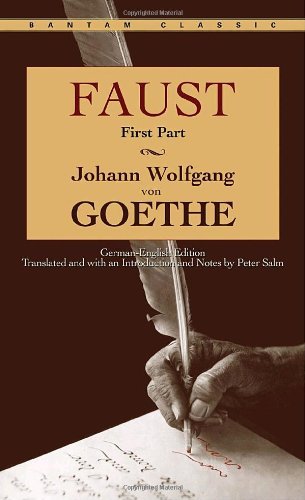
Goethe’s masterpiece and perhaps the greatest work in German literature, Faust has made the legendary German alchemist one of the central myths of the Western world. Here indeed is a monumental Faust, an audacious man boldly wagering with the devil, Mephistopheles, that no magic, sensuality, experience, or knowledge can lead him to a moment he would wish to last forever. Here, in Faust, Part I, the tremendous versatility of Goethe’s genius creates some of the most beautiful passages in literature. Here too we experience Goethe’s characteristic humor, the excitement and eroticism of the witches’ Walpurgis Night, and the moving emotion of Gretchen’s tragic fate.
This authoritative edition, which offers Peter Salm’s wonderfully readable translation as well as the original German on facing pages, brings us Faust in a vital, rhythmic American idiom that carefully preserves the grandeur, integrity, and poetic immediacy of Goethe’s words.
A master of poetry, drama, and the novel, German writer and scientist Johann Wolfgang von Goethe spent 50 years on his two-part dramatic poem Faust, published in 1808 and 1832, also conducted scientific research in various fields, notably botany, and held several governmental positions.
George Eliot called him "Germany's greatest man of letters... and the last true polymath to walk the earth." Works span the fields of literature, theology, and humanism. People laud this magnum opus as one of the peaks of world literature. Other well-known literary works include his numerous poems, the Bildungsroman Wilhelm Meister's Apprenticeship and the epistolary novel The Sorrows of Young Werther.
With this key figure of German literature, the movement of Weimar classicism in the late 18th and early 19th centuries coincided with Enlightenment, sentimentality (Empfindsamkeit), Sturm und Drang, and Romanticism. The author of the scientific text Theory of Colours, he influenced Darwin with his focus on plant morphology. He also long served as the privy councilor ("Geheimrat") of the duchy of Weimar.
Goethe took great interest in the literatures of England, France, Italy, classical Greece, Persia, and Arabia and originated the concept of Weltliteratur ("world literature"). Despite his major, virtually immeasurable influence on German philosophy especially on the generation of Georg Wilhelm Friedrich Hegel and Friedrich Wilhelm Joseph von Schelling, he expressly and decidedly refrained from practicing philosophy in the rarefied sense.
Influence spread across Europe, and for the next century, his works inspired much music, drama, poetry and philosophy. Many persons consider Goethe the most important writer in the German language and one of the most important thinkers in western culture as well. Early in his career, however, he wondered about painting, perhaps his true vocation; late in his life, he expressed the expectation that people ultimately would remember his work in optics.
«Наберись желаний новых, встретив солнечный восход. Сон держал тебя в оковах, сбрось с себя его налет. Подражать другим не надо, и бояться неудач. Побеждает все преграды, кто понятлив и горяч.»
I found Part 2 having layers upon layers of allegories with allusions and metaphors, and gave up after the first chapter. I really loved Faust 1 but second part seemed like a psychedelic fever dream, and frankly I understood nothing of it. Sort of fan-fiction on Iliad?
Overall this is one of the most remarkable productions of human mind.
Сначала я не мог понять почему повествование такое рваное, но потом, почитав отношение Гёте к потребителю, я понял что это задумка немца и стало даже приятно, что ли, потому-что я такого же мнения, люди любят критиковать, это нормально, и в Фаусте как раз есть подходящая цитата Гёте, которая мне очень понравилась: Wir sind gewohnt, daß die Menschen verhöhnen, Was sie nicht verstehn. И, как бы странно это не прозвучало, но первое с чем мне пришло в голову сравнить книгу, это Евгений Онегин)
Интересно было читать в прозе, но должен признаться, что скорее всего плохо понял произведение «Фауст». Даже написать особо ничего не получается. Похоже, что я совсем чего-то другого ожидал от этого произведения, реалии и ожидания не сошлись.
Перевод «Фауста», выполненный Пастернаком и изданный «АСТ» в 2002 году, не содержит комментариев (которые сопровождали издание 1960-го года). Рекомендую нагуглить эти комментарии, которые поясняют различные моменты и контексты.
В целом, мне кажется, что это произведение Гёте, скорее, удачно ставит вопрос о фаустовской личности/душе, нежели цельно разрешает связанный с нею конфликт. Гёте писал «Фауста» в течение всей жизни. Местами (часть вторая) неимоверно скучно. Ощущение, что живой порыв молодости был заменён в процессе написания какими-то интеллектуальными или эстетическими амбициями.
В любом случае для понимания смыслов, как и в случае с большинством классических произведений, важно обращаться к интерпретациям. Они придают красивый орнамент произведению, которое само по себе (по крайней мере, в данном переводе, — но, вероятно, дело не в переводчике) крайне неровное, раздробленное.
Мученья Фауста в первой части крайне близки мне, как и многим жителям планеты Земля. Но разрешенье их малоубедительно.
Несколько интересных фактов, о которых вы возможно не знали: 1. Доктор Фауст - историческая личность 16 века, упоминания о нем можно найти в разных документах 2. Настоящий доктор Фауст умер в результате алхимических опытов, состояние его трупа породило слухи о союзе с дьяволом, что и запечатлелось в истории Гете работал над романом “Фауст” на протяжении 60 лет, завершив его ненадолго до смерти в 82. 3. Фауст Гете заключает союз с Мефистофелем не в поисках удовлетворения желания, а как ученый - в поисках истины. 4.Гете был против определения одной единственной идеи своего произведения, говоря: “Вот они подступают ко мне и спрашивают: какую идею хотел я воплотить в “Фаусте”? Как будто я сам это знаю и могу выразить!.. В самом деле, хороша бы была шутка, если бы я пытался такую богатую, пеструю и в высшей степени разнообразную жизнь, которую я вложил в моего “Фауста”, нанизать на тощий шнурочек одной единой для всего произведения идеи!”
короче врать не буду жизнь слишком короткая чтобы читать вторую часть фауста учитывая что на первую у меня ушло insgesamt месяца три. очень рада что гете весело проводил время но присоединяться не планирую!)