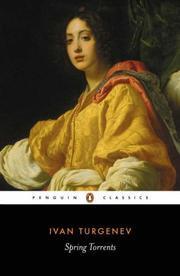
Returning to Russia from a tour in Italy, twenty-three-year-old Dimitry Sanin breaks his journey in Frankfurt, where he encounters the beautiful Gemma Roselli, who works in her parents' patisserie, and falls deeply and deliriously in love for the first time. Convinced that nothing can come in the way of everlasting happiness with his fiancee, Dimitry impetuously decides to begin a new life and sell his Russian estates. But when he meets the potential buyer, the intriguing Madame Polozov, his youthful vulnerability makes him prey for a darker, destructive infatuation.
A novel of haunting beauty, "Spring Torrents" (1870-1) is a fascinating, partly autobiographical account of one of Turgenev's favourite themes - a man's inability to love without losing his innocence and becoming enslaved to obsessive passions.
Ivan Sergeyevich Turgenev (Cyrillic: Иван Сергеевич Тургенев) was a novelist, poet, and dramatist, and now ranks as one of the towering figures of Russian literature. His major works include the short-story collection A Sportsman’s Sketches (1852) and the novels Rudin (1856), Home of the Gentry (1859), On the Eve (1860), and Fathers and Sons (1862).
These works offer realistic, affectionate portrayals of the Russian peasantry and penetrating studies of the Russian intelligentsia who were attempting to move the country into a new age. His masterpiece, Fathers and Sons, is considered one of the greatest novels of the nineteenth century.
Turgenev was a contemporary with Fyodor Dostoevsky and Leo Tolstoy. While these wrote about church and religion, Turgenev was more concerned with the movement toward social reform in Russia.
Așa cum presimțeam înainte să mă apuc de citit romanul, subiectul său e dat de o temă nu predilectă, ci definitorie (aproape totală) în opera lui Turgheniev: resemnarea în față iubirii pierdute a tinereții. De Turgheniev am dat când am citit Un cuib de nobili, din colecția Adevărul, undeva prin 2015. Mi-a plăcut foarte mult romanul. Am reținut de acolo replici și versuri fără să depun vreun efort în acest sens, atât de frumos "ungeau". Deși Apele primăverii tratează aceeași tema -poate într-o manieră mai europeană decât Un cuib de nobili- nu m-a impresionat la fel de mult. Fi-va vorba de spiritul rus (la el acasă într-Un cuib de nobili și eclipsat aici) sau, deopotrivă, de ce să n-o recunosc?, poate am devenit eu prea cinic și sceptic în ceea ce privește coordonatele temei definitorii din opera lui Turgheniev. Totuși, citindu-l, ceva mă gâdilă și îmi da curaj. To the happy few!