

What do you think?
Aus dem Bleistiftgebiet #1-6
Microscripts
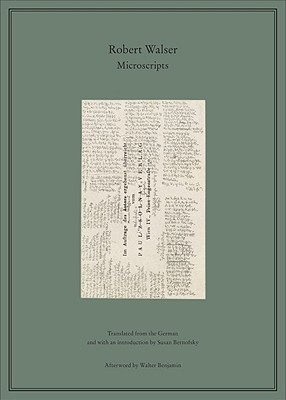
Robert Walser wrote many of his manuscripts in a highly enigmatic, shrunken-down form. These narrow strips of paper (many of them written during his hospitalization in the Waldau sanatorium) covered with tiny ant-like markings only a millimeter or two high, came to light only after the author’s death in 1956. At first considered a secret code, the microscripts were eventually discovered to be a radically miniaturized form of a German script: a whole story could fit on the back of a business card.
Selected from the six-volume German transcriptions from the original microscripts, these 25 short pieces are gathered in this gorgeously illustrated co-publication with the Christine Burgin Gallery. Each microscript is reproduced in full color in its original form: the detached cover of a trashy crime novel, a disappointing letter, a receipt of payment. Sometimes Walser used the pages of small tear-off calendars (but only after cutting them lengthwise and filling up each half with text). Schnapps, rotten husbands, small town life, the radio, pigs (and how none of us can deny being one), jealousy, Van Gogh and marriage proposals are some of Walser’s subjects. These texts take strength from Walser’s motto: “To be small and to stay small.”
Selected from the six-volume German transcriptions from the original microscripts, these 25 short pieces are gathered in this gorgeously illustrated co-publication with the Christine Burgin Gallery. Each microscript is reproduced in full color in its original form: the detached cover of a trashy crime novel, a disappointing letter, a receipt of payment. Sometimes Walser used the pages of small tear-off calendars (but only after cutting them lengthwise and filling up each half with text). Schnapps, rotten husbands, small town life, the radio, pigs (and how none of us can deny being one), jealousy, Van Gogh and marriage proposals are some of Walser’s subjects. These texts take strength from Walser’s motto: “To be small and to stay small.”
160 pages, Hardcover
First published January 1, 1985
About the author
Robert Walser
222 books880 followersRobert Walser, a German-Swiss prose writer and novelist, enjoyed high repute among a select group of authors and critics in Berlin early in his career, only to become nearly forgotten by the time he committed himself to the Waldau mental clinic in Bern in January 1929. Since his death in 1956, however, Walser has been recognized as German Switzerland’s leading author of the first half of the twentieth century, perhaps Switzerland’s single significant modernist. In his homeland he has served as an emboldening exemplar and a national classic during the unparalleled expansion of German-Swiss literature of the last two generations.
Walser’s writing is characterized by its linguistic sophistication and animation. His work exhibits several sets of tensions or contrasts: between a classic modernist devotion to art and a ceaseless questioning of the moral legitimacy and practical utility of art; between a spirited exuberance in style and texture and recurrent reflective melancholy; between the disparate claims of nature and culture; and between democratic respect for divergence in individuals and elitist reaction to the values of the mass culture and standardization of the industrial age.
Walser’s writing is characterized by its linguistic sophistication and animation. His work exhibits several sets of tensions or contrasts: between a classic modernist devotion to art and a ceaseless questioning of the moral legitimacy and practical utility of art; between a spirited exuberance in style and texture and recurrent reflective melancholy; between the disparate claims of nature and culture; and between democratic respect for divergence in individuals and elitist reaction to the values of the mass culture and standardization of the industrial age.
Ratings & Reviews
Friends & Following
Create a free account to discover what your friends think of this book!
Community Reviews
Displaying 1 - 1 of 1 review

January 26, 2026
Kā miniatūru ''Laupītāju'' sakopojums. Bet tas, ko Benjamins apgalvo, ka Valzers bija Kafkas mīļākais rakstnieks raisa šaubas, Kafkas vēstulēs un dienasgrāmatās Valzers ir pieminēts tikai reizi un tikai garām ejot. Iespējams Benjaminam to kāds, piemēram, Makss Brods varētu būt teicis, bet tā ir tikai mana spekulācija.
Displaying 1 - 1 of 1 review