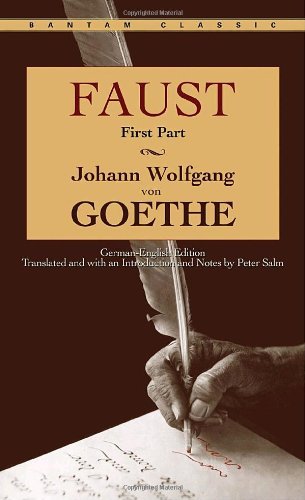
Goethe’s masterpiece and perhaps the greatest work in German literature, Faust has made the legendary German alchemist one of the central myths of the Western world. Here indeed is a monumental Faust, an audacious man boldly wagering with the devil, Mephistopheles, that no magic, sensuality, experience, or knowledge can lead him to a moment he would wish to last forever. Here, in Faust, Part I, the tremendous versatility of Goethe’s genius creates some of the most beautiful passages in literature. Here too we experience Goethe’s characteristic humor, the excitement and eroticism of the witches’ Walpurgis Night, and the moving emotion of Gretchen’s tragic fate.
This authoritative edition, which offers Peter Salm’s wonderfully readable translation as well as the original German on facing pages, brings us Faust in a vital, rhythmic American idiom that carefully preserves the grandeur, integrity, and poetic immediacy of Goethe’s words.
A master of poetry, drama, and the novel, German writer and scientist Johann Wolfgang von Goethe spent 50 years on his two-part dramatic poem Faust, published in 1808 and 1832, also conducted scientific research in various fields, notably botany, and held several governmental positions.
George Eliot called him "Germany's greatest man of letters... and the last true polymath to walk the earth." Works span the fields of literature, theology, and humanism. People laud this magnum opus as one of the peaks of world literature. Other well-known literary works include his numerous poems, the Bildungsroman Wilhelm Meister's Apprenticeship and the epistolary novel The Sorrows of Young Werther.
With this key figure of German literature, the movement of Weimar classicism in the late 18th and early 19th centuries coincided with Enlightenment, sentimentality (Empfindsamkeit), Sturm und Drang, and Romanticism. The author of the scientific text Theory of Colours, he influenced Darwin with his focus on plant morphology. He also long served as the privy councilor ("Geheimrat") of the duchy of Weimar.
Goethe took great interest in the literatures of England, France, Italy, classical Greece, Persia, and Arabia and originated the concept of Weltliteratur ("world literature"). Despite his major, virtually immeasurable influence on German philosophy especially on the generation of Georg Wilhelm Friedrich Hegel and Friedrich Wilhelm Joseph von Schelling, he expressly and decidedly refrained from practicing philosophy in the rarefied sense.
Influence spread across Europe, and for the next century, his works inspired much music, drama, poetry and philosophy. Many persons consider Goethe the most important writer in the German language and one of the most important thinkers in western culture as well. Early in his career, however, he wondered about painting, perhaps his true vocation; late in his life, he expressed the expectation that people ultimately would remember his work in optics.
Kai pats velnias tau sako: “Seni, raminkis. Jai penkiolika.” Reikėtų susivokti, kad jau truputi per toli nuzaunyjai. Tačiau, Gerbiamasis Daktaras pats sau laidotuves ir aš antrą dalį skaitysiu tik patenkinti savo norą jam trenkti su plyta.
Faustas labai protinga asmenybė, bet jis trokšta visas savo žinias paversti potyriais, pats viską išgyventi : tiek, kas gera, tiek bloga, todėl velnio įtikintas pasirašo su juo sutartį. Jų susitarimu - Faustui ištarus "Sustok, akimirka žavinga", kitaip sakant pripažinus, jog jam pakanka, po mirties siela atiteks į velnio rankas.
Per ilgą jų kelionę kartu Faustas ne tik apsilanko bare ar atgauna jaunystę, bet ir įsimyli, tik deja, tai meilei nelemta ilgai gyvuoti. Įsimylėjęs Margaritą, jis pasmerkia ją nuodėmėms, nors ji ir yra labai religinga, atvirkščiai nei Faustas.
Jų meilė pridarė daug žąlos, už kurią Margarita, netekusi skaistybės atsiduria kalėjime. Ji ne tik kitų, bet ir savęs kaltinama nužudžiusi mamą, nors manė ją tik užmigdysianti Fausto duotais lašiukais, taip pat dėl Fausto mirė ir jos brolis. Nors mylimasis ateina jos išgelbėti iš kalėjimo, ji niekur neina, nes jaučiasi kalta už tai, kas įvyko ir prašo išgelbėti kūdikį, kuris jau seniai miręs.
Tačiau net ir po tiek Fausto klaidinimo, Margarita visą laiką lieka ištikima Dievui ir būdama kalėjime nuoširdžiai meldžiasi už savo nuodėmes, todėl yra paimama į dangų...
Beskaitydama “Meistras ir Margarita”, galutinai nusprendžiau sugrįžti prie Goethe’s “Faustas”, kurio pirmą dalį pačiupinėjau vidurinėje mokykloje (ir akivaizdu, kad buvau stipriai primiršusi), o antra dalis likus neliesta.
Nors eiliuoti tekstai yra, švelniai tariant, ne mano stichija, bet “Faustas” skaitosi maloniai, o jame gausiai trykštanti satyra išspaudžia šypseną (priešingai nei skaitant “Meistras ir Margarita”, kur visi “bajeriukai” ir fantastika man atrodo kaip nesibaigiantis nesusipratimas).