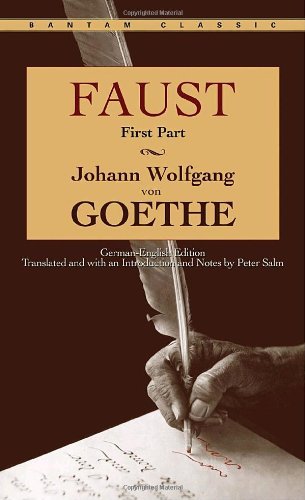
Goethe’s masterpiece and perhaps the greatest work in German literature, Faust has made the legendary German alchemist one of the central myths of the Western world. Here indeed is a monumental Faust, an audacious man boldly wagering with the devil, Mephistopheles, that no magic, sensuality, experience, or knowledge can lead him to a moment he would wish to last forever. Here, in Faust, Part I, the tremendous versatility of Goethe’s genius creates some of the most beautiful passages in literature. Here too we experience Goethe’s characteristic humor, the excitement and eroticism of the witches’ Walpurgis Night, and the moving emotion of Gretchen’s tragic fate.
This authoritative edition, which offers Peter Salm’s wonderfully readable translation as well as the original German on facing pages, brings us Faust in a vital, rhythmic American idiom that carefully preserves the grandeur, integrity, and poetic immediacy of Goethe’s words.
A master of poetry, drama, and the novel, German writer and scientist Johann Wolfgang von Goethe spent 50 years on his two-part dramatic poem Faust, published in 1808 and 1832, also conducted scientific research in various fields, notably botany, and held several governmental positions.
George Eliot called him "Germany's greatest man of letters... and the last true polymath to walk the earth." Works span the fields of literature, theology, and humanism. People laud this magnum opus as one of the peaks of world literature. Other well-known literary works include his numerous poems, the Bildungsroman Wilhelm Meister's Apprenticeship and the epistolary novel The Sorrows of Young Werther.
With this key figure of German literature, the movement of Weimar classicism in the late 18th and early 19th centuries coincided with Enlightenment, sentimentality (Empfindsamkeit), Sturm und Drang, and Romanticism. The author of the scientific text Theory of Colours, he influenced Darwin with his focus on plant morphology. He also long served as the privy councilor ("Geheimrat") of the duchy of Weimar.
Goethe took great interest in the literatures of England, France, Italy, classical Greece, Persia, and Arabia and originated the concept of Weltliteratur ("world literature"). Despite his major, virtually immeasurable influence on German philosophy especially on the generation of Georg Wilhelm Friedrich Hegel and Friedrich Wilhelm Joseph von Schelling, he expressly and decidedly refrained from practicing philosophy in the rarefied sense.
Influence spread across Europe, and for the next century, his works inspired much music, drama, poetry and philosophy. Many persons consider Goethe the most important writer in the German language and one of the most important thinkers in western culture as well. Early in his career, however, he wondered about painting, perhaps his true vocation; late in his life, he expressed the expectation that people ultimately would remember his work in optics.
La grande innovazione di Goethe sta nel trasformare la leggenda di Faust, già elaborata da Marlowe e da una lunga tradizione precedente, in un mito della modernità. Faust non è più soltanto l’uomo che vende l’anima al diavolo, diventa l’individuo moderno incapace di accettare limiti, continuamente spinto verso conoscenza, esperienza, desiderio e trasformazione. La Parte I è particolarmente importante perché unisce questa ambizione filosofica a una struttura drammatica molto concreta. La vicenda di Gretchen porta il problema faustiano fuori dall’astrazione: il desiderio di superare i confini dell’esperienza produce conseguenze reali, morali e sociali. Goethe riesce così a fondere tragedia, lirica, satira, filosofia, religione e teatro popolare in una forma estremamente mobile. Rispetto alla tradizione precedente cambia anche il significato del patto. Il centro non è più semplicemente la dannazione per curiosità o superbia ma l’inquietudine permanente dell’uomo moderno, incapace di fermarsi in un singolo momento di appagamento. È uno dei motivi per cui Faust continua a essere reinterpretato come testo sulla scienza, sul capitalismo, sul desiderio, sulla tecnica e sull’idea stessa di progresso. Faust è uno dei testi centrali della letteratura europea e la Parte I, anche separata dalla seconda, possiede già una completezza e un’influenza straordinarie.
"E che vuoi darmi tu, povero diavolo?”, chiede Faust a Mefistofele. Faust accestra una scommessa quando è sul punto si togliersi la vita. Riuscirá a trovare un senso alla sua vita? così, sottoscrivendo un patto col suo stesso sangue, inizia il viaggio con l'essere dallo zoccolo caprino, conoscendo l'amore di Margherita, quello di Elena di Troia. è un viaggio anche dentro se stesso fino alla rendenzione o alla eterna dannazione. un'opera drammatica con dialoghi caratterizzati da una poetica - a volte eccessiva - verbosità. comunque, da leggere!
Trama molto bella, specie nella prima metà dell'opera quando Faust e Mefistofele viaggiano vivendo varie avventure. La seconda parte richiede invece buone conoscenze di epica, mitologia e filosofia per poter essere capita e apprezzata. Alcuni punti li ho trovati difficili da comprendere.
Letto per un esame universitario, capolavoro assoluto, seppur di comprensione impossibile senza un valido commento. La figura di Faust è la perfetta rappresentazione della condanna delle estreme conseguenze della modernità, Mefistofele un diavolo ironico, schietto, intelligente, che aspetta sempre il momento buono. Margherita è la figura della innocente popolana che vive nel suo piccolo mondo armonioso, la consapevolezza dell’inconciliabilità tra amore e sete di conoscenza è la chiave dell’opera, tragedia dell’amore e della conoscenza.