

What do you think?
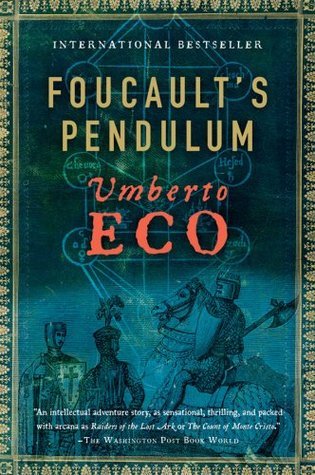
Foucault’s Pendulum
International bestselling and award-winning author Umberto Eco's Foucault's Pendulum is "an intellectual adventure story, as sensational, thrilling, and packed with arcana as Raiders of the Lost Ark or The Count of Monte Cristo" (The Washington Post Book World).
Bored with their work, three Milanese editors cook up "the Plan," a hoax that connects the medieval Knights Templar with other occult groups from ancient to modern times. This produces a map indicating the geographical point from which all the powers of the earth can be controlled — a point located in Paris, France, at Foucault’s Pendulum. But in a fateful turn the joke becomes all too real, and when occult groups, including Satanists, get wind of the Plan, they go so far as to kill one of the editors in their quest to gain control of the earth.
Orchestrating these and other diverse characters into his multilayered semiotic adventure, Eco has created a superb cerebral entertainment.
Bored with their work, three Milanese editors cook up "the Plan," a hoax that connects the medieval Knights Templar with other occult groups from ancient to modern times. This produces a map indicating the geographical point from which all the powers of the earth can be controlled — a point located in Paris, France, at Foucault’s Pendulum. But in a fateful turn the joke becomes all too real, and when occult groups, including Satanists, get wind of the Plan, they go so far as to kill one of the editors in their quest to gain control of the earth.
Orchestrating these and other diverse characters into his multilayered semiotic adventure, Eco has created a superb cerebral entertainment.
623 pages, Paperback
First published October 4, 1988
About the author
Umberto Eco
912 books12.5k followersUmberto Eco was an Italian medievalist, philosopher, semiotician, novelist, cultural critic, and political and social commentator. In English, he is best known for his popular 1980 novel The Name of the Rose, a historical mystery combining semiotics in fiction with biblical analysis, medieval studies and literary theory, as well as Foucault's Pendulum, his 1988 novel which touches on similar themes.
Eco wrote prolifically throughout his life, with his output including children's books, translations from French and English, in addition to a twice-monthly newspaper column "La Bustina di Minerva" (Minerva's Matchbook) in the magazine L'Espresso beginning in 1985, with his last column (a critical appraisal of the Romantic paintings of Francesco Hayez) appearing 27 January 2016. At the time of his death, he was an Emeritus professor at the University of Bologna, where he taught for much of his life. In the 21st century, he has continued to gain recognition for his 1995 essay "Ur-Fascism", where Eco lists fourteen general properties he believes comprise fascist ideologies.
Eco wrote prolifically throughout his life, with his output including children's books, translations from French and English, in addition to a twice-monthly newspaper column "La Bustina di Minerva" (Minerva's Matchbook) in the magazine L'Espresso beginning in 1985, with his last column (a critical appraisal of the Romantic paintings of Francesco Hayez) appearing 27 January 2016. At the time of his death, he was an Emeritus professor at the University of Bologna, where he taught for much of his life. In the 21st century, he has continued to gain recognition for his 1995 essay "Ur-Fascism", where Eco lists fourteen general properties he believes comprise fascist ideologies.
Ratings & Reviews
Friends & Following
Create a free account to discover what your friends think of this book!
Community Reviews
Displaying 1 - 1 of 1 review

May 7, 2013
Sagan segir frá þremur starfsmönnum bókaútgeáfu sem vinna við útgáfu dulspekirita. Sér til skemmtunar búa þeir til samsæriskenningu um öflugt ritúal sem byggir á starfsemi helstu leynifélaga innan dulspekigeirans. Óafvitandi leka þeir samsæriskenningunni til aðila innan þessarra félaga sem er ekki hlátur í huga heldur trúa þeir því að eftirsóknarvert leyndarmál sé hér á ferðinni.
Þetta er upplýsandi frásögn af mörgum af helstu leynifélögum sögunnar og skemmtilega tvinnuð saman. Eco gerir vel í að tengja saman dulhyggju félaganna og lýsir því skemmtilega hvernig dulhyggjan og leyndarmálin rugla reglumenn og magna upp öfgar.
Þetta er þó þunglamaleg saga og nær seint upp dampi.
Þetta er upplýsandi frásögn af mörgum af helstu leynifélögum sögunnar og skemmtilega tvinnuð saman. Eco gerir vel í að tengja saman dulhyggju félaganna og lýsir því skemmtilega hvernig dulhyggjan og leyndarmálin rugla reglumenn og magna upp öfgar.
Þetta er þó þunglamaleg saga og nær seint upp dampi.
Displaying 1 - 1 of 1 review