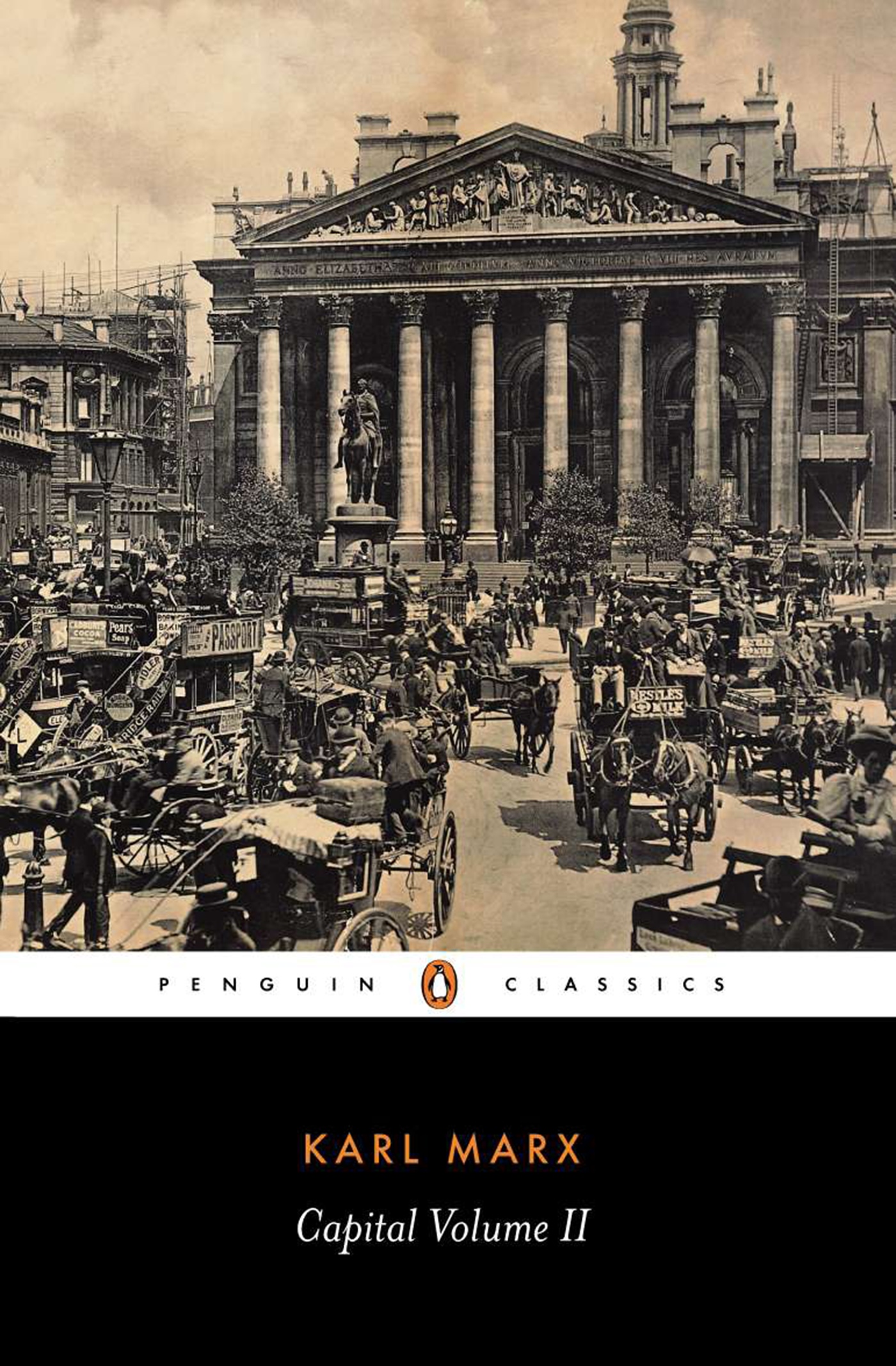
The second volume of a political treatise that changed the world
A vital cornerstone to Marx’s overall theory of economics, the second volume of Capital considers in depth the nature of commodity and the market-place bourgeois society. This immensely powerful work argues that prosperity in a capitalist society inevitably holds within itself the seeds of its own destruction.
With the help of Friedrich Engels, German philosopher and revolutionary Karl Marx wrote The Communist Manifesto (1848) and Das Kapital (1867-1894), works, which explain historical development in terms of the interaction of contradictory economic forces, form many regimes, and profoundly influenced the social sciences.
German social theorist Friedrich Engels collaborated with Karl Marx on The Communist Manifesto in 1848 and on numerous other works.
The Prussian kingdom introduced a prohibition on Jews, practicing law; in response, a man converted to Protestantism and shortly afterward fathered Karl Marx.
Marx began co-operating with Bruno Bauer on editing Philosophy of Religion of Georg Wilhelm Friedrich Hegel (see Democritus and Epicurus), doctoral thesis, also engaged Marx, who completed it in 1841. People described the controversial essay as "a daring and original piece... in which Marx set out to show that theology must yield to the superior wisdom." Marx decided to submit his thesis not to the particularly conservative professors at the University of Berlin but instead to the more liberal faculty of University of Jena, which for his contributed key theory awarded his Philosophiae Doctor in April 1841. Marx and Bauer, both atheists, in March 1841 began plans for a journal, entitled Archiv des Atheismus (Atheistic Archives), which never came to fruition.
Marx edited the newspaper Vorwärts! in 1844 in Paris. The urging of the Prussian government from France banished and expelled Marx in absentia; he then studied in Brussels. He joined the league in 1847 and published.
Marx participated the failure of 1848 and afterward eventually wound in London. Marx, a foreigner, corresponded for several publications of United States. He came in three volumes. Marx organized the International and the social democratic party.
People describe Marx, who most figured among humans. They typically cite Marx with Émile Durkheim and Max Weber, the principal modern architects.
Bertrand Russell later remarked of non-religious Marx, "His belief that there is a cosmic ... called dialectical materialism, which governs ... independently of human volitions, is mere mythology" (Portraits from Memory, 1956).
Volume 2 is hard work. One good thing about it is that it makes Capital: Volume One: A Critique of Political Economy seem like child's play - nothing intimidating whatsoever in Volume 1, now I've waded through the sequel.
It's slow going. Lots of repetition where none is necessary; the lack of repetition where it might really help. And after the literary brilliance of Volume 1, it is an unambiguously dull book. And yet it contains some genuinely important concepts, shifting focus from the sphere of production to the sphere of circulation, and expanding from the capitalist microcosm (a single business) to the entire system of social reproduction.
I wouldn't recommend this book to many people. If you are, or aspire to be, a serious Marxist economist, I guess it's indispensable. If not, you could probably get away with reading a summary. Either way, Understanding Capital, volume II: a reader's guide is an absolute treasure. I'll have to revisit good old Political Economy: A Beginner's Course soon and see if covers enough of the concepts from volumes 2 and 3 that it could save people some unnecessary pain.
Whatever the social forms of production, workers and the means of production always remain virtual factors, as long as they are separated and do not act. Only when they united with each other. The particular model of their combination distinguishes the different economic epochs of the social structure. The case which concerns us have characterized by the free worker dissociation and his means of production; we have seen how and under what conditions they come together in the capitalist's hands to constitute his productive capital. The production process that material and personal creators of commodities undertake, brought in this way, becomes a function of money, the nature of which has developed in detail in the first volume of this work. Each production of commodities becomes, at the same time, exploitation of labour power. Still, it is only with the capitalist production of things that a new era of exploitation begins, which, in its historical development, revolutionizes the whole economic structure of society and incomparably exceeds all previous generations by the organization of the labour process and by the massive growth of the technique.
Marx, as one of the main German Idealists and as a radical revolutionary, is taking a serious shot at the capitalist system and at the British political economy. In the end, it all boils down in explaining how the profit or surplus value is created by the capitalist system. For Marx, the entire theory of political economy is just concealing the real issue and thus legitimizing the capitalist system. The truth according to Marx is that the profit is just the unpaid difference between the value of the labor incorporated in the commodities and the wages actually paid by the capitalist to the laborer for his labor. By not paying the entire sum, the capitalist steals, exploits the laborer, and accumulates more capital. Beside this fundamental topic, there is also this haunting experience of the capitalist system (with its commodities, relationships, money, cycles, classes, and so on) that acquires an autonomous and monstrous life, pulls everything into itself, and changes everything it touches accordingly. Not as philosophical, polished, political, poetical, dramatic, and in general not as great as Vol.1; but a nice reading nevertheless.
As so many others have pointed out here, Marx's Capital Vol. II is much more difficult than Vol. I. It's less literary in it's language; it's less polemical and so contains little "red meat" for political agitation; what this really means is that it contains none of the gripping historical material that grounded Vol. I and provided such a wonderful context for understanding the theoretical points Marx was making there. Vol. II is much more abstract and theoretical and it contains all that math, especially in the presentation of the reproduction schemas for the simple and expanded reproduction of capital (i.e. capital accumulation). Hence, it is more dry and difficult to plow through. However, Vol. II is still vital for an understanding capital circulation and accumulation because you gain an understanding of how the capitalism is inherently unstable, of why crisis is inherent the capitalist system, and you also gain an understanding of all the possible points where crisis could occur, from blockages in circulation such as problems in turnover time, to the imbalances and disproportionalities between the two major departments of the economy, production of the means of production (raw materials, machinery, etc.) and production of the means of consumption (consumer goods) with overproduction or underproduction in one dept. or the other. This later aspect is why Marx's reproduction schemas are so important and they have been recognized as a major contribution to macroeconomics by even non-Marxist economists. Another reviewer recommended reading this in conjunction with David Harvey's A Companion To Marx's Capital, Volume 2; not a bad idea but I would also suggest watching Prof. Harvey's series of video lectures on Reading Capital Vol. II (link: http://davidharvey.org/reading-capital/) as you work your way though the text. He will be of great assistance to your comprehension of this difficult material. He will also have you read sections of Vol. III on commercial capital and credit system which are of great importance for understanding the circulation and accumulation of capital in a more concrete "real-life" fashion.
In Das Kapital, Volume 1 (1867), Karl Marx laid out his critique of political economy. According to Marx, all his predecessors and contemporaries had failed to grasp capitalism for what it truly is: value in motion. Value is created by the exploitation of labourtime - in other words: capitalism presupposes the existence of a capitalist and a labour class. In essence, surplus value (s) is created by variable capital (v) transforming constant capital (c) into new commodities that the capitalist will sell dear on the market.
In Volume 1 of Das Kapital, Marx zoomed in on how surplus value is created in the production process (i.e. on the exploitation of labourers). In Volume 2, Marx was determined to set out how capitalism functions as a system of circulating capital: value creating surplus value, surplus value creating more surplus value, etc. Marx never got to finishing this project (as well as Volume 3), and Friedrich Engels published Volume 2 out Marx' manuscripts, adding and deleting material here and there. The result is a very incoherent, unfinished and incomplete work.
But Das Kapital Volume 2 (1885) is not only incomplete, it is also very abstract. This has nothing to do with the state of Volume 2 when Marx passed away; it has everything to do with Marx' approach to present the material. In essence: Marx uses the method of critical analysis to study capitalism and discover the natural laws determining this economic system. He does this out of necessity, since he wants to offer a scientific analysis of capitalism. The scientist wants to do controlled experiments - i.e. singling out one variable for variation, while holding all other variables constant. This is, of course, impossible to achieve in economics. (This, by the way, is a problem that still pesters modern day economics - some critics use this problem to argue that economics isn't even a science.)
Anyway, Marx studies capitalism on a very abstract, general level. He then zooms in on particular phenomena, and assumes all other interrelated phenomena are given. So when he presents his results, one has always to add this caveat to his conclusions. By following this method, he discovers interesting lawlike tendencies in the capitalist system and interesting questions that were never before raised by scientists. For example, the aim of capital is to reduce the time spent on producing commodities (i.e. the working period) and the time spent on buying and selling commodities (i.e. the circulation period). Why? The faster the process in which a given capital is applied to create surplus value and is again re-invested (i.e. the turnover rate), the more profit the capitalist makes. One can only discover this lawlike tendency in capitalism by zooming in on the cycle of circulation, production and (again) circulation of commodities.
In part 1 of Volume 2, Marx explains the three forms in which capital exists: (1) money capital, (2) production capital and (3) commodity capital. Capital takes on these forms successively in the system of capitalism. The three processes associated with these three forms of capital are circulation (of money), production (of commodities containing surplus value) and circulation (of the produced commodities).
Then, in part 2 of Volume 2, Marx zooms in on how the individual capitalist is affected by the aforementioned forms and processes of capitalism - all the while ignoring technological change, competition, credit, etc. The individual capital consists of the means of production (constant capital), labourtime (cariable capital) and the created value (surplus value). This was already outlined in Volume 1. Now Marx makes a new distinction, between fixed and circulating capital. The interplay and peculiarities of fixed and circulating capital are what truly determines the movement of capital.
Fixed capital transfers its use value, at the hands of the labourer, step by step onto the commodities that are produced. Once the use value of the fixed capital is completely transformed into commodities (i.e. the machine is used up), the capitalist has earned back all his capital spent on this fixed capital. With this capital, the capitalist then buys a new machine. Of course, once one includes continuous technological improvements and inventions (leading to cheaper and more efficient machines) as well as competition by other capitalists, it's easy to see that there's an inherent drive in the capitalist system of production to reduce the turnover rate (i.e. the time in which the capitalist completely earns back his invested money). If you buy a machine for 5000 dollars, which is completely used up in 10 years, you earn back each year 500 dollars of your original investment. I.e. the turnover rate of this machine is 10 years. But once some competitor buys new, cheaper and/or more efficient machinery in the third year, your machine will be worth less on the market, you will not get back the original capital you spend on your machine, so you lose capital. The quicker you wear out your machine, the safer you are, and the more profit you will make. How to achieve this? By instituting 24 hour working days, by making labourers work in shifts, by not stopping machines even for repairs, etc.
Marx uses a major part of part 2 to criticize earlier economists like Adam Smith, David Ricardo and Francois Quesnay. According to Marx, these economists have failed to grasp capitalism for what it truly is: a system of creating surplus value (C = c+v+s). They all focused on the distinction between fixed and circulating capital, failing to see how the distinction between constant (means of production), variable (labour time) and surplus capital (surplus value) is the truly important one to understand capitalism. Surplus (s) gets created out of nothing by making labourers (v) work on the means of production (m). Once you understand this, and understand the difference between the make-up of capital on the one hand and the type of capital (fixed and circulating) on the other hand, you truly grasp capitalism for what it is: exploitation of labour, or even more crudly, the existence of class relations.
The system of individual capital can be described in terms of the time necessary to produce commodities (production time, including the working period) and the time necessary to buy the commodities necessary to produce and the time time necessary to sell your newly produced commodities on the market (both circulation time). Since capital is value in motion, the system of production and circulation has to keep running. And this is where the biggest flaw (in Marx' terms a fatal contradiction) in capitalism lies. We know from experience that it takes time and effort to buy and sell products, that markets fluctuate, that stocks will form, that production will require more time than simply the time to produce a product (e.g. trees have to grow, cattle has to be raised), etc.
This is where the credit system comes in. The individual capitalist will need more money than is simply required for production - he will need money to buy a stock of commodities (in order to keep the production process going), to produce new commodities when the old batch is brought to the market, etc. So banks and speculative investors will loan the capitalist money, or he will put in more of his own money, in order to keep the process of production and circulation going.
But the credit system can only do so much. It can temporarily smoothen things a bit, but it cannot solve the inherent flaws of the system. When stocks start to accumulate on the market, prices will tend to drop, hence surplus value will be destroyed, and since this is someone's capital (the merchant or the capitalist), problems will erupt. Similar problems arise when capitalists start to compete with each other. There are many weak spots in the processes of production and circulation that are dangers to the continuous flow of capital - and these weak spots are the causes of crises. According to Marx, consequently, the capitalist mode of production is inherently instable, stable conditions are only temporary events.
Then, in part 3 of Volume 2, Marx leaves the perspective of the individual capital and he zooms in on the collection of all individual capitals: the social capital. Social capital (just like individual capital) consists of constant, variable and surplus capital. There are two major groups, or departments on the level of society: (1) the production of means of production and (2) the production of the means of consumption. As any labourer, as well as capitalist, has to consume to keep living, consumption becomes a major component of capitalism on the level of social capital. The variable and surplus capital of department 1 is spent on the constant capital of department 2: the commodities of department 1 form the means of production (i.e. constant capital) of department 2.
At the same time, the variable and surplus capital within department 2 are spent on consumption as well (since the labourers and capitalists producing means of consumption have to eat as well), so within department 2 (the production of means of consumption) there's an internal flow of capital as well. All these flows of capital (between department 1 and 2 and within department 2) are mediated by money - this is were the merchant and investor come in. But where does the constant capital (the means of production) in department 1 (the production of the means of production) come from? Well, according to Marx this is partly natural resources and partly the product of its own process (so department 1 produces the means of production for itself as well).
This is all very technical and abstract, but the main point here is that from the perspective of society, the total surplus value is created by setting to work (or exploiting) the total variable capital, the labour force, on the total constant capital, the means of production. Since all people, labourer and capitalist alike, have to eat, live, etc. (i.e. consume), the production of the means of consumption emerges on a societal level. So, the highly general process of capitalist production is divided up into the production of the means of production (department 1) and the production of the means of consumption (department 2). Both departments are related, in that department 1 produces the necessities for department 2 and both departments live of the created use value of department 2 (i.e. everyone consumes).
How does capital accumulate, or expand, on a societal level? Within department 1, production of the means of production, this is simple: the labour forces literally creates surplus value for the capitalist. In other words: the exploitation of the labourer creates 'free' means of production that the capitalist can either sell (to capitalists from department 2) or use himself to expand the scale of his own production.
The humanity of the people making up department 1 forms the basis for the accumulation of capital within department 2. The capitalists and workers that produce means of production have to consume in order to produce. They will spend capital on commodities that are produced by department 2 (the production of the means of consumption). So workers produce capital that is then used as means of production to produce means of consumption; these means of consumption are bought by all people within society. So we here see a nice, neat cyclical process of consumption and production.
One can see how the analysis of the capitalist mode of production (i.e. the circulation of capital through its various stages and forms) on the level of society leads to the same conclusion as Marx already drew in Das Kapital Volume 1, i.e. that the whole system of creating surplus value is based on the existence of an exploitable labour class. Without the existence of this class, society could never produce surplus value in both departments of production. This, by the way, makes it easy to see what one needs to do in order to destroy capitalism: extinguish the class relations. Once the class relations disappear, no more surplus value is being created, and hence the capitalist mode of production breaks down. This is, of course, the message Marx and Engels preach in their Communist Manifesto, this was the aim of their Workers International, and this is what socialists and marxists have tried to put into practice ever since the time of Karl Marx. Uplifting the labour classes means the destruction of capitalism; collective production (i.e. communism) means the destruction of capitalism; forming trade unions and actively working against the fundamentals of capitalist mode of production (e.g. the creation of a reserve army, the suppression of wages, etc.) means the destruction of capitalism.
(For the record: I am not describing my own opinions here, I am just following Marx's argument to its logical conclusion.)
I am glad I re-read Das Kapital Volume 2, since this made me see the ingenuity of Karl Marx' approach to economics. Even though I don't subscribe to his conclusions - I do subscribe to much of his critical analysis of capitalism. Marx exposes the inherent flaws within this economic system - the necessity of continuous circulation of capital and the importance this gives to the (global]) credit system - and the dangerous tendencies of capitalism - the formation of monopolies, the exploitation of man and nature, the elevation of the means (making profits) to a goal in and of itself.
Based on the content of both books, I prefer Volume 2 over Volume 1 - the problem is that Volume 1 is written a much more accessible style and a more livelier and policially inflammatory way. Volume 2, is simply put, a book that doesn't give up its secrets very easily. The question is: does one have the motivation to struggle through this.
I am so rarely in awe nowadays after years of reading all sorts of different texts, but Volume II has blown me away. In many ways I prefer it to Volume I (which I read like five years ago, not knowing what I know now), which is more romantic, still using pathos with millions of examples of exploitation taking up space where instead one could be understanding its basis (not that its bad, just a preference). Still, in Volume II you get a complexity of what one could call Marx’s “chemistry,” seeing the preservation of matter/energy (capital) throughout the system and its multiple alchemical shifts. In Volume I far too many things are assumed whereas in Volume II far to few, which makes it brutal to read at times (the ways both volumes work with abstraction is fascinating).
Volume I has been presented as more “philosophical.” I’m not sure how anyone can say that seeing Marx express, in the most dialectical, immanent, and honestly with incredible finesse, the means by which capital is “converted” or “transformed” into multiple forms in its life cycles. Also how these three cycles of productive, commodity, and money capital seem to hold a life of their own and yet are each necessary for the others’ completion. One should praise Engels for taking two manuscripts, written eight years apart, and organizing them so they follow a (mostly) dialectical presentation.
Volume II is essentially logic laid bare, without any historical details. It is the concept within reality, finding a means of reproducing itself. If you want an insanely precise example of immanent critique, you’d do well to read the 60 or so pages of the volume just dedicated to critiquing Adam Smith’s lack of insight into constant capital.
What is fascinating is the implication (notably pursued by Luxemburg) that in such cycles C-M-C (not JUST as labor power, but also as existing forms of simple reproduction) that both pre capitalist and capitalism forms of production exist simultaneously. While this already happens with workers, who use money as revenue instead of capital, the ways in which Marx lays out the interlocking life cycles of capital is amazing, if somewhat dizzying.
Nevertheless, this book is definitely unfinished. Seeing Engels interrupt the narrative to basically say that he’s suffering alongside the reader says it all. Marx does get lost in multiple calculations but the numbers aren’t as substantial as the arguments themselves. Chapter 20 is the most painful thing I’ve read, it makes Hegel feel like reading Harry Potter, but nevertheless, as with the classic dialectical presentation, the end of each section suddenly makes the previous sections make sense.
After reading this Volume I finally understand why Althusser and others considered this book as important as Newton’s Principia. I have to conclude by saying that Volume I does NOT stand alone as a book, and the fact that it does for some traditions of “Western” Marxism should immediately indicate their limits.
Be warned: Capital, Vol. 2 is a ROUGH read. Marx's worst tendencies as a writer come out in force, bogging down in arid theoretical presentations and interminable algebraic calculations, with little of the literary flair and almost none of the demonstrative examples that characterize Capital, Vol. 1: A Critical Analysis of Capitalist Production. I STRONGLY suggest you arm yourself with a companion volume - David Harvey's A Companion To Marx's Capital, Volume 2, published just last year, is every bit as helpful and lucid as his gloss on Vol. 1. With Harvey or some other Virgil-like figure to guide you, however, it becomes possible to see how Vol. 2 occupies a central place in Marx's political economy, providing as it does a revealing and necessary window onto capital's macroeconomic circulation processes. For if capital is, as Marx so frequently defines it, value in motion, then understanding the inner workings of that famous M-C-M' circuit are absolutely critical to understanding the laws of motion of capital, and to understanding its inherent and irrevocable tendency to generate catastrophic crises.
It's hard to imagine the dedication it must have taken for Engels to sift through Marx's apparently illegible notes and compile this book - considering how it came to be, it's shockingly coherent. Still, it's much harder to read than Volume 1, which is sprightly and fun.
But no one is reading the second volume of Capital for its sparkling prose. The ideas are here, and it's remarkable how often you can point to a modern economic event and see it explained in a book from 150 years ago. The final section, which might be considered the birth of macroeconomics, is actually pretty engaging, if you're into that sort of thing.
I remember hearing that Aristotle had written a more consumer-friendly version of his philosophy that was lost when the library at Alexandria was destroyed, so all we have left are his notes (which is why Plato seems so energetic and Aristotle seems like a snooze). Whether or not that's true, I think the final two volumes of Capital are a similar situation - Marx didn't live long enough to give us the easily digested version, so we need to take what we can from the notes.
Book II is perhaps the most challenging book of Marx's The Capital. It is pure theory and abstraction, despite focusing on a very practical phenomenon of reality: the process of circulation and transformation of capital in the capitalist economy.
Marx never shifts his attention to other themes, as he does in Book I, where, in addition to presenting an economic theory, he also lays out a social theory often using descriptions of reality, such as the terrible social conditions of workers in England in the 19th century.
Book II is entirely description of process. Marx performs the herculean task of describing and analyzing what, in his view, is the circulation and metamorphosis or transformation of capital in its various stages within an industrial cycle. The phenomenon that leads Marx to carry out his analysis is the capital’s increase in value throughout the process, or as he puts it: M-C-M’ (Money—>Commodity—>increased Money). The industrial cycle starts with capital in its money form, passing through the acquisition and use of labor power (where the surplus value over labor occurs, with the tendency of extending the working hours and reducing the salaries) and means of production, the manufacturing of the commodity, the carrying out of its sale and the return of the capital employed with added value to its money state. Or as the author puts it M-C…P…C’-M’, and countless derivations.
Marx meticulously analyzes all possible variations in the arrangements for producing and selling commodities, seeking to unravel the process of valorization and accumulation and the consequent impoverishment of the worker in the process, which had been identified in Book I.
Book II was edited and published after Marx's death by Engels, who undertook the task of organizing the author's manuscripts and put them in a coherent order. Engels had to intervene at some points in the work to give it cohesion, but from the indications in the edition I read and the reading of Engels' own preface, it is clear that his interventions in the work were short and sporadic.
It is an arid work, difficult to read and can easily be put down if the reader is not enormously interested and persistent.
PORTUGUÊS
O Livro II é talvez o livro mais desafiador da trilogia O Capital de Marx. É marcada pelo excesso de teoria e abstração, apesar de ter seu foco sobre um fenômeno bastante prático da realidade: o processo de circulação e transformação do capital na economia capitalista.
Marx não desvia seu foco em nenhum momento para outros temas, como o faz no Livro I, em que, além de apresentar uma teoria econômica, também apresenta uma teoria social, utilizando-se frequentemente de descrições da realidade, como as terríveis condições sociais dos trabalhadores da Inglaterra no século XIX.
O Livro II é pura descrição de processo, fluxo. Marx realiza a hercúlea tarefa de descrever e analisar o que, em sua ótica, é a circulação e metamorfose ou transformação do capital em suas várias etapas dentro de um ciclo industrial. O fenômeno que leva Marx a realizar sua análise é o aumento de valor que o capital sofre no processo, ou como ele coloca: D-M-D’ (Dinheiro—>Mercadoria—>Dinheiro aumentado). O ciclo industrial começa com o capital em sua forma dinheiro, passando pela aquisição e emprego da força de trabalho (onde o mais-valor sobre o trabalho acontece, com a tendência à extensão das horas de trabalho e redução dos salários) e de meios de produção, a fabricação da mercadoria, a realização de sua venda e o retorno do capital empregado valorizado ao seu estado dinheiro. Ou, como refere o autor D-M…P…M’-D’ e inúmeras derivações.
Marx analisa minuciosamente todas as variações possíveis dos arranjos de produção e venda de mercadorias, procurando desvendar o processo de valorização e acumulação e consequente empobrecimento do trabalhador no processo, que fora identificado no Livro I.
O Livro II foi editado e publicado após a morte de Marx por Engels, que realizou a tarefa de organizar os manuscritos do autor e ordená-los de modo coerente. Engels precisou intervir em alguns pontos da obra para lhe dar coesão, mas pelas indicações da edição que li e da leitura do prefácio do próprio Engels, fica claro que as suas intervenções na obra foram curtas e esporádicas.
Trata-se de uma obra árida, de leitura difícil e pode ser abandonada facilmente se não houver por parte do leitor enorme interesse e persistência.
Whoa finished! Marx explains in this volume his most important concept is redistribution schema and thus explains the process of circulation of capital in simple and complex circuits at length critiquing the concepts of his predecessors and proposing his own method.
I feel myself the desire to refrain from heaping any judgment on this book. Whereas Volume I is a literary and intellectual masterpiece that stands on its own, Volume II feels much more fragmented and incomplete. Along with the work itself being a collection of manuscripts arranged by Engels following Marx's death, most of what is there always comes across as restrained due to Marx abstracting out merchant's capital and the credit system to Volume III. Lacking much of the literary flourish and careful crafting of Volume I, Volume II is certainly a much less exciting read. I found myself skimming through much of the second half of the text as my eyes glazed over different formulas. However, between the rough exterior, shiny diamonds of knowledge shine through from the necessity of circulation in realizing surplus value, the geographical and temporal aspects of capital, the distinctions between productive and unproductive labor, as well as the overall reproduction schema in the last section of the book. I expect to come back to this work after completing Volume III for greater insight.
Also surplus value is (basically) a distributive scam on the level of social capital lmao. Also fixed capital industries dominate allocation of social labour as production develops and that fucks everything up. Really fucked up but also pretty cool when put into a theory. Also increased industry means more fake money is created(Too bad Marx didnt take the final step int saying that commodity money would dissapear completely tho, hopefully other marxists later on fixed that)
Se nota que no está tan refinado como el volumen 1. Aquí se empieza a apreciar el cuidado que ponía Marx a la hora de publicar sus libros. Carece de la conexión que te guiaba en el volumen 1, pero su lógica sigue siendo preciosa.
Ciertamente ayuda leer los capítulos del sistema crediticio como manda Harvey en el curso (Aunque duela). El cerebro se va expandiendo a medida que se te fríe.
A very hard read despite having a background in economics, however, I found the books account of capital circulation to be highly interesting and enjoyed how the book gradually builds out its explanations in a logical manner.
I found the book to be more insightful than Volume 1 and found it to be essential in clarifying my knowledge of areas covered in the prior Volume.
I will need some rest before tackling Volume 3 however, look forward to completing the set and understanding the series’ key messages. From the two volumes so far I realise I had some misunderstood preconceptions of the series and whilst not agreeing with many of its theories believe readers of all political persuasions can benefit from understanding its concepts.
Finally feel that Marx/Engels could have benefited from including some charts as opposed to strings and strings of basic algebra which is hard to wade through!
If you want to understand Marx, this is essential. However, it's also the absolutely worst thing ever as far as readability goes. Expect to skim a lot of algebra. So 4/5 for contents, 2/5 for the style, that makes 3/5. I suspect most of us will get more out of secondary works and commentaries, anyway.
Really wish he had edited this before he died. Also my man badly needed algebra. Huge thanks to John Fox and David Harvey's guide or I would never have finished this.
it's harder for me to give my thoughts on this than on Vol. I because this one is just so much tougher. While I believe the first book was a masterpiece, and i expect the third one to be amazing as well, Althusser's description of this one as having "arid deserts" seems apt. I actually found Mandel's introduction to be more insightful than the actual book. maybe on a reread I'll get more out of it. I just think a lot of this stuff is either "common sense" or gleaned from the previous volume and Marx's other writings. I am curious to read Luxemburg's complication of the final chapters to this volume -- on capital accumulation -- but I don't expect that I will be convinced by her, since I already know what her conclusions were.
The continuation of Marx’s magnum opus comes to us raw and unfinished, from Engel’s compilation of Marx’s manuscripts. But this hardly detracts from the voice and impact of the text. In many ways, like the circulation process it analyzes, Volume 2 undergoes a journey of departures from and returns to the themes of Volume 1. But still, without Volume 2 we only have a part of the picture.
Whereas Volume 1 dealt with production of capital, and therefore focussed spatially on the factory or the workshop, Volume 2 deals with the circulation of capital, and therefore focusses on the marketplace. We expand the basic formula from Volume 1 (C–M–C; where C = commodity and M = money) into its expression which represents the whole circulation process:
M–C… P …C’–M’ (where ‘ = the altered commodity or money, the value added during the production stage). Stressing the importance of circulation for the spatial character of capitalism, Marx writes:
“Just as C-M and M-C are separated in time, so they may also be separated in space, the selling and the buying markets being in different places… Circulation is just as necessary for commodity production as is production itself, and thus agents of circulation are just as necessary as agents of production.” (pp. 205).
Being a critique of political economy, Marx responds in Part 3 to the prevailing models of “the reproduction and circulation of the total social capital”, focussing mostly on Adam Smith’s formulation. He observes that Smith overlooks the role of constant capital in commodity value, as well as obscures the source of surplus value (surplus labour) behind rent and profit.
“The process of production disappears in the finished commodity. The fact that labour-power was expended to create it now appears in the form that the commodity has the following concrete property: it possesses value. The magnitude of this value is measured by the amount of labour expended; the commodity value cannot be resolved into anything further, and consists of nothing more.” (pp. 462)
And to make matters worse, Ricardo’s only real departure from Smith is that he “eliminates ground rent as a necessary component” of surplus value (pp. 466). Through this critique, which was introduced in Volume 1, we can now understand how the simple and expanded reproduction operate on the broader scale of the circulation process.
As we would expect, Volume 2 is quite a slog, and the very end is the most dense with Marx’s notorious math and equations. But these are merely proofs—Marx is relentlessly thorough in showing his work, not because it’s necessary to understand his arguments, but because he’s engaging in critical scholarship with political economists and is prepared to defend himself. The brief sections, however, where we get more accessible conversation, are well worth the read.
Final Note: I have a bone to pick with Penguin. I love their little blurbs on the back covers, but for Capital Volume 2, they chose the often abused line: “If wages rise, the capitalists will increase the prices of their commodities.” However, the full quote on page 414 reads: “Alternatively, it is said that, if wages rise, the capitalists will increase the prices of their commodities.” And after a brief elaboration of the claim, Marx argues, “the entire objection is a red herring brought in by the capitalists and their economic sycophants.” He then goes on to refute the argument. Maybe Penguin is baiting us, or being clever, but I feel like this is just a genuinely irresponsible editing/publishing choice on their part.
Awesome! and this is an utterly technical book, a scientific tome that gathered some complaints about its apparent limitations to be used for the agitation of the proletariat masses, nor anecdotes for the literary readers.
There is a dramatic shift in Marx's focus. If in Volume 1 the factory took centre stage and the workers appeared as the creator of value; in Volume 2 the produced commodity and its surplus value is moved outside of the factory, and the workers once sellers of their commodity labour-power, now are buyers of commodities. Not that there is a contradiction, but one of the layers of Marx's analysis method by abstractions.
Here in Volume 2 -quoting the brilliant introduction by Ernest Mandel- one of the "modern"aspects of Marx's analysis is the treatment of the 'commodity-money' dialectic, and its correlation with problems relating to the reproduction of social capital and the trade cycle.
Thus, going through the three parts of this book is a hard task to accomplish, even at certain moments it is a tedious chore reading the numerous arithmetic examples; but, once through them one will look back with satisfaction (and giddiness) having understood the genius of Marx having at one point conducted design of experiments, by hand!
Also enjoyed the first part where the author establishes the general laws of capital motion through its intertwined metamorphoses from money capital through productive capital to commodity capital and the process of its realization. The second part deals with the Turnover of Capital, and then again, the effect of time during movement and reproduction. And, last but not least, the third part goes through the expanded reproduction of total social capital where Marx's famous schemas or reproduction are exposed in great detail.
It took a while but I finally made it. Now to Volume 3.
Was really on the brink of giving this 3 stars, but man, I really don’t think much of this was necessary. Vol. 1 is like a perfect 5/5 turning-point level philosophy/theory. Most of Vol. 2 however was a vast expansion of the points from Vol. 1 into detail so deep and cumbersome that I don’t even think the more balls-deep Marxists like myself need to retain much.
It did talk on some worthwhile points, mostly in the time and turnover of capital within the production process, and the fact that it was extra heavy on the Adam Smith remarks made it a little more entertaining, as well as clearing up why Smith’s analysis was incomplete. It dealt a lot in wage and labor reproduction around fixed and fluid capital, as an extension of variable capital from the previous volume. And, props for the mention of unproductive labor in the hands of the bourgeoisie being only a means of maintaining workers and giving them just enough to be consumers of their product. A lot of this was a more scientific expression of what I already thought, but I digress.
In any case, unless you’re a completion-obsessed psychopath like me, I’d skip this. The entire first section on the circulation of capital was unbearable. It has its place in the scholarly sense, but this was way too much damn math and numbers over and over and repetitive phrasing to make points that could have been made in a fraction of the pages, especially considering Vol. 1 was 300 pages longer and really didn’t have much of that. And despite that, this was the tougher read, I absolutely zoned out hard through some parts.